REVIEW 3 major objections 5 minor 34 references
Effective quasiparticle approach for a Cavity-QDots System
T0 review · 3 major / 5 minor · reviewed 2026-08-14 · deepseek-v4-flash
Pith's one-line read For two quantum dots coupled to a microcavity, a polaritonic basis of dressed photon–dot states gives the most faithful picture of the stationary eigenstates, making the Hamiltonian almost diagonal across the regimes tested.
desk verdict The algebra is sound and the figures are informative, but the abstract's 'whole regimes' claim is contradicted by the authors' own Case 3, making the central conclusion unsupported. read the letter →
The pith
A machine-rendered reading of the paper's core claim, the machinery that carries it, and where it could break.
The reading
What carries the argument
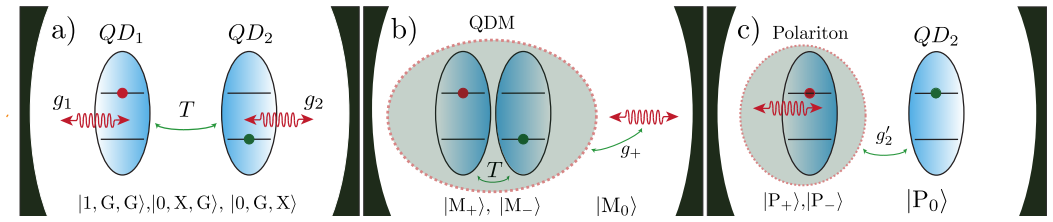
The central machinery is the change of basis among three pictures of the same single-excitation Hamiltonian. The polaritonic basis is obtained by diagonalizing the photon–QD1 subspace, yielding dressed states $|p_\pm\rangle = \cos\theta_p |0,X\rangle \pm \sin\theta_p |1,G\rangle$ with angle $\tan 2\theta_p = 2g_1/\Delta$; the molecular basis diagonalizes the QD1–QD2 tunneling block with $\tan 2\theta_m = 2T/(\omega_1 - \omega_2)$; the bare basis is the uncoupled occupation basis. The comparison is carried by two entanglement quantifiers, the linear entropy $S_L = 1 - \mathrm{Tr}(\rho^2)$ and the concurrence $C(\rho)$, together with the fractional composition of each eigenstate in each basis. The paper's argument is that the polaritonic rotation makes the Hamiltonian almost diagonal, so the residual entanglement measures are shallow and single dressed states carry most of the physical content.
What would settle it
A detuning scan in the strong-molecular-coupling regime ($T = 100$ meV, $g_1 = 1$ meV, $g_2 = 2$ meV) that computes linear entropy in each of the three bases would settle the claim: if the molecular basis gives lower entropy across the scan than the polaritonic basis, the abstract's global 'polaritonic is best' statement is not right for that regime.
Extended reading notes
Core claim
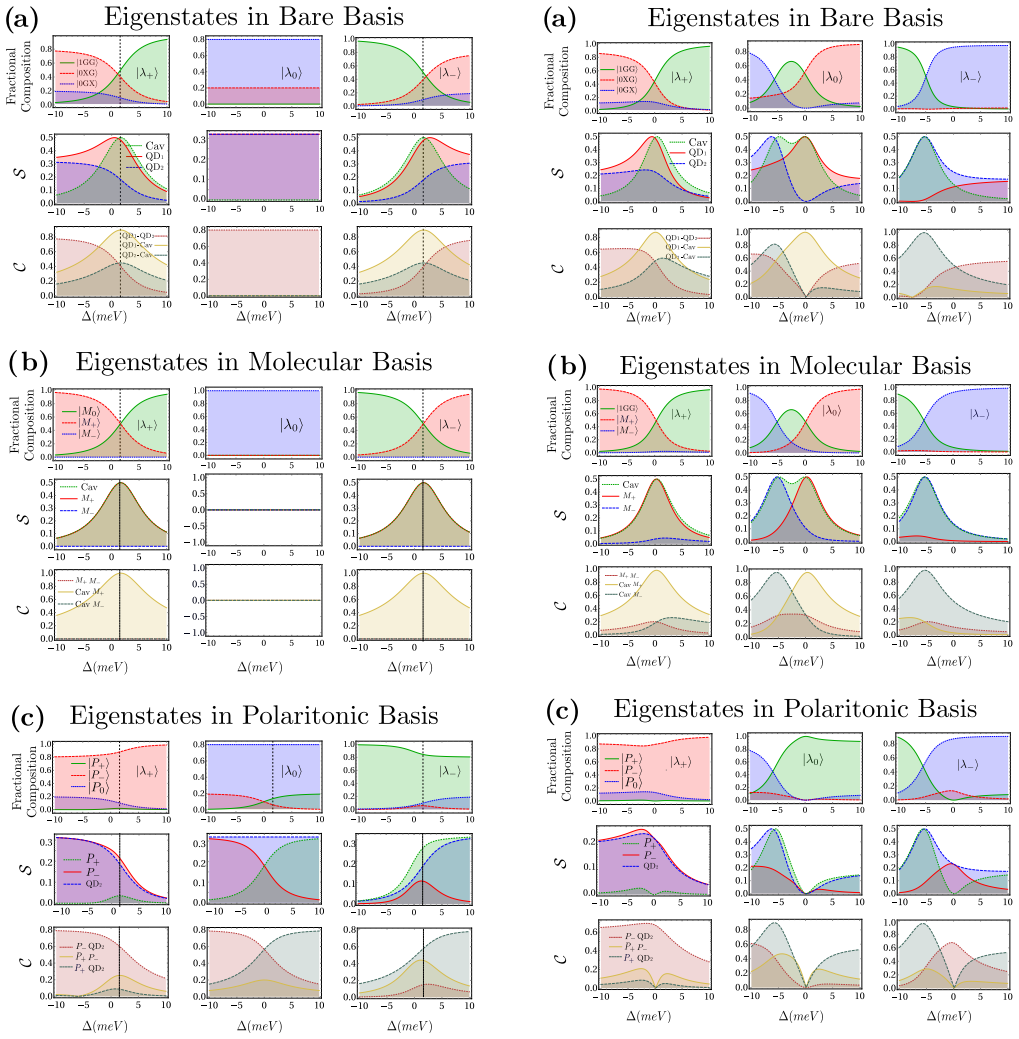
On the paper's own terms, the discovery is a ranking of effective descriptions: for the two-dot microcavity Hamiltonian in the first excitation manifold, the polaritonic basis provides a useful quasiparticle scheme, while the bare basis fails to be a quasiparticle description and the molecular basis captures only partial features. In the polaritonic basis, each Hamiltonian eigenstate is nearly identified with a single dressed state ($|P_0\rangle$, $|P_+\rangle$, $|P_-\rangle$), the Hamiltonian is almost diagonal, and linear entropy stays shallow, indicating that the remaining entanglement is properly assigned. The paper demonstrates this for two critical bandgap regimes—maximal first gap with suppressed second gap, and simultaneous maximal gaps—and finds it still captures essential features under strong molecular coupling, where the molecular basis becomes the most suitable. The general conclusion is that polaritonic dressed states can depict the physics contained in the model over the different regimes and can be used to search for collective quasiparticle modes.
Load-bearing premise
The ranking rests on the unvalidated rule that a basis is better when its eigenstates have shallow linear entropy—how unmixed each state looks in that basis—so choosing a different quality measure could reorder the bases.
Editorial extensions
If this is right
- In the single-excitation manifold, spectra and eigenstates of the two-dot microcavity can be read almost directly from the polaritonic basis, making anticrossing positions, decoupled states, and bandgap conditions transparent.
- The shallow linear entropy and peaked concurrence in the polaritonic basis mean that each eigenstate's entanglement is captured by one dressed quasiparticle rather than a mixture of bare states, in the regimes where light-matter dressing dominates.
- The bandgap-engineering conditions identified in Cases 1 and 2—choosing $T$ and $\Delta$ to maximize or suppress gaps—can be interpreted as points where the polaritonic or molecular rotation aligns the Hamiltonian with a dressed basis.
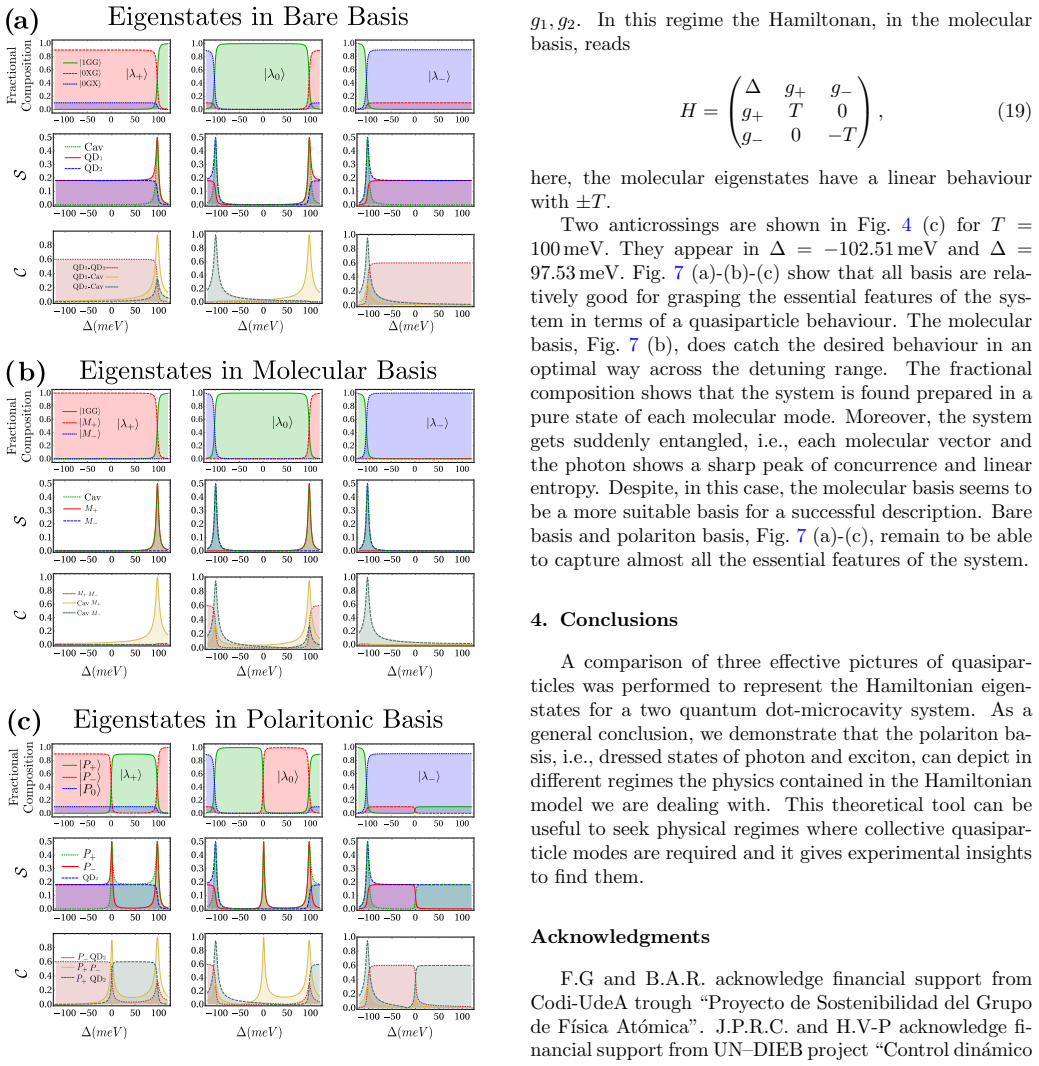
- Under strong molecular coupling, the molecular basis becomes the most suitable description while the polaritonic basis still reproduces the essential features, so the choice of basis is regime-dependent even though the polaritonic picture has the broadest validity across the tested cases.
Reading between the lines
- If the near-diagonality of the polaritonic basis persists beyond the first excitation manifold, the same dressed-photon basis could simplify models of two-excitation spectra and few-photon nonlinearities in quantum-dot cavities; the paper does not test this extension.
- The paper's quality criterion—shallow linear entropy—is one of several possible choices; a criterion based on how directly a basis maps to measured photon correlations, or how easily it accommodates dissipation, could reorder the ranking.
- Because Section 3.3 already shows the molecular basis becoming more suitable as $T$ grows beyond $g_1,g_2$, the abstract's global wording is best read as restricted to light-matter-dominated regimes; a natural next step is an adaptive basis that switches from polaritonic to molecular dressed states as $T$ increases.
- A direct testable extension would be to compute the same linear-entropy comparison for a chain of three or more quantum dots; the polaritonic construction generalizes immediately, but the paper gives no prediction about whether its near-diagonality survives.
Signed reviews
Editorial analysis
A structured set of objections, weighed in public.
Referee Report
Summary. The manuscript studies the first-excitation manifold of a Hamiltonian describing two quantum dots coupled to a single cavity mode and to each other by tunneling. It constructs three quasiparticle bases—bare, molecular, and polaritonic—and computes bandgaps, fractional composition, linear entropy, and concurrence for three parameter regimes. The central claim is that the polaritonic basis 'catch better the physics contained in the whole regimes considered.'
Significance. If substantiated, the paper would offer a simple rule of thumb for choosing a quasiparticle representation in a coupled QD-cavity system. The matrix algebra in Section 2 is transparent, the bandgap curves are consistent with exact diagonalization, and the model contains no fitted parameters and no circularity in the fitting sense. The main weakness is that the basis-quality comparison is not quantified, and the paper's own Case 3 contradicts the global conclusion. With a quantitative basis-quality metric and a more carefully scoped claim, the manuscript could serve as a compact methodological comparison.
major comments (3)
- [Abstract; Section 3.3] The abstract's claim that the polaritonic approach 'catch better the physics contained in the whole regimes considered' is not supported by the paper's own Section 3.3 (Case 3, T = 100 meV). The text there states that the molecular basis 'does catch the desired behaviour in an optimal way across the detuning range' and 'seems to be a more suitable basis', while the polaritonic basis only 'remain[s] to be able to capture almost all the essential features.' Since Case 3 is explicitly one of the regimes considered, the blanket conclusion must either be restricted to the parameter ranges in which the polaritonic basis is actually best, or the manuscript must provide a quantitative metric that yields the claimed global ordering despite this case.
- [Section 3.2] The 'good criterion' of shallow linear entropy is introduced in Section 3.2 but never converted into a measurable score; the rankings in Figs. 5–7 rest on visual inspection of fractional composition, linear entropy, and concurrence. Because all three bases span the same Hilbert space, 'catches better' is only meaningful relative to an explicit figure of merit such as the detuning-averaged entropy, the participation ratio, or the norm of the off-diagonal block of Eqs. (7) and (15). A concrete metric is needed to resolve Case 3, where the polaritonic Hamiltonian (15) has an off-diagonal coupling g'_2 ≈ T = 100 meV and is therefore nearly as non-diagonal as the bare basis.
- [Section 2.1.3] The polaritonic basis is constructed by dressing QD1 rather than QD2, and this asymmetry is not justified. The global conclusion depends on this choice: for the parameters of Case 2 (g2 > g1), dressing the more strongly coupled dot would give a different polaritonic basis, and for Case 3, away from resonance the dressing angle θp is nearly zero, so the polaritonic basis essentially coincides with the bare basis. The authors should either test the robustness of their ranking under this choice or explicitly limit the conclusion to the QD1-dressed polaritonic scheme used here.
minor comments (5)
- [Section 3.1] The terminology for the bandgaps is inconsistent: the caption of Fig. 4(a) says 'Maximal first bandgap and complete suppression of the second bandgap,' while the text says 'Making g− equal to zero ... suppresses the first bandgap' and later 'The first energy bandgap is suppressed ... and this condition maximises the second bandgap.' Please harmonize the naming of the first and second bandgaps.
- [Section 2.1.3, Eq. (14)] The eigenvalue expression in Eq. (14) is needlessly complicated; it simplifies to E'± = (ω1 + ωc)/2 ± 1/2 sqrt(Δ² + 4g1²), which makes the role of the detuning clearer.
- [Section 3.1, Fig. 5(c)] The statement that 'The Hamiltonian is almost diagonal in this polaritonic basis' is made for Case 1 only; the text should qualify it as regime-dependent, since Section 3.3 states a different conclusion for Case 3.
- [Figures 3–7] The captions use color names such as 'green-(cyan)' and 'orange-(brown)' that are difficult to follow in grayscale; direct labels on the curves or distinct line styles would improve readability.
- [Abstract; Section 2] The conclusions are derived within the first excitation manifold, but the abstract does not state this restriction; the abstract should make this limitation explicit.
Circularity Check
No circularity: the quasiparticle bases are analytic unitary transformations and the comparison is descriptive; the Case 3 exception weakens the abstract's claim but does not make the derivation circular.
full rationale
The paper contains no fitted parameters, no external data, and no prediction that is recycled as an input. Each quasiparticle basis is obtained by an explicit analytic unitary transformation: the molecular basis diagonalizes the 2x2 QD-QD block (Eq. (3)), and the polaritonic basis diagonalizes the 2x2 cavity-QD1 block (Eq. (11)); the full 3x3 Hamiltonian is then re-expressed in those bases (Eqs. (7), (15)) without further approximation. The subsequent comparison uses fractional composition, linear entropy, and concurrence as descriptive diagnostics of how well each basis aligns with the exact eigenstates. The 'shallow linear entropy' criterion in Section 3.2 is ad hoc and the Case 3 result in Section 3.3 explicitly favors the molecular basis, which undermines the abstract's universal 'polaritonic catches better' claim; however, this is an evidentiary or consistency problem, not a logical circularity. The only self-citation (Ref. [30]) appears in a general introductory list of quasiparticle models and is not load-bearing. No quantity is fitted to a subset and then renamed as a prediction, and no load-bearing result is imported from the authors' prior work. Therefore no circular step can be exhibited.
Assumptions & free parameters
free parameters (3)
- QD exciton energies omega1, omega2 =
1005, 1000 meV
- light-matter couplings g1, g2 =
2, 1 meV or 1, 2 meV
- tunneling strength values T =
3.3, 1.875, 100 meV
assumptions (4)
- domain assumption The single-excitation manifold truncation (Lambda 1) is sufficient to describe stationary states and bandgaps.
- ad hoc to paper A basis is good when linear entropy values of Hamiltonian eigenstates are shallow.
- ad hoc to paper The polaritonic basis should be built by dressing the cavity mode with QD1 rather than QD2.
- domain assumption QDs are approximated as two-level systems and the cavity by a single mode.
Cite this review
Pith. "Pith review of Effective quasiparticle approach for a Cavity-QDots System." pith.science (2026). https://pith.science/paper/P5JJV6OD
@misc{pith2026190803150,
  author       = {Pith},
  title        = {Pith review of: Effective quasiparticle approach for a Cavity-QDots System},
  year         = {2026},
  howpublished = {\url{https://pith.science/paper/P5JJV6OD}},
  note         = {Machine review of arXiv:1908.03150}
}
read the original abstract
In this work, we present a quasiparticle strategy to study the Hamiltonian description of the stationary states for two quantum dots--cavity system. We consider three different effective schemes of quasiparticles that give an in-depth insight into the physics involved in the Hamiltonian eigenstates for parameters that optimize or minimize the energy gap condition. We analyze features of quantum measures like fractional composition, linear entropy, and concurrence to observe which one description gives the complete physical information. Our findings show that a polaritonic---light-matter quasiparticle---approach catch better the physics contained in the whole regimes considered.
Figures


Figures from the paper (3 more)

Reference graph
Works this paper leans on
-
[1]
D. Sanvitto, S. K´ ena-Cohen, The road towards polaritonic de- vices, Nature Materials 15 (10) (2016) 1061. 6
work page 2016
-
[2]
T. Heindel, A. Thoma, M. von Helversen, M. Schmidt, A. Schle- hahn, M. Gschrey, P. Schnauber, J.-H. Schulze, A. Strittmatter, J. Beyer, et al., A bright triggered twin-photon source in the solid state, Nature Communications 8 (2017) 14870
work page 2017
-
[3]
R. Jayaprakash, F. Kalaitzakis, G. Christmann, K. Tsagaraki, M. Hocevar, B. Gayral, E. Monroy, N. Pelekanos, Ultra-low threshold polariton lasing at room temperature in a gan mem- brane microcavity with a zero-dimensional trap, Scientific Re- ports 7 (1) (2017) 5542
work page 2017
-
[4]
P. G. Lagoudakis, M. Martin, J. J. Baumberg, G. Malpuech, A. Kavokin, Coexistence of low threshold lasing and strong cou- pling in microcavities, Journal of Applied Physics 95 (5) (2004) 2487
work page 2004
-
[5]
G. Christmann, R. Butt´ e, E. Feltin, J.-F. Carlin, N. Grandjean, Room temperature polariton lasing in a GaN - AlGaN multiple quantum well microcavity, Applied Physics Letters 93 (5) (2008) 051102
work page 2008
-
[6]
M. Kira, F. Jahnke, S. Koch, J. Berger, D. Wick, T. Nel- son Jr, G. Khitrova, H. Gibbs, Quantum theory of nonlinear semiconductor microcavity luminescence explaining “boser” ex- periments, Physical Review Letters 79 (25) (1997) 5170
work page 1997
-
[7]
V. O. Byelobrov, J. Ctyroky, T. M. Benson, R. Sauleau, A. Al- tintas, A. I. Nosich, Low-threshold lasing eigenmodes of an in- finite periodic chain of quantum wires, Optics Letters 35 (21) (2010) 3634
work page 2010
-
[8]
K. A. Atlasov, M. Calic, K. F. Karlsson, P. Gallo, A. Rudra, B. Dwir, E. Kapon, Photonic-crystal microcavity laser with site- controlled quantum-wire active medium, Optics Express 17 (20) (2009) 18178
work page 2009
Show all 34 references
-
[9]
K. B. Arnardottir, I. V. Iorsh, T. C. Liew, I. A. Shelykh, Hy- perbolic region in an array of quantum wires in a planar cavity, ACS Photonics 4 (5) (2017) 1165
2017
-
[10]
C. Gies, J. Wiersig, M. Lorke, F. Jahnke, Semiconductor model for quantum-dot-based microcavity lasers, Physical Review A 75 (1) (2007) 013803
2007
-
[11]
Kreinberg, W
S. Kreinberg, W. W. Chow, J. Wolters, C. Schneider, C. Gies, F. Jahnke, S. H¨ ofling, M. Kamp, S. Reitzenstein, Emission from quantum-dot high-β microcavities: transition from spontaneous emission to lasing and the effects of superradiant emitter cou- pling, Light: Science & App...
2017
-
[12]
H. Deng, G. Weihs, D. Snoke, J. Bloch, Y. Yamamoto, Polariton lasing vs. photon lasing in a semiconductor microcavity, Pro- ceedings of the National Academy of Sciences 100 (26) (2003) 15318
2003
-
[13]
Azzini, D
S. Azzini, D. Gerace, M. Galli, I. Sagnes, R. Braive, A. Lemaˆ ıtre, J. Bloch, D. Bajoni, Ultra-low threshold polari- ton lasing in photonic crystal cavities, Applied Physics Letters 99 (11) (2011) 111106
2011
-
[14]
M. D. Eisaman, J. Fan, A. Migdall, S. V. Polyakov, Invited review article: Single-photon sources and detectors, Review of Scientific Instruments 82 (7) (2011) 071101
2011
-
[15]
Somaschi, V
N. Somaschi, V. Giesz, L. De Santis, J. Loredo, M. P. Almeida, G. Hornecker, S. L. Portalupi, T. Grange, C. Ant´ on, J. Demory, et al., Near-optimal single-photon sources in the solid state, Nature Photonics 10 (5) (2016) 340
2016
-
[16]
Ripka, H
F. Ripka, H. K¨ ubler, R. L¨ ow, T. Pfau, A room-temperature single-photon source based on strongly interacting Rydberg atoms, Science 362 (6413) (2018) 446
2018
-
[17]
C. M. Chow, A. M. Ross, D. Kim, D. Gammon, A. S. Bracker, L. Sham, D. G. Steel, Nonlocal nuclear spin quieting in quantum dot molecules: Optically induced extended two-electron spin coherence time, Physical Review Letters 117 (7) (2016) 077403
2016
-
[18]
Khoshnegar, A
M. Khoshnegar, A. Jafari-Salim, M. Ansari, A. Majedi, Toward tripartite hybrid entanglement in quantum dot molecules, New Journal of Physics 16 (2) (2014) 023019
2014
-
[19]
Tian, R.-G
S.-C. Tian, R.-G. Wan, L.-H. Li, C.-Z. Tong, Y.-Q. Ning, Cav- ity linewidth narrowing by tunneling induced double dark res- onances in triple quantum dot molecules, Optics Communica- tions 334 (2015) 94
2015
-
[20]
S. Y. Kruchinin, I. D. Rukhlenko, A. S. Baimuratov, M. Y. Leonov, V. K. Turkov, Y. K. Gun’ko, A. V. Baranov, A. V. Fe- dorov, Photoluminescence of a quantum-dot molecule, Journal of Applied Physics 117 (1) (2015) 14306
2015
-
[21]
R. E. Evans, M. K. Bhaskar, D. D. Sukachev, C. T. Nguyen, A. Sipahigil, M. J. Burek, B. Machielse, G. H. Zhang, A. S. Zi- brov, E. Bielejec, et al., Photon-mediated interactions between quantum emitters in a diamond nanocavity, Science 362 (6415) (2018) 662
2018
-
[22]
S. E. Economou, N. Lindner, T. Rudolph, Optically gener- ated 2-dimensional photonic cluster state from coupled quan- tum dots, Physical Review Letters 105 (9) (2010) 093601
2010
-
[23]
Calic, C
M. Calic, C. Jarlov, P. Gallo, B. Dwir, A. Rudra, E. Kapon, Deterministic radiative coupling of two semiconductor quantum dots to the optical mode of a photonic crystal nanocavity, Sci- entific Reports 7 (1) (2017) 4100
2017
-
[24]
Heo, C.-H
J. Heo, C.-H. Hong, M.-S. Kang, H. Yang, H.-J. Yang, J.-P. Hong, S.-G. Choi, Implementation of controlled quantum tele- portation with an arbitrator for secure quantum channels via quantum dots inside optical cavities, Scientific Reports 7 (1) (2017) 14905
2017
-
[25]
Tian, R.-G
S.-C. Tian, R.-G. Wan, E.-B. Xing, J.-M. Rong, H. Wu, L.-J. Wang, S.-L. Shu, C.-Z. Tong, Y.-Q. Ning, Tunneling induced transparency and giant kerr nonlinearity in multiple quantum dot molecules, Physica E: Low-dimensional Systems and Nanos- tructures 69 (2015) 349
2015
-
[26]
C. Yu, L. Sun, H. Zhang, F. Chen, Controllable optical bistabil- ity in double quantum dot molecule, IET Optoelectronics 12 (4) (2018) 215
2018
-
[27]
E. M. Gauger, A. Nazir, S. C. Benjamin, T. M. Stace, B. W. Lovett, Robust adiabatic approach to optical spin entangling in coupled quantum dots, New Journal of Physics 10 (7) (2008) 73016
2008
-
[28]
Z. Wang, S. Zhen, X. Wu, J. Zhu, Z. Cao, B. Yu, Controllable optical bistability via tunneling induced transparency in quan- tum dot molecules, Optics Communications 304 (2013) 7–10
2013
-
[29]
Y. Peng, A. Yang, B. Chen, L. Li, S. Liu, H. Guo, Tunable, high-sensitive measurement of inter-dot transition via tunneling induced absorption, Applied Physics Letters 109 (14) (2016) 141101
2016
-
[30]
Rojas-Arias, B
J. Rojas-Arias, B. Rodr´ ıguez, H. Vinck-Posada, Magnetic con- trol of dipolaritons in quantum dots, Journal of Physics: Con- densed Matter 28 (50) (2016) 505302
2016
-
[31]
H. Y. Ram´ ırez, S.-J. Cheng, Tunneling effects on fine-structure splitting in quantum-dot molecules, Physical Review Letters 104 (20) (2010) 206402
2010
-
[32]
Bracker, M
A. Bracker, M. Scheibner, M. Doty, E. Stinaff, I. Ponomarev, J. Kim, L. Whitman, T. Reinecke, D. Gammon, Engineering electron and hole tunneling with asymmetric inas quantum dot molecules, Applied Physics Letters 89 (23) (2006) 233110
2006
-
[33]
Abdel-Aty, Linear entropy of a driven central spin inter- acting with an antiferromagnetic environment, Natural Science 6 (07) (2014) 532
M. Abdel-Aty, Linear entropy of a driven central spin inter- acting with an antiferromagnetic environment, Natural Science 6 (07) (2014) 532
2014
-
[34]
W. K. Wootters, Entanglement of formation and concurrence., Quantum Information & Computation 1 (1) (2001) 27. 7
2001
Reviewed August 14, 2026 · model on record in the stance chip above.
Discussion (0). Continue with ORCID to comment.