Floquet Entanglement Generation in Parametrically Driven Coupled Superconducting Qubits
Pith reviewed 2026-06-27 21:35 UTC · model grok-4.3
The pith
Periodic driving mixes separable eigenstates to generate and suppress entanglement in coupled qubits via Floquet hybridization.
A machine-rendered reading of the paper's core claim, the machinery that carries it, and where it could break.
Core claim
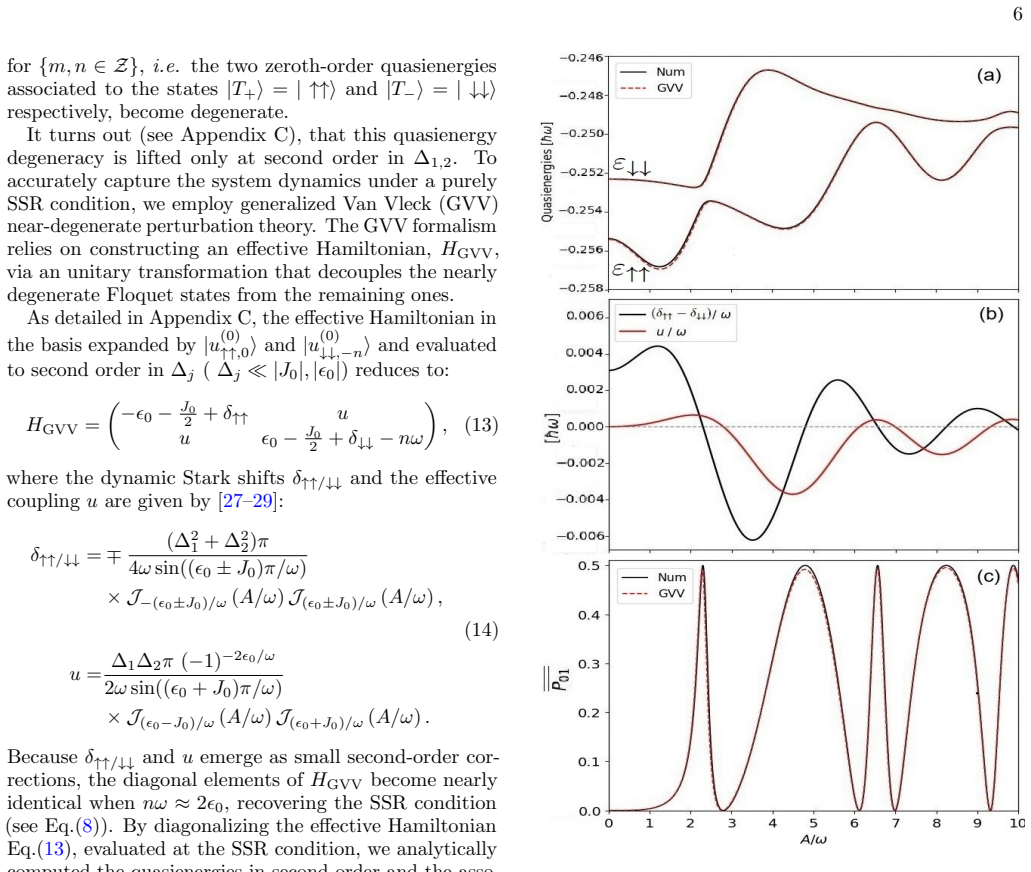
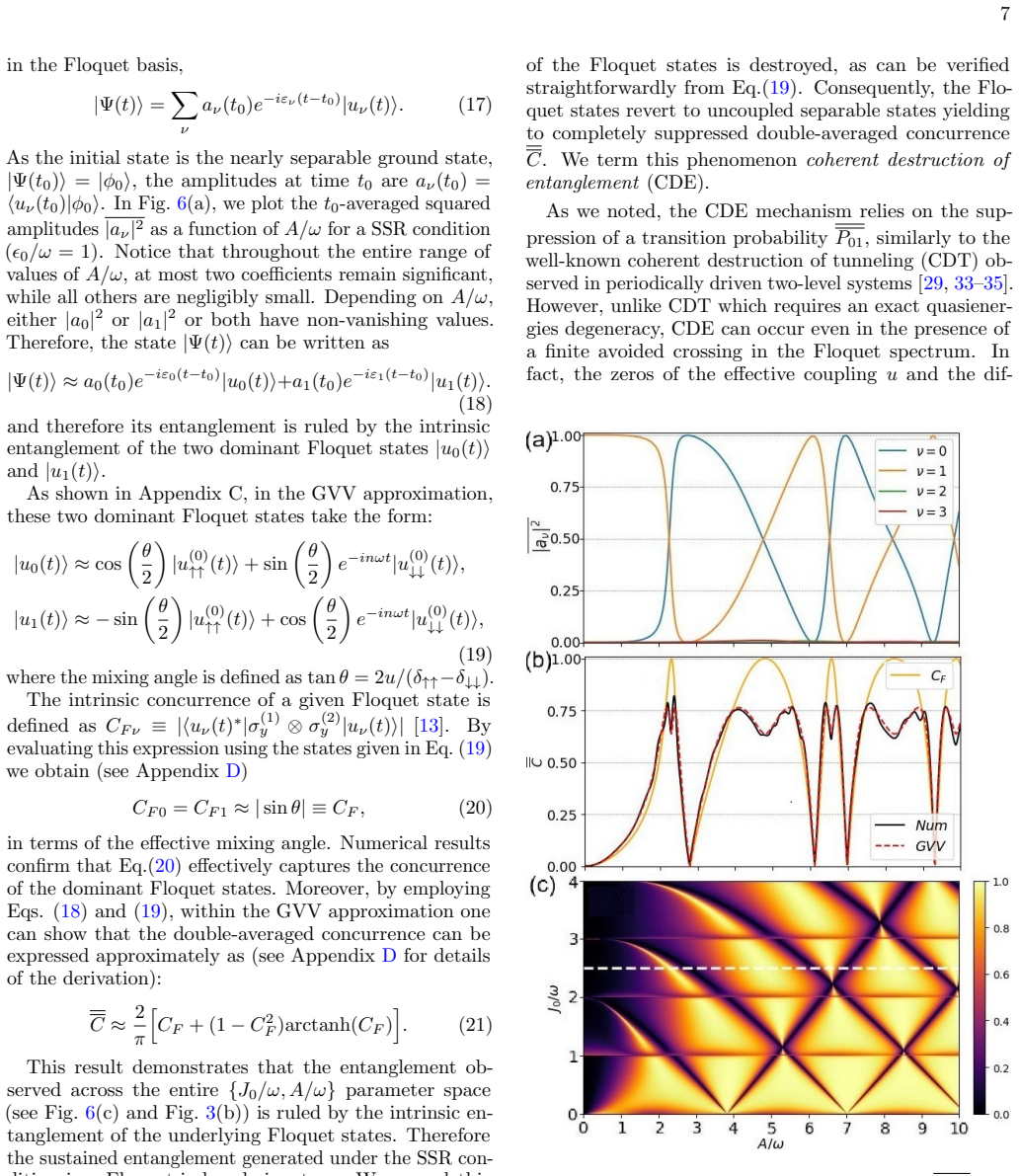
The sustained entanglement originates from the hybridization of the dominant Floquet states, namely those with the largest overlap with the initial ground state, and the degree of entanglement can be efficiently controlled through the driving amplitude; for specific amplitudes the entanglement is fully suppressed.
What carries the argument
Hybridization of dominant Floquet states under multiphoton resonance conditions, obtained via generalized Van Vleck near-degenerate perturbation theory
If this is right
- Entanglement arises from drive-induced mixing of initially separable eigenstates rather than from resonant excitation to an entangled eigenstate.
- The mixing effect requires generalized Van Vleck near-degenerate perturbation theory because the standard rotating-wave approximation cannot capture it.
- The degree of entanglement is set directly by the amplitude of the parametric drive.
- At particular drive amplitudes the entanglement vanishes completely, an effect labeled coherent destruction of entanglement.
Where Pith is reading between the lines
- The amplitude-controlled suppression points could serve as switches for turning entanglement on and off in driven quantum circuits.
- The same hybridization mechanism may appear in other periodically driven few-qubit or spin systems once multiphoton resonances are reached.
- Full numerical integration of the time-dependent Schrödinger equation would be required to test the perturbation-theory predictions outside the weak-drive regime.
Load-bearing premise
The periodic driving mixes two initially separable eigenstates under multiphoton resonance conditions in a manner that cannot be captured by the standard rotating-wave approximation and that the generalized Van Vleck near-degenerate perturbation theory accurately describes the resulting Floquet-state hybridization.
What would settle it
Numerical time evolution or experiment showing that the entanglement measure fails to reach zero at the specific driving amplitudes where the effective analytical model predicts full suppression.
Figures
read the original abstract
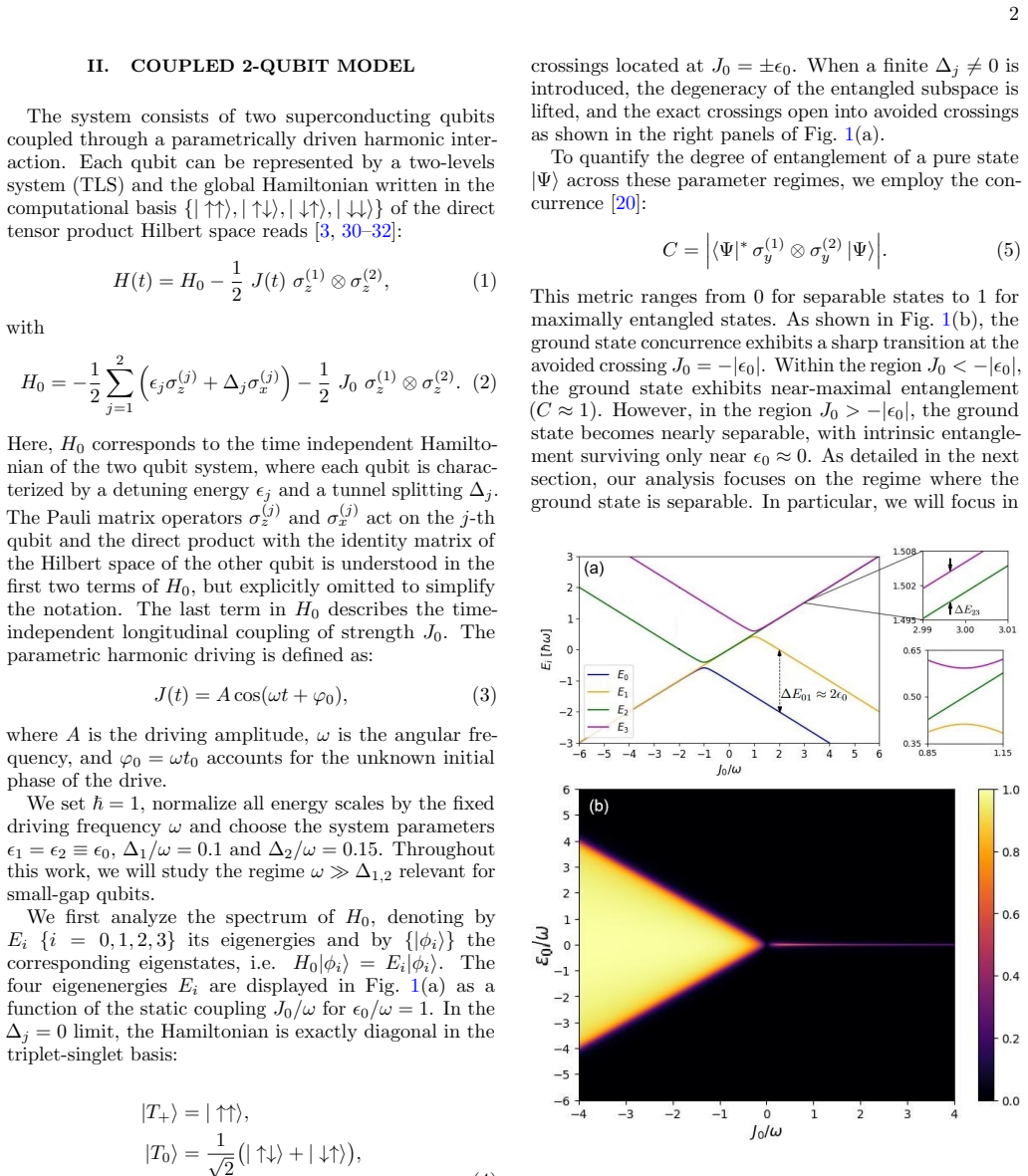
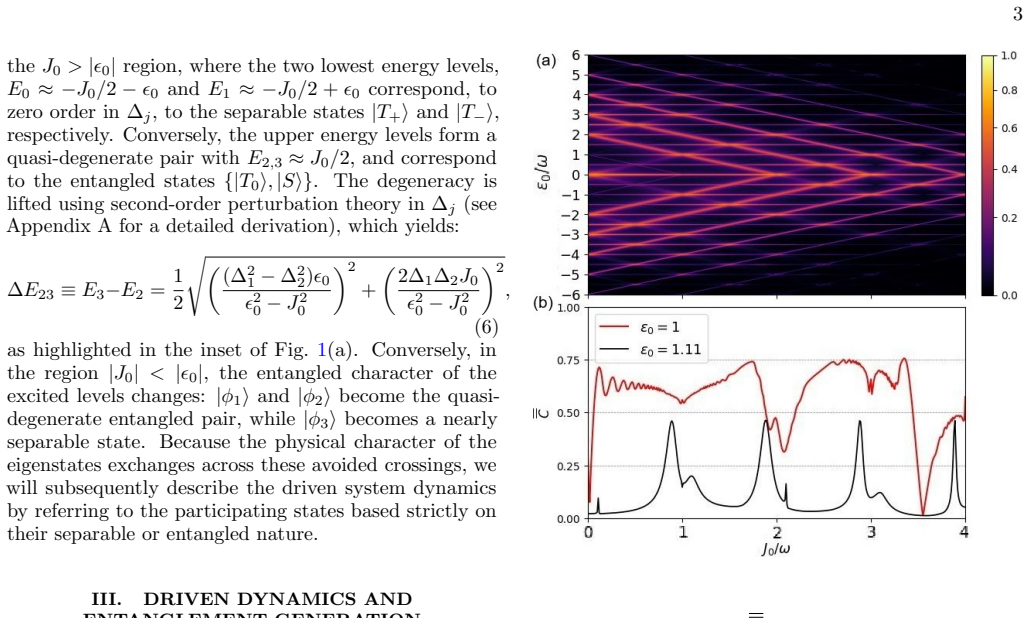
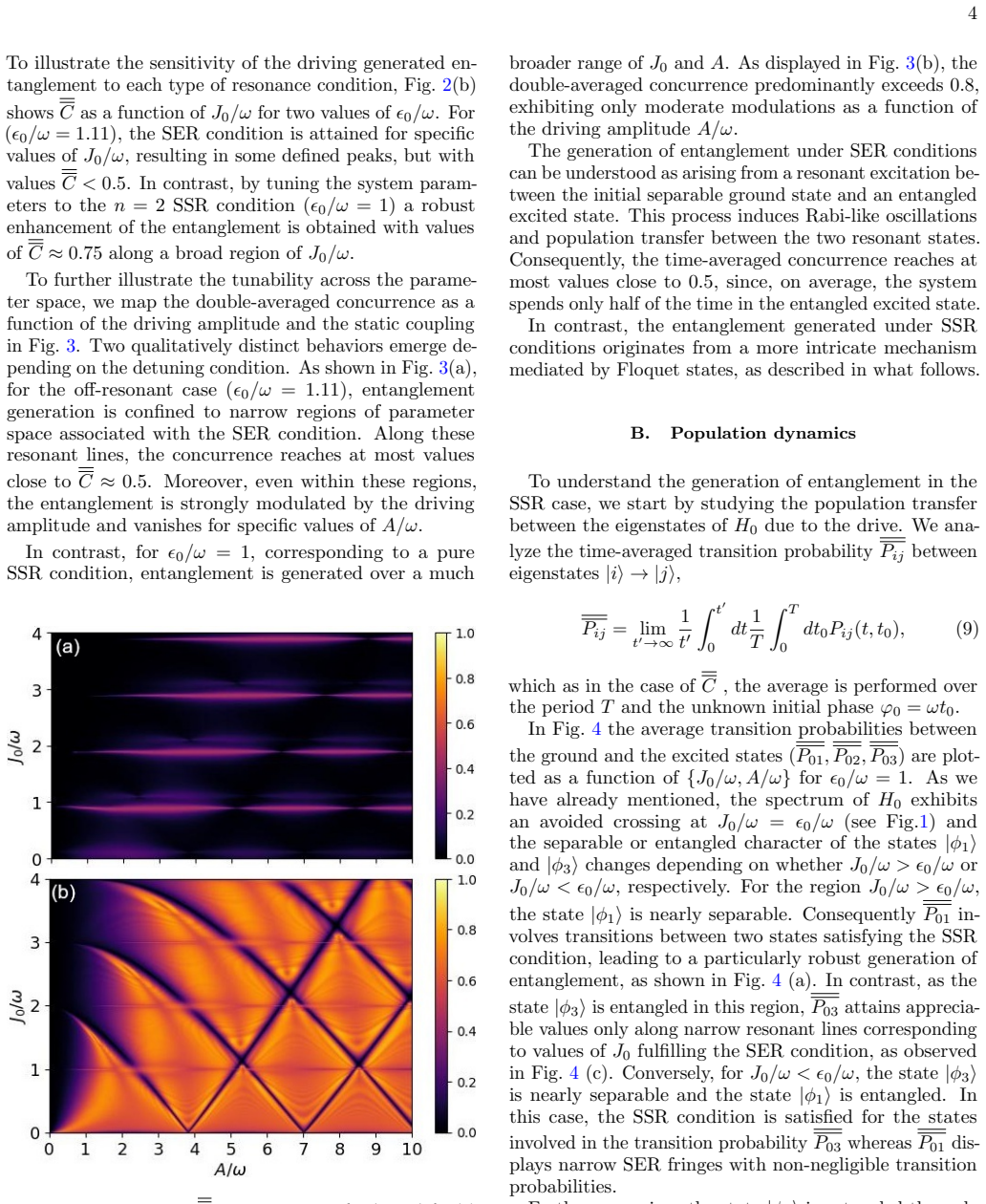
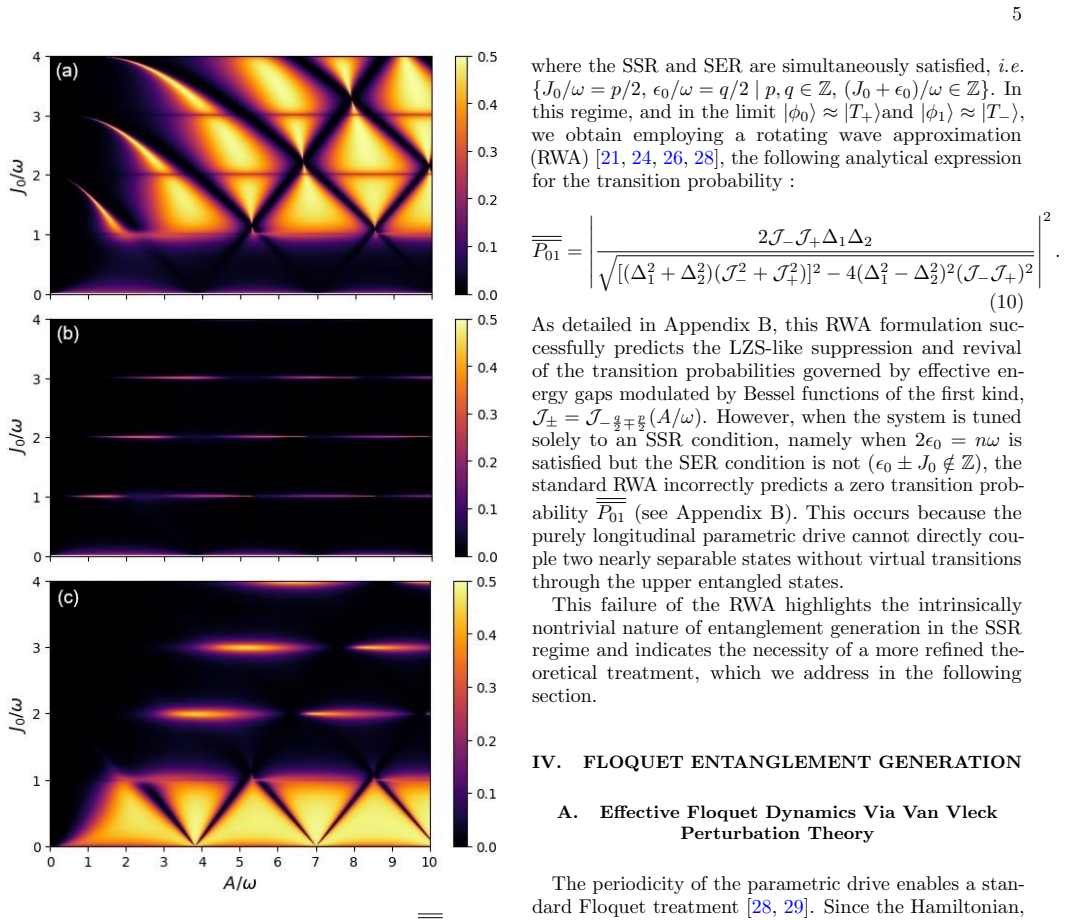
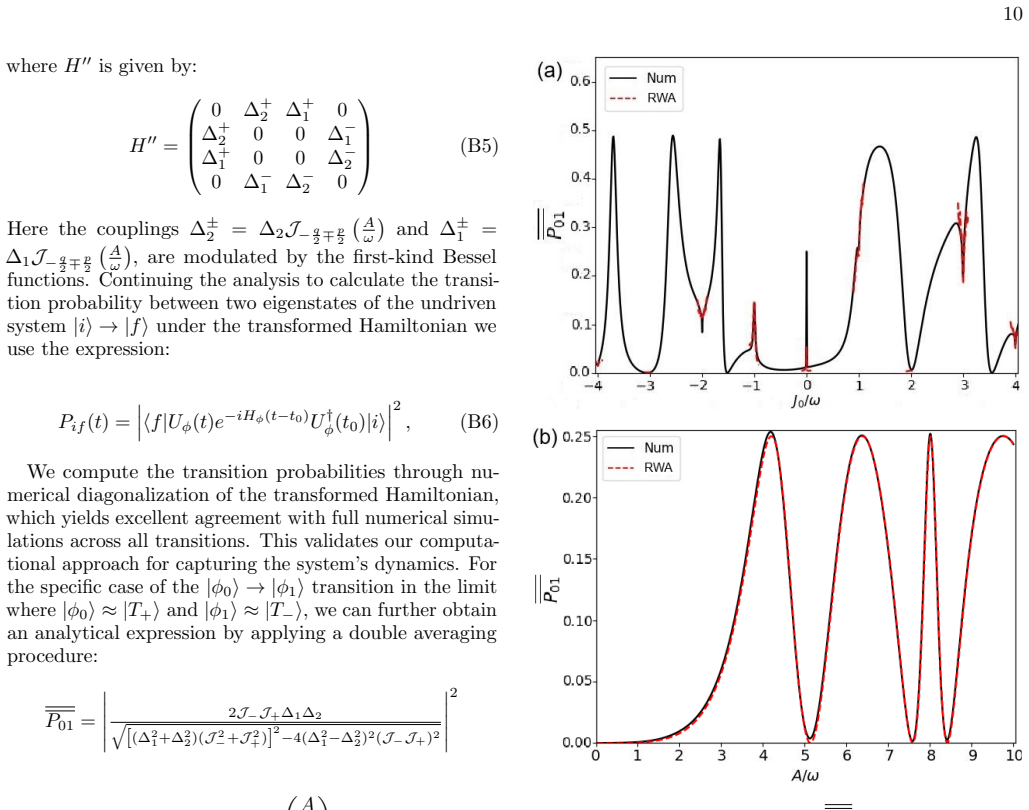
We investigate the dynamical generation of entanglement in a system of two superconducting qubits coupled through a parametrically driven longitudinal interaction. Using Floquet theory and exact numerical simulations, we analyze the time evolution of the system initialized in a separable ground state. Our results reveal a nontrivial mechanism for entanglement generation, fundamentally distinct from the conventional resonant excitation to an entangled eigenstate. We show that this mechanism emerges when two initially separable eigenstates are mixed by the periodic driving under multiphoton resonance conditions. Since the effect cannot be captured within a standard rotating-wave approximation, we employ generalized Van Vleck near-degenerate perturbation theory to derive an effective analytical description. Within this framework, we demonstrate that the sustained entanglement originates from the hybridization of the dominant Floquet states, namely those with the largest overlap with the initial ground state. Furthermore, the degree of entanglement can be efficiently controlled through the driving amplitude. In particular, for specific amplitudes, the entanglement is fully suppressed. We term this phenomenon as coherent destruction of entanglement.
Editorial analysis
A structured set of objections, weighed in public.
Referee Report
Summary. The paper claims that entanglement in two parametrically driven coupled superconducting qubits arises from a nontrivial mechanism: periodic driving mixes two initially separable eigenstates under multiphoton resonance conditions, producing sustained entanglement via hybridization of the dominant Floquet states (those with largest overlap to the initial ground state). This cannot be captured by standard RWA, so generalized Van Vleck near-degenerate perturbation theory is used to derive an effective analytic model. The degree of entanglement is controllable by driving amplitude, with full suppression at specific amplitudes (termed coherent destruction of entanglement). The analysis combines Floquet theory with exact numerical simulations.
Significance. If substantiated, the result identifies an amplitude-tunable entanglement mechanism in driven qubit systems that operates outside the rotating-wave regime and supplies explicit suppression points. This could inform control protocols in superconducting quantum devices. The explicit use of generalized Van Vleck theory to obtain an effective Hamiltonian beyond RWA is a methodological strength when the perturbation regime is verified.
major comments (2)
- [Section deriving the effective analytical description via generalized Van Vleck theory] The central claim that generalized Van Vleck near-degenerate perturbation theory quantitatively describes the Floquet-state hybridization (and therefore the effective coupling and the locations of full entanglement suppression) is load-bearing. When multiphoton resonance overlaps with higher-order processes, the perturbation series may miss resonant channels, making the predicted hybridization amplitudes unreliable. Explicit comparison of the effective model predictions against the exact numerics, including the regime of validity, is required.
- [Numerical results and comparison to analytic model] The abstract asserts results from exact numerical simulations and an effective analytic model, yet supplies no quantitative data, error bars, or direct comparisons between the Van Vleck effective Hamiltonian and the numerics. This prevents verification that the hybridization amplitudes and suppression points match within the claimed regime.
minor comments (1)
- The introduction of the term 'coherent destruction of entanglement' would benefit from a brief comparison to the established 'coherent destruction of tunneling' literature to clarify novelty.
Simulated Author's Rebuttal
We thank the referee for the careful and constructive review. The comments highlight important aspects of the perturbative analysis and presentation of comparisons, which we address below. We will revise the manuscript to strengthen these elements while preserving the core results.
read point-by-point responses
-
Referee: [Section deriving the effective analytical description via generalized Van Vleck theory] The central claim that generalized Van Vleck near-degenerate perturbation theory quantitatively describes the Floquet-state hybridization (and therefore the effective coupling and the locations of full entanglement suppression) is load-bearing. When multiphoton resonance overlaps with higher-order processes, the perturbation series may miss resonant channels, making the predicted hybridization amplitudes unreliable. Explicit comparison of the effective model predictions against the exact numerics, including the regime of validity, is required.
Authors: We agree that the reliability of the generalized Van Vleck approach must be explicitly verified, especially regarding potential interference from higher-order processes. The manuscript already presents direct comparisons in Section IV between the effective Hamiltonian predictions and exact numerical time evolution, demonstrating quantitative agreement for the hybridization and suppression points within the considered parameter regime. To further address the concern, we will add a new subsection explicitly mapping the regime of validity, including conditions for isolation of the multiphoton resonance and benchmarks showing where the approximation begins to deviate. revision: yes
-
Referee: [Numerical results and comparison to analytic model] The abstract asserts results from exact numerical simulations and an effective analytic model, yet supplies no quantitative data, error bars, or direct comparisons between the Van Vleck effective Hamiltonian and the numerics. This prevents verification that the hybridization amplitudes and suppression points match within the claimed regime.
Authors: The abstract is a concise summary and does not contain quantitative details by design. However, the main text provides the requested comparisons: Figures 2 and 3 overlay the entanglement dynamics and suppression amplitudes from the effective model against exact Floquet numerics, with the suppression points agreeing closely. We will revise to include explicit error bars derived from numerical convergence, a table of quantitative discrepancies for key observables (hybridization gap and suppression amplitudes), and a brief statement in the abstract noting the level of agreement. revision: yes
Circularity Check
No circularity: derivation uses standard Floquet + Van Vleck methods on driving conditions
full rationale
The paper's chain starts from the parametrically driven Hamiltonian, applies Floquet theory to the time-periodic system, identifies multiphoton resonance conditions that mix initially separable eigenstates, and invokes generalized Van Vleck near-degenerate perturbation theory (an established external technique) to obtain an effective Hamiltonian whose hybridization produces the entanglement. The amplitude-dependent suppression points follow directly from the resulting effective coupling matrix elements. No fitted parameters are relabeled as predictions, no self-citation supplies a load-bearing uniqueness theorem or ansatz, and the mechanism is not defined in terms of the entanglement it is meant to explain. The derivation therefore remains self-contained against external benchmarks.
Axiom & Free-Parameter Ledger
Reference graph
Works this paper leans on
-
[1]
Consequently, the corrected eigenstates decouple and become the maximally entangled states: |ϕ(1) 2 ⟩ → |T 0⟩and|ϕ (1) 3 ⟩ → |S⟩
vanish, the Γ matrix then becomes strictly diagonal, causing the mixing coefficients asymptotically yield c2 → 0 and d3 → 0. Consequently, the corrected eigenstates decouple and become the maximally entangled states: |ϕ(1) 2 ⟩ → |T 0⟩and|ϕ (1) 3 ⟩ → |S⟩. Appendix B: Transition Probability using RWA for both SSR and SER conditions We obtain an effective de...
-
[2]
DiCarlo, J
L. DiCarlo, J. M. Chow, J. M. Gambetta, L. S. Bishop, B. R. Johnson, D. I. Schuster, J. Majer, A. Blais, L. Frun- zio, S. Girvin,et al., Demonstration of two-qubit algo- rithms with a superconducting quantum processor, Nature 460, 240 (2009)
2009
-
[3]
Krantz, M
P. Krantz, M. Kjaergaard, F. Yan, T. P. Orlando, S. Gus- tavsson, and W. D. Oliver, A quantum engineer’s guide to superconducting qubits, Applied physics reviews6(2019)
2019
-
[4]
Kjaergaard, M
M. Kjaergaard, M. E. Schwartz, J. Braum¨ uller, P. Krantz, J. I.-J. Wang, S. Gustavsson, and W. D. Oliver, Super- conducting qubits: Current state of play, Annual Review of Condensed Matter Physics11, 369 (2020)
2020
-
[5]
Arute, K
F. Arute, K. Arya, R. Babbush, D. Bacon, J. C. Bardin, R. Barends, R. Biswas, S. Boixo, F. G. Brandao, D. A. Buell,et al., Quantum supremacy using a programmable superconducting processor, Nature574, 505 (2019)
2019
-
[6]
Mundada, G
P. Mundada, G. Zhang, T. Hazard, and A. Houck, Sup- pression of qubit crosstalk in a tunable coupling super- conducting circuit, Physical Review Applied12, 054023 (2019)
2019
-
[7]
M. C. Collodo, J. Herrmann, N. Lacroix, C. K. Andersen, A. Remm, S. Lazar, J.-C. Besse, T. Walter, A. Wallraff, and C. Eichler, Implementation of conditional phase gates based on tunable zz interactions, Physical review letters 125, 240502 (2020)
2020
- [8]
-
[9]
Y. Sung, L. Ding, J. Braum¨ uller, A. Veps¨ al¨ ainen, B. Kan- nan, M. Kjaergaard, A. Greene, G. O. Samach, C. Mc- Nally, D. Kim,et al., Realization of high-fidelity cz and zz-free iswap gates with a tunable coupler, Physical Re- view X11, 021058 (2021)
2021
-
[10]
Z. Ma, X. Li, H. Shi, R. Guo, J. Xu, X. Tan, and Y. Yu, Parametric phase modulation in superconducting circuits, Physical Review Applied24, 054067 (2025)
2025
-
[11]
Weiss, H
D. Weiss, H. Zhang, C. Ding, Y. Ma, D. I. Schuster, and J. Koch, Fast high-fidelity gates for galvanically- coupled fluxonium qubits using strong flux modulation, PRX Quantum3, 040336 (2022)
2022
-
[12]
Zhang, C
H. Zhang, C. Ding, D. Weiss, Z. Huang, Y. Ma, C. Guinn, S. Sussman, S. P. Chitta, D. Chen, A. A. Houck,et al., Tunable inductive coupler for high-fidelity gates between fluxonium qubits, PRX Quantum5, 020326 (2024)
2024
-
[13]
A. Chakraborty, B. Bhandari, D. D. Brise˜ no-Colunga, N. Stevenson, Z. Pedramrazi, C.-H. Liu, D. I. Santiago, I. Siddiqi, J. Dressel, and A. N. Jordan, Tunable supercon- ducting quantum interference device coupler for fluxonium qubits, arXiv preprint arXiv:2508.16907 (2025)
-
[14]
Sauer, F
S. Sauer, F. Mintert, C. Gneiting, and A. Buchleitner, Entanglement resonances of driven multi-partite quantum systems, journal of Physics B: Atomic, Molecular and Optical Physics45, 154011 (2012)
2012
-
[15]
A. L. Gramajo, D. Dom´ ınguez, and M. J. S´ anchez, En- tanglement generation through the interplay of harmonic driving and interaction in coupled superconducting qubits, 15 The European Physical Journal B90, 1 (2017)
2017
-
[16]
Song, J.-B
W.-L. Song, J.-B. You, J. Xu, W. Yang, and J.-H. An, Flo- quet engineering of two weakly coupled superconducting flux qubits, Physical Review Applied14, 054049 (2020)
2020
-
[17]
A. L. Gramajo, D. Dom´ ınguez, and M. J. S´ anchez, Ef- ficient steady-state-entanglement generation in strongly driven coupled qubits, Physical Review A104, 032410 (2021)
2021
-
[18]
Munyaev and M
V. Munyaev and M. Bastrakova, Control of spectroscopic features of multiphoton transitions in two coupled qubits by driving fields, Physical Review A104, 012613 (2021)
2021
-
[19]
Bastrakova and V
M. Bastrakova and V. Munyaev, Dissipation entanglement control of two coupled qubits via strong driving fields, Chaos, Solitons & Fractals200, 116931 (2025)
2025
-
[20]
O. Ilinskaya and S. Shevchenko, Resonant excitation of single and coupled qubits for coherent quantum control and microwave detection, arXiv preprint arXiv:2603.27610 (2026)
-
[21]
W. K. Wootters, Entanglement of formation of an arbi- trary state of two qubits, Physical Review Letters80, 2245 (1998)
1998
-
[22]
W. D. Oliver, Y. Yu, J. C. Lee, K. K. Berggren, L. S. Levitov, and T. P. Orlando, Mach-zehnder interferometry in a strongly driven superconducting qubit, Science310, 1653 (2005)
2005
-
[23]
D. M. Berns, M. S. Rudner, S. O. Valenzuela, K. K. Berggren, W. D. Oliver, L. S. Levitov, and T. P. Orlando, Amplitude spectroscopy of a solid-state artificial atom, Nature455, 51 (2008)
2008
-
[24]
Neilinger, S
P. Neilinger, S. Shevchenko, J. Bog´ ar, M. Reh´ ak, G. Oel- sner, D. Karpov, U. H¨ ubner, O. Astafiev, M. Grajcar, and E. Il’Ichev, Landau-zener-st¨ uckelberg-majorana lasing in circuit quantum electrodynamics, Physical Review B94, 094519 (2016)
2016
-
[25]
Ivakhnenko, S
V. Ivakhnenko, S. N. Shevchenko, and F. Nori, Nonadia- batic landau–zener–st¨ uckelberg–majorana transitions, dy- namics, and interference, Physics Reports995, 1 (2023)
2023
-
[26]
E. C. Kemble,The fundamental principles of quantum mechanics: with elementary applications(McGraw-Hill, 1937)
1937
-
[27]
Cohen-Tannoudji, J
C. Cohen-Tannoudji, J. Dupont-Roc, and G. Grynberg, Atom-photon interactions: basic processes and applica- tions(John Wiley & Sons, 2024)
2024
-
[28]
Hausinger and M
J. Hausinger and M. Grifoni, Dissipative dynamics of a biased qubit coupled to a harmonic oscillator: analytical results beyond the rotating wave approximation, New Journal of Physics10, 115015 (2008)
2008
-
[29]
S.-K. Son, S. Han, and S.-I. Chu, Floquet formulation for the investigation of multiphoton quantum interference in a superconducting qubit driven by a strong ac field, Physical Review A—Atomic, Molecular, and Optical Physics79, 032301 (2009)
2009
-
[30]
Hausinger and M
J. Hausinger and M. Grifoni, Dissipative two-level system under strong ac driving: A combination of floquet and van vleck perturbation theory, Physical Review A—Atomic, Molecular, and Optical Physics81, 022117 (2010)
2010
-
[31]
Wendin and V
G. Wendin and V. Shumeiko, Quantum bits with joseph- son junctions, Low Temperature Physics33, 724 (2007)
2007
-
[32]
Blais, A
A. Blais, A. L. Grimsmo, S. M. Girvin, and A. Wallraff, Circuit quantum electrodynamics, Reviews of Modern Physics93, 025005 (2021)
2021
-
[33]
S. E. Rasmussen, K. S. Christensen, S. P. Pedersen, L. B. Kristensen, T. Bækkegaard, N. J. S. Loft, and N. T. Zin- ner, Superconducting circuit companion—an introduction with worked examples, PRX Quantum2, 040204 (2021)
2021
-
[34]
Grossmann, T
F. Grossmann, T. Dittrich, P. Jung, and P. H¨ anggi, Co- herent destruction of tunneling, Physical review letters 67, 516 (1991)
1991
-
[35]
Großmann and P
F. Großmann and P. H¨ anggi, Localization in a driven two-level dynamics, EPL (Europhysics Letters)18, 571 (1992)
1992
-
[36]
Hidden time-nonlocal Floquet symmetries
S. Kohler and J. Casado-Pascual, Hidden time-nonlocal floquet symmetries, arXiv preprint arXiv:2601.05783 (2026)
work page internal anchor Pith review Pith/arXiv arXiv 2026
-
[37]
Abramowitz and I
M. Abramowitz and I. A. Stegun,Handbook of Mathemat- ical Functions with Formulas, Graphs, and Mathematical Tables(National Bureau of Standards, 1972)
1972
-
[38]
B. S. Newberger, New sum rule for products of bessel functions with application to plasma physics, Journal of Mathematical Physics23, 1278 (1982)
1982
-
[39]
J. G. Russo and M. Tierz, Landau-zener transition rates of superconducting qubits and the absorption spectrum in quantum dots, Physical Review A109, 033702 (2024)
2024
-
[40]
G. N. Watson,A treatise on the theory of Bessel functions, Vol. 3 (The University Press, 1922)
1922
discussion (0)
Sign in with ORCID, Apple, or X to comment. Anyone can read and Pith papers without signing in.