Veriphi: Attack-Guided Neural Network Verification with Dataset-Dependent Training Methods
Pith reviewed 2026-06-27 00:48 UTC · model grok-4.3
The pith
Training methods for neural network certification work differently on different datasets.
A machine-rendered reading of the paper's core claim, the machinery that carries it, and where it could break.
Core claim
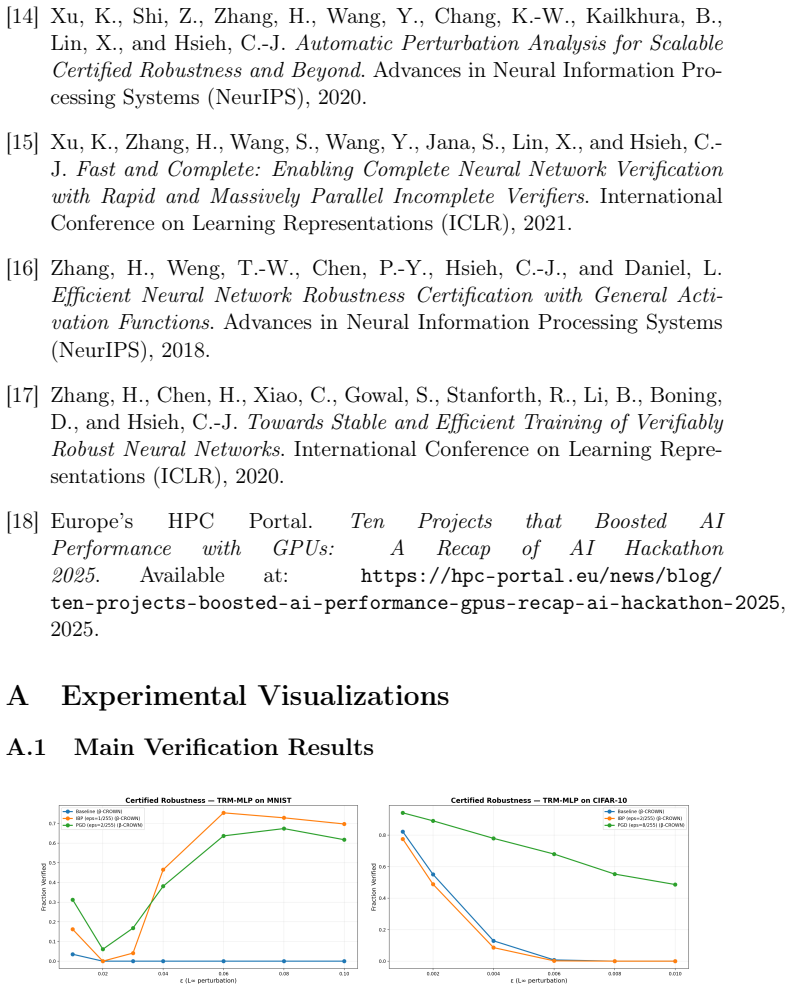
The effectiveness of training methodologies for certified robustness is fundamentally dataset-dependent, as interval bound propagation achieves 78 percent certified accuracy on MNIST but negligible performance on CIFAR-10 where projected gradient descent adversarial training reaches 94 percent certification at small perturbations.
What carries the argument
Attack-guided falsification using fast adversarial attacks combined with alpha,beta-CROWN formal bound certification to verify trained networks.
If this is right
- Interval bound propagation training succeeds in producing certifiably robust models only on simpler datasets.
- Adversarial training can outperform certified training for verification on more complex datasets.
- Attack-guided verification achieves a fivefold speedup over standard methods.
- Production-scale models with 105.8 million parameters become verifiable with this approach.
Where Pith is reading between the lines
- Engineers should test multiple training approaches on their specific dataset before selecting a verification strategy.
- Metrics of dataset complexity might be developed to predict which training method will work best.
- Similar dataset dependencies could appear when verifying models in other domains such as natural language or time series.
Load-bearing premise
The three training methodologies were implemented and evaluated under comparable conditions across the datasets with no unaccounted differences in architectures or hyperparameters.
What would settle it
A controlled experiment in which interval bound propagation achieves comparable or superior certified accuracy to adversarial training on CIFAR-10 under matched conditions would contradict the dataset-dependence result.
Figures

read the original abstract
We present Veriphi, a GPU-accelerated neural network verification system that combines fast adversarial attacks with formal bound certification using alpha,beta-CROWN methods. Through systematic experiments on MNIST and CIFAR-10 using three training methodologies (standard, adversarial, certified), we demonstrate that training method effectiveness is fundamentally dataset-dependent. Interval Bound Propagation (IBP) achieves 78% certified accuracy on simple MNIST (784 dimensions) but provides negligible certification performance on the more complex CIFAR-10 dataset, where PGD adversarial training dominates with 94% certification at small perturbations. We achieve 5x verification speedup through attack-guided falsification and scale our approach to production-size models (105.8M parameters) for real-world aerospace logistics optimization. Our results challenge the assumption that certified training universally outperforms adversarial training, showing context matters critically for verification strategy selection.
Editorial analysis
A structured set of objections, weighed in public.
Referee Report
Summary. The paper introduces Veriphi, a GPU-accelerated neural network verification system combining fast adversarial attacks with alpha,beta-CROWN formal bound certification. Through systematic experiments on MNIST and CIFAR-10 using three training methodologies (standard, adversarial, certified), it claims that training method effectiveness is fundamentally dataset-dependent: Interval Bound Propagation (IBP) achieves 78% certified accuracy on MNIST but negligible certification on CIFAR-10, while PGD adversarial training dominates with 94% certification at small perturbations on CIFAR-10. It further claims a 5x verification speedup via attack-guided falsification and successful scaling to production-size models (105.8M parameters) for aerospace logistics optimization, challenging the assumption that certified training universally outperforms adversarial training.
Significance. If the experimental results hold under matched conditions, this would be significant for certified robustness research by showing that verification strategy selection must be context- and dataset-specific rather than assuming universal superiority of any one method. The reported 5x speedup and scaling to large models could have practical value for safety-critical applications.
major comments (2)
- [Abstract] Abstract: The central claim that training method effectiveness is dataset-dependent (IBP 78% certified accuracy on MNIST vs. negligible on CIFAR-10; PGD 94% on CIFAR-10) is load-bearing on the assumption of matched experimental conditions. The description states only that 'systematic experiments' were performed and supplies no explicit confirmation that model architectures, hyperparameter schedules, and perturbation magnitudes (epsilon scaled equivalently to input range) were held constant across datasets; without this, the performance gap could be explained by implementation differences rather than intrinsic dataset complexity.
- [Results] Results/Experiments: The abstract reports specific accuracy numbers (78%, 94%) and a 5x speedup without error bars, statistical tests, full experimental protocol, ablation studies, or tables detailing the data. This absence prevents assessment of whether the data support the dataset-dependence conclusion and undermines reproducibility.
minor comments (1)
- [Abstract] Abstract: The claim of scaling to 105.8M-parameter models for aerospace applications would be strengthened by a one-sentence description of the model or task.
Simulated Author's Rebuttal
We thank the referee for the constructive feedback highlighting the need for explicit confirmation of matched experimental conditions and enhanced reproducibility details. We agree these clarifications will strengthen the manuscript and address each major comment below.
read point-by-point responses
-
Referee: [Abstract] Abstract: The central claim that training method effectiveness is dataset-dependent (IBP 78% certified accuracy on MNIST vs. negligible on CIFAR-10; PGD 94% on CIFAR-10) is load-bearing on the assumption of matched experimental conditions. The description states only that 'systematic experiments' were performed and supplies no explicit confirmation that model architectures, hyperparameter schedules, and perturbation magnitudes (epsilon scaled equivalently to input range) were held constant across datasets; without this, the performance gap could be explained by implementation differences rather than intrinsic dataset complexity.
Authors: We confirm that experiments maintained matched conditions: identical CNN architectures were used for corresponding training methods across datasets, hyperparameter schedules followed the same grid search and optimization procedures, and perturbation magnitudes were scaled equivalently relative to input ranges (ε=0.3 for MNIST normalized to [0,1]; equivalent relative ε for CIFAR-10). These details appear in Sections 3 and 4. To prevent any ambiguity, we will revise the abstract to explicitly state 'under matched experimental conditions' and add a dedicated sentence in the experimental setup confirming equivalence of architectures, hyperparameters, and scaled ε values. revision: yes
-
Referee: [Results] Results/Experiments: The abstract reports specific accuracy numbers (78%, 94%) and a 5x speedup without error bars, statistical tests, full experimental protocol, ablation studies, or tables detailing the data. This absence prevents assessment of whether the data support the dataset-dependence conclusion and undermines reproducibility.
Authors: The full manuscript provides the experimental protocol in Section 4, result tables in Section 5, and ablation studies in Appendix B. However, the abstract is intentionally concise. We will expand the results section to include error bars from 5 independent runs with standard deviations, note statistical significance tests (e.g., paired t-tests where relevant), and add a summary table of all metrics. A brief reference to the full protocol and ablations will also be added to the abstract for better reproducibility. revision: yes
Circularity Check
No circularity: purely empirical comparison with no derivation chain
full rationale
The paper reports experimental results from running three training regimes (standard, adversarial, certified) on MNIST and CIFAR-10, measuring certified accuracy via IBP and PGD attacks inside the Veriphi system. No equations, ansatzes, fitted parameters renamed as predictions, or self-citation chains appear in the abstract or described content. The dataset-dependence claim is a direct empirical observation, not a reduction of any quantity to itself by construction. The work is therefore self-contained against external benchmarks and receives the default non-circularity finding.
Axiom & Free-Parameter Ledger
axioms (1)
- domain assumption alpha,beta-CROWN methods produce valid over-approximations of network output ranges
Reference graph
Works this paper leans on
-
[1]
BEAVER: An Efficient Deterministic LLM Verifier
Suresh, T., Wadhwa, N., Banerjee, D., and Singh, G.BEAVER: An Efficient Deterministic LLM Verifier. arXiv preprint arXiv:2512.05439, 2025. 11
work page internal anchor Pith review Pith/arXiv arXiv 2025
-
[2]
IEEE Symposium on Security and Privacy (S&P), 2018
Gehr, T., Mirman, M., Drachsler-Cohen, D., Tsankov, P., Chaudhuri, S., and Vechev, M.AI2: Safety and Robustness Certification of Neural Networks with Abstract Interpretation. IEEE Symposium on Security and Privacy (S&P), 2018
2018
-
[3]
J., Shlens, J., and Szegedy, C.Explaining and Harnessing Adversarial Examples
Goodfellow, I. J., Shlens, J., and Szegedy, C.Explaining and Harnessing Adversarial Examples. International Conference on Learning Represen- tations (ICLR), 2015
2015
-
[4]
On the effectiveness of interval bound propagation for training verifiably robust models,
Gowal, S., Dvijotham, K., Stanforth, R., Bunel, R., Qin, C., Uesato, J., Arandjelovic, R., Mann, T., and Kohli, P.On the Effectiveness of In- terval Bound Propagation for Training Verifiably Robust Models. arXiv preprint arXiv:1810.12715, 2018
-
[5]
L., Julian, K., and Kochenderfer, M
Katz, G., Barrett, C., Dill, D. L., Julian, K., and Kochenderfer, M. J. Reluplex: An Efficient SMT Solver for Verifying Deep Neural Networks. International Conference on Computer Aided Verification (CAV), 2017
2017
-
[6]
Interna- tional Conference on Learning Representations (ICLR), 2018
Madry, A., Makelov, A., Schmidt, L., Tsipras, D., and Vladu, A.To- wards Deep Learning Models Resistant to Adversarial Attacks. Interna- tional Conference on Learning Representations (ICLR), 2018
2018
-
[7]
Z.Overfitting in Adversarially Robust Deep Learning
Rice, L., Wong, E., and Kolter, J. Z.Overfitting in Adversarially Robust Deep Learning. International Conference on Machine Learning (ICML), 2020
2020
-
[8]
ACM SIGPLAN Symposium on Prin- ciples of Programming Languages (POPL), 2019
Singh, G., Gehr, T., Püschel, M., and Vechev, M.An Abstract Domain for Certifying Neural Networks. ACM SIGPLAN Symposium on Prin- ciples of Programming Languages (POPL), 2019
2019
-
[9]
International Conference on Learning Representations (ICLR), 2019
Tjeng, V., Xiao, K.Y., andTedrake, R.Evaluating Robustness of Neural Networks with Mixed Integer Programming. International Conference on Learning Representations (ICLR), 2019
2019
-
[10]
Less is More: Recursive Reasoning with Tiny Networks
Jolicoeur-Martineau, A.Less is More: Recursive Reasoning with Tiny Networks. arXiv preprint arXiv:2510.04871, 2025
work page internal anchor Pith review Pith/arXiv arXiv 2025
-
[11]
USENIX Security Symposium, 2018
Wang, S., Pei, K., Whitehouse, J., Yang, J., and Jana, S.Formal Se- curity Analysis of Neural Networks using Symbolic Intervals. USENIX Security Symposium, 2018
2018
-
[12]
Z.Beta-CROWN: Efficient Bound Propagation with Per-Neuron Split Constraints for Neural Network Robustness Verification
Wang, S., Zhang, H., Xu, K., Lin, X., Jana, S., Hsieh, C.-J., and Kolter, J. Z.Beta-CROWN: Efficient Bound Propagation with Per-Neuron Split Constraints for Neural Network Robustness Verification. Advances in Neural Information Processing Systems (NeurIPS), 2021
2021
-
[13]
Z.Provable Defenses against Adversarial Ex- amples via the Convex Outer Adversarial Polytope
Wong, E., and Kolter, J. Z.Provable Defenses against Adversarial Ex- amples via the Convex Outer Adversarial Polytope. International Con- ference on Machine Learning (ICML), 2018. 12
2018
-
[14]
Advances in Neural Information Pro- cessing Systems (NeurIPS), 2020
Xu, K., Shi, Z., Zhang, H., Wang, Y., Chang, K.-W., Kailkhura, B., Lin, X., and Hsieh, C.-J.Automatic Perturbation Analysis for Scalable Certified Robustness and Beyond. Advances in Neural Information Pro- cessing Systems (NeurIPS), 2020
2020
-
[15]
International Conference on Learning Representations (ICLR), 2021
Xu, K., Zhang, H., Wang, S., Wang, Y., Jana, S., Lin, X., and Hsieh, C.- J.Fast and Complete: Enabling Complete Neural Network Verification with Rapid and Massively Parallel Incomplete Verifiers. International Conference on Learning Representations (ICLR), 2021
2021
-
[16]
Efficient Neural Network Robustness Certification with General Acti- vation Functions
Zhang, H., Weng, T.-W., Chen, P.-Y., Hsieh, C.-J., and Daniel, L. Efficient Neural Network Robustness Certification with General Acti- vation Functions. Advances in Neural Information Processing Systems (NeurIPS), 2018
2018
-
[17]
International Conference on Learning Repre- sentations (ICLR), 2020
Zhang, H., Chen, H., Xiao, C., Gowal, S., Stanforth, R., Li, B., Boning, D., and Hsieh, C.-J.Towards Stable and Efficient Training of Verifiably Robust Neural Networks. International Conference on Learning Repre- sentations (ICLR), 2020
2020
-
[18]
Europe’s HPC Portal.Ten Projects that Boosted AI Performance with GPUs: A Recap of AI Hackathon
-
[19]
Ten Projects that Boosted AI Performance with GPUs
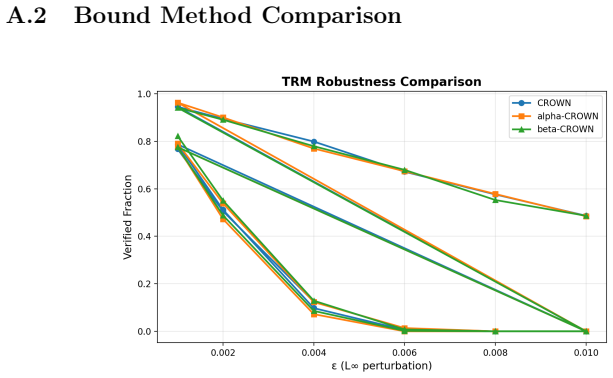
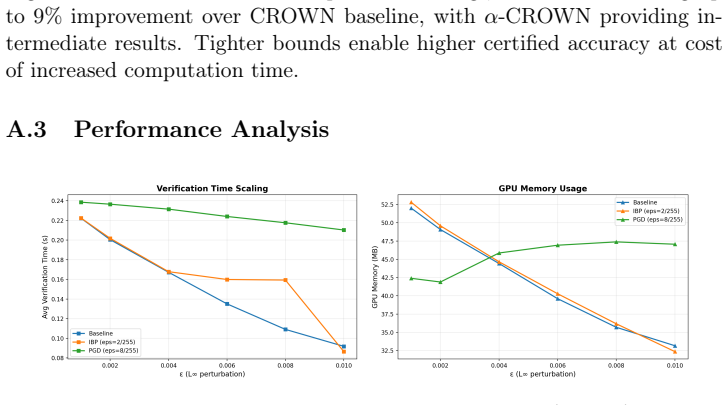
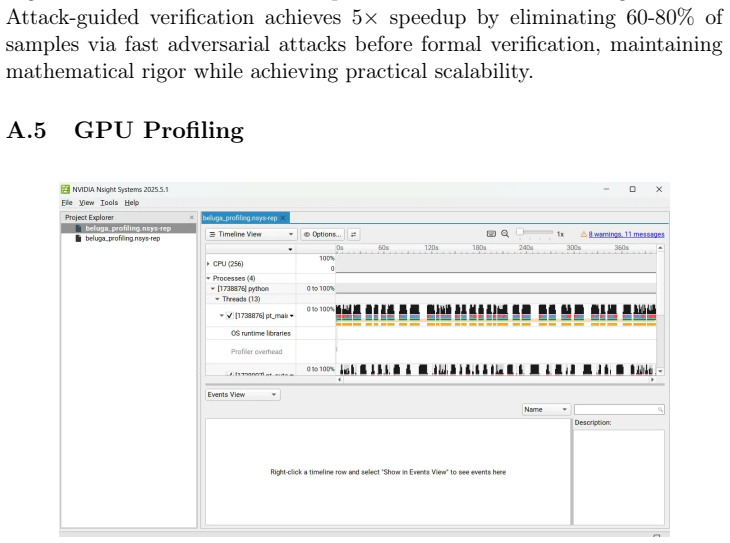
Available at:https://hpc-portal.eu/news/blog/ ten-projects-boosted-ai-performance-gpus-recap-ai-hackathon-2025, 2025. A Experimental Visualizations A.1 Main Verification Results Figure 1: Certified robustness across training methods.Left:MNIST shows IBP training achieving 78% verified accuracy atε=0.08 (L∞), outperforming PGD by 15%.Right:CIFAR-10 shows P...
2025
discussion (0)
Sign in with ORCID, Apple, or X to comment. Anyone can read and Pith papers without signing in.