REVIEW 3 major objections 6 minor 2 cited by
SplatFlow: Self-Supervised Dynamic Gaussian Splatting in Neural Motion Flow Field for Autonomous Driving
T0 review · 3 major / 6 minor · reviewed 2026-08-12 · deepseek-v4-flash
Pith's one-line read SplatFlow claims that a self-supervised 4D Gaussian representation inside a neural motion flow field reconstructs and renders dynamic urban scenes without tracked 3D bounding boxes.
desk verdict Solid box-free dynamic Gaussian splatting with a real gap around the static/dynamic threshold; worth refereeing. read the letter →
The pith
A machine-rendered reading of the paper's core claim, the machinery that carries it, and where it could break.
The reading
What carries the argument
The load-bearing mechanism is the Neural Motion Flow Field (NMFF), a temporal sequence of MLP fields $\phi_{t_1:t_2}$ that map any query point at time $t_1$ to its 3D displacement and motion angle at time $t_2$. Each field is eight ReLU-MLP stacks. NMFF does two jobs: it produces a 3D dynamic mask by thresholding per-point flow magnitude, deciding which LiDAR points initialize static 3D Gaussians versus dynamic 4D Gaussians, and it warps aggregated 4D Gaussians across timestamps so that at render time all Gaussians are brought to the target time and splatted. The authors find that rendering loss alone does not sufficiently constrain motion, so they pretrain the field on LiDAR geometry with bidirectional Chamfer distance and add optical-flow distillation from a 2D foundation model to inject motion knowledge from images.
What would settle it
Take a scene containing a small, mostly occluded vehicle moving in 3D but slowly in image space; render it with SplatFlow, then render the same scene after forcing the dynamic mask from ground-truth 3D bounding boxes. If the flow-based mask misses the vehicle, the dynamic-region PSNR will drop sharply relative to the box-forced version, while static metrics stay similar.
Extended reading notes
Core claim
SplatFlow's central claim is that a 4D Gaussian splatting representation, when coupled to a neural motion flow field, can learn dynamic urban scenes without tracking or 3D bounding-box annotations. The motion field predicts where each LiDAR point and Gaussian moves between consecutive timestamps; the authors pretrain it on LiDAR point clouds with a bidirectional Chamfer distance, then jointly optimize it with Gaussian attributes on image and depth losses, and distill optical flow from a 2D foundation model. Static content is stored as 3D Gaussians and dynamic content as 4D Gaussians that are warped to a target time before rasterization. On Waymo and KITTI, the paper reports higher PSNR, SSIM, and LPIPS than prior baselines, including box-supervised ones, for both image reconstruction and novel view synthesis, with the strongest gains on dynamic regions.
Load-bearing premise
The static/dynamic split rests on a fixed threshold applied to the learned 3D motion flow; if the flow field underestimates the motion of small, distant, or occluded objects, those objects are treated as static and the 4D representation cannot recover them.
Editorial extensions
If this is right
- Dynamic urban scenes can be reconstructed and rendered at roughly 40-44 FPS without any tracked 3D bounding boxes, using only calibrated cameras and LiDAR plus pretrained motion and optical-flow pseudo-labels.
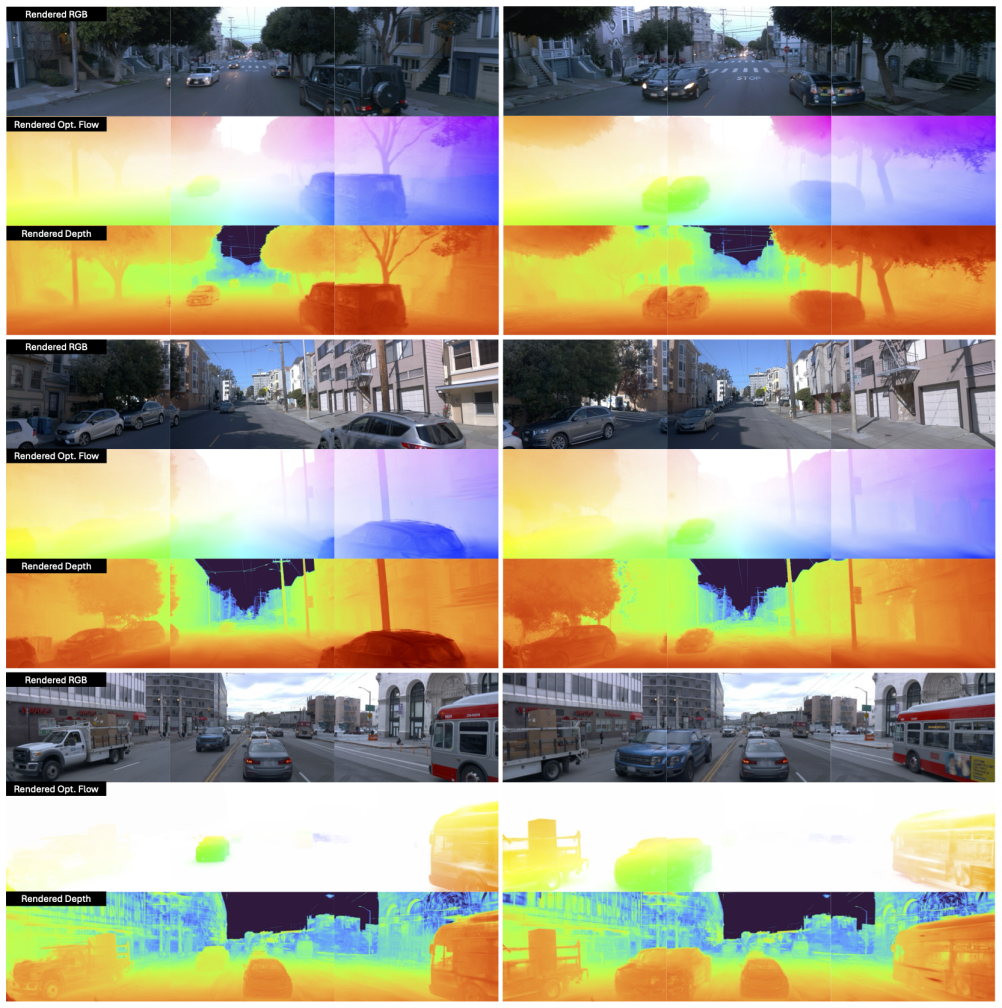
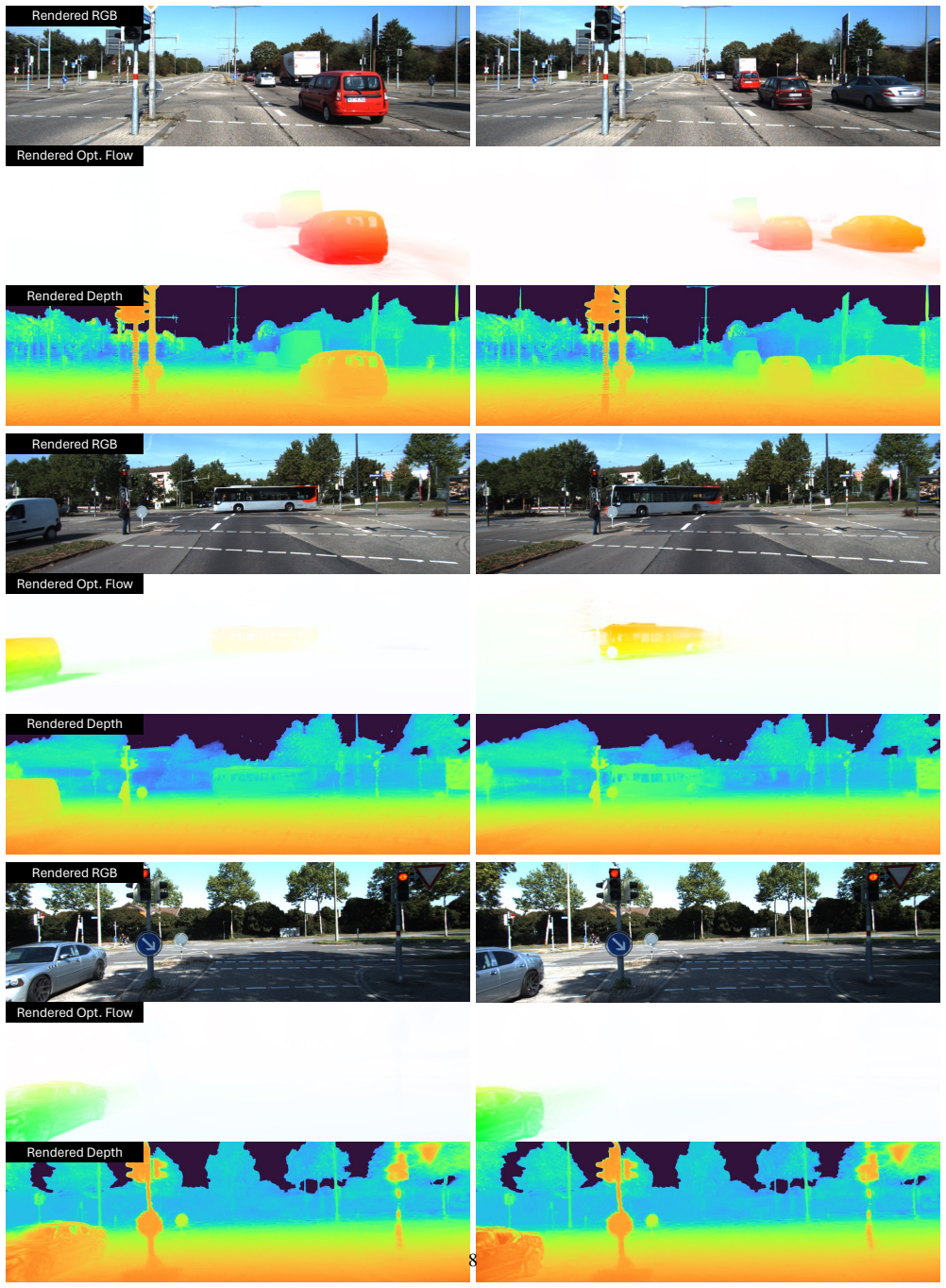
- The learned motion field enables novel-view synthesis at arbitrary timestamps, including ego trajectories shifted 0.5 meters from the recorded one, with rendered RGB, depth, and optical flow.
- Because the dynamic mask comes from per-point motion magnitude rather than detectors, the method can scale to unlabeled in-the-wild driving data, which the authors identify as the main scalability bottleneck it removes.
- Ablations show that each component, LiDAR flow pretraining, NMFF optimization with 4D Gaussians, and optical-flow distillation, contributes to the final rendering quality, especially inside dynamic regions.
Reading between the lines
- Not pursued in the paper: the same NMFF motion prior could be reused as a warm start for other 4D representations, such as deformable radiance fields or motion forecasting modules, since it already outputs dense 3D point trajectories.
- Not pursued in the paper: replacing the unspecified threshold with a confidence-weighted soft mask could make the static/dynamic decomposition robust without per-scene threshold tuning; this is a testable variant of the method as described.
- Not pursued in the paper: because SplatFlow renders dense optical flow and depth, the same pipeline could be turned around to generate pseudo-labels for training scene-flow or optical-flow networks in driving data, where such labels are scarce.
Signed reviews
Editorial analysis
A structured set of objections, weighed in public.
Referee Report
Summary. SplatFlow proposes a self-supervised dynamic Gaussian splatting framework for autonomous driving scenes that avoids tracked 3D bounding boxes. The method introduces a Neural Motion Flow Field (NMFF), pretrained on temporally consecutive LiDAR point clouds with Chamfer distance, to predict 3D motion flow. A threshold on this flow decomposes points into static and dynamic sets, which seed static 3D Gaussians and dynamic 4D Gaussians, respectively. During Gaussian splatting, the NMFF is jointly optimized to propagate 4D Gaussians across time, and optical flow from SEA-RAFT is distilled into the representation. The paper reports state-of-the-art results on the Waymo Open Dataset and KITTI for image reconstruction and novel view synthesis, including ablations and runtime comparisons.
Significance. If the reported results hold, SplatFlow is a meaningful step toward scalable dynamic scene reconstruction for autonomous driving simulation, as it removes the dependence on expensive 3D bounding-box annotations that most leading dynamic urban Gaussian splatting methods require. The unified NMFF representation that simultaneously drives static/dynamic decomposition and cross-time 4D Gaussian correspondence is a well-conceived design. The paper provides clear ablations showing the contribution of each component, reports real-time inference FPS, and backs the claims with extensive qualitative visualizations. These strengths are, however, tempered by the absence of a code release and by several specification gaps that currently prevent full reproducibility and may affect the robustness of the SOTA claim.
major comments (3)
- [Section 3.4] The static/dynamic decomposition is obtained 'by applying a threshold on each point's 3D motion flow' (Section 3.4), but the threshold value, its selection criterion, and any sensitivity analysis are never reported in the manuscript or supplement. This threshold determines which LiDAR points seed 4D dynamic Gaussians and which seed static 3D Gaussians, so the entire 4D representation—and hence the NVS results in Tables 1–4—is contingent on an unspecified hyperparameter. Please provide the threshold value and an ablation over a range of thresholds (e.g., NVS metrics as a function of threshold), or a principled criterion (e.g., a percentile of flow magnitude) that makes the choice canonical.
- [Tables 1, 3, 4] The reported average metrics have no error bars or per-scene standard deviations. For the central SOTA claim, the differences against the strongest baseline PVG are modest in some cells (e.g., Table 3 KITTI image reconstruction SSIM 0.943 vs 0.937; LPIPS 0.057 vs 0.070), and without variance estimates it is impossible to judge whether these differences are statistically meaningful or driven by a few favorable segments. Please provide per-scene result tables and/or standard deviations across scenes and runs.
- [Supplement Section 6] The NMFF is pretrained on pseudo scene flow labels from [14] generated with Chamfer distance on raw LiDAR, but the paper never evaluates the accuracy of the learned 3D motion flow against any reference or manual annotations, nor does it analyze failure modes for fast-moving, distant, or occluded objects. Because the dynamic mask directly inherits errors from this prior, the box-free claim and the overall robustness depend on NMFF flow quality. Please provide a quantitative evaluation of NMFF's flow (e.g., end-point error on a validation subset with known object motions) or a sensitivity test where pseudo labels are perturbed (e.g., by noise) and the resulting NVS metrics are reported.
minor comments (6)
- [Introduction, page 2] The word 'Levaraging' should be 'Leveraging'.
- [Figure 11, Figure 15, Figure 17] The captions contain typos: 'SlatFlow' and 'SlpatFlow' should be 'SplatFlow'.
- [Table 2] The segment identifiers are partially redacted with ellipses (e.g., 'Seg. 1058...'); please provide the full segment IDs for reproducibility.
- [Section 3.4] The terms 'mid-timestamp reference frame' and 'step-by-step propagation' are not precisely defined; please specify how the reference timestamp is selected and how aggregation of 4D Gaussians across timestamps is performed.
- [Section 3.5] Equation (10) uses µ′ for projected centers, but the rendering equations in Eq. (3) use depth z_i without linking the two notations; clarify the projection and depth computation for the flow rendering.
- [Supplement Section 12] The runtime claim of 40–44 FPS is based on 'quantization and pruning optimization', but no details of the quantization method or pruning ratio are given; please specify these to support the real-time claim.
Circularity Check
No circular derivation: benchmark metrics are external, and the pretrained flow priors come from external sources rather than from the paper's own claims.
full rationale
SplatFlow's central claim—state-of-the-art reconstruction and novel-view synthesis on Waymo and KITTI without 3D bounding-box labels—is evaluated against held-out images using PSNR, SSIM, and LPIPS, compared with published baselines. These metrics are external to the method's own motion-flow field, so the headline result cannot be an artifact of a self-defined quantity. The static/dynamic decomposition is initialized from NMFF, which is pretrained using pseudo scene-flow labels generated following the external method Pontes et al. [14], with Chamfer-distance refinement on raw LiDAR; this is a teacher-prior setup from an external source, not the paper's own outputs. Optical-flow supervision comes from SEA-RAFT and sky masks from SegFormer, both external. The only self-citations are related-work mentions (TCLC-GS [28], Behind-the-Veil [18]); they supply no load-bearing premise and are not used to forbid alternatives or to justify the core formulation. Concerns raised by the skeptic—unspecified threshold for the 3D dynamic mask, no sensitivity analysis, no flow-accuracy check—are reproducibility and robustness issues rather than circular reductions; no equation in the paper defines the reported improvements in terms of the method's fitted parameters or prior self-citations. Even if the threshold or pseudo-label quality were favorable, that would be parameter or pretraining dependence, not circularity.
Assumptions & free parameters
free parameters (2)
- Loss weighting coefficients lambda1..4, lambda_ssim, lambda_f =
0.1, 0.005, 0.05, 0.001, 0.2, 0.8
- Static/dynamic flow magnitude threshold =
not reported
assumptions (4)
- domain assumption Pseudo scene flow labels from the method of [14] are accurate enough to pretrain NMFF via Chamfer distance.
- domain assumption SEA-RAFT [21] optical flow provides reliable pseudo ground truth for flow distillation.
- domain assumption Ego-motion compensation is correct, so residual flow equals only object motion.
- standard math Standard 3DGS differentiable rasterization (Kerbl et al.) and the Gaussian density model are valid for rendering.
invented entities (1)
-
Neural Motion Flow Field (NMFF)
Cite this review
Pith. "Pith review of SplatFlow: Self-Supervised Dynamic Gaussian Splatting in Neural Motion Flow Field for Autonomous Driving." pith.science (2026). https://pith.science/paper/P6R5TI7X
@misc{pith2026241115482,
  author       = {Pith},
  title        = {Pith review of: SplatFlow: Self-Supervised Dynamic Gaussian Splatting in Neural Motion Flow Field for Autonomous Driving},
  year         = {2026},
  howpublished = {\url{https://pith.science/paper/P6R5TI7X}},
  note         = {Machine review of arXiv:2411.15482}
}
read the original abstract
Most existing Dynamic Gaussian Splatting methods for complex dynamic urban scenarios rely on accurate object-level supervision from expensive manual labeling, limiting their scalability in real-world applications. In this paper, we introduce SplatFlow, a Self-Supervised Dynamic Gaussian Splatting within Neural Motion Flow Fields (NMFF) to learn 4D space-time representations without requiring tracked 3D bounding boxes, enabling accurate dynamic scene reconstruction and novel view RGB/depth/flow synthesis. SplatFlow designs a unified framework to seamlessly integrate time-dependent 4D Gaussian representation within NMFF, where NMFF is a set of implicit functions to model temporal motions of both LiDAR points and Gaussians as continuous motion flow fields. Leveraging NMFF, SplatFlow effectively decomposes static background and dynamic objects, representing them with 3D and 4D Gaussian primitives, respectively. NMFF also models the correspondences of each 4D Gaussian across time, which aggregates temporal features to enhance cross-view consistency of dynamic components. SplatFlow further improves dynamic object identification by distilling features from 2D foundation models into 4D space-time representation. Comprehensive evaluations conducted on the Waymo and KITTI Datasets validate SplatFlow's state-of-the-art (SOTA) performance for both image reconstruction and novel view synthesis in dynamic urban scenarios.
Figures


Figures from the paper (13 more)



Forward citations
Cited by 2 Pith papers
-
AD-GS: Object-Aware B-Spline Gaussian Splatting for Self-Supervised Autonomous Driving
A self-supervised Gaussian splatting method for driving scenes models object motion with learnable B-spline and quaternion B-spline curves plus bidirectional temporal visibility masks, achieving state-of-the-art rende...
-
ArbiViewGen: Controllable Arbitrary Viewpoint Camera Data Generation for Autonomous Driving via Stable Diffusion Models
ArbiViewGen generates arbitrary-viewpoint driving camera images by stitching the six input views into pseudo-target views and training a Stable Diffusion model to reconstruct the original views, enabling self-supervis...
Reference graph
Works this paper leans on
-
[14]
Scene flow from point clouds with or without learning
Jhony Kaesemodel Pontes, James Hays, and Simon Lucey. Scene flow from point clouds with or without learning. In 2020 international conference on 3D vision (3DV) , pages 261–270. IEEE, 2020. 1
work page 2020
-
[1]
Periodic vibration gaussian: Dynamic urban scene reconstruction and real-time rendering
Yurui Chen, Chun Gu, Junzhe Jiang, Xiatian Zhu, and Li Zhang. Periodic vibration gaussian: Dynamic urban scene reconstruction and real-time rendering. arXiv preprint arXiv:2311.18561, 20. 1, 2, 3, 5, 6, 7, 8
-
[2]
Carla: An open urban driv- ing simulator
Alexey Dosovitskiy, German Ros, Felipe Codevilla, Anto- nio Lopez, and Vladlen Koltun. Carla: An open urban driv- ing simulator. In Conference on robot learning, pages 1–16. PMLR, 2017. 2
2017
-
[3]
Multi-level neural scene graphs for dynamic urban environments
Tobias Fischer, Lorenzo Porzi, Samuel Rota Bulo, Marc Pollefeys, and Peter Kontschieder. Multi-level neural scene graphs for dynamic urban environments. In Proceedings of the IEEE/CVF Conference on Computer Vision and Pattern Recognition, pages 21125–21135, 2024. 1
2024
-
[4]
Are we ready for autonomous driving? the kitti vision benchmark suite
Andreas Geiger, Philip Lenz, and Raquel Urtasun. Are we ready for autonomous driving? the kitti vision benchmark suite. In 2012 IEEE conference on computer vision and pat- tern recognition, pages 3354–3361. IEEE, 2012. 2, 5
2012
-
[5]
Streetsurf: Extending multi-view im- plicit surface reconstruction to street views
Jianfei Guo, Nianchen Deng, Xinyang Li, Yeqi Bai, Bo- tian Shi, Chiyu Wang, Chenjing Ding, Dongliang Wang, and Yikang Li. Streetsurf: Extending multi-view im- plicit surface reconstruction to street views. arXiv preprint arXiv:2306.04988, 2023. 2, 5, 6, 7, 1
arXiv 2023
-
[6]
Antoine Gu ´edon and Vincent Lepetit. Sugar: Surface- aligned gaussian splatting for efficient 3d mesh reconstruc- tion and high-quality mesh rendering. In 2024 IEEE/CVF Conference on Computer Vision and Pattern Recognition (CVPR), pages 5354–5363, 2024. 2
work page 2024
-
[7]
3d gaussian splatting for real-time 4 Figure 15
Bernhard Kerbl, Georgios Kopanas, Thomas Leimk ¨uhler, and George Drettakis. 3d gaussian splatting for real-time 4 Figure 15. Visualization of rendered RGB image, optical flow, and depth by SlpatFlow on Waymo dataset. radiance field rendering. ACM Transactions on Graphics, 42 (4), 2023. 1, 2, 3, 5, 6, 7, 8
work page 2023
Show all 31 references
-
[8]
Panoptic neural fields: A semantic object-aware neural scene representation
Abhijit Kundu, Kyle Genova, Xiaoqi Yin, Alireza Fathi, Car- oline Pantofaru, Leonidas J Guibas, Andrea Tagliasacchi, Frank Dellaert, and Thomas Funkhouser. Panoptic neural fields: A semantic object-aware neural scene representation. In Proceedings of the IEEE/CVF Conference on...
2022
-
[9]
Urban radiance field representa- tion with deformable neural mesh primitives
Fan Lu, Yan Xu, Guang Chen, Hongsheng Li, Kwan-Yee Lin, and Changjun Jiang. Urban radiance field representa- tion with deformable neural mesh primitives. InProceedings of the IEEE/CVF International Conference on Computer Vi- sion, pages 465–476, 2023. 2
2023
-
[10]
Nerf: Representing scenes as neural radiance fields for view syn- thesis
Ben Mildenhall, Pratul P Srinivasan, Matthew Tancik, Jonathan T Barron, Ravi Ramamoorthi, and Ren Ng. Nerf: Representing scenes as neural radiance fields for view syn- thesis. Communications of the ACM, 65(1):99–106, 2021. 1, 2, 8
2021
-
[11]
Instant neural graphics primitives with a multires- olution hash encoding
Thomas M ¨uller, Alex Evans, Christoph Schied, and Alexan- der Keller. Instant neural graphics primitives with a multires- olution hash encoding. ACM Trans. Graph. , 41(4):102:1– 5 Figure 16. Visualization of rendered RGB image, optical flow, and depth by SplatFlow on Waymo da...
2022
-
[12]
Neural scene graphs for dynamic scenes
Julian Ost, Fahim Mannan, Nils Thuerey, Julian Knodt, and Felix Heide. Neural scene graphs for dynamic scenes. In Proceedings of the IEEE/CVF Conference on Computer Vi- sion and Pattern Recognition, pages 2856–2865, 2021. 1, 2, 5, 6, 7, 8
2021
-
[13]
Neural point light fields
Julian Ost, Issam Laradji, Alejandro Newell, Yuval Bahat, and Felix Heide. Neural point light fields. In Proceedings of the IEEE/CVF Conference on Computer Vision and Pattern Recognition, pages 18419–18429, 2022. 2
2022
-
[15]
Urban radiance fields
Konstantinos Rematas, Andrew Liu, Pratul P Srini- vasan, Jonathan T Barron, Andrea Tagliasacchi, Thomas Funkhouser, and Vittorio Ferrari. Urban radiance fields. In Proceedings of the IEEE/CVF Conference on Computer Vi- sion and Pattern Recognition, pages 12932–12942, 2022. 2
2022
-
[16]
Airsim: High-fidelity visual and physical simulation for autonomous vehicles
Shital Shah, Debadeepta Dey, Chris Lovett, and Ashish Kapoor. Airsim: High-fidelity visual and physical simulation for autonomous vehicles. In Field and Service Robotics: Re- 6 sults of the 11th International Conference , pages 621–635. Springer, 2018. 2
2018
-
[17]
Scalability in perception for autonomous driving: Waymo open dataset
Pei Sun, Henrik Kretzschmar, Xerxes Dotiwalla, Aurelien Chouard, Vijaysai Patnaik, Paul Tsui, James Guo, Yin Zhou, Yuning Chai, Benjamin Caine, et al. Scalability in perception for autonomous driving: Waymo open dataset. In Proceed- ings of the IEEE/CVF conference on computer ...
2020
-
[18]
Behind the veil: Enhanced indoor 3d scene reconstruction with occluded sur- faces completion
Su Sun, Cheng Zhao, Yuliang Guo, Ruoyu Wang, Xinyu Huang, Yingjie Victor Chen, and Liu Ren. Behind the veil: Enhanced indoor 3d scene reconstruction with occluded sur- faces completion. In Proceedings of the IEEE/CVF Confer- ence on Computer Vision and Pattern Recognition (CVP...
2024
-
[19]
Neurad: Neural rendering for autonomous driving
Adam Tonderski, Carl Lindstr ¨om, Georg Hess, William Ljungbergh, Lennart Svensson, and Christoffer Petersson. Neurad: Neural rendering for autonomous driving. In Pro- ceedings of the IEEE/CVF Conference on Computer Vision and Pattern Recognition, pages 14895–14904, 2024. 1
2024
-
[20]
Suds: Scalable urban dynamic scenes
Haithem Turki, Jason Y Zhang, Francesco Ferroni, and Deva Ramanan. Suds: Scalable urban dynamic scenes. In Pro- ceedings of the IEEE/CVF Conference on Computer Vision and Pattern Recognition, pages 12375–12385, 2023. 1, 2, 3, 5, 6, 7, 8
2023
-
[21]
Sea-raft: Simple, efficient, accurate raft for optical flow
Yihan Wang, Lahav Lipson, and Jia Deng. Sea-raft: Simple, efficient, accurate raft for optical flow. In European Confer- ence on Computer Vision, pages 36–54. Springer, 2025. 5
2025
-
[22]
Mars: An instance-aware, mod- ular and realistic simulator for autonomous driving
Zirui Wu, Tianyu Liu, Liyi Luo, Zhide Zhong, Jianteng Chen, Hongmin Xiao, Chao Hou, Haozhe Lou, Yuantao Chen, Runyi Yang, et al. Mars: An instance-aware, mod- ular and realistic simulator for autonomous driving. In CAAI International Conference on Artificial Intelligence, pages 3–
-
[23]
1, 2, 5, 6, 7, 8
Springer, 2023. 1, 2, 5, 6, 7, 8
2023
-
[24]
Segformer: Simple and effi- cient design for semantic segmentation with transformers
Enze Xie, Wenhai Wang, Zhiding Yu, Anima Anandkumar, Jose M Alvarez, and Ping Luo. Segformer: Simple and effi- cient design for semantic segmentation with transformers. In Neural Information Processing Systems (NeurIPS), 2021. 5
2021
-
[25]
S-nerf: Neural radiance fields for street views
Ziyang Xie, Junge Zhang, Wenye Li, Feihu Zhang, and Li Zhang. S-nerf: Neural radiance fields for street views. In In- ternational Conference on Learning Representations (ICLR),
-
[26]
Street gaussians for modeling dynamic ur- ban scenes
Yunzhi Yan, Haotong Lin, Chenxu Zhou, Weijie Wang, Haiyang Sun, Kun Zhan, Xianpeng Lang, Xiaowei Zhou, and Sida Peng. Street gaussians for modeling dynamic ur- ban scenes. arXiv preprint arXiv:2401.01339, 2024. 1, 2, 3, 5, 8
2024 arXiv
-
[27]
Emernerf: Emergent spatial-temporal scene decomposition via self-supervision
Jiawei Yang, Boris Ivanovic, Or Litany, Xinshuo Weng, Se- ung Wook Kim, Boyi Li, Tong Che, Danfei Xu, Sanja Fidler, Marco Pavone, et al. Emernerf: Emergent spatial-temporal scene decomposition via self-supervision. arXiv preprint arXiv:2311.02077, 2023. 1, 2, 3, 5, 6, 7
2023 arXiv
-
[28]
Nerfusion: Fusing radiance fields for large- scale scene reconstruction
Xiaoshuai Zhang, Sai Bi, Kalyan Sunkavalli, Hao Su, and Zexiang Xu. Nerfusion: Fusing radiance fields for large- scale scene reconstruction. CVPR, 2022. 2
2022
-
[29]
Tclc-gs: Tightly coupled lidar-camera gaussian splatting for autonomous driving: Supplementary materials
Cheng Zhao, Su Sun, Ruoyu Wang, Yuliang Guo, Jun-Jun Wan, Zhou Huang, Xinyu Huang, Yingjie Victor Chen, and Liu Ren. Tclc-gs: Tightly coupled lidar-camera gaussian splatting for autonomous driving: Supplementary materials. In European Conference on Computer Vision, pages 91–10...
2024
-
[30]
Hugs: Holistic urban 3d scene understanding via gaus- sian splatting
Hongyu Zhou, Jiahao Shao, Lu Xu, Dongfeng Bai, Weichao Qiu, Bingbing Liu, Yue Wang, Andreas Geiger, and Yiyi Liao. Hugs: Holistic urban 3d scene understanding via gaus- sian splatting. In Proceedings of the IEEE/CVF Conference on Computer Vision and Pattern Recognition, pages ...
2024
-
[31]
Drivinggaussian: Composite gaussian splatting for surrounding dynamic au- tonomous driving scenes
Xiaoyu Zhou, Zhiwei Lin, Xiaojun Shan, Yongtao Wang, Deqing Sun, and Ming-Hsuan Yang. Drivinggaussian: Composite gaussian splatting for surrounding dynamic au- tonomous driving scenes. In Proceedings of the IEEE/CVF Conference on Computer Vision and Pattern Recognition , pages...
2024
Reviewed August 12, 2026 · model on record in the stance chip above.
Discussion (0). Continue with ORCID to comment.