REVIEW 3 major objections 4 minor 1 cited by
Quantum Noncommutativity Uniquely Determines Relative Entropy
T0 review · 3 major / 4 minor · reviewed 2026-08-15 · deepseek-v4-flash
Pith's one-line read The paper proves that any normalized, additive measure of quantum distinguishability that is monotone under binary testing orders and continuous on classical inputs must be the Umegaki relative entropy.
desk verdict Genuinely new uniqueness theorem for Umegaki relative entropy, with a serious proof and one load-bearing adaptation of MPST that needs independent verification before the result can be trusted. read the letter →
The pith
A machine-rendered reading of the paper's core claim, the machinery that carries it, and where it could break.
The reading
What carries the argument
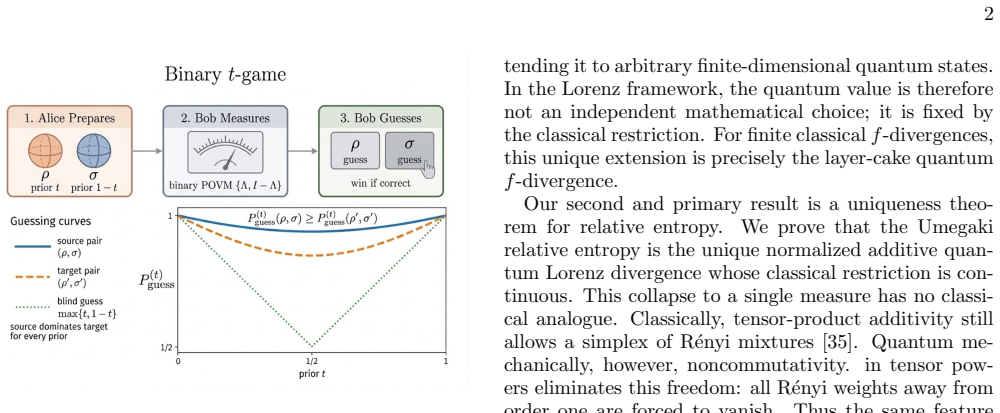
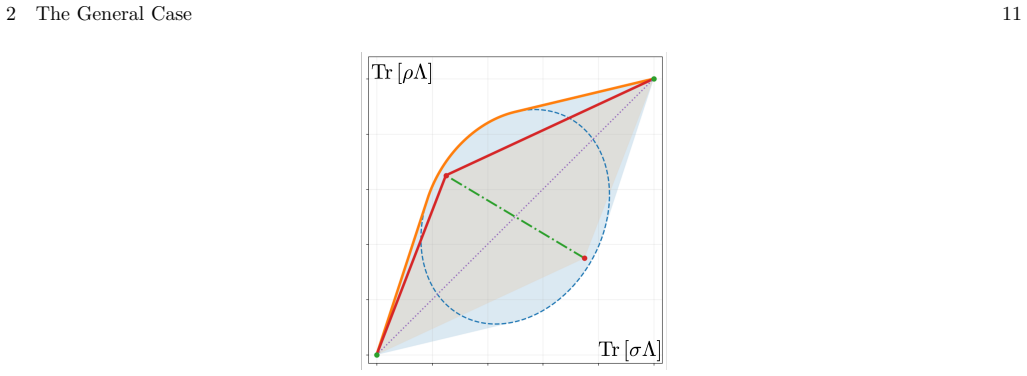
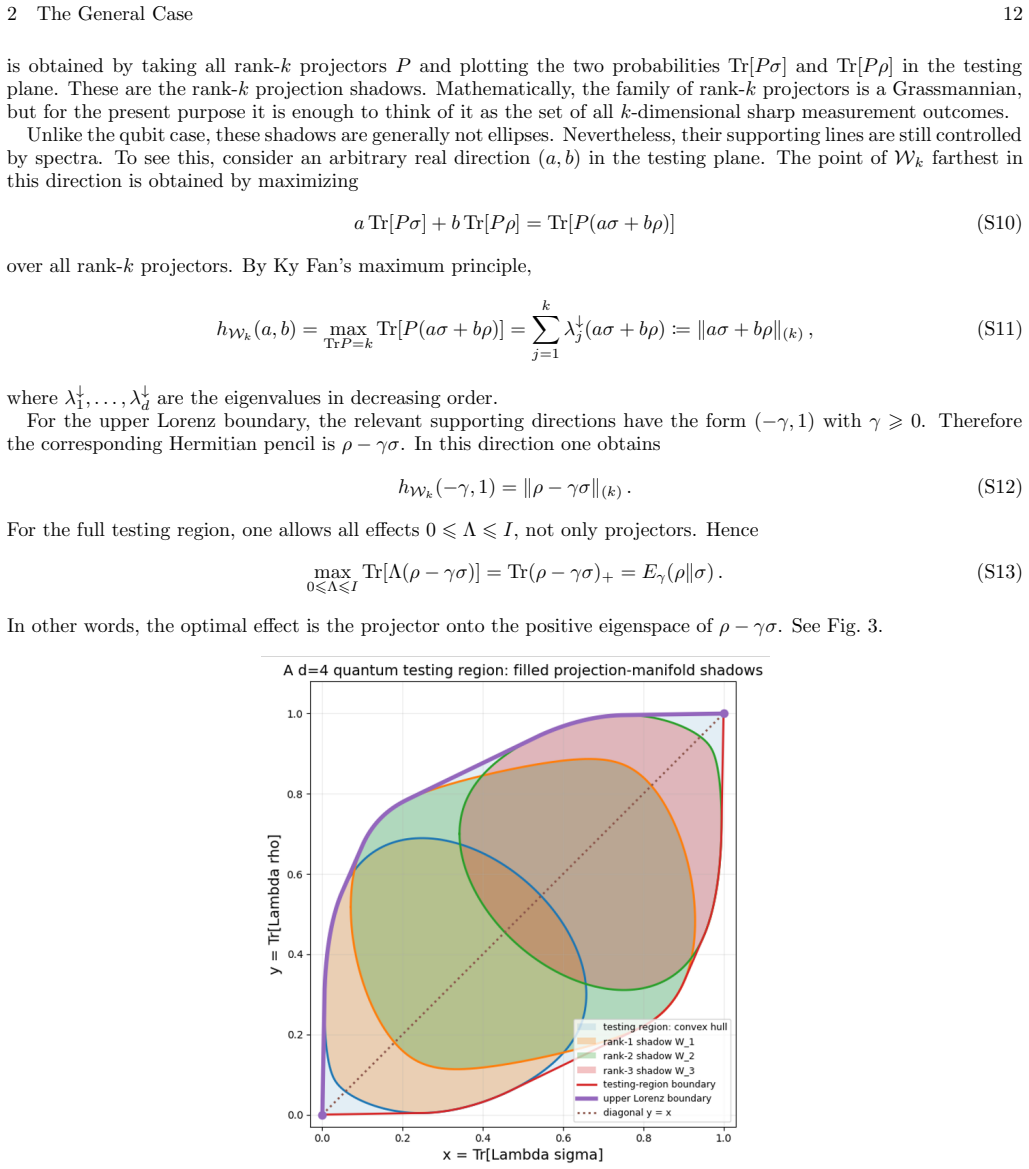
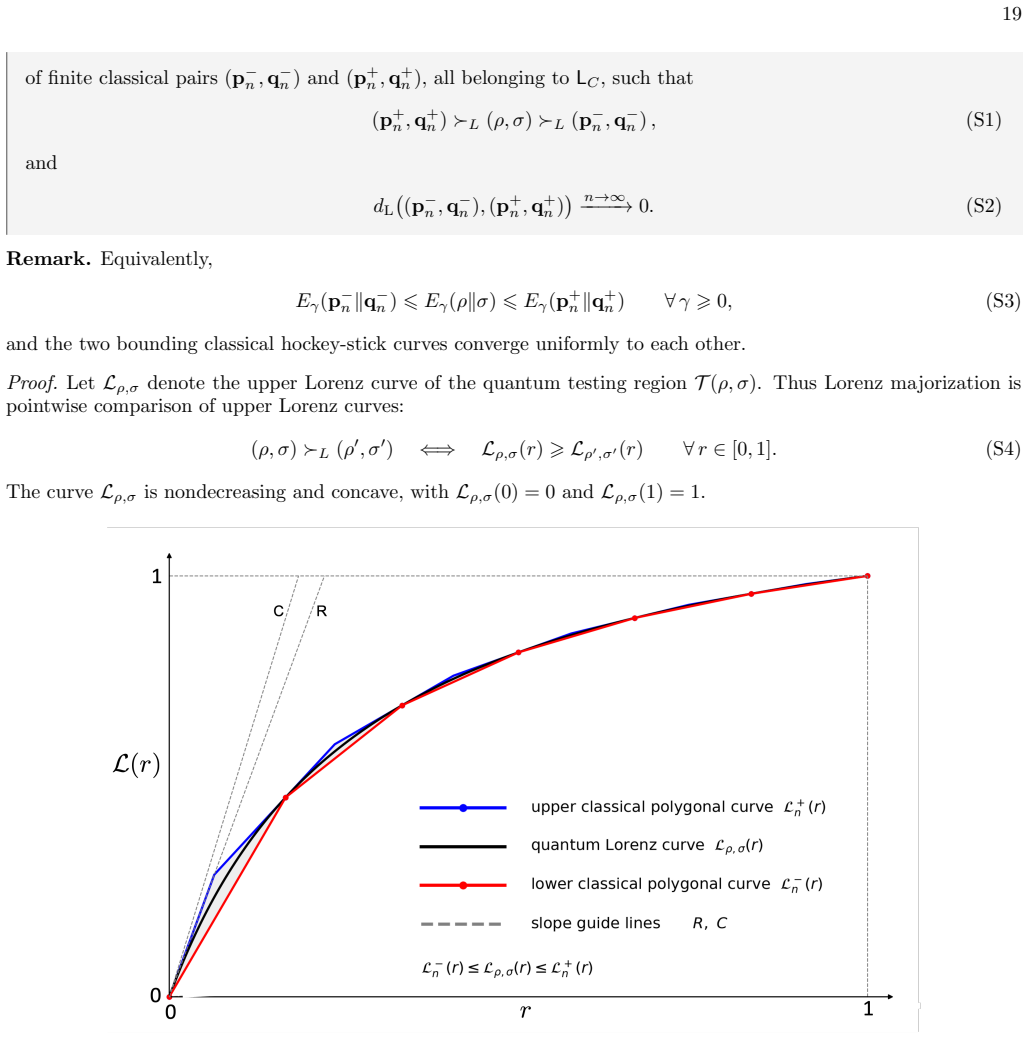
The central object is the quantum Lorenz preorder on pairs of states: $(\rho,\sigma)$ Lorenz-dominates $(\rho',\sigma')$ exactly when its testing region $T(\rho,\sigma)=\{(\operatorname{Tr}[\Lambda\sigma],\operatorname{Tr}[\Lambda\rho]):0\le\Lambda\le I\}$ contains the target's, equivalently when the hockey-stick divergences satisfy $E_\gamma(\rho\|\sigma)\ge E_\gamma(\rho'\|\sigma')$ for every $\gamma\ge 0$; these inequalities are also read as winning-odds dominance in every binary guessing game. The workhorse representation is the layer-cake Stieltjes measure $d\mu_{\rho,\sigma}$, whose stop-loss transforms are exactly the hockey-stick divergences, so Lorenz monotone functionals become convex-order monotone functionals on measures. The proof then runs through three load-bearing components: Theorem 3's bracketing construction, which sandwiches any bounded quantum Lorenz curve between finite classical Lorenz curves and shows Lorenz-continuous classical data fix the quantum value; the classical simplex representation of admissible additive divergences as positive mixtures of Rényi divergences (adapted in Supplementary Section S8); and the qubit gap-separation lemma, which computes, on an explicit two-parameter qubit family, the second-order differences between the standard quantum Rényi regularizations below and above order one and the one-shot layer-cake divergences, proving that no positive mixture of orders below one can balance a positive mixture of orders above one in the additivity identity.
What would settle it
Take the two-parameter qubit family $\rho_r=\frac12\begin{pmatrix}1&r\\r&1\end{pmatrix}$ and $\sigma_s=\operatorname{diag}(\frac{1+s}{2},\frac{1-s}{2})$ from Supplementary Section S7, pick an order $\alpha\neq 1$, and numerically evaluate the one-shot layer-cake divergence (38) on tensor powers: if $D_\alpha(\rho_r^{\otimes 2}\|\sigma_s^{\otimes 2})=2D_\alpha(\rho_r\|\sigma_s)$ holds for some $\alpha\neq 1$ and some $r,s$, then additivity does not single out order one and Theorem 4 is false. Equivalently, a direct search for any normalized additive quantum Lorenz divergence with Lorenz-continuous classical restriction that differs from the Umegaki value on this family would refute the claim.
Extended reading notes
Core claim
In the paper's own terms, the discovery is Theorem 4: if $D$ is a normalized, additive quantum Lorenz divergence—monotone under the Lorenz preorder generated by binary testing regions—and its restriction to commuting (classical) pairs is Lorenz continuous, then for every finite-dimensional pair with $\operatorname{supp}(\rho)\subseteq\operatorname{supp}(\sigma)$, $D(\rho\|\sigma)=\operatorname{Tr}[\rho\log\rho]-\operatorname{Tr}[\rho\log\sigma]$. The theorem is exact and single-shot; it does not assume a thermodynamic limit or super-additivity for correlated states. The route is: (i) a structural result (Theorem 3) that any classical divergence satisfying a mild continuity condition has at most one quantum Lorenz extension, with the extension constructed by bracketing the quantum Lorenz curve between classical Lorenz curves; (ii) the classical result that normalized, additive, data-processing monotone, Lorenz-continuous classical divergences form a simplex of Rényi mixtures; and (iii) the observation that additivity on noncommuting pairs forces every Rényi weight to vanish except the order-one one, because the one-shot layer-cake Rényi divergences regularize differently below and above order one and a qubit gap-separation lemma shows the two sides cannot balance. The paper frames the collapse as a purely quantum phenomenon: classically the same axioms leave a continuous family of admissible measures, and it is noncommutativity in tensor powers that removes all freedom.
Load-bearing premise
The load-bearing premise is the finite-alphabet classification theorem imported in Supplementary Section S8 (Eq. 37): every normalized, additive, data-processing monotone, Lorenz-continuous classical divergence is a positive mixture of Rényi divergences, an assumption the paper adapts to its one-sided normalization without proving that the theorem's own hypotheses follow from exactly the conditions used here.
Editorial extensions
If this is right
- The infinite family of data-processing-monotone divergences collapses at the single-shot level: once binary-testing comparison and additivity are imposed, only the Umegaki relative entropy survives, with no asymptotic limit needed.
- Classical Lorenz-continuous divergences have unique quantum extensions; the known one-shot quantum $f$-divergences are therefore forced by their classical restrictions rather than being a matter of quantization choice.
- In quantum resource theories and single-shot thermodynamics, relative entropy is the unique additive distinguishability measure, so quantities such as free energy acquire a single-shot justification directly from binary discrimination.
- The failure of additivity for every Rényi order other than one is itself a quantitative phenomenon: the regularization gaps $\Delta^-_\alpha$ and $\Delta^+_\alpha$ measure how far each order deviates from legitimate additivity, and the separation is provable already on qubits.
Reading between the lines
- The same mechanism suggests a template for other uniqueness questions: any operational preorder strictly finer than channel convertibility, combined with tensor-product additivity, may collapse admissible measures to the order-one entropy; multi-hypothesis testing or conditional entropies are natural next targets (the paper lists them as open directions, without proof).
- The bracketing construction of Theorem 3 carries a quantitative by-product: any additive quantum Lorenz divergence is squeezed between classical envelopes, so its deviation from the Umegaki value is controlled by the Lorenz distance of the pair to the classical domain; this could be tested numerically on the qubit families used in the proof.
- The threat to the theorem is the imported finite-alphabet classification used in Supplementary Section S8: if the classical representation (Eq. 37) requires stronger regularity than the conditions imposed here, the classical reduction breaks; a reader verifying the theorem's hypotheses against the original classification statement would settle this.
- Without Lorenz continuity, normalized additive QLDs other than relative entropy do exist—the paper's own example $D(\rho\|\sigma)+D_{\min}(\sigma\|\rho)$ shows boundary-sensitive, orientation-reversing terms are otherwise admissible—so the continuity assumption, not additivity alone, delimits the theorem's reach.
Signed reviews
Editorial analysis
A structured set of objections, weighed in public.
Referee Report
Summary. The paper proposes an axiomatic characterization of the Umegaki quantum relative entropy. It defines quantum Lorenz divergences as functionals monotone under quantum Lorenz majorization, which is an operational preorder based on binary guessing games, and proves two main results. Theorem 3 states that a classical divergence that is monotone under classical relative majorization and Lorenz continuous has a unique quantum Lorenz extension. Theorem 4 states that a normalized, additive quantum Lorenz divergence whose classical restriction is Lorenz continuous must equal Tr[rho log rho] - Tr[rho log sigma] for all finite-dimensional pairs with supp(rho) subset of supp(sigma). The proof combines the classical MPST representation of additive monotone divergences as mixtures of Renyi divergences with a qubit-based separation lemma that forces all mass of the mixture to concentrate at alpha = 1. The paper includes a lengthy supplementary information section with detailed proofs of the layer-cake representation, Lorenz continuity properties, the qubit gap computations, and the MPST adaptation.
Significance. If the main theorem is correct, it is a substantial result: it eliminates the infinite family of DPI-monotone quantum divergences at the single-shot level, under an operational distinguishability ordering and additivity, without assuming super-additivity. The proof is not circular: the Umegaki form is not assumed, and the conclusion follows from the axioms plus the imported MPST classification. The paper ships a detailed supplementary with explicit formulas, including the qubit perturbative expansion that underlies the collapse to alpha = 1. The claimed rigidity is also falsifiable, since any normalized additive Lorenz-continuous divergence violating Eq. (39) would constitute a counterexample. The main risk is that the classical classification step is imported from Mu, Pomatto, Strack, and Tamuz via an 'adaptation' rather than proved from the paper's own assumptions.
major comments (3)
- [S8 / Eq. (37)] The finite-alphabet MPST representation is load-bearing and is not proved from the paper's axioms. Section S8 states, without proof, that every normalized, additive, monotone-under-stochastic-maps, Lorenz-continuous classical divergence admits the one-sided Renyi mixture (37). The original MPST theorem has different technical hypotheses, involving a symmetric representation, finiteness on bounded pairs, and a continuity/topology condition that is not obviously identical to the sectorwise Lorenz continuity of Definition 2. The paper rewrites the symmetric MPST formula and removes endpoint terms, but it never verifies that a divergence satisfying the paper's conditions satisfies all hypotheses of [36]. If the MPST theorem requires stronger regularity, Eq. (37) fails, and with it Eqs. (38), (42)-(44), and Theorem 4 lose their foundation. This needs to be either proved as a self-contained lemma or explicitly added as an axiom.
- [Abstract and Eq. (40)] The abstract claims the result 'requires neither a thermodynamic limit of infinitely many copies', but the proof of Theorem 4 explicitly uses the infinite-copy regularization limit D(rho||sigma) = lim_{n->infinity} (1/n) D(rho^{otimes n}||sigma^{otimes n}) in Eq. (40), and Section S9 justifies interchanging this limit with the MPST integral. It is true that exact additivity makes Eq. (40) redundant for the value of D, but the derivation of Eq. (42) relies on the asymptotic regularization of HT Renyi divergences in Eq. (41). The abstract and Section V should be rephrased to say that no thermodynamic limit is assumed as an axiom, while acknowledging that an n-to-infinity regularization step is used in the proof. As written, the claim is misleading.
- [Lemma 11 (SI S6)] The bracket construction in Lemma 11 states 'fix C > 2 Dmax(rho||sigma)' for the bounded sector. If this is literally the number 2 times the max-divergence, the condition is insufficient: the slopes of the quantum Lorenz curve are governed by the exponential of Dmax, e.g. C should be larger than a quantity like exp(Dmax) or 2^{Dmax}. For Dmax large, a literal C > 2 Dmax may fall below the maximal slope, invalidating the claim that the approximating classical pairs lie in L_C. Please clarify whether this is a typesetting error and correct the bound in the final version.
minor comments (4)
- [Abstract] There is a stray punctuation artifact in the abstract: 'quantum noncommutativity. collapses' should read 'quantum noncommutativity collapses', and the accented 'R\'enyi' appears with broken markups.
- [Eqs. (42)-(44)] The notation D_alpha is used for both the one-shot HT Renyi divergence and the Petz Renyi divergence after regularization. In Eqs. (42)-(44) the two objects have different meanings; please introduce separate symbols (e.g., D_alpha^{HT}, D_alpha^{Petz}) to avoid confusion in the cancellation step.
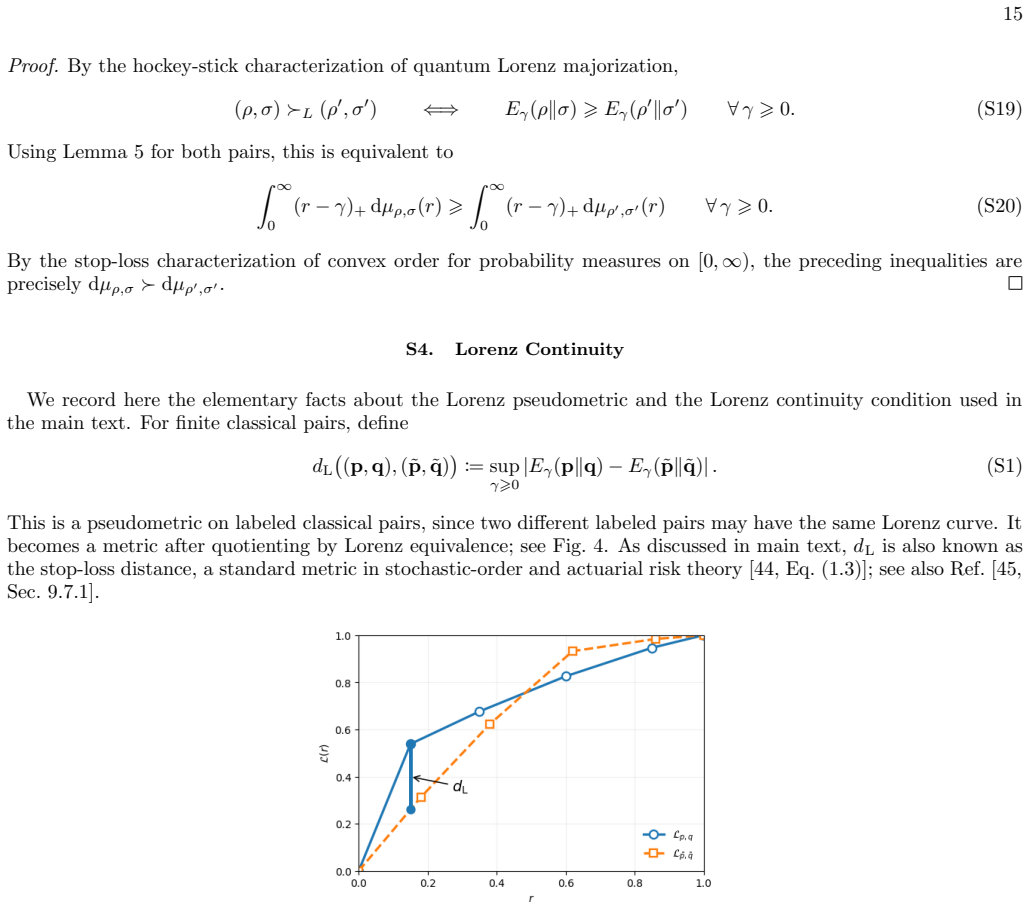
- [SI S3] The supplementary material contains internal numbering remnants: '2 The General Case' appears as a subsection header inside S3, and some figure labels appear to come from an earlier draft. Please clean up the section and figure numbering.
- [Definition 2] The Lorenz continuity condition is stated for the classical restriction on sectors L_C. It would help to state explicitly that D_cl is assumed to take finite values on each L_C, since uniform continuity with respect to d_L is otherwise ambiguous when infinite values are allowed.
Circularity Check
No significant circularity: the uniqueness theorem derives Umegaki relative entropy from the stated axioms without assuming the target form.
full rationale
The central claim of the paper, Theorem 4, is not circular. The argument starts from an arbitrary normalized additive quantum Lorenz divergence whose classical restriction is Lorenz continuous, and derives that it must equal the Umegaki relative entropy. No equation of the form D = Umegaki is assumed as an input: the classical restriction is represented, via the external MPST classification theorem [36], as a mixture of classical Rényi divergences (Eq. 37); the paper's Supplementary Section S8 gives an explicit reduction of that theorem under its own Lorenz-continuity and normalization assumptions, rather than assuming the target result. The extension uniqueness (Theorem 3) is proved geometrically using classical Lorenz bracketing in Supplementary Section S6, and it is used to force the one-shot layer-cake form (38) for the quantum divergence. The additivity constraint is then applied by comparing the one-shot mixture with its tensor-power regularization (Eqs. 40-44); the α=1 contribution is not presupposed to be the whole measure, and the qubit gap-separation lemma (Lemma 12) is proved from explicit computations of the Petz, HT, and sandwiched Rényi divergences on a two-parameter qubit family. Only after that lemma forces the measure to be supported at α=1 does normalization fix the constant to 1, yielding the Umegaki form. The self-citations that appear, such as [20] for the Lorenz preorder and [44] for the envelope construction, are used as external mathematical tools with stated assumptions that do not include the target theorem, so they do not constitute load-bearing circularity. The paper does rely on the MPST theorem and on its own finite-alphabet adaptation, but reliance on an external classification result is not circular unless the adaptation assumes the conclusion; the adaptation does not. The derivation is therefore self-contained relative to its stated axioms and contains no fitted parameter renamed as a prediction.
Assumptions & free parameters
assumptions (6)
- domain assumption D is additive under tensor products: D(ρ1⊗ρ2∥σ1⊗σ2)=D(ρ1∥σ1)+D(ρ2∥σ2).
- domain assumption The classical restriction D_cl is Lorenz continuous on bounded sectors L_C (Definition 2).
- domain assumption Normalization: D_cl([1,0]^T ∥ [1/2,1/2]^T)=1 bit.
- standard math MPST classical representation: a normalized, additive, DPI-monotone, Lorenz-continuous classical divergence is a positive mixture of Rényi divergences over α∈(0,∞).
- standard math Asymptotic regularization split of HT Rényi divergences (Eq. 41): below α=1 they regularize to Petz, at α=1 to Umegaki, above α=1 to sandwiched Rényi.
- domain assumption Finite dimensionality and supp(ρ)⊆supp(σ) throughout.
Cite this review
Pith. "Pith review of Quantum Noncommutativity Uniquely Determines Relative Entropy." pith.science (2026). https://pith.science/paper/P6RQQF5Y
@misc{pith2026260701712,
  author       = {Pith},
  title        = {Pith review of: Quantum Noncommutativity Uniquely Determines Relative Entropy},
  year         = {2026},
  howpublished = {\url{https://pith.science/paper/P6RQQF5Y}},
  note         = {Machine review of arXiv:2607.01712}
}
read the original abstract
Quantum relative entropy is a core concept in physics, governing the limits of communication, thermodynamic irreversibility and quantum resource conversion. However, the requirement that physical processes cannot increase state distinguishability, the data-processing inequality, permits an infinite family of alternative divergence measures. Here we show that quantum relative entropy is uniquely selected by a sharper operational principle. We evaluate distinguishability through binary guessing games, in which an observer discriminates between pairs of quantum states using the optimal measurement. We prove that any additive measure that respects the odds revealed by these optimal measurements must coincide with the Umegaki relative entropy. This rigidity is a purely quantum phenomenon. Whereas classical theory permits a continuous family of valid divergence measures, including R\'enyi divergences, quantum noncommutativity. collapses this mathematical freedom. The result is exact, requiring neither a thermodynamic limit of infinitely many copies nor super-additivity assumptions for correlated states. It establishes quantum relative entropy not merely as an asymptotic quantity, but as the unique additive distinguishability measure compatible with single-shot quantum discrimination.
Figures
Figures from the paper (5 more)



Forward citations
Cited by 1 Pith paper
-
Maximal R\'enyi Relative Entropy for $\alpha>2$
For α>2, every quantum relative entropy extending the classical Rényi relative entropy is upper bounded by D_{α,α-1}, which is therefore the maximal quantum Rényi relative entropy.
Reference graph
Works this paper leans on
-
[36]
X. Mu, L. Pomatto, P. Strack, and O. Tamuz, Econometrica89, 475 (2021), https://onlinelibrary.wiley.com/doi/pdf/10.3982/ECTA17548
-
[1]
M. A. Nielsen and I. L. Chuang,Quantum Computation and Quantum Information(Cambridge University Press, 2000)
2000
-
[2]
M. M. Wilde,Quantum Information Theory, 2nd ed. (Cambridge University Press, 2017)
2017
-
[3]
Watrous,The Theory of Quantum Information(Cam- bridge University Press, 2018)
J. Watrous,The Theory of Quantum Information(Cam- bridge University Press, 2018)
2018
-
[4]
Tomamichel,Quantum Information Processing with Finite Resources: Mathematical Foundations, Springer- Briefs in Mathematical Physics (Springer International Publishing, 2015)
M. Tomamichel,Quantum Information Processing with Finite Resources: Mathematical Foundations, Springer- Briefs in Mathematical Physics (Springer International Publishing, 2015)
2015
-
[5]
S. Khatri and M. M. Wilde, Principles of quantum communication theory: A modern approach (2024), arXiv:2011.04672 [quant-ph]
arXiv 2024
-
[6]
Gour,Quantum Resource Theories(Cambridge Uni- versity Press, 2025)
G. Gour,Quantum Resource Theories(Cambridge Uni- versity Press, 2025)
2025
- [7]
Show all 55 references
-
[8]
Wilming, R
H. Wilming, R. Gallego, and J. Eisert, Entropy19, 241 (2017)
2017
-
[9]
Blackwell, Ann
D. Blackwell, Ann. Math. Statist.24, 265 (1953)
1953
-
[10]
Shmaya,38, 9717 (2005)
E. Shmaya,38, 9717 (2005)
2005
-
[11]
Buscemi, Communications in Mathematical Physics 310, 625 (2012)
F. Buscemi, Communications in Mathematical Physics 310, 625 (2012)
2012
-
[12]
Buscemi, N
F. Buscemi, N. Datta, and S. Strelchuk, Journal of Math- ematical Physics55, 092202 (2014)
2014
-
[13]
Matsumoto, A quantum version of randomization cri- terion (2015), arXiv:1012.2650 [quant-ph]
K. Matsumoto, A quantum version of randomization cri- terion (2015), arXiv:1012.2650 [quant-ph]
2015 arXiv
-
[14]
Jencov´ a, in2016 IEEE International Symposium on Information Theory (ISIT)(IEEE, 2016) pp
A. Jencov´ a, in2016 IEEE International Symposium on Information Theory (ISIT)(IEEE, 2016) pp. 2249–2253
2016
-
[15]
Takagi and B
R. Takagi and B. Regula, Phys. Rev. X9, 031053 (2019)
2019
-
[16]
Skrzypczyk, I
P. Skrzypczyk, I. Supic, and D. Cavalcanti, Phys. Rev. Lett.122, 130403 (2019)
2019
-
[17]
Brandsen, I
S. Brandsen, I. J. Geng, and G. Gour, Phys. Rev. E105, 024117 (2022)
2022
-
[18]
G. Gour, M. M. Wilde, S. Brandsen, and I. J. Geng, Quantum8, 1529 (2024)
2024
-
[19]
G. Gour, D. Kim, T. Nateeboon, G. Shemesh, and G. Yoeli, Phys. Rev. A111, 052424 (2025)
2025
-
[20]
Buscemi and G
F. Buscemi and G. Gour, Phys. Rev. A95, 012110 (2017)
2017
-
[21]
P. E. Frenkel, Quantum7, 1102 (2023)
2023
-
[22]
Wang and R
L. Wang and R. Renner, Phys. Rev. Lett.108, 200501 (2012)
2012
-
[23]
Buscemi and N
F. Buscemi and N. Datta, IEEE Transactions on Infor- mation Theory56, 1447 (2010)
2010
-
[24]
Nagaoka and M
H. Nagaoka and M. Hayashi, IEEE Transactions on In- formation Theory53, 534 (2007)
2007
-
[25]
Datta and R
N. Datta and R. Renner, IEEE Transactions on Informa- tion Theory55, 2807 (2009)
2009
-
[26]
Tomamichel and M
M. Tomamichel and M. Hayashi, IEEE Transactions on Information Theory59, 7693 (2013)
2013
-
[27]
Datta, IEEE Transactions on Information Theory55, 2816 (2009)
N. Datta, IEEE Transactions on Information Theory55, 2816 (2009)
2009
-
[28]
Datta, M
N. Datta, M. Mosonyi, M.-H. Hsieh, and F. G. S. L. Brandao, IEEE Transactions on Information Theory59, 8014 (2013)
2013
-
[29]
Datta and F
N. Datta and F. Leditzky, IEEE Transactions on Infor- mation Theory61, 582 (2015)
2015
-
[30]
Hirche and M
C. Hirche and M. Tomamichel, Communications in Math- ematical Physics405, 208 (2024)
2024
-
[31]
Sason and S
I. Sason and S. Verd´ u, IEEE Transactions on Information Theory62, 5973 (2016)
2016
-
[32]
P.-C. Liu, C. Hirche, and H.-C. Cheng, Layer cake representations for quantum divergences (2025), arXiv:2507.07065 [quant-ph]
2025 arXiv
-
[33]
Cheng, L
H.-C. Cheng, L. Gao, C. Hirche, H.-W. Huang, and P.-C. Liu, Sharp estimates of quantum covering problems via a novel trace inequality (2025), arXiv:2507.07961 [quant- ph]
2025 arXiv
-
[34]
Cheng, G
H.-C. Cheng, G. Gour, L. Lami, and P.-C. Liu, The oper- ator layer cake theorem is equivalent to frenkel’s integral formula (2025), arXiv:2512.04345 [quant-ph]
2025
-
[35]
Berta, H.-C
M. Berta, H.-C. Cheng, and Y. Yao, Tight any-shot quan- tum decoupling (2026), arXiv:2602.17430 [quant-ph]
2026
-
[37]
Arthur F
J. Arthur F. Veinott, Management Science17, 547 (1971)
1971
-
[38]
Oppenheim and M
J. Oppenheim and M. Horodecki, Nature Communica- tions4, 2059 (2013)
2013
-
[39]
Dahl, Linear Algebra and its Applications288, 53 (1999)
G. Dahl, Linear Algebra and its Applications288, 53 (1999)
1999
-
[40]
Alberti and A
P. Alberti and A. Uhlmann, Reports on Mathematical Physics18, 163 (1980)
1980
-
[41]
Dall’Arno, F
M. Dall’Arno, F. Buscemi, and V. Scarani, Quantum4, 233 (2020)
2020
-
[42]
Matsumoto, An example of a quantum statistical model which cannot be mapped to a less informa- tive one by any trace preserving positive map (2014), arXiv:1409.5658 [quant-ph]
K. Matsumoto, An example of a quantum statistical model which cannot be mapped to a less informa- tive one by any trace preserving positive map (2014), arXiv:1409.5658 [quant-ph]
2014 arXiv
-
[43]
Shaked and J
M. Shaked and J. G. Shanthikumar,Stochastic Orders, Springer Series in Statistics (Springer, New York, 2007)
2007
-
[44]
Gour and M
G. Gour and M. Tomamichel, Phys. Rev. A102, 062401 (2020)
2020
-
[45]
A. N. Kumar and P. Vellaisamy, arXiv preprint arXiv:2203.12895 (2022), arXiv:2203.12895 [math.PR]
2022 arXiv
-
[46]
Denuit, J
M. Denuit, J. Dhaene, M. Goovaerts, and R. Kaas,Actu- arial Theory for Dependent Risks: Measures, Orders and Models(John Wiley & Sons, Chichester, 2005)
2005
-
[47]
Cheng and P.-C
H.-C. Cheng and P.-C. Liu, Error exponents for quan- tum packing problems via an operator layer cake theorem (2025), arXiv:2507.06232 [quant-ph]. Supplementary Information Quantum Noncommutativity Uniquely Determines Relative Entropy S1. Operational Interpretation of F renkel’...
2025 arXiv
-
[48]
These are the usual pure-state projectors, or equivalently the sharp yes/no measurements associated with directions on the Bloch sphere
Qubit Example For a qubit,d= 2, the only nontrivial projectors have rank one. These are the usual pure-state projectors, or equivalently the sharp yes/no measurements associated with directions on the Bloch sphere. Thus we can write Pn = 1 2(I+n·τ),|n|= 1,(S5) whereτdenotes th...
-
[49]
more ellipses
The General Case Ford>2, the correct generalization of the qubit picture is not simply “more ellipses.” Instead, one must consider sharp yes/no measurements of all possible ranks. For eachk= 1,...,d−1, the set Wk(ρ,σ) = Tr[Pσ],Tr[Pρ] :P=P 2 =P ∗,TrP=k (S9) 2 The General Case 1...
-
[50]
Furthermore,a α(s)⩾0 and lim s↑1 aα(s) = α2 2(2−α) .(S15)
For 0<α<1, ∆ − α (ρr,σs) is given as in (S5) witha α(s) =L α(s)− α 2 . Furthermore,a α(s)⩾0 and lim s↑1 aα(s) = α2 2(2−α) .(S15)
-
[51]
Forα>1, ∆ + α (ρr,σs) is given as in (S6) withb α(s) =S α(s)−L α(s). Furthermore,b α(s)⩾0 and lim s↓0 bα(s) s2 = α−1 6 .(S16) Proof.We compute the second-order perturbations, in the parameterr, of the Petz, HT, and sandwiched R´ enyi divergences for the qubit family (ρ r,σs). ...
-
[52]
1− s2γp s2γ2 +r 2 # .(S25) Substitution into (S22) gives Qα(ρr∥σs) =γ α − + α 2 Z γ+ γ− γα−1
Sinceσ s is diagonal in the {|0⟩,|1⟩}basis, Qα(ρr∥σs) =Q (0) α (s)(1 +r)α + (1−r) α 2 .(S19) Thus, since (1 +r)α + (1−r) α 2 = 1 +α(α−1) 2 r2 +O(r 4),(S20) we get Dα(ρr∥σs) =Dα(ρ0∥σs) +α 2r2 +O(r 4).(S21) (ii)The HT R´ enyi Divergence.We next compute the HT R´ enyi moment forα...
-
[53]
For allr∈(0,1/ √ 2) 0⩽ ∆+ α (ρr,σs) r2 ⩽2C s.(S50)
-
[54]
To prove the upper bound, letEbe the pinching channel in the eigenbasis ofσ s, which satisfiesE(ρ r) =ρ 0 andE(σ s) =σ s
For alls∈(0,1) we have bα(s)⩽C s and lim s↑1 bα(s) = 0.(S51) Proof.We write the gap as ∆+ α (ρ∥σ) = eDα(ρ∥σ)−D α(ρ∥σ).(S52) The lower bound follows directly from the known inequality eDα ⩾D α. To prove the upper bound, letEbe the pinching channel in the eigenbasis ofσ s, which...
-
[55]
For the second part, recall the definitionb α(s) :=S α(s)−L α(s)
Integrating this uniform bound gives: ∆+ α (ρr,σs)⩽R α(r2) = Z r2 0 R′ α(t)dt⩽2C sr2, which completes the proof of the first part. For the second part, recall the definitionb α(s) :=S α(s)−L α(s). SinceL α(s)⩾0 we obtain thatb α(s)⩽S α(s). Now, by definition Sα(s) = α α−1 u−u ...
Reviewed August 15, 2026 · model on record in the stance chip above.
Discussion (0). Continue with ORCID to comment.