REVIEW 4 major objections 5 minor 31 references
A small persona-aware classifier can route messy notes into overlapping categories accurately enough for interactive use.
Reviewed by Pith at T0; open to challenge. T0 means a machine referee read the full paper against a public rubric. the ladder, T0–T4 →
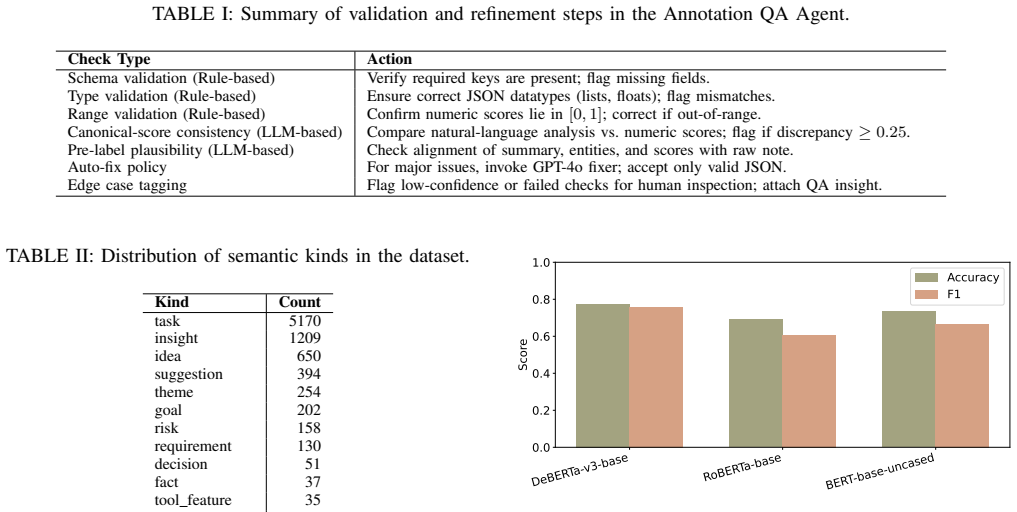
NoteBar introduces a persona-conditioned synthetic note dataset and shows DeBERTa-v3 reaches 0.78 accuracy and 0.76 F1 on multi-label note classification, while claiming user-facing benefits it does not actually measure.
T0 review reviewed 2026-08-05 challenge →
load-bearing objection The dataset is the only thing worth keeping; the system's central mechanism and the claimed user study are both absent from the evaluation. the 4 major comments →
NoteBar: An AI-Assisted Note-Taking System for Personal Knowledge Management
The pith
A machine-rendered reading of the paper's core claim, the machinery that carries it, and where it could break.
The reading
Core claim
The core discovery is that combining persona conditioning with an encoder-only transformer makes multi-label note routing both accurate enough and cheap enough for practical deployment. Persona conditioning is the mechanism that separates overlapping labels: it normalizes noisy or idiosyncratic phrasing into simpler representations that highlight concept boundaries, so a note that would otherwise look like both a task and an insight can be routed to the right set of categories. The experiments show DeBERTa-v3-base reaching 0.78 accuracy and 0.76 F1 on the long-tailed synthetic dataset, with performance highly sensitive to hyperparameters (batch size 8, learning rate 2e-5, about 10 epochs). T
What carries the argument
The system rests on persona-conditioned multi-label classification with an encoder-only transformer backbone, DeBERTa-v3-base. Persona tags serve as disambiguating context meant to normalize idiosyncratic phrasing and separate overlapping concepts; the backbone's disentangled attention is the mechanism claimed to discriminate long-tailed semantic kinds without expensive inference.
Load-bearing premise
The evaluation rests on the assumption that notes and labels generated by GPT-4o behave enough like real users' notes and human annotations that the 0.76 F1 transfers to practice, which the paper itself flags as a risk.
What would settle it
Run the identical DeBERTa-v3 model on a corpus of real user notes with human annotations; if F1 falls well below 0.76 or the long-tail labels become unpredictable, the synthetic dataset is not a valid proxy. In parallel, an ablation that removes persona identifiers would reveal whether persona conditioning or the encoder alone explains label separability.
If this is right
- Automatic note routing can run on CPU or on-device, avoiding the latency and privacy cost of sending every note to a large language model.
- Adding stable persona descriptors—MBTI or otherwise—can disambiguate short, informal texts that share surface wording but differ in intent.
- The released 3,173-note / 8,494-concept benchmark gives the PKM community a reproducible, long-tailed multi-label classification task.
- Multi-label routing feeds directly into actionable artifacts: calendar entries, kanban tasks, and retrieval-augmented suggestions can be generated from the same classification.
- A user-in-the-loop feedback loop, once implemented, could let acceptance or edits refine threshold calibration and retrieval quality over time.
Where Pith is reading between the lines
- Because notes and labels come from the same generator, the reported 0.76 F1 is likely an optimistic ceiling; a real-world evaluation on human notes is needed before the efficiency claim transfers.
- The persona-conditioning claim is not directly tested here: no ablation removes persona tags while keeping the model fixed, so the source of the label-separation gain remains open.
- If the mechanism generalizes, it should work for any stable user metadata (occupation, project, language register), not just MBTI; swapping persona definitions on the same notes would be a cheap test.
Editorial analysis
A structured set of objections, weighed in public.
Referee Report
Summary. The paper presents NoteBar, an AI-assisted note-taking system that routes free-form notes into multiple semantic kinds using an encoder-only transformer classifier (DeBERTa-v3-base), supported by a vector database and RAG-based suggestions. The authors introduce a persona-conditioned synthetic dataset of 3,173 notes with 8,494 concept annotations across 16 MBTI personas, generated via a four-stage GPT-4o pipeline. Experiments compare three encoder backbones on multi-label classification and report DeBERTa-v3-base as best (Accuracy 0.78, F1 0.76). The abstract and contributions additionally claim a deployment-ready architecture and a preliminary user study showing efficiency and engagement gains.
Significance. If the central claims were supported, the paper would offer a useful and reproducible resource: a synthetic multi-label note-classification dataset, a concrete encoder-based routing pipeline, and a practical deployment story for CPU-friendly PKM tools. Positive aspects include the public dataset and code links, the detailed data-generation and QA pipeline, and the explicit discussion of synthetic-data limitations. However, the experimental evidence is substantially narrower than the claims: the persona-conditioning mechanism is never tested, the promised user study is absent, and the evaluation relies entirely on LLM-generated labels. The contribution is therefore currently more a dataset-plus-baselines report than a validated system.
major comments (4)
- [Section III.A and Section IV.D] Persona conditioning is presented as the core mechanism—'persona conditioning enables the system to normalize noisy or idiosyncratic phrasing into simpler, cleaner representations that highlight concept boundaries'—but no experiment varies or even includes persona information. Section IV.D compares only encoder backbones (BERT, RoBERTa, DeBERTa-v3) and never ablates persona conditioning; the model input specification does not mention persona IDs or embeddings. The reported 0.78 Accuracy / 0.76 F1 could therefore be entirely due to encoder choice. This internal-validity gap undermines a central claim and must be addressed, either by adding a with/without-persona ablation or by explicitly reframing the paper's claims.
- [Section I, contribution 3; Section III.B] The third contribution states that the paper provides 'a preliminary user study, showing that NoteBar improves efficiency and engagement in personal knowledge management workflows,' and the abstract implies efficiency and engagement benefits. No user study appears anywhere in the manuscript; the only human-related element is 'flagged for human inspection' in the QA pipeline, with no human data reported. Sections III.A and III.B explicitly state that the feedback loop 'does not yet realize this functionality' and is 'currently under design.' The claimed user-study evidence is therefore unsupported and should be removed or the study must actually be reported.
- [Section IV.A.1 and Section V.A] The evaluation's ground truth is fully synthetic: notes are generated by GPT-4o and labels are produced by a GPT-4o-based Concept Router, with validation also performed by GPT-4o. The reported F1 thus measures agreement with an LLM's annotation scheme on text generated by the same LLM family, not agreement with human annotation. The authors acknowledge in V.A that 'synthetic persona-driven notes ... may diverge from real-world user behavior,' but this limitation is load-bearing for the dataset contribution and for any practical deployment claim. A human-annotation sample (even a few hundred notes) or a real-user evaluation is needed to establish that the 0.76 F1 transfers to actual note-taking.
- [Section IV.C-D and Section VI] The conclusion claims that DeBERTa-v3 'offer[s] significant efficiency gains over GPT-based heuristics,' but no GPT-based or LLM-prompting baseline is included in the experiments. The related-work section mentions such methods and the abstract highlights cost-effectiveness, yet the comparison is missing. Without a baseline that measures accuracy, latency, or cost against an LLM-prompting approach, the efficiency and cost-effectiveness claims are unsupported. Adding such a baseline, or removing the comparative claim, is necessary.
minor comments (5)
- [Section IV.C.3] The metric 'Accuracy' is not defined for the multi-label setting. Please specify whether it is exact-match (subset) accuracy, example-based accuracy, or something else, since the conclusions depend on this choice.
- [Section IV.B / Table II] The text says the dataset contains 8,494 concept annotations but then states 8,349 passed QA. Table II sums to 8,349. This should be clarified: are the reported experiments on the full set or the QA-passed subset?
- [Figure 3] Typo in figure text: 'whean' should be 'when'.
- [Figure 6] The x-axis label 'DeBERT a-v3-base' has an erroneous space; also the caption could state that reported values are the best over hyperparameter search.
- [General] The paper alternates between describing the feedback loop as implemented and as future work (e.g., Section III.B says 'eventually' and 'under development,' while Section I lists it as part of the unified system). Please harmonize these descriptions to avoid overclaiming.
Circularity Check
No circularity: reported results are not forced by construction and no load-bearing self-citation is present.
full rationale
The paper's claims do not reduce to their inputs by construction. No parameter is fitted to a subset and then renamed a prediction; no self-citation is load-bearing (the cited persona papers [28], [29], and model papers [23], [26], [27] are external, not author self-citations). The central mechanism, persona conditioning, is asserted in Section III.A but never directly ablated in the experiments, so the reported 0.78 accuracy / 0.76 F1 cannot be attributed to it—this is a serious internal-validity gap, but the absence of a test is not circularity. Likewise, the synthetic dataset's labels are generated and QA'd by GPT-4o, making the F1 a generator-agreement metric rather than a measure against independent human ground truth; the paper partially acknowledges this limitation in Section V.A. That is an external-validity concern, not a by-construction equivalence: the DeBERTa classifier did not use GPT-4o and could have scored anywhere. The claimed preliminary user study never appears, and the feedback loop is explicitly unimplemented, but these are omitted supports rather than circular steps. Therefore, under the hard rules, the appropriate circularity score is 0.
Axiom & Free-Parameter Ledger
free parameters (2)
- Multi-label decision threshold =
not reported
- Training hyperparameters (learning rate 2e-5, batch size 8, epochs ~10) =
2e-5, 8, 10
axioms (3)
- domain assumption Synthetic notes generated by GPT-4o are representative of real user notes.
- domain assumption GPT-4o-produced concept annotations are reliable ground truth for multi-label classification.
- domain assumption MBTI personality types capture meaningful, stable differences in note-writing style.
Cite this review
Pith. "Pith review of NoteBar: An AI-Assisted Note-Taking System for Personal Knowledge Management." pith.science (2026). https://pith.science/paper/P73GMND2
@misc{pith2026250903610,
  author       = {Pith},
  title        = {Pith review of: NoteBar: An AI-Assisted Note-Taking System for Personal Knowledge Management},
  year         = {2026},
  howpublished = {\url{https://pith.science/paper/P73GMND2}},
  note         = {Machine review of arXiv:2509.03610}
}
read the original abstract
Note-taking is a critical practice for capturing, organizing, and reflecting on information in both academic and professional settings. The recent success of large language models has accelerated the development of AI-assisted tools, yet existing solutions often struggle with efficiency. We present NoteBar, an AI-assisted note-taking tool that leverages persona information and efficient language models to automatically organize notes into multiple categories and better support user workflows. To support research and evaluation in this space, we further introduce a novel persona-conditioned dataset of 3,173 notes and 8,494 annotated concepts across 16 MBTI personas, offering both diversity and semantic richness for downstream tasks. Finally, we demonstrate that NoteBar can be deployed in a practical and cost-effective manner, enabling interactive use without reliance on heavy infrastructure. Together, NoteBar and its accompanying dataset provide a scalable and extensible foundation for advancing AI-assisted personal knowledge management.
Figures



Reference graph
Works this paper leans on
-
[1]
Cognitive effort during note taking,
A. Piolat, T. Olive, and R. T. Kellogg, “Cognitive effort during note taking,” Applied cognitive psychology, vol. 19, no. 3, pp. 291–312, 2005
work page 2005
-
[2]
Challenges of digital note taking,
M. A. Mosleh, M. S. Baba, S. Malek, and M. A. Alhussein, “Challenges of digital note taking,” in Advanced Computer and Communication Engineering Technology: Proceedings of ICOCOE 2015 . Springer, 2015, pp. 211–231
work page 2015
-
[3]
An integrative review of the cognitive costs and benefits of note-taking,
R. S. Jansen, D. Lakens, and W. A. IJsselsteijn, “An integrative review of the cognitive costs and benefits of note-taking,” Educational Research Review, vol. 22, pp. 223–233, 2017
work page 2017
-
[4]
A tool for taking class notes,
N. Ward and H. Tatsukawa, “A tool for taking class notes,” International Journal of Human-Computer Studies, vol. 59, no. 6, pp. 959–981, 2003
work page 2003
-
[5]
R. J. Srinivasa, S. Dodson, K. Seo, D. Yoon, and S. Fels, “Notelink: A point-and-shoot linking interface between students’ handwritten note- books and instructional videos,” in 2021 ACM/IEEE Joint Conference on Digital Libraries (JCDL) . IEEE, 2021, pp. 140–149
work page 2021
-
[6]
Notecostruct: Powering online learners with socially scaffolded note taking and sharing,
J. Fang, Y . Wang, C.-L. Yang, and H.-C. Wang, “Notecostruct: Powering online learners with socially scaffolded note taking and sharing,” in Extended Abstracts of the 2021 CHI Conference on Human Factors in Computing Systems, 2021, pp. 1–5
work page 2021
-
[7]
Conotate: Suggesting queries based on notes promotes knowledge discovery,
S. Palani, Z. Ding, A. Nguyen, A. Chuang, S. MacNeil, and S. P. Dow, “Conotate: Suggesting queries based on notes promotes knowledge discovery,” in Proceedings of the 2021 CHI Conference on Human Factors in Computing Systems , 2021, pp. 1–14
work page 2021
-
[8]
Stupad: Integrating student notes with class lectures,
K. N. Truong and G. D. Abowd, “Stupad: Integrating student notes with class lectures,” in CHI’99 extended abstracts on Human factors in computing systems, 1999, pp. 208–209
work page 1999
-
[9]
Use of classroom presenter in engineering courses,
R. Anderson, R. Anderson, L. McDowell, and B. Simon, “Use of classroom presenter in engineering courses,” in Proceedings Frontiers in Education 35th Annual Conference . IEEE, 2005, pp. T2G–13
work page 2005
-
[10]
Segmenting meetings into agenda items by extracting implicit supervision from human note-taking,
S. Banerjee and A. I. Rudnicky, “Segmenting meetings into agenda items by extracting implicit supervision from human note-taking,” in Proceedings of the 12th international conference on Intelligent user interfaces, 2007, pp. 151–159
work page 2007
-
[11]
Tsaap-notes–an open micro- blogging tool for collaborative notetaking during face-to-face lectures,
F. Silvestre, P. Vidal, and J. Broisin, “Tsaap-notes–an open micro- blogging tool for collaborative notetaking during face-to-face lectures,” in 2014 IEEE 14th International Conference on Advanced Learning Technologies. IEEE, 2014, pp. 39–43
work page 2014
-
[12]
Meetingvis: Visual narratives to assist in recalling meeting context and content,
Y . Shi, C. Bryan, S. Bhamidipati, Y . Zhao, Y . Zhang, and K.-L. Ma, “Meetingvis: Visual narratives to assist in recalling meeting context and content,” IEEE Transactions on Visualization and Computer Graphics , vol. 24, no. 6, pp. 1918–1929, 2018
work page 1918
-
[13]
Notee- line: Supporting real-time, personalized notetaking with llm-enhanced micronotes,
F. Huq, A. Samee, D. C.-E. Lin, A. X. Tang, and J. P. Bigham, “Notee- line: Supporting real-time, personalized notetaking with llm-enhanced micronotes,” in Proceedings of the 30th International Conference on Intelligent User Interfaces , 2025, pp. 1064–1081
work page 2025
-
[14]
H.-R. Tsai, S.-K. Chiu, and B. Wang, “Gazenoter: Co-piloted ar note- taking via gaze selection of llm suggestions to match users’ intentions,” in Proceedings of the 2025 CHI Conference on Human Factors in Computing Systems, 2025, pp. 1–22
work page 2025
-
[15]
Handwriting recognition: Tablet pc text input,
J. A. Pittman, “Handwriting recognition: Tablet pc text input,” Computer, vol. 40, no. 9, pp. 49–54, 2007
work page 2007
-
[16]
D. Berque, “An evaluation of a broad deployment of dyknow software to support note taking and interaction using pen-based computers,” Journal of Computing Sciences in Colleges , vol. 21, no. 6, pp. 204–216, 2006
work page 2006
-
[17]
Notelook: Taking notes in meetings with digital video and ink,
P. Chiu, A. Kapuskar, S. Reitmeier, and L. Wilcox, “Notelook: Taking notes in meetings with digital video and ink,” in Proceedings of the seventh ACM international conference on Multimedia (Part 1) , 1999, pp. 149–158
work page 1999
-
[18]
Inkseine: In situ search for active note taking,
K. Hinckley, S. Zhao, R. Sarin, P. Baudisch, E. Cutrell, M. Shilman, and D. Tan, “Inkseine: In situ search for active note taking,” in Proceedings of the SIGCHI conference on human factors in computing systems, 2007, pp. 251–260
work page 2007
-
[19]
Videosticker: A tool for active viewing and visual note-taking from videos,
Y . Cao, H. Subramonyam, and E. Adar, “Videosticker: A tool for active viewing and visual note-taking from videos,” in Proceedings of the 27th International Conference on Intelligent User Interfaces , 2022, pp. 672– 690
work page 2022
-
[20]
L. Grippa. (2024) Obsidian ai tagger: simplify tagging in obsidian. GitHub. [Online]. Available: https://github.com/lucagrippa/ obsidian-ai-tagger
work page 2024
-
[21]
Distilbert, a distilled version of bert: smaller, faster, cheaper and lighter,
V . Sanh, L. Debut, J. Chaumond, and T. Wolf, “Distilbert, a distilled version of bert: smaller, faster, cheaper and lighter,” arXiv preprint arXiv:1910.01108, 2019
Pith/arXiv arXiv 1910
-
[22]
Tinybert: Distilling bert for natural language understanding,
X. Jiao, Y . Yin, L. Shang, X. Jiang, X. Chen, L. Li, F. Wang, and Q. Liu, “Tinybert: Distilling bert for natural language understanding,” arXiv preprint arXiv:1909.10351 , 2019
Pith/arXiv arXiv 1909
-
[23]
P. He, J. Gao, and W. Chen, “Debertav3: Improving deberta using electra-style pre-training with gradient-disentangled embedding shar- ing,” arXiv preprint arXiv:2111.09543 , 2021
Pith/arXiv arXiv 2021
-
[24]
A review on multi-label learning algo- rithms,
M.-L. Zhang and Z.-H. Zhou, “A review on multi-label learning algo- rithms,” IEEE transactions on knowledge and data engineering , vol. 26, no. 8, pp. 1819–1837, 2013
work page 2013
-
[25]
Classifier chains for multi-label classification,
J. Read, B. Pfahringer, G. Holmes, and E. Frank, “Classifier chains for multi-label classification,” Machine learning , vol. 85, no. 3, pp. 333– 359, 2011
work page 2011
-
[26]
Bert: Pre-training of deep bidirectional transformers for language understanding,
J. Devlin, M.-W. Chang, K. Lee, and K. Toutanova, “Bert: Pre-training of deep bidirectional transformers for language understanding,” in Pro- ceedings of the 2019 conference of the North American chapter of the association for computational linguistics: human language technologies, volume 1 (long and short papers) , 2019, pp. 4171–4186
2019
-
[27]
Deberta: Decoding-enhanced bert with disentangled attention,
P. He, X. Liu, J. Gao, and W. Chen, “Deberta: Decoding-enhanced bert with disentangled attention,” arXiv preprint arXiv:2006.03654 , 2020
Pith/arXiv arXiv 2006
-
[28]
Scaling synthetic data creation with 1,000,000,000 personas,
T. Ge, X. Chan, X. Wang, D. Yu, H. Mi, and D. Yu, “Scaling synthetic data creation with 1,000,000,000 personas,” arXiv preprint arXiv:2406.20094, 2024
Pith/arXiv arXiv 2024
-
[29]
Faithful persona-based conversational dataset generation with large language models,
P. Jandaghi, X. Sheng, X. Bai, J. Pujara, and H. Sidahmed, “Faithful persona-based conversational dataset generation with large language models,” arXiv preprint arXiv:2312.10007 , 2023
Pith/arXiv arXiv 2023
-
[30]
Roberta: A robustly optimized bert pretraining approach,
Y . Liu, M. Ott, N. Goyal, J. Du, M. Joshi, D. Chen, O. Levy, M. Lewis, L. Zettlemoyer, and V . Stoyanov, “Roberta: A robustly optimized bert pretraining approach,” arXiv preprint arXiv:1907.11692 , 2019
Pith/arXiv arXiv 1907
-
[31]
Unsu- pervised cross-lingual representation learning at scale,
A. Conneau, K. Khandelwal, N. Goyal, V . Chaudhary, G. Wenzek, F. Guzm´an, E. Grave, M. Ott, L. Zettlemoyer, and V . Stoyanov, “Unsu- pervised cross-lingual representation learning at scale,” arXiv preprint arXiv:1911.02116, 2019
Pith/arXiv arXiv 1911
This paper was first reviewed by deepseek-v4-flash on August 5, 2026.
discussion (0)
Sign in with ORCID, Apple, or X to comment. Anyone can read and Pith papers without signing in.