REVIEW 4 major objections 6 minor 2 references
Prime Fourier Embeddings: A Principled Basis for Modular Arithmetic
T0 review · 4 major / 6 minor · reviewed 2026-07-15 · grok-4.5
Pith's one-line read Prime Fourier Embeddings encode integers so modular arithmetic reduces to selecting the relevant prime channels rather than rediscovering algebraic structure.
desk verdict Clean prime-channel embedding with a correct Schur block-diagonal theorem and strong CRT ablations; the open gap is only that the theorem constrains linear equivariant maps while the network is nonlinear. read the letter →
The pith
A machine-rendered reading of the paper's core claim, the machinery that carries it, and where it could break.
The reading
What carries the argument
The Block-Diagonal Decomposition Theorem (Theorem 3.1): each PFE block realises a distinct character of Z, so Schur’s lemma forces every equivariant linear map to have zero cross-prime (and cross-depth) coupling.
What would settle it
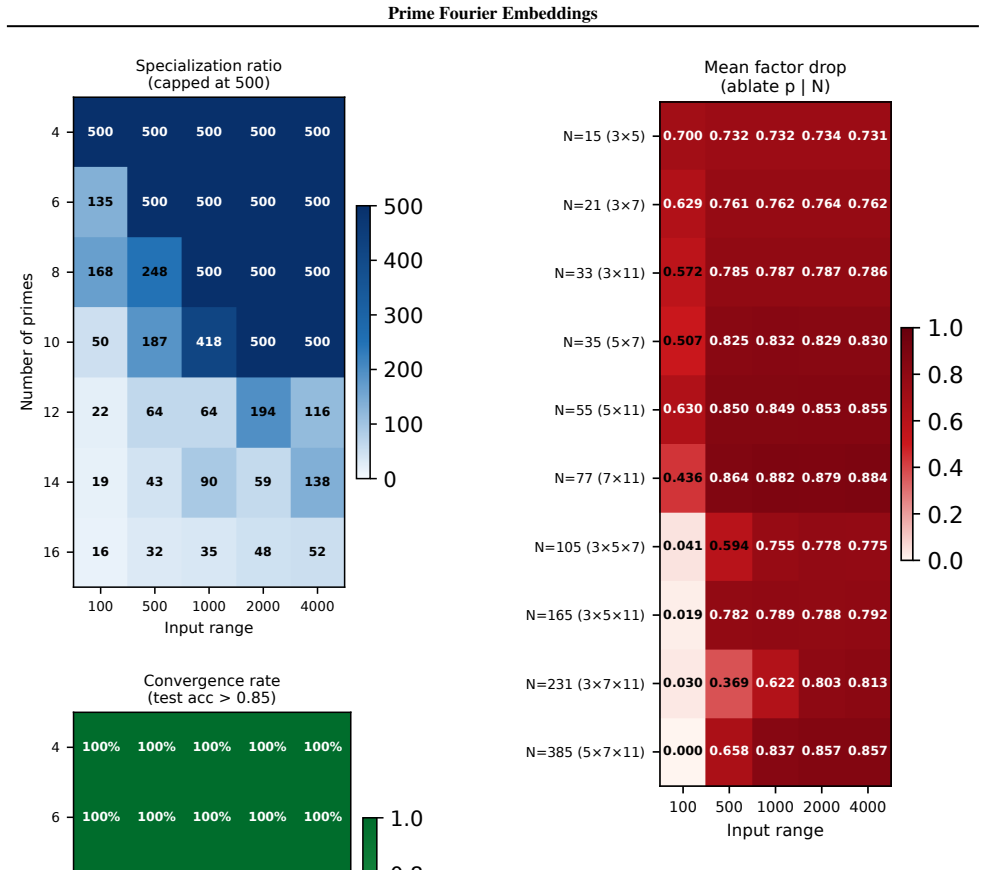
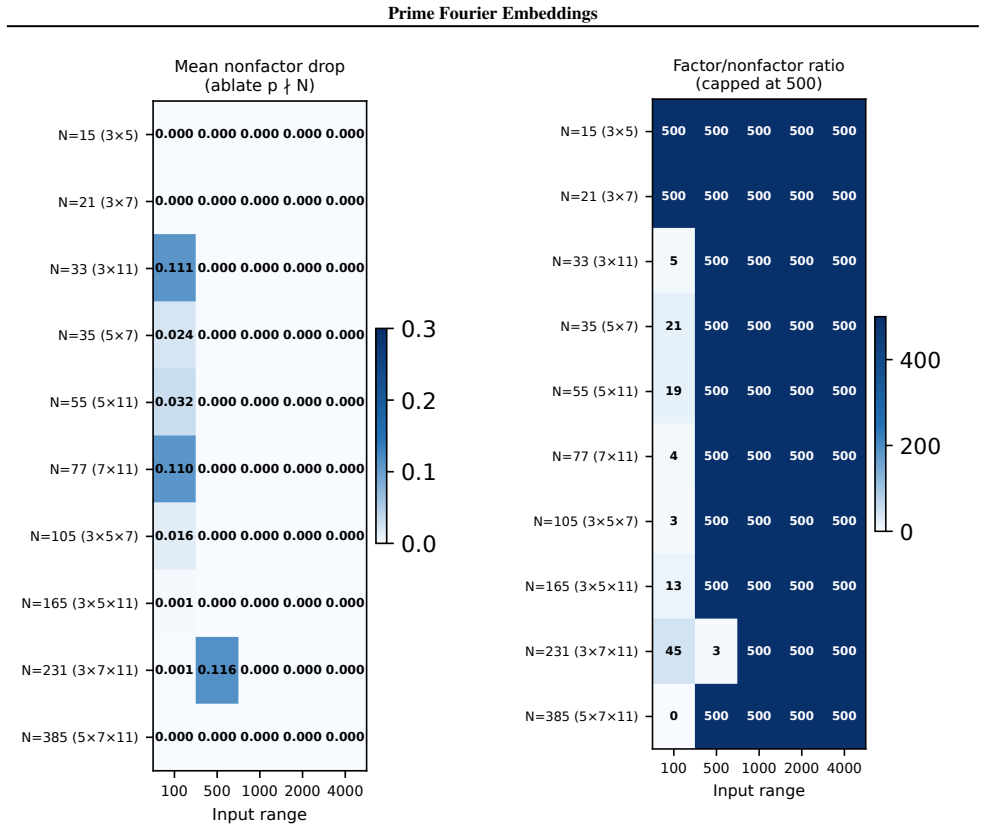
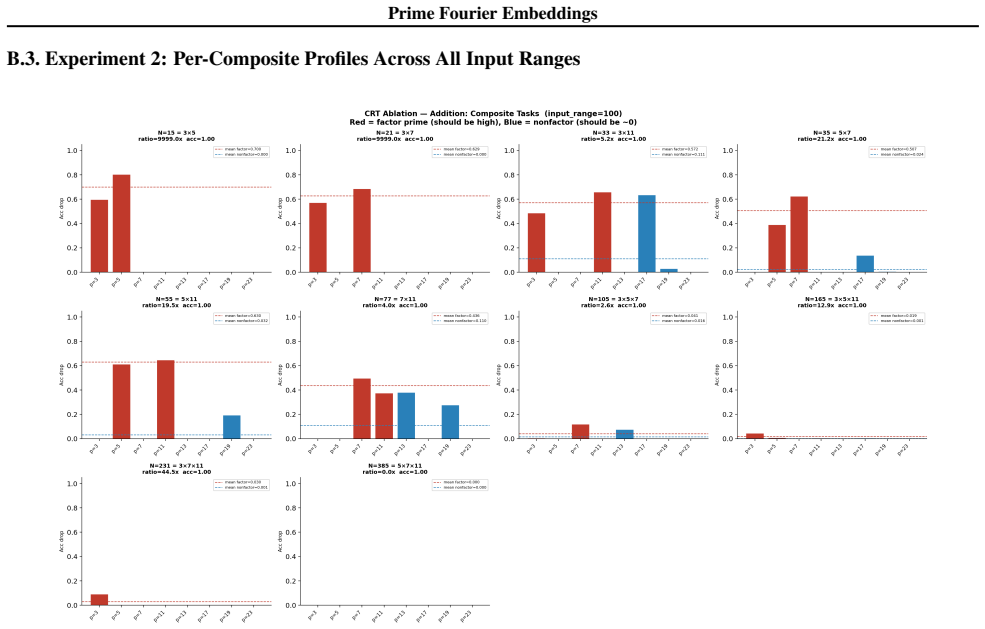
Train the same architecture on a square-free modulus at large input range and observe that ablating a non-factor prime drops accuracy comparably to ablating a true factor prime, or that the factor/nonfactor specialisation ratio stays near 1 instead of climbing past hundreds.
Extended reading notes
Core claim
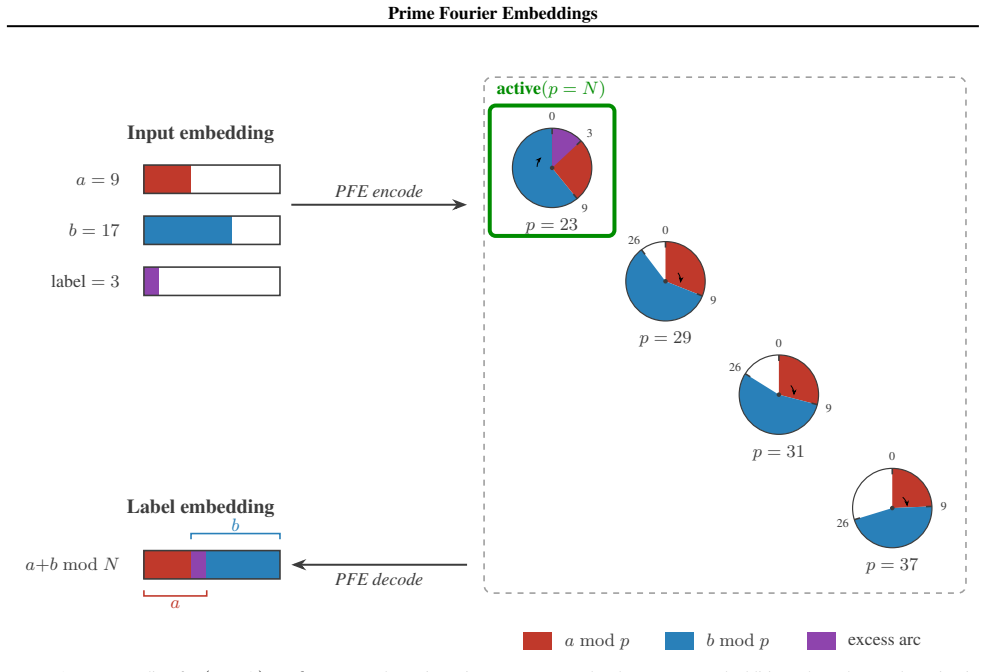
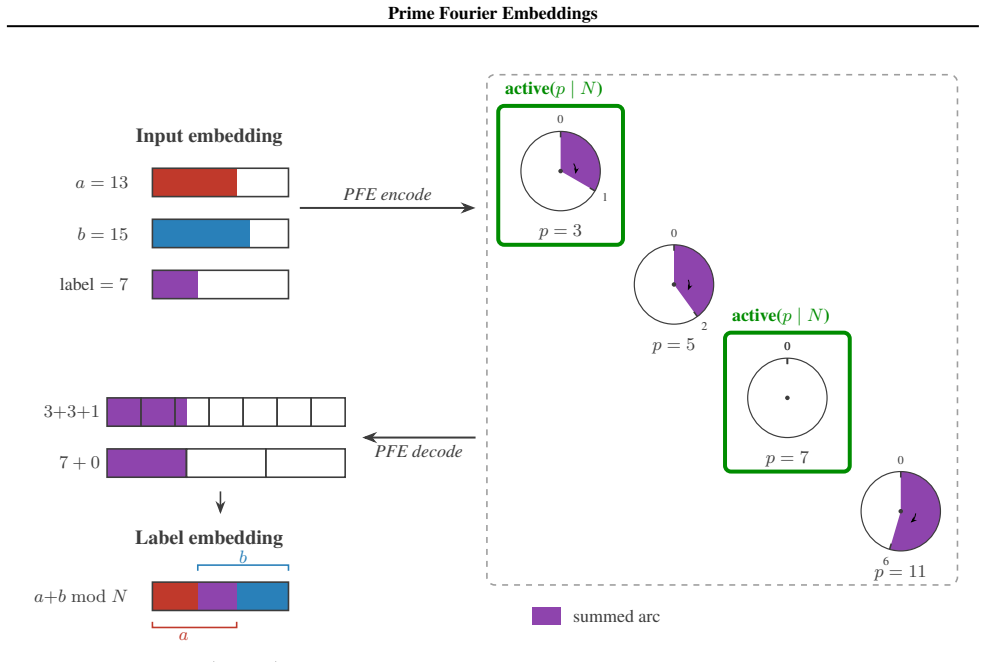
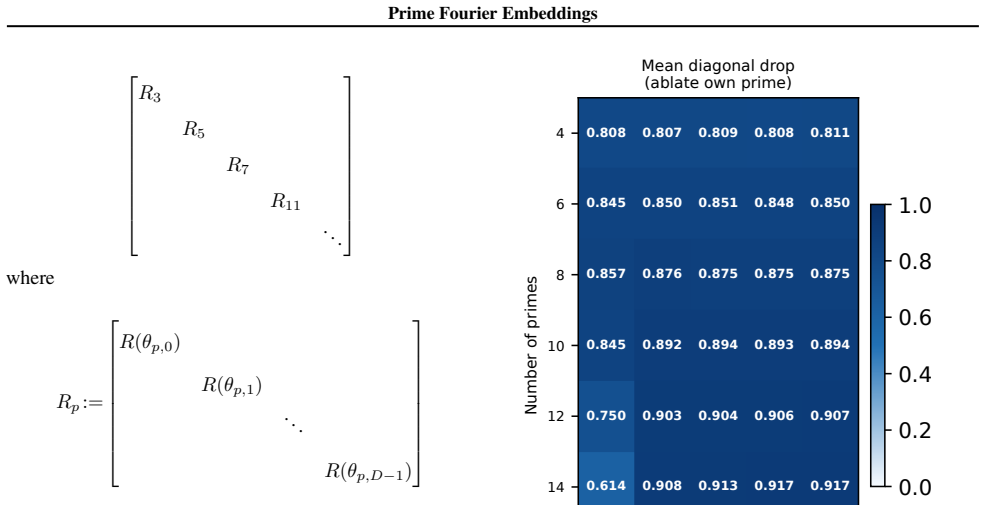
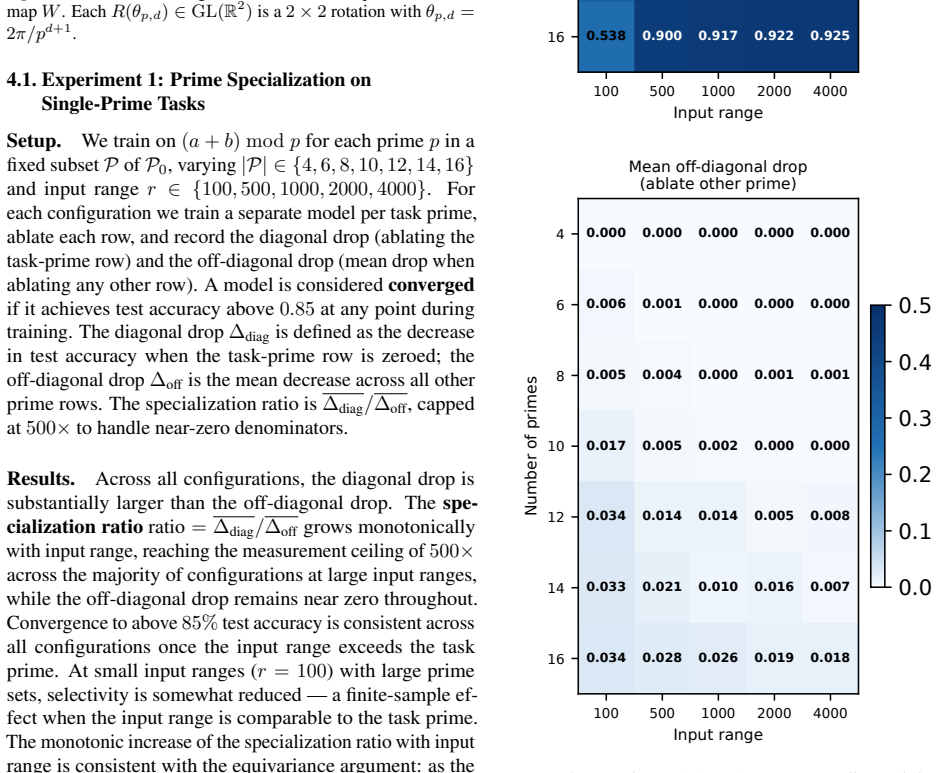
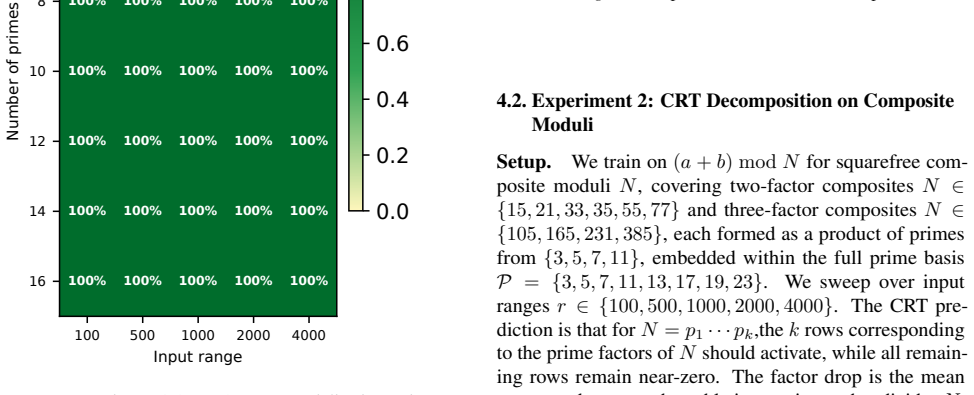
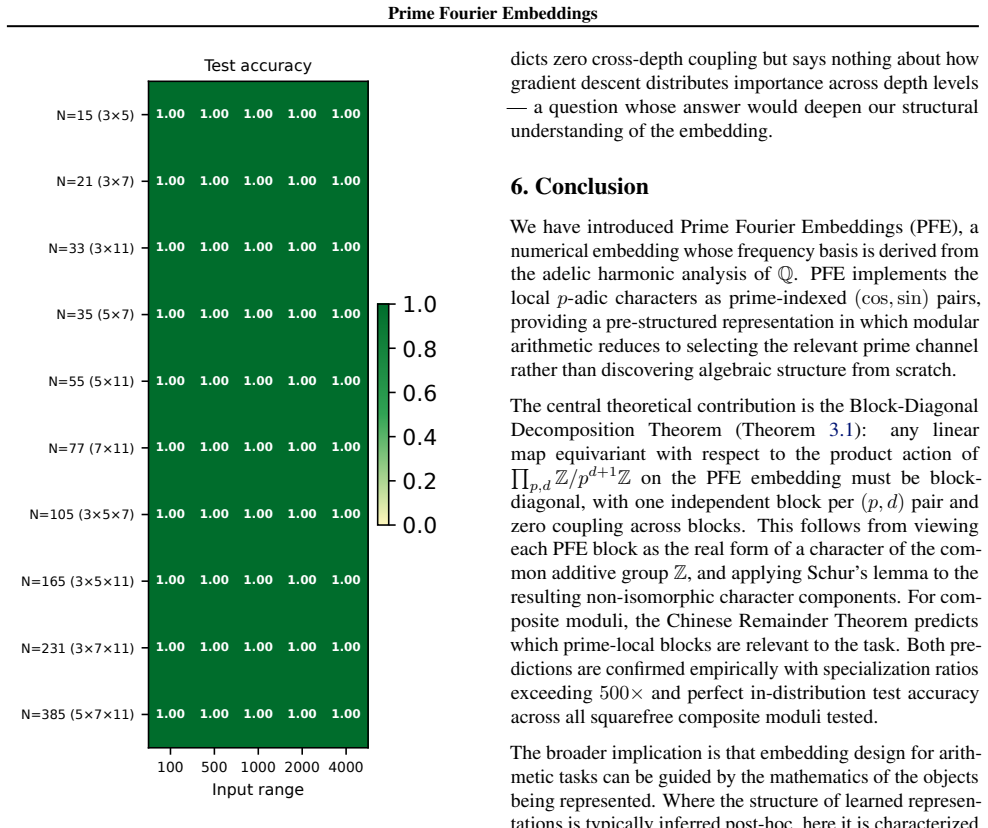
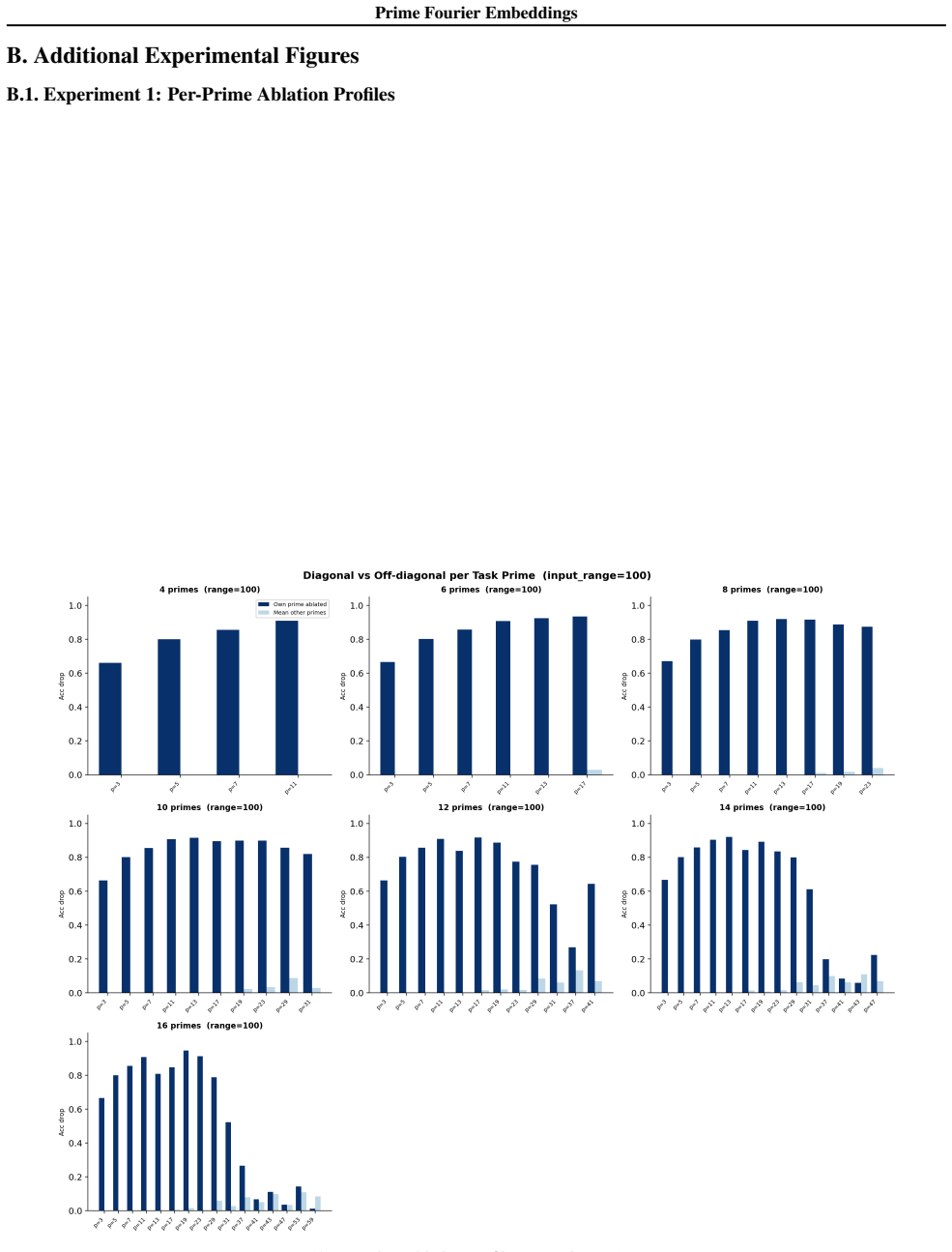
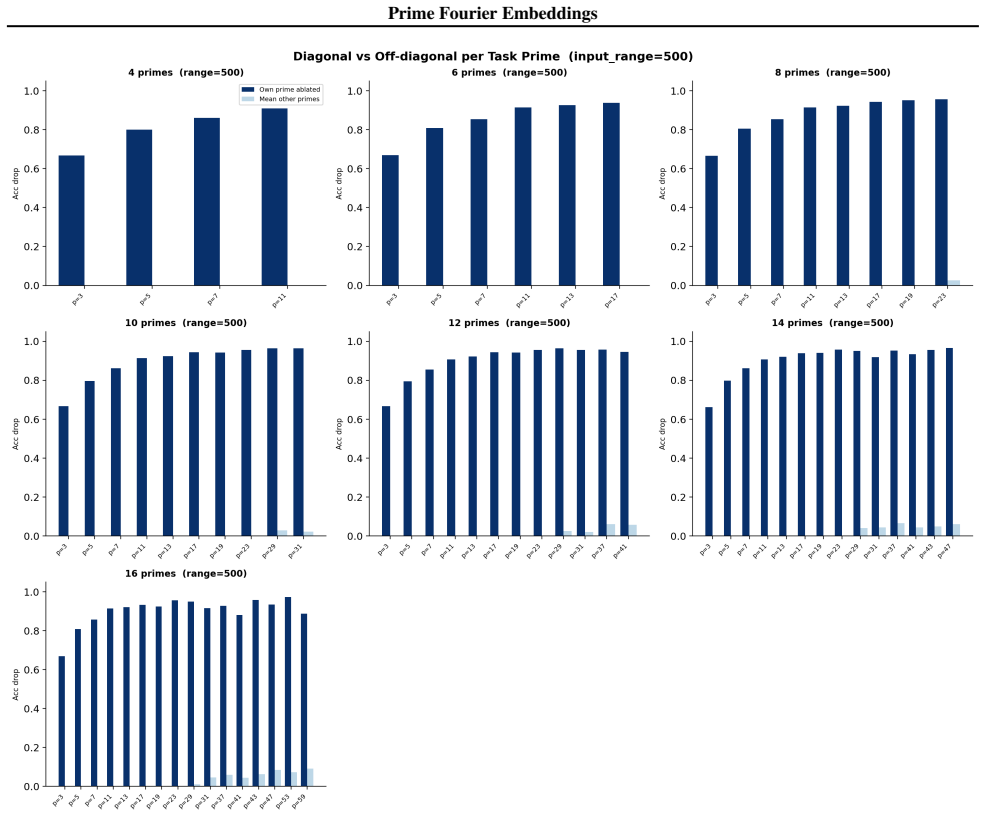
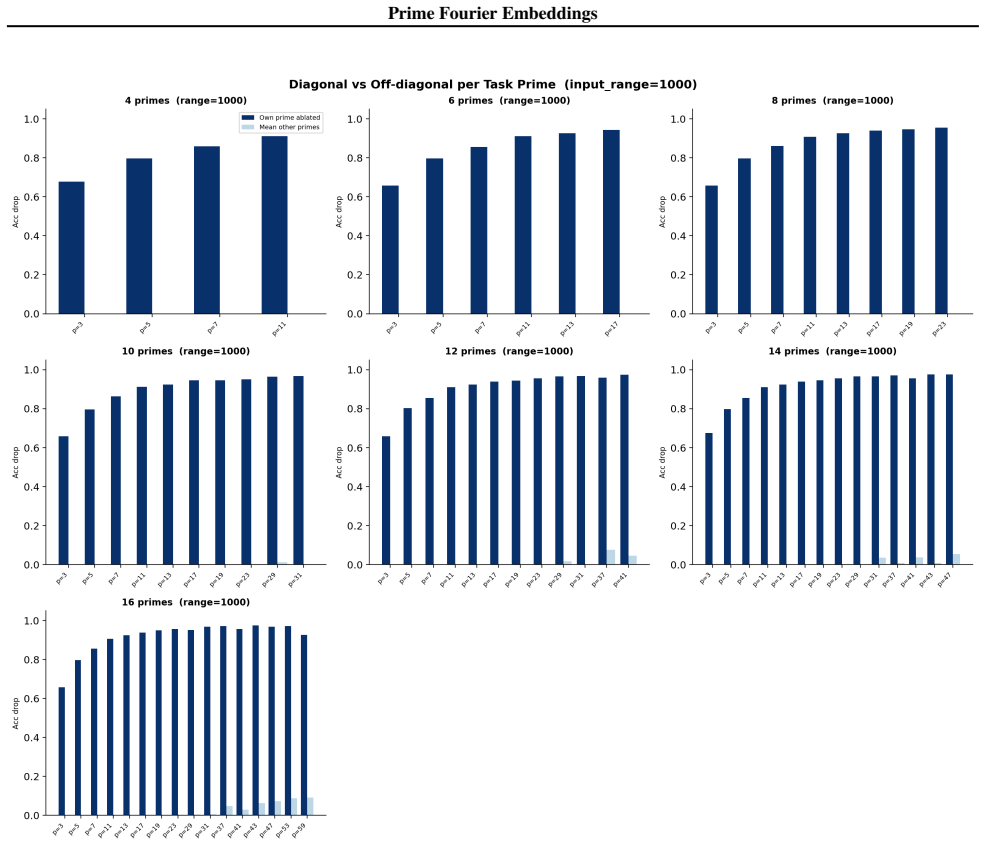
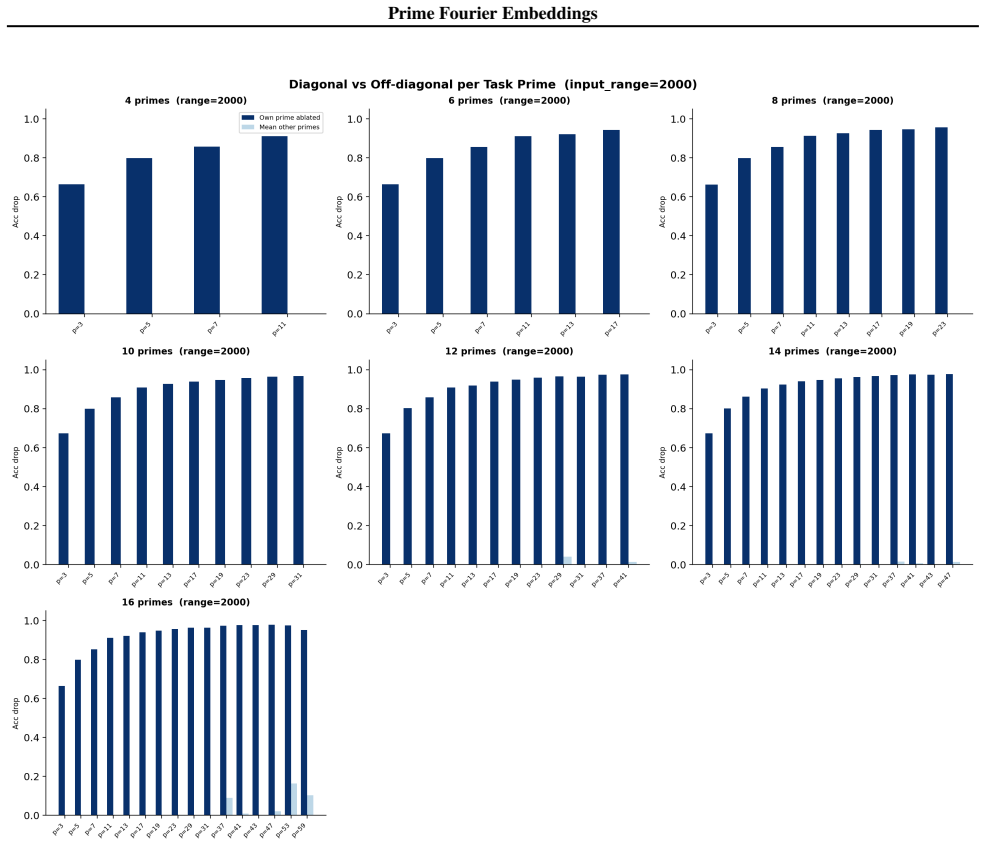
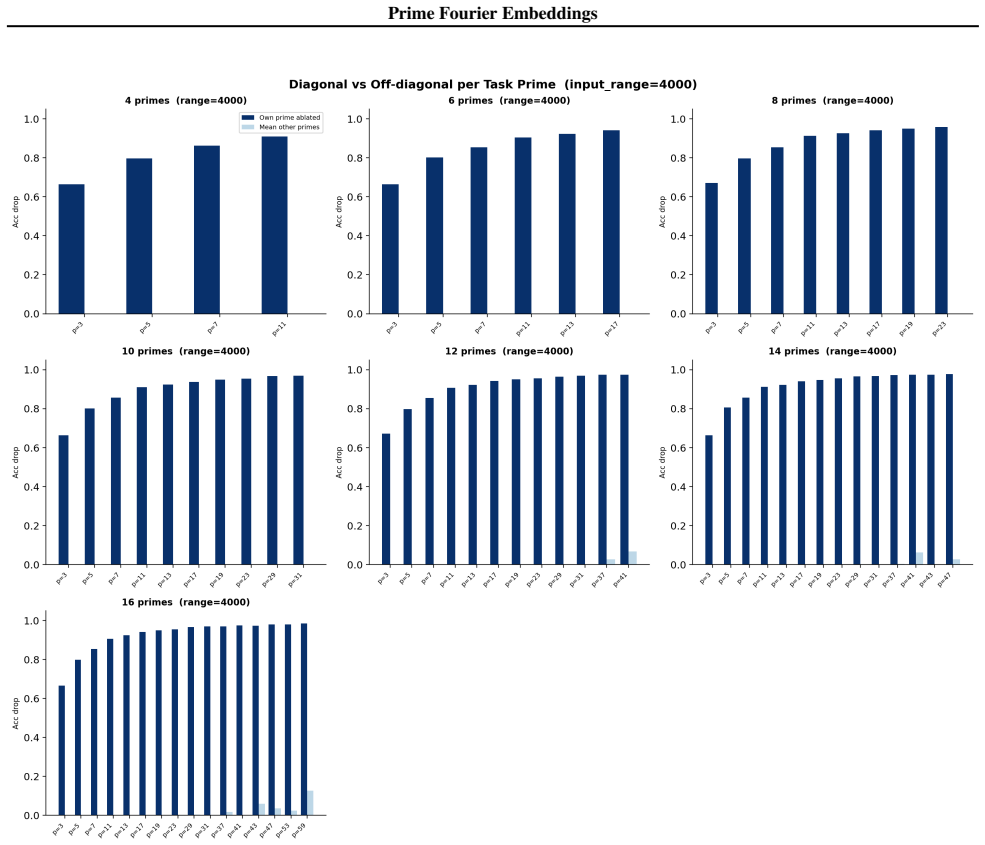
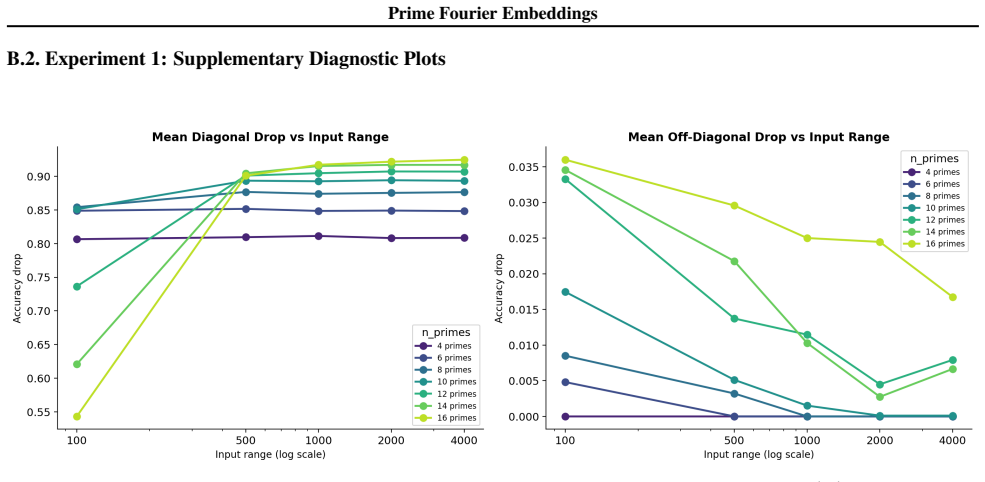
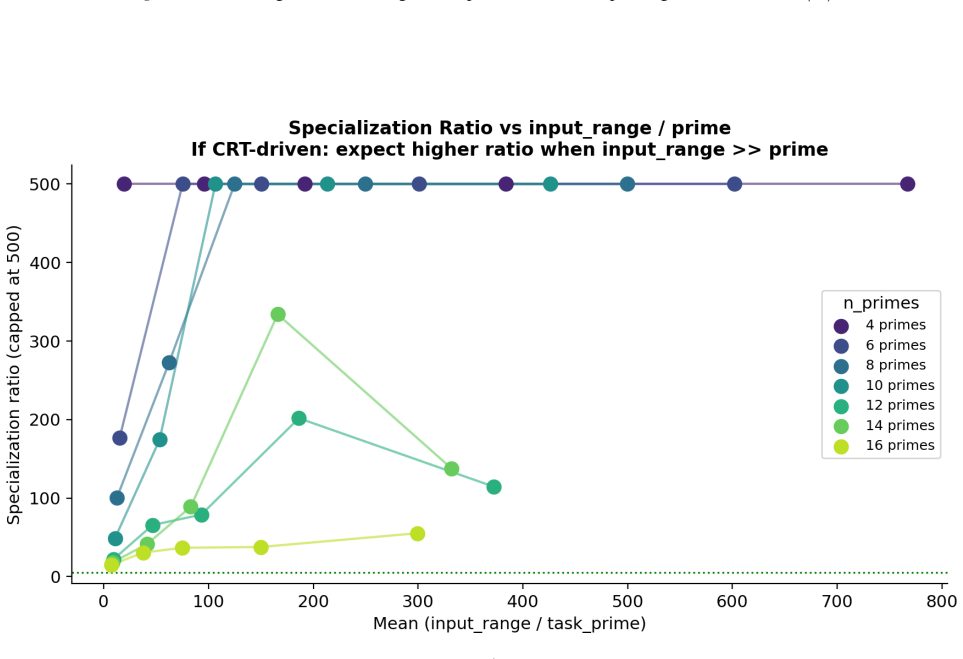
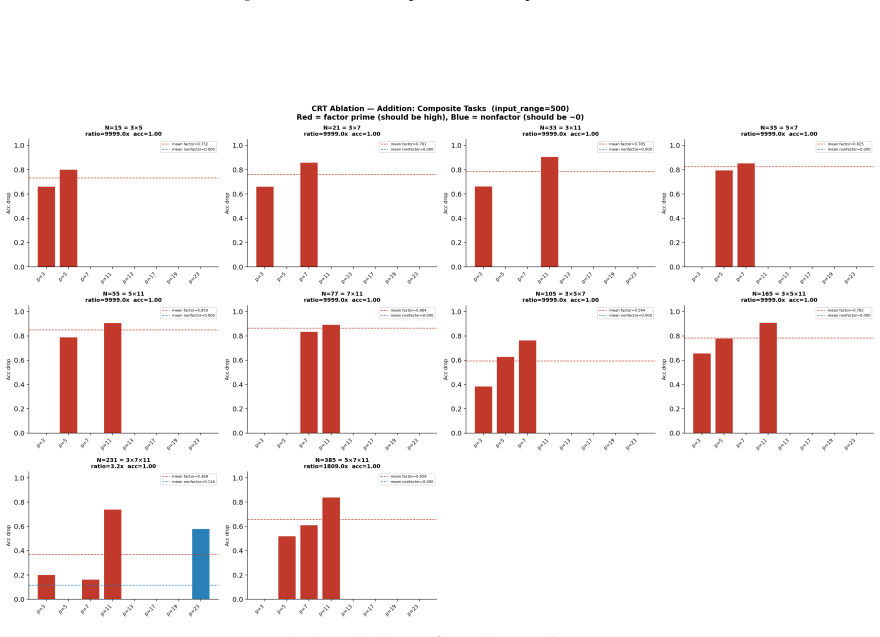
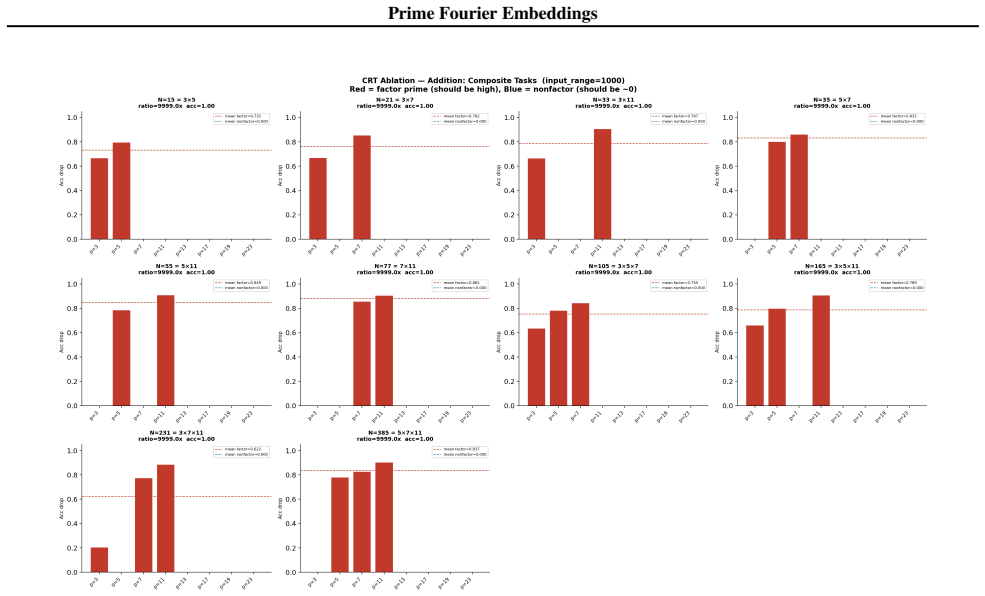
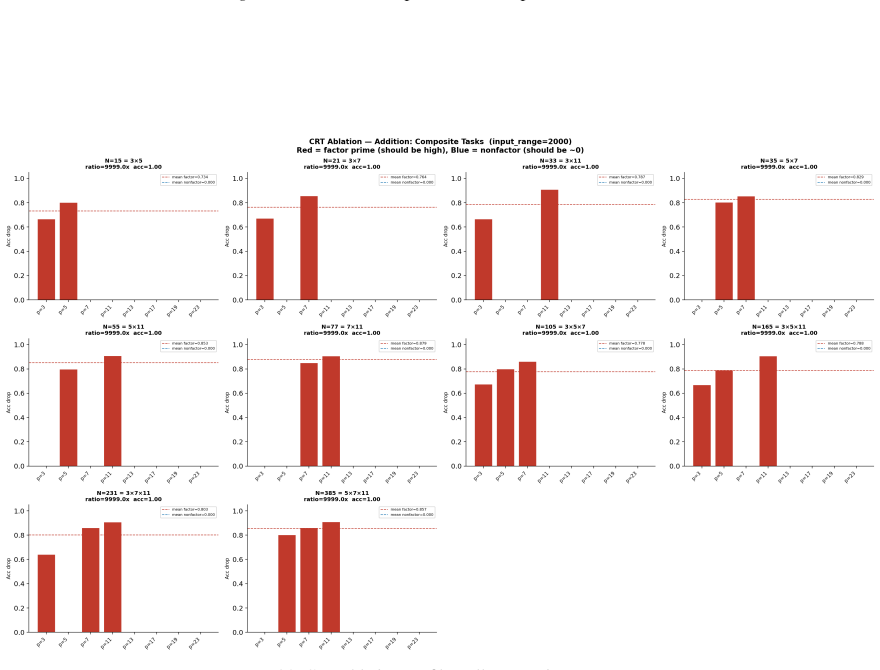
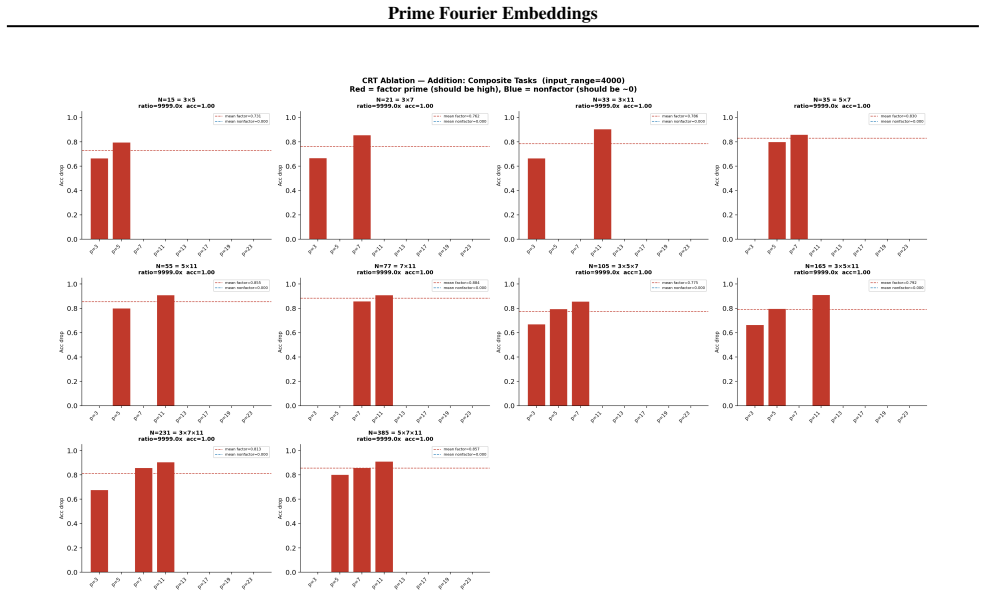
Any linear map equivariant under the product group action on Prime Fourier Embeddings must be block-diagonal with one independent block per prime and per depth; this follows from Schur’s lemma applied to the non-isomorphic characters carried by each prime-indexed (cos, sin) block. For square-free composite moduli the Chinese Remainder Theorem further identifies exactly which prime blocks are task-relevant. Both structural predictions are confirmed by ablation: specialization ratios exceed 500 imes and every tested square-free modulus reaches perfect test accuracy.
Load-bearing premise
Gradient descent on the actual non-linear network will still converge to solutions that approximately obey the linear equivariance the theorem assumes.
Editorial extensions
If this is right
- Modular arithmetic tasks become channel-selection problems once the embedding already isolates prime-local residues.
- Targeted row ablations can verify or falsify the predicted block structure before any architectural changes are made.
- Embedding design for arithmetic can be guided by adelic character factorisation rather than by base-10 or other heuristic frequencies.
- Perfect in-distribution accuracy on square-free moduli is expected once the relevant prime channels are present and selected.
Reading between the lines
- The same prime-channel construction may reduce grokking delay on other group-structured algorithmic tasks that currently force the network to invent the decomposition.
- How gradient descent actually distributes weight across depth levels inside a single prime remains open; measuring that distribution would test whether deeper blocks simply subsume shallower ones.
- Extending the basis to include the prime 2 (or p-adic characters of higher conductor) would show whether the block-diagonal guarantee survives the degenerate sine feature the authors currently exclude.
Signed reviews
Editorial analysis
A structured set of objections, weighed in public.
Referee Report
Summary. The paper introduces Prime Fourier Embeddings (PFE), which map integers to prime-indexed (cos, sin) pairs at successive p-adic digit depths, motivated by the adelic character factorization of Q. Theorem 3.1 proves that any linear map equivariant under the product action of the groups Z/p^{d+1}Z on these blocks must be block-diagonal, with one independent block per (p,d) pair and zero cross-prime (and cross-depth) coupling, via Schur’s lemma applied to non-isomorphic characters of Z. For square-free composite moduli the Chinese Remainder Theorem further predicts which prime channels are task-relevant. Empirically, a fixed PFE front-end plus a shared per-prime MLP encoder and a mixing classifier, trained on (a+b) mod N, yields specialization ratios exceeding 500× under row ablation and perfect in-distribution test accuracy across the square-free composites tested.
Significance. If the framing holds, the work is a clean example of embedding design guided by representation theory and number theory rather than post-hoc interpretability: the block-diagonal constraint is stated before training, the CRT channel list is an external prediction, and both are checked by systematic ablations over many prime counts, moduli, and input ranges. The perfect in-distribution accuracy and extreme specialization ratios are strong empirical signals that pre-structuring modular arithmetic as prime-local selection can remove the usual representational bottleneck. The explicit use of Schur’s lemma, CRT, and adelic factorization, together with a large configuration sweep, are genuine strengths. The main scientific value is therefore as a falsifiable, theory-first account of when modular arithmetic becomes easy for a network—not as a generic claim that Schur’s lemma forces nonlinear training dynamics.
major comments (4)
- Theorem 3.1 constrains only linear equivariant maps W on the PFE blocks. The trained model is nonlinear: a shared per-prime encoder (24→64→32, ReLU) that already processes each prime row independently, followed by a classifier on the concatenation. Remark 3.3 correctly flags that gradient descent is not guaranteed to preserve equivariance, yet the abstract and §5 present the ablation ratios as confirmation of the theorem’s structural prediction. Without a residual cross-prime linear-coupling measurement, a purely linear equivariant baseline, or an ablation that freezes the encoder to linear maps, the bridge from Schur’s lemma to observed routing remains an empirical correlation. Please either (i) measure residual cross-prime coupling in the trained classifier weights, (ii) report a linear-only control, or (iii) reframe the empirical claims as confirmation of the CRT channel-selection pre
- §4 Experimental setup: the encoder is defined to process each prime row independently before any mixing occurs. That architectural choice already enforces the between-prime independence that Theorem 3.1 derives for linear intertwiners. The load-bearing empirical content is therefore almost entirely the CRT selection result (which primes the classifier uses), not the discovery of block-diagonal structure. The manuscript should state this separation explicitly in §3–§5 and adjust the claim language (“both predictions are confirmed”) so that readers do not attribute the encoder’s independence to the representation-theoretic theorem.
- §4: all runs use a single fixed seed (42) with no error bars; variance is asserted to be “negligible” without quantification. Specialization ratios are capped at 500× precisely when off-diagonal drops approach zero, so the headline “exceeding 500×” is sensitive to numerical noise in the denominator. At minimum, report multi-seed means and standard deviations for a representative subset of configurations (e.g., one two-factor and one three-factor modulus at r∈{500,4000}), or replace the capped ratio with a more stable statistic (e.g., absolute factor vs nonfactor drops with confidence intervals).
- The paper’s central practical claim is that PFE turns modular arithmetic from a discovery problem into a selection problem (§5). That claim would be much stronger with head-to-head comparisons against the embeddings the introduction criticizes (FoNE base-10, xVal, learned embeddings) on the same (a+b) mod N tasks, measuring both final accuracy and sample/epoch efficiency or grokking delay. Conceptual discussion of misalignment is present; quantitative baselines are not. Without them, “perfect accuracy with PFE” is hard to calibrate against the status quo the paper aims to improve.
minor comments (6)
- Figures 6–9 captions repeatedly misspell “Experiment” as “Experiemnt”; fix throughout.
- §2 Parameter choices: “excluding 2¹” is typeset awkwardly; state clearly that p=2 is excluded because sin(2πa/2)≡0 (as in footnote 1).
- Theorem 3.1 proof: the argument that χ_{p,d} and χ_{q,d′} are non-isomorphic characters of the common group Z is correct, but a one-line reminder that the real 2D blocks are the real forms of these complex characters (and that Schur still forces the real intertwiners to vanish) would help readers who work only over R.
- Remark 3.2 usefully distinguishes strong (between-prime) from weaker (within-prime depth) independence; consider elevating a short version of this distinction into the main theorem statement or abstract so the CRT prediction is not over-read as applying to depth levels.
- Appendix B figures (10–21) are referenced but not described in the main text beyond “additional experimental figures”; a one-sentence pointer in §4 to what the per-prime profiles show would improve navigability.
- Related work: FoNE is cited as Zhou et al., 2026 and Simon et al., 2026 appears in the impact statement; ensure arXiv/venue identifiers are stable at camera-ready time.
Circularity Check
No significant circularity: Theorem 3.1 is a direct Schur application to independently defined characters of the PFE blocks; CRT channel selection is an external number-theoretic fact; ablations measure a pre-stated prediction rather than a fitted quantity.
full rationale
The derivation chain is self-contained and non-circular. PFE is defined (Section 2) as the real/imaginary parts of the standard characters χ₁ of ℤ/p^{d+1}ℤ. Theorem 3.1 then applies Schur’s lemma (standard, cited to Serre/Fulton-Harris) to the resulting non-isomorphic one-dimensional representations of the common additive group ℤ, concluding that any equivariant linear map must be block-diagonal with zero cross-prime (and cross-depth) coupling. This is ordinary representation theory applied to the objects just defined; it does not redefine the characters in terms of the block-diagonal conclusion. The CRT prediction of which primes are task-relevant for square-free N is likewise an external classical theorem (Ireland-Rosen), not derived from the network or the data. The ablation experiments (Section 4) zero entire prime rows of a frozen trained model and measure accuracy drops; they report specialization ratios and perfect in-distribution accuracy as empirical confirmation of the pre-stated theoretical predictions. No free parameters are fitted to a data subset and then re-used as “predictions,” no uniqueness theorem is imported from the authors’ own prior work, and the architecture’s per-prime encoders, while deliberately aligned with the block structure, still leave a mixing classifier whose reliance on particular channels is measured rather than forced by definition. Remark 3.3 explicitly leaves open why gradient descent finds equivariant solutions, so the paper does not claim the empirical routing is forced by the linear theorem. Consequently the central claims do not reduce to their own inputs by construction.
Assumptions & free parameters
free parameters (3)
- depth cap D =
3
- prime basis P0 =
{3,5,7,...,59}
- encoder/classifier widths and learning rate =
lr=3e-3, widths as stated
assumptions (5)
- standard math Schur’s lemma for irreducible representations of finite groups
- standard math Chinese Remainder Theorem for square-free moduli
- standard math Characters of Z/nZ are the one-dimensional irreps e^{2πika/n}
- standard math Adelic characters of AQ factor into independent local components (Pontryagin duality)
- domain assumption Gradient descent will discover approximately equivariant solutions on the given architecture
invented entities (1)
-
Prime Fourier Embedding (PFE)
independent evidence
Cite this review
Pith. "Pith review of Prime Fourier Embeddings: A Principled Basis for Modular Arithmetic." pith.science (2026). https://pith.science/paper/P7M5RY6B
@misc{pith2026260623044,
  author       = {Pith},
  title        = {Pith review of: Prime Fourier Embeddings: A Principled Basis for Modular Arithmetic},
  year         = {2026},
  howpublished = {\url{https://pith.science/paper/P7M5RY6B}},
  note         = {Machine review of arXiv:2606.23044}
}
read the original abstract
Numbers have algebraic structure that standard neural embeddings often fail to expose. We introduce Prime Fourier Embeddings (PFE), which encode integers as prime-indexed (cos, sin) pairs derived from the harmonic analysis of Q, providing a pre-structured representation in which modular arithmetic reduces to selecting the relevant prime channel rather than discovering algebraic structure from scratch. We prove that any linear map equivariant with respect to the product group action on PFE must be block-diagonal with one independent block per prime -- a consequence of Schur's lemma applied to the resulting character decomposition. For square-free composite moduli, the Chinese Remainder Theorem predicts which prime channels are task-relevant. Both predictions are confirmed empirically: ablation studies show specialization ratios exceeding 500x between task-relevant and task-irrelevant channels, with perfect in-distribution test accuracy across all square-free composite moduli tested.
Figures
Figures from the paper (17 more)
Reference graph
Works this paper leans on
-
[1]
doi: 10.52202/079017-3430. URL https: //proceedings.neurips.cc/paper_files /paper/2024/file/c35986bc1ee29b31c10 11481b77fe540-Paper-Conference.pdf. Munkres, J. R.Topology. Prentice Hall, 2nd edition, 2000. Neukirch, J.Algebraic Number Theory, volume 322 ofGrundlehren der mathematischen Wissenschaften. Springer-Verlag, 1999. Nickel, M. and Kiela, D. Poinca...
-
[2]
cc/paper_files/paper/2017/file/59dfa 2df42d9e3d41f5b02bfc32229dd-Paper.p df
URL https://proceedings.neurips. cc/paper_files/paper/2017/file/59dfa 2df42d9e3d41f5b02bfc32229dd-Paper.p df. Power, A., Burda, Y ., Edwards, H., Babuschkin, I., and Misra, V . Grokking: Generalization beyond overfitting on small algorithmic datasets, 2022. URL https:// arxiv.org/abs/2201.02177. Ramakrishnan, D. and Valenza, R. J.Fourier Analysis on Numbe...
Reviewed July 15, 2026 · model on record in the stance chip above.
Discussion (0). Continue with ORCID to comment.