REVIEW 4 major objections 7 minor 41 references
Causal Graph Fuzzy LLMs: A First Introduction and Applications in Time Series Forecasting
T0 review · 4 major / 7 minor · reviewed 2026-08-06 · deepseek-v4-flash
Pith's one-line read Feeding GPT-2 fuzzy causal text instead of raw numbers makes time series forecasts more accurate and cheaper.
desk verdict A genuinely new pipeline (fuzzy time series + PCMCI + GPT-2) and a real token-efficiency observation, but the accuracy claim is not yet supported: the protocol may leak test-set info through the fuzzy partition and causal graph, and the paper's own numbers contradict its 'all scenarios' claim. read the letter →
The pith
A machine-rendered reading of the paper's core claim, the machinery that carries it, and where it could break.
The reading
What carries the argument
The central object is the fuzzy causal text: a textual pattern that strings fuzzy-set labels of causally selected variables into an antecedent–consequent rule, such as "F(Y0(t−1)), F(Y1(t−1)) → F(Y0(t))". Each input series is partitioned into overlapping fuzzy sets with a membership function and central points; the PCMCI algorithm selects which lagged variables and links belong in the causal graph; and the two are combined to produce the text. That text is tokenized and fed to a pretrained GPT-2 fine-tuned with a self-attention pooling layer and linear head, whose output is defuzzified to a number. Fuzzy labels like "f1" often tokenize as a single unit, whereas numeric strings split into multiple tokens, which is the mechanism behind the reported order-of-magnitude reductions in token count.
What would settle it
A decisive check would be a control run on a synthetic dataset whose true causal graph is known: corrupt the PCMCI graph by replacing half of its edges with the same number of random variables, and compare NRMSE with the uncorrupted graph; if accuracy does not degrade, the causal component is not carrying the reported gain.
Extended reading notes
Core claim
On the paper's own terms, the central discovery is that fuzzification plus causal-graph selection is not just an interpretability aid but a performance and efficiency device for LLM-based forecasting. With GPT-2 fully fine-tuned, CGF-LLM reports average NRMSE of 0.094 for economics, 0.066 for energy, 0.027 for IoT, and 0.029 for climatic data, versus 0.104, 0.104, 0.075, and 0.077 for the baseline that feeds raw numeric text; total token counts drop from 846,300 to 17,340 on economics and from 30,699,520 to 839,412 on IoT. The paper reports one exception: on the climatic dataset with frozen parameters, the no-fuzzy causal variant CG-LLM edges out CGF-LLM (0.116 vs. 0.135). The authors claim this is the first architecture combining fuzzy time series, causal discovery, and an LLM, presented as a multiple-input single-output forecasting system.
Load-bearing premise
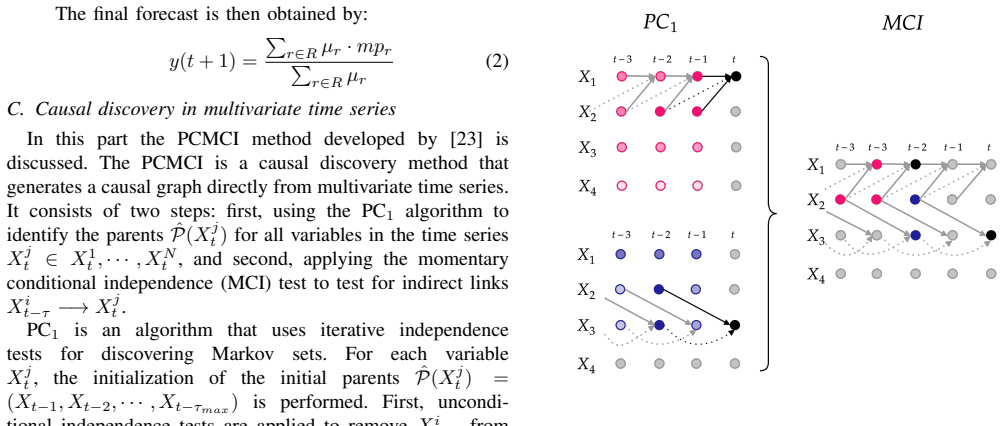
The load-bearing premise is that the causal links PCMCI finds on each dataset are real rather than statistical artifacts, because those links decide which variables and lags appear in the text that GPT-2 reads.
Editorial extensions
If this is right
- If the claim holds, the choice of textual representation matters as much as model choice for LLM-based forecasting: simple linguistic labels can make a forecaster both more accurate and dramatically cheaper.
- Token reductions of this scale, up to 36-fold on the IoT dataset, lower memory and compute demands, making LLM forecasting practical on longer histories and smaller hardware.
- Because the causal graph and fuzzy labels are human-readable, the text input provides an inspectable record of which variables and lags the model is using, enabling audit of forecasts.
- The architecture is a MISO system that reports consistently lower error without parameter freezing than with freezing, indicating that full fine-tuning is worth its extra cost when resources allow.
- The same pipeline should transfer to other pretrained LLMs and to multi-step or multi-output forecasting, with the token-efficiency benefit expected to persist wherever numbers fragment into many tokens.
Reading between the lines
- The token-efficiency result is probably the most robust finding, since it follows mechanically from tokenizer behavior on short repetitive labels and depends less on distributional assumptions than the accuracy gains do.
- A testable extension the authors do not run is a random-link control: replace PCMCI's selected causal parents with the same number of randomly chosen variables and compare NRMSE; if accuracy does not drop, the causal structure itself is not load-bearing.
- On synthetic VAR processes with known ground-truth links, corrupting the causal graph before text generation should raise error if the causal component matters; this would isolate the contribution of the graph from the fuzzification alone.
- The framework also points to a way to inject domain knowledge: an expert-supplied causal graph could replace the learned one, turning CGF-LLM into a general tool for encoding known relationships into LLM prompts.
Editorial analysis
A structured set of objections, weighed in public.
Referee Report
Summary. The paper introduces CGF-LLM, a multivariate time series forecasting architecture that combines fuzzy time series (FTS), causal discovery via PCMCI, and a fine-tuned GPT-2 model. Numerical series are fuzzified into linguistic labels, a causal graph is estimated to select relevant variables and lags, and both are combined into textual patterns that are used as inputs to GPT-2, whose output is defuzzified into a numerical forecast. The authors compare three configurations (CGF-LLM, CG-LLM without fuzzification, and a raw-number LLM baseline) under two training strategies (freezing and no freezing) across four datasets, reporting NRMSE and token counts. The central claim is that CGF-LLM surpasses the standard LLM in both accuracy and computational efficiency, with the token-efficiency argument being mechanistically plausible and the accuracy claim requiring scrutiny.
Significance. If the findings hold under a clean protocol, the paper offers a useful and reasonably novel contribution: representing multivariate time series as fuzzy-causal text is a natural way to make LLM-based forecasting more interpretable, and the reported token reduction (e.g., 36x on IoT) is a concrete practical benefit. The study is empirical rather than derivational, and its strengths are the straightforward integration of established components (FTS, PCMCI, GPT-2), the multi-domain evaluation, and the clear ablation structure. The main significance is limited by the absence of comparisons to existing LLM-based TSF methods and by unresolved protocol questions that could affect the accuracy conclusions; the token-efficiency result is less affected by those questions.
major comments (4)
- [Section IV.B] The manuscript does not state whether the Universe of Discourse U = [min(Y), max(Y)] used for fuzzification (Section II.B) and the PCMCI causal graph (Section III.2) are estimated on the training split of each window or on the full window before the 80/20 train/test split. Since each window is split after preprocessing, a full-window estimate would allow test information to enter both the fuzzy partitions and the causal-parent selection that defines the textual inputs; the raw-number LLM baseline is not subject to this kind of preprocessing, so the comparison in Table II could be differentially biased in favor of CGF-LLM. Please specify the exact fit/transform order, or rerun the experiments with a train-only preprocessing pipeline, and also state how the hyperparameters (K = 30, tau_max = 20, alpha_PC = 0.1) were selected rather than tuned on the full datasets.
- [Section IV.C] The text states that 'CGF-LLM outperforms CG-LLM and LLM in all scenarios' immediately before acknowledging exceptions, and Table II contradicts the claim. In CLIMATIC with freezing, CG-LLM achieves NRMSE 0.116 ± 0.011 versus 0.135 ± 0.015 for CGF-LLM; in ECONOMIC no-freezing, CGF-LLM (0.094 ± 0.018) and LLM (0.104 ± 0.018) are within one standard deviation, and with freezing CGF-LLM's 0.201 ± 0.032 overlaps LLM's 0.222 ± 0.034. The universal superiority claim should be replaced by a precise statement of where the advantage is and is not observed, and the abstract and conclusion should be revised accordingly.
- [Table II and Section IV.B] All accuracy conclusions are based on means and standard deviations over ten windows, with no paired significance test, confidence interval, or effect size. Given the overlapping standard deviations noted above, differences such as IoT no-freezing CGF-LLM 0.027 ± 0.003 versus CG-LLM 0.030 ± 0.008 are not established. Please report per-window paired differences or a signed test (e.g., Wilcoxon) across the ten windows, or provide confidence intervals, so that the accuracy ranking is supported statistically.
- [Section II.C and Section III.2] The causal graph is a load-bearing component of the method because it determines which variables and lags appear in the fuzzy text, but the paper gives no evidence that the PCMCI assumptions (causal sufficiency, Markov condition, faithfulness, stationarity, no contemporaneous effects) are tenable for the four datasets, nor does it report the stability of the estimated parents across the ten windows. A sensitivity analysis over alpha_PC or a comparison of parent sets across windows would materially strengthen the claim that the graph, rather than noise, drives the forecasting improvements; without it, the interpretability and robustness arguments are largely unsupported.
minor comments (7)
- [Section IV.B] The reproducibility statement gives only 'https://github.com' as the code location; please provide the actual repository URL or a DOI.
- [Section IV.C] There is a typo in 'the proposed CGF-LMM method' (Table III discussion); this should read CGF-LLM.
- [Section IV.B] The description of the freezing strategy is inconsistent: the text first says only an additional output layer is trained, then says 'only the last two layers (including attention pooling and MLP head) are fine-tuned'; please clarify which parameters are frozen.
- [Table III] The units of 'Total Text Size' are not specified; if these are character counts, state this explicitly so the token-count comparison is interpretable.
- [Section IV.A] The four datasets are described only by domain and target variable, with no sources, licenses, or preprocessing details; adding this information would improve reproducibility.
- [Section II.B] In Equations (1) and (2), the definition of the rule central point mpr is unclear; please specify how the central points of consequent fuzzy sets are combined, since this affects the defuzzification formula.
- [Section I and Section IV] The related-work section surveys many LLM-based TSF methods, but the experiments do not include any of them; a sentence clarifying that the comparison is an ablation of the proposed components rather than a state-of-the-art benchmark would help calibrate the claims.
Circularity Check
No significant circularity: the central comparison is an empirical ablation, and the minor self-citations are not load-bearing.
full rationale
CGF-LLM is an empirical forecasting pipeline rather than a derivational framework. Numerical series are fuzzified via U = [min(Y), max(Y)] and a PCMCI causal graph is estimated, but the forecast itself is produced by fine-tuning GPT-2 on the resulting text; the output is not an algebraic function of the fitted fuzzy partitions or graph, so no prediction reduces to a fitted parameter by construction. The token-efficiency result (Table III) follows deterministically from GPT-2 tokenizing short fuzzy labels into fewer tokens than numeric strings, and is not a fitted claim. The accuracy claim (Table II) is an experimental comparison on held-out test windows; although the paper does not explicitly state that the UoD and PCMCI graph are computed on the training split only, this is a protocol-specification concern about possible leakage rather than a demonstrated equivalence between input and output. The self-citations ([22], the authors' FTS tutorial, and [39], the authors' PyFTS library) supply background and implementation tooling; the FTS definitions are independently given in Section II.B with original references [35]-[38], so the central result does not rest on these citations. The conclusion's admission that hyperparameters were predefined is a limitation, not a circular step. Overall, the paper is self-contained and its claims are externally falsifiable, so no circularity is established.
Assumptions & free parameters
free parameters (5)
- Number of fuzzy partitions K =
30
- Maximum lag window tau_max =
20
- PCMCI significance level alpha_PC =
0.1
- Fine-tuning epochs =
20
- Experimental window length and overlap =
window 0.3*|D|, overlap 30%, test 20%
assumptions (4)
- domain assumption PCMCI's assumptions hold on the datasets: causal sufficiency, Causal Markov Condition, faithfulness, stationarity, and no contemporaneous effects.
- domain assumption Fuzzy sets with triangular membership and grid partitioning provide a faithful representation of each time series at K=30.
- domain assumption A fine-tuned pretrained GPT-2 with pooling and linear layers can map fuzzy causal text to accurate numerical forecasts.
- standard math Standard fuzzy set theory and fuzzy time series definitions from Song, Chissom, Chen, and Zadeh.
Cite this review
Pith. "Pith review of Causal Graph Fuzzy LLMs: A First Introduction and Applications in Time Series Forecasting." pith.science (2026). https://pith.science/paper/P7WALBAI
@misc{pith2026250717016,
  author       = {Pith},
  title        = {Pith review of: Causal Graph Fuzzy LLMs: A First Introduction and Applications in Time Series Forecasting},
  year         = {2026},
  howpublished = {\url{https://pith.science/paper/P7WALBAI}},
  note         = {Machine review of arXiv:2507.17016}
}
read the original abstract
In recent years, the application of Large Language Models (LLMs) to time series forecasting (TSF) has garnered significant attention among researchers. This study presents a new frame of LLMs named CGF-LLM using GPT-2 combined with fuzzy time series (FTS) and causal graph to predict multivariate time series, marking the first such architecture in the literature. The key objective is to convert numerical time series into interpretable forms through the parallel application of fuzzification and causal analysis, enabling both semantic understanding and structural insight as input for the pretrained GPT-2 model. The resulting textual representation offers a more interpretable view of the complex dynamics underlying the original time series. The reported results confirm the effectiveness of our proposed LLM-based time series forecasting model, as demonstrated across four different multivariate time series datasets. This initiative paves promising future directions in the domain of TSF using LLMs based on FTS.
Figures

Reference graph
Works this paper leans on
-
[1]
Time-series large language models: A systematic review of state-of-the-art,
S. Abdullahi, K. Usman Danyaro, A. Zakari, I. Abdul Aziz, N. Amila Wan Abdullah Zawawi, and S. Adamu, “Time-series large language models: A systematic review of state-of-the-art,” IEEE Access, vol. 13, pp. 30 235–30 261, 2025
work page 2025
-
[2]
How can time series analysis benefit from multiple modalities? a survey and outlook,
H. Liu, H. Kamarthi, Z. Zhao, S. Xu, S. Wang, Q. Wen, T. Hartvigsen, F. Wang, and B. A. Prakash, “How can time series analysis benefit from multiple modalities? a survey and outlook,” 2025. [Online]. Available: https://arxiv.org/abs/2503.11835
arXiv 2025
-
[3]
J. Kim, H. Kim, H. Kim, D. Lee, and S. Yoon, “A comprehensive survey of deep learning for time series forecasting: Architectural diversity and open challenges,” 2025. [Online]. Available: https: //arxiv.org/abs/2411.05793
work page Pith review arXiv 2025
-
[4]
Towards time series reasoning with llms,
W. Chow, L. Gardiner, H. T. Hallgr ´ımsson, M. A. Xu, and S. Y . Ren, “Towards time series reasoning with llms,” 2024. [Online]. Available: https://arxiv.org/abs/2409.11376
arXiv 2024
-
[5]
V . Ekambaram, A. Jati, P. Dayama, S. Mukherjee, N. H. Nguyen, W. M. Gifford, C. Reddy, and J. Kalagnanam, “Tiny time mixers (ttms): Fast pre-trained models for enhanced zero/few-shot forecasting of multivariate time series,” 2024. [Online]. Available: https://arxiv.org/ abs/2401.03955
arXiv 2024
-
[6]
Empowering time series analysis with large language models: A survey,
Y . Jiang, Z. Pan, X. Zhang, S. Garg, A. Schneider, Y . Nevmyvaka, and D. Song, “Empowering time series analysis with large language models: A survey,” arXiv preprint arXiv:2402.03182 , 2024
arXiv 2024
-
[7]
Time-llm: Time series forecasting by re- programming large language models,
M. Jin, S. Wang, L. Ma, Z. Chu, J. Y . Zhang, X. Shi, P.-Y . Chen, Y . Liang, Y .-F. Li, S. Panet al., “Time-llm: Time series forecasting by re- programming large language models,” arXiv preprint arXiv:2310.01728, 2023
arXiv 2023
-
[8]
Tempo: Prompt-based generative pre-trained transformer for time series forecasting,
D. Cao, F. Jia, S. O. Arik, T. Pfister, Y . Zheng, W. Ye, and Y . Liu, “Tempo: Prompt-based generative pre-trained transformer for time series forecasting,” arXiv preprint arXiv:2310.04948 , 2023
arXiv 2023
Show all 41 references
-
[9]
Promptcast: A new prompt-based learning paradigm for time series forecasting,
H. Xue and F. D. Salim, “Promptcast: A new prompt-based learning paradigm for time series forecasting,” IEEE Trans. on Knowl. and Data Eng., vol. 36, no. 11, p. 6851–6864, Nov. 2024. [Online]. Available: https://doi.org/10.1109/TKDE.2023.3342137
2024
-
[10]
Chronos: Learning the language of time series,
A. F. Ansari, L. Stella, C. Turkmen, X. Zhang, P. Mercado, H. Shen, O. Shchur, S. S. Rangapuram, S. P. Arango, S. Kapoor, J. Zschiegner, D. C. Maddix, H. Wang, M. W. Mahoney, K. Torkkola, A. G. Wilson, M. Bohlke-Schneider, and Y . Wang, “Chronos: Learning the language of time ...
2024 arXiv
-
[11]
Large language models are zero-shot time series forecasters,
N. Gruver, M. Finzi, S. Qiu, and A. G. Wilson, “Large language models are zero-shot time series forecasters,” 2024. [Online]. Available: https://arxiv.org/abs/2310.07820
2024 arXiv
-
[12]
Gpt4mts: prompt-based large language model for multimodal time-series forecasting,
F. Jia, K. Wang, Y . Zheng, D. Cao, and Y . Liu, “Gpt4mts: prompt-based large language model for multimodal time-series forecasting,” ser. AAAI’24/IAAI’24/EAAI’24. AAAI Press, 2024. [Online]. Available: https://doi.org/10.1609/aaai.v38i21.30383
2024 doi
-
[13]
Unitime: A language-empowered unified model for cross-domain time series forecasting,
X. Liu, J. Hu, Y . Li, S. Diao, Y . Liang, B. Hooi, and R. Zimmermann, “Unitime: A language-empowered unified model for cross-domain time series forecasting,” in Proceedings of the ACM Web Conference 2024, ser. WWW ’24. New York, NY , USA: Association for Computing Machinery, ...
2024
-
[14]
S2ip-llm: semantic space informed prompt learning with llm for time series forecasting,
Z. Pan, Y . Jiang, S. Garg, A. Schneider, Y . Nevmyvaka, and D. Song, “S2ip-llm: semantic space informed prompt learning with llm for time series forecasting,” in Proceedings of the 41st International Conference on Machine Learning , ser. ICML’24. JMLR.org, 2024
2024
-
[15]
Language models can improve event prediction by few-shot abductive reasoning,
X. Shi, S. Xue, K. Wang, F. Zhou, J. Zhang, J. Zhou, C. Tan, and H. Mei, “Language models can improve event prediction by few-shot abductive reasoning,” Advances in Neural Information Processing Systems, vol. 36, pp. 29 532–29 557, 2023
2023
-
[16]
Temporal data meets llm–explainable financial time series forecasting,
X. Yu, Z. Chen, Y . Ling, S. Dong, Z. Liu, and Y . Lu, “Temporal data meets llm–explainable financial time series forecasting,” arXiv preprint arXiv:2306.11025, 2023
2023 arXiv
-
[17]
Can chatgpt forecast stock price movements? return predictability and large language models,
A. Lopez-Lira and Y . Tang, “Can chatgpt forecast stock price movements? return predictability and large language models,” 2024. [Online]. Available: https://arxiv.org/abs/2304.07619
2024
-
[18]
Large language models are few-shot health learners,
X. Liu, D. McDuff, G. Kovacs, I. Galatzer-Levy, J. Sunshine, J. Zhan, M.-Z. Poh, S. Liao, P. Di Achille, and S. Patel, “Large language models are few-shot health learners,” arXiv preprint arXiv:2305.15525 , 2023
2023 arXiv
-
[19]
Leveraging language foun- dation models for human mobility forecasting,
H. Xue, B. P. V outharoja, and F. D. Salim, “Leveraging language foun- dation models for human mobility forecasting,” in Proceedings of the 30th International Conference on Advances in Geographic Information Systems, 2022, pp. 1–9
2022
-
[20]
Where would i go next? large language models as human mobility predictors,
X. Wang, M. Fang, Z. Zeng, and T. Cheng, “Where would i go next? large language models as human mobility predictors,” 2024. [Online]. Available: https://arxiv.org/abs/2308.15197
2024 arXiv
-
[21]
Spatial- temporal large language model for traffic prediction,
C. Liu, S. Yang, Q. Xu, Z. Li, C. Long, Z. Li, and R. Zhao, “Spatial- temporal large language model for traffic prediction,” in 2024 25th IEEE International Conference on Mobile Data Management (MDM) . IEEE, 2024, pp. 31–40
2024
-
[22]
A tutorial on fuzzy time series forecasting models: recent advances and challenges,
P. O. Lucas, O. Orang, P. C. Silva, E. Mendes, and F. G. Guimaraes, “A tutorial on fuzzy time series forecasting models: recent advances and challenges,” Learn Nonlinear Models , vol. 19, pp. 29–50, 2022
2022
-
[23]
Detecting and quantifying causal associations in large nonlinear time series datasets,
J. Runge, P. Nowack, M. Kretschmer, S. Flaxman, and D. Sejdinovic, “Detecting and quantifying causal associations in large nonlinear time series datasets,” Science Advances , vol. 5, no. 11, pp. 4996–5023, 11
-
[24]
Bert: Pre-training of deep bidirectional transformers for language understanding,
J. Devlin, M.-W. Chang, K. Lee, and K. Toutanova, “Bert: Pre-training of deep bidirectional transformers for language understanding,” in Pro- ceedings of the 2019 conference of the North American chapter of the association for computational linguistics: human language technolo...
2019
-
[25]
Language models are unsupervised multitask learners,
A. Radford, J. Wu, R. Child, D. Luan, D. Amodei, I. Sutskever et al., “Language models are unsupervised multitask learners,” OpenAI blog , vol. 1, no. 8, p. 9, 2019
2019
-
[26]
Roberta: A robustly optimized bert pretraining approach,
Y . Liu, M. Ott, N. Goyal, J. Du, M. Joshi, D. Chen, O. Levy, M. Lewis, L. Zettlemoyer, and V . Stoyanov, “Roberta: A robustly optimized bert pretraining approach,” arXiv preprint arXiv:1907.11692 , 2019
1907 arXiv
-
[27]
Attention is all you need,
A. Vaswani, N. Shazeer, N. Parmar, J. Uszkoreit, L. Jones, A. N. Gomez, L. Kaiser, and I. Polosukhin, “Attention is all you need,” in Proceedings of the 31st International Conference on Neural Information Processing Systems, ser. NIPS’17. Red Hook, NY , USA: Curran Associates ...
2017
-
[28]
Language models are few-shot learners,
T. B. Brown et al. , “Language models are few-shot learners,” in Proceedings of the 34th International Conference on Neural Information Processing Systems , ser. NIPS ’20. Red Hook, NY , USA: Curran Associates Inc., 2020
2020
-
[29]
Palm: Scaling language modeling with pathways,
A. Chowdhery et al. , “Palm: Scaling language modeling with pathways,” Journal of Machine Learning Research , vol. 24, no. 1, pp. 240:1–240:113, 2023. [Online]. Available: https://www.jmlr.org/papers/ volume24/21-1378/21-1378.pdf
2023
-
[30]
Training compute-optimal large language models,
J. Hoffmann, S. Borgeaud, A. Mensch, E. Buchatskaya, T. Cai, E. Rutherford, D. d. L. Casas, L. A. Hendricks, J. Welbl, A. Clark et al., “Training compute-optimal large language models,”arXiv preprint arXiv:2203.15556, 2022
2022 arXiv
-
[31]
Gpt-4 technical report,
O. et al., “Gpt-4 technical report,” 2024. [Online]. Available: https://arxiv.org/abs/2303.08774
2024 arXiv
-
[32]
Lamda: Language models for dialog applications,
R. T. et al., “Lamda: Language models for dialog applications,” 2022. [Online]. Available: https://arxiv.org/abs/2201.08239
2022 arXiv
-
[33]
Llama: Open and efficient foundation language models,
T. et al., “Llama: Open and efficient foundation language models,”
-
[34]
Deepseek-r1: Incentivizing reasoning capability in llms via reinforcement learning,
D.-A. et al., “Deepseek-r1: Incentivizing reasoning capability in llms via reinforcement learning,” 2025. [Online]. Available: https: //arxiv.org/abs/2501.12948
2025 arXiv
-
[35]
Forecasting enrollments with fuzzy time series—part i,
Q. Song and B. S. Chissom, “Forecasting enrollments with fuzzy time series—part i,” Fuzzy sets and systems , vol. 54, no. 1, pp. 1–9, 1993
1993
-
[36]
Forecasting enrollments with fuzzy time series—part ii,
——, “Forecasting enrollments with fuzzy time series—part ii,” Fuzzy sets and systems , vol. 62, no. 1, pp. 1–8, 1994
1994
-
[37]
Forecasting enrollments based on fuzzy time series,
S.-M. Chen, “Forecasting enrollments based on fuzzy time series,” Fuzzy sets and systems , vol. 81, no. 3, pp. 311–319, 1996
1996
-
[38]
Fuzzy sets,
L. A. Zadeh, “Fuzzy sets,” Information and control , vol. 8, no. 3, pp. 338–353, 1965
1965
-
[39]
PYFTS/pyFTS: Stable version 1.7,
P. C. e Lima E Silva, C. A. S. J ´unior, M. A. Alves, R. C. P. Silva, G. L. Vieira, P. De Oliveira E Lucas, H. J. Sadaei, and F. G. Guimar ˜aes, “PYFTS/pyFTS: Stable version 1.7,” 2019
2019
-
[2019]
Available: https://www.science.org/doi/10.1126/sciadv
[Online]. Available: https://www.science.org/doi/10.1126/sciadv. aau4996
-
[2023]
Available: https://arxiv.org/abs/2302.13971
[Online]. Available: https://arxiv.org/abs/2302.13971
Reviewed August 6, 2026 · model on record in the stance chip above.
Discussion (0). Sign in to comment.