REVIEW 3 major objections 5 minor 1 cited by
Explainable Compliance Detection with Multi-Hop Natural Language Inference on Assurance Case Structure
T0 review · 3 major / 5 minor · reviewed 2026-08-07 · deepseek-v4-flash
Pith's one-line read Compliance detection can be reframed as multi-hop natural language inference over claim-argument-evidence trees, so a single fine-tuned model returns both a compliance verdict and an auditable chain of reasoning.
desk verdict A useful but under-validated idea: the multi-hop NLI-on-assurance-cases claim is built on LLM-generated data whose logical correctness is never checked, though the flat NLI baseline is solid. read the letter →
The pith
A machine-rendered reading of the paper's core claim, the machinery that carries it, and where it could break.
The reading
What carries the argument
The load-bearing object is the claim-argument-evidence (CAE) tree of an assurance case, reformulated as a multi-hop NLI structure: each parent-child edge becomes a premise-hypothesis pair, and a multi-hop pair connects a root claim to far-lying evidence through intermediate subclaims and arguments. The training mechanism is to append those intermediate steps to the model input so the transformer performs the chain of deduction instead of inferring from a single indirect premise. LLM-generated assurance cases supply the trees, and the proposed flat metrics (absolute count differences per element type) plus graph edit distance are the instruments used to argue that the generated trees are structurally consistent enough to learn from.
What would settle it
A human-annotated set of assurance cases with expert-verified links would settle it: if chain-trained models do not outperform implicit models on those cases, or if experts judge a large share of the generated intermediate links to be invalid, the synthetic-data results would not transfer to real regulatory audits.
Extended reading notes
Core claim
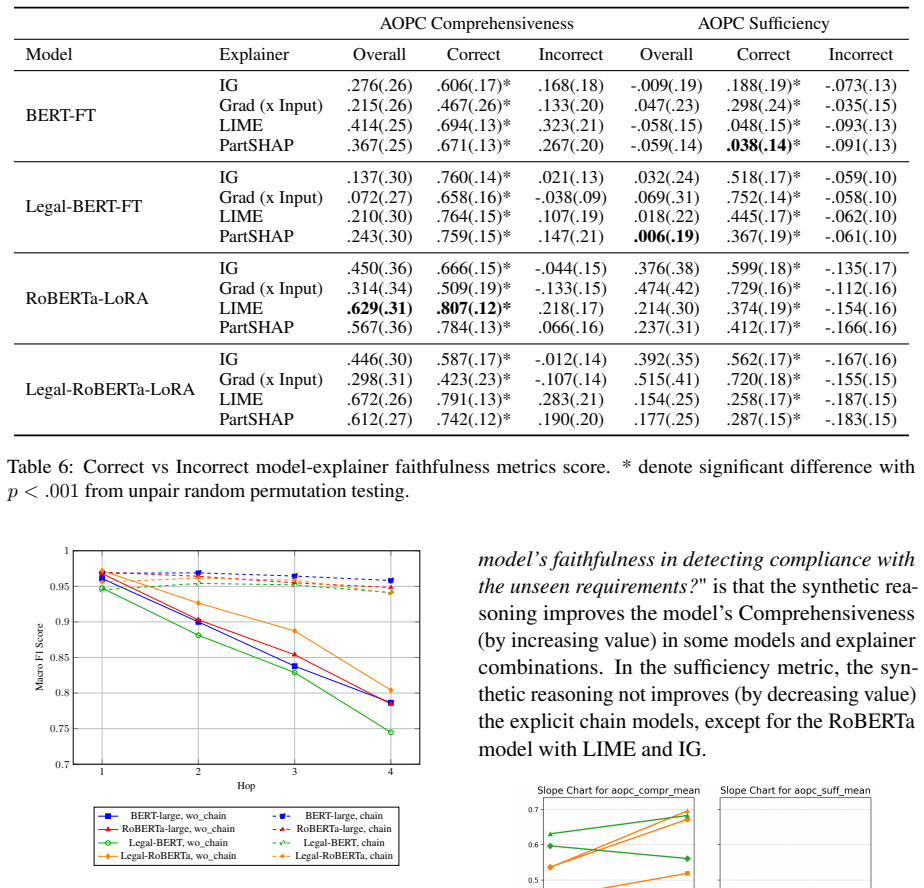
The central discovery is that the deductive structure of an assurance case can be converted into training data for NLI models. Each requirement is a premise, each piece of evidence a hypothesis, and entailment marks compliance while non-entailment marks a gap in the argument. The claim-argument-evidence (CAE) tree is then used as a multi-hop structure: parent nodes are premises, child nodes are hypotheses, and the link between a high-level claim and distant evidence requires chaining through intermediate subclaims and arguments. On the human-annotated GDPR-DPA dataset, fine-tuned BERT- and RoBERTa-family models reach scores competitive with earlier binary and multi-class classifiers while using one model for all requirements. On LLM-generated assurance cases, models trained with explicit intermediate chains outperform models that see only the indirect premise on held-out requirements, and the authors conclude from their faithfulness metrics that these chains make the model's explanations more faithful.
Load-bearing premise
The multi-hop results stand on the assumption that LLM-generated assurance cases are valid enough to serve as ground truth, but the paper's own metrics check consistency and structure, not whether the argument links are actually correct.
Editorial extensions
If this is right
- A single NLI model can handle all requirements at once, replacing one-classifier-per-requirement pipelines and returning a verdict with a trace.
- Explicitly appending intermediate reasoning steps improves accuracy on held-out requirement categories, so synthetic assurance cases can support generalization to unseen regulations.
- Correct predictions come with higher comprehensiveness scores, meaning the model's rationales are more faithful when it is right, which matters for auditability.
- LLM-generated assurance cases can be screened at scale using element-count differences and graph edit distance, and the largest model disagreement appears in evidence coverage.
- Token-level sufficiency does not improve with chains, indicating that salient-word rationales alone are not sufficient for legal compliance reasoning.
Reading between the lines
- An extension the authors leave implicit: the same CAE-to-NLI conversion could apply to safety cases in other notations and to regulations beyond GDPR, but only after the logical-validity gap in synthetic assurance cases is closed.
- The chain advantage on unseen requirements may be a property of LLM-generated trees rather than a general property of multi-hop NLI; re-running the experiment on expert-annotated cases would separate the two.
- Since sufficiency did not improve with chains, the explainability result rests mainly on comprehensiveness; a study with auditors judging the emitted traces would test whether the chains actually aid understanding.
- The flat and structural metrics could be extended from consistency checks to validity checks by adding formal verification or expert annotation of intermediate links, which would remove the paper's stated limitation.
Editorial analysis
A structured set of objections, weighed in public.
Referee Report
Summary. The paper proposes EXCLAIM, an explainable compliance detection approach that formulates compliance checking as natural language inference (NLI). For the flat setting, GDPR requirements serve as premises and Data Processing Agreement (DPA) clauses as hypotheses, evaluated on a human-annotated dataset. For the multi-hop setting, the claim-argument-evidence (CAE) structure of assurance cases is converted into multi-hop premise-hypothesis pairs, and the required assurance cases are generated by LLMs because real data are scarce. The paper evaluates several transformer models, four post-hoc explanation methods, and faithfulness metrics, and it proposes flat (element-count) and structured (graph edit distance) metrics for assessing the generated data. The reported results show competitive NLI performance on the GDPR-DPA dataset and, on the synthetic CAE data, better performance for explicit chains over implicit ones in some configurations, with mixed faithfulness improvements.
Significance. The GDPR-DPA NLI experiment is externally grounded in human annotations and gives some credibility to the claim that compliance detection can be recast as NLI. The paper also contributes a public dataset split and a systematic evaluation of faithfulness for legal text. However, the central multi-hop contribution rests on LLM-generated assurance cases whose logical validity is never confirmed; the proposed metrics measure consistency rather than correctness. The faithfulness improvement is also inconsistent across models and explainers. If the synthetic-data foundation were strengthened and the multi-hop claims tempered to match the mixed evidence, the work would be a useful step toward traceable compliance checking; in its present form the significance is conditional.
major comments (3)
- [§4.3, §6.2, §9]
- [§7 (RQ4, Figure 5)]
- [§6.1, Table 5]
minor comments (5)
- [§6.2]
- [§5.2]
- [§4.1]
- [Table 3]
- [§7]
Circularity Check
No significant circularity: the flat NLI result is anchored by an external human-annotated benchmark, and the multi-hop synthetic-target limitation is explicitly disclosed by the authors rather than a definitional reduction.
full rationale
The central flat-NLI claim is tested against the GDPR-DPA dataset from Azeem and Abualhaija (2024), an external human-annotated resource, and the RQ1 comparison to prior classifiers is a genuine empirical evaluation whose outcomes are not forced by construction. The multi-hop experiments (RQ3/RQ4) are a synthetic benchmark: premise-hypothesis pairs and entailment labels are extracted from the LLM-generated CAE trees, so accuracy measures the model's ability to reproduce the generated structure. This is a validity limitation, not a circular reduction, and the authors explicitly concede it in Section 9: "these do not fully ensure logical correctness" and synthetic data "may affect the generalizability of our results." No load-bearing self-citation chain or imported uniqueness theorem is used; the self-citations (Ikhwantri et al., 2023, 2024) appear only as related work on plausibility evaluation and are not premises of the derivation. The formulation of CAE structure as multi-hop NLI is a modeling choice rather than a self-defined prediction, and the faithfulness comparison (chain vs. wo_chain) is an empirical manipulation with measurable outcomes. Accordingly, the paper's derivation chain is self-contained with respect to circularity, although the synthetic-data foundation carries a correctness risk that the authors themselves flag.
Assumptions & free parameters
free parameters (3)
- Negative sampling rate =
0.1
- Number of requirements =
20 of 45
- Multi-hop train/test requirement split =
15 train, 4 test (exact test count not stated)
assumptions (4)
- domain assumption Textual entailment between a GDPR requirement and a DPA clause is a valid proxy for legal compliance.
- domain assumption The claim-argument-evidence tree can be decomposed into pairwise premise-hypothesis entailment steps whose composition captures the assurance case reasoning.
- domain assumption LLM-generated CAE structures are sufficiently valid to serve as training and test data for the multi-hop task.
- standard math Graph edit distance is an appropriate structural similarity measure for comparing generated assurance case trees.
Cite this review
Pith. "Pith review of Explainable Compliance Detection with Multi-Hop Natural Language Inference on Assurance Case Structure." pith.science (2026). https://pith.science/paper/PAEYFRIM
@misc{pith2026250608713,
  author       = {Pith},
  title        = {Pith review of: Explainable Compliance Detection with Multi-Hop Natural Language Inference on Assurance Case Structure},
  year         = {2026},
  howpublished = {\url{https://pith.science/paper/PAEYFRIM}},
  note         = {Machine review of arXiv:2506.08713}
}
read the original abstract
Ensuring complex systems meet regulations typically requires checking the validity of assurance cases through a claim-argument-evidence framework. Some challenges in this process include the complicated nature of legal and technical texts, the need for model explanations, and limited access to assurance case data. We propose a compliance detection approach based on Natural Language Inference (NLI): EXplainable CompLiance detection with Argumentative Inference of Multi-hop reasoning (EXCLAIM). We formulate the claim-argument-evidence structure of an assurance case as a multi-hop inference for explainable and traceable compliance detection. We address the limited number of assurance cases by generating them using large language models (LLMs). We introduce metrics that measure the coverage and structural consistency. We demonstrate the effectiveness of the generated assurance case from GDPR requirements in a multi-hop inference task as a case study. Our results highlight the potential of NLI-based approaches in automating the regulatory compliance process.
Figures


Figures from the paper (5 more)


Forward citations
Cited by 1 Pith paper
-
Ask Only When Needed: Proactive Retrieval from Memory and Skills for Experience-Driven Lifelong Agents
ProactAgent treats memory retrieval as a learned policy action and reports large gains in success rate and fewer interaction rounds on SciWorld, AlfWorld, and StuLife.
Reference graph
Works this paper leans on
-
[1]
Marah Abdin, Jyoti Aneja, Harkirat Behl, S \'e bastien Bubeck, Ronen Eldan, Suriya Gunasekar, Michael Harrison, Russell J Hewett, Mojan Javaheripi, Piero Kauffmann, et al. 2024. Phi-4 technical report. arXiv preprint arXiv:2412.08905
arXiv 2024
-
[2]
Pepa Atanasova, Jakob Grue Simonsen, Christina Lioma, and Isabelle Augenstein. 2020. https://doi.org/10.18653/v1/2020.emnlp-main.263 A diagnostic study of explainability techniques for text classification . In Proceedings of the 2020 Conference on Empirical Methods in Natural Language Processing (EMNLP), pages 3256--3274, Online. Association for Computati...
-
[3]
Giuseppe Attanasio, Eliana Pastor, Chiara Di Bonaventura, and Debora Nozza. 2023. https://doi.org/10.18653/v1/2023.eacl-demo.29 ferret: a framework for benchmarking explainers on transformers . In Proceedings of the 17th Conference of the European Chapter of the Association for Computational Linguistics: System Demonstrations, pages 256--266, Dubrovnik, C...
-
[4]
Muhammad Ilyas Azeem and Sallam Abualhaija. 2024. A multi-solution study on gdpr ai-enabled completeness checking of dpas. Empirical Software Engineering, 29(4):96
work page 2024
-
[5]
Jasmijn Bastings, Sebastian Ebert, Polina Zablotskaia, Anders Sandholm, and Katja Filippova. 2022. https://doi.org/10.18653/v1/2022.emnlp-main.64 will you find these shortcuts? a protocol for evaluating the faithfulness of input salience methods for text classification . In Proceedings of the 2022 Conference on Empirical Methods in Natural Language Proces...
-
[6]
Robin Bloomfield and Peter Bishop. 2009. Safety and assurance cases: Past, present and possible future--an adelard perspective. In Making Systems Safer: Proceedings of the Eighteenth Safety-Critical Systems Symposium, Bristol, UK, 9-11th February 2010, pages 51--67. Springer
work page 2009
-
[7]
Bowman, Gabor Angeli, Christopher Potts, and Christopher D
Samuel R. Bowman, Gabor Angeli, Christopher Potts, and Christopher D. Manning. 2015. https://doi.org/10.18653/v1/D15-1075 A large annotated corpus for learning natural language inference . In Proceedings of the 2015 Conference on Empirical Methods in Natural Language Processing, pages 632--642, Lisbon, Portugal. Association for Computational Linguistics
-
[8]
Julieth Patricia Castellanos Ardila, Barbara Gallina, and Faiz Ul Muram. 2022. Compliance checking of software processes: A systematic literature review. Journal of Software: Evolution and Process, 34(5):e2440
work page 2022
Show all 49 references
-
[9]
Orlando Amaral Cejas, Muhammad Ilyas Azeem, Sallam Abualhaija, and Lionel C. Briand. 2023. https://doi.org/10.1109/TSE.2023.3288901 NLP-Based Automated Compliance Checking of Data Processing Agreements Against GDPR . IEEE Transactions on Software Engineering, 49(09):4282--4303
2023
-
[10]
Ilias Chalkidis, Manos Fergadiotis, Prodromos Malakasiotis, Nikolaos Aletras, and Ion Androutsopoulos. 2020. https://doi.org/10.18653/v1/2020.findings-emnlp.261 LEGAL - BERT : The muppets straight out of law school . In Findings of the Association for Computational Linguistics...
2020 doi
-
[11]
Ilias Chalkidis, Nicolas Garneau, Catalina Goanta, Daniel Katz, and Anders S gaard. 2023. https://doi.org/10.18653/v1/2023.acl-long.865 L e XF iles and L egal LAMA : Facilitating E nglish multinational legal language model development . In Proceedings of the 61st Annual Meetin...
2023 doi
-
[12]
Zezhong Chen, Yuxin Deng, and Wenjie Du. 2025. https://doi.org/10.1016/j.scico.2025.103288 Trusta: Reasoning about assurance cases with formal methods and large language models . Science of Computer Programming, 244:103288
2025
-
[13]
Ido Dagan, Oren Glickman, and Bernardo Magnini. 2005. The pascal recognising textual entailment challenge. In Machine learning challenges workshop, pages 177--190. Springer
2005
-
[14]
Jacob Devlin, Ming-Wei Chang, Kenton Lee, and Kristina Toutanova. 2019. https://doi.org/10.18653/v1/N19-1423 BERT : Pre-training of deep bidirectional transformers for language understanding . In Proceedings of the 2019 Conference of the North A merican Chapter of the Associat...
2019 doi
-
[15]
Jay DeYoung, Sarthak Jain, Nazneen Fatema Rajani, Eric Lehman, Caiming Xiong, Richard Socher, and Byron C. Wallace. 2020. https://doi.org/10.18653/v1/2020.acl-main.408 ERASER : A benchmark to evaluate rationalized NLP models . In Proceedings of the 58th Annual Meeting of the A...
2020 doi
-
[16]
Paul M Duvall, Steve Matyas, and Andrew Glover. 2007. Continuous integration: improving software quality and reducing risk. Pearson Education
2007
-
[17]
Oliver Eberle, Stephanie Brandl, Jonas Pilot, and Anders S gaard. 2022. https://doi.org/10.18653/v1/2022.acl-long.296 Do transformer models show similar attention patterns to task-specific human gaze? In Proceedings of the 60th Annual Meeting of the Association for Computation...
2022 doi
-
[18]
Mohamad Fazelnia, Viktoria Koscinski, Spencer Herzog, and Mehdi Mirakhorli. 2024. https://api.semanticscholar.org/CorpusID:269626547 Lessons from the use of natural language inference (nli) in requirements engineering tasks . 2024 IEEE 32nd International Requirements Engineeri...
2024
-
[19]
Aaron Grattafiori, Abhimanyu Dubey, Abhinav Jauhri, Abhinav Pandey, Abhishek Kadian, Ahmad Al-Dahle, Aiesha Letman, Akhil Mathur, Alan Schelten, Alex Vaughan, et al. 2024. The llama 3 herd of models. arXiv preprint arXiv:2407.21783
2024 arXiv
-
[20]
Nora Hollenstein and Lisa Beinborn. 2021. https://doi.org/10.18653/v1/2021.acl-short.19 Relative importance in sentence processing . In Proceedings of the 59th Annual Meeting of the Association for Computational Linguistics and the 11th International Joint Conference on Natura...
2021 doi
-
[21]
Edward J Hu, Yelong Shen, Phillip Wallis, Zeyuan Allen-Zhu, Yuanzhi Li, Shean Wang, Lu Wang, Weizhu Chen, et al. 2022. Lora: Low-rank adaptation of large language models. ICLR, 1(2):3
2022
-
[22]
Fariz Ikhwantri, Jan Wira Gotama Putra, Hiroaki Yamada, and Takenobu Tokunaga. 2023. https://doi.org/10.1016/j.ipm.2022.103195 Looking deep in the eyes: Investigating interpretation methods for neural models on reading tasks using human eye-movement behaviour . Information Pro...
2023
-
[23]
Fariz Ikhwantri, Hiroaki Yamada, and Takenobu Tokunaga. 2024. https://aclanthology.org/2024.lrec-main.84/ Analyzing interpretability of summarization model with eye-gaze information . In Proceedings of the 2024 Joint International Conference on Computational Linguistics, Langu...
2024
-
[24]
Alon Jacovi and Yoav Goldberg. 2020. https://doi.org/10.18653/v1/2020.acl-main.386 Towards faithfully interpretable NLP systems: How should we define and evaluate faithfulness? In Proceedings of the 58th Annual Meeting of the Association for Computational Linguistics, pages 41...
2020 doi
-
[25]
Joxan Jaffar and Michael J. Maher. 1994. https://doi.org/10.1016/0743-1066(94)90033-7 Constraint logic programming: a survey . The Journal of Logic Programming, 19-20:503--581. Special Issue: Ten Years of Logic Programming
1994 doi
-
[26]
Peter Jansen. 2018. https://doi.org/10.18653/v1/W18-1703 Multi-hop inference for sentence-level T ext G raphs: How challenging is meaningfully combining information for science question answering? In Proceedings of the Twelfth Workshop on Graph-Based Methods for Natural Langua...
2018 doi
-
[27]
Tim Kelly and Rob Weaver. 2004. The goal structuring notation--a safety argument notation. In Proceedings of the dependable systems and networks 2004 workshop on assurance cases, volume 6. Citeseer Princeton, NJ
2004
-
[28]
Ananya Kumar, Aditi Raghunathan, Robbie Matthew Jones, Tengyu Ma, and Percy Liang. 2022. Fine-tuning can distort pretrained features and underperform out-of-distribution. In International Conference on Learning Representations
2022
-
[29]
Yinhan Liu, Myle Ott, Naman Goyal, Jingfei Du, Mandar Joshi, Danqi Chen, Omer Levy, Mike Lewis, Luke Zettlemoyer, and Veselin Stoyanov. 2019. Roberta: A robustly optimized bert pretraining approach. arXiv preprint arXiv:1907.11692
2019 arXiv
-
[30]
Scott M Lundberg and Su-In Lee. 2017. A unified approach to interpreting model predictions. Advances in neural information processing systems, 30
2017
-
[31]
Nikolai Mansourov and Djenana Campara. 2011. https://doi.org/10.1016/B978-0-12-381414-2.00002-6 Chapter 2 - confidence as a product . In Nikolai Mansourov and Djenana Campara, editors, System Assurance, The MK/OMG Press, pages 23--47. Morgan Kaufmann, Boston
2011 doi
-
[32]
Christoph Molnar. 2025. https://christophm.github.io/interpretable-ml-book Interpretable Machine Learning , 3 edition. n.p
2025
-
[33]
Bloomfield
Kateryna Netkachova, Oleksandr Netkachov, and Robin E. Bloomfield. 2015. https://api.semanticscholar.org/CorpusID:37514799 Tool support for assurance case building blocks - providing a helping hand with cae . In SAFECOMP Workshops
2015
-
[34]
Belle, Song Wang, Segla Kpodjedo, Timothy C
Oluwafemi Odu, Alvine B. Belle, Song Wang, Segla Kpodjedo, Timothy C. Lethbridge, and Hadi Hemmati. 2025. https://doi.org/10.1016/j.jss.2025.112353 Automatic instantiation of assurance cases from patterns using large language models . Journal of Systems and Software, 222:112353
2025
-
[35]
Piovesan and E
A. Piovesan and E. Griffor. 2017. https://doi.org/10.1016/B978-0-12-803773-7.00007-3 7 - reasoning about safety and security: The logic of assurance . In Edward Griffor, editor, Handbook of System Safety and Security, pages 113--129. Syngress, Boston
2017 doi
-
[36]
Thomas Rhodes, Frederick Boland, Elizabeth Fong, and Michael Kass. 2010. Software assurance using structured assurance case models. Journal of research of the National Institute of Standards and Technology, 115(3):209
2010
-
[37]
why should i trust you?
Marco Tulio Ribeiro, Sameer Singh, and Carlos Guestrin. 2016. " why should i trust you?" explaining the predictions of any classifier. In Proceedings of the 22nd ACM SIGKDD international conference on knowledge discovery and data mining, pages 1135--1144
2016
-
[38]
Ross, Mark Winstead, and Michael McEvilley
Ronald S. Ross, Mark Winstead, and Michael McEvilley. 2022. https://doi.org/10.6028/NIST.SP.800-160v1r1 Engineering trustworthy secure systems
2022 doi
-
[39]
John Rushby, Xidong Xu, Murali Rangarajan, and Thomas L Weaver. 2015. Understanding and evaluating assurance cases. Technical report, Langley Research Center, National Aeronautics and Space Administration
2015
-
[40]
Marzieh Saeidi, Majid Yazdani, and Andreas Vlachos. 2021. https://doi.org/10.18653/v1/2021.emnlp-main.678 Cross-policy compliance detection via question answering . In Proceedings of the 2021 Conference on Empirical Methods in Natural Language Processing, pages 8622--8632, Onl...
2021 doi
-
[41]
Oscar Sainz, Oier Lopez de Lacalle, Gorka Labaka, Ander Barrena, and Eneko Agirre. 2021. https://doi.org/10.18653/v1/2021.emnlp-main.92 Label verbalization and entailment for effective zero and few-shot relation extraction . In Proceedings of the 2021 Conference on Empirical M...
2021 doi
-
[42]
K Simonyan, A Vedaldi, and A Zisserman. 2014. Deep inside convolutional networks: visualising image classification models and saliency maps. In International Conference on Learning Representations 2014. International Conference on Learning Representations
2014
-
[43]
Mukund Sundararajan, Ankur Taly, and Qiqi Yan. 2017. Axiomatic attribution for deep networks. In International conference on machine learning, pages 3319--3328. PMLR
2017
-
[44]
Gemma Team, Morgane Riviere, Shreya Pathak, Pier Giuseppe Sessa, Cassidy Hardin, Surya Bhupatiraju, L \'e onard Hussenot, Thomas Mesnard, Bobak Shahriari, Alexandre Ram \'e , et al. 2024. Gemma 2: Improving open language models at a practical size, 2024. URL https://arxiv. org...
2024 arXiv
-
[45]
Sinong Wang, Han Fang, Madian Khabsa, Hanzi Mao, and Hao Ma. 2021. Entailment as few-shot learner. arXiv preprint arXiv:2104.14690
2021 arXiv
-
[46]
An Yang, Baosong Yang, Binyuan Hui, Bo Zheng, Bowen Yu, Chang Zhou, Chengpeng Li, Chengyuan Li, Dayiheng Liu, Fei Huang, Guanting Dong, Haoran Wei, Huan Lin, Jialong Tang, Jialin Wang, Jian Yang, Jianhong Tu, Jianwei Zhang, Jianxin Ma, Jin Xu, Jingren Zhou, Jinze Bai, Jinzheng...
2024 arXiv
-
[47]
Zhilin Yang, Peng Qi, Saizheng Zhang, Yoshua Bengio, William Cohen, Ruslan Salakhutdinov, and Christopher D. Manning. 2018. https://doi.org/10.18653/v1/D18-1259 H otpot QA : A dataset for diverse, explainable multi-hop question answering . In Proceedings of the 2018 Conference...
2018 doi
-
[48]
online" 'onlinestring :=
ENTRY address archivePrefix author booktitle chapter edition editor eid eprint eprinttype howpublished institution journal key month note number organization pages publisher school series title type volume year doi pubmed url lastchecked label extra.label sort.label short.list...
-
[49]
write newline
" write newline "" before.all 'output.state := FUNCTION n.dashify 't := "" t empty not t #1 #1 substring "-" = t #1 #2 substring "--" = not "--" * t #2 global.max substring 't := t #1 #1 substring "-" = "-" * t #2 global.max substring 't := while if t #1 #1 substring * t #2 gl...
Reviewed August 7, 2026 · model on record in the stance chip above.
Discussion (0). Continue with ORCID to comment.