C²R: Cross-sample Consistency Regularization Mitigates Feature Splitting and Absorption in Sparse Autoencoders
Pith reviewed 2026-06-30 06:46 UTC · model grok-4.3
The pith
Cross-sample consistency regularization reduces feature splitting and absorption in sparse autoencoders while keeping reconstruction intact.
A machine-rendered reading of the paper's core claim, the machinery that carries it, and where it could break.
Core claim
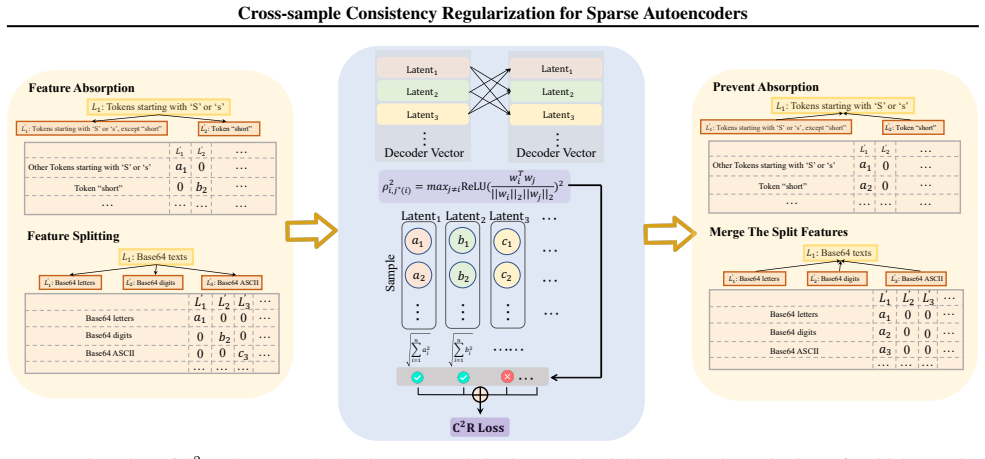
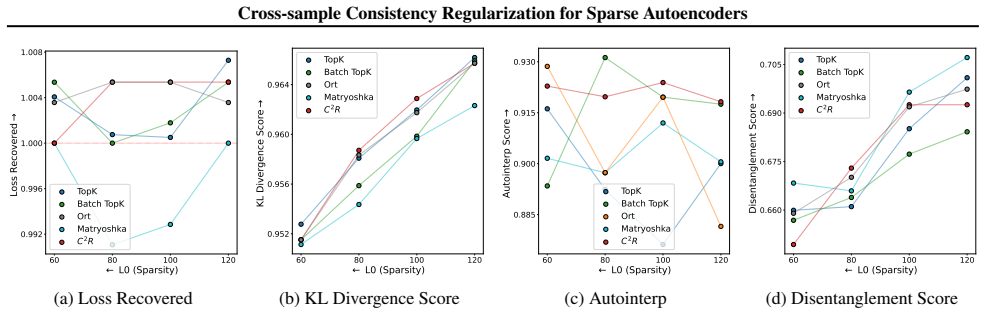
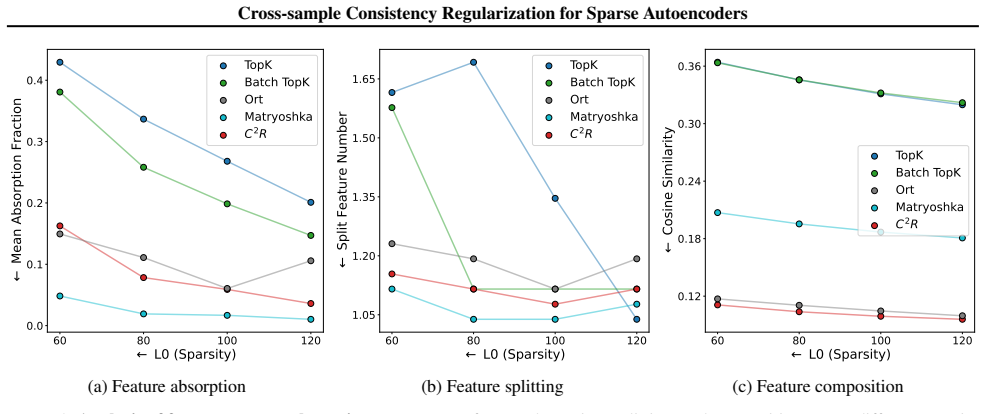
C²R encourages each semantic feature to be represented by a single consistent latent across samples in a batch by adding a term that penalizes the joint activation of directionally similar latents. When applied to standard sparse autoencoders, this regularization measurably decreases both splitting and absorption while the reconstruction loss remains unchanged.
What carries the argument
C²R, a regularization term that penalizes co-activation of directionally similar latents within each training batch to enforce cross-sample consistency.
If this is right
- Splitting is reduced because each concept is forced into one latent rather than distributed across redundant ones.
- Absorption is reduced because general features no longer absorb inconsistent exceptions from other samples.
- Reconstruction quality stays the same because the added term only constrains assignment, not the core reconstruction objective.
- Latent reliability increases, making downstream interpretability analyses more stable across different inputs.
Where Pith is reading between the lines
- The same consistency penalty could be tested on other dictionary-learning methods that decompose activations without explicit cross-sample terms.
- If the regularization scales to larger models, it might reduce the need for post-hoc merging steps that current interpretability pipelines often require.
- A natural next measurement would be whether the improved latents lead to more stable causal interventions in the original language model.
Load-bearing premise
Inconsistent latent assignment across samples is the main driver of splitting and absorption rather than other factors like dictionary size or loss terms.
What would settle it
Run the same SAE training with and without the C²R term on a fixed model and dataset, then compare the measured rates of feature splitting and absorption using the paper's proposed metrics while also checking reconstruction error.
Figures
read the original abstract
Sparse Autoencoders (SAEs) are widely used to interpret large language models by decomposing activations into sparse, human-understandable features, but scaling to large dictionaries exposes fundamental challenges. Systematic studies reveal pervasive feature splitting that fragments coherent concepts into non-atomic latents and widespread feature absorption that creates arbitrary exceptions in general features, severely compromising latent reliability. These issues stem from inconsistent latent assignment across samples: without cross-sample constraints, per-sample optimization often allows a single underlying concept to be inconsistently distributed across multiple redundant or interfering latents. To address this, we introduce C$^2$R (\underline{\textbf{C}}ross-sample \underline{\textbf{C}}onsistency \underline{\textbf{R}}egularization). C$^2$R explicitly encourages that each semantic feature is consistently represented by a unified latent across the batch by penalizing the co-activation of directionally similar latents. Comprehensive evaluation demonstrates that C$^2$R effectively mitigates both splitting and absorption while, crucially, preserving reconstruction fidelity, providing a principled solution that enhances latent interpretability without degrading model performance. Source code is available at https://github.com/hr-jin/Cross-sample-Consistency-Regularization.
Editorial analysis
A structured set of objections, weighed in public.
Referee Report
Summary. The paper identifies pervasive feature splitting and absorption in Sparse Autoencoders (SAEs) as resulting from inconsistent latent assignments across samples in the absence of cross-sample constraints. It introduces C²R, a regularization term that penalizes co-activation of directionally similar latents to enforce consistent representation of semantic features across a batch. The central claim is that C²R mitigates both splitting and absorption while preserving reconstruction fidelity, as demonstrated by comprehensive evaluation, with source code released.
Significance. If the empirical results hold and the causal mechanism is isolated, C²R would offer a targeted, low-overhead regularization for improving SAE feature reliability and interpretability at scale without the usual reconstruction trade-offs. The public release of source code strengthens reproducibility and allows direct testing of the approach in the mechanistic interpretability community.
major comments (2)
- [Abstract] Abstract: the claim that splitting and absorption 'stem from inconsistent latent assignment across samples' and are mitigated specifically by the consistency penalty is load-bearing, yet no controls, ablations, or isolation experiments (e.g., holding dictionary size and sparsity fixed while varying only the cross-sample term) are described to distinguish this mechanism from changes in effective sparsity, optimization dynamics, or dictionary-size interactions.
- [Abstract] Abstract: the assertion of 'comprehensive evaluation' that demonstrates mitigation 'while, crucially, preserving reconstruction fidelity' is unsupported by any quantitative metrics, baselines, error bars, or tables in the provided text, leaving the no-trade-off claim unverified despite being central to the contribution.
Simulated Author's Rebuttal
We thank the referee for the constructive comments on our manuscript. We address each major comment below and commit to revisions that strengthen the evidential basis for our claims.
read point-by-point responses
-
Referee: [Abstract] Abstract: the claim that splitting and absorption 'stem from inconsistent latent assignment across samples' and are mitigated specifically by the consistency penalty is load-bearing, yet no controls, ablations, or isolation experiments (e.g., holding dictionary size and sparsity fixed while varying only the cross-sample term) are described to distinguish this mechanism from changes in effective sparsity, optimization dynamics, or dictionary-size interactions.
Authors: We agree that isolating the causal contribution of the cross-sample term requires explicit controls. The full manuscript reports experiments that hold dictionary size and target sparsity fixed while adding only the C²R term, with improvements in splitting and absorption metrics. To more rigorously rule out confounds from optimization dynamics or dictionary-size interactions, we will add dedicated ablation studies in the revision that compare C²R against alternative regularizers matched for effective sparsity. revision: yes
-
Referee: [Abstract] Abstract: the assertion of 'comprehensive evaluation' that demonstrates mitigation 'while, crucially, preserving reconstruction fidelity' is unsupported by any quantitative metrics, baselines, error bars, or tables in the provided text, leaving the no-trade-off claim unverified despite being central to the contribution.
Authors: The full manuscript contains the requested quantitative support in Section 5, including Tables 2–4 and Figures 2–5 that report reconstruction MSE, cosine similarity, splitting indices, and absorption rates with error bars across multiple models, dictionary sizes, and random seeds, alongside standard SAE baselines. These results show mitigation of splitting and absorption with no statistically significant degradation in reconstruction fidelity. We will revise the abstract to include a concise summary of these key metrics and error bars so that the no-trade-off claim is directly supported within the abstract itself. revision: yes
Circularity Check
No circularity: new regularization objective introduced without reduction to fitted inputs or self-citations
full rationale
The paper hypothesizes that splitting and absorption arise from per-sample optimization lacking cross-sample constraints, then defines C²R as an explicit penalty on co-activation of similar latents. This is a direct methodological proposal rather than a derivation that reduces to its own inputs by construction. No equations are shown that equate a 'prediction' to a fitted parameter, no load-bearing self-citation chain is invoked for uniqueness, and the central claim rests on the new regularization term itself rather than renaming or smuggling prior results. The approach is self-contained as an added loss component evaluated empirically.
Axiom & Free-Parameter Ledger
axioms (1)
- domain assumption Feature splitting and absorption arise primarily from lack of cross-sample consistency constraints during per-sample optimization.
Reference graph
Works this paper leans on
-
[1]
URL https://aclanthology.org/2024. acl-long.470/. Huben, R., Cunningham, H., Smith, L. R., Ewart, A., and Sharkey, L. Sparse autoencoders find highly interpretable features in language models. InThe Twelfth International Conference on Learning Representations, 2023. Karvonen, A. dictionary_learning_demo. https: //github.com/adamkarvonen/dictionary_ learni...
-
[2]
Association for Computational Linguistics. ISBN 979-8-89176-189-6. doi: 10.18653/v1/2025.naacl-long
-
[3]
This neuron activates on the word ’knows’ in rhetorical questions
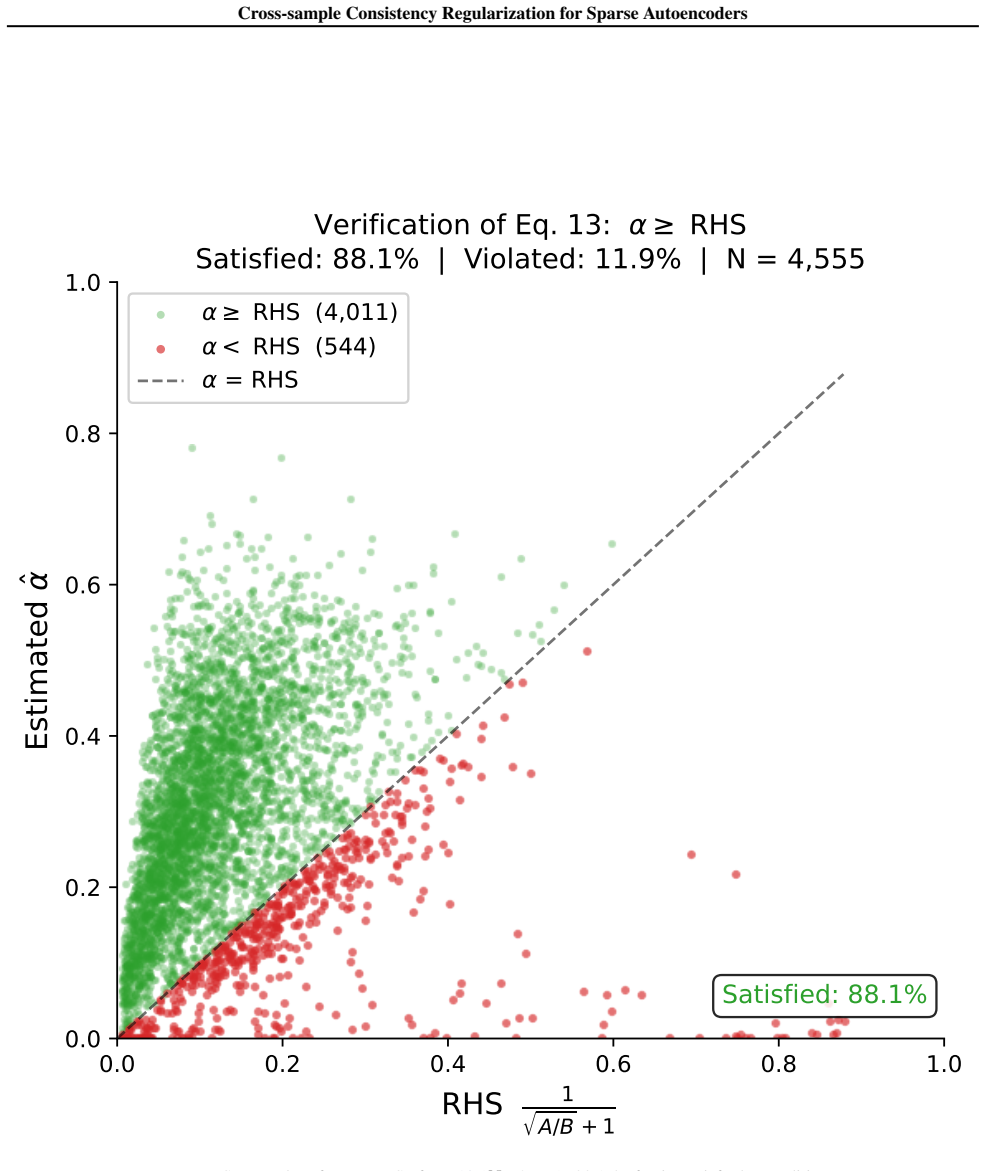
URL https://aclanthology.org/2025. naacl-long.264/. 11 Cross-sample Consistency Regularization for Sparse Autoencoders A. C2R Promotes Cross-sample Consistency When feature absorption occurs, the C2R Loss is: LC2R(X) = vuut mX i=1 (z(i) 1 )2 + m+nX i=m+1 ((1−α)z (i) 1 )2 + vuut m+nX i=m+1 (αz(i) 1 )2 + m+nX i=m+1 (z(i) 2 )2. (19) Taking the partial deriva...
2025
-
[4]
in South Africa • Uganda) · Asia (in China • India • Myanmar • Pakistan • Taiwan • Japan
-
[5]
ized was either beheaded or shot at point blank range." more »←-A Syrian mother and widow was tortured
-
[6]
This is something most traders simply cannot
method’ anyone can do that but getting the right mindset to succeed. This is something most traders simply cannot
-
[7]
Facebook Be Fixed?←-CMS Wire (May 24, 2012) - Facebook
2012
-
[8]
The metal dial has polished silver
Finished in a weathered brown and accented with a circular polished silver bezel. The metal dial has polished silver
-
[9]
when a customer has changed his or her mind about a transaction, or when an error has occurred, the
-
[10]
You’ve warned
Several of you have reached out to us and to our colleagues across the Administration. You’ve warned
-
[11]
Its circular structure is nearly a kilometer below the←-surface and
crater is that←-you cannot see it. Its circular structure is nearly a kilometer below the←-surface and
-
[12]
sound crazy? Okay?←-DW:I’m just going to tell you the truth.←-THE
-
[13]
am I missing some key information here?<eos>The eleventh round of 2020 Monster Energy Super
2020
-
[14]
awesome Flashflight Light-Up Flying Discs are circular, and our equally saucy Meteorlight LED Light
-
[15]
rather than doubling Defense on Dodge←-Strength ••, Brawl •←-Add Brawl rather than doubling Defense on Dodge
-
[16]
Lastly the grain is circular-grained, after which the stone will not move
achieve a perfectly snug fit. Lastly the grain is circular-grained, after which the stone will not move
-
[17]
Instead he drew a Dalek with two big round holes in it, and a guy catching a baseball
-
[18]
This neuron activates on the word ’knows’ in rhetorical questions
abb, Sean McDermott, Kevin Kolb). If the Eagles are waiting for a Packers assistant, the best Table 4.Prompt example for LLM judger to predict latent activations based on its explanation generated by the LLM explainer. 15 Cross-sample Consistency Regularization for Sparse Autoencoders Instruction example for human annotators We’re studying neurons in a ne...
-
[19]
off-the-wall in this first directorial effort from the 49-year-old Belgian
-
[20]
<eos>The Academy of Motion Picture Arts and Sciences which is best known for organizing the Oscars has
your organization. <eos>The Academy of Motion Picture Arts and Sciences which is best known for organizing the Oscars has
-
[21]
That’s because
Realtors and the Mortgage Bankers Association.←-But this time, lobbyists are worried. That’s because
-
[22]
Valtrex is used to treat herpes zoster and herpes simplex and,
considered a natural antihistamine. Valtrex is used to treat herpes zoster and herpes simplex and,
-
[23]
of the stomach and intestines.←-Be sure to tell your doctor if you experience any of these side effects Table 5.Instruction example for human annotators to predict latent activation. 16 Cross-sample Consistency Regularization for Sparse Autoencoders Prediction Match Pearsonr Annotator 1 97.8% 0.74 Annotator 2 96.7% 0.63 Annotator 3 97.6% 0.86 Average 97.3...
discussion (0)
Sign in with ORCID, Apple, or X to comment. Anyone can read and Pith papers without signing in.