REVIEW 3 minor 1 cited by
Optimal Calibration of Quantum Network Links
T0 review · 0 major / 3 minor · reviewed 2026-06-26 · grok-4.3
Pith's one-line read An analytical protocol assigns optimal activation periods to links in linear quantum repeater chains to meet end-to-end fidelity requirements despite calibration downtime.
desk verdict The paper gives a clean analytical derivation for optimal activation periods on linear quantum repeater chains under general fidelity thresholds, plus a heuristic for broader networks. read the letter →
The pith
A machine-rendered reading of the paper's core claim, the machinery that carries it, and where it could break.
The reading
What carries the argument
Analytical assignment of activation periods that trades off fidelity decay against calibration unavailability in linear chains.
What would settle it
An experiment that measures fidelity over time in real quantum links and finds either no measurable decay or decay that cannot be reversed by the assumed calibration step.
Extended reading notes
Core claim
The authors derive an analytical protocol that determines the activation period for each link in a linear quantum repeater chain such that the end-to-end fidelity meets a required threshold, given initial local fidelities, while minimizing the impact of calibration periods that render links unavailable. For general topologies, they propose a heuristic that approximates the optimal assignment and validate it against numerical optimization and bounds.
Load-bearing premise
Entanglement generation fidelity in each link decays over time in a predictable way that can be restored only by a calibration operation that temporarily disables the link.
Editorial extensions
If this is right
- Each link receives an explicit on-time that just satisfies the global fidelity floor without unnecessary calibration overhead.
- Linear repeater chains can be scheduled so that end-to-end entanglement distribution remains feasible under any stated fidelity target.
- The heuristic produces near-optimal activation schedules for networks with crossing paths while remaining computationally tractable.
- Simulation comparisons confirm the heuristic stays within a few percent of both numerical optima and theoretical bounds.
Reading between the lines
- Network designers could pre-compute activation tables when laying out repeater spacing and calibration intervals.
- Real-time environmental sensors could feed updated decay rates into the same formulas to adjust periods dynamically.
- The same availability-quality trade-off may apply to other limited quantum resources such as memory storage times.
- Joint calibration across multiple shared links would require extending the linear solution to a coupled optimization.
Editorial analysis
A structured set of objections, weighed in public.
Referee Report
Summary. The paper claims to derive analytically an optimal protocol for assigning activation periods to links in linear quantum repeater chains. The protocol balances fidelity decay during activation periods against link unavailability during calibration, subject to arbitrary end-to-end fidelity constraints and per-link initial fidelity thresholds. It then proposes a heuristic extension to general (non-linear) quantum networks with crossing paths and evaluates the heuristic via simulation against a numerical benchmark and theoretical bounds.
Significance. If the central analytical derivation is correct and the model assumptions match experimental conditions, the result supplies a concrete, constraint-respecting method for duty-cycle optimization in repeater chains—an issue directly motivated by recent experimental observations of time-varying entanglement generation. The simulation-based comparison for the general-network heuristic provides practical guidance even if the extension remains non-analytical. Explicit credit is due for framing the problem with general fidelity requirements rather than fixed numerical targets.
minor comments (3)
- The abstract states that an analytical derivation exists for linear chains, yet the provided text contains no equations, objective function, or proof sketch; the full manuscript should include the explicit optimization formulation (e.g., the expression for end-to-end fidelity as a function of per-link activation times) so that the claimed generality can be verified.
- The heuristic for general networks is described only at a high level; a dedicated section or pseudocode would clarify how shared-link constraints are resolved when multiple paths intersect.
- Simulation results are mentioned but no details on the number of trials, network topologies tested, or statistical error bars appear in the visible text; these should be added to support the comparison with the numerical benchmark.
Simulated Author's Rebuttal
We thank the referee for their positive summary of our work and for recommending minor revision. The referee's description accurately reflects the analytical results for linear chains and the heuristic evaluation for general networks. No specific major comments were raised in the report.
Circularity Check
No significant circularity detected
full rationale
The paper's central contribution is an analytical derivation of optimal activation periods for linear repeater chains, treating fidelity decay during activation and unavailability during calibration as externally motivated inputs from recent experimental studies. No equations, fitted parameters, or self-citations are visible in the provided text that would reduce the optimization result to a self-defined quantity or prior author work by construction. The extension to general networks is explicitly heuristic. This matches the default expectation of a self-contained derivation against external benchmarks.
Assumptions & free parameters
Cite this review
Pith. "Pith review of Optimal Calibration of Quantum Network Links." pith.science (2026). https://pith.science/paper/PAYMMV6Q
@misc{pith2026260618167,
  author       = {Pith},
  title        = {Pith review of: Optimal Calibration of Quantum Network Links},
  year         = {2026},
  howpublished = {\url{https://pith.science/paper/PAYMMV6Q}},
  note         = {Machine review of arXiv:2606.18167}
}
read the original abstract
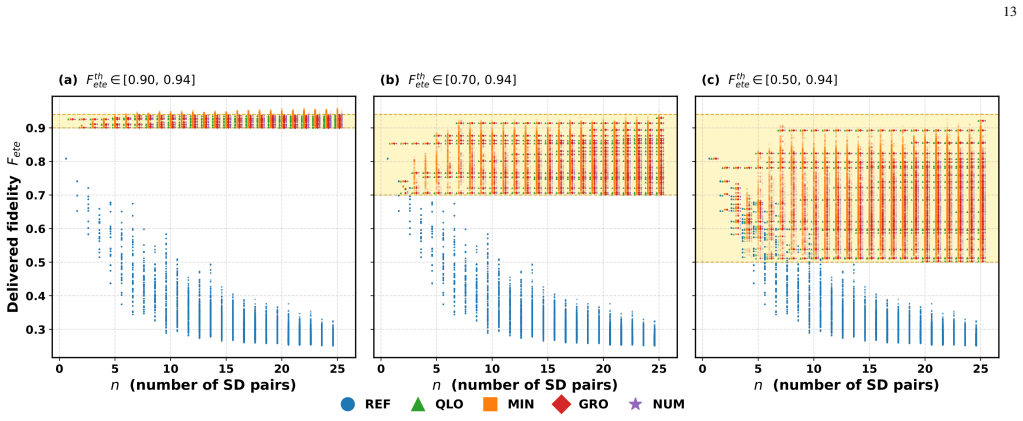
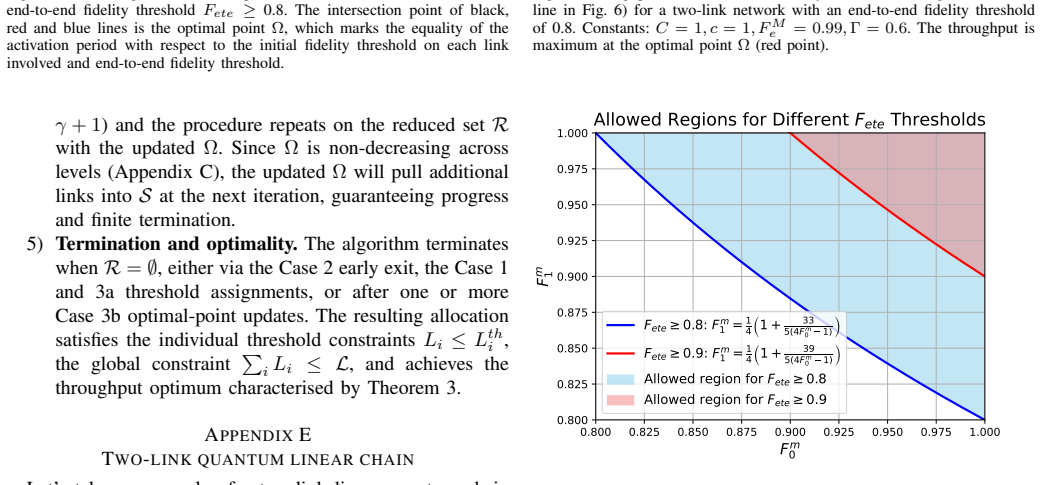
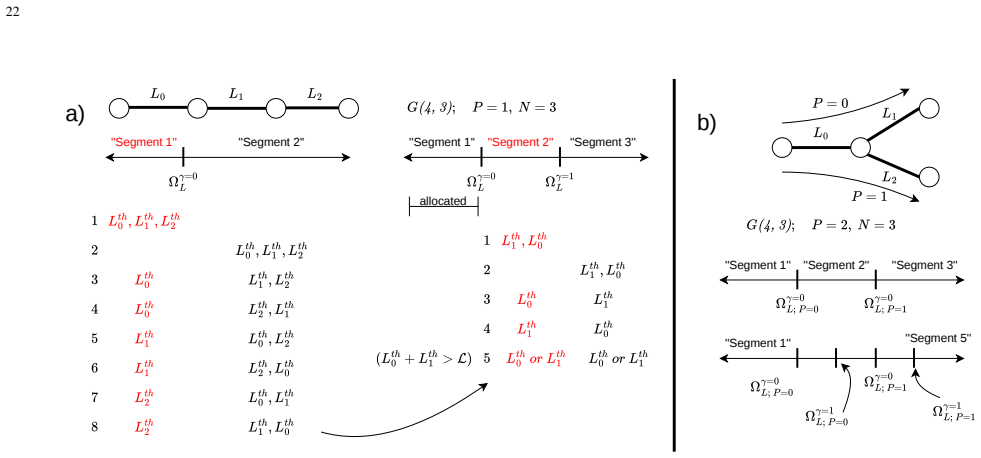
The reliable distribution of entanglement is essential for the effective operation of quantum networks. Due to fundamental differences between quantum and classical communication systems, it is necessary to develop specialised algorithms and protocols that also account for quantum-specific constraints. In this work, we focus on the issue of recalibration. As suggested by recent experimental studies, the process of local entanglement generation in a quantum link degrades over time due to environmental changes that have to be estimated and compensated via a calibration operation, during which the link is not available. Therefore, in such a quantum network, every link alternates between an activation period, during which it operates normally, and a calibration period, during which it cannot participate in the end-to-end entanglement distribution, thereby creating a trade-off between link quality (the fidelity of generated pairs, which decays during activation) and availability (the fraction of time the link is usable, which calibration reduces). We develop analytically a protocol for optimally assigning activation periods to each link in linear quantum repeater chains, subject to any general end-to-end fidelity requirements and local initial fidelity thresholds. Building on this foundation, we extend to general quantum networks, where multiple paths may cross at common links, proposing a heuristic approach evaluated in simulations and compared with a benchmark, numerical approach, and theoretical bounds.
Figures


Figures from the paper (6 more)



Forward citations
Cited by 1 Pith paper
-
Making Quantum Networks Work: Routing, Calibration, and Programmable Quantum Repeaters
The thesis introduces grey-box routing using partial node knowledge, optimal calibration schedules for repeater chains, and a programmable ISA to improve fidelity and throughput in quantum repeater networks under real...
Reference graph
Works this paper leans on
-
[1]
”Quantum internet: Technologies, protocols, and research challenges.” International Journal of Networked and Distributed Computing 13.2 (2025): 22
Kumar, Vinay, et al. ”Quantum internet: Technologies, protocols, and research challenges.” International Journal of Networked and Distributed Computing 13.2 (2025): 22
2025
-
[2]
”The Quantum Internet (Technical Version).” arXiv preprint arXiv:2501.12107 (2025)
Rohde, Peter P., et al. ”The Quantum Internet (Technical Version).” arXiv preprint arXiv:2501.12107 (2025)
-
[3]
Making Quantum Networks Work: Routing, Calibration, and Programmable Quantum Repeaters
Kumar, V ., “Making Quantum Networks Work: Routing, Calibration, and Programmable Quantum Repeaters.” (2026). Ph.D. dissertation, Univer- sity of Pisa, submitted. 15
2026
-
[4]
”Quantum internet building blocks state of research and development.” Computer Networks 261 (2025): 111151
Meddeb, Aref. ”Quantum internet building blocks state of research and development.” Computer Networks 261 (2025): 111151
2025
-
[5]
”Indistinguishability of arbitrary photons for entanglement generation in scalable quantum networks.” Optics Express 33.26 (2025): 54501-54512
Lal, Nijil, et al. ”Indistinguishability of arbitrary photons for entanglement generation in scalable quantum networks.” Optics Express 33.26 (2025): 54501-54512
2025
-
[6]
”” Event-ready-detectors” Bell experiment via entanglement swapping.” Physical review letters 71.26 (1993)
Zukowski, Marek, et al. ”” Event-ready-detectors” Bell experiment via entanglement swapping.” Physical review letters 71.26 (1993)
1993
-
[7]
”Realization of a multinode quantum network of remote solid-state qubits.” Science 372.6539 (2021): 259-264
Pompili, Matteo, et al. ”Realization of a multinode quantum network of remote solid-state qubits.” Science 372.6539 (2021): 259-264
2021
-
[8]
”Entanglement of trapped-ion qubits separated by 230 meters.” Physical Review Letters 130.5 (2023): 050803
Krutyanskiy, Viktor, et al. ”Entanglement of trapped-ion qubits separated by 230 meters.” Physical Review Letters 130.5 (2023): 050803
2023
Show all 34 references
-
[9]
”Entanglement of nanophotonic quantum memory nodes in a telecom network.” Nature 629.8012 (2024): 573-578
Knaut, Can M., et al. ”Entanglement of nanophotonic quantum memory nodes in a telecom network.” Nature 629.8012 (2024): 573-578
2024
-
[10]
”Automated distribution of polarization- entangled photons using deployed New York City fibers.” PRX Quantum 5.3 (2024): 030330
Craddock, Alexander N., et al. ”Automated distribution of polarization- entangled photons using deployed New York City fibers.” PRX Quantum 5.3 (2024): 030330
2024
-
[11]
Hermans, S. L. N., et al. ”Qubit teleportation between non-neighbouring nodes in a quantum network.” Nature 605.7911 (2022): 663-668
2022
-
[12]
”Routing in quantum networks with end-to-end knowledge.” IET Quantum Communication 6.1 (2025): e70000
Kumar, Vinay, et al. ”Routing in quantum networks with end-to-end knowledge.” IET Quantum Communication 6.1 (2025): e70000
2025
-
[13]
”Routing in Quantum Repeater Networks with Mixed Efficiency Figures.” 2024 IEEE Future Networks World Forum (FNWF)
Kumar, Vinay, et al. ”Routing in Quantum Repeater Networks with Mixed Efficiency Figures.” 2024 IEEE Future Networks World Forum (FNWF). IEEE, 2024
2024
-
[14]
”Routing entanglement in the quantum internet.” npj Quantum Information 5.1 (2019): 25
Pant, Mihir, et al. ”Routing entanglement in the quantum internet.” npj Quantum Information 5.1 (2019): 25
2019
-
[15]
”Entanglement buffering with multiple quantum memories.” arXiv preprint arXiv:2502.20240 (2025)
I ˜nesta, ´Alvaro G., et al. ”Entanglement buffering with multiple quantum memories.” arXiv preprint arXiv:2502.20240 (2025)
2025
-
[16]
”Quantum repeaters based on entanglement purifi- cation.” Physical Review A 59.1 (1999): 169
D ¨ur, Wolfgang, et al. ”Quantum repeaters based on entanglement purifi- cation.” Physical Review A 59.1 (1999): 169
1999
-
[17]
”A study of polarization compensation for quantum networks.” EPJ quantum technology 10.1 (2023): 30
Perani ´c, Matej, et al. ”A study of polarization compensation for quantum networks.” EPJ quantum technology 10.1 (2023): 30
2023
-
[18]
”Non-local polarization alignment and control in fibers using feedback from correlated measurements of entangled photons.” Optics Express 31.2 (2023): 2316-2329
Dowling, Evan, et al. ”Non-local polarization alignment and control in fibers using feedback from correlated measurements of entangled photons.” Optics Express 31.2 (2023): 2316-2329
2023
-
[19]
”Efficient polarization-entangled state compensa- tion in quantum entanglement distribution.” Optics Express 33.11 (2025): 23204-23213
Zhou, Xiao-yan, et al. ”Efficient polarization-entangled state compensa- tion in quantum entanglement distribution.” Optics Express 33.11 (2025): 23204-23213
2025
-
[20]
”Design and implementation of the Illinois Express quantum metropolitan area network.” IEEE Transactions on Quantum Engineering 3 (2022): 1-20
Chung, Joaquin, et al. ”Design and implementation of the Illinois Express quantum metropolitan area network.” IEEE Transactions on Quantum Engineering 3 (2022): 1-20
2022
-
[21]
”The QUANT-NET testbed development and preliminary results.” 2024 IEEE International Conference on Quantum Computing and Engineering (QCE)
Schon, Damian, et al. ”The QUANT-NET testbed development and preliminary results.” 2024 IEEE International Conference on Quantum Computing and Engineering (QCE). V ol. 1. IEEE, 2024
2024
-
[22]
”Experimental Demonstration of Software- Orchestrated Quantum Network Applications over a Campus-Scale Testbed.” arXiv preprint arXiv:2511.01247 (2025)
Islam, Md Shariful, et al. ”Experimental Demonstration of Software- Orchestrated Quantum Network Applications over a Campus-Scale Testbed.” arXiv preprint arXiv:2511.01247 (2025)
2025
-
[23]
”Quantum repeaters: From quantum networks to the quantum internet.” Reviews of Modern Physics 95.4 (2023): 045006
Azuma, Koji, et al. ”Quantum repeaters: From quantum networks to the quantum internet.” Reviews of Modern Physics 95.4 (2023): 045006
2023
-
[24]
”Purification scheduling control for throughput max- imization in quantum networks.” Communications Physics 7.1 (2024): 307
Xiao, Zirui, et al. ”Purification scheduling control for throughput max- imization in quantum networks.” Communications Physics 7.1 (2024): 307
2024
-
[25]
”Link configuration for fidelity-constrained en- tanglement routing in quantum networks.” IEEE INFOCOM 2025-IEEE Conference on Computer Communications
Zhang, Qiaolun, et al. ”Link configuration for fidelity-constrained en- tanglement routing in quantum networks.” IEEE INFOCOM 2025-IEEE Conference on Computer Communications. IEEE, 2025
2025
-
[26]
”Quantum network utility maximization.” 2023 IEEE International Conference on Quantum Com- puting and Engineering (QCE)
Vardoyan, Gayane, and Stephanie Wehner. ”Quantum network utility maximization.” 2023 IEEE International Conference on Quantum Com- puting and Engineering (QCE). V ol. 1. IEEE, 2023
2023
-
[27]
”A Framework for Distributed Resource Allocation in Quantum Networks.” arXiv preprint arXiv:2510.09371 (2025)
Panigrahy, Nitish K., et al. ”A Framework for Distributed Resource Allocation in Quantum Networks.” arXiv preprint arXiv:2510.09371 (2025)
2025
-
[28]
”Quantum network optimization: From optimal routing to fair resource allocation.” Proceedings of the ACM on Mea- surement and Analysis of Computing Systems 9.2 (2025): 1-26
Wang, Zhaozhen, et al. ”Quantum network optimization: From optimal routing to fair resource allocation.” Proceedings of the ACM on Mea- surement and Analysis of Computing Systems 9.2 (2025): 1-26
2025
-
[29]
”An on-demand resource allocation algorithm for a quantum network hub and its performance analysis.” 2024 IEEE International Conference on Quantum Computing and Engineering (QCE)
Gauthier, Scarlett, Thirupathaiah Vasantam, and Gayane Vardoyan. ”An on-demand resource allocation algorithm for a quantum network hub and its performance analysis.” 2024 IEEE International Conference on Quantum Computing and Engineering (QCE). V ol. 1. IEEE, 2024
2024
-
[30]
”Fidelity-Age-Aware Scheduling in Quantum Repeater Networks.” arXiv preprint arXiv:2602.09562 (2026)
Ercetin, Ozgur, and Zafer Gedik. ”Fidelity-Age-Aware Scheduling in Quantum Repeater Networks.” arXiv preprint arXiv:2602.09562 (2026)
2026
-
[31]
”A new look at the statistical model identification.” IEEE transactions on automatic control 19.6 (2003): 716-723
Akaike, Hirotugu. ”A new look at the statistical model identification.” IEEE transactions on automatic control 19.6 (2003): 716-723
2003
-
[32]
Rongqing Hui, Maurice O’Sullivan, Chapter 2 - Basic Instrumen- tation for Optical Measurement, Fiber Optic Measurement Tech- niques, Academic Press, 2009, Pages 129-258, ISBN 9780123738653, https://doi.org/10.1016/B978-0-12-373865-3.00002-1
2009 doi
-
[33]
https://physics.stackexchange.com/questions/238957/ converting-stokes-parameters-to-jones-vector
-
[34]
1 + 3 N−1Y i=0 4F i(ae)−1 3 # .(27) Let the quantum network require an end-to-end fidelity thresh- old ofF th ete.So F th ete ≤F ete(ae) = 1 4
Burnham, Kenneth P., and David R. Anderson, eds. Model selection and multimodel inference: a practical information-theoretic approach. New York, NY: Springer New York, 2002. 16 APPENDIXA PROCESSING OFEXPERIMENTALDATA ANDDERIVATION OFFIG. 1 A. Raw Data Format The experimental d...
2002
Reviewed June 26, 2026 · model on record in the stance chip above.
Discussion (0). Continue with ORCID to comment.