Designed by Journalists, but Is It for Readers? Rethinking AI Disclosures and Transparency in News
Pith reviewed 2026-06-27 11:14 UTC · model grok-4.3
The pith
Detailed AI disclosures in news reduce reader trust instead of building it.
A machine-rendered reading of the paper's core claim, the machinery that carries it, and where it could break.
Core claim
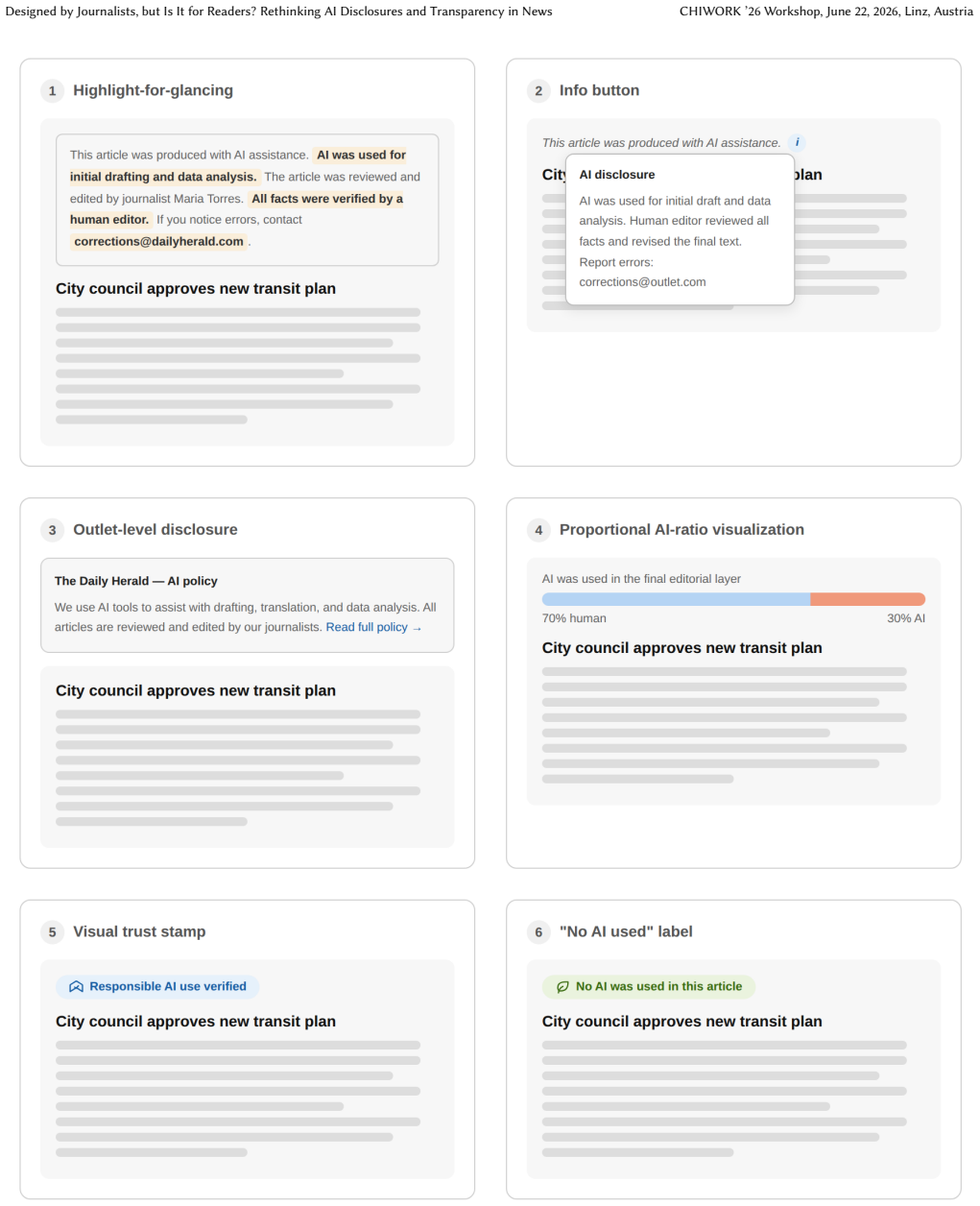
A controlled experiment with 34 news readers shows that detailed disclosures trigger a transparency dilemma that reduces trust, while one-line disclosures create an information gap prompting readers to search for AI signs. Readers proposed user-agency centered designs including detail-on-demand interactions, proportional AI-ratio visualizations, outlet-level signals, and explicit no-AI labels, revealing a disconnect between journalistic practices and reader needs.
What carries the argument
The transparency dilemma observed when comparing detailed versus brief AI disclosure formats in the reader experiment.
If this is right
- News organizations risk introducing dark patterns when using detailed AI disclosures.
- One-line labels should be paired with mechanisms for readers to access more information on demand.
- Proportional visualizations of AI involvement and explicit no-AI labels could address reader concerns.
- Outlet-level transparency signals may prove more effective than article-by-article disclosures.
Where Pith is reading between the lines
- Disclosure design issues identified here may apply to AI use in other trust-sensitive areas like health or finance reporting.
- Real-world testing of the proposed detail-on-demand formats could validate their effectiveness beyond the lab setting.
- The gap between journalist assumptions and reader preferences points to opportunities for interface experiments in news platforms.
Load-bearing premise
Results from the experiment with 34 participants reflect how broader populations of news readers respond to disclosure formats.
What would settle it
A larger study with diverse readers that finds detailed disclosures increase trust or that the suggested reader designs fail to improve outcomes.
Figures
read the original abstract
As newsrooms integrate generative AI, journalists face a disclosure challenge: how to communicate AI involvement in ways that maintain reader trust. Current practice offers two approaches: brief one-line labels or detailed disclosures specifying human oversight, editorial accountability, and error reporting mechanisms. Neither achieves journalists' goal of building trust through transparency. An existing controlled experiment with 34 news readers show that detailed disclosures trigger a \textit{transparency dilemma}, reducing trust rather than increasing it, and risk introducing dark patterns that readers scroll past with the illusion of transparency. One-line disclosures avoid this effect but can create an information gap, prompting readers to expend cognitive effort searching for signs of AI involvement that the disclosure indicates but does not explain. Yet readers are not rejecting transparency, they proposed disclosure designs centered on user agency: detail-on-demand interactions, proportional AI-ratio visualizations, outlet-level signals, and explicit "no AI" labels. I argue that this disconnect between what practitioners believe is responsible disclosure and what users actually need is a design problem for the HCI community.
Editorial analysis
A structured set of objections, weighed in public.
Referee Report
Summary. The paper examines how newsrooms disclose generative AI involvement to readers, contrasting brief one-line labels with detailed disclosures that specify human oversight and error reporting. It claims neither approach builds trust: an experiment with 34 readers shows detailed disclosures create a 'transparency dilemma' that lowers trust and risks dark patterns readers scroll past, while one-line labels leave information gaps prompting extra cognitive effort. Readers instead proposed agency-centered designs such as detail-on-demand, AI-ratio visualizations, outlet-level signals, and 'no AI' labels. The manuscript frames the mismatch between journalistic practice and reader needs as an HCI design problem.
Significance. If the reported experiment is methodologically sound and generalizable, the work identifies a practical tension in AI transparency for journalism that could inform disclosure standards and reduce unintended trust erosion. It contributes by shifting focus from practitioner assumptions to user-proposed alternatives, potentially guiding HCI research on interactive transparency mechanisms. No machine-checked proofs, open code, or parameter-free derivations are present.
major comments (2)
- [Abstract / experiment description] Abstract and the paragraph describing the experiment: The central claim that detailed disclosures trigger a transparency dilemma and reduce trust rests entirely on 'an existing controlled experiment with 34 news readers,' yet the manuscript supplies no information on recruitment, trust scales or items, stimuli, control conditions, statistical tests, effect sizes, power analysis, or exclusion criteria. A sample of this size cannot reliably support the reported effect or the broader claims about dark patterns and scrolling behavior without these details.
- [Abstract / discussion of reader proposals] The generalizability claim: The manuscript extrapolates from the N=34 sample to 'readers' in general and to risks of dark patterns without discussing limitations, demographic details of participants, or any replication or follow-up data. This is load-bearing for the recommendation that current practices fail and that HCI should intervene.
minor comments (2)
- [Abstract] Grammatical error: 'An existing controlled experiment with 34 news readers show that' should be 'shows that.'
- [Abstract] The term 'dark patterns' is used without definition or citation in the context of disclosure interfaces; a brief clarification or reference would improve precision.
Simulated Author's Rebuttal
We thank the referee for their constructive comments, which highlight important issues regarding the transparency and generalizability of the referenced experiment. We agree that additional details and caveats are needed and will revise the manuscript accordingly.
read point-by-point responses
-
Referee: [Abstract / experiment description] Abstract and the paragraph describing the experiment: The central claim that detailed disclosures trigger a transparency dilemma and reduce trust rests entirely on 'an existing controlled experiment with 34 news readers,' yet the manuscript supplies no information on recruitment, trust scales or items, stimuli, control conditions, statistical tests, effect sizes, power analysis, or exclusion criteria. A sample of this size cannot reliably support the reported effect or the broader claims about dark patterns and scrolling behavior without these details.
Authors: The referee is correct that the manuscript lacks these methodological details. The experiment is an existing study conducted by the authors and reported in a separate venue (we will add the citation). In the revised manuscript, we will include a brief methods description covering recruitment (e.g., via online panels), the trust measurement items (adapted from established scales), the stimuli used (mock news articles with different disclosure types), control conditions, and statistical results including effect sizes. We will also note the small sample size as a limitation and frame the findings as preliminary insights rather than definitive evidence. This addresses the concern about supporting the claims. revision: yes
-
Referee: [Abstract / discussion of reader proposals] The generalizability claim: The manuscript extrapolates from the N=34 sample to 'readers' in general and to risks of dark patterns without discussing limitations, demographic details of participants, or any replication or follow-up data. This is load-bearing for the recommendation that current practices fail and that HCI should intervene.
Authors: We agree with the referee that the current text overgeneralizes without adequate discussion of limitations. In the revision, we will add a Limitations section that explicitly discusses the small sample size, the absence of detailed demographic information in the original study (which we will attempt to retrieve and report), and the lack of replication. We will revise the language throughout to refer to 'participants in our study' rather than 'readers' broadly, and qualify the recommendations as suggestions for future HCI research based on these initial findings. This will ensure the claims are appropriately scoped. revision: yes
Circularity Check
No significant circularity; empirical claims rest on referenced experiment
full rationale
The paper is an empirical HCI study whose central claim (transparency dilemma from detailed disclosures) is supported by reference to an existing controlled experiment with 34 readers. There are no equations, fitted parameters, self-definitional logic, ansatzes, or derivations that reduce any result to its own inputs by construction. The reference to prior experimental evidence does not create a self-citation chain that forces the conclusion; it functions as external support even if details are summarized. This matches the default expectation of no circularity for non-theoretical papers.
Axiom & Free-Parameter Ledger
Reference graph
Works this paper leans on
-
[1]
2025.How we’re designing user-centred AI labels at the BBC
BBC. 2025.How we’re designing user-centred AI labels at the BBC. https://www. bbc.co.uk/mediacentre/articles/user-centred-ai-labels
2025
-
[2]
de Vreese, Stephan Lewandowsky, Natali Helberger, Anders Søgaard, Naja Holten Møller, Irina Shklovski, Virginia Dignum, Madalina Botan, and Giovanni De Gregorio
Anja Bechmann, Claes H. de Vreese, Stephan Lewandowsky, Natali Helberger, Anders Søgaard, Naja Holten Møller, Irina Shklovski, Virginia Dignum, Madalina Botan, and Giovanni De Gregorio. 2026.Transparency of AI-generated content when AI is the norm. CAISA Brief. Center for AI in Society (CAISA). https: //caisa.dk/forskning/governing-ai-generated-content
2026
-
[3]
Charlie Beckett and Mira Yaseen. 2023. Generating change: A global survey of what news organisations are doing with AI. (2023)
2023
-
[4]
2024.AI transparency in journalism
Nordic AI Journalism in collaboration with Utgivarna. 2024.AI transparency in journalism. https://www.nordicaijournalism.com/ai-transparency
2024
-
[5]
Michael Koliska. 2022. Trust and journalistic transparency online.Journalism Studies23, 12 (2022), 1488–1509
2022
-
[6]
Amber Kusters, Pooja Prajod, Pablo Cesar, and Abdallah El Ali. 2026. More Human or More AI? Visualizing Human-AI Collaboration Disclosures in Journalistic News Production. InProceedings of the 2026 CHI Conference on Human Factors in Computing Systems. 1–22
2026
-
[7]
Bingjie Liu and Lewen Wei. 2019. Machine authorship in situ: Effect of news organization and news genre on news credibility.Digital journalism7, 5 (2019), 635–657
2019
-
[8]
George Loewenstein. 1994. The psychology of curiosity: A review and reinter- pretation.Psychological bulletin116, 1 (1994), 75
1994
-
[9]
Andreas Nanz, Alice Binder, and Jörg Matthes. 2025. AI in the Newsroom: Does the Public Trust Automated Journalism and Will They Pay for It?Journalism Studies(2025), 1–20
2025
-
[10]
Stanislaw Piasecki, Sophie Morosoli, Natali Helberger, and Laurens Naudts. 2024. AI-generated journalism: Do the transparency provisions in the AI Act give news readers what they hope for?Internet Policy Review13, 4 (2024), 1–28
2024
-
[11]
Pooja Prajod, Hannes Cools, Thomas Röggla, Pablo Cesar, and Abdallah El Ali
-
[12]
Towards Gaze-Informed AI Disclosure Interfaces: Eye-Tracking Atten- tional and Cognitive Load While Reading AI-Assisted News.arXiv preprint arXiv:2605.14999(2026)
Pith/arXiv arXiv 2026
-
[13]
Pooja Prajod, Hannes Cools, Thomas Röggla, Karthikeya Puttur Venkatraj, Amber Kusters, Alia ElKattan, Pablo Cesar, and Abdallah El Ali. 2026. Full Disclosure, Less Trust? How the Level of Detail about AI Use in News Writing Affects Readers’ Trust.arXiv preprint arXiv:2601.09620(2026)
Pith/arXiv arXiv 2026
-
[14]
Hauke Sandhaus, Kashif Imteyaz, Mohammed Almutairi, Pooja Prajod, Divya Ramesh, Saiph Savage, Qian Yang, and Michael Muller. 2026. Interrogating GenAI Augmentation for CHIworkers: Strategies for Professional Autonomy and Accountability. InAdjunct Proceedings of the 5th Annual Symposium on Human- Computer Interaction for Work(Linz, Austria)(CHIWORK ’26). A...
-
[15]
Sebastián Valenzuela, Ingrid Bachmann, Porismita Borah, and Natalia Solís Valdés
-
[16]
The Effects of Generative AI in News on Media Credibility and Selectivity: Evidence from a Conjoint Experiment in Chile.Digital Journalism(2026), 1–22
2026
discussion (0)
Sign in with ORCID, Apple, or X to comment. Anyone can read and Pith papers without signing in.