BodyReLux: Temporally Consistent Full-Body Video Relighting
Pith reviewed 2026-05-22 08:48 UTC · model grok-4.3
The pith
A subject-specific video diffusion model can relight full-body human performances consistently across frames under new lighting.
A machine-rendered reading of the paper's core claim, the machinery that carries it, and where it could break.
Core claim
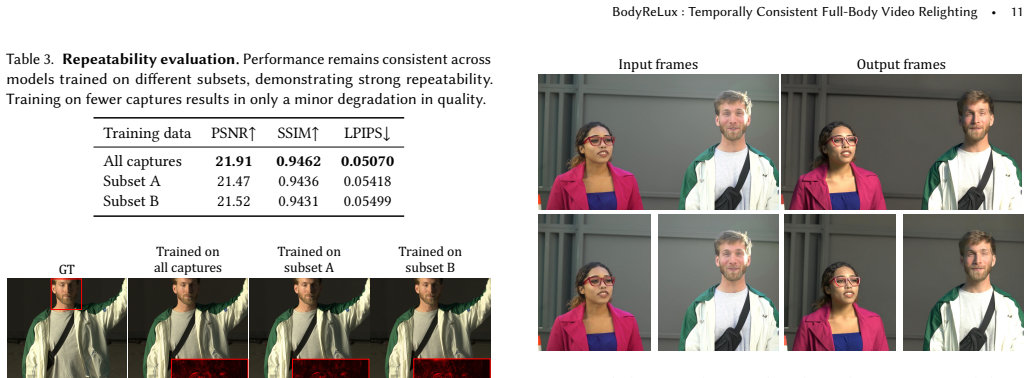
BodyReLux is a subject-specific video diffusion-based framework that relights full-body human performances in a temporally consistent way. It trains on a hybrid dataset of pixel-aligned video relighting pairs obtained from traditional static One-Light-at-a-Time capture plus a novel dynamic capture that rapidly interleaves two smoothly varying lighting sequences above the flicker-fusion threshold. The model starts from a pretrained text-to-video diffusion model, adds a lighting conditioning method that represents each light source as a token, and uses masked attention over lighting sequences to support dynamic control, together with a data augmentation pipeline.
What carries the argument
Token representation of each light source together with masked attention over sequences of lighting, which supplies precise dynamic control inside the video diffusion model.
If this is right
- Human performance videos can be edited with arbitrary dynamic lighting changes after capture while preserving motion and detail.
- The hybrid capture approach supplies enough aligned training pairs to adapt generative video models to lighting tasks without large new datasets.
- Token-based lighting control enables fine-grained, frame-by-frame lighting edits that respect physical light sources.
- Data augmentation during training increases robustness to viewpoint and performance variation in the relit results.
Where Pith is reading between the lines
- The interleaving capture technique could supply paired data for other video tasks that require exact alignment under varying conditions, such as material or weather changes.
- If inference speed improves, the same conditioning approach might support live relighting in virtual production or augmented reality settings.
- Extending the light tokens to include color temperature or shadow parameters could allow more complete scene editing beyond simple relighting.
Load-bearing premise
Rapidly interleaving two smoothly varying lighting sequences above the human flicker-fusion threshold yields accurate pixel-aligned relighting pairs without visible artifacts or motion disruption.
What would settle it
Relit output videos that exhibit flickering, lighting mismatches, or visible artifacts when tested on new performances under changing lights would show the temporal consistency and alignment claims do not hold.
Figures



read the original abstract
Being able to relight human performance is a fundamental task for post production and content creation. We present BodyReLux, a subject-specific video diffusion-based framework for relighting full-body human performances in a temporally consistent way. Our model is trained on a hybrid dataset of pixel-aligned video relighting pairs, covering a diverse combination of lighting conditions, performances and viewpoints. To acquire such dataset, we combine traditional static One-Light-at-a-Time (OLAT) capture and a novel dynamic performance capture in which two smoothly varying lighting sequences are rapidly interleaved. Because the lighting operates above the human flicker-fusion threshold, the interleaving does not appear to strobe. We train our video relighting model from a pretrained text-to-video model to fully leverage the generative priors for producing high quality videos. To achieve accurate lighting control, we introduce a new lighting conditioning method that represents each light source as a token. We further condition on sequences of lighting using masked attention to support dynamic lighting control. Together with a carefully designed data augmentation pipeline, we achieve photorealistic, robust, and temporally consistent video relighting of subject-specific human performances.
Editorial analysis
A structured set of objections, weighed in public.
Referee Report
Summary. The manuscript presents BodyReLux, a subject-specific video diffusion-based framework for temporally consistent full-body human performance relighting. The model is trained on a hybrid dataset of pixel-aligned video relighting pairs obtained by combining traditional static One-Light-at-a-Time (OLAT) capture with a novel dynamic performance capture that rapidly interleaves two smoothly varying lighting sequences. Because the lighting operates above the human flicker-fusion threshold, the interleaving is claimed to be imperceptible and to yield clean pairs. The approach fine-tunes a pretrained text-to-video diffusion model, introduces a lighting token representation for each light source, and uses masked attention over lighting sequences together with data augmentation to achieve photorealistic, robust, and temporally consistent results.
Significance. If the central claims hold, the work would be a useful contribution to computer vision for post-production and content creation by providing a practical route to subject-specific video relighting data. The hybrid capture strategy and the token-based lighting conditioning that leverages pretrained generative priors are clear strengths. The method addresses a real data bottleneck in dynamic relighting. However, the significance is limited by the absence of detailed quantitative validation of the core data-acquisition assumption in the provided material.
major comments (1)
- The central claim that photorealistic and temporally consistent relighting is achieved rests on the quality of the pixel-aligned training pairs produced by the novel dynamic capture. The manuscript states that interleaving two smoothly varying lighting sequences at high speed works because lighting operates above the flicker-fusion threshold and therefore does not appear to strobe. This perceptual argument does not automatically guarantee the technical properties required for the claim, such as exact per-frame lighting isolation, absence of motion-induced lighting bleed, or sub-frame temporal alignment between the interleaved sequences and the performance. Any residual misalignment or bleed would directly degrade the diffusion model's ability to learn accurate relighting, especially under fast motion or complex lighting changes. Quantitative evidence (e.g., lighting-separation error, per
minor comments (1)
- The abstract asserts photorealistic results without referencing any quantitative metrics, ablation studies, or baseline comparisons; adding a concise statement of key numerical findings would improve the summary.
Simulated Author's Rebuttal
We thank the referee for the constructive review and for recognizing the strengths of the hybrid capture strategy and token-based lighting conditioning. We address the major comment on the validation of the dynamic capture data below.
read point-by-point responses
-
Referee: The central claim that photorealistic and temporally consistent relighting is achieved rests on the quality of the pixel-aligned training pairs produced by the novel dynamic capture. The manuscript states that interleaving two smoothly varying lighting sequences at high speed works because lighting operates above the flicker-fusion threshold and therefore does not appear to strobe. This perceptual argument does not automatically guarantee the technical properties required for the claim, such as exact per-frame lighting isolation, absence of motion-induced lighting bleed, or sub-frame temporal alignment between the interleaved sequences and the performance. Any residual misalignment or bleed would directly degrade the diffusion model's ability to learn accurate relighting, especially under fast motion or complex lighting changes. Quantitative evidence (e.g., lighting-separation error, per
Authors: We agree that the perceptual argument based on the flicker-fusion threshold alone does not automatically guarantee the precise technical properties needed for high-quality training pairs. Our capture setup synchronizes the lighting controller and camera such that each video frame is exposed under a single, consistent lighting condition from one of the interleaved sequences, with the rapid smooth variation ensuring no visible strobing. However, we acknowledge that the original manuscript lacks detailed quantitative validation of lighting isolation error, motion-induced bleed, or sub-frame alignment. We will add a new section with controlled experiments on static scenes (comparing interleaved dynamic captures against traditional OLAT ground truth) reporting per-frame lighting separation error (measured as mean intensity deviation across light sources) and temporal alignment metrics. These additions will directly address the concern and strengthen the central claim. revision: yes
Circularity Check
No circularity: method builds on external pretrained model and novel capture without self-referential reductions
full rationale
The paper describes an engineering pipeline for subject-specific video relighting: a hybrid dataset is acquired via static OLAT plus a new interleaved dynamic capture, then used to fine-tune a pretrained text-to-video diffusion model with added lighting-token conditioning and masked attention. No equations, derivations, or fitted parameters are presented that reduce any output quantity to an input quantity by construction. The central claims rest on the empirical effectiveness of the capture technique and conditioning design rather than on any self-definition or self-citation chain that would force the result.
Axiom & Free-Parameter Ledger
axioms (1)
- domain assumption Pretrained text-to-video diffusion model supplies generative priors that transfer usefully to relighting
invented entities (1)
-
Lighting token representation
no independent evidence
Lean theorems connected to this paper
-
IndisputableMonolith/Foundation/AlexanderDuality.leanalexander_duality_circle_linking unclear?
unclearRelation between the paper passage and the cited Recognition theorem.
OLAToken... each light source as a token... block diagonal attention masks... dynamic lighting conditioning
What do these tags mean?
- matches
- The paper's claim is directly supported by a theorem in the formal canon.
- supports
- The theorem supports part of the paper's argument, but the paper may add assumptions or extra steps.
- extends
- The paper goes beyond the formal theorem; the theorem is a base layer rather than the whole result.
- uses
- The paper appears to rely on the theorem as machinery.
- contradicts
- The paper's claim conflicts with a theorem or certificate in the canon.
- unclear
- Pith found a possible connection, but the passage is too broad, indirect, or ambiguous to say the theorem truly supports the claim.
Reference graph
Works this paper leans on
-
[1]
Mei, Yiqun and He, Mingming and Ma, Li and Philip, Julien and Xian, Wenqi and George, David M and Yu, Xueming and Dedic, Gabriel and Ta. Lux Post Facto: Learning Portrait Performance Relighting with Conditional Video Diffusion and a Hybrid Dataset , booktitle =. 2025 , pages =
work page 2025
-
[2]
DifFRelight: Diffusion-Based Facial Performance Relighting , year =
He, Mingming and Clausen, Pascal and Ta. DifFRelight: Diffusion-Based Facial Performance Relighting , year =. doi:10.1145/3680528.3687644 , booktitle =
-
[3]
Bi, Sai and Lombardi, Stephen and Saito, Shunsuke and Simon, Tomas and Wei, Shih-En and Mcphail, Kevyn and Ramamoorthi, Ravi and Sheikh, Yaser and Saragih, Jason , title =. 2021 , issue_date =. doi:10.1145/3450626.3459829 , journal =
-
[4]
Simulating Spatially Varying Lighting on a Live Performance , booktitle =
Jones, Andrew and Gardner, Andrew and Bolas, Mark and Mcdowall, Ian and Debevec, Paul , year =. Simulating Spatially Varying Lighting on a Live Performance , booktitle =
-
[5]
Relightable Full-body Gaussian Codec Avatars , author =. arXiv.org , volume =
-
[6]
Shunsuke Saito and Gabriel Schwartz and Tomas Simon and Junxuan Li and Giljoo Nam , title =. CVPR , year =
-
[7]
European Conference on Computer Vision (ECCV) , year=
Geometry-aware Single-image Full-body Human Relighting , author=. European Conference on Computer Vision (ECCV) , year=
-
[8]
Daichi Tajima, Yoshihiro Kanamori, Yuki Endo , title =. Computer Graphics Forum (Proc. of Eurographics 2025) , volume =
work page 2025
-
[9]
Relighting human locomotion with flowed reflectance fields , year =
Chabert, Charles-F\'. Relighting human locomotion with flowed reflectance fields , year =. doi:10.1145/1179849.1179944 , booktitle =
-
[10]
Guo, Kaiwen and Lincoln, Peter and Davidson, Philip and Busch, Jay and Yu, Xueming and Whalen, Matt and Harvey, Geoff and Orts-Escolano, Sergio and Pandey, Rohit and Dourgarian, Jason and Tang, Danhang and Tkach, Anastasia and Kowdle, Adarsh and Cooper, Emily and Dou, Mingsong and Fanello, Sean and Fyffe, Graham and Rhemann, Christoph and Taylor, Jonathan...
-
[11]
Meka, Abhimitra and H\". Deep reflectance fields: high-quality facial reflectance field inference from color gradient illumination , year =. doi:10.1145/3306346.3323027 , journal =
-
[12]
Deep relightable textures: volumetric performance capture with neural rendering , year =
Meka, Abhimitra and Pandey, Rohit and H\". Deep relightable textures: volumetric performance capture with neural rendering , year =. doi:10.1145/3414685.3417814 , journal =
-
[13]
Wenger, Andreas and Gardner, Andrew and Tchou, Chris and Unger, Jonas and Hawkins, Tim and Debevec, Paul , title =. ACM Trans. Graph. , month = jul, pages =. 2005 , issue_date =. doi:10.1145/1073204.1073258 , abstract =
-
[14]
Proceedings of the IEEE/CVF Conference on Computer Vision and Pattern Recognition , pages=
Sunstage: Portrait reconstruction and relighting using the sun as a light stage , author=. Proceedings of the IEEE/CVF Conference on Computer Vision and Pattern Recognition , pages=
-
[15]
Peers, Pieter and Tamura, Naoki and Matusik, Wojciech and Debevec, Paul , title =. 2007 , issue_date =. doi:10.1145/1276377.1276442 , journal =
-
[16]
IEEE/CVF Conference on Computer Vision and Pattern Recognition (CVPR) , year =
Andrew Hou and Michel Sarkis and Ning Bi and Yiying Tong and Xiaoming Liu , title =. IEEE/CVF Conference on Computer Vision and Pattern Recognition (CVPR) , year =
-
[17]
Proceedings of the IEEE/CVF Conference on Computer Vision and Pattern Recognition (CVPR) , month =
Kim, Hoon and Jang, Minje and Yoon, Wonjun and Lee, Jisoo and Na, Donghyun and Woo, Sanghyun , title =. Proceedings of the IEEE/CVF Conference on Computer Vision and Pattern Recognition (CVPR) , month =. 2024 , pages =
work page 2024
-
[18]
ACM Transactions on Graphics (Proceedings SIGGRAPH) , volume =
Pandey, Rohit and Orts-Escolano, Sergio and LeGendre, Chloe and Haene, Christian and Bouaziz, Sofien and Rhemann, Christoph and Debevec, Paul and Fanello, Sean , title =. ACM Transactions on Graphics (Proceedings SIGGRAPH) , volume =. 2021 , doi =
work page 2021
-
[19]
Free-viewpoint Indoor Neural Relighting from Multi-view Stereo
Philip, Julien and Morgenthaler, S\'ebastien and Gharbi, Micha \"e l and Drettakis, George. Free-viewpoint Indoor Neural Relighting from Multi-view Stereo. ACM Transactions on Graphics. 2021
work page 2021
-
[20]
ACM Transactions on Graphics (TOG) , year=
Learning to Relight Portrait Images via a Virtual Light Stage and Synthetic-to-Real Adaptation , author=. ACM Transactions on Graphics (TOG) , year=
-
[21]
Proceedings of the IEEE/CVF Conference on Computer Vision and Pattern Recognition , year=
SynthLight: Portrait Relighting with Diffusion Model by Learning to Re-render Synthetic Faces , author =. Proceedings of the IEEE/CVF Conference on Computer Vision and Pattern Recognition , year=
-
[22]
Proceedings of the IEEE/CVF Conference on Computer Vision and Pattern Recognition (CVPR) , month =
Futschik, David and Ritland, Kelvin and Vecore, James and Fanello, Sean and Orts-Escolano, Sergio and Curless, Brian and S\'ykora, Daniel and Pandey, Rohit , title =. Proceedings of the IEEE/CVF Conference on Computer Vision and Pattern Recognition (CVPR) , month =. 2023 , pages =
work page 2023
-
[23]
Computer Graphics Forum , volume=
OutCast: Single Image Relighting with Cast Shadows , author=. Computer Graphics Forum , volume=. 2022 , organization=
work page 2022
-
[24]
Multi-view relighting using a geometry-aware network , year =
Philip, Julien and Gharbi, Micha\". Multi-view relighting using a geometry-aware network , year =. doi:10.1145/3306346.3323013 , journal =
-
[25]
Sun, Tiancheng and Barron, Jonathan T. and Tsai, Yun-Ta and Xu, Zexiang and Yu, Xueming and Fyffe, Graham and Rhemann, Christoph and Busch, Jay and Debevec, Paul and Ramamoorthi, Ravi , title =. 2019 , issue_date =. doi:10.1145/3306346.3323008 , journal =
-
[26]
Wang, Zhibo and Yu, Xin and Lu, Ming and Wang, Quan and Qian, Chen and Xu, Feng , title =. 2020 , issue_date =. doi:10.1145/3414685.3417824 , journal =
-
[27]
ACM Transactions on Graphics (TOG) , volume=
Portrait Shadow Manipulation , author=. ACM Transactions on Graphics (TOG) , volume=
- [28]
-
[29]
Mei, Yiqun and Zhang, He and Zhang, Xuaner and Zhang, Jianming and Shu, Zhixin and Wang, Yilin and Wei, Zijun and Yan, Shi and Jung, HyunJoon and Patel, Vishal M. , title =. Proceedings of the IEEE/CVF Conference on Computer Vision and Pattern Recognition (CVPR) , month =. 2023 , pages =
work page 2023
-
[30]
IEEE/CVF Conference on Computer Vision and Pattern Recognition (CVPR) , year =
Andrew Hou and Ze Zhang and Michel Sarkis and Ning Bi and Yiying Tong and Xiaoming Liu , title =. IEEE/CVF Conference on Computer Vision and Pattern Recognition (CVPR) , year =
- [31]
-
[32]
Proceedings of the IEEE/CVF Conference on Computer Vision and Pattern Recognition (CVPR) , month =
Ranjan, Anurag and Yi, Kwang Moo and Chang, Jen-Hao Rick and Tuzel, Oncel , title =. Proceedings of the IEEE/CVF Conference on Computer Vision and Pattern Recognition (CVPR) , month =. 2023 , pages =
work page 2023
-
[33]
Palette: Image-to-image diffusion models
Tan, Feitong and Fanello, Sean and Meka, Abhimitra and Orts-Escolano, Sergio and Tang, Danhang and Pandey, Rohit and Taylor, Jonathan and Tan, Ping and Zhang, Yinda , title =. 2022 , isbn =. doi:10.1145/3528233.3530751 , booktitle =
-
[34]
Hou, Andrew and Shu, Zhixin and Zhang, Xuaner and Zhang, He and Hold-Geoffroy, Yannick and Yoon, Jae Shin and Liu, Xiaoming , title =. 2024 , isbn =. doi:10.1007/978-3-031-73030-6_20 , booktitle =
-
[35]
LightIt: Illumination Modeling and Control for Diffusion Models , booktitle =
Peter Kocsis and Julien Philip and Kalyan Sunkavalli and Matthias Nie. LightIt: Illumination Modeling and Control for Diffusion Models , booktitle =
-
[36]
Computer Graphics Forum , title =
Poirier-Ginter, Yohan and Gauthier, Alban and Philip, Julien and Lalonde, Jean-François and Drettakis, George , year =. Computer Graphics Forum , title =
-
[37]
Proceedings of the IEEE/CVF International Conference on Computer Vision (ICCV) , month =
Ponglertnapakorn, Puntawat and Tritrong, Nontawat and Suwajanakorn, Supasorn , title =. Proceedings of the IEEE/CVF International Conference on Computer Vision (ICCV) , month =. 2023 , pages =
work page 2023
-
[38]
Zeng, Chong and Dong, Yue and Peers, Pieter and Kong, Youkang and Wu, Hongzhi and Tong, Xin , title =. 2024 , isbn =. doi:10.1145/3641519.3657396 , booktitle =
-
[39]
The Thirteenth International Conference on Learning Representations , year=
Scaling In-the-Wild Training for Diffusion-based Illumination Harmonization and Editing by Imposing Consistent Light Transport , author=. The Thirteenth International Conference on Learning Representations , year=
-
[40]
Proceedings of the IEEE/CVF Conference on Computer Vision and Pattern Recognition (CVPR) , month =
Ren, Mengwei and Xiong, Wei and Yoon, Jae Shin and Shu, Zhixin and Zhang, Jianming and Jung, HyunJoon and Gerig, Guido and Zhang, He , title =. Proceedings of the IEEE/CVF Conference on Computer Vision and Pattern Recognition (CVPR) , month =. 2024 , pages =
work page 2024
-
[41]
Proceedings of the IEEE/CVF International Conference on Computer Vision (ICCV) , month =
Zhang, Longwen and Zhang, Qixuan and Wu, Minye and Yu, Jingyi and Xu, Lan , title =. Proceedings of the IEEE/CVF International Conference on Computer Vision (ICCV) , month =. 2021 , pages =
work page 2021
-
[42]
ACM SIGGRAPH 2024 Conference Papers , year =
Junxuan Li and Chen Cao and Gabriel Schwartz and Rawal Khirodkar and Christian Richardt and Tomas Simon and Yaser Sheikh and Shunsuke Saito , title =. ACM SIGGRAPH 2024 Conference Papers , year =
work page 2024
-
[43]
SIGGRAPH 2024 Conference Proceedings , year=
VRMM: A Volumetric Relightable Morphable Head Model , author=. SIGGRAPH 2024 Conference Proceedings , year=
work page 2024
-
[44]
Nadav Magar and Amir Hertz and Eric Tabellion and Yael Pritch and Alex Rav-Acha and Ariel Shamir and Yedid Hoshen , Title =. 2025 , Eprint =
work page 2025
-
[45]
LBM: Latent Bridge Matching for Fast Image-to-Image Translation , author=. 2025 , journal =
work page 2025
-
[46]
ReLumix: Extending Image Relighting to Video via Video Diffusion Models , author=. 2025 , eprint=
work page 2025
-
[47]
Advances in Neural Information Processing Systems , year =
Neural Gaffer: Relighting Any Object via Diffusion , author =. Advances in Neural Information Processing Systems , year =
-
[48]
Bharadwaj, Shrisha and Feng, Haiwen and Becherini, Giorgio and Abrevaya, Victoria Fernandez and Black, Michael J. , year =. SIGGRAPH Asia Conference Papers '25 , series =. doi:10.1145/3757377.3763970 , url =
-
[49]
The IEEE Conference on Computer Vision and Pattern Recognition (CVPR) , month =
Ruofan Liang and Zan Gojcic and Huan Ling and Jacob Munkberg and Jon Hasselgren and Zhi-Hao Lin and Jun Gao and Alexander Keller and Nandita Vijaykumar and Sanja Fidler and Zian Wang , title =. The IEEE Conference on Computer Vision and Pattern Recognition (CVPR) , month =
-
[50]
arXiv preprint arXiv:2506.15673 , year=
UniRelight: Learning Joint Decomposition and Synthesis for Video Relighting , author=. arXiv preprint arXiv:2506.15673 , year=
-
[51]
Proceedings of the SIGGRAPH Asia 2025 Technical Communications , articleno =
Yu, Xueming and He, Mingming and George, David and Joshi, Avani and Debevec, Paul , title =. Proceedings of the SIGGRAPH Asia 2025 Technical Communications , articleno =. 2025 , isbn =. doi:10.1145/3757376.3771405 , abstract =
-
[52]
Proceedings of the 27th Annual Conference on Computer Graphics and Interactive Techniques , pages =
Debevec, Paul and Hawkins, Tim and Tchou, Chris and Duiker, Haarm-Pieter and Sarokin, Westley and Sagar, Mark , title =. Proceedings of the 27th Annual Conference on Computer Graphics and Interactive Techniques , pages =. 2000 , isbn =. doi:10.1145/344779.344855 , abstract =
-
[53]
Debevec, Paul and Wenger, Andreas and Tchou, Chris and Gardner, Andrew and Waese, Jamie and Hawkins, Tim , title =. 2002 , issue_date =. doi:10.1145/566654.566614 , journal =
-
[54]
LeGendre, Chloe and Yu, Xueming and Liu, Dai and Busch, Jay and Jones, Andrew and Pattanaik, Sumanta and Debevec, Paul , title =. 2016 , issue_date =. doi:10.1145/2897824.2925934 , journal =
-
[55]
Animatable facial reflectance fields , year =
Hawkins, Tim and Wenger, Andreas and Tchou, Chris and Gardner, Andrew and G\". Animatable facial reflectance fields , year =. Proceedings of the Fifteenth Eurographics Conference on Rendering Techniques , pages =
-
[56]
Bi, Zoubin and Zeng, Yixin and Zeng, Chong and Pei, Fan and Feng, Xiang and Zhou, Kun and Wu, Hongzhi , title =. 2024 , isbn =. doi:10.1145/3680528.3687576 , booktitle =
-
[57]
SIGGRAPH Asia 2024 Conference Papers , pages=
OLAT Gaussians for Generic Relightable Appearance Acquisition , author=. SIGGRAPH Asia 2024 Conference Papers , pages=
work page 2024
-
[58]
Fyffe, Graham , title =. 2009 , isbn =. doi:10.1145/1599301.1599381 , booktitle =
-
[59]
Zeng, Zheng and Deschaintre, Valentin and Georgiev, Iliyan and Hold-Geoffroy, Yannick and Hu, Yiwei and Luan, Fujun and Yan, Ling-Qi and Ha. RGB↔X: Image decomposition and synthesis using material- and lighting-aware diffusion models , year =. doi:10.1145/3641519.3657445 , booktitle =
-
[60]
Proceedings of the IEEE/CVF Conference on Computer Vision and Pattern Recognition (CVPR) , month =
Li, Zhengqin and Shafiei, Mohammad and Ramamoorthi, Ravi and Sunkavalli, Kalyan and Chandraker, Manmohan , title =. Proceedings of the IEEE/CVF Conference on Computer Vision and Pattern Recognition (CVPR) , month =
-
[61]
Proceedings of the IEEE/CVF Conference on Computer Vision and Pattern Recognition (CVPR) , month =
Zhu, Rui and Li, Zhengqin and Matai, Janarbek and Porikli, Fatih and Chandraker, Manmohan , title =. Proceedings of the IEEE/CVF Conference on Computer Vision and Pattern Recognition (CVPR) , month =. 2022 , pages =
work page 2022
-
[62]
SIGGRAPH Asia 2022 Conference Papers , articleno =
Zhu, Jingsen and Luan, Fujun and Huo, Yuchi and Lin, Zihao and Zhong, Zhihua and Xi, Dianbing and Wang, Rui and Bao, Hujun and Zheng, Jiaxiang and Tang, Rui , title =. SIGGRAPH Asia 2022 Conference Papers , articleno =. 2022 , publisher =
work page 2022
-
[63]
Conference on Computer Vision and Pattern Recognition (CVPR) , year =
Kocsis, Peter and Sitzmann, Vincent and Nie\ ss ner, Matthias , title =. Conference on Computer Vision and Pattern Recognition (CVPR) , year =
- [64]
-
[65]
Proceedings of the IEEE/CVF Conference on Computer Vision and Pattern Recognition (CVPR) , month =
Liang, Zhihao and Zhang, Qi and Feng, Ying and Shan, Ying and Jia, Kui , title =. Proceedings of the IEEE/CVF Conference on Computer Vision and Pattern Recognition (CVPR) , month =. 2024 , pages =
work page 2024
-
[66]
NeRV: Neural Reflectance and Visibility Fields for Relighting and View Synthesis , author=. CVPR , year=
- [67]
-
[68]
Kai Zhang and Fujun Luan and Qianqian Wang and Kavita Bala and Noah Snavely , booktitle=
-
[69]
Proceedings of the IEEE/CVF Conference on Computer Vision and Pattern Recognition (CVPR) , year=
TensoIR: Tensorial Inverse Rendering , author=. Proceedings of the IEEE/CVF Conference on Computer Vision and Pattern Recognition (CVPR) , year=
-
[70]
3D Gaussian Inverse Rendering with Approximated Global Illumination , author=. arXiv preprint , url=
-
[71]
Proceedings of the IEEE/CVF Conference on Computer Vision and Pattern Recognition (CVPR) , month =
Sun, Hanxiao and Gao, Yupeng and Xie, Jin and Yang, Jian and Wang, Beibei , title =. Proceedings of the IEEE/CVF Conference on Computer Vision and Pattern Recognition (CVPR) , month =. 2025 , pages =
work page 2025
- [72]
-
[73]
arXiv preprint arXiv:2502.08590 , year=
Light-A-Video: Training-free Video Relighting via Progressive Light Fusion , author=. arXiv preprint arXiv:2502.08590 , year=
-
[74]
RelightVid: Temporal-Consistent Diffusion Model for Video Relighting , author=. 2025 , eprint=
work page 2025
-
[75]
Wang, Junying and Liu, Jingyuan and Sun, Xin and Singh, Krishna Kumar and Shu, Zhixin and Zhang, He and Yang, Jimei and Zhao, Nanxuan and Wang, Tuanfeng Y. and Chen, Simon S. and Neumann, Ulrich and Yoon, Jae Shin , title =. Proceedings of the IEEE/CVF Conference on Computer Vision and Pattern Recognition (CVPR) , month =. 2025 , pages =
work page 2025
-
[76]
Computer Graphics Forum , volume =
Song, Guoxian and Cham, Tat-Jen and Cai, Jianfei and Zheng, Jianmin , title =. Computer Graphics Forum , volume =. doi:https://doi.org/10.1111/cgf.14384 , url =. https://onlinelibrary.wiley.com/doi/pdf/10.1111/cgf.14384 , year =
-
[77]
Daichi Tajima, Yoshihiro Kanamori, Yuki Endo , title =. Computer Graphics Forum (Proc. of Pacific Graphics 2021) , volume =
work page 2021
-
[78]
Single-image Full-body Human Relighting , journal =
Lagunas, Manuel and Sun, Xin and Yang, Jimei and Villegas, Ruben and Zhang, Jianming and Shu, Zhixin and Masia, Belen and Gutierrez, Diego , keywords =. Single-image Full-body Human Relighting , journal =. doi:10.2312/SR.20211300 , url =
-
[79]
Yu, Xueming and George, David and Millward, John and Debevec, Paul , title =. 2025 , isbn =. doi:10.1145/3721250.3743035 , booktitle =
- [80]
discussion (0)
Sign in with ORCID, Apple, or X to comment. Anyone can read and Pith papers without signing in.