REVIEW 5 major objections 4 minor 78 references
Low-Resource Neural Machine Translation Using Recurrent Neural Networks and Transfer Learning: A Case Study on English-to-Igbo
T0 review · 5 major / 4 minor · reviewed 2026-08-16 · deepseek-v4-flash
Pith's one-line read English-to-Igbo machine translation improves by 4.83 BLEU points through transfer learning.
desk verdict The headline BLEU claim does not survive contact with the paper's own tables, and the fine-tune evaluation has no documented train/test split; the RNN case study itself is a competent but standard engineering write-up. read the letter →
The pith
A machine-rendered reading of the paper's core claim, the machinery that carries it, and where it could break.
The reading
What carries the argument
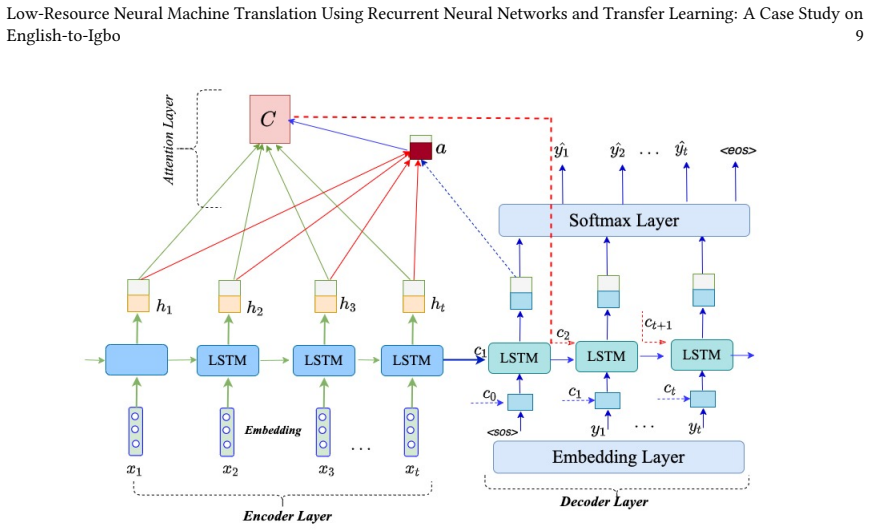
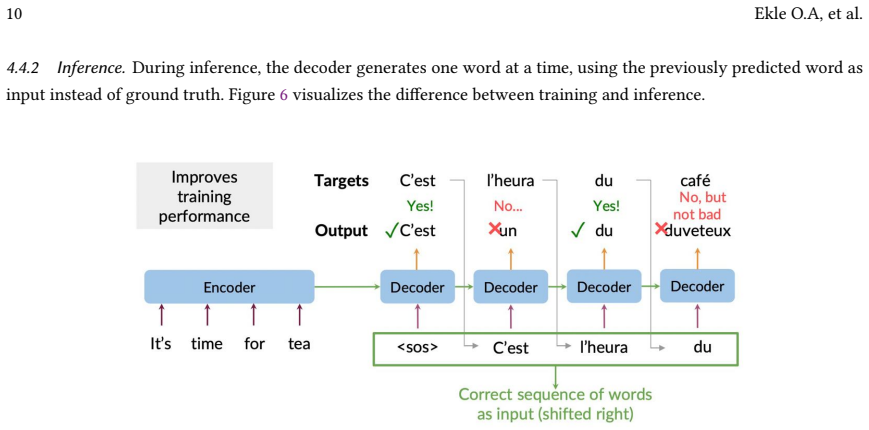
The argument rides on two complementary systems. The first is an attention-equipped recurrent encoder-decoder: an LSTM encoder with 1024 units and 256-dimensional embeddings, a decoder using dot-product global attention, teacher forcing during training, and greedy decoding at inference. The second is MarianNMT, a pretrained encoder-decoder transformer for machine translation, fine-tuned for 20 epochs on 597 verified English-Igbo sentence pairs. The attention mechanism lets the decoder align output tokens to input tokens, which matters for low-resource pairs where the model cannot rely on massive data; the pretrained transformer supplies general translation knowledge that the small fine-tuning set then adapts to Igbo. Comparing the two systems against published English-Igbo benchmarks is what turns the numbers into the claimed +4.83 BLEU gain.
What would settle it
Evaluate the fine-tuned model on a held-out set of English-Igbo sentences that were never used in fine-tuning, and also run it on the exact test sets behind the published Tatoeba and JW300 baseline scores; if the score falls to near or below 0.395, the claimed +4.83 gain is an artifact of test-set overlap or score incomparability.
Extended reading notes
Core claim
The paper's central claim is that transfer learning closes the quality gap for English-to-Igbo machine translation. A from-scratch LSTM sequence-to-sequence model with dot-product global attention, teacher forcing, and greedy decoding reaches BLEU 0.3817, close to the published JW300 benchmark of 0.395. Fine-tuning the pretrained MarianNMT transformer for 20 epochs on 597 English-Igbo sentence pairs raises the score to 0.43, above both published baselines (Tatoeba 0.38 and JW300 0.395); the paper reports this as a gain of +4.83 BLEU points and an estimated 70% semantic translation accuracy. The same pipeline also surpasses the English-French Tatoeba benchmark by roughly 9 BLEU points, which the authors take as evidence the approach carries across language pairs.
Load-bearing premise
The reported +4.83 BLEU gain rests on the assumption that the 597 sentence pairs used in transfer learning are split into disjoint training and test sets, and that the resulting BLEU of 0.43 is directly comparable to benchmark scores computed on different test sentences.
Editorial extensions
If this is right
- Fine-tuning a pretrained MarianNMT model on 597 English-Igbo pairs yields BLEU 0.43, above the published Tatoeba (0.38) and JW300 (0.395) baselines.
- An LSTM sequence-to-sequence model with dot-product attention reaches BLEU 0.3817 with a 16K vocabulary, essentially matching the JW300 baseline without pretraining.
- The fine-tuned model produced semantically accurate translations on more than 70% of a 597-sample evaluation set, including long and special-character sentences.
- The same architecture outperformed the English-French Tatoeba benchmark by about 9 BLEU points on a 70,000-pair subset, evidence for cross-lingual generalizability.
- Since the fine-tuning loss was still decreasing at 20 epochs, the authors expect additional training to improve the score further.
Reading between the lines
- The paper never states how the 597 transfer-learning pairs were split into training and test sets, so the first test of the +4.83 gain is whether the evaluation sentences were also used for fine-tuning.
- The same recipe could be tried on other African language pairs: if a pretrained multilingual checkpoint exists, a few hundred expert-verified sentence pairs may be enough to beat from-scratch RNNs.
- For a morphologically rich language like Igbo, BLEU is a weak proxy for quality, so the 70% semantic-accuracy estimate would be more convincing if confirmed by human ratings or a character-level metric.
Signed reviews
Editorial analysis
A structured set of objections, weighed in public.
Referee Report
Summary. The paper proposes RNN-based (LSTM/GRU) sequence-to-sequence models with attention, teacher forcing, and greedy/beam decoding for English-to-Igbo translation, and additionally fine-tunes a MarianNMT model through the SimpleTransformers framework. It reports a final RNN BLEU of 0.3817, a transfer-learning BLEU of 0.43 on 597 samples, a claimed improvement of +4.83 BLEU over HuggingFace baselines, and an estimated translation accuracy of 70%. The paper also reports English-French experiments that it claims surpass a Tatoeba benchmark.
Significance. If the empirical claims were reproducible, the transfer-learning result on a very small parallel corpus would be a useful data point for low-resource NMT for African languages. The paper also includes useful comparisons of attention scoring functions, decoding strategies, and hyperparameter choices, and the qualitative translation examples give some insight into model behavior. However, the central claims are not supported by the manuscript's own tables and descriptions: the evaluation split for the transfer-learning experiment is undocumented, the +4.83 BLEU figure is arithmetically inconsistent with the cited baselines, and the 70% accuracy is undefined. These are not cosmetic issues; they affect the abstract's main contribution and make the reported performance gains unverifiable.
major comments (5)
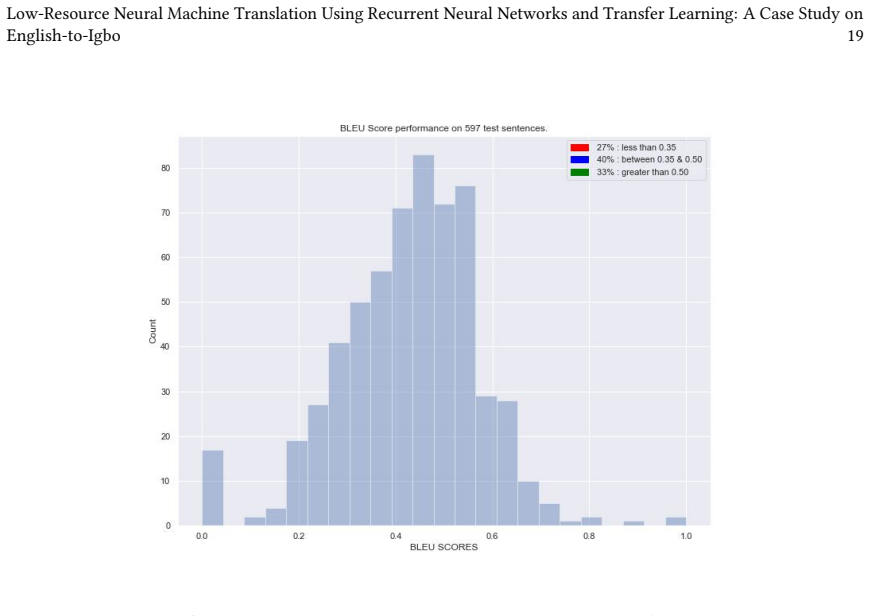
- [Section 5.6, Figure 12] The transfer-learning evaluation has no documented train/validation/test split. The text states that MarianNMT was fine-tuned on 597 sentence pairs, and Figure 12 reports a BLEU distribution 'across 597 test samples' with no indication that the evaluation set is disjoint from the training set. If the same 597 pairs are used for both training and evaluation, the reported BLEU of 0.43 is inflated by memorization and cannot be compared with any external benchmark. The RNN experiments in Section 4.5, described as testing on 300 English-Igbo sentence pairs, have the same missing split information. This is load-bearing because the paper's headline claim depends entirely on a valid held-out evaluation.
- [Abstract; Section 7; Table 13] The claimed '+4.83 BLEU points' is not the difference between the transfer model and the HuggingFace baselines. Table 13 lists the transfer model at 0.4300 and the final optimized RNN at 0.3817, and 0.4300 - 0.3817 = 0.0483, which is the apparent source of the '4.83' figure. The differences against the cited baselines are 0.4300 - 0.380 = 0.050 and 0.4300 - 0.395 = 0.035 (or 5.0 and 3.5 if the scores are rescaled to 0-100). The claim in Section 7 that the improvement is over existing HuggingFace English-Igbo baselines is therefore not supported by the paper's own table.
- [Table 11; Table 13] The baseline BLEU values are not consistently scaled across tables. Table 11 reports JW300.en.ig BLEU as 39.5 and Tatoeba.en.ig as 3.8, while Table 13 reports the same two baselines as 0.395 and 0.380. The Tatoeba value changes by an order of magnitude, and no explanation is given for the rescaling. Since the central comparison is against these baselines, the manuscript needs a single consistent scale and explicit statement of which test sets were used to produce each score.
- [Section 4.5; Section 5.6.4] The '70% translation accuracy' figure is not defined or measured. It appears in the abstract and Section 4.5 as translation quality or semantic accuracy, and Section 5.6.4 supports it only with a qualitative statement about a small number of examples. No metric, rubric, annotator agreement, or error-count procedure is provided. This claim should be removed or replaced with a defined evaluation.
- [Section 5.5; Section 7] The English-French experiment also lacks a documented evaluation split. The text says the model was trained on a 70,000-sentence subset of Tatoeba and reports BLEU scores up to 0.590, but it does not state whether the evaluation pairs were held out from training. In addition, Section 7 states that the model surpassed the English-French benchmark by 9 BLEU points, whereas the table difference is 0.085; the scaling inconsistency makes the claimed cross-lingual generalization unverifiable.
minor comments (4)
- [Section 4.4.2; Section 5.4] The beam width for beam search is reported inconsistently: Section 4.4.2 says beam width = 2, while Section 5.4 says beam width = 5. Please reconcile these values.
- [Section 4.3.1; Section 5.4] The final hyperparameters are unclear: Section 4.3.1 states a batch size of 128 and 1024 LSTM units, while Figure 10 and the text report that batch size 32 and dropout 0.5 give the best performance. The final model configuration should be stated in one place.
- [Section 4.1] The data source is attributed to reference [26], but the exact dataset version, license, and release are not specified. Please cite the actual data release and state any filtering performed after download.
- [Section 1] The contribution 'first high-performing translation system for the low-resource English-Igbo language pair' is an overclaim given that the paper itself compares against existing HuggingFace English-Igbo benchmarks; please temper this claim and cite recent Igbo NMT work.
Circularity Check
The central +4.83 BLEU claim over HuggingFace baselines reduces to two internal comparisons: evaluation on (apparently) the same 597 training pairs, and subtraction of the authors' own RNN score rather than external baseline scores.
-
fitted input called prediction
[Section 5.6 (Effect of Transfer Learning), Figure 12]
"The training was conducted for 20 epochs on 597 sentence pairs using an NVIDIA Tesla K80 GPU. ... Fig. 12. BLEU Score Performance: BLEU score distribution across 597 test samples using the fine-tuned MarianNMT model."
The fine-tuned model was trained on exactly 597 sentence pairs, and its reported BLEU score is computed 'across 597 test samples'; no train/validation/test split is described anywhere in Section 5.6. As written, the test set has the same cardinality as the training set and appears to consist of the same 597 pairs. The 0.43 BLEU is therefore a fit-to-training score, not an independent test-set prediction. Comparing that number to HuggingFace benchmarks evaluated on Tatoeba and JW300 test sets makes the claimed transfer-learning gain a difference of evaluation sets, not a measured improvement; the 'prediction' that transfer learning surpasses baselines is forced by evaluating on the fitted data.
-
other
[Section 7 (Conclusion) with Table 13]
"This yielded a BLEU score of 0.43, an improvement of 4.83 points over existing HuggingFace English-Igbo baselines (Tatoeba and JW300) [34], with approximately 70% semantic translation accuracy on an evaluation set of 597 samples."
The claimed 'improvement over existing HuggingFace baselines' is not the number the manuscript's own table produces. Table 13 reports Transfer Learning BLEU 0.4300 and Final Optimized RNN-based (Ours) 0.3817, and 0.4300 - 0.3817 = 0.0483. Against the cited baselines in the same table the differences are 0.4300 - 0.380 = 0.050 (Tatoeba) and 0.4300 - 0.395 = 0.035 (JW300). Thus '+4.83' is the authors' own within-paper RNN-to-transfer difference, relabeled as an external benchmark gain; the headline claim reduces to a self-comparison rather than a comparison with the cited external systems.
full rationale
The paper's RNN experiments themselves are self-contained and not circular: LSTM/GRU, attention variants, and decoding strategies are compared on the authors' own data, and those internal comparisons do not depend on the disputed claim. The circularity is concentrated in the transfer-learning headline. First, Section 5.6 trains MarianNMT on 597 sentence pairs and reports BLEU 'across 597 test samples' without any split, so the evaluation appears to use the fitted data as its own test set; a score on training data cannot support a benchmark comparison. Second, the '+4.83' improvement is arithmetically the difference between the authors' transfer model (0.4300) and their own RNN (0.3817), not the difference from either HuggingFace baseline (0.380 or 0.395). The central empirical claim therefore reduces, in the manuscript as written, to an internal self-comparison and a training-set score, rather than an independent external prediction. There is no load-bearing self-citation or uniqueness-theorem issue; the flaw is in the evaluation construction itself.
Assumptions & free parameters
free parameters (6)
- LSTM hidden units =
1024
- Embedding dimension =
256
- Batch size =
32
- Dropout rate =
0.5
- Learning rate =
0.001
- Training epochs =
100 for RNN, 20 for transfer learning
assumptions (3)
- domain assumption BLEU score is a sufficient measure of translation quality for this comparison
- domain assumption The English-Igbo corpus and the 597-pair subset are correctly aligned and representative
- ad hoc to paper HuggingFace benchmark BLEU scores are comparable to scores measured on the authors' own test set
Cite this review
Pith. "Pith review of Low-Resource Neural Machine Translation Using Recurrent Neural Networks and Transfer Learning: A Case Study on English-to-Igbo." pith.science (2026). https://pith.science/paper/PBRGYB5K
@misc{pith2026250417252,
  author       = {Pith},
  title        = {Pith review of: Low-Resource Neural Machine Translation Using Recurrent Neural Networks and Transfer Learning: A Case Study on English-to-Igbo},
  year         = {2026},
  howpublished = {\url{https://pith.science/paper/PBRGYB5K}},
  note         = {Machine review of arXiv:2504.17252}
}
read the original abstract
In this study, we develop Neural Machine Translation (NMT) and Transformer-based transfer learning models for English-to-Igbo translation - a low-resource African language spoken by over 40 million people across Nigeria and West Africa. Our models are trained on a curated and benchmarked dataset compiled from Bible corpora, local news, Wikipedia articles, and Common Crawl, all verified by native language experts. We leverage Recurrent Neural Network (RNN) architectures, including Long Short-Term Memory (LSTM) and Gated Recurrent Units (GRU), enhanced with attention mechanisms to improve translation accuracy. To further enhance performance, we apply transfer learning using MarianNMT pre-trained models within the SimpleTransformers framework. Our RNN-based system achieves competitive results, closely matching existing English-Igbo benchmarks. With transfer learning, we observe a performance gain of +4.83 BLEU points, reaching an estimated translation accuracy of 70%. These findings highlight the effectiveness of combining RNNs with transfer learning to address the performance gap in low-resource language translation tasks.
Figures


Figures from the paper (10 more)




Reference graph
Works this paper leans on
-
[1]
Ben Athiwaratkun, Andrew Gordon Wilson, and Anima Anandkumar. 2018. Probabilistic fasttext for multi-sense word embeddings. arXiv preprint arXiv:1806.02901 (2018)
arXiv 2018
-
[2]
Priya Ba, JM Nandhini, and Gnanasekaran Tc. 2021. An Analysis of the Applications of Natural Language Processing in Various Sectors. (2021)
work page 2021
-
[3]
Dzmitry Bahdanau, Kyunghyun Cho, and Yoshua Bengio. 2014. Neural machine translation by jointly learning to align and translate. arXiv preprint arXiv:1409.0473 (2014)
arXiv 2014
-
[4]
Jasmijn Bastings, Ivan Titov, Wilker Aziz, Diego Marcheggiani, and Khalil Sima’an. 2017. Graph convolutional encoders for syntax-aware neural machine translation. arXiv preprint arXiv:1704.04675 (2017). Low-Resource Neural Machine Translation Using Recurrent Neural Networks and Transfer Learning: A Case Study on English-to-Igbo 23
arXiv 2017
-
[5]
Randall D Beer. 1997. The dynamics of adaptive behavior: A research program. Robotics and Autonomous Systems 20, 2-4 (1997), 257–289
work page 1997
-
[6]
Yoshua Bengio, Réjean Ducharme, and Pascal Vincent. 2000. A neural probabilistic language model. Advances in Neural Information Processing Systems 13 (2000)
work page 2000
-
[7]
Siddharth Bhatia, Bryan Hooi, Minji Yoon, Kijung Shin, and Christos Faloutsos. 2020. Midas: Microcluster-based detector of anomalies in edge streams. In Proceedings of the AAAI conference on artificial intelligence , Vol. 34. 3242–3249
work page 2020
-
[8]
Lukas Biewald. 2020. Experiment Tracking with Weights and Biases. https://www.wandb.com/ Software available from wandb.com
2020
Show all 78 references
-
[9]
Piotr Bojanowski, Edouard Grave, Armand Joulin, and Tomas Mikolov. 2017. Enriching word vectors with subword information. Transactions of the association for computational linguistics 5 (2017), 135–146
2017
-
[10]
James Bradbury, Stephen Merity, Caiming Xiong, and Richard Socher. 2016. Quasi-recurrent neural networks. arXiv preprint arXiv:1611.01576 (2016)
2016 arXiv
-
[11]
Tom Brown, Benjamin Mann, Nick Ryder, Melanie Subbiah, Jared Kaplan, Prafulla Dhariwal, et al. 2020. Language models are few-shot learners. Advances in neural information processing systems 33 (2020), 1877–1901
2020
-
[12]
Jason Brownlee. 2017. Why One-Hot Encode Data in Machine Learning? https://machinelearningmastery.com/why-one-hot-encode-data-in- machine-learning/. Accessed: 2022-03-28
2017
-
[13]
Yen-Yu Chang, Pan Li, Rok Sosic, MH Afifi, Marco Schweighauser, and Jure Leskovec. 2021. F-fade: Frequency factorization for anomaly detection in edge streams. In Proceedings of the 14th ACM International Conference on Web Search and Data Mining . 589–597
2021
-
[14]
Mia Xu Chen, Orhan Firat, Ankur Bapna, Melvin Johnson, Wolfgang Macherey, George Foster, Llion Jones, Niki Parmar, Mike Schuster, Zhifeng Chen, et al. 2018. The best of both worlds: Combining recent advances in neural machine translation. arXiv preprint arXiv:1804.09849 (2018)
2018 arXiv
-
[15]
Kyunghyun Cho, Bart Van Merriënboer, Caglar Gulcehre, Dzmitry Bahdanau, Fethi Bougares, Holger Schwenk, and Yoshua Bengio. 2014. Learning phrase representations using RNN encoder-decoder for statistical machine translation. arXiv preprint arXiv:1406.1078 (2014)
2014 arXiv
-
[16]
Ronan Collobert and Jason Weston. 2008. A unified architecture for natural language processing: Deep neural networks with multitask learning. In Proceedings of the 25th international conference on Machine learning . 160–167
2008
-
[17]
Mario Costa, Eros Pasero, Federico Piglione, and Daniela Radasanu. 1999. Short term load forecasting using a synchronously operated recurrent neural network. In IJCNN’99. International Joint Conference on Neural Networks. Proceedings (Cat. No. 99CH36339) , Vol. 5. IEEE, 3478–3482
1999
-
[18]
Marta R Costa-Jussa and José AR Fonollosa. 2015. Latest trends in hybrid machine translation and its applications. Computer Speech & Language 32, 1 (2015), 3–10
2015
-
[19]
Debabala S., Prasant K
Pradeep K. Debabala S., Prasant K. 2019. Advances in Intelligent Systems and Computing . O’Reilly Media, Inc
2019
-
[20]
Deeplearing.AI. 2021. NLP Specialization. https://www.deeplearning.ai/. Accessed: 2022-04-20
2021
-
[21]
Jacob Devlin, Ming-Wei Chang, Kenton Lee, and Kristina Toutanova. 2018. Bert: Pre-training of deep bidirectional transformers for language understanding. arXiv preprint arXiv:1810.04805 (2018)
2018 arXiv
-
[22]
Ocheme Anthony Ekle and William Eberle. 2024. Anomaly Detection in Dynamic Graphs: A Comprehensive Survey.ACM Transactions on Knowledge Discovery from Data (2024)
2024
-
[23]
Ocheme Anthony Ekle and William Eberle. 2024. Dynamic PageRank with Decay: A Modified Approach for Node Anomaly Detection in Evolving Graph Streams. In The International FLAIRS Conference Proceedings , Vol. 37
2024
-
[24]
Ocheme Anthony Ekle, William Eberle, and Jared Christopher. 2025. Adaptive DecayRank: Real-Time Anomaly Detection in Dynamic Graphs with Bayesian PageRank Updates. Applied Sciences 15, 6 (2025), 3360
2025
-
[25]
Kawin Ethayarajh. 2019. How contextual are contextualized word representations? comparing the geometry of BERT, ELMo, and GPT-2 embeddings. arXiv preprint arXiv:1909.00512 (2019)
2019 arXiv
-
[26]
Ignatius Ezeani, Paul Rayson, Ikechukwu Onyenwe, Chinedu Uchechukwu, and Mark Hepple. 2020. Igbo-english machine translation: An evaluation benchmark. arXiv preprint arXiv:2004.00648 (2020)
2020 arXiv
-
[27]
Jonas Gehring, Michael Auli, David Grangier, Denis Yarats, and Yann N Dauphin. 2017. Convolutional sequence to sequence learning. InInternational Conference on Machine Learning . PMLR, 1243–1252
2017
-
[28]
Felix A Gers, Nicol N Schraudolph, and Jürgen Schmidhuber. 2002. Learning precise timing with LSTM recurrent networks. Journal of machine learning research 3, Aug (2002), 115–143
2002
-
[29]
C Lee Giles, Steve Lawrence, and Ah Chung Tsoi. 1997. Rule inference for financial prediction using recurrent neural networks. InProceedings of the IEEE/IAFE 1997 Computational Intelligence for Financial Engineering (CIFEr) . IEEE, 253–259
1997
-
[30]
Palash Goyal, Sumit Pandey, and Karan Jain. 2018. Deep learning for natural language processing. New York: Apress (2018)
2018
-
[31]
Alex Graves, Santiago Fernández, Faustino Gomez, and Jürgen Schmidhuber. 2006. Connectionist temporal classification: labelling unsegmented sequence data with recurrent neural networks. In Proceedings of the 23rd international conference on Machine learning . 369–376
2006
-
[32]
Philip A Gregory, Andrew G Bert, Emily L Paterson, Simon C Barry, Anna Tsykin, Gelareh Farshid, Mathew A Vadas, Yeesim Khew-Goodall, and Gregory J Goodall. 2008. The miR-200 family and miR-205 regulate epithelial to mesenchymal transition by targeting ZEB1 and SIP1. Nature cel...
2008
-
[33]
Joel C Heck and Fathi M Salem. 2017. Simplified minimal gated unit variations for recurrent neural networks. In 2017 IEEE 60th International Midwest Symposium on Circuits and Systems (MWSCAS) . IEEE, 1593–1596
2017
-
[34]
Helsinki-NLP. 2021. OPUS-MT for English-Igbo Translation. https://huggingface.co/Helsinki-NLP/opus-mt-en-ig. Accessed: 2025-04-23
2021
-
[35]
Sepp Hochreiter and Jürgen Schmidhuber. 1997. Long short-term memory. Neural computation 9, 8 (1997), 1735–1780. 24 Ekle O.A, et al
1997
-
[36]
John Hutchins. 1997. From first conception to first demonstration: the nascent years of machine translation, 1947–1954. a chronology. Machine Translation 12, 3 (1997), 195–252
1997
-
[37]
Nal Kalchbrenner, Lasse Espeholt, Karen Simonyan, Aaron van den Oord, Alex Graves, and Koray Kavukcuoglu. 2016. Neural machine translation in linear time. arXiv preprint arXiv:1610.10099 (2016)
2016 arXiv
-
[38]
Shubham Khandelwal, Benjamin Lecouteux, and Laurent Besacier. 2016. Comparing GRU and LSTM for automatic speech recognition . Ph. D. Dissertation. LIG
2016
-
[39]
Diederik P Kingma and Jimmy Ba. 2014. Adam: A method for stochastic optimization. arXiv preprint arXiv:1412.6980 (2014)
2014 arXiv
-
[40]
E Kumar. 2011. Natural Language Processing; IK International Pvt. Ltd.: New Delhi, India (2011)
2011
-
[41]
Alex M Lamb, Anirudh Goyal ALIAS PARTH GOYAL, Ying Zhang, Saizheng Zhang, Aaron C Courville, and Yoshua Bengio. 2016. Professor forcing: A new algorithm for training recurrent networks. Advances in neural information processing systems 29 (2016)
2016
-
[42]
Xuan-Hien Le, Hung Viet Ho, Giha Lee, and Sungho Jung. 2019. Application of long short-term memory (LSTM) neural network for flood forecasting. Water 11, 7 (2019), 1387
2019
-
[43]
Robert B Lees. 1957. Syntactic structures
1957
-
[44]
ED Liddy. 2001. Natural language processing in Encyclopedia of Library and Information Science 2nd ed., New York: Marcel Decker
2001
-
[45]
Yangshengyan Liu, Fu Gu, Xinjian Gu, Yijie Wu, Jianfeng Guo, and Jin Zhang. 2022. Resource recommendation based on industrial knowledge graph in low-resource conditions. International Journal of Computational Intelligence Systems 15, 1 (2022), 42
2022
-
[46]
Minh-Thang Luong, Hieu Pham, and Christopher D Manning. 2015. Effective approaches to attention-based neural machine translation. arXiv preprint arXiv:1508.04025 (2015)
2015 arXiv
-
[47]
Larry Medsker and Lakhmi C Jain. 1999. Recurrent neural networks: design and applications . CRC press
1999
-
[48]
Tomáš Mikolov, Wen-tau Yih, and Geoffrey Zweig. 2013. Linguistic regularities in continuous space word representations. In Proceedings of the 2013 conference of the north american chapter of the association for computational linguistics: Human language technologies . 746–751
2013
-
[49]
Prakash M Nadkarni, Lucila Ohno-Machado, and Wendy W Chapman. 2011. Natural language processing: an introduction. Journal of the American Medical Informatics Association 18, 5 (2011), 544–551
2011
-
[50]
Suraj Nair, Eugene Yang, Dawn Lawrie, Kevin Duh, Paul McNamee, Kenton Murray, James Mayfield, and Douglas W Oard. 2022. Transfer Learning Approaches for Building Cross-Language Dense Retrieval Models. arXiv preprint arXiv:2201.08471 (2022)
2022 arXiv
-
[51]
Graham Neubig. 2017. Neural machine translation and sequence-to-sequence models: A tutorial. arXiv preprint arXiv:1703.01619 (2017)
2017 arXiv
-
[52]
Toan Q Nguyen and David Chiang. 2017. Transfer learning across low-resource, related languages for neural machine translation. arXiv preprint arXiv:1708.09803 (2017)
2017 arXiv
-
[53]
MD Okpor. 2014. Machine translation approaches: issues and challenges. International Journal of Computer Science Issues (IJCSI) 11, 5 (2014), 159
2014
-
[54]
Kishore Papineni, Salim Roukos, Todd Ward, and Wei-Jing Zhu. 2002. Bleu: a method for automatic evaluation of machine translation. InProceedings of the 40th annual meeting of the Association for Computational Linguistics . 311–318
2002
-
[55]
Jeffrey Pennington, Richard Socher, and Christopher D Manning. 2014. Glove: Global vectors for word representation. In Proceedings of the 2014 conference on empirical methods in natural language processing (EMNLP) . 1532–1543
2014
-
[56]
Duc Truong Pham and Dervis Karaboga. 1999. Training Elman and Jordan networks for system identification using genetic algorithms. Artificial Intelligence in Engineering 13, 2 (1999), 107–117
1999
-
[57]
Libo Qin, Qiguang Chen, Xiachong Feng, Yang Wu, Yongheng Zhang, Yinghui Li, Min Li, Wanxiang Che, and Philip S Yu. 2024. Large language models meet nlp: A survey. arXiv preprint arXiv:2405.12819 (2024)
2024 arXiv
-
[58]
Colin Raffel, Noam Shazeer, Adam Roberts, Katherine Lee, Sharan Narang, Michael Matena, Yanqi Zhou, Wei Li, and Peter J Liu. 2020. Exploring the limits of transfer learning with a unified text-to-text transformer. The Journal of Machine Learning Research 21, 1 (2020), 5485–5551
2020
-
[59]
Thilina Rajapakse. 2020. Simple Transformers. https://simpletransformers.ai/docs/seq2seq-model/. Accessed: 2022-03-28
2020
-
[60]
Nils Reimers and Iryna Gurevych. 2020. Multilingual sentence embeddings using distillation. In Proceedings of the 2020 Conference on Empirical Methods in Natural Language Processing (EMNLP) . 4512–4525
2020
-
[61]
Roger C Schank and Larry Tesler. 1969. A conceptual dependency parser for natural language. In International Conference on Computational Linguistics COLING 1969: Preprint No. 2
1969
-
[62]
Jürgen Schmidhuber. 2015. Deep learning in neural networks: An overview. Neural networks 61 (2015), 85–117
2015
-
[63]
Lane Schwartz. 2018. The history and promise of machine translation. Innovation and expansion in translation process research (2018), 161
2018
-
[64]
Peter Shaw, Jakob Uszkoreit, and Ashish Vaswani. 2018. Self-attention with relative position representations.arXiv preprint arXiv:1803.02155 (2018)
2018 arXiv
-
[65]
Ilya Sutskever, Oriol Vinyals, and Quoc V Le. 2014. Sequence to sequence learning with neural networks. Advances in neural information processing systems 27 (2014)
2014
-
[66]
HuggingFace Tatoaba. 2022. Eng-Fra Benchmark. https://huggingface.co/Helsinki-NLP/opus-mt-en-fr. Accessed: 2022-04-25
2022
-
[67]
Tolga Uslu, Alexander Mehler, Daniel Baumartz, and Wahed Hemati. 2018. fastsense: An efficient word sense disambiguation classifier. InProceedings of the Eleventh International Conference on Language Resources and Evaluation (LREC 2018)
2018
-
[68]
Ashish Vaswani, Noam Shazeer, Niki Parmar, Jakob Uszkoreit, Llion Jones, Aidan N Gomez, Łukasz Kaiser, and Illia Polosukhin. 2017. Attention is all you need. Advances in neural information processing systems 30 (2017)
2017
-
[69]
Lilapati Waikhom and Ripon Patgiri. 2021. Graph neural networks: Methods, applications, and opportunities. arXiv preprint arXiv:2108.10733 (2021). Low-Resource Neural Machine Translation Using Recurrent Neural Networks and Transfer Learning: A Case Study on English-to-Igbo 25
2021 arXiv
-
[70]
Sheng Wang, Dian Yu, Yizhong Zhang, Yejin Choi, Jianfeng Gao, et al. 2023. Text Embeddings by Weakly-Supervised Contrastive Pre-training. arXiv preprint arXiv:2302.13952 (2023)
2023 arXiv
-
[71]
Thomas Wolf, Lysandre Debut, Victor Sanh, Julien Chaumond, Clement Delangue, Anthony Moi, Pierric Cistac, Tim Rault, Rémi Louf, Morgan Funtowicz, et al. 2019. Huggingface’s transformers: State-of-the-art natural language processing. arXiv preprint arXiv:1910.03771 (2019)
2019 arXiv
-
[72]
Linting Xue, Noah Constant, Adam Roberts, Mihir Kale, Rami Al-Rfou, Aditya Siddhant, Paul Barham, Xiaodong Guo, and Colin Raffel. 2021. mT5: A massively multilingual pre-trained text-to-text transformer. arXiv preprint arXiv:2010.11934 (2021)
2021 arXiv
-
[73]
Kenji Yamada and Kevin Knight. 2001. A syntax-based statistical translation model. In Proceedings of the 39th Annual Meeting of the Association for Computational Linguistics. 523–530
2001
-
[74]
Baosong Yang, Longyue Wang, Derek Wong, Lidia S Chao, and Zhaopeng Tu. 2019. Convolutional self-attention networks. arXiv preprint arXiv:1904.03107 (2019)
2019 arXiv
-
[75]
Yongjing Yin, Fandong Meng, Jinsong Su, Chulun Zhou, Zhengyuan Yang, Jie Zhou, and Jiebo Luo. 2020. A novel graph-based multi-modal fusion encoder for neural machine translation. arXiv preprint arXiv:2007.08742 (2020)
2020 arXiv
-
[76]
Hongwei Zhao, Zhongxin Chen, Hao Jiang, Wenlong Jing, Liang Sun, and Min Feng. 2019. Evaluation of three deep learning models for early crop classification using sentinel-1A imagery time series—A case study in Zhanjiang, China. Remote Sensing 11, 22 (2019), 2673
2019
-
[77]
Guo-Bing Zhou, Jianxin Wu, Chen-Lin Zhang, and Zhi-Hua Zhou. 2016. Minimal gated unit for recurrent neural networks. International Journal of Automation and Computing 13, 3 (2016), 226–234
2016
-
[78]
Barret Zoph, Deniz Yuret, Jonathan May, and Kevin Knight. 2016. Transfer learning for low-resource neural machine translation. arXiv preprint arXiv:1604.02201 (2016)
2016 arXiv
Reviewed August 16, 2026 · model on record in the stance chip above.
Discussion (0). Continue with ORCID to comment.