Optimising transient discovery with Swift-XRT
Pith reviewed 2026-06-30 05:24 UTC · model grok-4.3
The pith
A simulation-based Bayesian framework corrects Eddington bias to classify faint Swift-XRT sources as real transients with higher accuracy.
A machine-rendered reading of the paper's core claim, the machinery that carries it, and where it could break.
Core claim
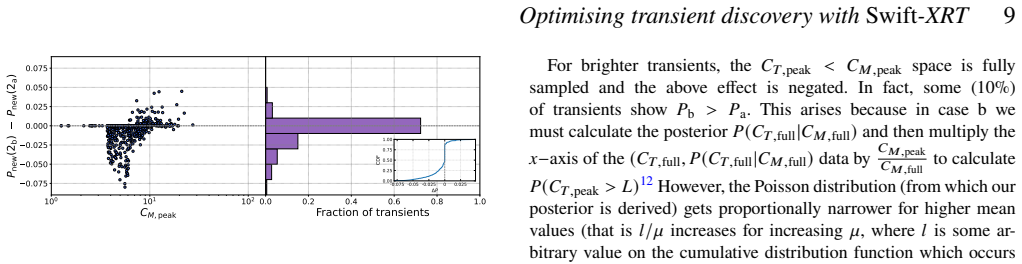
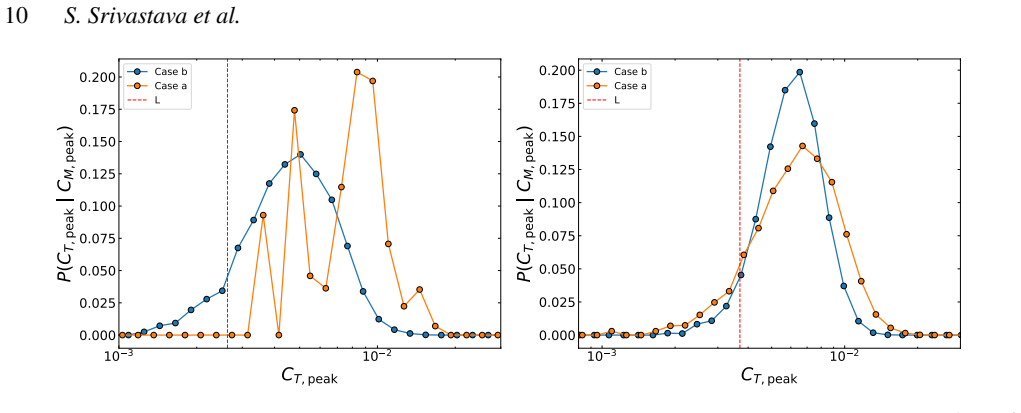
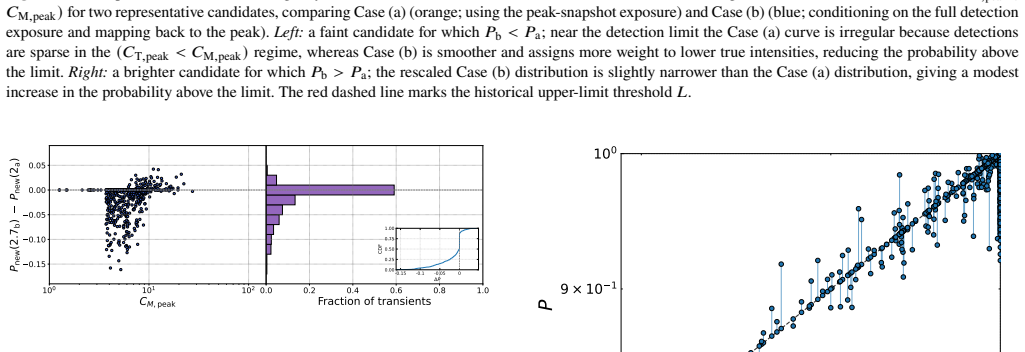
The simulation-based Bayesian framework corrects for Eddington bias and supplies more accurate probabilities that each low-significance source is a genuine transient whose true intensity exceeds the historical 3-sigma upper limit. When applied to LSXPS data the method recovers over 500 such transients, more than eight times the original confirmed sample. Extensive simulations based on real Swift-XRT images confirm that the corrected probabilities remain stable across different exposure times and background levels, establishing an internally consistent framework for real-time transient identification.
What carries the argument
Simulation-based Bayesian framework that derives posterior probabilities of true transient status after correcting measured fluxes for Eddington bias.
If this is right
- Low-significance LSXPS sources receive revised probabilities that allow more reliable real-time transient alerts.
- The number of catalogued transients rises from the original confirmed sample to over 500 sources above the historical 3-sigma threshold.
- Classification performance stays consistent when exposure time and background conditions vary.
- The corrected probabilities form an internally consistent basis for future transient searches in the same catalogue.
Where Pith is reading between the lines
- The same simulation-plus-Bayesian correction could be tested on other X-ray catalogues that suffer similar threshold bias.
- If the recovered transients are followed up at other wavelengths, the fraction that show genuine counterparts would provide an external check on the method.
- Extending the framework to sources detected in stacked rather than single-epoch images might further increase the yield of faint transients.
Load-bearing premise
Simulations built from real Swift-XRT images faithfully reproduce the statistical fluctuations, background levels, and detection properties that govern all low-significance sources.
What would settle it
Running the Bayesian procedure on a fresh set of simulated sources whose true transient or non-transient status is known in advance and finding that the recovered sample size or classification accuracy deviates substantially from the input truth.
Figures
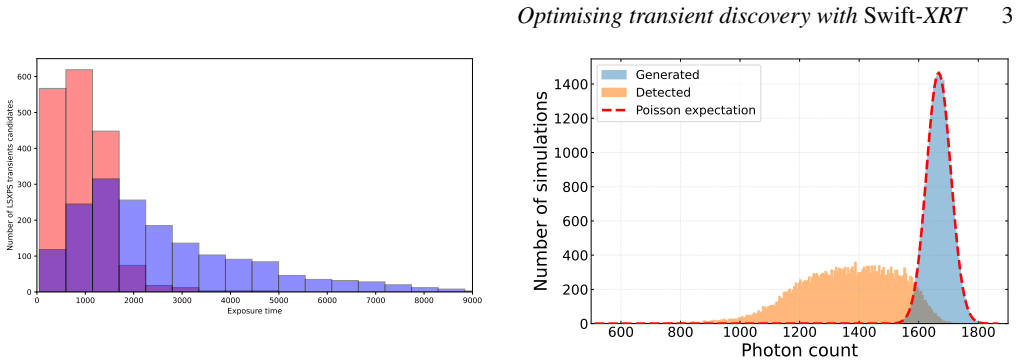
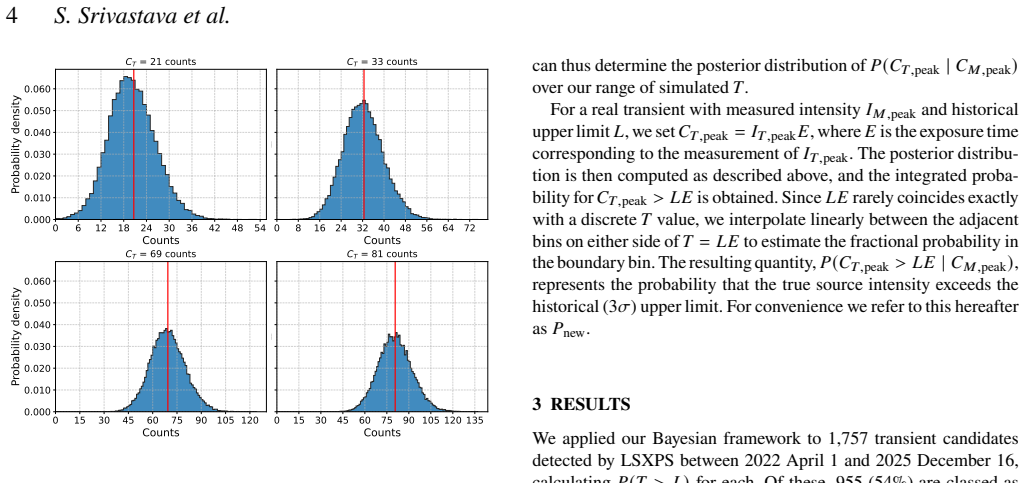
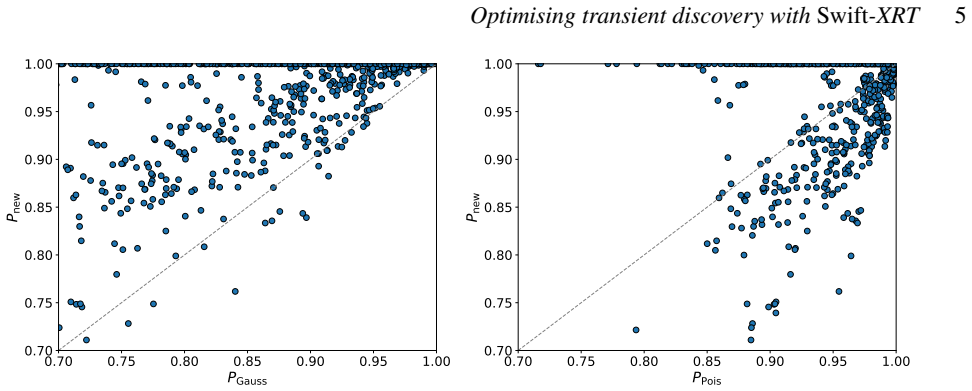
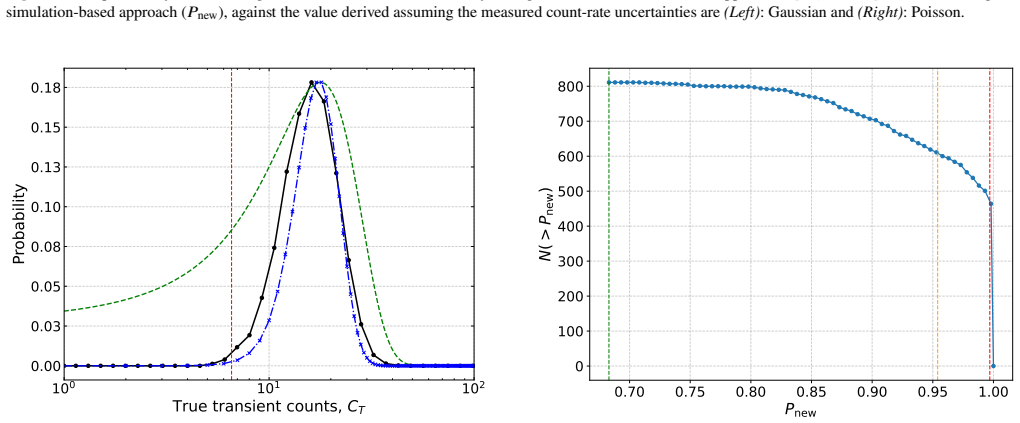

read the original abstract
The Living Swift-XRT Point Source Catalogue (LSXPS) enables near real-time searches for X-ray transients. Many detected candidates are faint, often near the XRT detection limit, and are classed as "low significance," as it is often unclear whether their apparent brightening reflects a genuine transient or a statistical fluctuation. Some of these sources are affected by Eddington bias, a statistical effect that inflates measured fluxes near the detection threshold. We present a simulation-based Bayesian framework that corrects for this bias and provides more accurate probabilities for each source being truly transient, i.e. that its true intensity exceeds the historical 3$\sigma$ upper limit. Applied to LSXPS data, this method yields more reliable classifications, recovering over 500 transients above this threshold -- more than an eight-fold increase over the original confirmed sample. Using extensive simulations based on real Swift-XRT images, we validate the robustness of this approach, showing that it remains stable across varying exposure times and background conditions. These results demonstrate that the LSXPS transient probabilities, corrected for Eddington bias, provide a reliable and internally consistent framework for real-time X-ray transient identification.
Editorial analysis
A structured set of objections, weighed in public.
Referee Report
Summary. The paper introduces a simulation-based Bayesian method to correct for Eddington bias in low-significance sources from the Living Swift-XRT Point Source Catalogue (LSXPS). It computes posterior probabilities that a source's true intensity exceeds the historical 3σ upper limit, yielding more reliable transient classifications. When applied to LSXPS data the method recovers >500 transients (an eight-fold increase over the prior confirmed sample) and is reported to remain stable across exposure times and background levels based on simulations constructed from real Swift-XRT images.
Significance. If the simulation-derived probabilities are shown to be well-calibrated, the framework would materially enlarge the sample of reliably identified X-ray transients available for follow-up, directly addressing a long-standing limitation of near-real-time Swift-XRT searches. The use of simulations built on actual Swift-XRT images rather than purely synthetic backgrounds is a methodological strength that could improve fidelity if quantitative validation metrics are supplied.
major comments (2)
- [Abstract / simulation-validation section] Abstract and simulation-validation section: the central claim that the method recovers >500 transients (eight-fold increase) rests on the assertion that the Bayesian posteriors are well-calibrated after Eddington-bias correction. No quantitative diagnostics (e.g., Kolmogorov-Smirnov distances between simulated and observed count-rate histograms, or recovery fractions for injected sources at the low-significance threshold) are reported to demonstrate that the simulations reproduce the precise statistical regime where Eddington bias is strongest.
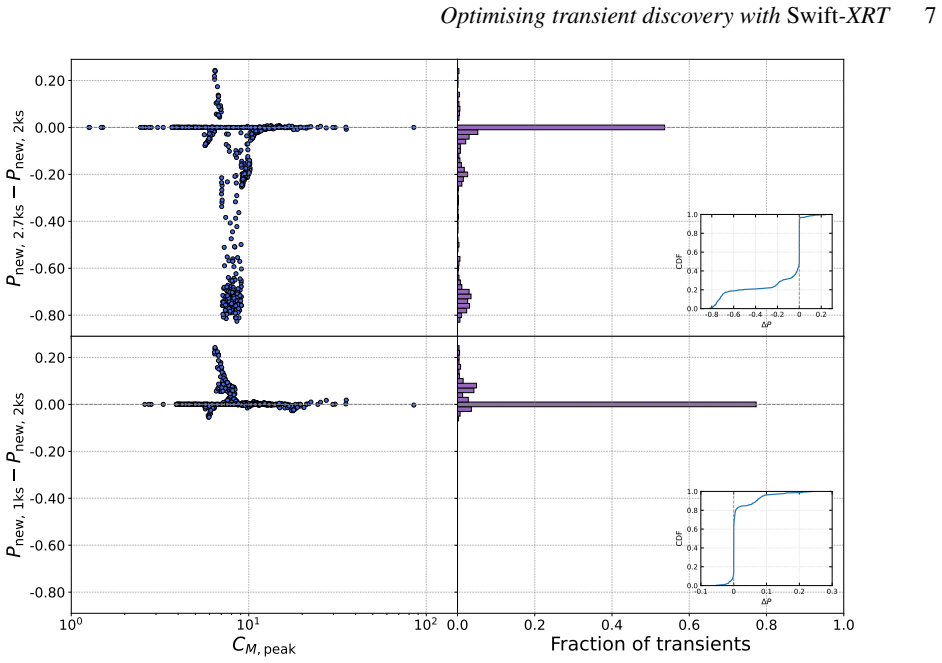
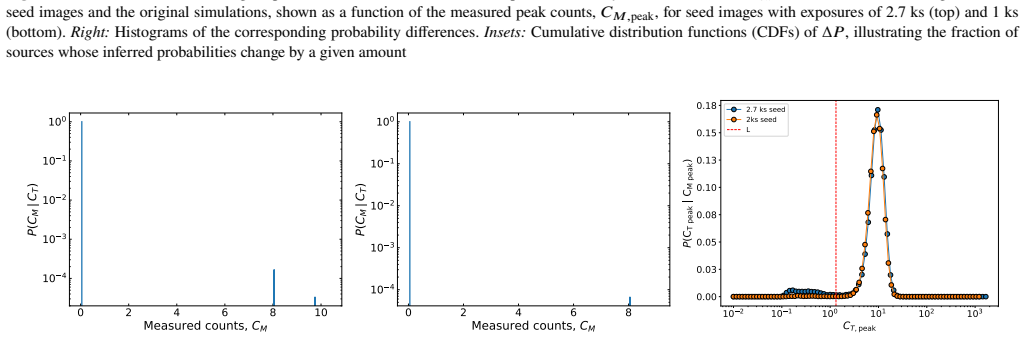
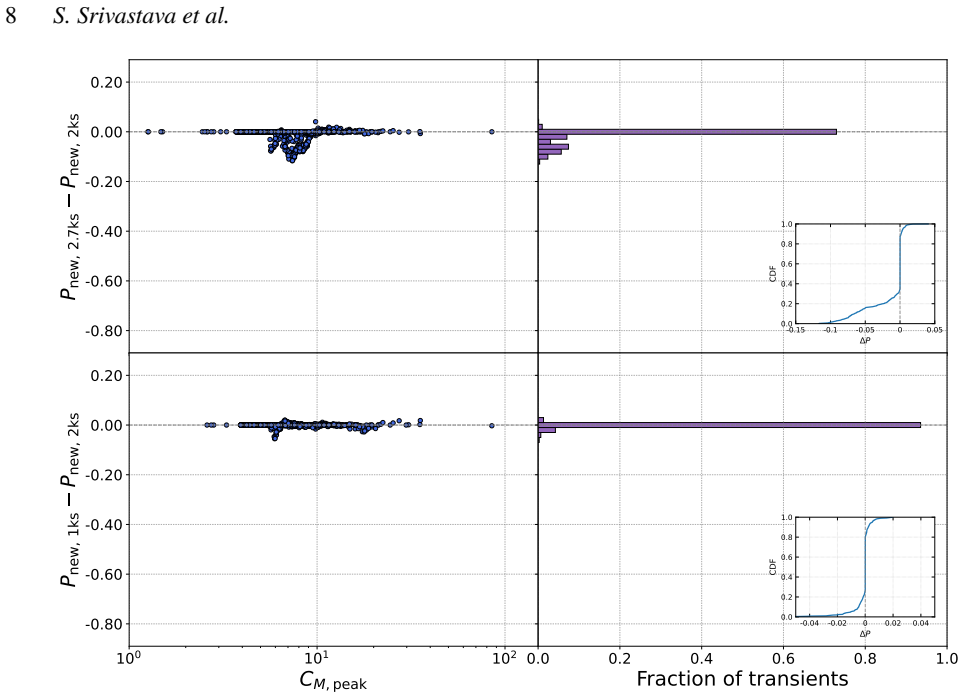
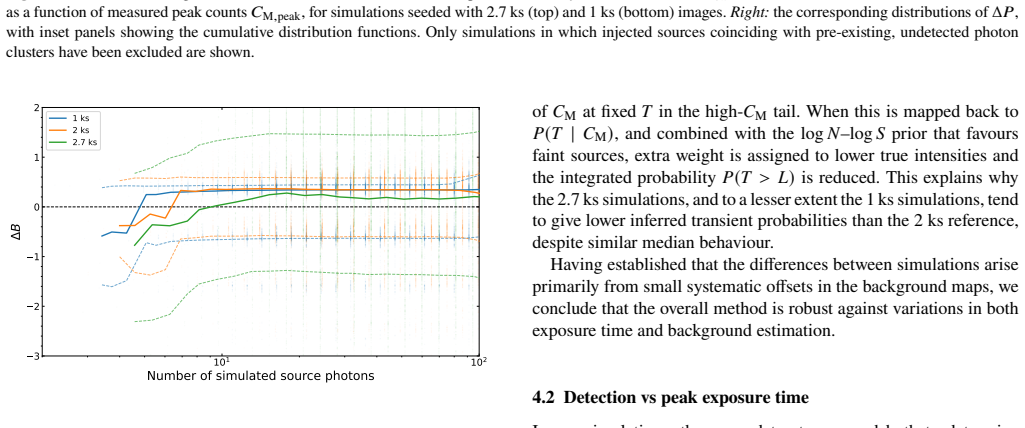
- [Abstract / simulation-validation section] The manuscript states that the approach 'remains stable across varying exposure times and background conditions,' yet supplies no tabulated or plotted metrics (e.g., variation of recovered fraction or posterior bias versus exposure or background rate) that would allow a reader to assess the magnitude of any residual dependence.
Simulated Author's Rebuttal
We thank the referee for their constructive comments highlighting the need for explicit quantitative validation of the simulation framework. We agree that additional metrics will strengthen the presentation of the calibration and stability claims and will incorporate them in the revised manuscript.
read point-by-point responses
-
Referee: [Abstract / simulation-validation section] Abstract and simulation-validation section: the central claim that the method recovers >500 transients (eight-fold increase) rests on the assertion that the Bayesian posteriors are well-calibrated after Eddington-bias correction. No quantitative diagnostics (e.g., Kolmogorov-Smirnov distances between simulated and observed count-rate histograms, or recovery fractions for injected sources at the low-significance threshold) are reported to demonstrate that the simulations reproduce the precise statistical regime where Eddington bias is strongest.
Authors: The referee is correct that the current manuscript does not report formal quantitative diagnostics such as Kolmogorov-Smirnov distances or explicit recovery fractions for injected sources. Although the simulations were constructed from real Swift-XRT images to match the observed statistical properties, and internal checks confirmed good reproduction of the low-significance regime, these specific metrics were not included. In the revised manuscript we will add (i) KS distances between simulated and observed count-rate histograms and (ii) recovery fractions for sources injected at the low-significance threshold, thereby providing direct evidence that the posteriors are well-calibrated where Eddington bias is strongest. revision: yes
-
Referee: [Abstract / simulation-validation section] The manuscript states that the approach 'remains stable across varying exposure times and background conditions,' yet supplies no tabulated or plotted metrics (e.g., variation of recovered fraction or posterior bias versus exposure or background rate) that would allow a reader to assess the magnitude of any residual dependence.
Authors: We agree that the stability statement would be more convincing with explicit metrics. The existing simulation suite already spans a range of exposure times and background levels drawn from real Swift-XRT data, but no variation plots or tables were presented. In the revision we will add figures or tables showing the recovered transient fraction and any residual posterior bias as functions of exposure time and background rate, allowing readers to quantify the degree of stability. revision: yes
Circularity Check
No circularity: simulation-based Bayesian calibration is externally grounded
full rationale
The paper derives transient probabilities via a Bayesian posterior (P(true intensity > historical 3σ UL)) after Eddington-bias correction, with the correction and calibration obtained from simulations constructed on real Swift-XRT images. This step is not self-definitional, does not rename a fitted input as a prediction, and does not rely on self-citation chains or imported uniqueness theorems; the simulations function as an independent external benchmark rather than reducing the output to quantities defined by the same fitted parameters. The reported recovery of >500 transients follows directly from applying these calibrated probabilities to LSXPS catalog entries, without the count being forced by construction from the input data alone. The derivation chain therefore remains self-contained against external benchmarks.
Axiom & Free-Parameter Ledger
Reference graph
Works this paper leans on
-
[1]
The Burst Alert Telescope (BAT) on the SWIFT Midex Mission. , eprint =. doi:10.1007/s11214-005-5096-3 , adsurl =
work page internal anchor Pith review doi:10.1007/s11214-005-5096-3
-
[2]
and Osborne, J.P
Evans, P.A. and Osborne, J.P. and Beardmore, A.P. and others , title =. Astrophysical Journal Supplement , volume =. 2014 , doi =
2014
-
[3]
and others , title =
Evans, P.A. and others , title =. Monthly Notices of the Royal Astronomical Society , volume =. 2020 , doi =
2020
-
[4]
and Page, K.L
Evans, P.A. and Page, K.L. and Osborne, J.P. and Beardmore, A.P. and others , title =. Monthly Notices of the Royal Astronomical Society , year =
-
[5]
and others , title =
Jonker, P.G. and others , title =. Monthly Notices of the Royal Astronomical Society , volume =. 2013 , doi =
2013
-
[6]
and others , title =
Bauer, F.E. and others , title =. Monthly Notices of the Royal Astronomical Society , volume =. 2017 , doi =
2017
-
[7]
and others , title =
Quirola-Vásquez, J. and others , title =. Astronomy & Astrophysics , volume =. 2022 , doi =
2022
-
[8]
and others , title =
Miniutti, G. and others , title =. Nature , volume =. 2019 , doi =
2019
-
[9]
and others , title =
Giustini, M. and others , title =. Astronomy & Astrophysics , volume =. 2020 , doi =
2020
-
[10]
and others , title =
Starling, R.L.C. and others , title =. Monthly Notices of the Royal Astronomical Society , volume =. 2011 , doi =
2011
-
[11]
and others , title =
Strotjohann, N.L. and others , title =. Astrophysical Journal Letters , volume =. 2016 , doi =
2016
-
[12]
and others , title =
Evans, P.A. and others , title =. Monthly Notices of the Royal Astronomical Society , year =
-
[13]
Eddington, A. S. , title =. Monthly Notices of the Royal Astronomical Society , volume =. 1940 , doi =
1940
-
[14]
Swift XRT CALDB Release Note SWIFT-XRT-CALDB-10: Point Spread Function , year =
-
[15]
and Falkner, S
Dauser, T. and Falkner, S. and Lorenz, M. and Kirsch, C. and Peille, P. and Cucchetti, E. and Schmid, C. and Brand, T. and Oertel, M. and Smith, R. and others , title =. Astronomy & Astrophysics , volume =. 2019 , doi =
2019
-
[16]
Klein, R. W. and Roberts, S. D. , title =. Simulation , volume =. 1984 , doi =
1984
-
[17]
and others , title =
Moretti, A. and others , title =. Experimental Astronomy , volume =. 2005 , doi =
2005
-
[18]
2024 , institution =
Swift XRT Team , title =. 2024 , institution =
2024
-
[19]
, title =
Kennea, J.A. , title =. 2020 , institution =
2020
-
[20]
and Kennea, J.A
Burrows, D.N. and Kennea, J.A. and Hill, J.E. and others , title =. 2013 , institution =
2013
-
[21]
and Moretti, A
Romano, P. and Moretti, A. and Banat, P. and Burrows, D. N. and Campana, S. and Capalbi, M. and Chincarini, G. and Cusumano, G. and La Parola, V. and Perri, M. and Tagliaferri, G. and others , title =. Astronomy & Astrophysics , volume =. 2006 , doi =
2006
-
[22]
and Warwick, R
Mateos, S. and Warwick, R. S. and Carrera, F. J. and Stewart, G. C. and Ebrero, J. and Della Ceca, R. and Caccianiga, A. and Gilli, R. and Page, M. J. and Treister, E. and others , title =. Astronomy & Astrophysics , volume =. 2008 , doi =
2008
-
[23]
and Chincarini, G
Gehrels, N. and Chincarini, G. and Giommi, P. and Mason, K. O. and Nousek, J. A. and Wells, A. A. and White, N. E. and Barthelmy, S. D. and Burrows, D. N. and Cominsky, L. R. and others , title =. The Astrophysical Journal , volume =. 2004 , doi =
2004
-
[24]
Burrows, D. N. and Hill, J. E. and Nousek, J. A. and Kennea, J. A. and Wells, A. and Osborne, J. P. and Abbey, A. F. and others , title =. Space Science Reviews , volume =. 2005 , doi =
2005
-
[25]
Burrows, D. N. and Kennea, J. A. and Ghisellini, G. and Mangano, V. and Zhang, B. and Page, K. L. and Eracleous, M. and Romano, P. and Sakamoto, T. and others , title =. Nature , volume =. 2011 , doi =
2011
-
[26]
Cenko, S. B. and Krimm, H. A. and Horesh, A. and Rau, A. and Frail, D. A. and Kocevski, D. and others , title =. The Astrophysical Journal , volume =. 2012 , doi =
2012
-
[27]
Soderberg, A. M. and Berger, E. and Page, K. L. and Schady, P. and Parrent, J. and Pooley, D. and others , title =. Nature , volume =. 2008 , doi =
2008
-
[28]
and in't Zand, J
Heise, J. and in't Zand, J. and Kippen, R. M. and Woods, P. M. , title =. Gamma-ray Bursts in the Afterglow Era: Proceedings of the International Workshop Held in Rome, CNR Headquarters , pages =
-
[29]
and Zhang, C
Yuan, W. and Zhang, C. and Feng, H. and Ling, Z. and Zhang, S. N. and Brandt, W. N. and others , title =. Science China Physics, Mechanics & Astronomy , volume =. 2022 , doi =
2022
- [30]
-
[31]
and others , title =
Guolo, M. and others , title =. Nature Astronomy , volume =. 2024 , doi =
2024
-
[32]
Evans, I. N. and others , title =. The Astrophysical Journal Supplement Series , volume =. 2010 , doi =
2010
-
[33]
Webb, N. A. and others , title =. Astronomy & Astrophysics , volume =. 2020 , doi =
2020
-
[34]
Astronomy & Astrophysics , volume=
Extragalactic fast X-ray transient candidates discovered by Chandra (2014--2022) , author=. Astronomy & Astrophysics , volume=. 2023 , publisher=
2014
-
[35]
Astronomy & Astrophysics , volume=
Probing a magnetar origin for the population of extragalactic fast X-ray transients detected by Chandra , author=. Astronomy & Astrophysics , volume=. 2024 , publisher=
2024
-
[36]
arXiv preprint arXiv:2504.08886 , year=
The kangaroo's first hop: the early fast cooling phase of EP250108a/SN 2025kg , author=. arXiv preprint arXiv:2504.08886 , year=
-
[37]
Monthly Notices of the Royal Astronomical Society , volume=
Nine tidal disruption event candidates in eROSITA-DE DR1 discovered through supersoft X-ray selection , author=. Monthly Notices of the Royal Astronomical Society , volume=. 2025 , publisher=
2025
-
[38]
and Aschenbach, B
Voges, W. and Aschenbach, B. and Boller, T. and others , title =. A&A , year =
-
[39]
and Freyberg, M
Boller, T. and Freyberg, M. J. and Trümper, J. and Haberl, F. and Voges, W. and Nandra, K. , title =. A&A , year =
-
[40]
Saxton, R. D. and Read, A. M. and Esquej, P. and Freyberg, M. J. and Altieri, B. and Bermejo, D. , title =. A&A , year =
-
[41]
Saxton, R. D. and Read, A. M. and Esquej, P. and Komossa, S. and Dougherty, S. and Rodriguez-Pascual, P. and Barrado, D. , title =. A&A , year =
-
[42]
The Astrophysical Journal , volume=
Swift follow-up observations of gravitational-wave and high-energy neutrino coincident signals , author=. The Astrophysical Journal , volume=. 2021 , publisher=
2021
-
[43]
Page, K. L. and Evans, P. A. and Tohuvavohu, A. and others , title =. Monthly Notices of the Royal Astronomical Society , year =
-
[44]
Bloom, Joshua S. and Giannios, Dimitrios and Metzger, Brian D. and others , title =. Science , year =. doi:10.1126/science.1207150 , eprint =
-
[45]
Brown, G. C. and Levan, A. J. and Stanway, E. R. and Tanvir, N. R. and Cenko, S. B. and Berger, E. and Chornock, R. and Cucchiara, A. , title =. Monthly Notices of the Royal Astronomical Society , year =. doi:10.1093/mnras/stv1520 , eprint =
-
[46]
Pasham, Dheeraj R. and Cenko, S. Bradley and Levan, A. J. and others , title =. The Astrophysical Journal , year =. doi:10.1088/0004-637X/805/1/68 , eprint =
-
[47]
A fast powerful X-ray transient from possible tidal disruption of a white dwarf. arXiv e-prints , keywords =. doi:10.48550/arXiv.2509.25877 , archivePrefix =. 2509.25877 , primaryClass =
-
[48]
Comprehensive X-Ray Observations of the Exceptional Ultralong X-Ray and Gamma-Ray Transient GRB 250702B with Swift, NuSTAR, and Chandra: Insights from the X-Ray Afterglow Properties. , keywords =. doi:10.3847/2041-8213/ae1741 , archivePrefix =. 2509.22787 , primaryClass =
-
[49]
Nature Astronomy , year = 2025, month = sep, volume =
Fast X-ray transient EP240315A from a Lyman-continuum-leaking galaxy at z 5. Nature Astronomy , year = 2025, month = sep, volume =. doi:10.1038/s41550-025-02612-9 , adsurl =
-
[50]
Unveiling the nature of the Einstein Probe transient EP241021a. , keywords =. doi:10.1093/mnras/staf2064 , archivePrefix =. 2511.13314 , primaryClass =
-
[51]
EP241021a: A Months-duration X-Ray Transient with Luminous Optical and Radio Emission. , keywords =. doi:10.3847/2041-8213/adf4cd , archivePrefix =. 2505.07665 , primaryClass =
-
[52]
EP 250108a/SN 2025kg: Observations of the Most Nearby Broad-line Type Ic Supernova Following an Einstein Probe Fast X-Ray Transient. , keywords =. doi:10.3847/2041-8213/ade7f9 , archivePrefix =. 2504.08889 , primaryClass =
-
[53]
Is it due to a binary compact object merger?
EP250207b is not a collapsar fast X-ray transient. Is it due to a binary compact object merger?. , keywords =. doi:10.1093/mnras/staf2021 , archivePrefix =. 2508.13039 , primaryClass =
-
[54]
An extremely soft and weak fast X-ray transient associated with a luminous supernova. arXiv e-prints , keywords =. doi:10.48550/arXiv.2504.17034 , archivePrefix =. 2504.17034 , primaryClass =
-
[55]
Science China Physics, Mechanics, and Astronomy , keywords =
Einstein Probe discovery of EP240408a: A peculiar X-ray transient with an intermediate timescale. Science China Physics, Mechanics, and Astronomy , keywords =. doi:10.1007/s11433-024-2524-4 , archivePrefix =. 2410.21617 , primaryClass =
-
[56]
2024, A&A, 682, A34, doi: 10.1051/0004-6361/202347165
Merloni, A. and Lamer, G. and Liu, T. and others , title =. Astronomy & Astrophysics , year =. doi:10.1051/0004-6361/202347165 , eprint =
work page internal anchor Pith review doi:10.1051/0004-6361/202347165
-
[57]
2020, ApJ, 896, 39, doi: 10.3847/1538-4357/ab91ba
Alp, Dennis and Larsson, Josefin , title =. The Astrophysical Journal , year =. doi:10.3847/1538-4357/ab91ba , eprint =
-
[58]
De Luca, A. and Salvaterra, R. and Belfiore, A. and others , title =. Astronomy & Astrophysics , year =. doi:10.1051/0004-6361/202039783 , eprint =
-
[59]
E., Treister, E., Schawinski, K., et al
Bauer, Franz E. and Brandt, W. N. and Lehmer, B. D. and others , title =. Monthly Notices of the Royal Astronomical Society , year =. doi:10.1093/mnras/stx417 , eprint =
-
[60]
An extremely luminous panchromatic outburst from the nucleus of a distant galaxy
An Extremely Luminous Panchromatic Outburst from the Nucleus of a Distant Galaxy. Science , keywords =. doi:10.1126/science.1207143 , archivePrefix =. 1104.3356 , primaryClass =
work page internal anchor Pith review Pith/arXiv arXiv doi:10.1126/science.1207143
-
[61]
First tidal disruption events discovered by SRG/eROSITA: X-ray/optical properties and X-ray luminosity function at z < 0.6. , keywords =. doi:10.1093/mnras/stab2843 , archivePrefix =. 2108.02449 , primaryClass =
discussion (0)
Sign in with ORCID, Apple, or X to comment. Anyone can read and Pith papers without signing in.