REVIEW 4 major objections 5 minor 56 references
STEAM: A Spatio-TEmporal Alignment Mixture-of-Experts Model with Hierarchical Pre-training for EEG Decoding
T0 review · 4 major / 5 minor · reviewed 2026-08-07 · deepseek-v4-flash
Pith's one-line read STEAM claims that one EEG foundation model can both transfer broadly across paradigms and specialize cheaply: across seven datasets and fourteen settings it reports the best average rank among compared models.
desk verdict Solid empirical architecture study with thorough ablations; the benchmark win is plausible but the headline rank margin depends on baseline fairness that isn't fully documented. read the letter →
The pith
A machine-rendered reading of the paper's core claim, the machinery that carries it, and where it could break.
The reading
What carries the argument
The central mechanism is the shared soft mixture-of-experts (SSMoE) module, a cross-branch communication interface placed at selected encoder layers: spatial and temporal tokens are concatenated, softly routed through a small set of expert slots (eight by default) using two softmax normalizations, and the transformed slots are redistributed back to each branch through token-specific combination weights. This lets the two streams exchange global information while preserving their separate local structures. Two supporting mechanisms carry the rest of the argument: frequency-aware gated attention, which computes log band-power descriptors per token and uses them to reweight attention outputs inside every layer, injecting a spectral prior useful under low signal-to-noise ratios; and the two-stage general-to-paradigm pre-training, which first optimizes masked reconstruction with cross-view contrastive alignment and then adds a supervised classification objective on multi-dataset paradigm corpora to specialize the backbone.
What would settle it
Re-run the fourteen-setting evaluation giving every baseline foundation model the same per-method validation tuning and the same adaptation budget on the standardized 60-channel preprocessing, then check whether STEAM's 1.43 mean rank and 9.12-position margin over the ten baseline foundation models persist; if the baselines close the gap once tuned equally, the best-rank claim would not survive.
Extended reading notes
Core claim
The paper's central claim is that a single EEG foundation model can simultaneously achieve three things that prior models treat as a trade-off: broad cross-paradigm transfer, accurate paradigm-specific decoding, and cheap downstream adaptation. The proposed STEAM architecture keeps spatial and temporal representations in separate branches, couples them through a shared soft mixture-of-experts bottleneck with compact slots, and injects band-power-based frequency gates into every encoder layer. A two-stage pre-training regime first learns general EEG structure from a large unlabeled clinical corpus, then continues training on multiple datasets within a target paradigm with supervised objectives to produce a specialized variant. The paper reports that this recipe yields the best average rank across seven datasets and fourteen evaluation settings, with the specialized variants improving on the general model for motor imagery and emotion decoding.
Load-bearing premise
The headline rank result depends on the ten baseline foundation models having been evaluated as fairly and carefully as STEAM: the paper says they used official implementations and released checkpoints, but it does not report per-method hyperparameter tuning or adaptation to the standardized 60-channel inputs.
Editorial extensions
If this is right
- A single pre-trained EEG backbone can be reused across tasks and subjects without per-task training from scratch, then specialized to a target paradigm by continued pre-training instead of a fresh model.
- Adapting only the spatial and temporal embedding modules plus a task head, about 5.1% of parameters, can match full fine-tuning on most classification tasks and shrink optimizer-state storage.
- Stage-I initialization yields stronger downstream accuracy throughout Stage-II training and reaches a given accuracy in about 2.8x fewer epochs, so paradigm-specific variants are cheaper to produce.
- The SSMoE slots visually concentrate on distinct temporal intervals and channel subsets, indicating that the model learns decomposable spatio-temporal responses rather than one global routing pattern.
Reading between the lines
- The same general-to-paradigm recipe would likely carry over to other physiological signals with spatial and temporal tokenization, such as MEG or multimodal biosignals, though the paper does not test this.
- The gains could partly come from the standardized 60-channel interpolation rather than the architecture; ablating montage normalization against native-channel adaptation would isolate the source.
- Stage-II specialization helps only within the target paradigm, so deployment choices depend on the task: general Stage-I for broad transfer, specialized variants when the paradigm is known in advance.
- The SSMoE visualizations hint at interpretable spatio-temporal explanations for predictions, but the paper offers only qualitative evidence; measuring slot selectivity quantitatively would test that promise.
Signed reviews
Editorial analysis
A structured set of objections, weighed in public.
Referee Report
Summary. The paper proposes STEAM, a dual-branch spatio-temporal encoder with a shared soft mixture-of-experts (SSMoE) module, frequency-aware gated attention, and a two-stage hierarchical pre-training strategy (Stage-I on TUH, Stage-II on paradigm-specific corpora). It claims the best average rank across seven downstream datasets and fourteen evaluation settings at competitive inference cost, and reports consistent gains from paradigm-specific specialization, alongside a lightweight adaptation method that updates about 5.1% of parameters. The empirical evaluation uses cross-subject LOSO and within-subject few-shot protocols, with internal ablations isolating the contributions of the architecture and pre-training objectives.
Significance. If the empirical claims are substantiated, STEAM is a meaningful contribution to EEG foundation models: it proposes a plausible mechanism for reconciling broad transfer with paradigm specialization, and the architecture details are presented with enough specificity to permit reimplementation. The paper's internal ablations are unusually thorough—Tables 2, 3, 11, and 12 isolate SSMoE, frequency gating, pre-training objectives, and fusion mechanisms, including a parameter-matched control for the shared expert pool—and the subject-level figures and explicit corpus partitioning strengthen the presentation. The main weakness is that the headline rank claim rests on a baseline-fairness assumption that is not yet documented, and the configuration of the model itself is selected on the same benchmark datasets, which undermines the comparison.
major comments (4)
- [Appendix C (Subject-Level Results / Aggregate-rank calculation), Table 13] The headline claim of a 1.43 average rank versus a 10.55 mean for ten foundation-model baselines rests entirely on the fairness of the external comparison. The paper states that all baselines use 'their official implementations and publicly released pre-trained checkpoints,' but it does not report per-method preprocessing or hyperparameter tuning. All downstream data are mapped to a standardized 60-channel montage by inverse-distance interpolation (Appendix B), and these interpolated signals are then fed to models pretrained on their native channel layouts (e.g., LaBraM, SingLEM, BIOT). If the official checkpoints receive out-of-native-format inputs and default hyperparameters, the 9.12-position rank margin could partly reflect under-tuning. Please provide, for each baseline, the exact preprocessing pipeline used, the validation-based hyperparameter selection protocol, and the number of epochs/learning rates, or re-run the comparison with the native preprocessing of each baseline.
- [Appendix C (SSMoE Expert-Count Sensitivity), Figure 6, Table 1] The default configuration of eight SSMoE experts was selected from a sensitivity sweep on the same downstream datasets that appear in the main benchmark (BNCI2015001, CHB-MIT, SEED, BNCI2014009). This constitutes selection on the evaluation set: the reported STEAM numbers in Table 1 are produced by the configuration that performs best on those datasets, while the ten baselines did not receive an equivalent configuration-selection step. This asymmetry can inflate the rank margin. Please either select the expert count on a held-out subset or show that the rank conclusion is stable across expert counts (e.g., that STEAM's combined rank remains below the baselines' mean for M = 2, 4, 8, and 16).
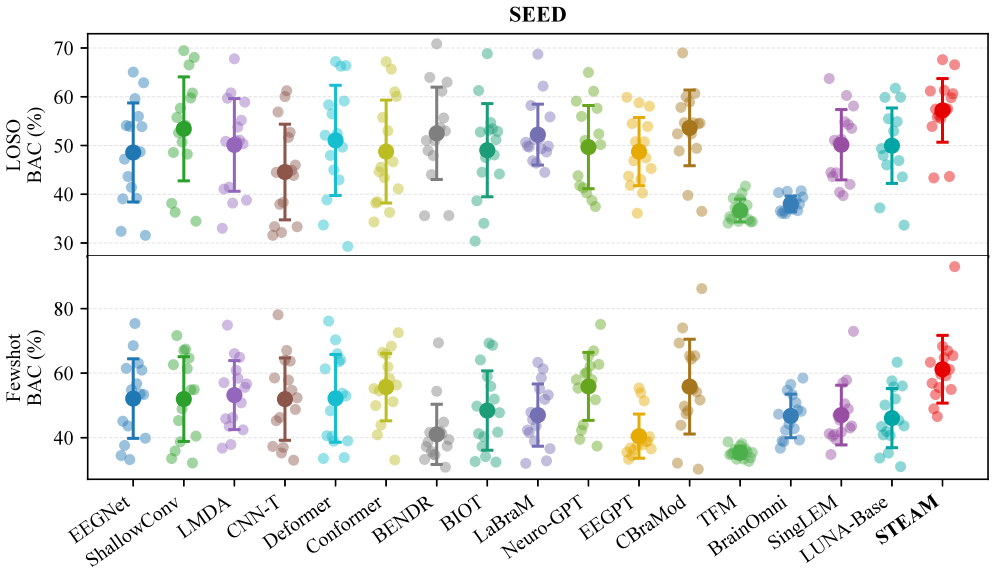
- [Tables 1 and 13] The paper reports mean ± std over three runs but provides no significance tests. Several setting-level differences that contribute to the rank comparison are smaller than one standard deviation; for example, on BNCI2014009 LOSO, STEAM achieves 78.63±0.54 versus EEGNet's 78.39±0.44, and on SEED-VIG LOSO, STEAM's RMSE 0.2281±0.0036 is statistically indistinguishable from LaBraM's 0.2281±0.0035. The 'best average rank' claim should be supported by paired tests at the subject level (e.g., Wilcoxon signed-rank tests for LOSO and few-shot per dataset) or by reporting confidence intervals for the combined rank.
- [Appendix A (Reproducibility)] The manuscript provides architecture tables and hyperparameters but does not release code, pre-trained checkpoints, or a link to any repository. Given the complexity of the two-stage pre-training pipeline and the many baseline evaluations, independent verification is not currently possible. A public release of the code and the Stage-I/Stage-II checkpoints (or at least a detailed, step-by-step reproduction protocol) is necessary to support the empirical claims.
minor comments (5)
- [Method, Eq. (15)] The diversity loss L_div is referenced in the pre-training objective but never defined in the main text; please provide its exact form.
- [Table 1] Entries such as '–38.02 ±0.03' and '–60.83 ±0.30' appear to be rendering artifacts of missing values; please use a clear dash with a footnote explaining that the result is not applicable.
- [Figure 1 caption] The caption should describe the axes (presumably average rank and inference FLOPs) and explain the bubble-size parameter count scale more explicitly.
- [Appendix B, 'BNCI2014009'] The input duration is 0.80 s while the model input is 1.00 s; please state whether zero-padding or resampling is used to reconcile this mismatch.
- [Experiment Settings] The statement that 'all models use full fine-tuning' should also explicitly state that the same full-fine-tuning protocol is used for the rank comparison in Tables 1 and 13, so that the reader does not conflate the lightweight adaptation results with the main benchmark.
Circularity Check
No significant circularity: benchmark and Stage-II gains are evaluated on held-out datasets with external baselines; self-citations are motivational or baseline-only.
full rationale
No significant circularity. The paper's central claims are empirical: Stage-I transferability is measured on seven datasets (BNCI2014001, BNCI2015001, BNCI2014009, CHB-MIT, EEGMAT, SEED, SEED-VIG) that Appendix B explicitly excludes from both pre-training stages, and Stage-II specialization gains are reported on BNCI2014001, BNCI2015001, and SEED, none of which appear in the Stage-II MI or emotion corpora. Tables 2 and 3 and Appendix C ablate components and objectives against held-out downstream protocols, so the gains are not forced by the training objectives in Eqs. 16 and 17. The aggregate rank (STEAM 1.43 vs. mean 10.55) is an evaluation statistic computed from external BAC/RMSE results, not a fitted quantity. Self-citations (MIRepNet and the authors' EEG-FM benchmark) appear as motivation and as baselines; no load-bearing argument reduces to an unpublished self-citation, and no uniqueness theorem or ansatz is imported from the authors' prior work. The skeptic's baseline-fairness point concerns whether official checkpoints were equally well tuned, which is a correctness and external-validity risk, not circularity.
Assumptions & free parameters
free parameters (5)
- SSMoE expert/slot count M =
8
- Stage-I self-supervised weights and masking ratio =
alpha=0.30, lambda=0.01, mask=0.50, tau=0.20
- Stage-II classification loss weight mu =
1.00
- Frequency-band definitions and count K =
not reported
- Backbone capacity: layers, hidden size, heads =
6 layers, d=128, 8 heads
assumptions (5)
- domain assumption Channel-centric and temporal-segment-centric tokenizations preserve complementary discriminative structure in EEG.
- domain assumption Band-power log-descriptors are a robust frequency prior that improves attention under low signal-to-noise ratio.
- ad hoc to paper Shared soft MoE routing can exchange spatial and temporal information through a small slot bottleneck without disrupting branch structure.
- domain assumption General pre-training on the clinical TUH corpus transfers to non-clinical BCI paradigms.
- domain assumption Aligned label spaces in Stage-II corpora provide supervision that is beneficial and not harmed by label mapping or montage interpolation.
Cite this review
Pith. "Pith review of STEAM: A Spatio-TEmporal Alignment Mixture-of-Experts Model with Hierarchical Pre-training for EEG Decoding." pith.science (2026). https://pith.science/paper/PCMNI7YD
@misc{pith2026260802070,
  author       = {Pith},
  title        = {Pith review of: STEAM: A Spatio-TEmporal Alignment Mixture-of-Experts Model with Hierarchical Pre-training for EEG Decoding},
  year         = {2026},
  howpublished = {\url{https://pith.science/paper/PCMNI7YD}},
  note         = {Machine review of arXiv:2608.02070}
}
read the original abstract
Brain-computer interfaces (BCIs) have been widely used in motor rehabilitation, disease diagnosis, and other neural engineering scenarios. However, conventional neural signal decoding algorithms often suffer from limited generalizability and high adaptation costs, motivating recent interest in BCI foundation models. Existing approaches still struggle to jointly achieve general transferability, accurate decoding, and efficient downstream adaptation. We present STEAM, a hierarchical transfer framework that reconciles general-purpose representation learning with paradigm-specific specialization in EEG foundation models. The framework is instantiated as a dual-branch spatio-temporal encoder in which a shared soft mixture-of-experts (SSMoE) module aligns the spatial and temporal branches, allowing complementary representations to exchange information through a compact set of soft slots. Across seven downstream datasets and fourteen evaluation settings, STEAM attains the best average rank among the compared methods at a competitive inference cost measured in FLOPs. Building upon the Stage-I general initialization, the hierarchical pre-training strategy further specializes the model to a target paradigm without retraining from scratch, yielding consistent gains in paradigm-specific decoding accuracy.
Figures


Figures from the paper (10 more)




Reference graph
Works this paper leans on
-
[1]
Brain-computer interfaces (BCIs) for communication and control , author=. Proceedings of the 9th international ACM SIGACCESS conference on Computers and accessibility , pages=
-
[2]
The Journal of physiology , volume=
Brain--computer interfaces: communication and restoration of movement in paralysis , author=. The Journal of physiology , volume=. 2007 , publisher=
work page 2007
-
[3]
Clinical neurophysiology , volume=
Event-related EEG/MEG synchronization and desynchronization: basic principles , author=. Clinical neurophysiology , volume=. 1999 , publisher=
1999
-
[4]
Journal of neural engineering , volume=
A review of classification algorithms for EEG-based brain--computer interfaces , author=. Journal of neural engineering , volume=
-
[5]
IEEE transactions on rehabilitation engineering , volume=
Optimal spatial filtering of single trial EEG during imagined hand movement , author=. IEEE transactions on rehabilitation engineering , volume=. 2000 , publisher=
work page 2000
-
[6]
IEEE Signal processing magazine , volume=
Optimizing spatial filters for robust EEG single-trial analysis , author=. IEEE Signal processing magazine , volume=. 2008 , publisher=
work page 2008
-
[7]
Liu, Dingkun and Li, Siyang and Wang, Ziwei and Li, Wei and Wu, Dongrui , journal=. 2025 , publisher=
work page 2025
-
[8]
Human brain mapping , volume=
Deep learning with convolutional neural networks for EEG decoding and visualization , author=. Human brain mapping , volume=. 2017 , publisher=
2017
Show all 56 references
-
[9]
Journal of neural engineering , volume=
EEGNet: a compact convolutional neural network for EEG-based brain--computer interfaces , author=. Journal of neural engineering , volume=. 2018 , publisher=
2018
-
[10]
, journal =
Craik, Alexander and He, Yongtian and Contreras-Vidal, Jose L. , journal =. Deep learning for electroencephalogram (. 2019 , publisher =
2019
-
[11]
Advances in Neural Information Processing Systems , volume =
Attention is all you need , author =. Advances in Neural Information Processing Systems , volume =
-
[12]
A multi-view
Mane, Ravikiran and Robinson, Neethu and Vinod, A Prasad and Lee, Seong-Whan and Guan, Cuntai , booktitle=. A multi-view
-
[13]
IEEE Transactions on Neural Systems and Rehabilitation Engineering , volume=
EEG conformer: Convolutional transformer for EEG decoding and visualization , author=. IEEE Transactions on Neural Systems and Rehabilitation Engineering , volume=. 2022 , publisher=
2022
-
[14]
IEEE Journal of Biomedical and Health Informatics , volume=
EEG-Deformer: A dense convolutional transformer for brain-computer interfaces , author=. IEEE Journal of Biomedical and Health Informatics , volume=. 2024 , publisher=
2024
-
[15]
IEEE Journal of Biomedical and Health Informatics , year=
DBConformer: Dual-branch convolutional transformer for EEG decoding , author=. IEEE Journal of Biomedical and Health Informatics , year=
-
[16]
Frontiers in Human Neuroscience , volume=
BENDR: Using transformers and a contrastive self-supervised learning task to learn from massive amounts of EEG data , author=. Frontiers in Human Neuroscience , volume=. 2021 , publisher=
2021
-
[17]
Advances in Neural Information Processing Systems , volume=
Biot: Biosignal transformer for cross-data learning in the wild , author=. Advances in Neural Information Processing Systems , volume=
-
[18]
International Conference on Learning Representations , volume=
Large brain model for learning generic representations with tremendous EEG data in BCI , author=. International Conference on Learning Representations , volume=
-
[19]
Advances in Neural Information Processing Systems , volume=
Eegpt: Pretrained transformer for universal and reliable representation of eeg signals , author=. Advances in Neural Information Processing Systems , volume=
-
[20]
International conference on learning representations , volume=
Cbramod: A criss-cross brain foundation model for eeg decoding , author=. International conference on learning representations , volume=
-
[21]
Advances in Neural Information Processing Systems , volume=
Csbrain: A cross-scale spatiotemporal brain foundation model for eeg decoding , author=. Advances in Neural Information Processing Systems , volume=
-
[22]
Neural Networks , pages=
Eegmamba: An eeg foundation model with mamba , author=. Neural Networks , pages=. 2025 , publisher=
2025
-
[23]
International conference on learning representations , volume=
NeuroLM: A universal multi-task foundation model for bridging the gap between language and EEG signals , author=. International conference on learning representations , volume=
-
[24]
Knowledge-Based Systems , pages=
MIRepNet: A pipeline and pre-trained model for EEG-based motor imagery classification , author=. Knowledge-Based Systems , pages=. 2026 , publisher=
2026
-
[25]
Deng, Guifeng and Wang, Pan and Wang, Jiquan and Rao, Shuying and Xie, Junyi and Guo, Wanjun and Li, Tao and Jiang, Haiteng , journal =
-
[26]
Proceedings of the IEEE/CVF Conference on Computer Vision and Pattern Recognition , pages =
Masked Autoencoders Are Scalable Vision Learners , author =. Proceedings of the IEEE/CVF Conference on Computer Vision and Pattern Recognition , pages =
-
[27]
International Conference on Learning Representations , volume=
From sparse to soft mixtures of experts , author=. International Conference on Learning Representations , volume=
-
[28]
Parameter-Efficient Transfer Learning for
Houlsby, Neil and Giurgiu, Andrei and Jastrzebski, Stanislaw and Morrone, Bruna and De Laroussilhe, Quentin and Gesmundo, Andrea and Attariyan, Mona and Gelly, Sylvain , booktitle =. Parameter-Efficient Transfer Learning for. 2019 , organization =
2019
-
[29]
Proceedings of the 2021 conference on empirical methods in natural language processing , pages=
The power of scale for parameter-efficient prompt tuning , author=. Proceedings of the 2021 conference on empirical methods in natural language processing , pages=
2021
-
[30]
Devlin, Jacob and Chang, Ming-Wei and Lee, Kenton and Toutanova, Kristina , booktitle =
-
[31]
Frontiers in neuroscience , volume=
The temple university hospital EEG data corpus , author=. Frontiers in neuroscience , volume=. 2016 , publisher=
2016
-
[32]
Biomedical Engineering/Biomedizinische Technik , volume=
Random forests in non-invasive sensorimotor rhythm brain-computer interfaces: a practical and convenient non-linear classifier , author=. Biomedical Engineering/Biomedizinische Technik , volume=. 2016 , publisher=
2016
-
[33]
GigaScience , volume=
EEG datasets for motor imagery brain--computer interface , author=. GigaScience , volume=. 2017 , publisher=
2017
-
[34]
Scientific Data , volume=
A large EEG database with users’ profile information for motor imagery brain-computer interface research , author=. Scientific Data , volume=. 2023 , publisher=
2023
-
[35]
GigaScience , volume=
EEG dataset and OpenBMI toolbox for three BCI paradigms: An investigation into BCI illiteracy , author=. GigaScience , volume=. 2019 , publisher=
2019
-
[36]
PloS one , volume=
Evaluation of EEG oscillatory patterns and cognitive process during simple and compound limb motor imagery , author=. PloS one , volume=. 2014 , publisher=
2014
-
[37]
PloS one , volume=
A fully automated trial selection method for optimization of motor imagery based brain-computer interface , author=. PloS one , volume=. 2016 , publisher=
2016
-
[38]
IEEE Transactions on biomedical engineering , volume=
BCI2000: a general-purpose brain-computer interface (BCI) system , author=. IEEE Transactions on biomedical engineering , volume=. 2004 , publisher=
2004
-
[39]
Frontiers in neuroscience , volume=
Review of the BCI competition IV , author=. Frontiers in neuroscience , volume=. 2012 , publisher=
2012
-
[40]
Journal of neural engineering , volume=
Influence of P300 latency jitter on event related potential-based brain--computer interface performance , author=. Journal of neural engineering , volume=. 2014 , publisher=
2014
-
[41]
2010 , month = jun, note =
Guttag, John , title =. 2010 , month = jun, note =. doi:10.13026/C2K01R , url =
2010 doi
-
[42]
Data , volume=
Electroencephalograms during mental arithmetic task performance , author=. Data , volume=. 2019 , publisher=
2019
-
[43]
IEEE Transactions on autonomous mental development , volume=
Investigating critical frequency bands and channels for EEG-based emotion recognition with deep neural networks , author=. IEEE Transactions on autonomous mental development , volume=. 2015 , publisher=
2015
-
[44]
Journal of neural engineering , volume=
A multimodal approach to estimating vigilance using EEG and forehead EOG , author=. Journal of neural engineering , volume=. 2017 , publisher=
2017
-
[45]
Liu, Dingkun and Chen, Yuheng and Chen, Zhu and Cui, Zhenyao and Wen, Yaozhi and An, Jiayu and Luo, Jingwei and Wu, Dongrui , journal=
-
[46]
Thapa, Rahul and He, Bryan and Kj. Sleep. arXiv preprint arXiv:2405.17766 , year=
-
[47]
NeuroImage , volume=
LMDA-Net: A lightweight multi-dimensional attention network for general EEG-based brain-computer interfaces and interpretability , author=. NeuroImage , volume=. 2023 , publisher=
2023
-
[48]
2024 IEEE International Symposium on Biomedical Imaging (ISBI) , pages=
Neuro-gpt: Towards a foundation model for eeg , author=. 2024 IEEE International Symposium on Biomedical Imaging (ISBI) , pages=. 2024 , organization=
2024
-
[49]
arXiv preprint arXiv:2502.16060 , year=
Tokenizing Single-Channel EEG with Time-Frequency Motif Learning , author=. arXiv preprint arXiv:2502.16060 , year=
-
[50]
Advances in Neural Information Processing Systems , volume=
Brainomni: A brain foundation model for unified eeg and meg signals , author=. Advances in Neural Information Processing Systems , volume=
-
[51]
arXiv preprint arXiv:2509.17920 , year=
SingLEM: Single-Channel Large EEG Model , author=. arXiv preprint arXiv:2509.17920 , year=
-
[52]
Advances in Neural Information Processing Systems , volume=
LUNA: efficient and topology-agnostic foundation model for EEG signal analysis , author=. Advances in Neural Information Processing Systems , volume=
-
[53]
2022 44th Annual International Conference of the IEEE Engineering in Medicine & Biology Society (EMBC) , pages=
Transformer convolutional neural networks for automated artifact detection in scalp EEG , author=. 2022 44th Annual International Conference of the IEEE Engineering in Medicine & Biology Society (EMBC) , pages=. 2022 , organization=
2022
-
[54]
IEEE Transactions on Cognitive and Developmental Systems , year=
Comparing Recognition Performance and Robustness of Multimodal Deep Learning Models for Multimodal Emotion Recognition , author=. IEEE Transactions on Cognitive and Developmental Systems , year=
-
[55]
IEEE transactions on affective computing , volume=
Deap: A database for emotion analysis; using physiological signals , author=. IEEE transactions on affective computing , volume=. 2011 , publisher=
2011
-
[56]
Autocalibration and Recurrent Adaptation: Towards a Plug and Play Online ERD-BCI , year=
Faller, Josef and Vidaurre, Carmen and Solis-Escalante, Teodoro and Neuper, Christa and Scherer, Reinhold , journal=. Autocalibration and Recurrent Adaptation: Towards a Plug and Play Online ERD-BCI , year=
Reviewed August 7, 2026 · model on record in the stance chip above.
Discussion (0). Continue with ORCID to comment.