REVIEW 3 major objections 8 minor 26 references
Tunable mesoscopic numerical model for bacterial biofilms
T0 review · 3 major / 8 minor · reviewed 2026-07-30 · grok-4.5
Pith's one-line read Biofilm network structure is set by competition between polymer–polymer and polymer–bacteria crosslinks that share the same polymer binding sites.
desk verdict Clean, usable extension of their permanent-crosslink DPD biofilm model; the real result is the p–p vs p–b competition map, not rheology yet. read the letter →
The pith
A machine-rendered reading of the paper's core claim, the machinery that carries it, and where it could break.
The reading
What carries the argument
DPD plus Gillespie-inspired stochastic bonding (creation propensity set by activation energy; breakage propensity set by activation energy minus a shifted harmonic bond energy), together with the phenomenological competition formulas for the fractions of polymer–polymer and polymer–bacteria bonds as functions of sticky-area fraction r.
What would settle it
Measure equilibrium polymer–polymer versus polymer–bacteria bond fractions while varying bacterial sticky-site density or the two binding energies; the observed crossover should shift as predicted by the energy-difference ratio and the fitted availability exponents.
Extended reading notes
Core claim
Biofilm structure at the mesoscale is governed by competition between reversible polymer–polymer and polymer–bacteria crosslinks. Their relative fractions follow a two-channel statistical model whose weights encode the binding energies and whose effective exponents encode how partner availability changes with the sticky-area fraction on bacteria; the crossover between network regimes is set by that energy difference together with linker availability and bond stiffness.
Load-bearing premise
That the chosen Monte Carlo update interval, fixed activation barrier, and geometric cutoffs produce physically realistic bond lifetimes rather than algorithm-dependent artifacts.
Editorial extensions
If this is right
- Independently tuning the two binding energies selectively chooses a polymer-driven network or a bacteria-anchored one rather than only changing total crosslink number.
- Bond stiffness redistributes bonds toward polymer–polymer links and shortens polymer–bacteria lifetimes through geometric incompatibility.
- Permanent-crosslink mesoscale models miss structural regimes that reversible bonding allows.
- Future oscillatory-strain runs on this model are expected to show channel-dependent viscoelastic moduli.
- Changing linker availability or bond stiffness offers a route to remodel biofilm matrices for control or removal.
Reading between the lines
- The same two-channel competition should apply to other multiphase gels in which two crosslink species share one binding-site pool.
- If stiff polymer–bacteria bonds are systematically shorter-lived, shear may preferentially rupture bacteria anchors first, giving a kinetic path to detachment.
- Mapping measured sticky-protein density on real cell surfaces onto the model’s sticky fraction would make the predicted crossover directly testable in vitro.
Editorial analysis
A structured set of objections, weighed in public.
Referee Report
Summary. The manuscript extends the authors' previously published DPD mesoscale biofilm model (bacteria as sphero-cylindrical bead shells, EPS as freely jointed chains, explicit solvent) by replacing permanent crosslinks with reversible ones, governed by a Gillespie-inspired τ-leaping kinetic Monte Carlo scheme: bond creation has a uniform propensity exp(−Ea/RT), while breakage depends on a shifted bond energy Ubs that includes the binding energy Ee and instantaneous stretch (Eqs. 8–10), supplemented by geometric cutoffs (rmin=0, rmax=Rmax=σ0) and a rule forbidding intramolecular polymer bonds. The central result is that biofilm connectivity is governed by a competition between polymer–polymer (p–p) and polymer–bacteria (p–b) crosslinks sharing a common pool of polymer binding sites; the fractions x(r), y(r) of each type as a function of the bacterial sticky-area fraction r are captured by a two-channel phenomenological model with Boltzmann-like weights w∼exp(Ee/RT) and effective exponents α, β (Eqs. 12–14), with a crossover r* separating a polymer-percolated regime from a bacteria-anchored regime. The authors further report a stiffness-driven redistribution (increasing KCL destabilizes p–b relative to p–b bonds, §3.2) and an asymmetric response to decoupled binding energies Ee,pp vs Ee,pb (§3.3).
Significance. If the quantitative claims hold, the work is a useful contribution to mesoscale biofilm modeling: reversible, kinetically controlled crosslinking within a DPD framework is a genuine extension over permanent-network models and is the right substrate for the rheology studies the authors announce. The kinetic scheme is internally consistent in an important way: at the equilibrium bond length, Eq. (10) reduces to λb = λc exp(−Ee/RT), so the stationary bond probability carries the Boltzmann factor exp(Ee/RT) that the two-channel model (Eqs. 12–14) then assumes — the phenomenology is therefore grounded in the simulation rule rather than being purely ad hoc, and the crossover condition Eq. (14) is in principle a falsifiable prediction connecting r* to Ee,pb − Ee,pp. The model is implemented in LAMMPS with standard tools, which favors reproducibility. These strengths are currently offset by thin validation of the quantities that carry the central claim and by the absence of any uncertainty quantification.
major comments (3)
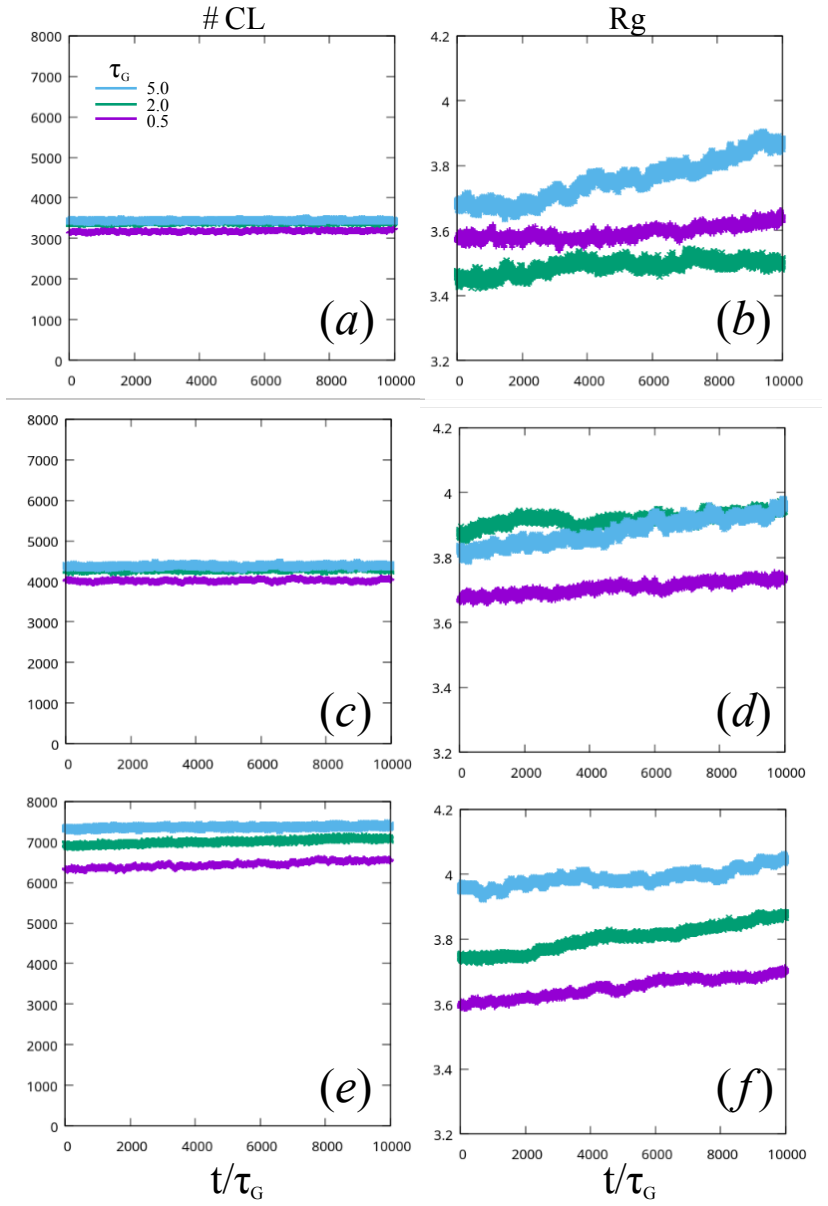
- [§3.1–3.3, Appendices B–C (Figs. 7–8)] The claim that the fitted fractions x(r), y(r), the crossover r*, and the exponents α, β reflect an algorithm-independent competition law rests on sensitivity checks that never test those quantities. Appendices B–C vary τG (0.5, 2, 5 τ0) and Ea (3, 4, 5) but report only the total CL number and polymer Rg, for the single symmetric case Ee,pp=Ee,pb=4 at r=0, 0.2, 0.7, with NG=10^4 MC events — ten times shorter than the production runs (NG=10^5, §2.4) — and with time axes normalized by τG so that all curves are compared at equal event count rather than equal physical time. The statement in §2.3 that the update frequency 'does not alter the intrinsic kinetics' is stronger than what is shown, since τ-leaping with propensities frozen over each window is generically τG-dependent. Given that rmax=Rmax=σ0, the random linker assignment, and the no-intramolecular-bond rule could all plausibly impri
- [§3.1, Figs. 2–4] No uncertainty quantification is given anywhere: Figs. 2(e,f), 3, 4, 5, and 6 show single curves with no error bars, no statement of the number of independent replicas, and no confidence intervals on the fits of Eqs. (12)–(13). This is load-bearing in two places: (i) the non-monotonic dependence of α on Ee in Fig. 3(b) is given a physical interpretation ('competition between bond stabilization and structural heterogeneity'), but without fit uncertainties the non-monotonicity cannot be distinguished from noise; (ii) the claim that the data are 'accurately described' by Eqs. (12)–(13) requires reported goodness-of-fit and parameter errors, especially since r0, α, β are correlated through Eq. (14). Please state the number of independent runs per parameter set and add error bars or confidence bands to Figs. 2–4 and to the fitted parameters in Fig. 3.
- [Appendix D vs. Eq. (12), §3.1] Appendix D derives degeneracy factors ΩA∝(1−r)^α and ΩB∝r^β (Eq. 19) and arrives at Eqs. (22)–(23), which correspond to the main-text model only with r0=1. The main text, however, fits x(r) with (r0−r)^α and reports r0>1 (Fig. 3a), with r0 interpreted as encoding saturation at r=1. The appendix therefore does not 'recover the phenomenological expression used in the main text' as claimed; the fitted r0 is an additional ad hoc parameter with no microscopic interpretation within the two-state picture. Either the derivation should be extended to motivate r0≠1, or the text should state plainly that r0 is purely phenomenological. Additionally, the final two paragraphs of Appendix D (KCL=3, 30, 300, 'under shear', 'viscoelastic moduli') refer to deformation results and moduli that appear nowhere in the manuscript and have no associated figure; this looks like misplaced text from a future rheolo
minor comments (8)
- [Appendix A, Eq. (16); Appendix B] Internal inconsistency in the bond-counting bound: with Nb=184, Bb=440, Np=80, Bp=100 and r=1, Eq. (16) gives Lb=88960 and hence Nmax=⌊Lb/2⌋=44480, yet Appendix B quotes Nmax=8000. The value 8000 is in fact the tighter (correct) bound, since every bond consumes at least one polymer bead and there are only Np·Bp=8000 of them; Eq. (16) should be amended to reflect this constraint. Also in Appendix A, Bb is given as 400 versus 440 in §2.1.
- [§2.4] §2.4 is confusing about equilibration: it first states an equilibration run of 10^3 τ0, then 'the length of the equilibration is set to 10^5 τ0', then production of 2·10^5 τ0. Please rewrite with a clear protocol (equilibration vs production lengths, number of MC updates in each).
- [§3.2, Figs. 4–5, Appendix B] Notation: §3.2 and the Fig. 5 caption refer to a cutoff 'Gmax'; the model defines Rmax (§2.3). Figs. 4–5 captions list 'kpp=30' — presumably Kp, but KCL is the varied parameter; please clarify. In Appendix B the polymer bead radius is denoted σb, which collides with the bacterial bead diameter σb of §2.1.
- [§2.3] The bonding energy is introduced with 'R is the ideal gas constant considered as a fundamental unit (R=1)' while the rest of the paper uses kBT=1; please use kB consistently (or state the mapping explicitly) since Ee/RT and Ee/kBT are mixed across §2.3 and Appendix D.
- [Figs. 2, 6] The normalization of the '#CL' curves in Figs. 2(e,f) ('Normalized #CL') and of the p–p counts in Fig. 6 is not defined (normalized by Nmax? by the r=0 value? by the total at each r?). Please state the normalization in each caption.
- [Figures] Several axis labels and legends in Figs. 2–5 are difficult to read at the presented scale, and the bottom fraction panels of Fig. 2(e,f) are described in the caption but not clearly identifiable. Please increase font sizes and label the fraction sub-panels explicitly.
- [Throughout] Typos and language: 'calculations of of bacterial biofilms' (abstract); 'brekage' (§3.2); 'surfase', 'polymners', 'specie' (§3); 'surroundder' (§2.2); 'more prone to rupture then equilibrium' (§2.3, should be 'than'); 'Inthiswork' and multiple missing spaces (§1, §2.3); 'parametrizing individual the dynamic' (§1). A careful proofread is needed.
- [Data availability; §2.3] Data availability is 'upon reasonable request'. Given that the model's value lies in its reusability (LAMMPS implementation of the Gillespie crosslinker), depositing the bond-formation/breakage module and analysis scripts in a public repository would substantially strengthen the paper; at minimum the propensity-evaluation pseudocode (event selection proportional to λ within a τG window) should be specified precisely enough to reimplement.
Circularity Check
Mild descriptive circularity only: the two-channel formula is fitted to the same Npp/Npb runs it is said to explain, and Appendix D recovers it by writing free energies that produce it by construction; the core competition claim is simulation-measured, not tautological.
-
fitted input called prediction
[§3.1, Eqs. (12)–(14) and Fig. 3]
"Remarkably, the simulation data can be accurately described by a simple phenomenological model of the form x(r)=wpp(r0−r)α/[wpp(r0−r)α+wpbrβ], y(r)=wpbrβ/[...], where wpp∼eEe,pp/RT and wpb∼eEe,pb/RT encode the energetic preference for each type of bond. [...] The crossover point r∗ is naturally defined by the condition x=y, which yields (r0−r∗)α/(r∗)β=wpb/wpp=exp((Ee,pb−Ee,pp)/RT)."
x(r) and y(r) are ratios of the same simulated Npp and Npb that are then fit with free α, β, r0 (and weights tied to the input Ee). The ‘model’ therefore restates the fitted fractions; r∗ and the energy-ratio relation are rearrangements of that fit, not independent predictions of held-out structure.
-
self definitional
[Appendix D, Eqs. (18)–(24)]
"More generally, these effects can be expressed as effective degeneracy factors ΩA∝(1−r)α, ΩB∝rβ, where the exponents α and β account for many-body effects, steric constraints, and spatial correlations beyond a simple mean-field description. Combining energetic and entropic contributions, the free energy of each state can be written as FA=−Ee,pp−RTαln(1−r), FB=−Ee,pb−RTβlnr. [...] we recover the phenomenological expression used in the main text."
The free energies are defined to include exactly the logarithmic terms that, when inserted into the two-state Boltzmann weights, reproduce Eqs. 12–13 by algebra. Appendix D therefore does not derive the phenomenological form from independent microscopic principles; it encodes the fit ansatz into FA, FB and recovers it by construction.
full rationale
The paper’s load-bearing scientific content is direct DPD+Gillespie output: counts of polymer–polymer vs polymer–bacteria crosslinks versus sticky fraction r, binding energies Ee, and stiffness KCL, plus the observed crossover and redistribution. Those observables are not defined in terms of the phenomenological fit. The two-channel expressions (Eqs. 12–13) and the fitted r*, α, β are post-hoc descriptions of those runs, and Appendix D obtains the same algebra by positing free energies FA, FB that already contain the power-law degeneracies (1−r)^α and r^β—so the ‘statistical derivation’ is equivalent to the ansatz by construction. That is ordinary phenomenological reverse-engineering, not a claim-by-construction of the structural result. Prior self-citations ([19], [9]) supply the permanent-bond DPD baseline being extended; they do not force the new reversible-bond competition findings. No uniqueness theorem, no external prediction forced by a fitted parameter, and no renaming of a known empirical law. Score 2 reflects one minor fitted-description loop plus a self-definitional appendix rewrite, with the central claim remaining independently grounded in simulation.
Assumptions & free parameters
free parameters (8)
- bonding energies Ee,pp and Ee,pb =
scanned ~1–6 (RT units)
- activation energy Ea =
4
- Gillespie interval τG =
2 τ0
- sticky area fraction r =
scanned 0–1
- CL stiffness KCL =
e.g. 3, 30, 300
- phenomenological exponents α, β and r0 =
α>2, β≲1; r0 often >1
- DPD repulsion matrix Aαβ and γ =
A_ss=A_sb=A_sp=25; A_bb=A_pp=A_pb=30; γ=4.5
- geometric cutoffs rmin, rmax, Rmax =
rmin=0, rmax=Rmax=σ0
assumptions (6)
- domain assumption DPD conservative, dissipative, and random forces with soft repulsions adequately represent mesoscale biofilm hydrodynamics and excluded volume.
- ad hoc to paper Crosslink creation propensity is spatially uniform λc=exp(-Ea/RT); breakage adds shifted harmonic energy Ubs only.
- ad hoc to paper No intramolecular polymer–polymer bonds; only inter-chain p–p and p–b bonds allowed.
- ad hoc to paper Only a random surface fraction r of bacterial beads are reactive linkers; all polymer beads are linkers.
- domain assumption Steady-state CL populations after ~10^5 τ0 with NG~10^5 MC events represent equilibrium network structure relevant to future rheology.
- ad hoc to paper Two-state Boltzmann/softmax competition with degeneracy (1-r)^α and r^β describes bond-type fractions.
invented entities (3)
-
Sticky area fraction r on bacterial surfaces
-
Shifted bond potential Ubs(ri,Ee) in breakage propensity
-
Two-channel phenomenological CL fraction model (x(r), y(r))
Cite this review
Pith. "Pith review of Tunable mesoscopic numerical model for bacterial biofilms." pith.science (2026). https://pith.science/paper/PD3O7CT2
@misc{pith2026260723677,
  author       = {Pith},
  title        = {Pith review of: Tunable mesoscopic numerical model for bacterial biofilms},
  year         = {2026},
  howpublished = {\url{https://pith.science/paper/PD3O7CT2}},
  note         = {Machine review of arXiv:2607.23677}
}
read the original abstract
We present a tunable mesoscale model to provide a basis for future rheological calculations of of bacterial biofilms, explicitly incorporating reversible crosslinking within the extracellular polymeric substance (EPS) matrix. Using a Dissipative Particle Dynamics framework combined with a Gillespie-inspired algorithm, bonds between polymers and bacteria dynamically form and break, capturing the intrinsically evolving nature of the network. We show that biofilm structure is governed by a competition between polymer-polymer and polymer-bacteria crosslinks, controlled by binding energy, linker availability, and bond stiffness and provide a minimal model that helps to understand the competition between both species.
Figures


Figures from the paper (6 more)



Reference graph
Works this paper leans on
-
[1]
Mechan- ical interactions between bacteria and hydrogels.Scientific reports, 8(1):10893, 2018
Nehir Kandemir, Waldemar Vollmer, Nicholas S Jakubovics, and Jinju Chen. Mechan- ical interactions between bacteria and hydrogels.Scientific reports, 8(1):10893, 2018
2018
-
[2]
Picioreanu, M
C. Picioreanu, M. C. M. Van Loosdrecht, and J. J. Heijnen. Discrete-differential mod- elling of biofilm structure.Water Science and Technology, 39(7):115–122, 1999. 17
1999
-
[3]
Pseudomonas biofilm matrix composition and niche biology.FEMS microbiology reviews, 36(4):893–916, 2012
Ethan E Mann and Daniel J Wozniak. Pseudomonas biofilm matrix composition and niche biology.FEMS microbiology reviews, 36(4):893–916, 2012
2012
-
[4]
E. J. Marsden, C. Valeriani, I. Sullivan, M. E. Cates, and D. Marenduzzo. Chemotactic clusters in confined run-and-tumble bacteria: a numerical investigation.Soft Matter, 10(1):157–165, 2014
2014
-
[5]
Clinically addressing biofilm in chronic wounds.Advances in wound care, 1(3):127–132, 2012
Christopher Attinger and Randy Wolcott. Clinically addressing biofilm in chronic wounds.Advances in wound care, 1(3):127–132, 2012
2012
-
[6]
The consequences of biofilm dispersal on the host.Scientific reports, 8(1):10738, 2018
Derek Fleming and Kendra Rumbaugh. The consequences of biofilm dispersal on the host.Scientific reports, 8(1):10738, 2018
2018
-
[7]
In situ rheology of staphy- lococcus epidermidis bacterial biofilms.Soft matter, 9(1):122–131, 2013
Leonid Pavlovsky, John G Younger, and Michael J Solomon. In situ rheology of staphy- lococcus epidermidis bacterial biofilms.Soft matter, 9(1):122–131, 2013
2013
-
[8]
Modeling of mesoscale variability in biofilm shear behavior.PLoS One, 11(11):e0165593, 2016
Pallab Barai, Aloke Kumar, and Partha P Mukherjee. Modeling of mesoscale variability in biofilm shear behavior.PLoS One, 11(11):e0165593, 2016
2016
Show all 26 references
-
[9]
Self-adaptation of pseudomonas fluorescens biofilms to hydrodynamic stress.Frontiers in microbiology, 11:588884, 2021
Josué Jara, Francisco Alarcón, Ajay K Monnappa, José Ignacio Santos, Valentino Bianco, Pin Nie, Massimo Pica Ciamarra, Ángeles Canales, Luis Dinis, Iván López- Montero, et al. Self-adaptation of pseudomonas fluorescens biofilms to hydrodynamic stress.Frontiers in microbiology,...
2021
-
[10]
Towards standardized mechanical characterization of microbial biofilms: analysis and critical review.npj Biofilms and Microbiomes, 4(1):17, 2018
Héloïse Boudarel, Jean-Denis Mathias, Benoît Blaysat, and Michel Grédiac. Towards standardized mechanical characterization of microbial biofilms: analysis and critical review.npj Biofilms and Microbiomes, 4(1):17, 2018
2018
-
[11]
Biofilms and mechanics: a review of experimental techniques and findings.Journal of Physics D: Applied Physics, 50(22):223002, 2017
Vernita D Gordon, Megan Davis-Fields, Kristin Kovach, and Christopher A Rodesney. Biofilms and mechanics: a review of experimental techniques and findings.Journal of Physics D: Applied Physics, 50(22):223002, 2017
2017
-
[12]
Spatial orga- nization of different sigma factor activities and c-di-gmp signalling within the three- dimensional landscape of a bacterial biofilm.Open biology, 8(8):180066, 2018
Gisela Klauck, Diego O Serra, Alexandra Possling, and Regine Hengge. Spatial orga- nization of different sigma factor activities and c-di-gmp signalling within the three- dimensional landscape of a bacterial biofilm.Open biology, 8(8):180066, 2018
2018
-
[13]
Artifi- cial biofilms establish the role of matrix interactions in staphylococcal biofilm assembly and disassembly.Scientific reports, 5(1):13081, 2015
Elizabeth J Stewart, Mahesh Ganesan, John G Younger, and Michael J Solomon. Artifi- cial biofilms establish the role of matrix interactions in staphylococcal biofilm assembly and disassembly.Scientific reports, 5(1):13081, 2015
2015
-
[14]
Rigidity and mechanical response in biological structures.arXiv preprint arXiv:2508.18432, 2025
Kelly Aspinwall, Tyler Hain, and M Lisa Manning. Rigidity and mechanical response in biological structures.arXiv preprint arXiv:2508.18432, 2025
2025 arXiv
-
[15]
The mechanical world of bacteria.Cell, 161(5):988–997, 2015
Alexandre Persat, Carey D Nadell, Minyoung Kevin Kim, Francois Ingremeau, Al- bert Siryaporn, Knut Drescher, Ned S Wingreen, Bonnie L Bassler, Zemer Gitai, and Howard A Stone. The mechanical world of bacteria.Cell, 161(5):988–997, 2015
2015
-
[16]
As above, so below, and also in between: mesoscale active matter in fluids.Soft matter, 15(44):8946–8950, 2019
Daphne Klotsa. As above, so below, and also in between: mesoscale active matter in fluids.Soft matter, 15(44):8946–8950, 2019. 18
2019
-
[17]
R. D. Groot and P. B. Warren. Dissipative particle dynamics: Bridging the gap between atomistic and mesoscopic simulation.The Journal of chemical physics, 107(11):4423– 4435, 1997
1997
-
[18]
Espanol and P
P. Espanol and P. B. Warren. Perspective: Dissipative particle dynamics.The Journal of Chemical Physics, 146(15), 2017
2017
-
[19]
Rhe- ology of pseudomonas fluorescens biofilms: From experiments to predictive dpd meso- scopic modeling.The Journal of Chemical Physics, 158(7), 2023
José Martín-Roca, Valentino Bianco, Francisco Alarcón, Ajay K Monnappa, Paolo Na- tale, Francisco Monroy, Belen Orgaz, Ivan López-Montero, and Chantal Valeriani. Rhe- ology of pseudomonas fluorescens biofilms: From experiments to predictive dpd meso- scopic modeling.The Journa...
2023
-
[20]
Z. Xu, P. Meakin, A. Tartakovsky, and T. D. Scheibe. Dissipative-particle-dynamics model of biofilm growth.Physical Review E, 83(6):066702, 2011
2011
-
[21]
Mayur Mukhi and AS Vishwanathan. Identifying potential inhibitors of biofilm- antagonistic proteins to promote biofilm formation: a virtual screening and molecular dynamics simulations approach.Molecular Diversity, 26(4):2135–2147, 2022
2022
-
[22]
Modeling biofilm formation on dynamically reconfigurable composite surfaces.Langmuir, 34(4):1807–1816, 2018
Ya Liu and Anna C Balazs. Modeling biofilm formation on dynamically reconfigurable composite surfaces.Langmuir, 34(4):1807–1816, 2018
2018
-
[23]
J. A. Stotsky, J. F. Hammond, L. Pavlovsky, E. J. Stewart, J. G. Younger, M. J. Solomon, and D. M. Bortz. Variable viscosity and density biofilm simulations using an immersed boundary method, part ii: Experimental validation and the heterogeneous rheology-ibm.Journal of Comput...
2016
-
[24]
Fast parallel algorithms for short-range molecular dynamics.J
S.Plimpton. Fast parallel algorithms for short-range molecular dynamics.J. Comput. Phys, 117(4):1–19, 1995
1995
-
[25]
A general method for numerically simulating the stochastic time evolution of coupled chemical reactions.Journal of computational physics, 22(4):403– 434, 1976
Daniel T Gillespie. A general method for numerically simulating the stochastic time evolution of coupled chemical reactions.Journal of computational physics, 22(4):403– 434, 1976
1976
-
[26]
Exact stochastic simulation of coupled chemical reactions.The journal of physical chemistry, 81(25):2340–2361, 1977
Daniel T Gillespie. Exact stochastic simulation of coupled chemical reactions.The journal of physical chemistry, 81(25):2340–2361, 1977. 19 A Maximum number of links In the system under study, two types of structures are present: bacterias and polymers. The bacterias are compo...
1977
Reviewed July 30, 2026 · model on record in the stance chip above.
Discussion (0). Continue with ORCID to comment.