REVIEW 3 major objections 5 minor 32 references
Semi-decentralized Training of Spatio-Temporal Graph Neural Networks for Traffic Prediction
T0 review · 3 major / 5 minor · reviewed 2026-08-11 · deepseek-v4-flash
Pith's one-line read Semi-decentralized training of spatio-temporal graph neural networks can match centralized traffic prediction accuracy within a fraction of a mph.
desk verdict A genuinely new empirical comparison of semi-decentralized ST-GNN training that is credible on accuracy but overclaims scalability and fault tolerance beyond what the experiments show. read the letter →
The pith
A machine-rendered reading of the paper's core claim, the machinery that carries it, and where it could break.
The reading
What carries the argument
The central object is the semi-decentralized cloudlet architecture with ST-GCN, a spatio-temporal graph convolutional network, as the model. Sensors are partitioned by geographical proximity into cloudlets; each cloudlet builds the local subgraph needed for a 2-hop GNN receptive field and broadcasts its node features to cloudlets that need them, then trains locally and exchanges model updates through a server in traditional FL, directly among in-range cloudlets in server-free FL, or to a randomly chosen cloudlet in gossip learning. The load-bearing mechanism is the planar structure of road networks: because the receptive field of a node stays geographically local, the number of remote features a cloudlet must fetch and the amount of duplicate computation it performs do not grow with total network size. Chebyshev convolution over a distance-weighted adjacency matrix encodes the spatial correlations, and WMAPE is used alongside MAE and RMSE to compare setups fairly across regions with different traffic speeds.
What would settle it
Generate a synthetic road network with N nodes and random long-range edges, or measure a real highway network with bridges and tunnels, then scale N from hundreds to thousands with a fixed cloudlet range and record per-cloudlet node-feature transfer and FLOPs; if these grow with N instead of staying flat, the constant-cost scalability claim fails.
Extended reading notes
Core claim
The central discovery is that a semi-decentralized setup—cloudlets each owning a subgraph, fetching remote node features, and exchanging model updates—can train ST-GNNs for traffic prediction with accuracy comparable to centralized training. In the reported experiments the centralized baseline is best on every metric, but the gap is small: on METR-LA the best semi-decentralized setup is within 0.1 mph MAE at 15 minutes and about 0.2 mph at longer horizons, and on PeMS-BAY the gap is below 0.1 mph at all horizons. The paper also documents two issues that global averages hide: model error varies strongly across cloudlets because traffic patterns differ by region, and the dominant overhead in distributed ST-GNN training is the transfer of duplicated node features and the redundant computation of partial embeddings, not the model-exchange protocol.
Load-bearing premise
The scalability and fault-tolerance advantages depend on the assumption that road networks are planar, so each cloudlet's 2-hop neighborhood stays geographically bounded as the network grows; the experiments only test networks of 207 and 325 nodes.
Editorial extensions
If this is right
- If the claim holds, traffic prediction can be trained across geographically distributed edge devices without a central server, removing a single point of failure and a cyber-attack target.
- The measured performance gap, around 0.1 mph MAE on METR-LA at 15 minutes and below 0.1 mph on PeMS-BAY, is small enough that operators may choose decentralization for resilience without sacrificing practical accuracy.
- The dominant cost identified, node-feature transfer and partial-embedding computation, means future distributed ST-GNN designs should focus on sparsifying graph connectivity or constraining receptive fields rather than on improving aggregation protocols.
- Cloudlet-level heterogeneity in error suggests deployed systems should report per-region accuracy, not just global averages, because global metrics can hide local failures.
- Since per-cloudlet costs are claimed constant under planar graphs, the approach could in principle scale to much larger sensor networks, though that scaling is not demonstrated in the paper.
Reading between the lines
- Beyond the paper, the planar-graph argument suggests a testable scaling law: on road networks with bounded geometric density, per-cloudlet feature transfer should grow with the areal density of sensors, not with the total node count; measuring this on synthetic grids with growing N would confirm or refute the scalability claim.
- The paper's comparison does not include dynamic topology or sensor failures; a natural extension is to inject cloudlet outages mid-training and measure how quickly gossip learning recovers compared with centralized retraining.
- Because the accuracy gap is largest at longer horizons, semi-decentralized training may be best suited to short-term traffic management such as routing and signal control rather than long-term planning.
- The per-cloudlet variance result implies a personalization strategy: fine-tune each cloudlet's model on its own traffic regime, which could reduce the worst-case error while keeping the decentralized architecture.
Editorial analysis
A structured set of objections, weighed in public.
Referee Report
Summary. The paper presents a simulation framework for semi-decentralized training of spatio-temporal graph neural networks (ST-GNNs) for traffic speed prediction. Sensors are grouped into geographically defined cloudlets, which exchange node features and model updates to train local ST-GCN models. The authors compare four training setups—centralized, traditional federated learning, server-free federated learning, and gossip learning—on the METR-LA and PeMS-BAY datasets for 15-, 30-, and 60-minute prediction horizons. The main result is that the semi-decentralized setups achieve prediction errors close to those of centralized training, while the paper also claims advantages in scalability and fault tolerance. The paper additionally analyzes per-cloudlet error variability and quantifies model transfer, node-feature transfer, and FLOPs overheads.
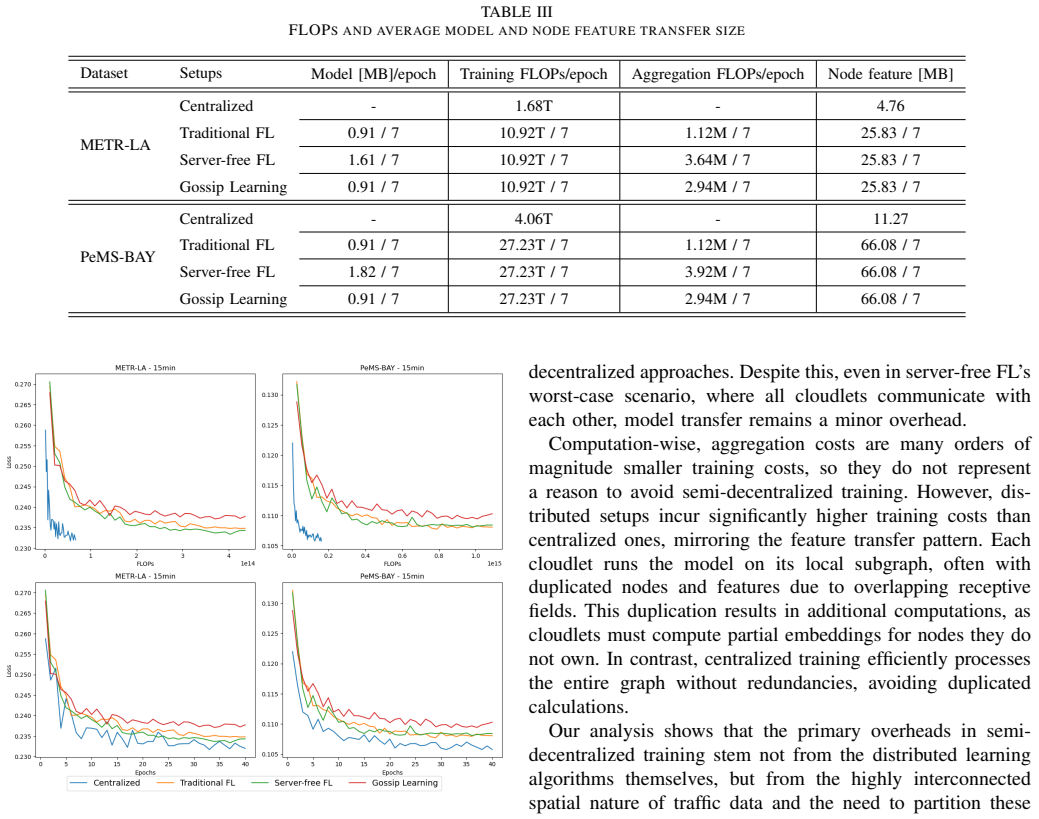
Significance. If the claims are supported, the paper would provide a useful empirical benchmark for deploying ST-GNN traffic predictors without a central aggregator. The main strengths are the systematic comparison across two real-world datasets and three horizons, the cloudlet-level error analysis in Figure 3, and the overhead breakdown in Table III, which together give a concrete picture of the trade-offs involved. The paper's own results also highlight a genuinely under-appreciated issue: GNN receptive fields cause substantial node-feature duplication and redundant computation in distributed settings. However, the advertised scalability and fault-tolerance advantages are not measured in the experiments, and the comparative performance claim is based on single runs without statistical quantification. These gaps are load-bearing because they appear in the abstract and conclusion as the paper's main contributions.
major comments (3)
- [Abstract, §V-C, Conclusion] The scalability claim is not supported by the experiments or by a quantitative argument. The only supporting statement is the assertion in §V-C that 'due to the planar nature of graphs, per-cloudlet costs remain consistent as the network grows,' but no experiment scales beyond 207 or 325 nodes, and the paper gives no bound on the size of the 2-hop receptive field as a function of graph size. If sensor density increases within a fixed area, or if the distance-based adjacency graph has high degree, per-cloudlet feature transfer and FLOPs will grow with the number of nodes. The paper's own future-work section (§VII-A) identifies reducing node-feature transfers and partial-embedding computation as open problems, which is in tension with the conclusion. A scaling experiment with varying graph size, together with an explicit statement of the conditions under which per-cloudlet costs stay bounded, is needed before the scalability claim can stand.
- [Abstract, Conclusion, §V] Fault tolerance is advertised as an advantage in the abstract and conclusion, but the paper contains no failure-injection experiment or analysis. None of the setups is subjected to cloudlet or link failures, and there is no measurement of degradation, recovery, or availability under faults. The authors should either add failure-injection experiments that compare the centralized and semi-decentralized setups under node or cloudlet failures, or remove the fault-tolerance claim from the summary of contributions.
- [Table II, §V-A] The central comparative claim rests on single-run results. Table II reports no standard errors, confidence intervals, or significance tests, and the paper does not specify random seeds or repeated initialization. Differences such as 3.78 vs. 3.88 MAE on METR-LA at 15 minutes are small enough that they could fall within run-to-run variability. The 'comparable to centralized' conclusion should be supported by multiple runs with reported variance, or the claim should be weakened accordingly.
minor comments (5)
- [Eq. (1), §IV-B] The WMAPE denominator in Eq. (1) uses the sum of predicted values rather than the sum of ground-truth values. This is not the standard weighted MAPE definition and makes the reported percentages difficult to interpret or compare with other work. Since the same denominator is used for all setups, the relative comparison is less affected, but the definition should be corrected or explicitly justified as non-standard.
- [Table III, §V-C] The slash notation in Table III (for example, '25.83 / 7' and '10.92T / 7') is never defined, so it is unclear whether the values are totals, per-cloudlet averages, or something else. This ambiguity matters because the text says distributed setups have 'several-fold higher' communication costs, yet if the values are read as per-cloudlet averages, the node-feature transfer per cloudlet is comparable to or smaller than the centralized total. The table and surrounding text should be aligned on one convention.
- [§IV-A, §IV-C] Section IV-A says the validation set is used for early stopping, while Section IV-C says all experiments were run with a fixed number of 40 epochs. These statements are inconsistent and should be reconciled, since the convergence comparison in Figure 4 depends on how training length was determined.
- [Table II, §IV-C] The centralized baseline is not compared with published ST-GCN results on METR-LA and PeMS-BAY. A short validation against known ST-GCN numbers would help readers judge whether the comparison is against a strong centralized baseline or a potentially weak one.
- [§VII-C] The paper acknowledges in Section VII-C that cloudlet placement and communication range are predefined and not optimized. This is an important limitation, and it should be stated earlier, not only in future work, because the claimed scalability and robustness properties may depend on the specific manual placement used in the experiments.
Circularity Check
No circularity: the results are direct empirical measurements, and the only self-citation is a non-load-bearing future-work reference.
full rationale
The paper's central claim—that semi-decentralized ST-GNN training is comparable to centralized training while offering scalability and fault-tolerance advantages—rests on direct measurements reported in Table II and on the overhead analysis in Section V-C. There is no derivation chain in which an output quantity is defined in terms of the quantity it is supposed to predict, no parameter fitted to a subset and then relabeled as a prediction, and no uniqueness theorem imported from the authors' prior work. The only self-citation is to Giaretta and Girdzijauskas [30], which appears in Related Work and Future Work as a proposed direction for restricting the receptive field; it does not support the main results and is therefore not load-bearing. The scalability claim ('due to the planar nature of graphs, per-cloudlet costs remain consistent as the network grows, unlike the growing costs in a centralized approach,' Section V-C and Conclusion) is an unsupported extrapolation, and Table III even suggests that per-cloudlet node-feature transfer currently exceeds centralized totals; however, that is a correctness and evidence concern, not circularity. The non-standard WMAPE denominator in Eq. (1), which divides by predicted rather than ground-truth values, also affects metric interpretation but does not make any result equivalent to its inputs by construction. Overall, the paper is an empirical benchmarking study whose reported numbers are generated by a simulation rather than derived from the claims, so no circular step is exhibited.
Assumptions & free parameters
free parameters (3)
- Number of cloudlets =
7
- Cloudlet communication range =
8 km
- Cloudlet placements =
Manual coordinates for 7 cloudlets per dataset
assumptions (4)
- domain assumption Sensor graphs are constructed from geographic distance (ChebNet formula), so nearby sensors are connected.
- domain assumption Road networks are planar, so a node's 2-hop neighborhood remains geographically bounded as the network grows.
- ad hoc to paper Cloudlets only communicate within an 8 km range.
- ad hoc to paper WMAPE using sum of predictions as denominator is a valid comparison metric.
Cite this review
Pith. "Pith review of Semi-decentralized Training of Spatio-Temporal Graph Neural Networks for Traffic Prediction." pith.science (2026). https://pith.science/paper/PDWHFJXC
@misc{pith2026241203188,
  author       = {Pith},
  title        = {Pith review of: Semi-decentralized Training of Spatio-Temporal Graph Neural Networks for Traffic Prediction},
  year         = {2026},
  howpublished = {\url{https://pith.science/paper/PDWHFJXC}},
  note         = {Machine review of arXiv:2412.03188}
}
read the original abstract
In smart mobility, large networks of geographically distributed sensors produce vast amounts of high-frequency spatio-temporal data that must be processed in real time to avoid major disruptions. Traditional centralized approaches are increasingly unsuitable to this task, as they struggle to scale with expanding sensor networks, and reliability issues in central components can easily affect the whole deployment. To address these challenges, we explore and adapt semi-decentralized training techniques for Spatio-Temporal Graph Neural Networks (ST-GNNs) in smart mobility domain. We implement a simulation framework where sensors are grouped by proximity into multiple cloudlets, each handling a subgraph of the traffic graph, fetching node features from other cloudlets to train its own local ST-GNN model, and exchanging model updates with other cloudlets to ensure consistency, enhancing scalability and removing reliance on a centralized aggregator. We perform extensive comparative evaluation of four different ST-GNN training setups -- centralized, traditional FL, server-free FL, and Gossip Learning -- on large-scale traffic datasets, the METR-LA and PeMS-BAY datasets, for short-, mid-, and long-term vehicle speed predictions. Experimental results show that semi-decentralized setups are comparable to centralized approaches in performance metrics, while offering advantages in terms of scalability and fault tolerance. In addition, we highlight often overlooked issues in existing literature for distributed ST-GNNs, such as the variation in model performance across different geographical areas due to region-specific traffic patterns, and the significant communication overhead and computational costs that arise from the large receptive field of GNNs, leading to substantial data transfers and increased computation of partial embeddings.
Figures


Figures from the paper (1 more)
Reference graph
Works this paper leans on
- [1]
- [2]
-
[3]
W. Min, L. Wynter, Real-time road traffic prediction with spatio- temporal correlations, Transportation Research Part C: Emerging Tech- nologies 19 (4) (2011) 606–616
work page 2011
- [4]
-
[5]
R. Vinayakumar, K. Soman, P. Poornachandran, Applying deep learning approaches for network traffic prediction, in: 2017 International Con- ference on Advances in Computing, Communications and Informatics (ICACCI), IEEE, 2017, pp. 2353–2358
work page 2017
- [6]
-
[7]
B. M. Williams, L. A. Hoel, Modeling and forecasting vehicular traffic flow as a seasonal arima process: Theoretical basis and empirical results, Journal of transportation engineering 129 (6) (2003) 664–672
work page 2003
-
[8]
C. Bent ´ejac, A. Cs ¨org˝o, G. Mart´ınez-Mu˜noz, A comparative analysis of gradient boosting algorithms, Artificial Intelligence Review 54 (2021) 1937–1967
work page 2021
Show all 32 references
-
[9]
Ramakrishnan, T
N. Ramakrishnan, T. Soni, Network traffic prediction using recurrent neural networks, in: 2018 17th IEEE International Conference on Machine Learning and Applications (ICMLA), IEEE, 2018, pp. 187– 193
2018
-
[10]
Andreoletti, S
D. Andreoletti, S. Troia, F. Musumeci, S. Giordano, G. Maier, M. Torna- tore, Network traffic prediction based on diffusion convolutional recur- rent neural networks, in: IEEE INFOCOM 2019-IEEE Conference on Computer Communications Workshops (INFOCOM WKSHPS), IEEE, 2019, pp. 246–251
2019
-
[11]
Z. Wu, S. Pan, F. Chen, G. Long, C. Zhang, P. S. Yu, A com- prehensive survey on graph neural networks, IEEE Transactions on Neural Networks and Learning Systems 32 (1) (2021) 4–24. doi: 10.1109/tnnls.2020.2978386. URL http://dx.doi.org/10.1109/TNNLS.2020.2978386
2021
-
[12]
Z. A. Sahili, M. Awad, Spatio-temporal graph neural networks: A survey (2023). arXiv:2301.10569
2023 arXiv
-
[13]
Y . Li, R. Yu, C. Shahabi, Y . Liu, Diffusion convolutional recurrent neural network: Data-driven traffic forecasting (2018). arXiv:1707.01926. URL https://arxiv.org/abs/1707.01926
2018 arXiv
-
[14]
S. Nuli, N. Vikranth, K. A. Gupta, Real-time traffic prediction using neural networks, in: IOP Conference Series: Earth and Environmental Science, V ol. 1086, IOP Publishing, 2022, p. 012029
2022
-
[15]
L. Ruiz, F. Gama, A. Ribeiro, Gated graph recurrent neural networks, IEEE Transactions on Signal Processing 68 (2020) 6303–6318. doi: 10.1109/tsp.2020.3033962
2020
-
[16]
B. Yu, H. Yin, Z. Zhu, Spatio-temporal graph convolutional networks: A deep learning framework for traffic forecasting, in: Proceedings of the Twenty-Seventh International Joint Conference on Artificial Intelligence, IJCAI-2018, International Joint Conferences on Artificial In...
2018 doi
-
[17]
T. Wu, F. Chen, Y . Wan, Graph attention lstm network: A new model for traffic flow forecasting, in: 2018 5th International Conference on Information Science and Control Engineering (ICISCE), 2018, pp. 241–
2018
-
[18]
Kairouz, H
P. Kairouz, H. B. McMahan, B. Avent, A. Bellet, M. Bennis, A. N. Bhagoji, K. Bonawitz, Z. Charles, G. Cormode, R. Cummings, et al., Advances and open problems in federated learning, Foundations and trends® in machine learning 14 (1–2) (2021) 1–210
2021
-
[19]
C. He, C. Tan, H. Tang, S. Qiu, J. Liu, Central server free feder- ated learning over single-sided trust social networks, arXiv preprint arXiv:1910.04956 (2019)
2019 arXiv
-
[20]
Orm ´andi, I
R. Orm ´andi, I. Heged ˝us, M. Jelasity, Gossip learning with linear models on fully distributed data, Concurrency and Computation: Practice and Experience 25 (4) (2013) 556–571
2013
-
[21]
Nazzal, A
M. Nazzal, A. Khreishah, J. Lee, S. Angizi, A. Al-Fuqaha, M. Guizani, Semi-decentralized inference in heterogeneous graph neural networks for traffic demand forecasting: An edge-computing approach, IEEE Transactions on Vehicular Technology (2024)
2024
-
[22]
Defferrard, X
M. Defferrard, X. Bresson, P. Vandergheynst, Convolutional neural networks on graphs with fast localized spectral filtering, Advances in neural information processing systems 29 (2016)
2016
-
[23]
Zheng, C
D. Zheng, C. Ma, M. Wang, J. Zhou, Q. Su, X. Song, Q. Gan, Z. Zhang, G. Karypis, Distdgl: Distributed graph neural network training for billion-scale graphs (2021). arXiv:2010.05337
2021 arXiv
-
[24]
L. Zeng, C. Yang, P. Huang, Z. Zhou, S. Yu, X. Chen, Gnn at the edge: Cost-efficient graph neural network processing over distributed edge servers (2022). arXiv:2210.17281
2022 arXiv
-
[25]
Z. Diao, X. Wang, D. Zhang, Y . Liu, K. Xie, S. He, Dynamic spatial- temporal graph convolutional neural networks for traffic forecasting, Proceedings of the AAAI Conference on Artificial Intelligence 33 (01) (2019) 890–897. doi:10.1609/aaai.v33i01.3301890
2019 doi
-
[26]
L. Liu, Y . Tian, C. Chakraborty, J. Feng, Q. Pei, L. Zhen, K. Yu, Multilevel federated learning-based intelligent traffic flow forecasting for transportation network management, IEEE Transactions on Network and Service Management 20 (2) (2023) 1446–1458. doi:10.1109/ TNSM.202...
2023
-
[27]
T. Qi, L. Chen, G. Li, Y . Li, C. Wang, Fedagcn: A traffic flow pre- diction framework based on federated learning and asynchronous graph convolutional network, Applied Soft Computing 138 (2023) 110175. doi:https://doi.org/10.1016/j.asoc.2023.110175
2023
-
[28]
X. Yuan, J. Chen, J. Yang, N. Zhang, T. Yang, T. Han, A. Taherko- rdi, Fedstn: Graph representation driven federated learning for edge computing enabled urban traffic flow prediction, IEEE Transactions on Intelligent Transportation Systems 24 (8) (2023) 8738–8748. doi: 10.1109...
2023
-
[29]
M. Xia, D. Jin, J. Chen, Short-term traffic flow prediction based on graph convolutional networks and federated learning, IEEE Transactions on Intelligent Transportation Systems 24 (1) (2023) 1191–1203. doi: 10.1109/TITS.2022.3179391
2023
-
[30]
Giaretta, S
L. Giaretta, S. Girdzijauskas, Fully-decentralized training of gnns using layer-wise self-supervision (2023)
2023
-
[146]
doi:https://doi.org/10.3390/joitmc7020146
-
[245]
doi:10.1109/ICISCE.2018.00058
2018
Reviewed August 11, 2026 · model on record in the stance chip above.
Discussion (0). Continue with ORCID to comment.