REVIEW 2 major objections 4 minor 68 references
Zero-shot Inexact CAD Model Alignment from a Single Image
T0 review · 2 major / 4 minor · reviewed 2026-08-06 · deepseek-v4-flash
Pith's one-line read This paper shows that a single image can align an inexact 3D CAD model to an object in 9 degrees of freedom without pose annotations, using geometry-aware features and NOC-based refinement.
desk verdict Strong method and a useful new benchmark, but the zero-shot claim is overstated because the metric depth estimator is fine-tuned on each target dataset; the headline margins likely depend on that adaptation. read the letter →
The pith
A machine-rendered reading of the paper's core claim, the machinery that carries it, and where it could break.
The reading
What carries the argument
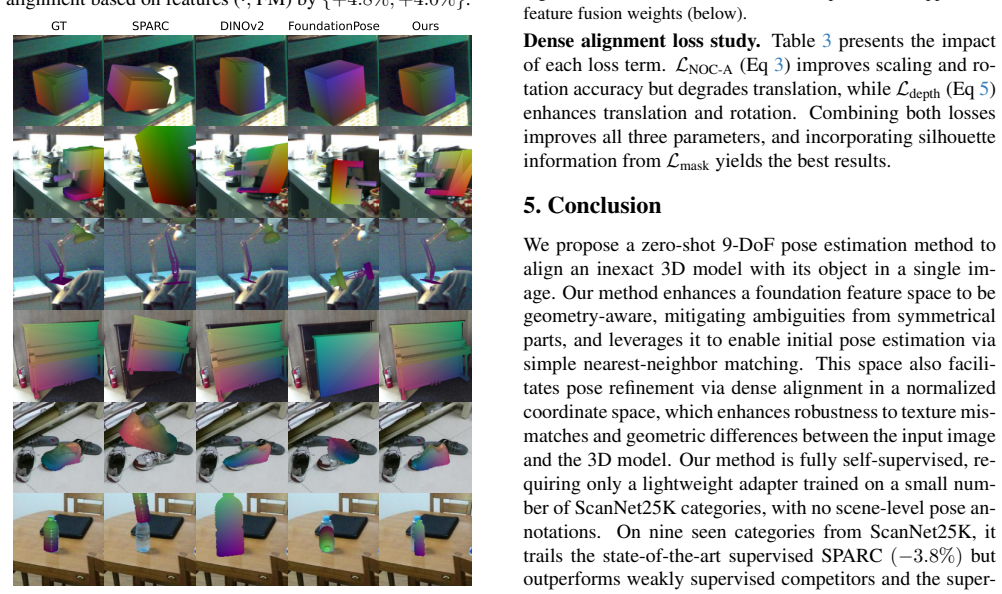
The load-bearing mechanism is the geometry-aware feature space produced by the adapter $E_\theta$, a two-layer MLP that maps DINOv2 features to adapted features, trained on multi-view CAD renderings with two losses: a NOC prediction loss ($\mathcal{L}_{\mathrm{NOC}}$) and a geometry-consistent triplet loss ($\mathcal{L}_{\mathrm{triplet}}$). The adapted features are fused with normalized DINOv2 features by a weight $\omega$ and used to build a feature voxel grid of the CAD model via back-projection of multi-view renderings. Coarse pose estimation then matches object-pixel features to voxel features and solves 3D-3D correspondences. Fine alignment optimizes the pose by rendering the model into a NOC map and minimizing an L1 NOC alignment loss plus silhouette and metric-depth losses, which makes the refinement texture-invariant and stable. The paper identifies the triplet loss as essential for separating symmetric parts (e.g., chair legs) that foundation features confuse, and the NOC-space comparison as essential for handling textureless or differently textured CAD models.
What would settle it
Run the open-source pipeline on ScanNet25k and SUN2CAD with an off-the-shelf metric depth estimator that is NOT fine-tuned on the target dataset, and compare mean alignment accuracy against the reported numbers; if accuracy does not drop substantially, the fine-tuned depth is not load-bearing, while a large drop would confirm the dependency.
Extended reading notes
Core claim
The paper's central claim is that zero-shot 9-DoF alignment of inexact CAD models is achievable from a single image using only synthetic, pose-free CAD renderings for supervision. The key discovery is that a small MLP feature adapter trained with a two-part self-supervised objective can turn DINOv2 foundation features into a geometry-aware space: a NOC prediction loss forces features to encode 3D location, and a triplet loss pulls together features of the same 3D part across views while pushing apart features of distant or symmetric parts. In this space, 2D image features and 3D model voxel features become directly comparable, so correspondences can be found by nearest-neighbor matching and a coarse pose solved with a robust pose solver using metric depth. The pose is then refined by differentiable rendering that compares, in NOC space, the predicted map of the input with the rendered map of the model, together with mask and depth losses. The authors report that this pipeline surpasses weakly supervised baselines by +4.3% mean alignment accuracy on ScanNet25k, becomes the only weakly supervised method to exceed supervised ROCA by +2.7%, and on the new SUN2CAD dataset of 20 unseen categories outperforms the supervised SPARC by +12.7%.
Load-bearing premise
The whole pipeline assumes the metric depth estimator, fine-tuned on the training images of each target dataset, predicts absolute scale accurately enough that lifting 2D features to 3D and the depth refinement loss stay reliable; if depth is biased, both coarse and fine pose estimates degrade and the zero-shot claim weakens.
Editorial extensions
If this is right
- CAD retrieval-and-alignment systems can be trained for new object categories using only synthetic renderings, removing the need for category-specific pose annotations.
- A pose estimated from a single image can be refined purely in normalized object coordinates, so textureless or differently textured CAD models no longer break dense alignment.
- On the introduced SUN2CAD benchmark, the method achieves state-of-the-art generalization to 20 unseen categories without prior training on them, suggesting category-agnostic alignment is feasible.
- The geometry-aware adapter could improve other tasks that build on foundation features, such as semantic correspondence or 6-DoF pose estimation, whenever part-level symmetry is a confound.
Reading between the lines
- The 'zero-shot' label is qualified by the need to fine-tune the metric depth estimator on each target dataset; a truly zero-shot variant would have to rely on a depth model that generalizes without per-dataset fine-tuning.
- The feature adapter is trained on only nine ShapeNet categories yet transfers to 20 unseen SUN2CAD categories, which suggests that the learned geometry-awareness is not category-specific and could improve with more diverse synthetic training data.
- The dependence on a predicted metric depth map for both coarse lifting and fine depth loss means the method's accuracy is bounded by depth quality; combining it with a different depth source (e.g., multi-view stereo) is a natural next step the paper does not explore.
- The SUN2CAD benchmark with manual refinement could be reused to quantify the relationship between CAD model inexactness (Chamfer distance) and pose accuracy, since the paper only studies this on 100 ScanNet images.
Editorial analysis
A structured set of objections, weighed in public.
Referee Report
Summary. The paper proposes a weakly supervised 9-DoF alignment method for inexact CAD models from a single RGB image. It enhances DINOv2 features with a lightweight MLP adapter trained on synthetic renderings using a NOC regression loss and a geometry-consistent triplet loss, then uses nearest-neighbor matching in the fused feature space together with a metric-depth estimator to solve for a coarse pose. A dense alignment stage refines the pose by comparing the input's predicted NOC map, silhouette, and depth to differentiable renderings of the posed model. The method is evaluated on ScanNet25k, DiffCAD's split, and a new SUN2CAD dataset with 20 unseen categories, where it is claimed to be the only weakly supervised approach to surpass the supervised ROCA and to achieve large margins on unseen categories.
Significance. If the central claims hold, the paper makes a useful contribution: it demonstrates that a small feature adapter trained on synthetic renderings can produce geometry-aware features that transfer to unseen categories, and it provides a texture-invariant NOC-space refinement that improves over feature-metric alternatives. The new SUN2CAD benchmark addresses a real gap in evaluating generalization to novel categories, and the ablation study in Table 1 convincingly isolates the gains from fused features (+5.2%) and NOC refinement (+4.8%). The paper is generally well written and includes extensive appendices with additional ablations and qualitative results. The main caveat is that the reported margins depend on fine-tuning the metric depth estimator on each target dataset, which is not reflected in the 'zero-shot' characterization; quantifying that dependence would substantially strengthen the paper.
major comments (2)
- [Section 3.1.3, Eq. (5), Appendix 6.6] The 'zero-shot' claim is confounded by target-domain fine-tuning of the metric depth estimator. Appendix 6.6 states that DepthAnything is fine-tuned on the training images of ScanNet25k and SUN-RGBD, and the method uses metric depth both to lift 2D features to 3D in coarse alignment (Section 3.1.3) and as a depth loss in fine alignment (Eq. 5). Since the evaluation thresholds include absolute translation (20 cm) and scale (20%), any bias in the fine-tuned depth directly affects pass/fail, so the reported margins over ROCA (+2.7% instance-wise on ScanNet25k) and SPARC (+12.7% on SUN2CAD) are not attributable solely to the proposed feature/NOC pipeline. The paper already uses a non-fine-tuned depth estimator for the DiffCAD comparison in Section 4.2, but no analogous off-the-shelf-depth ablation is reported for the main Table 1 NMS metric or Table 2 SUN2CAD results. I request that the authors report these results with off-the-shelf DepthAnything and either qualify the 'zero-shot' statement to specify that only the feature adapter and NOC predictor are category-zero-shot, or show that depth fine-tuning has a negligible effect on the headline numbers.
- [Section 5 and Abstract] The conclusion states that the method is 'fully self-supervised, requiring only a lightweight adapter trained on a small number of ScanNet25K categories', and the abstract says the method works 'without prior training on' the 20 unseen categories. These statements are inaccurate because the metric depth estimator is fine-tuned on the training images of each target dataset (Appendix 6.6), which is a form of target-domain supervision. The SUN2CAD training images are drawn from SUN-RGBD scenes that contain the same object categories as the test set (though disjoint scenes), so 'without prior training on them' is misleading. Please correct these characterizations or add an explicit caveat that the zero-shot property applies to the pose-alignment components only, not to the depth backbone.
minor comments (4)
- [Section 4.1] The text says the method surpasses ROCA 'by {+2.7%,+1.6%}' for category-wise and instance-wise NMS scores, but Table 1 shows the opposite pairing: ROCA Avg Cat is 21.5 vs Ours 23.1 (+1.6) and Avg Inst is 27.4 vs 30.1 (+2.7). Please correct the order of the braces.
- [Abstract and Section 1] The abstract reports '+4.3% mean alignment accuracy' over SOTA weakly supervised baselines, while the introduction reports '+4.2%'. Table 1 shows +4.2% instance-wise vs DiffCAD (Err) on DiffCAD's split, so the +4.3% does not exactly match any value in the table. Please reconcile these numbers.
- [Section 4 and Appendix 6.6] The main text should explicitly state at the start of Section 4 that the depth estimator is fine-tuned on the target dataset for the ScanNet25k and SUN2CAD comparisons, and that it is not fine-tuned for the DiffCAD-split comparison. Currently this is only disclosed in the appendix, which is easy to miss.
- [Section 3 and Appendix 9] The method description says 'we use ROCA's retrieval system [18]', but for the new SUN2CAD dataset the CAD models are manually selected from Objaverse/ShapeNet. Please clarify in the main text that the retrieval system is used only for ScanNet25k, while SUN2CAD uses human-provided model selection.
Circularity Check
No circular derivation; disclosed per-dataset depth fine-tuning is an attribution caveat, not a circular reduction.
full rationale
The core pipeline is self-contained. The feature adapter Eθ is trained on synthetic ShapeNet renderings with a NOC-regression loss (Eq. 1) and a triplet loss (Eq. 2); the decoder is discarded and no pose annotations are used. At inference, coarse alignment derives 2D–3D correspondences by nearest-neighbor matching in the fused DINOv2/adapter feature space and solves the pose with RANSAC, while fine alignment optimizes the NOC, silhouette, and depth losses (Eqs. 3–5) against renderings of the given CAD model. The NOC map used in refinement is a nearest-neighbor lookup in the same feature space; this is a standard correspondence-based refinement, not a self-fulfilling fit to the evaluation labels, because final accuracy is measured against external Scan2CAD and SUN-RGBD pose annotations. SUN2CAD's 20 categories are disjoint from the 9 ShapeNet categories used for adapter training, so the generalization claim is tested on genuinely held-out classes. The only caveat, disclosed in Appendix 6.6, is that DepthAnything is fine-tuned on the training images of ScanNet25k and SUN-RGBD before the main comparisons; this is target-domain adaptation of an auxiliary component and affects attribution of the headline margins, but it is not a circular step because the depth estimator is not fitted to pose predictions and the paper explicitly reports a non-fine-tuned depth variant for the DiffCAD comparison. No load-bearing self-citation or imported uniqueness theorem appears; references to ScanNet, Scan2CAD, ROCA, and Vid2CAD are standard external datasets, baselines, and metrics.
Assumptions & free parameters
free parameters (10)
- beta (adapter loss weight) =
0.1
- omega (feature fusion weight) =
0.5
- tau_plus_dist =
0.02
- tau_minus_dist =
0.4
- tau_minus_feat =
0.75
- alpha (triplet margin) =
0.5
- lambda_NOC_A =
0.33
- lambda_m =
3.0
- lambda_d =
0.27
- NOC_error_filter_threshold =
0.20
assumptions (6)
- domain assumption DINOv2 features provide a strong semantic prior for zero-shot visual correspondence.
- domain assumption Normalized Object Coordinates (NOC), derived from front-aligned CAD models, form a consistent canonical space for alignment.
- domain assumption A feature adapter trained on nine ShapeNet categories transfers to 20 unseen SUN2CAD categories.
- domain assumption The per-dataset fine-tuned DepthAnything estimator provides accurate metric depth.
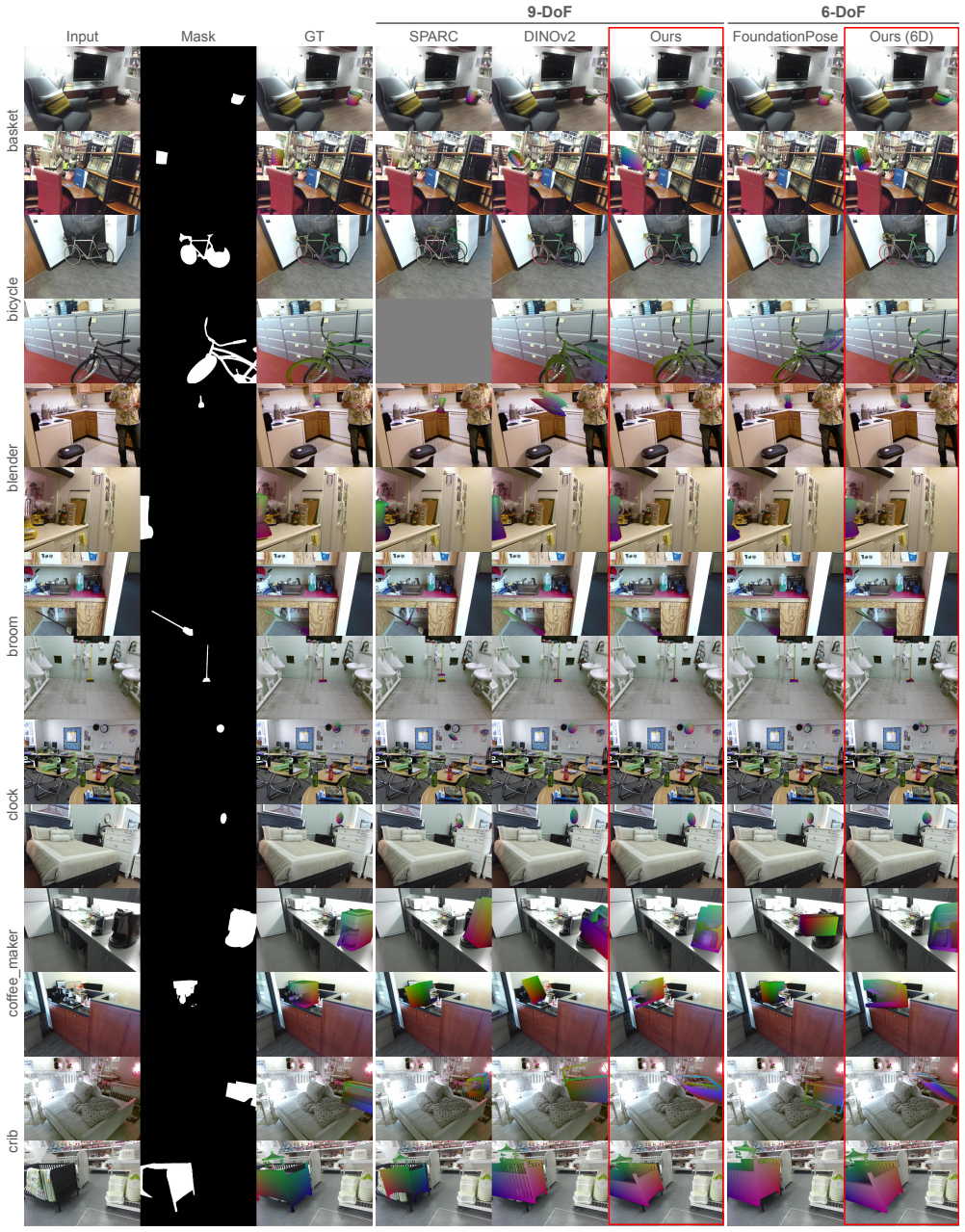
- domain assumption SAM and Grounded-SAM produce accurate object masks.
- domain assumption The nearest-neighbor matching in the feature voxel grid is robust to synthetic-to-real domain shift.
Cite this review
Pith. "Pith review of Zero-shot Inexact CAD Model Alignment from a Single Image." pith.science (2026). https://pith.science/paper/PDYE6DQI
@misc{pith2026250703292,
  author       = {Pith},
  title        = {Pith review of: Zero-shot Inexact CAD Model Alignment from a Single Image},
  year         = {2026},
  howpublished = {\url{https://pith.science/paper/PDYE6DQI}},
  note         = {Machine review of arXiv:2507.03292}
}
read the original abstract
One practical approach to infer 3D scene structure from a single image is to retrieve a closely matching 3D model from a database and align it with the object in the image. Existing methods rely on supervised training with images and pose annotations, which limits them to a narrow set of object categories. To address this, we propose a weakly supervised 9-DoF alignment method for inexact 3D models that requires no pose annotations and generalizes to unseen categories. Our approach derives a novel feature space based on foundation features that ensure multi-view consistency and overcome symmetry ambiguities inherent in foundation features using a self-supervised triplet loss. Additionally, we introduce a texture-invariant pose refinement technique that performs dense alignment in normalized object coordinates, estimated through the enhanced feature space. We conduct extensive evaluations on the real-world ScanNet25k dataset, where our method outperforms SOTA weakly supervised baselines by +4.3% mean alignment accuracy and is the only weakly supervised approach to surpass the supervised ROCA by +2.7%. To assess generalization, we introduce SUN2CAD, a real-world test set with 20 novel object categories, where our method achieves SOTA results without prior training on them.
Figures


Figures from the paper (17 more)






Reference graph
Works this paper leans on
-
[1]
Zs6d: Zero-shot 6d object pose estimation using vision transformers
Philipp Ausserlechner, David Haberger, Stefan Thalhammer, Jean-Baptiste Weibel, and Markus Vincze. Zs6d: Zero-shot 6d object pose estimation using vision transformers. In2024 IEEE International Conference on Robotics and Automation (ICRA), pages 463–469. IEEE, 2024. 2
work page 2024
-
[2]
Scan2cad: Learning cad model alignment in rgb-d scans
Armen Avetisyan, Manuel Dahnert, Angela Dai, Manolis Savva, Angel X Chang, and Matthias Nießner. Scan2cad: Learning cad model alignment in rgb-d scans. InProceed- ings of the IEEE/CVF Conference on computer vision and pattern recognition, pages 2614–2623, 2019. 1, 6, 4, 8
work page 2019
-
[3]
Depth pro: Sharp monocular metric depth in less than a second
Alexey Bochkovskiy, Ama ¨el Delaunoy, Hugo Germain, Marcel Santos, Yichao Zhou, Stephan Richter, and Vladlen Koltun. Depth pro: Sharp monocular metric depth in less than a second. InThe Thirteenth International Conference on Learning Representations, 2025. 2
work page 2025
-
[4]
Learning 6d object pose estimation using 3d object coordinates
Eric Brachmann, Alexander Krull, Frank Michel, Stefan Gumhold, Jamie Shotton, and Carsten Rother. Learning 6d object pose estimation using 3d object coordinates. In Computer Vision–ECCV 2014: 13th European Conference, Zurich, Switzerland, September 6-12, 2014, Proceedings, Part II 13, pages 536–551. Springer, 2014. 2, 5
work page 2014
-
[5]
Andrea Caraffa, Davide Boscaini, Amir Hamza, and Fabio Poiesi. Freeze: Training-free zero-shot 6d pose estimation with geometric and vision foundation models.ECCV, 2024. 2, 3, 5
work page 2024
-
[6]
Mathilde Caron, Hugo Touvron, Ishan Misra, Herv’e J’egou, Julien Mairal, Piotr Bojanowski, and Armand Joulin. Emerg- ing properties in self-supervised vision transformers.2021 IEEE/CVF International Conference on Computer Vision (ICCV), pages 9630–9640, 2021. 3
work page 2021
-
[7]
Angel X. Chang, Thomas A. Funkhouser, Leonidas J. Guibas, Pat Hanrahan, Qi-Xing Huang, Zimo Li, Silvio Savarese, Manolis Savva, Shuran Song, Hao Su, Jianxiong Xiao, L. Yi, and Fisher Yu. Shapenet: An information-rich 3d model repository.ArXiv, abs/1512.03012, 2015. 2, 3, 6, 1, 4
arXiv 2015
-
[8]
A simple framework for contrastive learning of visual representations
Ting Chen, Simon Kornblith, Mohammad Norouzi, and Ge- offrey Hinton. A simple framework for contrastive learning of visual representations. InProceedings of the 37th Inter- national Conference on Machine Learning. JMLR.org, 2020. 3
work page 2020
Show all 68 references
-
[9]
Open-vocabulary object 6d pose estimation
Jaime Corsetti, Davide Boscaini, Changjae Oh, Andrea Cav- allaro, and Fabio Poiesi. Open-vocabulary object 6d pose estimation. InProceedings of the IEEE/CVF Conference on Computer Vision and Pattern Recognition, pages 18071– 18080, 2024. 2
2024
-
[10]
Indoor semantic segmentation using depth in- formation
Camille Couprie, Cl ´ement Farabet, Laurent Najman, and Yann Lecun. Indoor semantic segmentation using depth in- formation. InFirst International Conference on Learning Representations (ICLR 2013), pages 1–8, 2013. 2
2013
-
[11]
Chang, Manolis Savva, Maciej Hal- ber, Thomas A
Angela Dai, Angel X. Chang, Manolis Savva, Maciej Hal- ber, Thomas A. Funkhouser, and Matthias Nießner. Scannet: Richly-annotated 3d reconstructions of indoor scenes.2017 IEEE Conference on Computer Vision and Pattern Recogni- tion (CVPR), pages 2432–2443, 2017. 1, 2, 6, 7, 3, 4, 5
2017
-
[12]
Obja- verse: A universe of annotated 3d objects.arXiv preprint arXiv:2212.08051, 2022
Matt Deitke, Dustin Schwenk, Jordi Salvador, Luca Weihs, Oscar Michel, Eli VanderBilt, Ludwig Schmidt, Kiana Ehsani, Aniruddha Kembhavi, and Ali Farhadi. Obja- verse: A universe of annotated 3d objects.arXiv preprint arXiv:2212.08051, 2022. 4
2022 arXiv
-
[13]
An image is worth 16x16 words: Transformers for image recognition at scale
Alexey Dosovitskiy, Lucas Beyer, Alexander Kolesnikov, Dirk Weissenborn, Xiaohua Zhai, Thomas Unterthiner, Mostafa Dehghani, Matthias Minderer, Georg Heigold, Syl- vain Gelly, Jakob Uszkoreit, and Neil Houlsby. An image is worth 16x16 words: Transformers for image recognition ...
2021
-
[14]
Random sample consensus: a paradigm for model fitting with applications to image analysis and automated cartography.Communications of the ACM, 24(6):381–395, 1981
Martin A Fischler and Robert C Bolles. Random sample consensus: a paradigm for model fitting with applications to image analysis and automated cartography.Communications of the ACM, 24(6):381–395, 1981. 5
1981
-
[15]
3d-front: 3d furnished rooms with layouts and semantics
Huan Fu, Bowen Cai, Lin Gao, Ling-Xiao Zhang, Jiaming Wang, Cao Li, Qixun Zeng, Chengyue Sun, Rongfei Jia, Bin- qiang Zhao, et al. 3d-front: 3d furnished rooms with layouts and semantics. InProceedings of the IEEE/CVF Interna- tional Conference on Computer Vision, pages 10933–10942,
-
[16]
Diffcad: Weakly-supervised probabilistic cad model retrieval and alignment from an rgb image.ACM Transactions on Graphics (TOG), 43(4):1–15, 2024
Daoyi Gao, D ´avid Rozenberszki, Stefan Leutenegger, and Angela Dai. Diffcad: Weakly-supervised probabilistic cad model retrieval and alignment from an rgb image.ACM Transactions on Graphics (TOG), 43(4):1–15, 2024. 1, 2, 3, 5, 6, 7, 4, 8, 11, 12, 13, 14
2024
-
[17]
Complete solution classification for the perspective-three-point problem.IEEE transactions on pattern analysis and machine intelligence, 25(8):930–943,
Xiao-Shan Gao, Xiao-Rong Hou, Jianliang Tang, and Hang-Fei Cheng. Complete solution classification for the perspective-three-point problem.IEEE transactions on pattern analysis and machine intelligence, 25(8):930–943,
-
[18]
Roca: Ro- bust cad model retrieval and alignment from a single image
Can G ¨umeli, Angela Dai, and Matthias Nießner. Roca: Ro- bust cad model retrieval and alignment from a single image. InProceedings of the IEEE/CVF conference on computer vi- sion and pattern recognition, pages 4022–4031, 2022. 1, 2, 3, 5, 6, 7, 4, 12, 13, 14
2022
-
[19]
LVIS: A dataset for large vocabulary instance segmentation
Agrim Gupta, Piotr Dollar, and Ross Girshick. LVIS: A dataset for large vocabulary instance segmentation. InPro- ceedings of the IEEE Conference on Computer Vision and Pattern Recognition, 2019. 4
2019
-
[20]
Mu Hu, Wei Yin, Chi Zhang, Zhipeng Cai, Xiaoxiao Long, Hao Chen, Kaixuan Wang, Gang Yu, Chunhua Shen, and Shaojie Shen. Metric3d v2: A versatile monocular geomet- ric foundation model for zero-shot metric depth and surface normal estimation.IEEE Transactions on Pattern Analysi...
2024
-
[21]
Matchu: Matching unseen objects for 6d pose estimation from rgb-d images
Junwen Huang, Hao Yu, Kuan-Ting Yu, Nassir Navab, Slo- bodan Ilic, and Benjamin Busam. Matchu: Matching unseen objects for 6d pose estimation from rgb-d images. InPro- ceedings of the IEEE/CVF Conference on Computer Vision and Pattern Recognition, pages 10095–10105, 2024. 2
2024
-
[22]
Berg, Wan-Yen Lo, Piotr Doll ´ar, and Ross B
Alexander Kirillov, Eric Mintun, Nikhila Ravi, Hanzi Mao, Chloe Rolland, Laura Gustafson, Tete Xiao, Spencer White- head, Alexander C. Berg, Wan-Yen Lo, Piotr Doll ´ar, and Ross B. Girshick. Segment anything.2023 IEEE/CVF In- ternational Conference on Computer Vision (ICCV), p...
2023
-
[23]
Mask2cad: 3d shape prediction by learning to segment and retrieve
Weicheng Kuo, Anelia Angelova, Tsung-Yi Lin, and Angela Dai. Mask2cad: 3d shape prediction by learning to segment and retrieve. InComputer Vision–ECCV 2020: 16th Euro- pean Conference, Glasgow, UK, August 23–28, 2020, Pro- ceedings, Part III 16, pages 260–277. Springer, 2020. 1, 3, 6
2020
-
[24]
Patch2cad: Patchwise embedding learning for in-the- wild shape retrieval from a single image
Weicheng Kuo, Anelia Angelova, Tsung-Yi Lin, and Angela Dai. Patch2cad: Patchwise embedding learning for in-the- wild shape retrieval from a single image. InProceedings of the IEEE/CVF International Conference on Computer Vi- sion, pages 12589–12599, 2021. 1, 3
2021
-
[25]
Megapose: 6d pose estimation of novel objects via render and compare
Yann Labb ´e, Lucas Manuelli, Arsalan Mousavian, Stephen Tyree, Stan Birchfield, Jonathan Tremblay, Justin Carpen- tier, Mathieu Aubry, Dieter Fox, and Josef Sivic. Megapose: 6d pose estimation of novel objects via render and compare. InProceedings of The 6th Conference on Rob...
2023
-
[26]
Langer, G
F. Langer, G. Bae, I. Budvytis, and R. Cipolla. Sparc: Sparse render-and-compare for cad model alignment in a single rgb image. InProc. British Machine Vision Conference, London,
-
[27]
Mrc- net: 6-dof pose estimation with multiscale residual correla- tion
Yuelong Li, Yafei Mao, Raja Bala, and Sunil Hadap. Mrc- net: 6-dof pose estimation with multiscale residual correla- tion. In2024 IEEE/CVF Conference on Computer Vision and Pattern Recognition (CVPR), page 10476–10486. IEEE,
-
[28]
Deep learning-based object pose estimation: A comprehensive survey.arXiv preprint arXiv:2405.07801,
Jian Liu, Wei Sun, Hui Yang, Zhiwen Zeng, Chongpei Liu, Jin Zheng, Xingyu Liu, Hossein Rahmani, Nicu Sebe, and Ajmal Mian. Deep learning-based object pose estimation: A comprehensive survey.arXiv preprint arXiv:2405.07801,
-
[29]
Soft ras- terizer: A differentiable renderer for image-based 3d reason- ing.The IEEE International Conference on Computer Vision (ICCV), 2019
Shichen Liu, Tianye Li, Weikai Chen, and Hao Li. Soft ras- terizer: A differentiable renderer for image-based 3d reason- ing.The IEEE International Conference on Computer Vision (ICCV), 2019. 5
2019
-
[30]
Grounding dino: Marrying dino with grounded pre-training for open-set object detec- tion.ArXiv, abs/2303.05499, 2023
Shilong Liu, Zhaoyang Zeng, Tianhe Ren, Feng Li, Hao Zhang, Jie Yang, Chun yue Li, Jianwei Yang, Hang Su, Jun-Juan Zhu, and Lei Zhang. Grounding dino: Marrying dino with grounded pre-training for open-set object detec- tion.ArXiv, abs/2303.05499, 2023. 3
2023 arXiv
-
[31]
Decoupled weight de- cay regularization
Ilya Loshchilov and Frank Hutter. Decoupled weight de- cay regularization. InInternational Conference on Learning Representations, 2017. 6, 1, 9
2017
-
[32]
Generating images with 3d annotations using diffusion models
Wufei Ma, Qihao Liu, Jiahao Wang, Angtian Wang, Xiaod- ing Yuan, Yi Zhang, Zihao Xiao, Guofeng Zhang, Beijia Lu, Ruxiao Duan, et al. Generating images with 3d annotations using diffusion models. InThe Twelfth International Confer- ence on Learning Representations, 2024. 2
2024
-
[33]
Vid2cad: Cad model alignment using multi- view constraints from videos.IEEE Transactions on Pattern Analysis and Machine Intelligence, 45:1320–1327, 2020
Kevis-Kokitsi Maninis, Stefan Popov, Matthias Nießner, and Vittorio Ferrari. Vid2cad: Cad model alignment using multi- view constraints from videos.IEEE Transactions on Pattern Analysis and Machine Intelligence, 45:1320–1327, 2020. 6, 8
2020
-
[34]
Im- proving semantic correspondence with viewpoint-guided spherical maps
Octave Mariotti, Oisin Mac Aodha, and Hakan Bilen. Im- proving semantic correspondence with viewpoint-guided spherical maps. InProceedings of the IEEE/CVF Conference on Computer Vision and Pattern Recognition, pages 19521– 19530, 2024. 2, 3
2024
-
[35]
Gigapose: Fast and robust novel object pose estimation via one correspondence
Van Nguyen Nguyen, Thibault Groueix, Mathieu Salzmann, and Vincent Lepetit. Gigapose: Fast and robust novel object pose estimation via one correspondence. InProceedings of the IEEE/CVF Conference on Computer Vision and Pattern Recognition, pages 9903–9913, 2024. 2
2024
-
[36]
Maxime Oquab, Timoth ´ee Darcet, Th´eo Moutakanni, Huy V . V o, Marc Szafraniec, Vasil Khalidov, Pierre Fernandez, Daniel HAZIZA, Francisco Massa, Alaaeldin El-Nouby, Mido Assran, Nicolas Ballas, Wojciech Galuba, Russell Howes, Po-Yao Huang, Shang-Wen Li, Ishan Misra, Michael ...
2024
-
[37]
Found- pose: Unseen object pose estimation with foundation fea- tures.European Conference on Computer Vision (ECCV),
Evin Pınar ¨Ornek, Yann Labb ´e, Bugra Tekin, Lingni Ma, Cem Keskin, Christian Forster, and Tom ´aˇs Hoda ˇn. Found- pose: Unseen object pose estimation with foundation fea- tures.European Conference on Computer Vision (ECCV),
-
[38]
SDXL: Improving latent diffusion models for high-resolution image synthesis
Dustin Podell, Zion English, Kyle Lacey, Andreas Blattmann, Tim Dockhorn, Jonas M ¨uller, Joe Penna, and Robin Rombach. SDXL: Improving latent diffusion models for high-resolution image synthesis. InThe Twelfth Interna- tional Conference on Learning Representations, 2024. 3
2024
-
[39]
Learning transferable visual models from natural language supervision
Alec Radford, Jong Wook Kim, Chris Hallacy, Aditya Ramesh, Gabriel Goh, Sandhini Agarwal, Girish Sastry, Amanda Askell, Pamela Mishkin, Jack Clark, Gretchen Krueger, and Ilya Sutskever. Learning transferable visual models from natural language supervision. InInternational Conf...
2021
-
[40]
Accelerating 3d deep learning with pytorch3d
Nikhila Ravi, Jeremy Reizenstein, David Novotny, Tay- lor Gordon, Wan-Yen Lo, Justin Johnson, and Georgia Gkioxari. Accelerating 3d deep learning with pytorch3d. arXiv preprint arXiv:2007.08501, 2020. 5, 6, 3
2007 arXiv
-
[41]
Grounded sam: Assembling open-world models for diverse visual tasks,
Tianhe Ren, Shilong Liu, Ailing Zeng, Jing Lin, Kun- chang Li, He Cao, Jiayu Chen, Xinyu Huang, Yukang Chen, Feng Yan, Zhaoyang Zeng, Hao Zhang, Feng Li, Jie Yang, Hongyang Li, Qing Jiang, and Lei Zhang. Grounded sam: Assembling open-world models for diverse visual tasks,
-
[42]
Blattmann, Dominik Lorenz, Patrick Esser, and Bj ¨orn Ommer
Robin Rombach, A. Blattmann, Dominik Lorenz, Patrick Esser, and Bj ¨orn Ommer. High-resolution image synthesis with latent diffusion models.2022 IEEE/CVF Conference on Computer Vision and Pattern Recognition (CVPR), pages 10674–10685, 2021. 3, 2, 7, 8
2022
-
[43]
Facenet: A unified embedding for face recognition and clus- tering
Florian Schroff, Dmitry Kalenichenko, and James Philbin. Facenet: A unified embedding for face recognition and clus- tering. InProceedings of the IEEE conference on computer vision and pattern recognition, pages 815–823, 2015. 2, 4
2015
-
[44]
Dpodv2: Dense correspondence-based 6 dof pose estima- tion.IEEE transactions on pattern analysis and machine intelligence, 44(11):7417–7435, 2021
Ivan Shugurov, Sergey Zakharov, and Slobodan Ilic. Dpodv2: Dense correspondence-based 6 dof pose estima- tion.IEEE transactions on pattern analysis and machine intelligence, 44(11):7417–7435, 2021. 2
2021
-
[45]
Sun rgb-d: A rgb-d scene understanding benchmark suite
Shuran Song, Samuel P Lichtenberg, and Jianxiong Xiao. Sun rgb-d: A rgb-d scene understanding benchmark suite. In Proceedings of the IEEE conference on computer vision and pattern recognition, pages 567–576, 2015. 7, 1, 3
2015
-
[46]
Onepose: One-shot object pose estimation without cad mod- els
Jiaming Sun, Zihao Wang, Siyu Zhang, Xingyi He, Hongcheng Zhao, Guofeng Zhang, and Xiaowei Zhou. Onepose: One-shot object pose estimation without cad mod- els. InProceedings of the IEEE/CVF Conference on Com- puter Vision and Pattern Recognition, pages 6825–6834,
-
[47]
An eigendecomposition approach to weighted graph matching problems.IEEE transactions on pattern analysis and machine intelligence, 10(5):695–703,
Shinji Umeyama. An eigendecomposition approach to weighted graph matching problems.IEEE transactions on pattern analysis and machine intelligence, 10(5):695–703,
-
[48]
Normalized object coordinate space for category-level 6d object pose and size estimation
He Wang, Srinath Sridhar, Jingwei Huang, Julien Valentin, Shuran Song, and Leonidas J Guibas. Normalized object coordinate space for category-level 6d object pose and size estimation. InProceedings of the IEEE/CVF Conference on Computer Vision and Pattern Recognition, pages 26...
2019
-
[49]
Foundationpose: Unified 6d pose estimation and tracking of novel objects
Bowen Wen, Wei Yang, Jan Kautz, and Stan Birchfield. Foundationpose: Unified 6d pose estimation and tracking of novel objects. InProceedings of the IEEE/CVF Conference on Computer Vision and Pattern Recognition, pages 17868– 17879, 2024. 1, 2, 3, 5, 6, 7, 4, 8, 12, 13, 14, 15, 16, 17
2024
-
[50]
Depth anything: Unleashing the power of large-scale unlabeled data.2024 IEEE/CVF Conference on Computer Vision and Pattern Recognition (CVPR), pages 10371–10381, 2024
Lihe Yang, Bingyi Kang, Zilong Huang, Xiaogang Xu, Jiashi Feng, and Hengshuang Zhao. Depth anything: Unleashing the power of large-scale unlabeled data.2024 IEEE/CVF Conference on Computer Vision and Pattern Recognition (CVPR), pages 10371–10381, 2024. 3, 4, 6, 1, 2
2024
-
[51]
Depth any- thing v2.NeurIPS, 2024
Lihe Yang, Bingyi Kang, Zilong Huang, Zhen Zhao, Xiao- gang Xu, Jiashi Feng, and Hengshuang Zhao. Depth any- thing v2.NeurIPS, 2024. 3
2024
-
[52]
A tale of two features: Stable diffusion complements DINO for zero-shot semantic correspondence
Junyi Zhang, Charles Herrmann, Junhwa Hur, Luisa Pola- nia Cabrera, Varun Jampani, Deqing Sun, and Ming-Hsuan Yang. A tale of two features: Stable diffusion complements DINO for zero-shot semantic correspondence. InThirty- seventh Conference on Neural Information Processing Sy...
2023
-
[53]
Telling left from right: Identifying geometry-aware semantic corre- spondence.2024 IEEE/CVF Conference on Computer Vision and Pattern Recognition (CVPR), pages 3076–3085, 2023
Junyi Zhang, Charles Herrmann, Junhwa Hur, Eric Chen, Varun Jampani, Deqing Sun, and Ming-Hsuan Yang. Telling left from right: Identifying geometry-aware semantic corre- spondence.2024 IEEE/CVF Conference on Computer Vision and Pattern Recognition (CVPR), pages 3076–3085, 2023. 2, 3
2024
-
[54]
Adding conditional control to text-to-image diffusion models
Lvmin Zhang, Anyi Rao, and Maneesh Agrawala. Adding conditional control to text-to-image diffusion models. In Proceedings of the IEEE/CVF International Conference on Computer Vision, pages 3836–3847, 2023. 2
2023
-
[55]
Uni-controlnet: All-in-one control to text-to-image diffusion models.Advances in Neural Information Processing Sys- tems, 36, 2024
Shihao Zhao, Dongdong Chen, Yen-Chun Chen, Jianmin Bao, Shaozhe Hao, Lu Yuan, and Kwan-Yee K Wong. Uni-controlnet: All-in-one control to text-to-image diffusion models.Advances in Neural Information Processing Sys- tems, 36, 2024. 3, 2 Zero-shot Inexact CAD Model Alignment fro...
2024
-
[57]
Additional Implementation Details of Our method 6.1. Training details and hyperparameters For training the feature adapter, we use the AdamW opti- mizer [31] with a constant learning rate of3e −4, a batch size of 140, andτ + dist = 0.02,τ − dist = 0.4,τ − feat = 0.75,α= 0.5, β...
-
[58]
We fol- low DST3D [32] to generate realistic renderings with natu- ral backgrounds, using Stable Diffusion (SD) [42]
Implementation Details of Rendered Image Augmentation Renderings often have limited texture and solid color back- grounds, creating a domain gap with real images. We fol- low DST3D [32] to generate realistic renderings with natu- ral backgrounds, using Stable Diffusion (SD) [4...
-
[59]
For ROCA, scores are reported as provided in their paper
Implementation Details of Competitors and Ablation Choices In this section, we provide implementation details for evalu- ating DiffCAD, FoundationPose, and SPARC in our setting, where scores are computed using their official code. For ROCA, scores are reported as provided in t...
-
[60]
The primary challenge in aligning images with 3D mod- els is the ambiguity in z-axis translation and scaling, which persists even with manual alignment
Additional Details on SUN2CAD Dataset To evaluate our alignment method on unseen or less com- mon object categories, we establish a new inexact match 9-DoF pose alignment test set spanning 20 categories with 550 images. The primary challenge in aligning images with 3D mod- els...
-
[61]
Additional Results on Experiment 4.1 We present a detailed comparison of translation, rotation, and scaling accuracies across competitors on the Scan- Net25k dataset in Table 4
Additional Experimentsal Results 10.1. Additional Results on Experiment 4.1 We present a detailed comparison of translation, rotation, and scaling accuracies across competitors on the Scan- Net25k dataset in Table 4. All accuracies are computed using the same thresholds define...
-
[62]
Additional Qualitative Results 11.1. Qualitative Results in NOC Map Prediction Figure 11 and Figure 12 show the NOC prediction results of our method and other NOC predictor baselines, NOC- S and DINOv2, on ScanNet25k [11] and SUN2CAD, re- Group Method basket bicycle blender br...
-
[63]
Study on the Architecture of Feature Adapter We study the best network architecture for our feature adapter
Additional Ablation Studies 12.1. Study on the Architecture of Feature Adapter We study the best network architecture for our feature adapter. We choose 3 choices: Autoencoder (AE), ViT [13] layers, and MLP layers. AE represents CNNs capable of decoding feature maps into pixel...
-
[64]
(for 9D) + GT depth 23.3 25.7 34.51.9 3.1 45.4 20.4 20.4 20.3 21.7 28.4 Ours 16.7 18.6 22.8 12.7 9.2 49.3 24.1 38.116.5 23.1 30.1 6D FoundationPose [49] 22.5 21.4 37.5 6.1 5.8 44.5 30.4 29.2 27.1 24.9 31.1
-
[65]
Our method still surpasses [49] + GT depth in average alignment accuracies
+ GT depth 25.8 27.1 47.09.0 7.3 46.7 32.5 38.1 33.1 29.6 35.0 Ours(for 6D) 20.8 25.7 27.6 19.8 22.7 56.1 51.8 45.120.1 32.2 38.0 Table 10.Comparison in NMS accuracy [33] on ScanNet25k [2] against FoundationPose [49].We additionally provide GT depth maps to FoundationPose to m...
-
[66]
Our method still surpasses [49] + GT depth in average alignment accuracies
+ GT depth28.650.014.3100.07.7 10.5 11.153.331.875.047.727.116.7 9.8 0.0 0.0 31.90.0 55.633.3 30.2 29.5 Ours(for 6D) 42.950.014.350.0 23.136.816.720.039.450.0 30.3 20.361.127.225.00.0 13.878.644.466.6 35.5 30.7 Table 11.Comparison in Single-view accuracy [16] on SUN2CAD agains...
-
[67]
Failure Cases Figure 16 illustrates failure cases. Poor input image quality, such as small objects (A), degrades DINOv2 features, mak- ing it difficult to distinguish object parts correctly, which can lead to incorrect pose estimation. Failures in dependencies, such as depth p...
-
[68]
However, its accuracy may be insufficient for safety-critical tasks like autonomous driving
Societal Impacts Our work on 9-DoF pose estimation benefits real-world ap- plications in synthetic environments such as VR and gam- ing, where safety is not a concern. However, its accuracy may be insufficient for safety-critical tasks like autonomous driving. Reliance on pred...
-
[2022]
1, 2, 3, 5, 6, 7, 4, 12, 13, 14, 15, 16, 17
Reviewed August 6, 2026 · model on record in the stance chip above.
Discussion (0). Continue with ORCID to comment.