Latent-CURE for Breast Cancer Diagnosis
Pith reviewed 2026-06-30 06:08 UTC · model grok-4.3
The pith
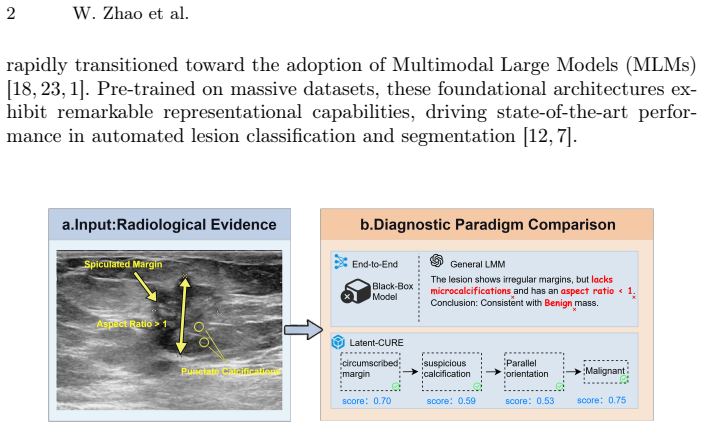
Latent-CURE forces sequential BI-RADS descriptor inference in latent space before final breast cancer diagnosis.
A machine-rendered reading of the paper's core claim, the machinery that carries it, and where it could break.
Core claim
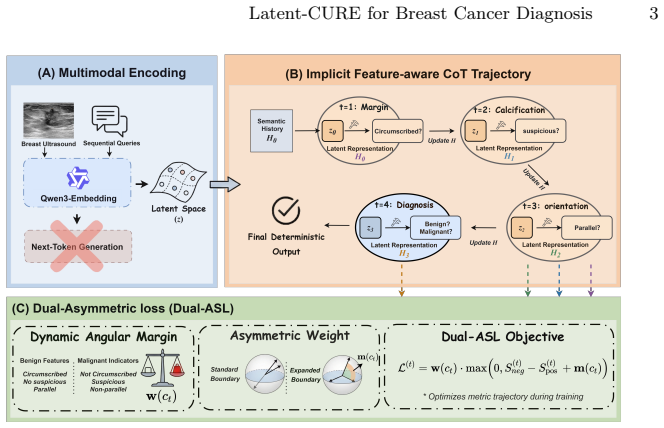
Latent-CURE is driven by asymmetric weighted chain-of-thought methodology grounded in latent space reasoning. It constructs an implicit reasoning trajectory that forces the model to sequentially infer standardized BI-RADS morphological descriptors before converging on a final diagnosis, and couples this with a dual-asymmetric optimization strategy that dynamically adjusts margins and weights to safeguard high-specificity malignant descriptors from being overshadowed by common benign priors.
What carries the argument
asymmetric weighted chain-of-thought trajectory in latent space that sequences BI-RADS morphological descriptor inference before diagnosis
If this is right
- The model produces step-by-step clinical evidence rather than a single opaque label.
- High-specificity malignant descriptors receive explicit protection against majority-class dominance.
- Diagnostic accuracy holds in cohorts with extreme benign-to-malignant imbalance.
- Shortcut learning is reduced by prioritizing structured descriptor reasoning over global correlations.
Where Pith is reading between the lines
- The same latent sequencing could be applied to other imaging tasks where rare positive findings must not be masked by frequent negatives.
- Explicit BI-RADS ordering may serve as a lightweight way to inject domain structure into existing multimodal models without full retraining.
- If the trajectory generalizes, it could support cross-device or multi-center validation studies focused on reasoning consistency rather than final accuracy alone.
Load-bearing premise
Forcing sequential inference of standardized BI-RADS morphological descriptors in latent space will prevent shortcut learning and protect high-specificity malignant indicators from being overshadowed by benign priors.
What would settle it
A test set of malignant cases where the enforced latent sequence still produces final diagnoses driven by benign priors, or where the generated descriptor steps fail to match independent radiologist BI-RADS assessments.
Figures
read the original abstract
Multimodal Large Models have significantly advanced automated breast ultrasound diagnosis. However, most existing frameworks utilize opaque, end-to-end paradigms prioritizing global statistical correlations over structured clinical reasoning. Consequently, these models remain susceptible to shortcut learning amid extreme real-world epidemiological imbalances, often bypassing rare but decisive malignant indicators for dominant benign patterns. To address this disconnect, we propose Latent-CURE, a novel diagnostic framework driven by asymmetric weighted chain-of-thought methodology grounded in latent space reasoning. Unlike traditional approaches, our framework constructs an implicit reasoning trajectory forcing the model to sequentially infer standardized BI-RADS morphological descriptors before converging on a final diagnosis. Furthermore, to combat the extreme scarcity of critical malignant features, we couple this architecture with a dual-asymmetric optimization strategy. By dynamically adjusting margins and weights, this strategy safeguards high-specificity malignant descriptors from being overshadowed by common benign priors. Comprehensive evaluations demonstrate that our knowledge-injected approach provides transparent clinical evidence while achieving robust, accurate diagnostic performance in imbalanced medical cohorts.
Editorial analysis
A structured set of objections, weighed in public.
Referee Report
Summary. The paper proposes Latent-CURE, a multimodal large-model framework for breast ultrasound diagnosis. It constructs an implicit reasoning trajectory in latent space that forces sequential inference of standardized BI-RADS morphological descriptors before a final diagnosis, and couples this with a dual-asymmetric optimization strategy that dynamically adjusts margins and weights to protect high-specificity malignant features from being overshadowed by benign priors in imbalanced cohorts. The central claim is that this knowledge-injected approach yields both transparent clinical evidence and robust diagnostic performance.
Significance. If the method were shown to deliver the claimed performance gains while enforcing the sequential BI-RADS trajectory, it would be significant for clinical AI: it would demonstrate a concrete mechanism for injecting structured medical knowledge into end-to-end models and for mitigating shortcut learning on rare but decisive malignant indicators.
major comments (2)
- [Abstract] Abstract: the statement that 'comprehensive evaluations demonstrate robust performance and transparent clinical evidence' is unsupported; the manuscript contains no datasets, baselines, quantitative metrics, ablation studies, or figures.
- [Abstract] Abstract: no loss function, auxiliary objectives, latent-variable constraints, or gradient-regularization terms are specified for either the sequential BI-RADS inference or the dual-asymmetric optimization, so it is impossible to verify whether the architecture actually blocks shortcut learning on malignant descriptors.
Simulated Author's Rebuttal
We thank the referee for their review and for identifying key gaps in the submitted manuscript. We agree that the current version lacks empirical support and technical specifications, and we outline revisions below to address these issues directly.
read point-by-point responses
-
Referee: [Abstract] Abstract: the statement that 'comprehensive evaluations demonstrate robust performance and transparent clinical evidence' is unsupported; the manuscript contains no datasets, baselines, quantitative metrics, ablation studies, or figures.
Authors: We agree that this claim is unsupported in the submitted manuscript, which contains only the abstract and high-level method description without any experimental results. The statement will be removed or substantially qualified in the abstract. In the revised manuscript we will add the missing datasets, baselines, metrics, ablation studies, and figures to substantiate the performance claims. revision: yes
-
Referee: [Abstract] Abstract: no loss function, auxiliary objectives, latent-variable constraints, or gradient-regularization terms are specified for either the sequential BI-RADS inference or the dual-asymmetric optimization, so it is impossible to verify whether the architecture actually blocks shortcut learning on malignant descriptors.
Authors: We acknowledge that the manuscript provides no explicit loss functions, auxiliary objectives, or regularization terms, which prevents verification of the shortcut-learning claims. The revised version will include the full mathematical definitions of the latent-space chain-of-thought trajectory, the dual-asymmetric optimization objective, margin adjustments, and any auxiliary losses or constraints. revision: yes
Circularity Check
No circularity detected from provided text
full rationale
The abstract and description outline a high-level architecture with sequential BI-RADS inference and dual-asymmetric optimization but contain no equations, loss functions, parameter-fitting details, or self-citations that would allow any claimed prediction or result to reduce by construction to its inputs. No load-bearing steps are exhibited that match the enumerated circularity patterns, so the derivation chain cannot be shown to collapse and is treated as self-contained.
Axiom & Free-Parameter Ledger
axioms (1)
- domain assumption BI-RADS morphological descriptors can be reliably inferred in latent space and serve as decisive clinical evidence
Reference graph
Works this paper leans on
-
[1]
BMC medical informatics and decision making20(1), 310 (2020)
Amann, J., Blasimme, A., Vayena, E., Frey, D., Madai, V.I., Consortium, P.: Ex- plainability for artificial intelligence in healthcare: a multidisciplinary perspective. BMC medical informatics and decision making20(1), 310 (2020)
2020
-
[2]
Bai, S., Cai, Y., Chen, R., Chen, K., Chen, X., Cheng, Z., Deng, L., Ding, W., Gao, C., Ge, C., et al.: Qwen3-vl technical report. arXiv preprint arXiv:2511.21631 (2025)
work page internal anchor Pith review Pith/arXiv arXiv 2025
-
[3]
American Journal of Roentgenology204(2), 234– 240 (2015)
Brem, R.F., Lenihan, M.J., Lieberman, J., Torrente, J.: Screening breast ultra- sound: past, present, and future. American Journal of Roentgenology204(2), 234– 240 (2015)
2015
-
[4]
Scientific Reports14(1), 1542 (2024)
Choi, J., Kim, J.W., Lee, Y.S., Tae, J.H., Choi, S.Y., Chang, I.H., Kim, J.H.: Availability of chatgpt to provide medical information for patients with kidney cancer. Scientific Reports14(1), 1542 (2024)
2024
-
[5]
An Image is Worth 16x16 Words: Transformers for Image Recognition at Scale
Dosovitskiy, A., Beyer, L., Kolesnikov, A., Weissenborn, D., Zhai, X., Unterthiner, T., Dehghani, M., Minderer, M., Heigold, G., Gelly, S., et al.: An image is worth 16x16 words: Transformers for image recognition at scale. arXiv preprint arXiv:2010.11929 (2020)
work page internal anchor Pith review Pith/arXiv arXiv 2010
-
[6]
Training Large Language Models to Reason in a Continuous Latent Space
Hao, S., Sukhbaatar, S., Su, D., Li, X., Hu, Z., Weston, J., Tian, Y.: Train- ing large language models to reason in a continuous latent space. arXiv preprint arXiv:2412.06769 (2024)
work page internal anchor Pith review Pith/arXiv arXiv 2024
-
[7]
npj Digital Medicine8(1), 450 (2025)
Hao, Y., Qiu, Z., Holmes, J., Löckenhoff, C.E., Liu, W., Ghassemi, M., Kalantari, S.: Large language model integrations in cancer decision-making: a systematic re- view and meta-analysis. npj Digital Medicine8(1), 450 (2025)
2025
-
[8]
He,K.,Zhang,X.,Ren,S.,Sun,J.:Deepresiduallearningforimagerecognition.In: Proceedings of the IEEE conference on computer vision and pattern recognition. pp. 770–778 (2016)
2016
-
[9]
Frontiers in Oncology13, 1219326 (2023) 10 W
Holmes, J., Liu, Z., Zhang, L., Ding, Y., Sio, T.T., McGee, L.A., Ashman, J.B., Li, X., Liu, T., Shen, J., et al.: Evaluating large language models on a highly- specialized topic, radiation oncology physics. Frontiers in Oncology13, 1219326 (2023) 10 W. Zhao et al
2023
-
[10]
Iclr1(2), 3 (2022)
Hu, E.J., Shen, Y., Wallis, P., Allen-Zhu, Z., Li, Y., Wang, S., Wang, L., Chen, W., et al.: Lora: Low-rank adaptation of large language models. Iclr1(2), 3 (2022)
2022
-
[11]
Cancer130(12), 2101–2107 (2024)
Kolla, L., Parikh, R.B.: Uses and limitations of artificial intelligence for oncology. Cancer130(12), 2101–2107 (2024)
2024
-
[12]
Advances in Neural Information Processing Systems36, 28541–28564 (2023)
Li, C., Wong, C., Zhang, S., Usuyama, N., Liu, H., Yang, J., Naumann, T., Poon, H., Gao, J.: Llava-med: Training a large language-and-vision assistant for biomedicine in one day. Advances in Neural Information Processing Systems36, 28541–28564 (2023)
2023
-
[13]
Nature Biomedical Engineering9(3), 356–370 (2025)
Qian, X., Pei, J., Han, C., Liang, Z., Zhang, G., Chen, N., Zheng, W., Meng, F., Yu, D., Chen, Y., et al.: A multimodal machine learning model for the stratification of breast cancer risk. Nature Biomedical Engineering9(3), 356–370 (2025)
2025
-
[14]
In: Proceedings of the IEEE/CVF international conference on computer vision
Ridnik, T., Ben-Baruch, E., Zamir, N., Noy, A., Friedman, I., Protter, M., Zelnik- Manor, L.: Asymmetric loss for multi-label classification. In: Proceedings of the IEEE/CVF international conference on computer vision. pp. 82–91 (2021)
2021
-
[15]
In: International Conference on Medical Image Computing and Computer-Assisted Intervention
Saleem, A., Lewis, J.R., Gilani, S.Z.: A hybrid contrastive ordinal regression method for advancing disease severity assessment in imbalanced medical datasets. In: International Conference on Medical Image Computing and Computer-Assisted Intervention. pp. 14–23. Springer (2025)
2025
-
[16]
CODI: Compressing Chain-of-Thought into Continuous Space via Self-Distillation
Shen, Z., Yan, H., Zhang, L., Hu, Z., Du, Y., He, Y.: Codi: Compressing chain-of- thought into continuous space via self-distillation. arXiv preprint arXiv:2502.21074 (2025)
work page internal anchor Pith review Pith/arXiv arXiv 2025
-
[17]
Singh, A., Fry, A., Perelman, A., Tart, A., Ganesh, A., El-Kishky, A., McLaughlin, A., Low, A., Ostrow, A., Ananthram, A., et al.: Openai gpt-5 system card. arXiv preprint arXiv:2601.03267 (2025)
work page internal anchor Pith review Pith/arXiv arXiv 2025
-
[18]
Nature620(7972), 172–180 (2023)
Singhal, K., Azizi, S., Tu, T., Mahdavi, S.S., Wei, J., Chung, H.W., Scales, N., Tanwani, A., Cole-Lewis, H., Pfohl, S., et al.: Large language models encode clinical knowledge. Nature620(7972), 172–180 (2023)
2023
-
[19]
arXiv preprint arXiv:2502.03275 (2025)
Su, D., Zhu, H., Xu, Y., Jiao, J., Tian, Y., Zheng, Q.: Token assorted: Mixing latent and text tokens for improved language model reasoning. arXiv preprint arXiv:2502.03275 (2025)
-
[20]
arXiv preprint arXiv:2505.16552 (2025)
Tan, W., Li, J., Ju, J., Luo, Z., Luan, J., Song, R.: Think silently, think fast: Dy- namic latent compression of llm reasoning chains. arXiv preprint arXiv:2505.16552 (2025)
-
[21]
Gemini 1.5: Unlocking multimodal understanding across millions of tokens of context
Team, G., Georgiev, P., Lei, V.I., Burnell, R., Bai, L., Gulati, A., Tanzer, G., Vin- cent,D.,Pan,Z.,Wang,S.,etal.:Gemini1.5:Unlockingmultimodalunderstanding across millions of tokens of context. arXiv preprint arXiv:2403.05530 (2024)
work page internal anchor Pith review Pith/arXiv arXiv 2024
-
[22]
Team, M., Dou, C., Liu, C., Yang, F., Li, F., Jia, J., Chen, M., Ju, Q., Wang, S., Dang, S., Li, T., Zeng, X., Zhou, Y., Zhu, C., Pan, D., Deng, F., Ai, G., Dong, G., Zhang, H., Tai, J., Hong, J., Lu, K., Sun, L., Guo, P., Ma, Q., Xin, R., Yang, S., Zhang, S., Mo, Y., Liang, Z., Zhang, Z., Cui, H., Zhu, Z., Wang, X.: Baichuan-m2: Scaling medical capabilit...
-
[23]
Nature medicine29(8), 1930–1940 (2023)
Thirunavukarasu, A.J., Ting, D.S.J., Elangovan, K., Gutierrez, L., Tan, T.F., Ting, D.S.W.: Large language models in medicine. Nature medicine29(8), 1930–1940 (2023)
1930
-
[24]
Advances in neural information processing systems35, 24824–24837 (2022)
Wei, J., Wang, X., Schuurmans, D., Bosma, M., Xia, F., Chi, E., Le, Q.V., Zhou, D., et al.: Chain-of-thought prompting elicits reasoning in large language models. Advances in neural information processing systems35, 24824–24837 (2022)
2022
-
[25]
Pattern Recognition79, 340–355 (2018) Latent-CURE for Breast Cancer Diagnosis 11
Xian, M., Zhang, Y., Cheng, H.D., Xu, F., Zhang, B., Ding, J.: Automatic breast ultrasound image segmentation: A survey. Pattern Recognition79, 340–355 (2018) Latent-CURE for Breast Cancer Diagnosis 11
2018
-
[26]
Ultrasonics91, 1–9 (2019)
Xu, Y., Wang, Y., Yuan, J., Cheng, Q., Wang, X., Carson, P.L.: Medical breast ultrasound image segmentation by machine learning. Ultrasonics91, 1–9 (2019)
2019
-
[27]
Qwen3 Embedding: Advancing Text Embedding and Reranking Through Foundation Models
Zhang, Y., Li, M., Long, D., Zhang, X., Lin, H., Yang, B., Xie, P., Yang, A., Liu, D., Lin, J., Huang, F., Zhou, J.: Qwen3 embedding: Advancing text embedding and reranking through foundation models. arXiv preprint arXiv:2506.05176 (2025)
work page internal anchor Pith review Pith/arXiv arXiv 2025
-
[28]
Zhang, Z., He, X., Yan, W., Shen, A., Zhao, C., Wang, S., Shen, Y., Wang, X.E.: Soft thinking: Unlocking the reasoning potential of llms in continuous concept space. arXiv preprint arXiv:2505.15778 (2025)
-
[29]
ACM Computing Surveys 57(8), 1–35 (2025)
Zheng, Y., Chen, Y., Qian, B., Shi, X., Shu, Y., Chen, J.: A review on edge large language models: Design, execution, and applications. ACM Computing Surveys 57(8), 1–35 (2025)
2025
-
[30]
Zhu, R.J., Peng, T., Cheng, T., Qu, X., Huang, J., Zhu, D., Wang, H., Xue, K., Zhang, X., Shan, Y., Cai, T., Kergan, T., Kembay, A., Smith, A., Lin, C., Nguyen, B.,Pan,Y.,Chou,Y.,Cai,Z.,Wu,Z.,Zhao,Y.,Liu,T.,Yang,J.,Zhou,W.,Zheng, C., Li, C., Zhou, Y., Li, Z., Zhang, Z., Liu, J., Zhang, G., Huang, W., Eshraghian, J.: A survey on latent reasoning (2025), ht...
discussion (0)
Sign in with ORCID, Apple, or X to comment. Anyone can read and Pith papers without signing in.