REVIEW 4 major objections 3 minor 1 cited by
SU(1,1) coherent states for the Dunkl- Klein-Gordon equation in its canonical form
T0 review · 4 major / 3 minor · reviewed 2026-08-06 · deepseek-v4-flash
Pith's one-line read The canonical Dunkl–Klein–Gordon equation admits exact complex energy spectra and radial Perelomov coherent states constructed from the su(1,1) symmetry algebra.
desk verdict The su(1,1) construction fails at its central step, so the claimed exact spectra and coherent states are unsupported. read the letter →
The pith
A machine-rendered reading of the paper's core claim, the machinery that carries it, and where it could break.
The reading
What carries the argument
The central object is the su(1,1) Lie algebra with generators $Z_3$ and $D_\pm$, constructed through Schrödinger factorization of the radial equation. Perelomov coherent states are built with the displacement operator $D(\xi)=\exp(\xi K_+ - \xi^* K_-)$ acting on the lowest state $|k,0\rangle$, where the Bargmann index is $k=\frac12 + \frac{\sqrt{1-8\alpha}}{4}$. This machinery turns a second-order differential equation into a ladder-algebra problem, yielding the spectrum from the relation $Z_3|k,n\rangle=(k+n)|k,n\rangle$ and the coherent states from the standard SU(1,1) normalized expansion.
What would settle it
Directly evaluate $Z_3$ as defined in Eq. (23) on a complete set of solutions of Eq. (15) and verify whether it equals $-i(E^2-m^2)/(4\Lambda)$ as an operator identity; alternatively, solve Eq. (14) numerically for the lowest eigenvalues and compare the real and imaginary parts with Eq. (29), since any mismatch in the imaginary part would rule out the claimed resonance spectrum.
Extended reading notes
Core claim
The central claim is that in the even-parity, small-curvature regime ($R \ll E^2 - m^2$), the effective radial equation for the canonical Dunkl–Klein–Gordon equation is an su(1,1) eigenvalue problem. The paper introduces a complex operator $Z_3$ (Eq. 23) and ladder operators $D_\pm$, asserts they close the su(1,1) algebra, and uses the unitary irreducible representations $Z_3|k,n\rangle = (k+n)|k,n\rangle$ to obtain $E_n^2 = m^2 - 8R\left(2n+1+i\sqrt{\frac{2\alpha-1}{4}}\right)^2$ for $a(x)=e^{-Rx^2}$, with analogous spectra for the other two profiles. The associated wave functions are Laguerre-type, and the Perelomov coherent states $R_{nk}(x,\xi)$ are given in closed form and studied in time. The spectrum's complex nature is interpreted as resonant or scattering states, not conventional bound states.
Load-bearing premise
The load-bearing premise is the asserted identification of the second-order differential operator $Z_3$ with the constant $-i(E^2-m^2)/(4\Lambda)$, stated in Eq. (23) without derivation from Eq. (15); if that operator identity or the resulting commutation relations fail, the spectra and coherent states built on them collapse.
Editorial extensions
If this is right
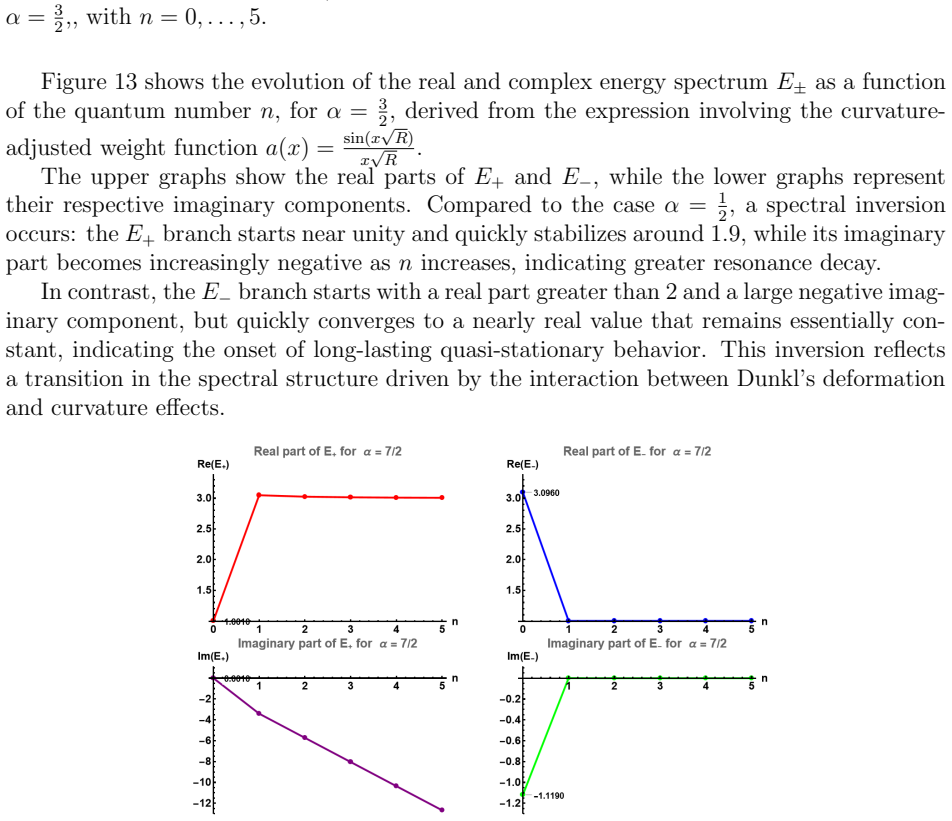
- The three closed-form spectra (Eqs. 29, 58, 68) predict complex energies whose imaginary parts grow linearly with $n$, describing resonances that decay faster at higher excitation.
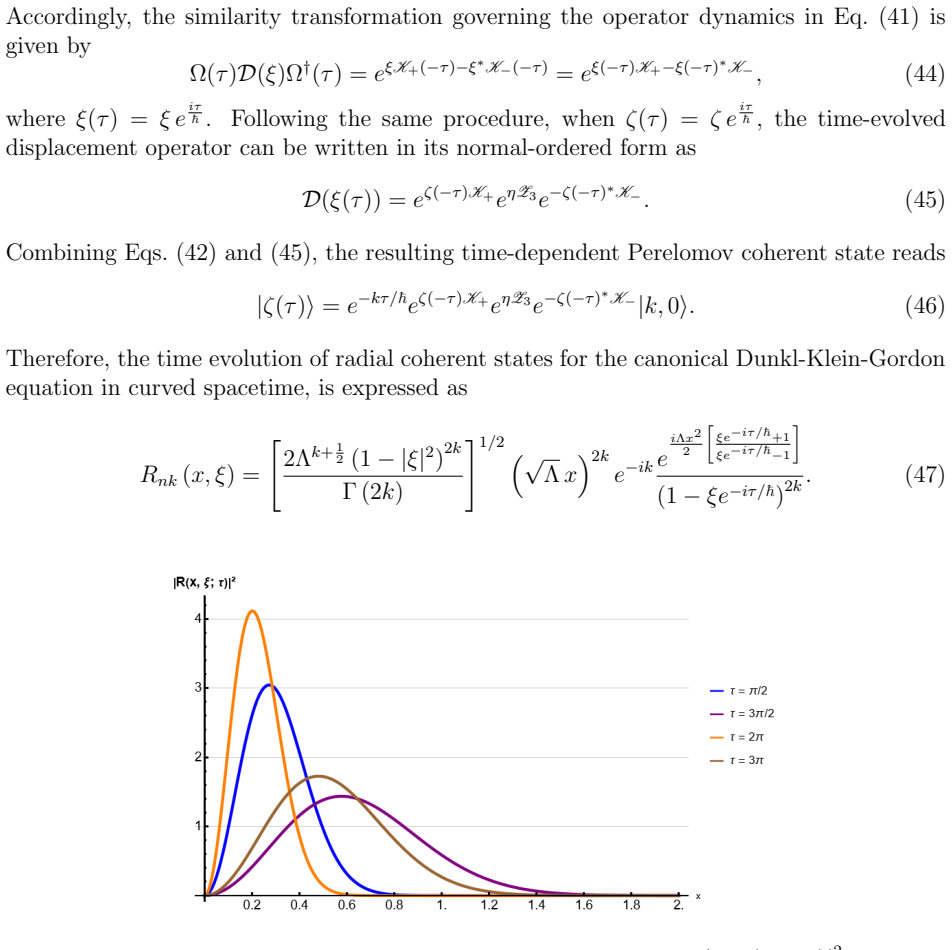
- The normalized radial Perelomov coherent states provide explicit wave packets whose localization depends on the Dunkl parameter $\alpha$ and the quantum number $n$, offering a testable profile for density measurements.
- The same su(1,1) construction applies to any even profile $a(x)$ whose effective radial equation reduces to the same differential form, so the method extends to other curvature models.
- The non-Hermitian nature of the Hamiltonian is compatible with an exact su(1,1) symmetry, supporting the idea that algebraic solvability and dissipative or resonant behavior can coexist.
Reading between the lines
- If the identification of $Z_3$ fails under a more careful derivation, the paper's results would reduce to a formal coincidence; a numerical check of Eq. (29) against direct diagonalization of Eq. (14) would settle the issue.
- The same factorization technique could be applied to the odd-parity sector ($\delta=0$), where the term $(4i\alpha E\sqrt{R})(x\sqrt{R})^{2\alpha-1}$ appears, to see whether the su(1,1) structure survives.
- The time-evolution formula (47) effectively describes a non-unitary evolution driven by a non-Hermitian 'Hamiltonian' $Z_3$; interpreting $\tau$ as a physical time would require a metric or norm prescription, which the paper does not provide.
Signed reviews
Editorial analysis
A structured set of objections, weighed in public.
Referee Report
Summary. The paper claims to derive exact complex energy spectra and radial Perelomov coherent states for the canonical Dunkl–Klein–Gordon equation in curved spacetime by constructing an su(1,1) symmetry algebra. The main case is a(x)=e^{-Rx^2}, where the spectrum is given in Eq. (29) and the coherent states in Eq. (35). The construction is based on identifying a second-order differential operator Z3 with the constant -i(E^2-m^2)/(4\Lambda), then using su(1,1) representation theory to quantize the energy. The same procedure is repeated for a(x)=(1-Rx^2)/(1+Rx^2) and a(x)=sin(x\sqrt{R})/(x\sqrt{R}). The analysis is restricted to the even-parity sector and to the regime R much smaller than the kinetic energy.
Significance. If the algebraic identification were correct, the paper would provide a unified closed-form treatment of spectra and coherent states for a non-Hermitian, Dunkl-deformed Klein–Gordon model, with explicit tables and figures. The authors are also transparent about the even-parity restriction and the small-R approximation. However, the central step, Eq. (23), is not a valid consequence of the differential equation, and the subsequent algebra, spectrum, and coherent-state formulas rest on this unsound identification. The paper therefore does not establish its main claims; the errors are load-bearing rather than merely presentational.
major comments (4)
- [Section 3, Eq. (23)] The operator identity Z3 = i[r d^2/dr^2 + (\alpha/2+3/16) r + r/4] = -i(E^2-m^2)/(4\Lambda) does not follow from Eq. (15) and is not correct. Dividing Eq. (15) by -r gives rF'' + L F + (1/4)rF + (\alpha/2+3/16)F/r = 0 with L=(E^2-m^2)/(4\Lambda). Thus on any eigenfunction of Eq. (15) the differential expression in Eq. (23) evaluates to -i[L F + (\alpha/2+3/16)(r-1/r)F], not -i L F. The identity also fails pointwise, e.g. for F(r)=1. Since the identification Z3=-iL is the foundation of the su(1,1) representation and the spectral derivation, the resulting spectrum and coherent states are unsupported.
- [Section 3, Eqs. (28)–(29)] The algebra connecting Eq. (28) to Eq. (29) is internally inconsistent. Eq. (28) states k+n = -i(E^2-m^2)/(4\sqrt{2R(E^2-m^2)}). Squaring gives (k+n)^2 = -(E^2-m^2)/(32R), i.e. E^2-m^2 = -32R(k+n)^2. Substituting k=1/2+\sqrt{1-8\alpha}/4 yields E^2 = m^2 - 32R(1/2+\sqrt{1-8\alpha}/4+n)^2, which is not the expression in Eq. (29), E_n^2 = m^2 - 8R(2n+1+i\sqrt{(2\alpha-1)/4})^2. For \alpha=3/2 and \alpha=7/2, the two formulas are numerically different. Therefore the claimed exact spectrum in Eq. (29) does not follow from the stated eigenvalue equation.
- [Section 3, Eqs. (22)–(24)] The claimed su(1,1) commutation relations in Eq. (24) are not established. If Z3 is the c-number -iL, then [Z3,D_\pm]=0, not \mp D_\pm. If Z3 is instead the second-order differential operator in Eq. (23), the commutators with D_\pm contain third-order derivative terms and do not close into the su(1,1) algebra. In either reading, Eq. (24) is contradictory. Since the entire representation-theoretic machinery (Bargmann index, Casimir relation, energy spectrum) depends on these commutation relations, the derivation collapses.
- [Section 3, Eq. (35) and Figures 1–3] The Perelomov coherent states are claimed to be normalized, but no proof is given, and for \alpha>1/2 the Bargmann index k is complex because \sqrt{1-8\alpha} is imaginary. The normalization factor (1-|\xi|^2)^k and the series in Eq. (34) require justification for complex k, and the radial density |R_{nk}(x,\xi)|^2 is not shown to integrate to unity. The paper also excludes the case n=0, \alpha=7/2 because of 'numerically unstable behavior' without providing a rigorous argument; excluding a member of the state family undercuts the claim of a complete construction of coherent states.
minor comments (3)
- [Section 3, Eqs. (36)–(39)] The re-definition of Hr in Eq. (37) as identical to the differential part of Z3 repeats the problematic identification without addressing the difference between the two sides of Eq. (23) on solutions of Eq. (15).
- [Sections 4 and 5, Eqs. (55) and (66)] The same unsupported identification between a second-order differential operator and a c-number is used for the other two choices of a(x), so the spectra and coherent states in those sections share the same defect.
- [General notation] There are notation and typographical issues: Eq. (16) uses F for both the function and a coefficient; Eqs. (30)–(32) use Ar, Br, Cr with inconsistent subscripts; and Refs. [29] and [34] appear to be duplicates of the same work.
Circularity Check
The energy spectra are extracted from the definition Z3 = -iL, with L containing the unknown energy E, so Eq. (29) and its analogues are rearrangements of the generator's defining relation rather than independent predictions.
-
self definitional
[Section 3, Eqs. (23)-(29)]
"Z3 = i [ r d2/dr2 + (α/2 + 3/16) r + 1/4 r ] = −i (E2−m2)/(4Λ) ... 1/2 + √1 − 8α/4 + n = −i (E2 − m2)/(4√(2R(E2−m2)))"
The operator Z3 is assigned the constant value −iL, where L=(E²−m²)/(4Λ) and Λ=√(2R(E²−m²)). The sought energy E therefore appears inside the very operator whose su(1,1) eigenvalue is then invoked. Eq. (28) is just L=−i(k+n) inverted: it algebraically gives E² = m² − 32R(k+n)², which is the claimed spectrum. No independent spectral information from Eq. (15) is used after this definition. Moreover, the differential form of Z3 is not equivalent to −iL on solutions of Eq. (15): dividing Eq. (15) by r yields rF'' + LF + rF/4 + HF/r = 0, so i[rF''+HrF+rF/4] = −iLF + iH(r−1/r)F, not −iLF. The spectrum is thus a restatement of the defining equation Z3 = −iL.
-
fitted input called prediction
[Section 3.1, Eqs. (36)-(39)]
"HrF(r) = Z3F(r) = −i (E2−m2)/(4Λ) F(r) ... one can recover the energy spectrum previously obtained ... E2n = m2 − 8R(2n+1+i√((2α−1)/4))2"
The time-evolution 'recovery' of the spectrum is again just the identity Hr = Z3 = −iL, with L a function of the unknown E. No new dynamical input is introduced; Eq. (39) is the same inversion of the defining relation Z3 = −iL as Eq. (29), now relabeled as a recovered result.
1 more flagged steps
-
self definitional
[Section 4, Eq. (55)/(57) and Section 5, Eq. (66)/(67)]
"T3 = i [ ... ] = −i (E2−m2+2R)/(4Θ) ... 1/2 + √1−8α/4 + n = −i (E2−m2+2R)/(4√(4R(E2−m2))) ; Γ3 = i [ ... ] = −i (6(E2−m2)+R)/(24Π) ... 1/2+√1−8α/4+n = −i (6(E2−m2)+R)/(24Π)"
For both additional curvature profiles the same construction is repeated: the generator T3 or Γ3 is defined as −i times a ratio that contains the unknown energy E, and then the spectrum is obtained by equating that ratio to the su(1,1) quantum number k+n. The resulting spectra are therefore algebraic inversions of the defining relations, not independent derivations from the respective differential equations.
full rationale
The central spectral claim of the paper is obtained by definitional construction rather than by an independent dynamical derivation. In Eq. (23) the paper sets Z3 equal to −iL with L=(E²−m²)/(4Λ), so the energy E is already an input to the operator whose su(1,1) eigenvalue is then used in Eq. (28) to solve for E. Eq. (29) is simply the inversion of that defining relation. The same pattern is repeated in Secs. 4 and 5. The differential-operator form of Z3 is not equivalent to −iL on solutions of Eq. (15), as a direct rearrangement shows, so the claimed algebraic basis does not supply independent constraints. There is no load-bearing self-citation: references [15], [16], and [33] are by the same group but are used for background or standard time-evolution formulas, not to justify the spectral derivation. The coherent-state construction is the standard Perelomov definition applied to the same representation parameters, so it inherits the circularity of the spectrum but adds no new circular step. Overall, the spectral predictions reduce by construction to the defining relation Z3 = −iL, giving a partial but significant circularity.
Assumptions & free parameters
free parameters (3)
- Dunkl deformation parameter alpha =
alpha = 1/2, 3/2, 7/2 in examples
- Curvature constant R =
R = 1 in tables; assumed small in derivation
- Coherent state parameter xi =
xi = 0.5 + 0.2i in plots
assumptions (4)
- domain assumption The canonical Dunkl-Klein-Gordon equation (Eqs. 5, 9, 11) as derived in Ref. [25] from a gamma-matrix algebra with a universal curvature scale.
- domain assumption Even-parity sector restriction delta=1 and half-odd-integer alpha ensure the transformation W(x) is even.
- ad hoc to paper The small-R expansion e^{2Rx^2} approx 1 + 2Rx^2 with no error bound.
- standard math Standard su(1,1) representation theory and Perelomov coherent state machinery.
Cite this review
Pith. "Pith review of SU(1,1) coherent states for the Dunkl- Klein-Gordon equation in its canonical form." pith.science (2026). https://pith.science/paper/PFPDAHJZ
@misc{pith2026250710947,
  author       = {Pith},
  title        = {Pith review of: SU(1,1) coherent states for the Dunkl- Klein-Gordon equation in its canonical form},
  year         = {2026},
  howpublished = {\url{https://pith.science/paper/PFPDAHJZ}},
  note         = {Machine review of arXiv:2507.10947}
}
abstract
Using representation-theoretic techniques associated with the $\mathfrak{su}(1,1)$ symmetry algebra, we construct Perelomov coherent states for the Dunkl-Klein-Gordon equation in its canonical form, which is free of first-order Dunkl derivatives. Our analysis is restricted to the even-parity sector and to the regime where the curvature constant $R$ is much smaller than the system's kinetic energy. The equation under consideration emerges from a matrix-operator framework based on Dirac gamma matrices and a universal length scale that encodes the curvature of space via the Dunkl operator, thereby circumventing the need for spin connections in the Dirac equation.
Figures


Figures from the paper (11 more)


Forward citations
Cited by 1 Pith paper
-
Generalized MICZ-Kepler systems on three-dimensional sphere and hyperboloid
Curved-space analogs of the generalized MICZ-Kepler system on S³ and the 3D hyperboloid are solved exactly, with two-quantum-number spectra and normalized wavefunctions.
Reference graph
Works this paper leans on
- [25]
-
[1]
C. F. Dunkl, Trans. Am. Math. Soc. 311, 167 (1989)
work page 1989
-
[2]
E. P. Wigner, Phys. Rev. 77, 711 (1950)
work page 1950
-
[3]
L. M. Yang, Phys. Rev. 84, 788 (1951)
work page 1951
-
[4]
H. S. Green, Phys. Rev. 90, 270 (1953)
work page 1953
-
[5]
S. Sargolzaeipor, H. Hassanabadi, and W. S. Chung, Mod. Phys. Lett. A 33, 1850146 (2018)
work page 2018
- [6]
- [7]
Show all 34 references
-
[8]
Hassanabadi, P
S. Hassanabadi, P. Sedaghatnia, W. S. Chung, B. C. L¨ utf¨ uoglu, J. Kriz, and H. Hassan- abadi, Eur. Phys. J. Plus 138, 331 (2023)
2023
-
[9]
Ballesteros, A
A. Ballesteros, A. Najafizade, H. Panahi, H. Hassanabadi, and S. H. Dong, Ann. Phys. 460, 169543 (2024)
2024
-
[10]
Hassanabadi, M
H. Hassanabadi, M. de Montigny, and W. S. Chung, Physica A 580, 126154 (2021)
2021
-
[11]
Merabtine, B
F. Merabtine, B. Hamil, B. C. L¨ utf¨ uoglu, A. Hocine, and M. Benarous,J. Stat. Mech. 2023, 053102 (2023)
2023
-
[12]
Merabtine, B
F. Merabtine, B. Hamil, and B. C. L¨ utf¨ uoglu,Physica A 623, 128841 (2023)
2023
-
[13]
Hocine, B
A. Hocine, B. Hamil, F. Merabtine, B. C. L¨ utf¨ uoglu, and M. Benarous,Rev. Mex. F ´ ıs. (in press, 2024)
2024
-
[14]
Hocine, F
A. Hocine, F. Merabtine, B. Hamil, B. C. L¨ utf¨ uoglu, and M. Benarous, Ind. J. Phys. (Early access, 2024)
2024
-
[15]
Salazar-Ram ´ ırezet al
M. Salazar-Ram ´ ırezet al. , Mod. Phys. Lett. A 33, 1850112 (2018). 21
2018
-
[16]
Salazar-Ram ´ ırezet al
M. Salazar-Ram ´ ırezet al. , Eur. Phys. J. Plus 132, 1 (2017)
2017
-
[17]
Brink, T
L. Brink, T. H. Hansson, and M. A. Vasiliev, Phys. Lett. B 286, 109 (1992)
1992
-
[18]
A. P. Polychronakos, Phys. Rev. Lett. 69, 703 (1992)
1992
-
[19]
Lapointe and L
L. Lapointe and L. Vinet, Commun. Math. Phys. 178, 425 (1996)
1996
-
[20]
Quesne, Mod
C. Quesne, Mod. Phys. Lett. A 10, 1323 (1995)
1995
-
[21]
Khare and C
A. Khare and C. Quesne, Phys. Lett. A 250, 33 (1998)
1998
-
[22]
V. X. Genest et al., J. Phys. A: Math. Theor. 46, 145201 (2013)
2013
-
[23]
Hamil, B
B. Hamil, B. C. L¨ utf¨ uoglu, and M. Merad,Mod. Phys. Lett. A 40, 2550094 (2025)
2025
-
[24]
Sedaghatnia et al
P. Sedaghatnia et al. , Ann. Phys. 458, 169445 (2023)
2023
-
[26]
A. D. Alhaidari and A. Jellal, Phys. Lett. A 379, 2946 (2015)
2015
-
[27]
A. O. Barut and L. Girardello, Commun. Math. Phys. 21, 41 (1971)
1971
-
[28]
A. M. Perelomov, Generalized Coherent States and Their Applications (Springer, Berlin, 1986)
1986
-
[29]
Maghsoodi, H
E. Maghsoodi, H. Hassanabadi, and S. Zarrinkamar, Chin. Phys. B 22, 030302 (2013)
2013
-
[30]
Gur and A
Y. Gur and A. Mann, Phys. At. Nucl. 68, 1700 (2005)
2005
-
[31]
Cohen-Tannoudji, B
C. Cohen-Tannoudji, B. Diu, and F. Laloe, Quantum Mechanics (Wiley-VCH, Berlin, 1977)
1977
-
[32]
C. C. Gerry and J. Kiefer, Phys. Rev. A 37, 665 (1988)
1988
-
[33]
Salazar-Ram ´ ırez, D
M. Salazar-Ram ´ ırez, D. Ojeda-Guill´ en, and R. D. Mota, J. Math. Phys. 57, 021704 (2016)
2016
-
[34]
Gur and A
Y. Gur and A. Mann, Phys. At. Nucl. 68, 1700 (2005). 22
2005
Reviewed August 6, 2026 · model on record in the stance chip above.
Discussion (0). Continue with ORCID to comment.