REVIEW 4 major objections 6 minor 1 cited by
Ultra-High-Definition Reference-Based Landmark Image Super-Resolution with Generative Diffusion Prior
T0 review · 4 major / 6 minor · reviewed 2026-08-05 · deepseek-v4-flash
Pith's one-line read TriFlowSR claims explicit patch-scale matching between low-resolution and reference images lets diffusion-based super-resolution transfer reference texture faithfully, setting the best reported perceptual scores on UHD landmark images.
desk verdict Incremental but useful RefSR paper with a credible diffusion recipe; the matching strategy is only tested on a small curated set and the mask substitution needs disclosure. read the letter →
The pith
A machine-rendered reading of the paper's core claim, the machinery that carries it, and where it could break.
The reading
What carries the argument
Patch-Ref Attention: cross-attention where the SR branch's query attends over a concatenation [K_SR, K_LR, K_Ref] and [V_SR, V_LR, V_Ref], so each output patch is explicitly matched to reference patches at the same feature scale. The Reference Matching Strategy is the companion mechanism for UHD: it runs the pretrained matcher at 560×560, upscales the mapping and confidence map, warps the reference HR into the LR frame, and gates low-confidence regions with a mask (in practice the SISR output). Together they feed spatially consistent reference texture to the frozen diffusion backbone.
What would settle it
Take a landmark pair with a large viewpoint change (for instance, a facade shot from 30 degrees apart, which Landmark-4K explicitly filters out), run TriFlowSR's Reference Matching Strategy, and inspect whether the warped reference aligns with the LR. If perceptual metrics (LPIPS, DISTS) on such pairs fall back to the SISR-only baseline while the SISR branch alone holds, the matching assumption is the bottleneck; visual misalignment in the masked warped reference would confirm it.
Extended reading notes
Core claim
TriFlowSR's central claim is that explicit pattern matching between the low-resolution image and the reference HR image at the patch scale is what lets a diffusion-based RefSR pipeline transfer semantic and texture information faithfully. The mechanism is Patch-Ref Attention, a cross-attention operation in which the SR branch's query attends to the concatenation of keys (and values) from the SR, LR, and reference branches, so reference features are selected by their similarity to the target patches rather than by a coarse global alignment. For UHD inference the paper adds a Reference Matching Strategy: a pretrained matcher (Roma) establishes dense correspondences at 560×560 between the bicub
Load-bearing premise
Everything rests on the pretrained matcher Roma giving reliable dense correspondences between a bicubically upscaled, heavily degraded LR image and the reference HR at 560×560, and on the confidence map C correctly suppressing bad warps; the Landmark-4K curation removes large viewpoint differences, so that regime is not tested.
Editorial extensions
If this is right
- Diffusion-based RefSR need not rely on ControlNet-style injection; explicit patch-scale matching gives better perceptual fidelity on the tested benchmarks.
- Tile-based UHD inference is feasible when the reference is warped and masked before each tile is processed, avoiding incorrect tile retrieval due to scale or position mismatch.
- The kscale knob makes the model interpolate continuously between SISR and RefSR behavior, offering a single checkpoint that can serve both tasks.
- Landmark-4K provides a UHD benchmark whose reference images contain fine-grained detail, making it possible to measure whether diffusion RefSR actually uses reference texture.
- The ablations show each component matters: the reference branch, the matching map, and the warping each increase PSNR, SSIM, LPIPS, or DISTS on Landmark-4K.
Reading between the lines
- Because Landmark-4K curation explicitly removes images with 'significant viewpoint variations', the claimed advantage over ControlNet-style methods is demonstrated only for near-frontal landmark views; robustness to large viewpoint or scale changes remains untested.
- The pipeline inherits the limitations of the pretrained matcher Roma; swapping in a stronger dense matcher should directly raise the ceiling of the Reference Matching Strategy, and the confidence map could be treated as an explicit uncertainty signal rather than a binary gate.
- The kscale and layer-count controls suggest a practical product feature, per-region user control over how much reference texture is trusted, which the paper does not explore.
- Using the SISR output as the mask means the pipeline already has a natural fallback; comparing a white mask against the SISR mask would isolate how much of the gain comes from the warping versus the masking.
Editorial analysis
A structured set of objections, weighed in public.
Referee Report
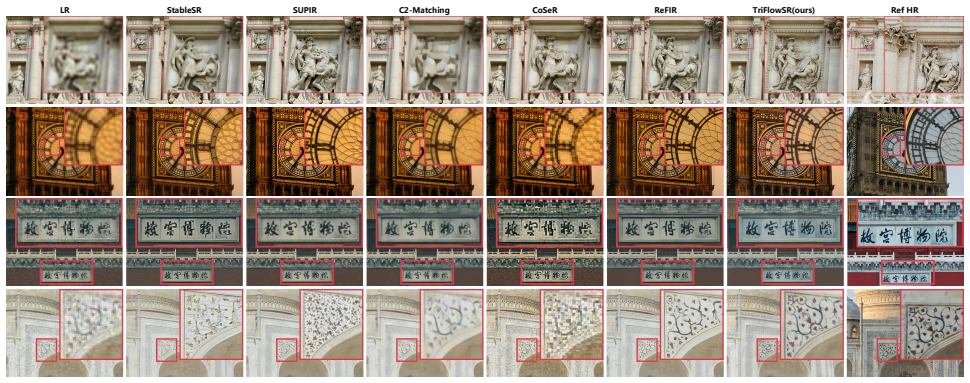
Summary. The paper proposes TriFlowSR, a reference-based super-resolution (RefSR) method built on a frozen Stable Diffusion 3 backbone. A trainable Reference HR branch is integrated through Patch-Ref Attention, where the attention keys/values of the SR, LR, and reference branches are concatenated (Eq. 1), enabling patch-level matching between LR and reference features. For ultra-high-definition (UHD) inference, a Reference Matching Strategy (Eqs. 3-4) uses a pre-trained dense matching model (Roma) at 560x560 resolution to warp the reference HR image to the upscaled LR image and suppress low-confidence regions. The authors also introduce Landmark-4K, a self-curated dataset of 185 UHD landmark images in 49 categories. Experiments report improved LPIPS/FID/DISTS on CUFED5 and WR-SR (Table 2) and improved PSNR/SSIM/LPIPS/DISTS on Landmark-4K (Table 3), leading to the claim that TriFlowSR is the first diffusion-based RefSR pipeline for UHD landmark scenarios under real-world degradation.
Significance. If fully supported, the paper would make a useful contribution: it demonstrates competitive perceptual performance on public RefSR benchmarks, introduces a new UHD RefSR dataset, and proposes a relatively simple, decoupled way to inject reference information into a frozen diffusion model. The public-benchmark perceptual wins (especially LPIPS, FID, DISTS on CUFED5 and WR-SR) are concrete evidence that Patch-Ref Attention helps. The promised code and model would also aid reproducibility. However, the paper's most distinctive component, the Roma-based Reference Matching Strategy for UHD inference, is only evaluated on Landmark-4K, a small, self-curated dataset from which the hard cases (significant viewpoint variation) have been explicitly removed. The current evidence therefore supports Patch-Ref Attention more strongly than it supports the full UHD matching strategy.
major comments (4)
- [Reference Matching Strategy / Landmark-4K Dataset] The central claim that the Reference Matching Strategy (Eqs. 3-4) effectively handles scale/perspective differences between LR and reference is only exercised on Landmark-4K, a 185-image benchmark the authors curated by removing images with 'significant viewpoint variations'. On CUFED5 and WR-SR, where references are naturally misaligned, the Appendix states that the images are 'padded to achieve alignment' rather than run through the 560x560 Roma warp/confidence-mask path. The matching strategy is therefore untested in exactly the regime it is designed for. I request either an evaluation on uncurated or deliberately misaligned references, or a restriction of the claim to the curated UHD setting.
- [Table 4 / Ablation Study] The ablation does not cleanly support the claim that 'Introducing the Reference Matching Strategy can solve the problem of incorrect tile retrieval'. Adding the Matching map without Warping (RB+M) decreases PSNR/SSIM relative to RB alone (25.37/0.750 vs 25.67/0.756) and gives only marginal LPIPS/DISTS improvement (0.239/0.110 vs 0.241/0.113). The best result appears only after Warping is also added. Thus the individual contribution of M is negative on two of four metrics, and the benefit is attributable to M+W jointly. Because the table reports no error bars or statistical tests, the 0.2 dB difference between the best configuration and RB alone may not be significant on 49-136 test images.
- [Figure 3 / Appendix 'Detail Experimental Setting'] There is a direct inconsistency between the main text and the appendix about the confidence mask. Figure 3 and the surrounding text say the mask used to suppress low-confidence regions is 'a pure white image', but the Appendix states: 'In practical implementation, since the mask can be any available image, we will use the result of the SISR model as the actual mask used.' This is not a cosmetic detail: it changes the input to the reference branch and affects the interpretation of Eq. 4 and the ablations. The authors must state which variant was used in Tables 3-5 and justify the discrepancy.
- [All quantitative tables] No error bars, confidence intervals, or paired statistical tests are provided for any table. This is especially important on Landmark-4K (Table 3), where the test set is small and many comparisons are within a few tenths of a dB. It is also relevant to the FID numbers on CUFED5/WR-SR, which are known to be unstable with small sample sizes. Please report per-image scores with variance or at least a paired comparison for the main claims.
minor comments (6)
- [Eq. (1)] The notation 'P atchRef Attn' has a formatting artifact; also Eq. (1) omits layer indexing, making it unclear whether Patch-Ref Attention is applied at every decoder layer or only some layers.
- [Figure 1 caption] The caption refers to 'TriFlow' while the method is named 'TriFlowSR'. Please make the nomenclature consistent.
- [Implementation Details / Reference Matching Strategy] The Roma matching model is mentioned only by citation. Please specify the exact checkpoint, the resolution at which matching is computed, and any confidence thresholding applied to C before the mask is formed. The choice of 560x560 also appears arbitrary and should be justified.
- [Landmark-4K Dataset] The test protocol is under-specified. The text says one image per category is used for self-reference and the remaining images for cross-reference, but it is not stated how Table 3 is computed: how many images are in the test set, whether self- and cross-reference results are pooled or reported separately, and how the reference for each test image is selected.
- [Table 11] The resource-efficiency table is missing TFLOPs for CoSeR, and no details are given about the input resolution, batch size, or number of diffusion steps used for each method. These affect both runtime and FLOPs.
- [General] Several appendix tables duplicate main-text tables (e.g., Tables 4/7 and 5/8). This is not a technical issue but adds length without new information.
Circularity Check
No significant circularity: the paper's central claims are architectural and supported by public benchmarks; the Landmark-4K-only validation of the matching strategy is an evaluation-scope limitation, not a circular reduction.
full rationale
TriFlowSR is an empirical system paper. Its central mechanisms—Patch-Ref Attention (Eq. 1) and the Roma-based Reference Matching Strategy (Eqs. 3–4)—are defined independently of the evaluation datasets and metrics. No parameter is fitted to a subset of the reported results and then renamed as a prediction: training uses LSDIR, FFHQ, DL3DV, and Inter4K, while evaluation is on CUFED5, WR-SR, and the authors' own Landmark-4K. The public-benchmark results (CUFED5, WR-SR) provide external, independent support for the Patch-Ref Attention claim, even though the appendix shows those tests use padded inference rather than the full UHD matching path. The Reference Matching Strategy is only exercised on Landmark-4K, a dataset the authors curated by removing significant viewpoint variations; this is a real limitation in the scope of evidence, and the paper itself notes that in real scenarios the LR and reference may have misalignments. However, removing hard cases does not make the reported improvements equivalent to the method's inputs by construction. There is also no load-bearing self-citation: TSD-SR is cited only as a baseline, and the pre-trained matcher Roma is external and independently published. The claim that concatenated cross-attention 'explicitly achieves pattern matching' is a design assertion, not a circular derivation. Therefore no circular step meeting the evidence bar is present; the appropriate finding is no significant circularity.
Assumptions & free parameters
free parameters (6)
- kscale (reference attention weight) =
1.0 (ablated from 0 to 1)
- Reference branch layer count =
23 (full)
- Matching downscale resolution =
560x560
- Tile size and step for UHD inference =
1024 tile, 256 step
- Mask blending weights for low-confidence regions =
1 for warped content, 0 for mask (binary)
- Training hyperparameters =
batch 16, lr 5e-5, 60k steps, warm-up 100
assumptions (5)
- domain assumption A frozen SD3 diffusion model supplies a generative prior strong enough for 4x real-world super-resolution.
- domain assumption Roma's dense matching generalizes from its training data to downscaled 560x560 landmark LR/HR pairs with a 4x scale difference.
- domain assumption Real-ESRGAN second-order degradation with 4x downsampling approximates real-world degradation for both training and evaluation.
- domain assumption Concatenating LR and reference K/V tokens into frozen attention layers transfers texture without corrupting the diffusion prior.
- standard math The rectified flow velocity-matching objective is a valid surrogate for sample quality in this setting.
Cite this review
Pith. "Pith review of Ultra-High-Definition Reference-Based Landmark Image Super-Resolution with Generative Diffusion Prior." pith.science (2026). https://pith.science/paper/PFTPBQRR
@misc{pith2026250810779,
  author       = {Pith},
  title        = {Pith review of: Ultra-High-Definition Reference-Based Landmark Image Super-Resolution with Generative Diffusion Prior},
  year         = {2026},
  howpublished = {\url{https://pith.science/paper/PFTPBQRR}},
  note         = {Machine review of arXiv:2508.10779}
}
read the original abstract
Reference-based Image Super-Resolution (RefSR) aims to restore a low-resolution (LR) image by utilizing the semantic and texture information from an additional reference high-resolution (reference HR) image. Existing diffusion-based RefSR methods are typically built upon ControlNet, which struggles to effectively align the information between the LR image and the reference HR image. Moreover, current RefSR datasets suffer from limited resolution and poor image quality, resulting in the reference images lacking sufficient fine-grained details to support high-quality restoration. To overcome the limitations above, we propose TriFlowSR, a novel framework that explicitly achieves pattern matching between the LR image and the reference HR image. Meanwhile, we introduce Landmark-4K, the first RefSR dataset for Ultra-High-Definition (UHD) landmark scenarios. Considering the UHD scenarios with real-world degradation, in TriFlowSR, we design a Reference Matching Strategy to effectively match the LR image with the reference HR image. Experimental results show that our approach can better utilize the semantic and texture information of the reference HR image compared to previous methods. To the best of our knowledge, we propose the first diffusion-based RefSR pipeline for ultra-high definition landmark scenarios under real-world degradation. Our code and model will be available at https://github.com/nkicsl/TriFlowSR.
Figures


Figures from the paper (8 more)



Forward citations
Cited by 1 Pith paper
-
ScaleResfusion: Residual Rectified Flow based on Residual Vector Field
ScaleResfusion modifies rectified flow to start from a noisy low-quality image and learn only a residual velocity field, enabling 4-step image restoration with LoRA fine-tuning of billion-scale text-to-image models.
Reference graph
Works this paper leans on
-
[1]
, " * write output.state after.block = add.period write newline
ENTRY address archivePrefix author booktitle chapter edition editor eid eprint howpublished institution isbn journal key month note number organization pages publisher school series title type volume year label extra.label sort.label short.list INTEGERS output.state before.all mid.sentence after.sentence after.block FUNCTION init.state.consts #0 'before.a...
-
[2]
write newline
" write newline "" before.all 'output.state := FUNCTION n.dashify 't := "" t empty not t #1 #1 substring "-" = t #1 #2 substring "--" = not "--" * t #2 global.max substring 't := t #1 #1 substring "-" = "-" * t #2 global.max substring 't := while if t #1 #1 substring * t #2 global.max substring 't := if while FUNCTION word.in bbl.in capitalize " " * FUNCT...
-
[3]
Cao, J.; Liang, J.; Zhang, K.; Li, Y.; Zhang, Y.; Wang, W.; and Gool, L. V. 2022. Reference-based image super-resolution with deformable attention transformer. In European conference on computer vision, 325--342. Springer
work page 2022
-
[4]
Dai, J.; Qi, H.; Xiong, Y.; Li, Y.; Zhang, G.; Hu, H.; and Wei, Y. 2017. Deformable convolutional networks. In Proceedings of the IEEE international conference on computer vision, 764--773
work page 2017
-
[5]
Ding, K.; Ma, K.; Wang, S.; and Simoncelli, E. P. 2020. Image quality assessment: Unifying structure and texture similarity. IEEE transactions on pattern analysis and machine intelligence, 44(5): 2567--2581
work page 2020
-
[6]
C.; He, K.; and Tang, X
Dong, C.; Loy, C. C.; He, K.; and Tang, X. 2014. Learning a deep convolutional network for image super-resolution. In Computer Vision--ECCV 2014: 13th European Conference, Zurich, Switzerland, September 6-12, 2014, Proceedings, Part IV 13, 184--199. Springer
2014
-
[7]
Dong, L.; Fan, Q.; Guo, Y.; Wang, Z.; Zhang, Q.; Chen, J.; Luo, Y.; and Zou, C. 2025. Tsd-sr: One-step diffusion with target score distillation for real-world image super-resolution. In Proceedings of the Computer Vision and Pattern Recognition Conference, 23174--23184
work page 2025
-
[8]
Edstedt, J.; Sun, Q.; B \"o kman, G.; Wadenb \"a ck, M.; and Felsberg, M. 2024. Roma: Robust dense feature matching. In Proceedings of the IEEE/CVF Conference on Computer Vision and Pattern Recognition, 19790--19800
work page 2024
Show all 54 references
-
[9]
Esser, P.; Kulal, S.; Blattmann, A.; Entezari, R.; M \"u ller, J.; Saini, H.; Levi, Y.; Lorenz, D.; Sauer, A.; Boesel, F.; et al. 2024. Scaling rectified flow transformers for high-resolution image synthesis. In Forty-first international conference on machine learning
2024
-
[10]
Esser, P.; Rombach, R.; and Ommer, B. 2021. Taming transformers for high-resolution image synthesis. In Proceedings of the IEEE/CVF conference on computer vision and pattern recognition, 12873--12883
2021
-
[11]
Goodfellow, I.; Pouget-Abadie, J.; Mirza, M.; Xu, B.; Warde-Farley, D.; Ozair, S.; Courville, A.; and Bengio, Y. 2020. Generative adversarial networks. Communications of the ACM, 63(11): 139--144
2020
-
[12]
Guo, H.; Dai, T.; Ouyang, Z.; Zhang, T.; Zha, Y.; Chen, B.; and Xia, S.-t. 2024. Refir: Grounding large restoration models with retrieval augmentation. Advances in Neural Information Processing Systems, 37: 46593--46621
2024
-
[13]
Heusel, M.; Ramsauer, H.; Unterthiner, T.; Nessler, B.; and Hochreiter, S. 2017. Gans trained by a two time-scale update rule converge to a local nash equilibrium. Advances in neural information processing systems, 30
2017
-
[14]
Ho, J.; Jain, A.; and Abbeel, P. 2020. Denoising diffusion probabilistic models. Advances in neural information processing systems, 33: 6840--6851
2020
-
[15]
Hu, L. 2024. Animate anyone: Consistent and controllable image-to-video synthesis for character animation. In Proceedings of the IEEE/CVF Conference on Computer Vision and Pattern Recognition, 8153--8163
2024
-
[16]
Huang, Y.; Zhang, X.; Fu, Y.; Chen, S.; Zhang, Y.; Wang, Y.-F.; and He, D. 2022. Task decoupled framework for reference-based super-resolution. In Proceedings of the IEEE/CVF Conference on Computer Vision and Pattern Recognition, 5931--5940
2022
-
[17]
C.; Wang, X.; Loy, C
Jiang, Y.; Chan, K. C.; Wang, X.; Loy, C. C.; and Liu, Z. 2021. Robust reference-based super-resolution via c2-matching. In Proceedings of the IEEE/CVF Conference on Computer Vision and Pattern Recognition, 2103--2112
2021
-
[18]
Karras, T.; Laine, S.; and Aila, T. 2019. A style-based generator architecture for generative adversarial networks. In Proceedings of the IEEE/CVF conference on computer vision and pattern recognition, 4401--4410
2019
-
[19]
K.; and Lee, K
Kim, J.; Lee, J. K.; and Lee, K. M. 2016 a . Accurate image super-resolution using very deep convolutional networks. In Proceedings of the IEEE conference on computer vision and pattern recognition, 1646--1654
2016
-
[20]
K.; and Lee, K
Kim, J.; Lee, J. K.; and Lee, K. M. 2016 b . Deeply-recursive convolutional network for image super-resolution. In Proceedings of the IEEE conference on computer vision and pattern recognition, 1637--1645
2016
-
[21]
Lai, W.-S.; Huang, J.-B.; Ahuja, N.; and Yang, M.-H. 2017. Deep laplacian pyramid networks for fast and accurate super-resolution. In Proceedings of the IEEE conference on computer vision and pattern recognition, 624--632
2017
-
[22]
Ledig, C.; Theis, L.; Husz \'a r, F.; Caballero, J.; Cunningham, A.; Acosta, A.; Aitken, A.; Tejani, A.; Totz, J.; Wang, Z.; et al. 2017. Photo-realistic single image super-resolution using a generative adversarial network. In Proceedings of the IEEE conference on computer vis...
2017
-
[23]
Li, Y.; Zhang, K.; Liang, J.; Cao, J.; Liu, C.; Gong, R.; Zhang, Y.; Tang, H.; Liu, Y.; Demandolx, D.; et al. 2023. Lsdir: A large scale dataset for image restoration. In Proceedings of the IEEE/CVF Conference on Computer Vision and Pattern Recognition, 1775--1787
2023
-
[24]
Lim, B.; Son, S.; Kim, H.; Nah, S.; and Mu Lee, K. 2017. Enhanced deep residual networks for single image super-resolution. In Proceedings of the IEEE conference on computer vision and pattern recognition workshops, 136--144
2017
-
[25]
Lin, X.; He, J.; Chen, Z.; Lyu, Z.; Dai, B.; Yu, F.; Qiao, Y.; Ouyang, W.; and Dong, C. 2024. Diffbir: Toward blind image restoration with generative diffusion prior. In European Conference on Computer Vision, 430--448. Springer
2024
-
[26]
Ling, L.; Sheng, Y.; Tu, Z.; Zhao, W.; Xin, C.; Wan, K.; Yu, L.; Guo, Q.; Yu, Z.; Lu, Y.; et al. 2024. Dl3dv-10k: A large-scale scene dataset for deep learning-based 3d vision. In Proceedings of the IEEE/CVF Conference on Computer Vision and Pattern Recognition, 22160--22169
2024
-
[27]
Liu, X.; Gong, C.; and Liu, Q. 2022. Flow straight and fast: Learning to generate and transfer data with rectified flow. arXiv preprint arXiv:2209.03003
2022 arXiv
-
[28]
Liu, Z.; Lin, Y.; Cao, Y.; Hu, H.; Wei, Y.; Zhang, Z.; Lin, S.; and Guo, B. 2021. Swin transformer: Hierarchical vision transformer using shifted windows. In Proceedings of the IEEE/CVF international conference on computer vision, 10012--10022
2021
-
[29]
Lu, L.; Li, W.; Tao, X.; Lu, J.; and Jia, J. 2021. Masa-sr: Matching acceleration and spatial adaptation for reference-based image super-resolution. In Proceedings of the IEEE/CVF Conference on Computer Vision and Pattern Recognition, 6368--6377
2021
-
[30]
Mou, C.; Wang, X.; Xie, L.; Wu, Y.; Zhang, J.; Qi, Z.; and Shan, Y. 2024. T2i-adapter: Learning adapters to dig out more controllable ability for text-to-image diffusion models. In Proceedings of the AAAI conference on artificial intelligence, volume 38, 4296--4304
2024
-
[31]
Rombach, R.; Blattmann, A.; Lorenz, D.; Esser, P.; and Ommer, B. 2022. High-resolution image synthesis with latent diffusion models. In Proceedings of the IEEE/CVF conference on computer vision and pattern recognition, 10684--10695
2022
-
[32]
Shim, G.; Park, J.; and Kweon, I. S. 2020. Robust reference-based super-resolution with similarity-aware deformable convolution. In Proceedings of the IEEE/CVF conference on computer vision and pattern recognition, 8425--8434
2020
-
[33]
Song, J.; Meng, C.; and Ermon, S. 2020. Denoising diffusion implicit models. arXiv preprint arXiv:2010.02502
2020 arXiv
-
[34]
P.; Kumar, A.; Ermon, S.; and Poole, B
Song, Y.; Sohl-Dickstein, J.; Kingma, D. P.; Kumar, A.; Ermon, S.; and Poole, B. 2020. Score-based generative modeling through stochastic differential equations. arXiv preprint arXiv:2011.13456
2020 arXiv
-
[35]
Stergiou, A.; and Poppe, R. 2022. Adapool: Exponential adaptive pooling for information-retaining downsampling. IEEE Transactions on Image Processing, 32: 251--266
2022
-
[36]
Sun, H.; Li, W.; Liu, J.; Chen, H.; Pei, R.; Zou, X.; Yan, Y.; and Yang, Y. 2024. Coser: Bridging image and language for cognitive super-resolution. In Proceedings of the IEEE/CVF Conference on Computer Vision and Pattern Recognition, 25868--25878
2024
-
[37]
Van Den Oord, A.; Vinyals, O.; et al. 2017. Neural discrete representation learning. Advances in neural information processing systems, 30
2017
-
[38]
C.; and Loy, C
Wang, J.; Yue, Z.; Zhou, S.; Chan, K. C.; and Loy, C. C. 2024. Exploiting diffusion prior for real-world image super-resolution. International Journal of Computer Vision, 132(12): 5929--5949
2024
-
[39]
Wang, X.; Xie, L.; Dong, C.; and Shan, Y. 2021. Real-esrgan: Training real-world blind super-resolution with pure synthetic data. In Proceedings of the IEEE/CVF international conference on computer vision, 1905--1914
2021
-
[40]
C.; Sheikh, H
Wang, Z.; Bovik, A. C.; Sheikh, H. R.; and Simoncelli, E. P. 2004. Image quality assessment: from error visibility to structural similarity. IEEE transactions on image processing, 13(4): 600--612
2004
-
[41]
Wu, R.; Sun, L.; Ma, Z.; and Zhang, L. 2024 a . One-step effective diffusion network for real-world image super-resolution. Advances in Neural Information Processing Systems, 37: 92529--92553
2024
-
[42]
Wu, R.; Yang, T.; Sun, L.; Zhang, Z.; Li, S.; and Zhang, L. 2024 b . Seesr: Towards semantics-aware real-world image super-resolution. In Proceedings of the IEEE/CVF conference on computer vision and pattern recognition, 25456--25467
2024
-
[43]
Xia, B.; Tian, Y.; Hang, Y.; Yang, W.; Liao, Q.; and Zhou, J. 2022. Coarse-to-fine embedded patchmatch and multi-scale dynamic aggregation for reference-based super-resolution. In Proceedings of the AAAI Conference on Artificial Intelligence, volume 36, 2768--2776
2022
-
[44]
Yang, F.; Yang, H.; Fu, J.; Lu, H.; and Guo, B. 2020. Learning texture transformer network for image super-resolution. In Proceedings of the IEEE/CVF conference on computer vision and pattern recognition, 5791--5800
2020
-
[45]
Ye, H.; Zhang, J.; Liu, S.; Han, X.; and Yang, W. 2023. Ip-adapter: Text compatible image prompt adapter for text-to-image diffusion models. arXiv preprint arXiv:2308.06721
2023 arXiv
-
[46]
Yu, F.; Gu, J.; Li, Z.; Hu, J.; Kong, X.; Wang, X.; He, J.; Qiao, Y.; and Dong, C. 2024. Scaling up to excellence: Practicing model scaling for photo-realistic image restoration in the wild. In Proceedings of the IEEE/CVF Conference on Computer Vision and Pattern Recognition, ...
2024
-
[47]
Zhang, K.; Liang, J.; Van Gool, L.; and Timofte, R. 2021. Designing a practical degradation model for deep blind image super-resolution. In Proceedings of the IEEE/CVF international conference on computer vision, 4791--4800
2021
-
[48]
Zhang, L.; Li, X.; He, D.; Li, F.; Ding, E.; and Zhang, Z. 2023. LMR: a large-scale multi-reference dataset for reference-based super-resolution. In Proceedings of the IEEE/CVF International Conference on Computer Vision, 13118--13127
2023
-
[49]
Zhang, L.; Rao, A.; and Agrawala, M. 2023. Adding conditional control to text-to-image diffusion models. In Proceedings of the IEEE/CVF international conference on computer vision, 3836--3847
2023
-
[50]
A.; Shechtman, E.; and Wang, O
Zhang, R.; Isola, P.; Efros, A. A.; Shechtman, E.; and Wang, O. 2018 a . The unreasonable effectiveness of deep features as a perceptual metric. In Proceedings of the IEEE conference on computer vision and pattern recognition, 586--595
2018
-
[51]
Zhang, Y.; Li, K.; Li, K.; Wang, L.; Zhong, B.; and Fu, Y. 2018 b . Image super-resolution using very deep residual channel attention networks. In Proceedings of the European conference on computer vision (ECCV), 286--301
2018
-
[52]
M.; and Mou, X
Zhang, Y.; Yang, Q.; Chandler, D. M.; and Mou, X. 2024. Reference-Based Multi-Stage Progressive Restoration for Multi-Degraded Images. IEEE Transactions on Image Processing
2024
-
[53]
Zhang, Z.; Wang, Z.; Lin, Z.; and Qi, H. 2019. Image super-resolution by neural texture transfer. In Proceedings of the IEEE/CVF conference on computer vision and pattern recognition, 7982--7991
2019
-
[54]
Zheng, H.; Ji, M.; Wang, H.; Liu, Y.; and Fang, L. 2018. Crossnet: An end-to-end reference-based super resolution network using cross-scale warping. In Proceedings of the European conference on computer vision (ECCV), 88--104
2018
Reviewed August 5, 2026 · model on record in the stance chip above.
Discussion (0). Continue with ORCID to comment.