REVIEW 3 major objections 4 minor 2 cited by
MUPA: Towards Multi-Path Agentic Reasoning for Grounded Video Question Answering
T0 review · 3 major / 4 minor · reviewed 2026-08-15 · deepseek-v4-flash
Pith's one-line read Running ground-first, answer-first, and joint paths, then fusing the verified evidence, sets a new state of the art in grounded video QA.
desk verdict A useful multi-path recipe with a solid NExT-GQA result, but the DeVE-QA 'zero-shot' SOTA and the 2B-beats-7B claim are contradicted by the paper's own tables. read the letter →
The pith
A machine-rendered reading of the paper's core claim, the machinery that carries it, and where it could break.
The reading
What carries the argument
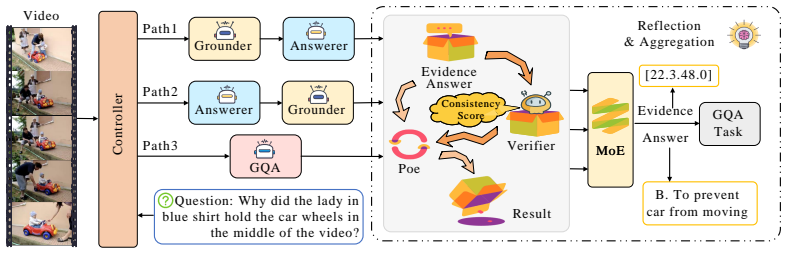
Three reasoning paths supply diversity: Path-1 grounds the question to moments, then answers; Path-2 answers first, then retrieves moments by combining answer and question; Path-3 decodes answer and evidence jointly. The reflection agent carries the argument: a Verifier trained with LoRA judges whether each zoomed-in, boundary-marked span contains the queried event, and the product-of-experts rule $p_{ik}=c_{ik}v_{ik}$ re-ranks spans so a span survives only if the Grounder and Verifier both believe it. Multi-path fusion then converts spans to (start, end) points, clusters them with confidence-weighted $k$-means, and refines cluster centers by weighted least squares, so the final top-$K$ evidence spans are a closed-form compromise across paths.
What would settle it
Train the Verifier on human-annotated ground-truth spans from NExT-GQA or DeVE-QA instead of Grounder-produced pseudo-spans while holding everything else fixed; if MUPA's Acc@GQA and IoP scores do not change, the reflection stage is not the source of the gains, whereas a drop would show the current Verifier mostly imitates the Grounder's biases rather than auditing them.
Extended reading notes
Core claim
On the paper's own terms, the discovery is that answer–evidence consistency, not extra capacity, is the bottleneck for grounded video question answering. The system uses four agents: a Grounder that localizes candidate moments, an Answerer that proposes answers, a GQA agent that does both at once, and a Reflective Agent that scores each answer–evidence pair, suppresses inconsistent pairs with a product-of-experts re-scoring rule, and fuses the rest by confidence-weighted clustering. The paper argues this makes answers driven primarily by video content rather than textual shortcuts. The headline empirical claim is state-of-the-art zero-shot grounded QA accuracy—30.3% on NExT-GQA and 47.4% on DeVE-QA at 7B scale—with grounding metrics improving across the board and answer accuracy staying on par with single-path models.
Load-bearing premise
The load-bearing premise is that the Verifier acts as an independent auditor of the Grounder's evidence, yet it is trained on pseudo-ground-truth spans produced by that same Grounder; if the Verifier has internalized the Grounder's mistakes, the claimed suppression of hallucinated evidence is not independently established.
Editorial extensions
If this is right
- If the central claim holds, a 2B-parameter grounded-QA model can beat larger systems by spending compute on multiple reasoning paths and verification rather than on raw scale.
- The same frozen backbone with swappable LoRA adapters covers moment retrieval, video QA, and grounded video QA, so one deployment can serve all three tasks.
- Because the fusion step (product-of-experts re-scoring plus weighted $k$-means) is parameter-free, the reflection stage's only extra trainable component is the Verifier itself.
- Each final answer comes with a confidence-weighted consensus time interval, making errors more inspectable by a human or downstream model.
Reading between the lines
- The Verifier is trained on spans produced by the same Grounder (Appendix C.1), so the reflection agent may be auditing the Grounder's own biases rather than an external notion of correctness; the paper does not isolate how much of the reported gain is independent verification.
- The answer-first path exploits the assumption that answer prediction is more reliable than temporal localization; if a deployment's localization model is stronger than its QA head, the fixed three-path weighting would likely be suboptimal.
- Inference cost scales with the number of paths, and the paper notes there is no planner to prune redundant trajectories; a learned gating module that skips low-value paths is a natural follow-up and can be tested on the same benchmarks.
- A scaling curve across backbone sizes would clarify whether multi-path diversity remains beneficial as single-path models grow stronger.
Signed reviews
Editorial analysis
A structured set of objections, weighed in public.
Referee Report
Summary. The paper proposes MUPA, a multi-path agentic framework for Grounded VideoQA. It combines a Grounder, an Answerer, a joint GQA agent, and a Reflective Agent along three reasoning paths (ground-first, answer-first, joint), then applies a verifier with product-of-experts rescoring for single-path consistency and mixture-of-experts clustering for multi-path fusion. The authors report state-of-the-art Acc@GQA results on NExT-GQA (30.3% for MUPA-7B) and DeVE-QA (47.4% for MUPA-7B), and claim that the 2B model outperforms all 7B-scale competitors. The paper includes ablations of the three paths and the reflection mechanism, qualitative examples, and additional moment-retrieval experiments on TACoS.
Significance. If the NExT-GQA result holds, MUPA provides a useful demonstration that orchestrating multiple lightweight LoRA-tuned agents with a post-hoc verifier and fusion module can improve grounded VideoQA over a single-path VideoMind baseline. The multi-path decomposition and the PoE/MoE pipeline are simple, modular, and the code is released. The ablation on NExT-GQA shows consistent, if modest, gains from multi-path reasoning and from the reflection mechanism. However, the DeVE-QA half of the central SOTA claim, the zero-shot description of those results, and the blanket '2B outperforms all 7B' claim are contradicted by the paper's own tables and training-data appendix; the verifier is trained on the Grounder's own pseudo-labels, so the claimed impartial auditing is not independently established.
major comments (3)
- [§4.1, Table 2, Appendix C.1] The DeVE-QA results are not zero-shot. Table 5 lists DeVE-QA (78K samples) in the supervised fine-tuning data of the GQA agent, and Section 3.2.1 states that the GQA agent is shared by all three reasoning paths. Every path therefore sees DeVE-QA question-answer pairs and ground-truth moments during training. Consequently, the 47.4% Acc@GQA on DeVE-QA is an in-domain fine-tuned number, not a zero-shot result, and the 'Zero-shot' label in Table 2 and the phrase 'zero-shot results on the challenging DEVE-QA benchmark' in Section 4.1 are inaccurate. This also contradicts the Section 4.1 claim that MUPA relies on 'no task-specific fine-tuning.' The NExT-GQA result is not affected, but the DeVE-QA part of the SOTA claim must be reframed as a fine-tuned comparison.
- [Abstract and Table 2] The claim that 'Despite using only 2B parameters, our method outperforms all 7B-scale competitors' is false on DeVE-QA: MUPA-2B achieves 43.9 Acc@GQA while VideoMind-7B achieves 44.2. The 2B claim does hold on NExT-GQA (28.7 vs. 28.2 for VideoMind-7B), but the abstract's blanket statement and Section 4.1's 'outperforming all existing 7B-scale competitors' must be restricted to NExT-GQA or otherwise qualified.
- [§3.3.1 and Appendix C.1] The Verifier is trained on pseudo-labels generated by the pretrained Grounder, and at inference the PoE fusion multiplies the Grounder's confidence by the Verifier score. The paper presents the Reflective Agent as 'an impartial auditor,' but the Verifier's training signal is the Grounder's own output, so the verification may simply imitate the Grounder's biases rather than independently audit its evidence. The claimed suppression of hallucinated evidence is therefore not independently established. The authors should either train the Verifier with human-annotated or otherwise independent spans, or provide an analysis (e.g., per-span error breakdown or calibration against ground-truth moments) showing that the Verifier does not merely confirm the Grounder's mistakes.
minor comments (4)
- [§4.1 and Table 1] The text states that MUPA-2B achieves 29.0% Acc@GQA and a mIoP of 39.7%, but Table 1 reports 28.7 and 39.1; these numbers should be reconciled.
- [Table 3] The column header 'w w/o R1@0.5 mIoU R1@0.5 mIoP' is ambiguous as typeset, and the table does not clearly show a multi-path-with-reflection versus multi-path-without-reflection comparison. Section 4.3's claim that the Reflection Agent improves the full MUPA system would be better supported by an explicit row pair for the multi-path condition.
- [§3.3.2 and Algorithm 2] Equation (3) defines answer consolidation using sum over i and k of p_ik, while Algorithm 2 uses sum over i of p_i; the paper should clarify which path-level or span-level confidence is intended in the final voting.
- [Appendix C.1] The reference to 'HiREST [? ]' is unresolved, and the appendix title 'Discussion on Entropy-based Measurement' does not match the actual content of the appendix.
Circularity Check
Circularity score 6: the reflection Verifier is trained on the Grounder's own pseudo-labeled spans and then multiplied into the Grounder's confidence, making 'verification' partly self-confirming; external benchmarks keep the central SOTA claim partially independent.
-
fitted input called prediction
[Appendix C.1 (Verifier dataset construction) and Section 3.3.1 (PoE Re-scoring, pik = cik * vik)]
"Verifier datasets are constructed by running the pretrained Grounder on each source benchmark and collecting its predicted spans as pseudo-ground-truth. ... After interpreting cik and vik as independent posterior probabilities, we combine them using the PoE, to obtain the fused confidence score, pik = cik vik."
The Verifier's training signal is the Grounder's own predicted spans, and at inference the same Verifier scores the Grounder's spans. The Verifier score vik is multiplied directly into the Grounder's confidence cik to re-rank evidence. A Verifier trained on the Grounder's pseudo-labels will tend to approve the very spans the Grounder favors, so it cannot independently detect systematic hallucinated evidence produced by the Grounder. The claimed 'impartial auditor' and the claim that reflection 'eliminates hallucinated evidence' are therefore partly self-confirming by construction. The final benchmark numbers are still measured against external ground truth, so the circularity affects the reflection mechanism's causal justification rather than the raw reported scores.
full rationale
The main evaluation chain is not circular: MUPA's final Acc@GQA numbers are measured against external NExT-GQA and DeVE-QA ground truth, and the multi-path aggregation is governed by closed-form PoE/MoE operations that are not fitted to the test labels. The one load-bearing circular step is the reflection Verifier: its training labels are the Grounder's own predicted spans (pseudo-ground-truth), and its inference score is multiplied into the Grounder's confidence to re-rank evidence. Hence the 'verification' is partly a self-agreement check rather than an independent audit, and the claimed grounding-fidelity improvement from reflection is not fully established by the internal machinery. I do not count the DeVE-QA 'zero-shot' contradiction as circularity: Section 4.1 calls Table 2 'zero-shot results on the challenging DEVE-QA benchmark,' but Table 5 lists DeVE-QA (78K) inside the GQA supervised fine-tuning set, so MUPA's 47.4% Acc@GQA is an in-domain fine-tuned number and the comparison with VideoMind-7B's zero-shot 44.2 is unfair. That is a contamination/labeling concern for the SOTA and efficiency claims, not a derivation that reduces to its own inputs. No load-bearing self-citation chain is present: VideoMind [20] is an external baseline whose Chain-of-LoRA and Grounder/Verifier designs are reused, but MUPA is also benchmarked against VideoMind on the same external test sets, so the central empirical claim retains independent content.
Assumptions & free parameters
free parameters (5)
- Loss weights lambda_ans and lambda_loc in Eq. (1)
- Number of candidate spans N =
5
- Number of final evidence segments K =
3 (default 5)
- NMS IoU threshold =
0.75
- Verifier positive IoU threshold =
0.5
assumptions (5)
- domain assumption Grounder confidence c_ik and Verifier score v_ik are independent posterior probabilities for the same event.
- standard math Weighted k-means on span endpoints is equivalent to maximizing the likelihood of an isotropic Gaussian mixture under the given weights.
- standard math The weighted average of cluster points in Eq. (5) is the Gauss-Markov minimum-variance unbiased estimate of the true boundary.
- domain assumption Acc@GQA with IoP >= 0.5 is a valid measure of answer grounding and trustworthiness.
- ad hoc to paper Verifier pseudo-labels generated by the pretrained Grounder provide a realistic training signal.
Cite this review
Pith. "Pith review of MUPA: Towards Multi-Path Agentic Reasoning for Grounded Video Question Answering." pith.science (2026). https://pith.science/paper/PHNZ4YTI
@misc{pith2026250618071,
  author       = {Pith},
  title        = {Pith review of: MUPA: Towards Multi-Path Agentic Reasoning for Grounded Video Question Answering},
  year         = {2026},
  howpublished = {\url{https://pith.science/paper/PHNZ4YTI}},
  note         = {Machine review of arXiv:2506.18071}
}
read the original abstract
Grounded Video Question Answering (Grounded VideoQA) requires aligning textual answers with explicit visual evidence. However, modern multimodal models often rely on linguistic priors and spurious correlations, resulting in poorly grounded predictions. In this work, we propose MUPA, a cooperative MUlti-Path Agentic approach that unifies video grounding, question answering, answer reflection and aggregation to tackle Grounded VideoQA. MUPA features three distinct reasoning paths on the interplay of grounding and QA agents in different chronological orders, along with a dedicated reflection agent to judge and aggregate the multi-path results to accomplish consistent QA and grounding. This design markedly improves grounding fidelity without sacrificing answer accuracy. Despite using only 2B parameters, our method outperforms all 7B-scale competitors. When scaled to 7B parameters, MUPA establishes new state-of-the-art results, with Acc@GQA of 30.3% and 47.4% on NExT-GQA and DeVE-QA respectively, demonstrating MUPA' effectiveness towards trustworthy video-language understanding. Our code is available in https://github.com/longmalongma/MUPA.
Figures


Figures from the paper (2 more)


Forward citations
Cited by 2 Pith papers
-
AgenticVAU: Multi-Agent Explore-Verify Reasoning for Video Anomaly Understanding
A training-free multi-agent explore-verify system with four specialized agents and a shared evidence registry outperforms zero-shot and RL-finetuned baselines on video anomaly understanding benchmarks.
-
Empowering Multimodal LLMs with External Tools: A Comprehensive Survey
A survey paper maps how external tools are used to augment multimodal large language models across data, tasks, evaluation, and future directions.
Reference graph
Works this paper leans on
-
[1]
Revealing single frame bias for video-and-language learning,
J. Lei, T. L. Berg, and M. Bansal, “Revealing single frame bias for video-and-language learning,” arXiv preprint arXiv:2206.03428, 2022
arXiv 2022
-
[2]
Qwen2-vl: Enhancing vision-language model’s perception of the world at any resolution,
P. Wang, S. Bai, S. Tan, S. Wang, Z. Fan, J. Bai, K. Chen, X. Liu, J. Wang, W. Ge, et al., “Qwen2-vl: Enhancing vision-language model’s perception of the world at any resolution,” arXiv preprint arXiv:2409.12191, 2024
arXiv 2024
-
[3]
Rethinking Multi-Modal Alignment in Video Question Answering from Feature and Sample Perspectives
S. Xiao, L. Chen, K. Gao, Z. Wang, Y . Yang, Z. Zhang, and J. Xiao, “Rethinking multi-modal alignment in video question answering from feature and sample perspectives,”arXiv preprint arXiv:2204.11544, 2022
work page Pith review arXiv 2022
-
[4]
Can I trust your answer? Visually grounded video question answering,
J. Xiao, A. Yao, Y . Li, and T.-S. Chua, “Can I trust your answer? Visually grounded video question answering,” in Proc. IEEE/CVF Conf. Comput. Vis. Pattern Recognit. (CVPR), 2024, pp. 13204–13214
work page 2024
-
[5]
Tvqa: Localized, compositional video question answering,
Lei, Jie, Yu, Licheng, Bansal, Mohit, et al., “Tvqa: Localized, compositional video question answering,” arXiv preprint arXiv:1809.01696, 2018
arXiv 2018
-
[6]
Zero-shot video question answering via frozen bidirectional language models,
Yang, Antoine, Miech, Antoine, Sivic, Josef,et al., “Zero-shot video question answering via frozen bidirectional language models,” Advances in Neural Information Processing Systems, 2022, pp. 124–141
work page 2022
-
[7]
Demonstrating and reducing shortcuts in vision-language representation learning,
Bleeker, Maurits, Hendriksen, Mariya, Yates, Andrew, et al., “Demonstrating and reducing shortcuts in vision-language representation learning,” arXiv preprint arXiv:2402.17510, 2024
arXiv 2024
-
[8]
Question-Answering Dense Video Events,
Qin, Hangyu, Xiao, Junbin, Yao, Angela, “Question-Answering Dense Video Events,”arXiv preprint arXiv:2409.04388, 2024
arXiv 2024
Show all 66 references
-
[9]
Grounding action descrip- tions in videos,
Regneri, Michaela, Rohrbach, Marcus, Wetzel, Dominikus, et al., “Grounding action descrip- tions in videos,” Transactions of the Association for Computational Linguistics , vol. 1, pp. 25–36, 2013
2013
-
[10]
Qvhighlights: Detecting moments and highlights in videos via natural language queries.(2021),
Lei, J, Berg, TL, Bansal, M, “Qvhighlights: Detecting moments and highlights in videos via natural language queries.(2021),” URL https://arxiv.org/abs/2107.09609, 2021
2021 arXiv
-
[11]
Videoagent: Long-form video understanding with large language model as agent,
Wang, Xiaohan, Zhang, Yuhui, Zohar, Orr,et al., “Videoagent: Long-form video understanding with large language model as agent,” in European Conference on Computer Vision, 2024, pp. 58–76
2024
-
[12]
Morevqa: Exploring modular reason- ing models for video question answering,
Min, Juhong, Buch, Shyamal, Nagrani, Arsha, et al., “Morevqa: Exploring modular reason- ing models for video question answering,” in Proceedings of the IEEE/CVF Conference on Computer Vision and Pattern Recognition, 2024, pp. 13235–13245
2024
-
[13]
Videoagent: A memory-augmented multimodal agent for video understanding,
Fan, Yue, Ma, Xiaojian, Wu, Rujie, et al., “Videoagent: A memory-augmented multimodal agent for video understanding,” in European Conference on Computer Vision, 2024, pp. 75–92. 10
2024
-
[14]
Retrieval-based video language model for efficient long video question answering,
Xu, Jiaqi, Lan, Cuiling, Xie, Wenxuan, et al., “Retrieval-based video language model for efficient long video question answering,” arXiv preprint arXiv:2312.04931, 2023
2023
-
[15]
Hierarchical video-moment retrieval and step-captioning,
Zala, Abhay, Cho, Jaemin, Kottur, Satwik, et al., “Hierarchical video-moment retrieval and step-captioning,” in Proceedings of the IEEE/CVF Conference on Computer Vision and Pattern Recognition, 2023, pp. 23056–23065
2023
-
[16]
Tgif-qa: Toward spatio-temporal reasoning in visual question answering,
Jang, Yunseok, Song, Yale, Yu, Youngjae, Kim, Youngjin, and Kim, Gunhee, “Tgif-qa: Toward spatio-temporal reasoning in visual question answering,” inProceedings of the IEEE Conference on Computer Vision and Pattern Recognition, 2017, pp. 2758–2766
2017
-
[17]
Video Question Answering via Gradually Refined Attention over Appearance and Motion,
Xu, Dejing, Zhao, Zhou, Xiao, Jun, et al., “Video Question Answering via Gradually Refined Attention over Appearance and Motion,” in ACM Multimedia, 2017
2017
-
[18]
Activitynet-qa: A dataset for understanding complex web videos via question answering,
Yu, Zhou, Xu, Dejing, Yu, Jun,et al., “Activitynet-qa: A dataset for understanding complex web videos via question answering,” inProceedings of the AAAI Conference on Artificial Intelligence, vol. 33, no. 01, pp. 9127–9134, 2019
2019
-
[19]
Next-qa: Next phase of question- answering to explaining temporal actions,
Xiao, Junbin, Shang, Xindi, Yao, Angela, and Chua, Tat-Seng, “Next-qa: Next phase of question- answering to explaining temporal actions,” in Proceedings of the IEEE/CVF Conference on Computer Vision and Pattern Recognition, 2021, pp. 9777–9786
2021
-
[20]
VideoMind: A Chain-of-LoRA Agent for Long Video Reasoning,
Liu, Ye, Lin, Kevin Qinghong, Chen, Chang Wen, and Shou, Mike Zheng, “VideoMind: A Chain-of-LoRA Agent for Long Video Reasoning,” in arXiv preprint arXiv:2503.13444, 2025
2025
-
[21]
Videoqa in the era of llms: An empirical study,
Xiao, Junbin, Huang, Nanxin, Qin, Hangyu, et al., “Videoqa in the era of llms: An empirical study,”International Journal of Computer Vision, pp. 1–24, 2025
2025
-
[22]
Grounded-videollm: Sharpening fine-grained temporal grounding in video large language models,
Wang, Haibo, Xu, Zhiyang, Cheng, Yu,et al., “Grounded-videollm: Sharpening fine-grained temporal grounding in video large language models,” arXiv preprint arXiv:2410.03290, 2024
2024 arXiv
-
[23]
Cinepile: A long video question answering dataset and benchmark,
Rawal, Ruchit, Saifullah, Khalid, Farré, Miquel, et al., “Cinepile: A long video question answering dataset and benchmark,” arXiv preprint arXiv:2405.08813, 2024
2024 arXiv
-
[24]
The surprising effectiveness of multimodal large language models for video moment retrieval,
Meinardus, Boris, Batra, Anil, Rohrbach, Anna, and Rohrbach, Marcus, “The surprising effectiveness of multimodal large language models for video moment retrieval,”arXiv preprint arXiv:2406.18113, 2024
2024
-
[25]
Neptune: The Long Orbit to Bench- marking Long Video Understanding,
Nagrani, Arsha, Zhang, Mingda, Mehran, Ramin, et al., “Neptune: The Long Orbit to Bench- marking Long Video Understanding,”arXiv preprint arXiv:2412.09582, 2024
2024 arXiv
-
[26]
Self-consistency improves chain of thought reasoning in language models,
Wang, Xuezhi, Wei, Jason, Schuurmans, Dale, Le, Quoc, Chi, Ed, Narang, Sharan, Chowdh- ery, Aakanksha, and Zhou, Denny, “Self-consistency improves chain of thought reasoning in language models,” arXiv preprint arXiv:2203.11171, 2022
2022 arXiv
-
[27]
Chain-of-thought prompting elicits reasoning in large language models,
Wei, Jason, Wang, Xuezhi, Schuurmans, Dale, et al., “Chain-of-thought prompting elicits reasoning in large language models,” Advances in Neural Information Processing Systems, vol. 35, pp. 24824–24837, 2022
2022
-
[28]
Tree of thoughts: Deliberate problem solving with large language models,
Yao, Shunyu, Yu, Dian, Zhao, Jeffrey,et al., “Tree of thoughts: Deliberate problem solving with large language models,” Advances in Neural Information Processing Systems, vol. 36, pp. 11809–11822, 2023
2023
-
[29]
Enhancing LLM Reasoning with Multi-Path Collaborative Reactive and Reflection agents,
He, Chengbo, Zou, Bochao, Li, Xin, et al., “Enhancing LLM Reasoning with Multi-Path Collaborative Reactive and Reflection agents,”arXiv preprint arXiv:2501.00430, 2024
2024 arXiv
-
[30]
React: Synergizing reasoning and acting in language models,
Yao, Shunyu, Zhao, Jeffrey, Yu, Dian, et al., “React: Synergizing reasoning and acting in language models,” in International Conference on Learning Representations (ICLR), 2023
2023
-
[31]
Reflexion: Language agents with verbal reinforcement learning,
Shinn, Noah, Cassano, Federico, Gopinath, Ashwin, et al., “Reflexion: Language agents with verbal reinforcement learning,” Advances in Neural Information Processing Systems, vol. 36, pp. 8634–8652, 2023
2023
-
[32]
Improving multi-agent debate with sparse communication topology,
Li, Yunxuan, Du, Yibing, Zhang, Jiageng, et al., “Improving multi-agent debate with sparse communication topology,”arXiv preprint arXiv:2406.11776, 2024
2024 arXiv
-
[33]
An empirical study of end-to-end video-language transformers with masked visual modeling,
Fu, Tsu-Jui, Li, Linjie, Gan, Zhe, et al., “An empirical study of end-to-end video-language transformers with masked visual modeling,” in Proceedings of the IEEE/CVF Conference on Computer Vision and Pattern Recognition, 2023, pp. 22898–22909
2023
-
[34]
Lan- guage repository for long video understanding,
Kahatapitiya, Kumara, Ranasinghe, Kanchana, Park, Jongwoo, and Ryoo, Michael S., “Lan- guage repository for long video understanding,” arXiv preprint arXiv:2403.14622, 2024. 11
2024 arXiv
-
[35]
Streaming long video understanding with large language models,
Qian, Rui, Dong, Xiaoyi, Zhang, Pan, et al., “Streaming long video understanding with large language models,” Advances in Neural Information Processing Systems, vol. 37, pp. 119336– 119360, 2024
2024
-
[36]
A simple LLM framework for long-range video question-answering,
Zhang, Ce, Lu, Taixi, Islam, Md Mohaiminul, et al., “A simple LLM framework for long-range video question-answering,” arXiv preprint arXiv:2312.17235, 2023
2023 arXiv
-
[37]
Hawkeye: Training video-text LLMs for grounding text in videos,
Wang, Yueqian, Meng, Xiaojun, Liang, Jianxin,et al., “Hawkeye: Training video-text LLMs for grounding text in videos,” arXiv preprint arXiv:2403.10228, 2024
2024 arXiv
-
[38]
Task preference optimization: Improving multimodal large language models with vision task alignment,
Yan, Ziang, Li, Zhilin, He, Yinan,et al., “Task preference optimization: Improving multimodal large language models with vision task alignment,” arXiv preprint arXiv:2412.19326, 2024
2024 arXiv
-
[39]
TVR: A large-scale dataset for video-subtitle moment retrieval,
Lei, Jie, Yu, Licheng, Berg, Tamara L., and Bansal, Mohit, “TVR: A large-scale dataset for video-subtitle moment retrieval,” in ECCV, 2020, pp. 447–463
2020
-
[40]
UMT: Unified multi-modal transformers for joint video moment retrieval and highlight detection,
Liu, Ye, Li, Siyuan, Wu, Yang,et al., “UMT: Unified multi-modal transformers for joint video moment retrieval and highlight detection,” in Proceedings of the IEEE/CVF Conference on Computer Vision and Pattern Recognition, 2022, pp. 3042–3051
2022
-
[41]
MomentDiff: Generative video moment retrieval from random to real,
Li, Pandeng, Xie, Chen-Wei, Xie, Hongtao, et al., “MomentDiff: Generative video moment retrieval from random to real,” Advances in Neural Information Processing Systems, vol. 36, pp. 65948–65966, 2023
2023
-
[42]
Query-dependent video representation for moment retrieval and highlight detection,
Moon, WonJun, Hyun, Sangeek, Park, SangUk, et al., “Query-dependent video representation for moment retrieval and highlight detection,” in Proceedings of the IEEE/CVF Conference on Computer Vision and Pattern Recognition, 2023, pp. 23023–23033
2023
-
[43]
UnivTG: Towards unified video- language temporal grounding,
Lin, Kevin Qinghong, Zhang, Pengchuan, Chen, Joya, et al., “UnivTG: Towards unified video- language temporal grounding,” in Proceedings of the IEEE/CVF International Conference on Computer Vision, 2023, pp. 2794–2804
2023
-
[44]
R2-Tuning: Efficient Image-to-Video Transfer Learning for Video Temporal Grounding,
Liu, Ye, He, Jixuan, Li, Wanhua,et al., “R2-Tuning: Efficient Image-to-Video Transfer Learning for Video Temporal Grounding,” inECCV, 2024, pp. 421–438
2024
-
[45]
Learning 2D temporal adjacent networks for moment localization with natural language,
Zhang, Songyang, Peng, Houwen, Fu, Jianlong, and Luo, Jiebo, “Learning 2D temporal adjacent networks for moment localization with natural language,” in Proceedings of the AAAI Conference on Artificial Intelligence, vol. 34, no. 07, pp. 12870–12877, 2020
2020
-
[46]
Span-based localizing network for natural language video localization,
Zhang, Hao, Sun, Aixin, Jing, Wei, and Zhou, Joey Tianyi, “Span-based localizing network for natural language video localization,” arXiv preprint arXiv:2004.13931, 2020
2004 arXiv
-
[47]
Dense- captioning events in videos,
Krishna, Ranjay, Hata, Kenji, Ren, Frederic, Fei-Fei, Li, and Niebles, Juan Carlos, “Dense- captioning events in videos,” inProceedings of the IEEE International Conference on Computer Vision, 2017, pp. 706–715
2017
-
[48]
Negative sample matters: A renaissance of metric learning for temporal grounding,
Wang, Zhenzhi, Wang, Limin, Wu, Tao, Li, Tianhao, and Wu, Gangshan, “Negative sample matters: A renaissance of metric learning for temporal grounding,” in Proceedings of the AAAI Conference on Artificial Intelligence, vol. 36, no. 3, pp. 2613–2623, 2022
2022
-
[49]
Towards generalisable video moment retrieval: Visual-dynamic injection to image-text pre-training,
Luo, Dezhao, Huang, Jiabo, Gong, Shaogang, Jin, Hailin, and Liu, Yang, “Towards generalisable video moment retrieval: Visual-dynamic injection to image-text pre-training,” inProceedings of the IEEE/CVF Conference on Computer Vision and Pattern Recognition, 2023, pp. 23045– 23055
2023
-
[50]
VideoChat: Chat-centric video understanding,
Li, KunChang, He, Yinan, Wang, Yi, et al., “VideoChat: Chat-centric video understanding,” arXiv preprint arXiv:2305.06355, 2023
2023 arXiv
-
[51]
Video-LLaMA: An instruction-tuned audio-visual language model for video understanding,
Zhang, Hang, Li, Xin, and Bing, Lidong, “Video-LLaMA: An instruction-tuned audio-visual language model for video understanding,” arXiv preprint arXiv:2306.02858, 2023
2023 arXiv
-
[52]
Video- ChatGPT: Towards detailed video understanding via large vision and language models,
Maaz, Muhammad, Rasheed, Hanoona, Khan, Salman, and Khan, Fahad Shahbaz, “Video- ChatGPT: Towards detailed video understanding via large vision and language models,”arXiv preprint arXiv:2306.05424, 2023
2023 arXiv
-
[53]
V ALLEY: Video assistant with large language model enhanced ability,
Luo, Ruipu, Zhao, Ziwang, Yang, Min, et al., “V ALLEY: Video assistant with large language model enhanced ability,”arXiv preprint arXiv:2306.07207, 2023
2023 arXiv
-
[54]
ChatVTG: Video temporal grounding via chat with video dialogue large language models,
Qu, Mengxue, Chen, Xiaodong, Liu, Wu, Li, Alicia, and Zhao, Yao, “ChatVTG: Video temporal grounding via chat with video dialogue large language models,” inProceedings of the IEEE/CVF Conference on Computer Vision and Pattern Recognition, 2024, pp. 1847–1856. 12
2024
-
[55]
Momentor: Advancing video large language model with fine-grained temporal reasoning,
Qian, Long, Li, Juncheng, Wu, Yu,et al., “Momentor: Advancing video large language model with fine-grained temporal reasoning,” arXiv preprint arXiv:2402.11435, 2024
2024 arXiv
-
[56]
ET Bench: Towards open-ended event-level video-language understanding,
Liu, Ye, Ma, Zongyang, Qi, Zhongang, Wu, Yang, Shan, Ying, and Chen, Chang W, “ET Bench: Towards open-ended event-level video-language understanding,”Advances in Neural Information Processing Systems, vol. 37, pp. 32076–32110, 2024
2024
-
[57]
LITA: Language instructed temporal-localization assistant,
Huang, De-An, Liao, Shijia, Radhakrishnan, Subhashree, et al., “LITA: Language instructed temporal-localization assistant,” in European Conference on Computer Vision, 2024, pp. 202– 218
2024
-
[58]
RexTime: A benchmark suite for reasoning- across-time in videos,
Chen, Jr-Jen, Liao, Yu-Chien, Lin, Hsi-Che,et al., “RexTime: A benchmark suite for reasoning- across-time in videos,” Advances in Neural Information Processing Systems , vol. 37, pp. 28662–28673, 2024
2024
-
[59]
VTimeLLM: Empower LLM to grasp video moments,
Huang, Bin, Wang, Xin, Chen, Hong, Song, Zihan, and Zhu, Wenwu, “VTimeLLM: Empower LLM to grasp video moments,” in Proceedings of the IEEE/CVF Conference on Computer Vision and Pattern Recognition, 2024, pp. 14271–14280
2024
-
[60]
TimeChat: A time-sensitive mul- timodal large language model for long video understanding,
Ren, Shuhuai, Yao, Linli, Li, Shicheng, Sun, Xu, and Hou, Lu, “TimeChat: A time-sensitive mul- timodal large language model for long video understanding,” in Proceedings of the IEEE/CVF Conference on Computer Vision and Pattern Recognition, 2024, pp. 14313–14323
2024
-
[61]
LoRA: Low-rank adaptation of large language models,
Hu, Edward J, Shen, Yelong, Wallis, Phillip, et al., “LoRA: Low-rank adaptation of large language models,” International Conference on Learning Representations (ICLR), vol. 1, no. 2, pp. 3, 2022
2022
-
[62]
Self-chained image-language model for video localization and question answering,
Yu, Shoubin, Cho, Jaemin, Yadav, Prateek, and Bansal, Mohit, “Self-chained image-language model for video localization and question answering,” Advances in Neural Information Process- ing Systems, vol. 36, pp. 76749–76771, 2023
2023
-
[63]
GPT-4o System Card,
Hurst, Aaron, Lerer, Adam, Goucher, Adam P,et al., “GPT-4o System Card,”arXiv preprint arXiv:2410.21276, 2024
2024 arXiv
-
[64]
Cosmo: Contrastive streamlined multimodal model with interleaved pre-training,
Wang, Alex Jinpeng, Li, Linjie, Lin, Kevin Qinghong,et al., “Cosmo: Contrastive streamlined multimodal model with interleaved pre-training,” arXiv preprint arXiv:2401.00849, 2024
2024 arXiv
-
[65]
Reinforcing video reasoning with focused thinking,
Dang, Jisheng, Wu, Jingze, Wang, Teng, et al., “Reinforcing video reasoning with focused thinking,” arXiv preprint arXiv:2505.24718, 2025
2025 arXiv
-
[66]
SynPO: Synergizing descriptiveness and preference optimization for video detailed captioning,
Dang, Jisheng, Zhang, Yizhou, Ye, Hao et al. , “SynPO: Synergizing descriptiveness and preference optimization for video detailed captioning,” arXiv preprint arXiv:2506.00835, 2025. 13 A Discussion on Entropy-based Measurement In this document, we provide more descriptions of ...
2025
Reviewed August 15, 2026 · model on record in the stance chip above.
Discussion (0). Continue with ORCID to comment.