REVIEW 4 major objections 5 minor 24 references
Addressing band-edge-property spatial variations and localized-state carrier trapping and recombination in solar cell numerical modeling
T0 review · 4 major / 5 minor · reviewed 2026-08-14 · deepseek-v4-flash
Pith's one-line read The paper argues that solar-cell modeling should include effective forces from position-dependent band-edge energies and density-of-states variations, plus full localized-state trapping and recombination, and asserts the AMPS code family…
desk verdict A competent but largely self-referential review of the AMPS modeling methodology; useful as a reference, not a research result, and the Boltzmann-statistics caveat deserves a firmer statement. read the letter →
The pith
A machine-rendered reading of the paper's core claim, the machinery that carries it, and where it could break.
The reading
What carries the argument
The load-bearing objects are the generalized drift-diffusion current densities, Eqs. (4)-(5), which add effective-force terms dχ/dx, d ln Nc/dx, d(χ+Eg)/dx, and d ln Nv/dx to the usual field and diffusion terms. Around these, the machinery is a catalog of occupation statistics: SRH recombination traffic (Eq. 8) and occupation probabilities for discrete, banded, Gaussian, and Urbach-tail states, plus donor/acceptor dopant statistics and amphoteric-state treatments following SRH or Sah-Shockley statistics. The numerical engine is steady-state 1-D discretization with Scharfetter-Gummel current differencing and a Newton-Raphson solve whose Jacobian is banded because each node couples only to its neighbors; the Appendix gives analytic integrals for banded states so the Jacobian derivatives can be taken without numerical quadrature.
What would settle it
Take a heavily doped or intensely illuminated device, solve the same system once with Boltzmann expressions (6)-(7) and once with Fermi-Dirac statistics, and compare the resulting J-V curves and recombination profiles; any significant difference shows the Boltzmann assumption is the limiting premise for that regime.
Extended reading notes
Core claim
In the paper's own terms, the central claim is that a complete numerical solar-cell model should solve Poisson's equation and the electron and hole continuity equations with current densities generalized to include effective forces from variations in χ, Eg, Nc, and Nv, and with all gap-state populations and recombination rates expressed through the same state variables ψ, Efn and Efp. The authors show the resulting system: free carriers follow Boltzmann statistics; dopant and defect states are populated through Shockley-Read-Hall traffic rather than full-ionization or linearized-lifetime assumptions; and localized states contribute both recombination and space charge to Poisson's equation. They further assert that the AMPS computer code and its derivatives were the first to implement this comprehensive treatment, and demonstrate the methodology by reviewing the discretized finite-difference equations, Scharfetter-Gummel current expressions, and Newton-Raphson solution used in that code family. The paper's stated goal is to let users compare the comprehensiveness of available programs and to provide the equations needed to include effective forces and gap-state effects in any solar-cell simulator.
Load-bearing premise
The model's accuracy rests on free carriers obeying Boltzmann statistics even at high doping or high injection; when degeneracy matters, the computed carrier densities, currents, and recombination rates would be wrong.
Editorial extensions
If this is right
- If the treatment is correct, simulators that drop the effective-force terms can misestimate carrier currents by amounts comparable to the electrostatic force, especially at heterojunctions and contacts.
- The full-ionization approximation for dopants and linearized recombination lifetimes become checkable special cases, not assumptions the model is forced to make.
- Contacts and interfaces can be represented as layers with their own band-edge properties and defect distributions, so highly nonlinear contact phenomena can be included without altering the boundary-condition scheme.
- The AMPS family can serve as a reference implementation for judging whether other solar-cell simulation programs cover band-edge variations and gap states comprehensively.
- The Sah-Shockley treatment of amphoteric states is identified as the more precise route, with the decoupled SRH approximation adequate when the correlation energy U is much larger than kT.
Reading between the lines
- Beyond this paper, the same state-variable formulation could be used to isolate when effective forces matter: run a heterojunction with the dχ/dx and d ln Nc/dx terms toggled on and off, and the difference in simulated J-V curves quantifies the error of simpler models.
- Because free carriers are assumed Boltzmann, an extension to Fermi-Dirac statistics would be needed before the methodology is applied to degenerate or very high-injection devices; the paper states the assumption but does not quantify its breakdown.
- The analytic band-integral technique in the Appendix looks directly transferable to other drift-diffusion solvers that currently approximate band-tail occupations by numerical quadrature, potentially improving speed and Jacobian accuracy.
- One testable consequence not developed in the paper: since trapped charge enters Poisson's equation, the model should reproduce capacitance or transient photocurrent signatures of trap filling, not just steady-state recombination.
Signed reviews
Editorial analysis
A structured set of objections, weighed in public.
Referee Report
Summary. This paper presents a review and formal description of the numerical methodology used in the AMPS family of solar cell simulation codes. It generalizes the drift-diffusion transport equations to include effective forces arising from spatial variations in band-edge energies and effective densities of states, and it catalogues the treatment of a wide variety of localized gap states: discrete, banded, Gaussian, Urbach-tail, and amphoteric states. The model couples Poisson's equation and the continuity equations through carrier populations, trapping, and Shockley-Read-Hall recombination, and solves the resulting nonlinear system with the Newton-Raphson method using a Scharfetter-Gummel discretization. The paper asserts in the abstract and Section 1 that AMPS was the first code to fully treat band-edge-property variations together with localized-state effects, and that its implementation has been successful.
Significance. If the methodology is sound and the implementation claims are correct, this review would serve as a useful reference for understanding what a comprehensive solar cell simulation code must include, and it would document the scope of the AMPS family for users and developers. The paper usefully organizes many recombination/trapping models under one framework, and the Sah-Shockley treatment in Section 4.4.5.2 provides a concise summary of a less-common formulation. However, the paper does not present new physics, and its central claims about implementation success and historical priority rest entirely on self-citations and on equations that, as printed, contain transcription errors. The lack of any validation example or comparison to experiment or alternative codes means the significance of the claimed 'successful implementation' cannot currently be assessed from this manuscript.
major comments (4)
- [Section 4.1, Eqs. (6)-(7)] The free-carrier populations are fixed to Boltzmann statistics, n = Nc exp[-(Ec-EFn)/kT] and p = Nv exp[-(EFp-Ev)/kT], and these n and p then enter the generalized current expressions in Eqs. (4)-(5) as well as every SRH, banded, Gaussian, tail, and amphoteric recombination or trapping rate. In degenerately doped regions (e.g., TCO contacts, heavily doped emitters, a-Si:H p/n layers), which are precisely the regions where band-edge-property variations can be important, Boltzmann statistics can be significantly in error and the effective-force terms involving d ln Nc/dx no longer have their Boltzmann form. The paper acknowledges the assumption but provides no validity range, no Fermi-Dirac extension, and no numerical check against Fermi-Dirac statistics. This is load-bearing for the claim of 'full treatment' in the abstract and Section 1: the comprehensiveness is not demonstrated in the degenerate regime where the band-edge effects matter most.
- [Section 5, Eqs. (43)-(44) and Appendix] The discretized current expressions labelled as Scharfetter-Gummel forms are not verifiable as printed. Equation (43) appears to multiply two exponential differences by a prefactor without the Bernoulli-function or flux-conservation structure of the standard Scharfetter-Gummel scheme, and the signs in the exponentials are missing or inconsistent (e.g., the second exponential difference has no minus sign on the energy variable). Equation (44) has analogous issues. The Appendix (Eqs. (A1)-(A4)) introduces c1, c2, and σ without clean definitions and presents integral results whose derivation and domain of validity (e.g., the conditions D=0, D>0, D<0) are not explained. Because the paper claims to demonstrate successful implementation via this discretization, these equations must be corrected and made checkable before the central claim can be accepted.
- [Abstract and Section 1] The abstract states 'The successful implementation of the numerical modeling of band-edge-property variations and defect state effects is demonstrated,' and Section 1 claims that 'The full treatment ... was first done in AMPS.' However, the manuscript contains no simulation results, no convergence tests, no comparison to experimental data, and no benchmark against other codes or analytic limits. The demonstration consists only of presenting the equations and asserting that AMPS implements them, with the implementation claims citing the authors' own prior work (refs. [2]-[6]). As it stands, the paper is a methodology review, not a demonstration. Either add a representative validation example (e.g., a simulated a-Si:H cell with band tails and amphoteric states compared to experiment or to an independent solver) or explicitly reframe the contribution as a review of the AMPS formulation without claiming demonstrated success.
- [Section 4.4.5.2] There is an internal inconsistency in the comprehensiveness claim. Section 1 says AMPS provides 'the full treatment' of localized-state effects, but Section 4.4.5.2 states that 'Currently AMPS and its derivatives use the SRH method' for amphoteric states and that the precise Sah-Shockley model 'is intended to be incorporated in later versions.' The paper itself notes in Section 4.4.5.1 that the decoupled SRH approximation 'could result in some degree of error' and cites articles discussing that inaccuracy. The manuscript should explicitly state, in the abstract and conclusions, that the current AMPS implementation treats amphoteric states within the SRH approximation, and should either justify the approximation for the targeted materials or present the Sah-Shockley form as an extension not yet implemented.
minor comments (5)
- [Throughout] Please correct typographical and transcription errors that make the text hard to read: 'respectfully' should be 'respectively' (Section 3), 'radioactive' should be 'radiative' (Section 4.2), and several equations have garbled subscripts and superscripts (e.g., N_DD, N_BD, N_CTi are not consistently typeset).
- [Section 4.4.5.1 and Figure 3] The discussion of the SRH approximation for amphoteric states relies on Figures 1-3, but in the provided manuscript the figures are separated from the text and not explicitly referenced within the relevant sections. Please ensure each figure is called out where it is first discussed and that the captions explain the symbols (e.g., E, E+U, F+, F0, F-).
- [Section 2, Eq. (1)] The sign of the space-charge term in Poisson's equation is written in a compressed way that is easy to misread. It would help to write Poisson's equation explicitly as d/dx(ε dψ/dx) = -q(p - n + Nd+ - Na- + pt - nt) or with an equivalent unambiguous sign convention.
- [Section 4.1] The text says 'we will see that the Boltzmann formulation is not used to determine the populations Nd+, Na-, pt and nt' but this point is not explicitly revisited later. A sentence in Sections 4.2 or 4.3 confirming that the occupation probabilities fA(E) and fD(E) are used (which incorporate Fermi-Dirac-like statistics through the SRH rates) would remove ambiguity.
- [References] The historical priority claim in Section 1 ('first done in AMPS') would be more persuasive if the authors acknowledged or compared with other simulation packages that also include band-edge and gap-state effects (e.g., SCAPS, ASA), even if only to explain differences in scope or chronology.
Circularity Check
Priority and comprehensiveness claims for AMPS rest on self-citations, but the device-physics equations themselves are independently grounded.
-
self citation load bearing
[Section 1 (Introduction), paragraph 3]
"The full treatment of the impact of both band-edge-property variations and localized states was first done in the Analysis of Microelectronic and Photonic Structures (AMPS) computer code [2-4] and this comprehensive treatment is also found in the several AMPS derivatives now in use [5, 6]."
The paper's central claim—that AMPS and its derivatives provide the first and comprehensive numerical treatment of band-edge variations plus localized states, and that this implementation is 'successful'—is supported by references [2]-[4] (McElheny/Arch/Lin/Fonash; Zhu/Fonash; Zhu et al., all with author Fonash) and [6] (Liu et al., co-author Liu). No derivation or external benchmark in this paper independently establishes 'first' or validates 'successful.' The priority and comprehensiveness assertion therefore reduces to the authors' own prior publications.
full rationale
This paper is primarily a review of the AMPS simulation methodology by the code's developers rather than a new derivation. The governing equations—drift-diffusion with effective forces, SRH recombination, dopant/discrete/banded/Gaussian/Urbach-tail/amphoteric state statistics, and Scharfetter-Gummel discretization—are rooted in standard semiconductor physics and are cited to external or textbook sources. The Boltzmann free-carrier assumption (Eqs. 6-7) is explicitly acknowledged and is a correctness/validity concern, not a circularity. The one genuinely load-bearing circular element is the priority claim that AMPS 'first' implemented the full treatment and that its derivatives are 'comprehensive'; this is supported only by self-citations and is not demonstrated with independent benchmarks in this paper. Because that claim is central to the abstract and introduction but the scientific content retains independent grounding, a score of 4 is appropriate rather than a higher score reserved for derivations that reduce entirely to fits or self-citation chains.
Assumptions & free parameters
assumptions (6)
- domain assumption Steady-state, one-dimensional device domain with metal contacts at both boundaries.
- domain assumption Drift-diffusion transport is valid when carrier mean free path is smaller than device dimensions.
- domain assumption Free carriers obey Boltzmann statistics; gap states use more general statistics.
- domain assumption Recombination through localized states is described by Shockley-Read-Hall (SRH) statistics.
- domain assumption Band tails are exponential (Urbach) distributions with fitting parameters NCT0, Ea, NVT0, Ed.
- domain assumption Amphoteric states are represented with two transition levels separated by a positive correlation energy U.
Cite this review
Pith. "Pith review of Addressing band-edge-property spatial variations and localized-state carrier trapping and recombination in solar cell numerical modeling." pith.science (2026). https://pith.science/paper/PHXSN4OY
@misc{pith2026190804994,
  author       = {Pith},
  title        = {Pith review of: Addressing band-edge-property spatial variations and localized-state carrier trapping and recombination in solar cell numerical modeling},
  year         = {2026},
  howpublished = {\url{https://pith.science/paper/PHXSN4OY}},
  note         = {Machine review of arXiv:1908.04994}
}
read the original abstract
Conduction and valence band-edge-property variations with position as well as defects giving rise to localized states in the energy gap can play a significant role in determining solar cell performance. Understanding their effects on a device is necessary in interpreting complex experimental observations and in optimizing the performance of solar cells. In this overview, we include the effective forces arising from electron and hole band-edge-property variations with position in a numerical formulation of solar cell performance. Further we systematically catalogue and review a variety of localized states with different types and distributions, and include in our numerical transport model the carrier trapping, electric field modification, and recombination caused by these localized states. The successful implementation of the numerical modeling of band-edge-property variations and defect state effects is demonstrated using the methodology of the solar cell simulation code Analysis of Microelectronic and Photonic Structures (AMPS) and its derivatives.
Figures

Reference graph
Works this paper leans on
-
[2]
Range of validity of the surface-photovoltage diffusion length measurement: A computer simulation
P . J. McElheny, J. K. Arch, H.-S. Lin, and S. J. Fonash, "Range of validity of the surface-photovoltage diffusion length measurement: A computer simulation", Journal of Applied Physics, vol. 64, pp. 1254-1265, 1988
work page 1988
-
[6]
A new simulation software of solar cells--wxAMPS
Y . Liu, Y . Sun, and A. Rockett, "A new simulation software of solar cells--wxAMPS", Solar Energy Materials and Solar Cells, 2011
work page 2011
-
[1]
S. J. Fonash, Solar Cell Device Physics. Amsterdam: Elsevier, 2010
work page 2010
-
[3]
Computer Simulation for Solar Cell Applications: Understanding and Design
H. Zhu and S. J. Fonash, "Computer Simulation for Solar Cell Applications: Understanding and Design", Proceedings of the Symposium, San Francisco, CA, pp. 395-402, 1998
work page 1998
-
[4]
Applications of AMPS-1D for solar cell simulation
H. Zhu, A. K. Kalkan, J. Hou, and S. J. Fonash, "Applications of AMPS-1D for solar cell simulation", in National center for photovoltaics (NCPV) 15th program review meeting, Denver, Colorado (USA), 1999, pp. 309-314
work page 1999
-
[5]
Microcrystalline n-i-p tunnel junction in a-Si:H/a-Si:H tandem cells
F. A. Rubinelli, J. K. Rath, and R. E. I. Schropp, "Microcrystalline n-i-p tunnel junction in a-Si:H/a-Si:H tandem cells", Journal of Applied Physics, vol. 89, pp. 4010-4018, 2001
work page 2001
-
[7]
P . J. McElheny, P. Chatterjie, and S. J. Fonash, "Collection efficiency of a‐Si:H Schottky barriers: A computer study of the sensitivity to material and device parameters", J. Appl. Phys, vol. 69, pp. 7674-7688, 1991. 17
work page 1991
-
[8]
Statistics of the Recombinations of Holes and Electrons
W. Shockley and W. T. Read, "Statistics of the Recombinations of Holes and Electrons", Physical Review, vol. 87, pp. 835-842, 1952
work page 1952
Show all 24 references
-
[9]
Electron-Hole Recombination in Germanium
R. N. Hall, "Electron-Hole Recombination in Germanium", Physical Review, vol. 87, pp. 387-387, 1952
1952
-
[10]
A Manual for AMPS-1D for Windows 95/NT,
S. Fonash, "A Manual for AMPS-1D for Windows 95/NT," The Pennsylvania State University,1997. Available at http://www.ampsmodeling.org
1997
-
[11]
M. Z. Ruud E.I. Schropp, Amorphous and Microcrystalline Silicon Solar Cells: Modeling, Materials and Device Technology (Electronic Materials: Science & Technology) Springer, 1998
1998
-
[12]
One-Dimensional Electro-Optical Simulations of Thin-Film Solar Cells,
B. E. Pieters, K. Decock, M. Burgelman, R. Stangl, and T. Kirchartz, "One-Dimensional Electro-Optical Simulations of Thin-Film Solar Cells," in Advanced Characterization Techniques for Thin Film Solar Cells, D. Abou-Ras, T. Kirchartz, and U. Rau, Eds., ed: WILEY-VCH, 2011
2011
-
[13]
STATISTICS OF RECOMBINATION VIA DANGLING BONDS IN AMORPHOUS SILICON
V. Halpern, "STATISTICS OF RECOMBINATION VIA DANGLING BONDS IN AMORPHOUS SILICON", Philosophical Magazine B: Physics of Condensed Matter; Electronic, Optical and Magnetic Properties, vol. 54, pp. 473-482, 1986
1986
-
[14]
Can a multivalent defect be mimicked by several Shockley--Read--Hall-like defects?
K. Decock, S. Khelifi, and M. Burgelman, "Can a multivalent defect be mimicked by several Shockley--Read--Hall-like defects?", Journal of Applied Physics, vol. 108, p. 063707, 2010
2010
-
[15]
Photovoltaic performance of a-Si:H homojunction p-i-n solar cells: A computer simulation study
P . Chatterjee, "Photovoltaic performance of a-Si:H homojunction p-i-n solar cells: A computer simulation study", Journal of Applied Physics, vol. 76, pp. 1301-1313, 1994
1994
-
[16]
Simulation of hetero-junction silicon solar cells with AMPS-1D
N. Hernández-Como and A. Morales-Acevedo, "Simulation of hetero-junction silicon solar cells with AMPS-1D", Solar Energy Materials and Solar Cells, vol. 94, pp. 62-67, 2010
2010
-
[17]
Modelling of amorphous silicon single- and multi-junction solar cells,
J. A. Willemen, "Modelling of amorphous silicon single- and multi-junction solar cells," Ph.D. thesis, Delft University of Technology, 1998
1998
-
[18]
Errors introduced in a-Si:H-based solar cell modeling when dangling bonds are approximated by decoupled states
E. Klimovsky, J. K. Rath, R. E. I. Schropp, and F. A. Rubinelli, "Errors introduced in a-Si:H-based solar cell modeling when dangling bonds are approximated by decoupled states", Thin Solid Films, vol. 422, pp. 211-219, 2002
2002
-
[19]
Electron-Hole Recombination Statistics in Semiconductors through Flaws with Many Charge Conditions
C.-T. Sah and W. Shockley, "Electron-Hole Recombination Statistics in Semiconductors through Flaws with Many Charge Conditions", Physical Review, vol. 109, pp. 1103-1115, 1958
1958
-
[20]
Modelling multivalent defects in thin film solar cells
K. Decock, S. Khelifi, and M. Burgelman, "Modelling multivalent defects in thin film solar cells", Thin Solid Films, vol. 519, p. 4, 2011
2011
-
[21]
Electronic behaviors of the gap states in amorphous semiconductors
H. Okamoto and Y . Hamakawa, "Electronic behaviors of the gap states in amorphous semiconductors", Solid State Communications, vol. 24, pp. 23-27, 1977
1977
-
[22]
Numerical Analysis for Semiconductor Devices
M. Kurata, "Numerical Analysis for Semiconductor Devices ", Lexington Books, Lexington, MA, 1982
1982
-
[23]
Large-signal analysis of a silicon Read diode oscillator
D. L. Scharfetter and H. K. Gummel, "Large-signal analysis of a silicon Read diode oscillator", Electron Devices, IEEE Transactions on, vol. 16, pp. 64-77, 1969
1969
-
[24]
Selberherr, Analysis and simulation of semiconductor devices: Springer-Verlag, 1984
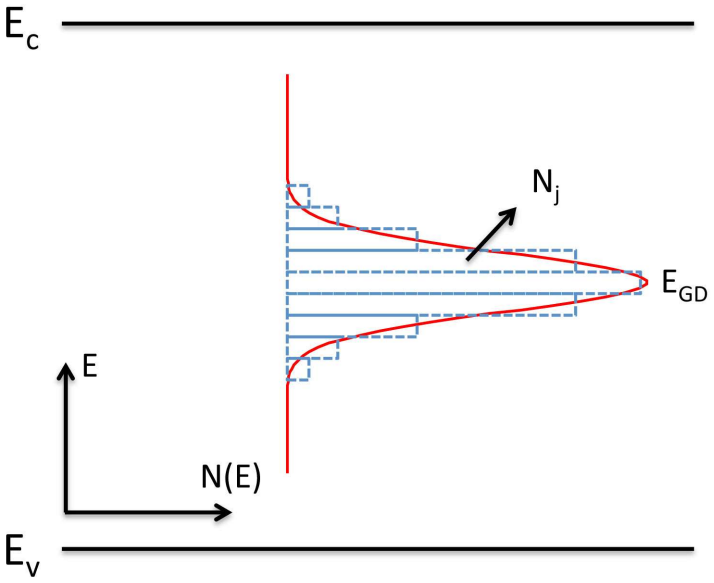
S. Selberherr, Analysis and simulation of semiconductor devices: Springer-Verlag, 1984. 18 Figure 1. A Gaussian density of states versus energy distribution centered at energy EGD. N(E) stands for the density of states per energy. The band Nj is an example of an energy band of...
1984
Reviewed August 14, 2026 · model on record in the stance chip above.
Discussion (0). Continue with ORCID to comment.