Scalar absorption beyond geometric optics in Klein-Gordon-separable Johannsen black hole spacetimes
Pith reviewed 2026-06-29 11:06 UTC · model grok-4.3
The pith
Finite-frequency scalar absorption detects radial deformations in Johannsen black holes that null geodesics miss.
A machine-rendered reading of the paper's core claim, the machinery that carries it, and where it could break.
Core claim
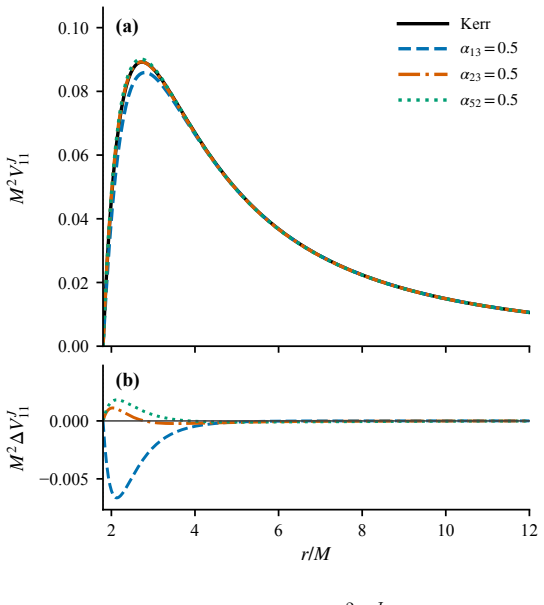
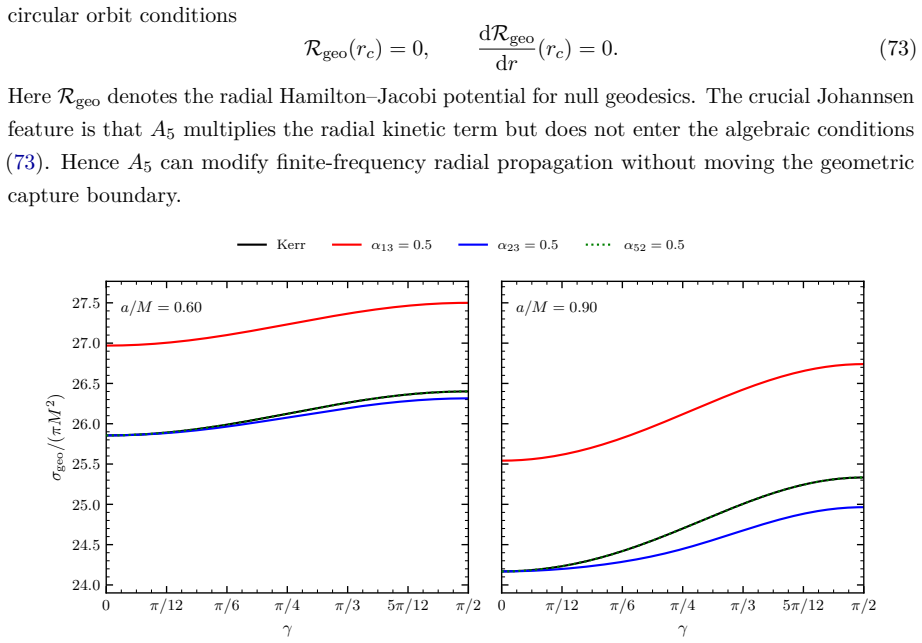
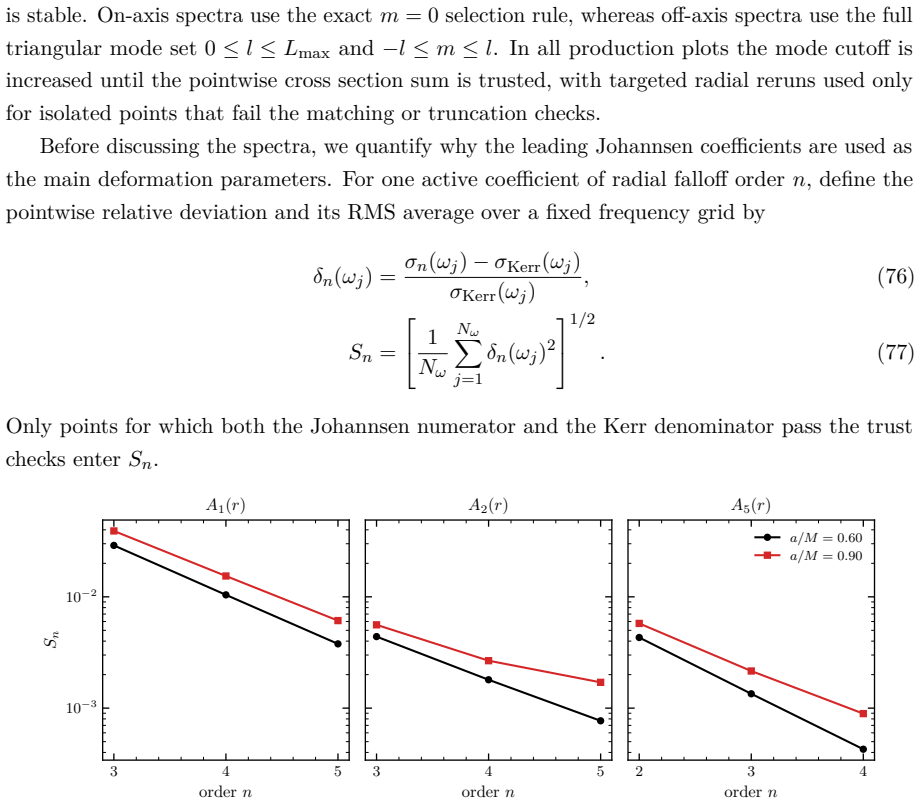
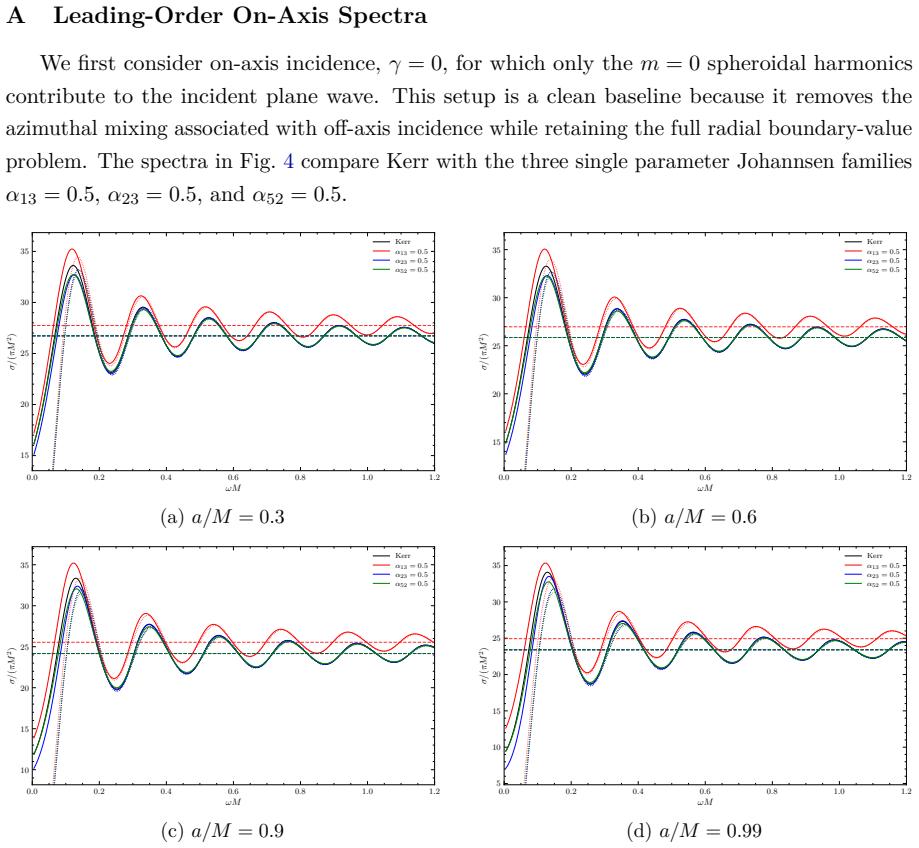
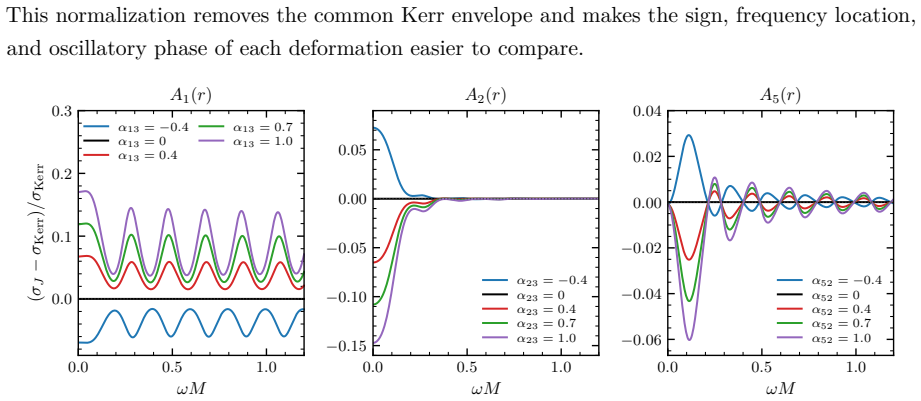
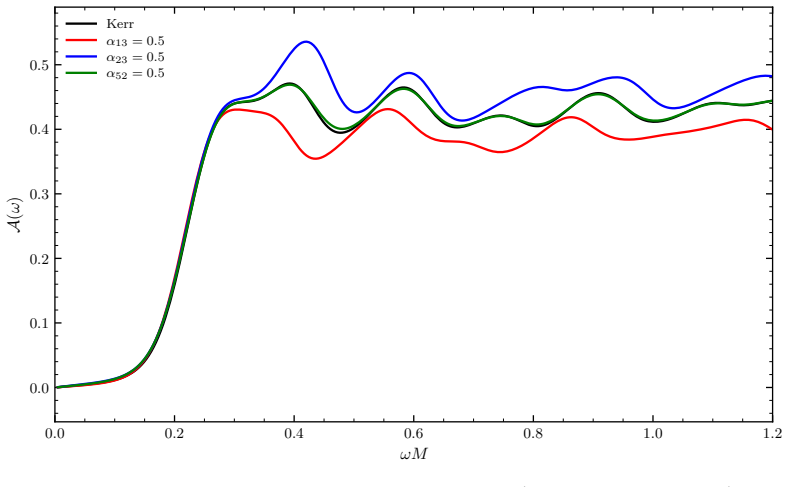
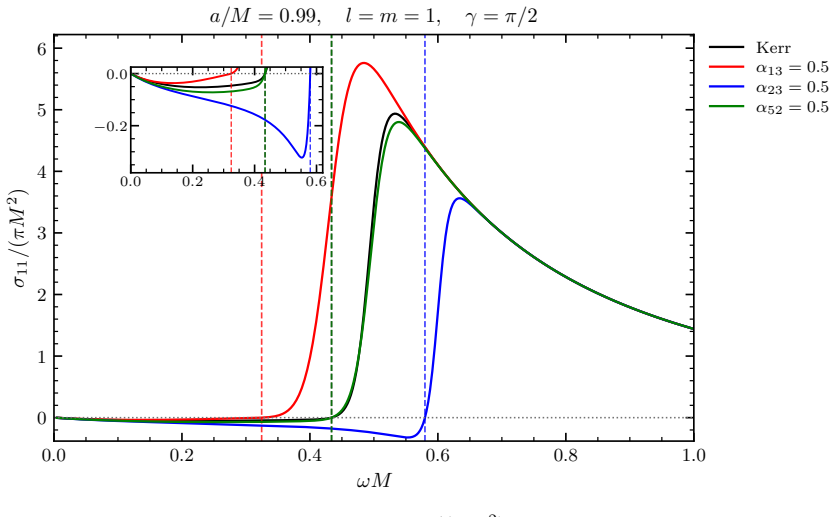
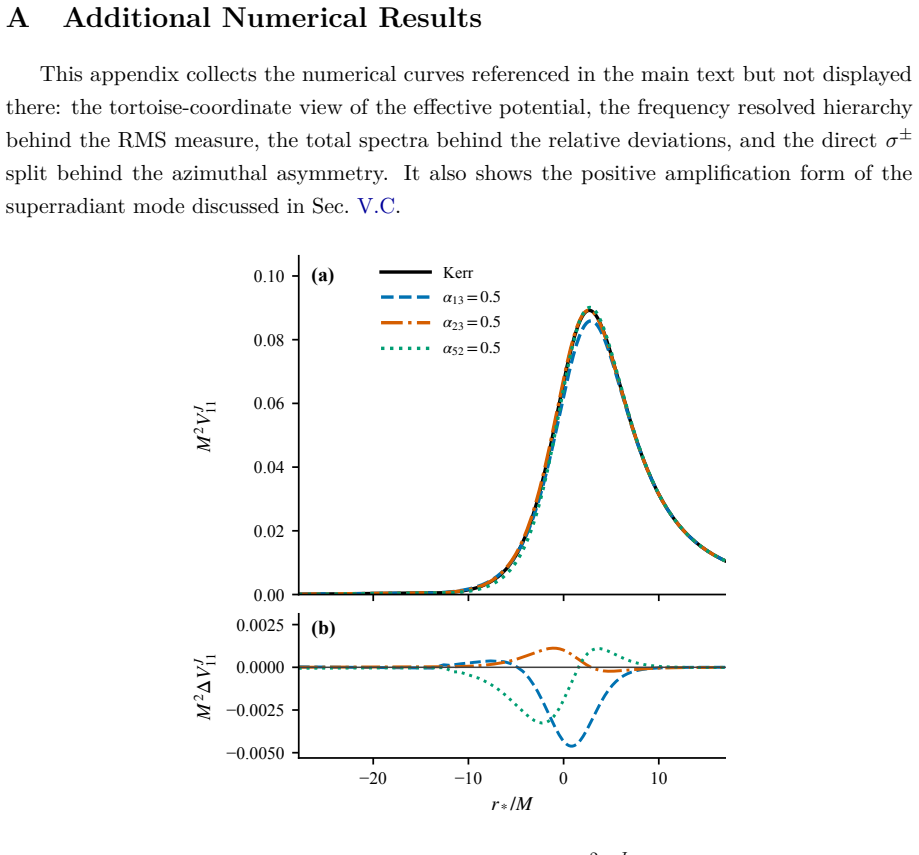
In asymptotically flat Johannsen spacetimes restricted to the A1, A2, and A5 deformation sectors that preserve Klein-Gordon separability, the partial-wave absorption of massless scalars separates deformations that alter the radial size function X(r) from those that enter only the radial kinetic term; the former modify the low-frequency area law, the high-frequency null-capture cross section, and the finite-frequency spectra, whereas a pure A5 deformation leaves the leading null-capture observable unchanged while remaining detectable in wave propagation, including off-axis incidence, co- and counter-rotating contributions, and superradiant modes whose threshold shifts with X(r+).
What carries the argument
The partial-wave framework obtained by matching solutions of the separated radial Klein-Gordon equation in Johannsen metrics to asymptotic plane waves.
If this is right
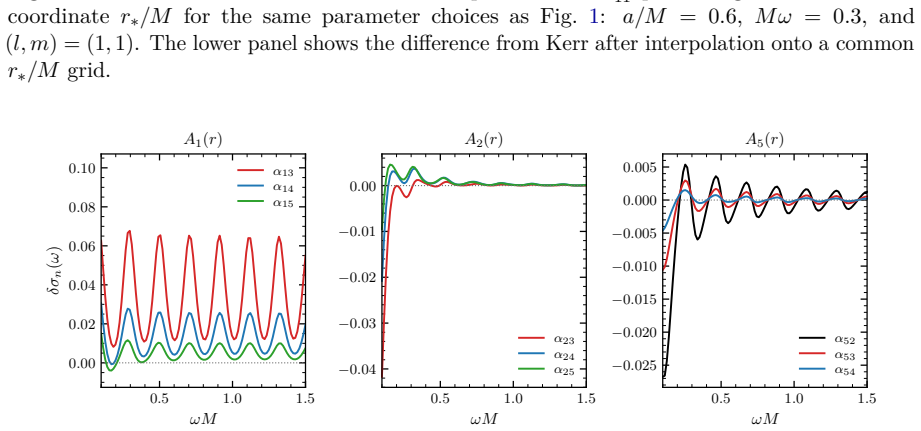
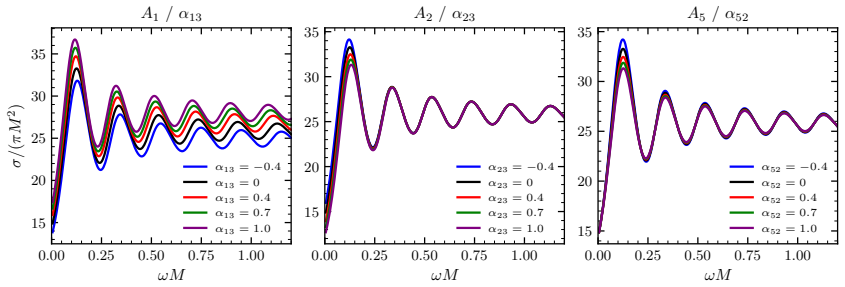
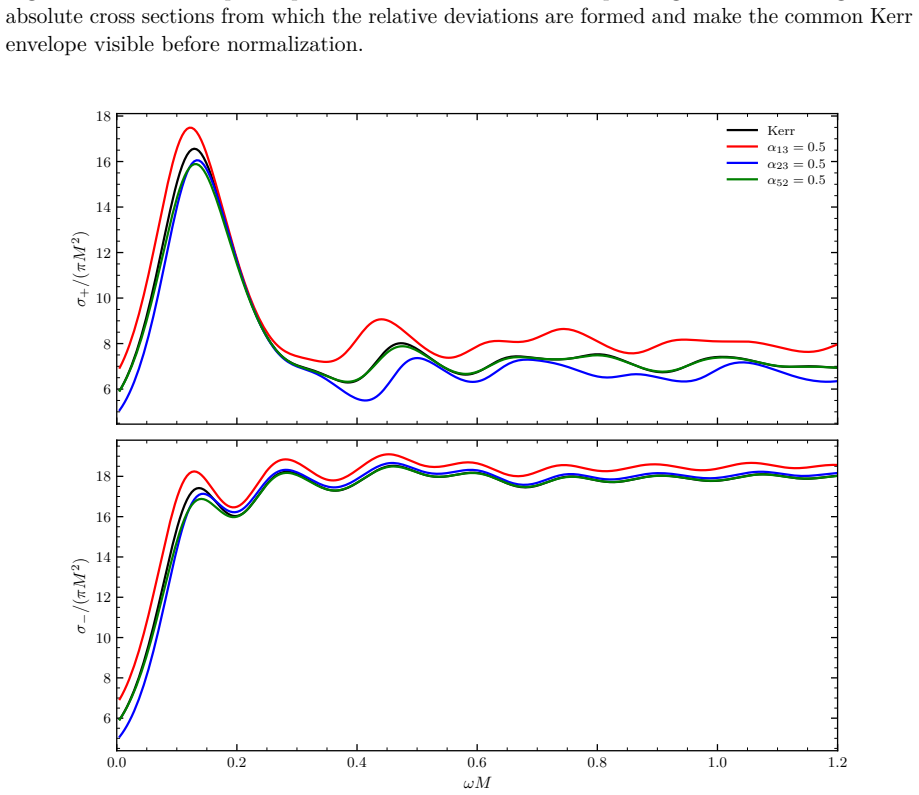
- Deformations changing X(r) alter the low-frequency absorption area law, the high-frequency capture cross section, and the finite-frequency spectra.
- A pure A5 deformation leaves the leading null-capture cross section unchanged but changes finite-frequency absorption.
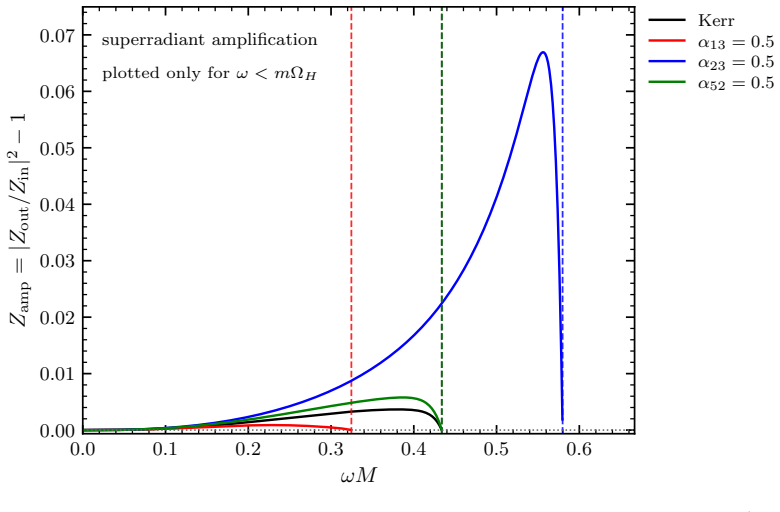
- Shifts in X(r+) move the horizon angular velocity and therefore the superradiant threshold for co-rotating modes.
- Off-axis incidence separates co- and counter-rotating contributions in the absorption spectra.
Where Pith is reading between the lines
- The same separation of radial-size and kinetic-term effects could be checked for electromagnetic or gravitational perturbations if separability extends to those fields.
- Numerical evaluation of the absorption spectra for concrete values of the deformation parameters would quantify how large the finite-frequency signal is relative to Kerr.
- Combining absorption measurements with shadow-size data could tighten bounds on the Johannsen parameters beyond what either observable achieves alone.
Load-bearing premise
The Johannsen metric in the chosen A1, A2, and A5 sectors admits exact Klein-Gordon separability so that radial solutions can be cleanly matched to incoming and outgoing waves at infinity.
What would settle it
An explicit partial-wave calculation for a nonzero A5 parameter that produces a measurable deviation from the Kerr absorption cross section at intermediate frequencies while the high-frequency limit exactly recovers the Kerr null-capture cross section.
Figures
read the original abstract
Johannsen metric is a natural and significant generalization of the Kerr metric, representing the most general stationary, axisymmetric spacetime that preserves the Carter constant of motion. The theoretical status furnishes a powerful, systematic framework for strong-field tests of the no-hair theorem and for investigations of deviations from Kerr black-hole geometries. We formulate massless scalar plane-wave absorption in a Klein-Gordon-separable subclass of Johannsen spacetimes. In the asymptotically flat Johannsen metric, we impose Klein-Gordon separability, derive the separated angular and radial equations, and build a partial wave framework for the leading deformation sectors $A_1(r)$, $A_2(r)$, and $A_5(r)$. The resulting description separates deformations that change the radial size function $X(r)$ from those that enter only the radial kinetic term. The former modify the low-frequency area law, the high-frequency null-capture cross section, and the finite-frequency absorption spectra, whereas a pure $A_5$ deformation leaves the leading null-capture observable unchanged while remaining detectable in wave propagation. We further examine off-axis incidence, co-/counter-rotating contributions, and superradiant modes, where changes in $X(r_+)$ shift the horizon angular velocity and hence the superradiant threshold. Our results identify finite-frequency absorption as a wave-optics diagnostic that can probe radial propagation sectors inaccessible to both the area law and null geodesic capture observables, offering a new tool for strong-field tests of black hole geometry.
Editorial analysis
A structured set of objections, weighed in public.
Referee Report
Summary. The paper formulates massless scalar plane-wave absorption in a Klein-Gordon-separable subclass of Johannsen spacetimes. It imposes separability to derive angular and radial equations for the leading A1(r), A2(r), and A5(r) deformation sectors, isolates deformations that modify the radial size function X(r) from those entering only the radial kinetic term, and computes their differential effects on the low-frequency area law, high-frequency null-capture cross section, finite-frequency absorption spectra, off-axis incidence, co-/counter-rotating modes, and superradiant thresholds via partial-wave matching to asymptotic plane waves.
Significance. If the separation and matching hold, the work supplies a concrete wave-optics diagnostic capable of probing radial propagation sectors inaccessible to both the horizon area law and null-geodesic capture observables. The explicit separation of X(r) deformations from pure kinetic-term deformations supplies a useful organizing principle for strong-field tests of the no-hair theorem.
minor comments (2)
- The abstract states that the Johannsen metric admits Klein-Gordon separability when restricted to A1(r), A2(r), and A5(r), but does not quote the explicit condition on the metric functions that enforces separability; an equation reference would clarify the domain of validity.
- The description of the partial-wave framework mentions matching to asymptotic plane waves but does not indicate whether the radial equation is solved numerically or via continued fractions; a brief statement on the method would aid reproducibility.
Simulated Author's Rebuttal
We thank the referee for the positive assessment of the manuscript, the accurate summary of its scope, and the recommendation for minor revision. No specific major comments were raised in the report.
Circularity Check
No significant circularity
full rationale
The derivation begins by restricting the Johannsen metric to the A1(r), A2(r), A5(r) sectors that admit Klein-Gordon separability, imposes the separation ansatz on the wave equation, obtains the radial ODE, and matches its asymptotic solutions to plane waves to extract absorption cross-sections. The separation of X(r) deformations from pure kinetic-term deformations is a direct algebraic consequence of the separated radial equation itself; the low-frequency area law, high-frequency capture cross-section, and finite-frequency spectra are then computed from that equation without any parameter being fitted to the target observables and then relabeled as a prediction. No load-bearing step reduces to a self-citation chain, an imported uniqueness theorem, or an ansatz smuggled from prior work by the same authors. The entire chain is therefore self-contained within the stated metric subclass and the standard partial-wave matching procedure.
Axiom & Free-Parameter Ledger
axioms (2)
- domain assumption The Johannsen metric admits a Carter constant and the chosen deformation functions allow separation of the massless Klein-Gordon equation.
- standard math Asymptotic flatness and standard boundary conditions at the horizon and infinity hold for the deformed metric.
Reference graph
Works this paper leans on
-
[1]
Roy P. Kerr. Gravitational field of a spinning mass as an example of algebraically special metrics.Physical Review Letters, 11(5):237–238, 1963. doi: 10.1103/PhysRevLett.11.237
-
[2]
Carter,Global structure of the Kerr family of gravitational fields,Phys
Brandon Carter. Global structure of the kerr family of gravitational fields.Physical Review, 174(5):1559–1571, 1968. doi: 10.1103/PhysRev.174.1559
-
[3]
LIGO Scientific Collaboration and Virgo Collaboration, B. P. Abbott, et al. Tests of general relativity with gw150914.Physical Review Letters, 116(22):221101, 2016. doi: 10.1103/PhysRevLett.116.221101
-
[4]
First m87 event horizon telescope results
Event Horizon Telescope Collaboration, Kazunori Akiyama, et al. First m87 event horizon telescope results. i. the shadow of the supermassive black hole.The Astrophysical Journal Letters, 875(1):L1, 2019. doi: 10.3847/2041-8213/ab0ec7
-
[5]
Leor Barack, Vitor Cardoso, Samaya Nissanke, Thomas P. Sotiriou, et al. Black holes, gravitational waves and fundamental physics: a roadmap.Classical and Quantum Gravity, 36(14):143001, 2019. doi: 10.1088/1361-6382/ab0587
-
[6]
Misner, Kip S
Charles W. Misner, Kip S. Thorne, and John Archibald Wheeler.Gravitation. W. H. Freeman, San Francisco, 1973
1973
-
[7]
Wald.General Relativity
Robert M. Wald.General Relativity. University of Chicago Press, Chicago, 1984
1984
-
[8]
Oxford University Press, Oxford, 1983
Subrahmanyan Chandrasekhar.The Mathematical Theory of Black Holes. Oxford University Press, Oxford, 1983
1983
-
[9]
Carroll.Spacetime and Geometry: An Introduction to General Relativity
Sean M. Carroll.Spacetime and Geometry: An Introduction to General Relativity. Addison Wesley, San Francisco, 2004
2004
-
[10]
Tim Johannsen and Dimitrios Psaltis. Metric for rapidly spinning black holes suitable for strong-field tests of the no-hair theorem.Physical Review D, 83(12):124015, 2011. doi: 10.1103/PhysRevD.83.124015
-
[11]
On generic parametrizations of spinning black-hole geometries.Physical Review D, 89(6):064007, 2014
Vitor Cardoso, Paolo Pani, and João Rico. On generic parametrizations of spinning black-hole geometries.Physical Review D, 89(6):064007, 2014. doi: 10.1103/PhysRevD.89.064007
-
[12]
Regular black hole metric with three constants of motion.Physical Review D, 88(4):044002, 2013
Tim Johannsen. Regular black hole metric with three constants of motion.Physical Review D, 88(4):044002, 2013. doi: 10.1103/PhysRevD.88.044002
-
[13]
Zack Carson and Kent Yagi. Asymptotically flat, parametrized black hole metric preserving kerr symmetries.Physical Review D, 101(8):084030, 2020. doi: 10.1103/PhysRevD.101. 084030
-
[14]
Frolov, Pavel Krtous, and David Kubiznak
Valeri P. Frolov, Pavel Krtous, and David Kubiznak. Black holes, hidden symmetries, and complete integrability.Living Reviews in Relativity, 20(1):6, 2017. doi: 10.1007/ s41114-017-0009-9. 26
2017
-
[15]
R. A. Konoplya, Z. Stuchlík, and A. Zhidenko. Axisymmetric black holes allowing for separation of variables in the klein-gordon and hamilton-jacobi equations.Physical Review D, 97(8):084044, 2018. doi: 10.1103/PhysRevD.97.084044
-
[16]
Che-Yu Chen and Pisin Chen. Separability of the klein-gordon equation for rotating spacetimes obtained from newman-janis algorithm.Physical Review D, 100(10):104054, 2019. doi: 10.1103/PhysRevD.100.104054
-
[17]
Rajibul Shaikh. Black hole shadow in a general rotating spacetime obtained through newman- janis algorithm.Physical Review D, 100(2):024028, 2019. doi: 10.1103/PhysRevD.100.024028
-
[18]
Fen Long, Songbai Chen, Mingzhi Wang, and Jiliang Jing. Shadow of a disformal kerr black hole in quadratic degenerate higher-order scalar-tensor theories.The European Physical Journal C, 80(12):1180, 2020. doi: 10.1140/epjc/s10052-020-08744-8
-
[19]
Volker Perlick and Oleg Yu. Tsupko. Calculating black hole shadows: Review of analytical studies.Physics Reports, 947:1–39, 2022. doi: 10.1016/j.physrep.2021.10.004
-
[20]
Kun Meng, Xi-Long Fan, Song Li, Wen-Biao Han, and Hongsheng Zhang. Dynamics of null particles and shadow for general rotating black hole.Journal of High Energy Physics, 2023 (11):141, 2023. doi: 10.1007/JHEP11(2023)141
-
[21]
W. G. Unruh. Absorption cross section of small black holes.Physical Review D, 14(12): 3251–3259, 1976. doi: 10.1103/PhysRevD.14.3251
-
[22]
Don N. Page. Particle emission rates from a black hole. ii. massless particles from a rotating hole.Physical Review D, 14(12):3260–3273, 1976. doi: 10.1103/PhysRevD.14.3260
-
[23]
Norma Sanchez. Absorption and emission spectra of a schwarzschild black hole.Physical Review D, 18(4):1030–1036, 1978. doi: 10.1103/PhysRevD.18.1030
-
[24]
Saul A. Teukolsky. Perturbations of a rotating black hole. i. fundamental equations for gravitational, electromagnetic, and neutrino-field perturbations.The Astrophysical Journal, 185:635–647, 1973. doi: 10.1086/152444
-
[25]
black hole
A. A. Starobinsky and S. M. Churilov. Amplification of electromagnetic and gravitational waves scattered by a rotating “black hole”.Soviet Physics JETP, 38:1–5, 1974. Zh. Eksp. Teor. Fiz. 65, 3 (1973)
1974
-
[26]
S. A. Teukolsky and W. H. Press. Perturbations of a rotating black hole. iii. interaction of the hole with gravitational and electromagnetic radiation.The Astrophysical Journal, 193: 443–461, 1974. doi: 10.1086/153180
-
[27]
J. A. H. Futterman, F. A. Handler, and R. A. Matzner.Scattering from Black Holes. Cambridge University Press, Cambridge, 1988
1988
-
[28]
Caio F. B. Macedo, Luiz C. S. Leite, Ednilton S. Oliveira, Sam R. Dolan, and Luís C. B. Crispino. Absorption of planar massless scalar waves by kerr black holes.Physical Review D, 88(6):064033, 2013. doi: 10.1103/PhysRevD.88.064033. 27
-
[29]
Sam R. Dolan. Scattering and absorption of gravitational plane waves by rotating black holes. Classical and Quantum Gravity, 25(23):235002, 2008. doi: 10.1088/0264-9381/25/23/235002
-
[30]
Luiz C. S. Leite, Sam R. Dolan, and Luís C. B. Crispino. Absorption of electromagnetic and gravitational waves by kerr black holes.Physics Letters B, 774:130–134, 2017. doi: 10.1016/j.physletb.2017.09.048
-
[31]
Luiz C. S. Leite, Sam R. Dolan, and Luís C. B. Crispino. Scattering of massless bosonic fields by kerr black holes: On-axis incidence.Physical Review D, 100(8):084025, 2019. doi: 10.1103/PhysRevD.100.084025
-
[32]
Das, Gary Gibbons, and Samir D
Sumit R. Das, Gary Gibbons, and Samir D. Mathur. Universality of low energy absorption cross sections for black holes.Physical Review Letters, 78(3):417–419, 1997. doi: 10.1103/ PhysRevLett.78.417
1997
-
[33]
Low-frequency scalar absorption cross sections for stationary black holes
Atsushi Higuchi. Low-frequency scalar absorption cross sections for stationary black holes. Classical and Quantum Gravity, 18(20):L139–L144, 2001. doi: 10.1088/0264-9381/18/20/102
-
[34]
Atsushi Higuchi. Addendum to ‘low-frequency scalar absorption cross sections for stationary black holes’.Classical and Quantum Gravity, 19(3):599–600, 2002. doi: 10.1088/0264-9381/ 19/3/401
-
[35]
Complex angular momentum in black hole physics and quasinormal modes.Physical Review D, 67(12):124017, 2003
Yves Décanini, Antoine Folacci, and Bruce Jensen. Complex angular momentum in black hole physics and quasinormal modes.Physical Review D, 67(12):124017, 2003. doi: 10.1103/ PhysRevD.67.124017
2003
-
[36]
Yves Décanini, Gilles Esposito-Farèse, and Antoine Folacci. Universality of high-energy absorption cross sections for black holes.Physical Review D, 83(4):044032, 2011. doi: 10.1103/PhysRevD.83.044032
-
[37]
Fine structure of high-energy absorption cross sections for black holes.Classical and Quantum Gravity, 28(17):175021,
Yves Décanini, Antoine Folacci, and Bernard Raffaelli. Fine structure of high-energy absorption cross sections for black holes.Classical and Quantum Gravity, 28(17):175021,
-
[38]
doi: 10.1088/0264-9381/28/17/175021
-
[39]
Benone, Luiz C
Carolina L. Benone, Luiz C. S. Leite, Luís C. B. Crispino, and Sam R. Dolan. On-axis scalar absorption cross section of kerr-newman black holes: Geodesic analysis, sinc and low-frequency approximations.International Journal of Modern Physics D, 27(11):1843012,
-
[40]
doi: 10.1142/S0218271818430125
-
[41]
Black hole absorption cross sections: Spin and regge poles.Physical Review D, 111(12):124041, 2025
Mohamed Ould El Hadj. Black hole absorption cross sections: Spin and regge poles.Physical Review D, 111(12):124041, 2025. doi: 10.1103/vj91-h7wd
-
[42]
Luiz C. S. Leite, Carolina L. Benone, and Luís C. B. Crispino. Scalar absorption by charged rotating black holes.Physical Review D, 96(4):044043, 2017. doi: 10.1103/PhysRevD.96. 044043
-
[43]
Caio F. B. Macedo and Luís C. B. Crispino. Absorption of planar massless scalar waves by bardeen regular black holes.Physical Review D, 90(6):064001, 2014. doi: 10.1103/PhysRevD. 90.064001. 28
-
[44]
E. S. de Oliveira. Scalar absorption cross section of rotating black holes with tidal charge. Physical Review D, 104(12):124008, 2021. doi: 10.1103/PhysRevD.104.124008
-
[45]
Yang Li and Yan-Gang Miao. Absorption cross section of regular black holes in scalar-tensor conformal gravity.Physical Review D, 105(4):044031, 2022. doi: 10.1103/PhysRevD.105. 044031
-
[46]
Marco A. A. De Paula, Luiz C. S. Leite, Sam R. Dolan, and Luís C. B. Crispino. Absorption and unbounded superradiance in a static regular black hole spacetime.Physical Review D, 109(6):064053, 2024. doi: 10.1103/PhysRevD.109.064053
-
[47]
Yang Huang and Hongsheng Zhang. Scattering of massless scalar field by charged dila- tonic black holes.The European Physical Journal C, 80:654, 2020. doi: 10.1140/epjc/ s10052-020-8228-8
-
[48]
Absorption and scattering of massless scalar waves by frolov black holes.Physical Review D, 113:084031, 2026
Jining Tang, Yang Huang, and Hongsheng Zhang. Absorption and scattering of massless scalar waves by frolov black holes.Physical Review D, 113:084031, 2026. doi: 10.1103/ 641v-2931
2026
-
[49]
de Felice and G
F. de Felice and G. Preti. On the meaning of the separation constant in the kerr metric. Classical and Quantum Gravity, 16(9):2929–2935, 1999
1999
-
[50]
E. T. Newman, E. Couch, K. Chinnapared, A. Exton, A. Prakash, and R. Torrence. Metric of a rotating, charged mass.Journal of Mathematical Physics, 6(6):918–919, 1965. doi: 10.1063/1.1704351
-
[51]
R. A. Konoplya and A. Zhidenko. Detection of gravitational waves from black holes: Is there a window for alternative theories?Physics Letters B, 756:350–353, 2016. doi: 10.1016/j.physletb.2016.03.044
-
[52]
Ashoke Sen. Rotating charged black hole solution in heterotic string theory.Physical Review Letters, 69(7):1006–1009, 1992. doi: 10.1103/PhysRevLett.69.1006
-
[53]
Sarah Vigeland, Nicolas Yunes, and Leo C. Stein. Bumpy black holes in alternate theories of gravity.Physical Review D, 83(10):104027, 2011. doi: 10.1103/PhysRevD.83.104027
-
[54]
Nicolas Yunes and Leo C. Stein. Non-spinning black holes in alternative theories of gravity. Physical Review D, 83(10):104002, 2011. doi: 10.1103/PhysRevD.83.104002
-
[55]
Dynamical Chern–Simons modified gravity
Nicolas Yunes and Frans Pretorius. Dynamical Chern–Simons modified gravity. i. spinning black holes in the slow-rotation approximation.Physical Review D, 79(8):084043, 2009. doi: 10.1103/PhysRevD.79.084043
-
[56]
A. N. Aliev and A. E. Gümrükçüoğlu. Charged rotating black holes on a 3-Brane.Physical Review D, 71(10):104027, 2005. doi: 10.1103/PhysRevD.71.104027
-
[57]
Will and Jr
Clifford M. Will and Jr. Nordtvedt, Kenneth. Conservation laws and preferred frames in relativistic gravity. i. preferred-frame theories and an extended ppn formalism.The Astrophysical Journal, 177:757–774, 1972. 29
1972
-
[58]
Clifford M. Will. The confrontation between general relativity and experiment.Living Reviews in Relativity, 17:4, 2014. doi: 10.12942/lrr-2014-4
-
[59]
Will.Theory and Experiment in Gravitational Physics
Clifford M. Will.Theory and Experiment in Gravitational Physics. Cambridge University Press, Cambridge, 2 edition, 2018
2018
-
[60]
Stanford University Press, Stanford, 1957
Carson Flammer.Spheroidal Wave Functions. Stanford University Press, Stanford, 1957. 30
1957
discussion (0)
Sign in with ORCID, Apple, or X to comment. Anyone can read and Pith papers without signing in.