REVIEW 2 major objections 5 minor 2 cited by
Tensor renormalization group approach to entanglement entropy
T0 review · 2 major / 5 minor · reviewed 2026-08-05 · deepseek-v4-flash
Pith's one-line read A tensor renormalization group method computes entanglement entropy for single intervals of arbitrary size, giving central charge c=0.49997(8) for the critical Ising model.
desk verdict A genuinely new binary-trimming construction for TRG entanglement entropy with a convincing Ising central-charge test, though the paper never checks positivity of the effective density matrix. read the letter →
The pith
A machine-rendered reading of the paper's core claim, the machinery that carries it, and where it could break.
The reading
What carries the argument
The central object is the trimmed tensor network ρ~A, obtained from the HOTRG coarse-grained representation of the reduced density matrix by eliminating isometry pairs UU† whose contraction is the identity. It carries the argument because it shrinks a D^ℓ × D^ℓ matrix to D^h × D^h with h the Hamming weight of the binary expansion of ℓ, while preserving the von Neumann entropy. The load-bearing identity is Tr(UρU† log(UρU†)) = Tr(ρ log ρ), valid when U†U=I, which licenses the trimming.
What would settle it
Take a small lattice, such as L=16 or 32, where the reduced density matrix can be formed exactly before coarse-graining, run the HOTRG plus trimming procedure, and inspect the final matrix. If any eigenvalue of the trimmed matrix is negative, or if its von Neumann entropy differs from the exact value by more than the truncation error, the method's central claim fails.
Extended reading notes
Core claim
The paper claims that for a one-dimensional quantum system, the reduced density matrix of a single-interval subsystem can be coarse-grained with HOTRG and then reduced to a much smaller 'trimmed' tensor network whose von Neumann entropy equals the original entanglement entropy up to truncation error. The arrangement of the leftover isometries is controlled by the binary expansion of the interval length ℓ, and the final matrix has dimension set by the Hamming weight of ℓ. Testing this on the two-dimensional Ising model at criticality, the method reproduces the CFT scaling formula and yields c=0.49997(8) at D=96, matching c=1/2.
Load-bearing premise
The method treats the approximate reduced density matrix as a genuine quantum state; if its eigenvalues are not all non-negative, the logarithm in the entropy is not defined.
Editorial extensions
If this is right
- Computing entanglement entropy no longer requires the replica trick and the n→1 extrapolation; the entropy is evaluated directly from the approximate reduced density matrix.
- Because TRG is free from sign problems, the method is a candidate for entanglement-entropy computations in theories where Monte Carlo methods struggle.
- For intervals whose length has a small Hamming weight, such as powers of two, the extra cost is modest, keeping large-system simulations feasible.
- The same construction extends to higher-dimensional quantum systems for hyperrectangular subsystems, with (d−1)-dimensional isometries replacing the scalar ones.
- The central charge extracted at criticality gives a direct numerical check of universal CFT predictions in lattice models.
Reading between the lines
- A natural next test is to apply the method to a theory without a known CFT prediction, where the extracted central charge could be cross-checked against other methods; the paper validates only the Ising case.
- Because the trimming relies on the algebraic identity for the von Neumann entropy, the method implicitly assumes the approximate reduced density matrix is positive semidefinite; checking the eigenvalue spectrum after truncation would make the method's range of validity concrete.
- For very long intervals with many 1 bits in their binary expansion, the cost exponent grows with Hamming weight, so choosing subsystem sizes whose binary form is sparse could make larger or higher-dimensional computations practical.
- The binary-box structure suggests similar trimming could produce inexpensive estimators for Rényi entropies or mutual information by replacing the logarithm with other functions of the reduced density matrix.
Signed reviews
Editorial analysis
A structured set of objections, weighed in public.
Referee Report
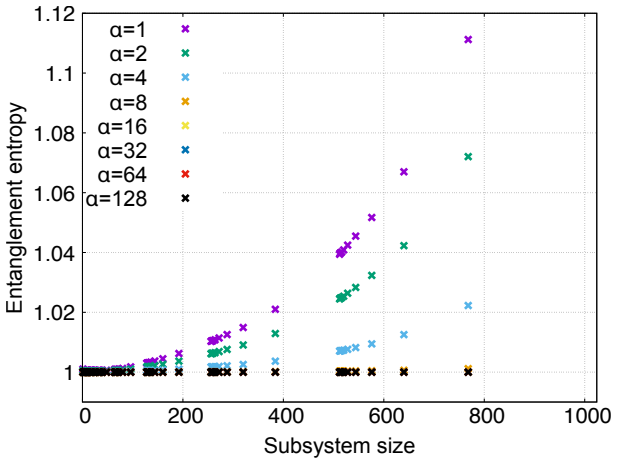
Summary. The paper proposes a tensor renormalization group (TRG) method for computing the entanglement entropy of a single-interval subsystem in a one-dimensional quantum system. The reduced density matrix is represented as a (1+1)-dimensional tensor network, and the authors develop a HOTRG-based coarse-graining procedure in which the isometries that do not affect the entropy are trimmed away, leaving a smaller matrix whose von Neumann entropy approximates the desired entanglement entropy. The method is designed for arbitrary interval size, not just half-space, with the final matrix size controlled by the Hamming weight of the binary representation of the interval length. The method is tested on the two-dimensional classical Ising model at criticality, and the extracted central charge c=0.49997(8) at D=96 agrees with the CFT prediction c=0.5, with consistent results for D=64,80 and for fixed ratios x=ℓ/L.
Significance. If the method is sound, it offers a potentially valuable sign-problem-free route to entanglement entropy without the replica trick, extending previous TRG-based work that was largely limited to half-space partitions. The binary-trimming construction is conceptually elegant and the numerical agreement with c=0.5 across several bond dimensions and subsystem ratios is encouraging. The paper also gives a clear computational-cost estimate in terms of the Hamming weight. However, the central claim depends on the positivity of the object whose von Neumann entropy is evaluated, and this is not established; the numerical validation also relies on fit ranges and error estimates that are not fully standard. These issues need to be addressed before the method can be considered reliably demonstrated.
major comments (2)
- [§2.2 and §3.1] The derivation uses the identity Tr(U ρ̃ U† log(U ρ̃ U†)) = Tr(ρ̃ log ρ̃) to discard isometries, and evaluates S_A as −Tr(ρ̃_A log ρ̃_A). This is valid only when ρ̃_A is Hermitian positive semidefinite. The paper never verifies positivity of the initial "density matrix" (the quotes in §3.1 are telling) or its preservation under HOTRG truncation and the trimming step. For a closed network the classical Ising tensor (3.1) gives positive Boltzmann weights, but the reduced density matrix with open indices, and especially the truncated/trimmed network, need not be PSD. If any negative eigenvalues appear, the von Neumann entropy is not well defined, the trace identity fails, and the numerical agreement with c=0.5 could be accidental. The authors should report the spectrum of ρ̃_A for the parameters used in Table 1, or prove that positivity is preserved by their coarse-graining/trimming. This i
- [§3.2] The error estimate for the central charge is obtained by fixing k1 to its fitted central value and taking the maximal deviation of solutions of Eq. (3.2) for individual ℓ. This ignores the covariance between c and k1 and the uncertainty in the choice of fit ranges (7≤ℓ≤768 and the plateau 16≤xL≤128 are selected from the data). The reported errors such as 0.49997(8) are therefore not a reliable measure of the method's accuracy. A standard fitting procedure with full covariance, or a bootstrap over the fit range, should be reported. This is important because the central validation claim is the agreement with c=0.5.
minor comments (5)
- [§2.1] Typo: "subsysmtem" should be "subsystem".
- [Table 1] Typo: "T able 1" should be "Table 1".
- [Fig. 5] The labels and the binary-path markings in Fig. 5 are hard to read at normal print size; please use larger fonts and clearer arrows.
- [Eq. (3.3)] In the definition of the effective central charge, it would help to state explicitly that L is fixed and that the formula uses S_A(L,ℓ) and S_A(L,ℓ′). The notation is clear from context but should be spelled out.
- [§3.1] The paper calls the object in Fig. 1b a "density matrix" in quotation marks. This is confusing because the numerical test uses the isotropic classical Ising model. The authors should either justify the terminology or use a neutral term such as "tensor network state" and clarify the relation to a genuine quantum density matrix.
Circularity Check
No significant circularity: the EE algorithm follows from tensor-network topology and isometry properties, and the central-charge comparison is an external benchmark.
full rationale
The paper's derivation chain is self-contained and does not reduce to its own inputs. The reduced density matrix is represented as a (d+1)-dimensional tensor network using the standard Suzuki-Trotter / path-integral construction (Sec. 2.1), and the proposed algorithm in Sec. 2.2 coarse-grains this network with HOTRG isometries U defined from M†M eigenvectors. The key trimming step uses the identity Tr(U ρ̃ U† log(U ρ̃ U†)) = Tr(ρ̃ log ρ̃) with U†U = I, which is a mathematical property of isometries, not an input of the target result. The entanglement entropy is then evaluated from the trimmed network ρ̃_A, and the numerical test compares the extracted central charge against the known CFT value c = 0.5 using the theoretical formula (3.2). Fitting c and k1 to the computed EE values and comparing with an external prediction is standard benchmarking, not a fitted-input-called-prediction circularity. The paper does cite work by its own authors ([19] Takeda, [23] Kadoh-Nakayama), but these citations are historical or optional-algorithm remarks, not load-bearing for the central claim. The main caveat—that the trimmed ρ̃_A is not explicitly shown to be positive semidefinite, so the von Neumann logarithm may be ill-defined—is a rigor/correctness concern, not a circularity of the derivation. Therefore no circular step is present.
Assumptions & free parameters
free parameters (4)
- fit range lower bound ℓ_min =
7
- fit range upper bound ℓ_max =
768
- plateau fit range for xL =
16 to 128
- temporal extent ratio α =
16
assumptions (4)
- domain assumption The reduced density matrix of a d-dimensional quantum system admits a (d+1)-dimensional tensor network representation with locally connected homogeneous tensors.
- domain assumption The isotropic classical Ising model tensor network at Tc describes the same entanglement scaling as the (1+1)-dimensional quantum Ising chain, so the CFT formula (3.2) applies.
- standard math HOTRG isometries satisfy U†U=I by construction.
- standard math Tr(ρ log ρ) is invariant under isometric conjugation UρU† when U†U=I and ρ is positive semidefinite.
Cite this review
Pith. "Pith review of Tensor renormalization group approach to entanglement entropy." pith.science (2026). https://pith.science/paper/PI3UHS5R
@misc{pith2026250902185,
  author       = {Pith},
  title        = {Pith review of: Tensor renormalization group approach to entanglement entropy},
  year         = {2026},
  howpublished = {\url{https://pith.science/paper/PI3UHS5R}},
  note         = {Machine review of arXiv:2509.02185}
}
abstract
We propose a method to compute the entanglement entropy (EE) using the tensor renormalization group (TRG) method. The reduced density matrix of a $d$-dimensional quantum system is represented as a $(d+1)$-dimensional tensor network. We develop an explicit algorithm for $d=1$ that enables the calculation of EE for single-interval subsystems of arbitrary size. We test our method in two-dimensional tensor network of the Ising model. The central charge is obtained as $c=0.49997(8)$ for $D=96$, which agrees with the theoretical prediction within an error, demonstrating the accuracy and reliability of our proposed method.
Figures


Figures from the paper (14 more)




Forward citations
Cited by 2 Pith papers
-
Determination of thermodynamics from entanglement entropy in the finite-density O(N) model
The derivative of entanglement entropy with respect to subregion volume equals the thermal entropy density in the large-subregion limit, verified via lattice simulations of the finite-density O(4) model using dual wor...
-
Thermal and chemical response from entanglement entropy
The derivative of entanglement entropy with respect to region size equals the thermal entropy density, and a generalized Maxwell relation connects it to charge density — tested nonperturbatively in the 3D O(4) model.
Reference graph
Works this paper leans on
-
[1]
Entanglement in a simple quantum phase transition
T.J. Osborne and M.A. Nielsen, Entanglement in a simple quantum phase transition , Phys. Rev. A 66 (2002) 032110 [ quant-ph/0202162]
work page Pith review arXiv 2002
-
[2]
G. Vidal, J.I. Latorre, E. Rico and A. Kitaev, Entanglement in quantum critical phenomena , Phys. Rev. Lett. 90 (2003) 227902 [ quant-ph/0211074]
arXiv 2003
-
[3]
M.A. Nielsen and I.L. Chuang, Quantum Computation and Quantum Information: 10th Anniversary Edition, Cambridge University Press (2010)
work page 2010
-
[4]
Hawking, Particle Creation by Black Holes , Commun
S.W. Hawking, Particle Creation by Black Holes , Commun. Math. Phys. 43 (1975) 199
1975
-
[5]
Van Raamsdonk, Building up spacetime with quantum entanglement , Gen
M. Van Raamsdonk, Building up spacetime with quantum entanglement , Gen. Rel. Grav. 42 (2010) 2323 [ 1005.3035]
arXiv 2010
-
[6]
Hawking, Breakdown of predictability in gravitational collapse , Phys
S.W. Hawking, Breakdown of predictability in gravitational collapse , Phys. Rev. D 14 (1976) 2460
work page 1976
-
[7]
J.L. Cardy, O.A. Castro-Alvaredo and B. Doyon, Form factors of branch-point twist fields in quantum integrable models and entanglement entropy , J. Statist. Phys. 130 (2008) 129 [0706.3384]
arXiv 2008
-
[8]
P. Calabrese and J. Cardy, Entanglement entropy and conformal field theory , J. Phys. A 42 (2009) 504005 [ 0905.4013]
arXiv 2009
Show all 30 references
-
[9]
Ryu and T
S. Ryu and T. Takayanagi, Aspects of Holographic Entanglement Entropy , JHEP 08 (2006) 045 [hep-th/0605073]
2006 arXiv
-
[10]
Buividovich and M.I
P.V. Buividovich and M.I. Polikarpov, Numerical study of entanglement entropy in SU(2) lattice gauge theory, Nucl. Phys. B 802 (2008) 458 [ 0802.4247]
2008 arXiv
-
[11]
Nakagawa, A
Y. Nakagawa, A. Nakamura, S. Motoki and V.I. Zakharov, Entanglement entropy of SU(3) Yang-Mills theory, PoS LA T2009(2009) 188 [ 0911.2596]
2009 arXiv
-
[12]
Nakagawa, A
Y. Nakagawa, A. Nakamura, S. Motoki and V.I. Zakharov, Quantum entanglement in SU(3) lattice Yang-Mills theory at zero and finite temperatures , PoS LA TTICE2010(2010) 281 [1104.1011]
2010 arXiv
-
[13]
E. Itou, K. Nagata, Y. Nakagawa, A. Nakamura and V.I. Zakharov, Entanglement in Four-Dimensional SU(3) Gauge Theory , PTEP 2016 (2016) 061B01 [ 1512.01334]
2016 arXiv
-
[14]
Rabenstein, N
A. Rabenstein, N. Bodendorfer, P. Buividovich and A. Sch¨ afer, Lattice study of R´ enyi entanglement entropy in SU (Nc) lattice Yang-Mills theory with Nc = 2, 3, 4, Phys. Rev. D 100 (2019) 034504 [ 1812.04279]
2019 arXiv
-
[15]
Bulgarelli and M
A. Bulgarelli and M. Panero, Entanglement entropy from non-equilibrium Monte Carlo simulations, JHEP 06 (2023) 030 [ 2304.03311]
2023 arXiv
-
[16]
Jokela, K
N. Jokela, K. Rummukainen, A. Salami, A. P¨ onni and T. Rindlisbacher, Progress in the lattice evaluation of entanglement entropy of three-dimensional Yang-Mills theories and holographic bulk reconstruction, JHEP 12 (2023) 137 [ 2304.08949]
2023 arXiv
-
[17]
Levin and C.P
M. Levin and C.P. Nave, Tensor renormalization group approach to 2D classical lattice models , Phys. Rev. Lett. 99 (2007) 120601 [ cond-mat/0611687]
2007 arXiv
-
[18]
Shimizu, Analysis of the (1 + 1)-dimensional lattice ϕ4 model using the tensor renormalization group, Chin
Y. Shimizu, Analysis of the (1 + 1)-dimensional lattice ϕ4 model using the tensor renormalization group, Chin. J. Phys. 50 (2012) 749
2012
-
[19]
Kawauchi and S
H. Kawauchi and S. Takeda, Phase structure analysis of CP(N-1) model using Tensor renormalization group, PoS LA TTICE2016(2016) 322 [ 1611.00921]. 15
2016 arXiv
-
[20]
Hirasawa, A
M. Hirasawa, A. Matsumoto, J. Nishimura and A. Yosprakob, Tensor renormalization group and the volume independence in 2D U(N) and SU(N) gauge theories , jhep 2021 (2021) 011 [2110.05800]
2021 arXiv
-
[21]
Z.Y. Xie, J. Chen, M.P. Qin, J.W. Zhu, L.P. Yang and T. Xiang, Coarse-graining renormalization by higher-order singular value decomposition , Phys. Rev. B 86 (2012) 045139 [1201.1144]
2012 arXiv
-
[22]
Adachi, T
D. Adachi, T. Okubo and S. Todo, Anisotropic Tensor Renormalization Group, Phys. Rev. B 102 (2020) 054432 [ 1906.02007]
2020 arXiv
-
[23]
Kadoh and K
D. Kadoh and K. Nakayama, Renormalization group on a triad network , 1912.02414
1912 arXiv
-
[24]
Nakayama, Randomized higher-order tensor renormalization group , 2307.14191
K. Nakayama, Randomized higher-order tensor renormalization group , 2307.14191
-
[25]
H. Ueda, K. Okunishi and T. Nishino, Doubling of entanglement spectrum in tensor renormalization group, Phys. Rev. B 89 (2014) 075116 [ 1306.6829]
2014 arXiv
-
[26]
L.-P. Yang, Y. Liu, H. Zou, Z.Y. Xie and Y. Meurice, Fine structure of the entanglement entropy in the O(2) model , Phys. Rev. E93 (2016) 012138 [ 1507.01471]
2016 arXiv
-
[27]
Bazavov, Y
A. Bazavov, Y. Meurice, S.W. Tsai, J. Unmuth-Yockey, L.-P. Yang and J. Zhang, Estimating the central charge from the R´ enyi entanglement entropy, Phys. Rev. D 96 (2017) 034514 [1703.10577]
2017 arXiv
-
[28]
Luo and Y
X. Luo and Y. Kuramashi, Entanglement and R´ enyi entropies of (1+1)-dimensional O(3) nonlinear sigma model with tensor renormalization group , JHEP 03 (2024) 020 [ 2308.02798]
2024 arXiv
-
[29]
M. Suzuki, Relationship between d-Dimensional Quantal Spin Systems and (d+1)-Dimensional Ising Systems: Equivalence, Critical Exponents and Systematic Approximants of the Partition Function and Spin Correlations , Progress of Theoretical Physics 56 (1976) 1454
1976
-
[30]
Calabrese and J.L
P. Calabrese and J.L. Cardy, Entanglement entropy and quantum field theory , J. Stat. Mech. 0406 (2004) P06002 [ hep-th/0405152]. 16
2004 arXiv
Reviewed August 5, 2026 · model on record in the stance chip above.
Discussion (0). Continue with ORCID to comment.