Determination of thermodynamics from entanglement entropy in the finite-density O(N) model
Reviewed by Pith T0 review T1 audit T2 compute T3 formal T4 kernel 2026-07-08 10:50 UTCglm-5.2pith:3REY6O2Frecord.jsonopen to challenge →
The pith
Entanglement entropy yields thermal entropy density in large slabs
A machine-rendered reading of the paper's core claim, the machinery that carries it, and where it could break.
Core claim
The central result is Equation (20): in the regime where all correlation lengths are much smaller than the slab width and system size, the quantity (1/V⊥) ∂S_EE/∂ℓ is identically the thermal entropy density s. This is not an approximation or a scaling relation but an exact identity derived from the replica trick. The paper then demonstrates it nonperturbatively by showing that the r=2 Rényi analogue satisfies the corresponding Maxwell relation (Equation 87) on the lattice, with agreement persisting up to ξ_max/ℓ ≈ 0.5–1.0 depending on temperature.
What carries the argument
The derivation hinges on the observation that when a thin slice is moved from deep inside region B to deep inside region A (both regions being much larger than the correlation length), the interface between A and B can be neglected and the bulk free energy densities ω(β, μ) and ω(rβ, μ) apply independently. This reduces the ℓ-derivative of the replicated free energy to a difference of free energy densities, which upon taking the r→1 limit yields the standard thermodynamic expression for entropy. The lattice verification uses a dual-variable representation of the O(N) model that eliminates the sign problem, combined with a boundary-deformation worm algorithm to compute Rényi entropyderivativ.
If this is right
- If the relation holds broadly, entanglement entropy measurements on the lattice could serve as an alternative route to extracting the full equation of state of interacting quantum field theories, including those where direct thermodynamic measurements are difficult.
- The method is most cleanly applicable in confining or gapped phases where correlation lengths are finite; near critical points where correlation lengths diverge, the window of validity shrinks and the relation breaks down, as confirmed by the lattice data near μ_c ≈ 0.5.
- The framework extends to any Rényi order r, where the derivative yields a step-scaling approximation s_r of the entropy density, converging to s as r→1; this means even r=2 Rényi data (which are far more accessible on the lattice than von Neumann entropy) carry genuine thermodynamic information.
- The relation works in reverse: in theories where thermal entropy is easier to compute than entanglement entropy, one can use thermodynamic data to infer entanglement properties.
Where Pith is reading between the lines
- If entanglement entropy derivatives encode the equation of state, then measuring S_EE at multiple temperatures and chemical potentials could in principle reconstruct the full thermodynamic phase diagram from purely information-theoretic observables, though the practicality depends on whether the correlation-length constraint can be satisfied across the full parameter space.
- The breakdown near criticality suggests a natural complementarity: entanglement entropy is most useful as a thermodynamic probe away from phase transitions (where it gives bulk thermodynamics) and most useful as a diagnostic tool near phase transitions (where it detects critical behavior but not the equation of state).
- The dual-variable worm algorithm and boundary-deformation technique developed here could be adapted to other theories admitting dual formulations, potentially including CP(N−1) models or abelian gauge-Higgs systems, extending the reach of entanglement-based thermodynamic extraction beyond O(N) models.
Load-bearing premise
The derivation assumes that when a thin slice is transferred between the two regions, the interface between them can be neglected and the bulk free energy densities apply independently. This requires the correlation length to be simultaneously much smaller than the slab width and the system size, a condition that fails near the critical point where the correlation length diverges.
What would settle it
Compute (1/V⊥) ∂S_EE/∂ℓ and the independently measured thermal entropy density s in the same theory at the same parameters; if they disagree in the regime ξ ≪ ℓ ≪ L, the identity (Equation 20) is falsified. The lattice test via the Maxwell relation (Equation 87) is an indirect version of this check.
Figures




read the original abstract
We nonperturbatively compute R\'enyi entropies for strip-shaped subregions in the three-dimensional O(4) model at finite density on the lattice. By using a dual variable representation and a tailored worm algorithm, we circumvent the sign problem when sampling the grand canonical ensemble. In the limit of large subregions, we also establish a direct, quantitative relationship between the derivative of entanglement entropy with respect to the size of the entangling region and the thermal entropy density for general quantum field theories, providing a new way to study their thermodynamics. We corroborate this argument with our lattice results by demonstrating that, in the appropriate limit, the derivative of entanglement entropy satisfies the same Maxwell relation as the thermal entropy density.
Editorial analysis
A structured set of objections, weighed in public.
Referee Report
Summary. This paper establishes a relation between the derivative of entanglement entropy (and Rényi entropies) with respect to the entangling region width and the thermal entropy density for slab-shaped subregions in general QFTs, in the limit where all linear sizes exceed the longest correlation length. The authors then test this relation nonperturbatively in the (2+1)-dimensional O(4) model at finite density using a dual-variable worm algorithm that avoids the sign problem. The lattice verification proceeds by checking a Maxwell relation (Eq. 87) rather than a direct comparison of the entropy density with the entanglement derivative. The theoretical derivation (Section 3) is clean and parameter-free; the lattice methodology is technically sound with two independent boundary-update algorithms showing consistent results.
Significance. The paper makes a worthwhile contribution on two fronts. First, the theoretical relation (Eq. 20/27) is derived from first principles (replica trick, thermodynamic identities, bulk free energy density assumption) with no fitted parameters, and applies to general QFTs. Second, the lattice implementation is a genuine technical achievement: the dual-variable worm algorithm with boundary deformation in the replicated geometry is non-trivial, the sign problem is circumvented, and the authors provide two independent update schemes (plaquette and boundary worm) with fully consistent results (Fig. 21, Table II). The observation that the phase transition at μc is visible in ∂ℓH₂ (Fig. 13) is a nice physical result. The framework offers a novel route to extracting thermodynamic equations of state from entanglement data, which is of broad interest.
major comments (2)
- §7, Eq. (87) and Fig. 15: The central theoretical claim is (1/V⊥)∂ℓH_r = s_r(T,μ) (Eq. 27), but the lattice test verifies only its μ-derivative: ∂μ[(1/V⊥)∂ℓH₂] = ∂μ[s₂(T,μ)] (Eq. 87). A μ-independent offset C(T) at finite ℓ — for instance from subleading boundary/interface contributions that are O(ξ/ℓ) but not exactly zero — would be invisible to this test. The authors acknowledge this gap explicitly in §8 ('we tested the proposed framework here through the Maxwell relation rather than by directly comparing s with (1/V⊥)∂ℓSEE'), so it is not a hidden flaw. However, the abstract and conclusion could be read as claiming direct verification. I recommend the authors strengthen the presentation by: (a) stating more prominently in the abstract that the Maxwell relation (not the direct equality) is what is verified, and (b) providing a quantitative bound on the plateau value of ∂ℓH₂/V⊥ against
- §3, Eq. (18): The derivation assumes that when a thin slice is moved from deep inside region B to deep inside region A, the interface between A and B can be neglected and the bulk free energy densities ω(β,μ) and ω(rβ,μ) apply independently. This requires ξ ≪ ℓ ≪ L simultaneously. Near the critical point μc ≈ 0.5, ξ_max diverges (Eq. 81), shrinking the validity window. The lattice data in Fig. 15 confirms agreement only up to ξ_max/ℓ ≈ 0.5, and the authors restrict entropy extraction to μ ≤ 0.4. This is handled reasonably, but the manuscript would benefit from a brief quantitative discussion of the expected scaling of finite-ℓ corrections — e.g., whether the residual at ξ/ℓ ≈ 0.5 is consistent with O(ξ/ℓ) or O((ξ/ℓ)²) — to justify the choice of cutoff.
minor comments (6)
- §3, Eq. (18): The notation lim_{ℓ,L→∞, ℓ≪L} is slightly ambiguous about the order of limits. Clarifying whether the limit is ℓ→∞ at fixed L→∞ with ℓ/L→0, or a double limit with the constraint maintained, would improve precision.
- §6: The simulation parameters (κ=1.2, j₃=0.2, Ns=12, Nx=36) are stated, but no continuum extrapolation is attempted. The authors note this is intentional. A brief remark on the expected size of lattice artifacts at these parameters would be welcome.
- Fig. 15: The horizontal axis is ξ_max(μ)/ℓ, but the different temperature curves correspond to different μ ranges. It would help the reader if the μ values corresponding to the plotted ξ_max/ℓ range were indicated, perhaps as a secondary axis.
- §7, Figs. 16–17: The entropy density extracted from ∂ℓH₂ is labeled s₂ (the r=2 step-scaling approximation), but the figure captions and axis labels sometimes refer to 'thermal entropy density s' without the subscript. Consistency in notation would avoid confusion about whether s or s₂ is being shown.
- §4.2, Eq. (65): The partition function in dual variables is lengthy. A compact summary table of the dual variables and their physical meanings (which is currently spread across the text) would improve readability.
- Reference [57] is cited as a companion letter. If it contains overlapping results, a brief statement of what is new in this paper versus [57] would help assess novelty.
Simulated Author's Rebuttal
We thank the referee for a careful and constructive report. Both major comments are well-taken and will be addressed in a revised manuscript. The first concerns the distinction between direct verification of Eq. (27) and verification of its μ-derivative (the Maxwell relation, Eq. (87)); we agree the abstract and conclusion should state this more prominently and will add a quantitative bound on the plateau value. The second concerns finite-ℓ corrections near the critical point and the expected scaling; we will add a quantitative discussion of the residual at ξ/ℓ ≈ 0.5.
read point-by-point responses
-
Referee: §7, Eq. (87) and Fig. 15: The central theoretical claim is (1/V⊥)∂ℓH_r = s_r(T,μ) (Eq. 27), but the lattice test verifies only its μ-derivative. A μ-independent offset C(T) at finite ℓ would be invisible to this test. The authors acknowledge this gap in §8, but the abstract and conclusion could be read as claiming direct verification. Recommendations: (a) state more prominently in the abstract that the Maxwell relation (not the direct equality) is what is verified, and (b) provide a quantitative bound on the plateau value of ∂ℓH₂/V⊥ against s₂.
Authors: We fully agree with this assessment. The referee correctly identifies that our lattice test verifies the Maxwell relation (Eq. 87), i.e., the μ-derivative of Eq. (27), rather than the direct equality (1/V⊥)∂ℓH₂ = s₂(T,μ) itself. A μ-independent offset C(T) from subleading boundary/interface contributions would indeed be invisible to our test. We acknowledge this explicitly in §8 but agree that the abstract and conclusion could be misread as claiming direct verification. We will implement both recommendations: (a) We will revise the abstract to state more prominently that the Maxwell relation—not the direct equality—is what is verified on the lattice. The current abstract already mentions the Maxwell relation in its final sentence, but we will make the distinction sharper and more upfront. (b) We will provide a quantitative bound on the plateau value of ∂ℓH₂/V⊥ against s₂(T,μ). Concretely, from the data in Fig. 11, the plateau in ∂ℓH₂ is reached for ℓ ≥ 5 at the parameter values shown. At ℓ = ℓ* = 17.5, the residual ℓ-dependence is consistent with zero within errors for μ ≤ 0.4 (where ξ_max/ℓ ≲ 0.5). We will extract a numerical bound on |∂ℓH₂/V⊥ − s₂| at fixed T and μ from the plateau region and include it in the revised §7, along with a discussion of the expected O(ξ/ℓ) scaling of any residual offset. We note that a fully direct comparison of ∂ℓH₂/V⊥ with an independently computed s₂ requires a separate lattice determination of the thermal entropy density in the O(4) model, which to our knowledge does not yet exist in the literature. We state this explicitly in §8 and identify it as an important next step. revision: yes
-
Referee: §3, Eq. (18): The derivation assumes ξ ≪ ℓ ≪ L simultaneously. Near μc ≈ 0.5, ξ_max diverges, shrinking the validity window. The lattice data in Fig. 15 confirms agreement only up to ξ_max/ℓ ≈ 0.5. The manuscript would benefit from a brief quantitative discussion of the expected scaling of finite-ℓ corrections — e.g., whether the residual at ξ/ℓ ≈ 0.5 is consistent with O(ξ/ℓ) or O((ξ/ℓ)²) — to justify the choice of cutoff.
Authors: This is a fair point. The derivation of Eq. (18) requires ξ ≪ ℓ ≪ L, and near μc the divergence of ξ_max (Eq. 81) shrinks the validity window. We will add a quantitative discussion of the expected finite-ℓ corrections. The interface contributions that are neglected in going from Eq. (17) to Eq. (18) arise from the boundary between regions A and B. For a slab geometry, these are surface terms scaling as the area of the entangling surface, i.e., O(ξ^d−2) relative to the bulk O(ℓ · ξ^d−2) contribution, giving corrections of order O(ξ/ℓ). The data in Fig. 15 shows agreement up to ξ_max/ℓ ≈ 0.5 at the lowest temperature and up to ξ_max/ℓ ≈ 1.0 at the highest temperature (where thermal effects shorten the effective correlation length below ξ_max). We will extract the residual deviation as a function of ξ_max/ℓ from the data underlying Fig. 15 and discuss whether it is consistent with linear O(ξ/ℓ) scaling or whether the data favor a faster, e.g., O((ξ/ℓ)²), falloff. This analysis will be included in the revised §7 to justify the choice of μ ≤ 0.4 as the cutoff for entropy extraction. We note that the current data, while clearly showing the onset of deviation as ξ_max/ℓ increases, may not have sufficient resolution to cleanly distinguish O(ξ/ℓ) from O((ξ/ℓ)²) across the full range; we will be transparent about this limitation. revision: yes
Circularity Check
No significant circularity; one minor self-citation for the boundary deformation method, but the central derivation is self-contained and the lattice test compares independently computed quantities.
specific steps
-
self citation load bearing
[Section 3, Eq. (17) and surrounding text]
"Next, following the argument from [7], we write the ℓ-derivative in (16) as ∂ ˜Ω(ℓ, β, V, µ, r)/∂ℓ = [˜Ω(ℓ + δℓ, β, V, µ, r) − ˜Ω(ℓ, β, V, µ, r)] / δℓ ."
Reference [7] (Jokela, Rummukainen, Salami, Pönni, Rindlisbacher) shares three authors with the present paper. The cited work introduces the boundary deformation method for computing ℓ-derivatives of free energies. However, this citation is methodological (how to compute the finite difference on the lattice), not load-bearing for the theoretical derivation itself. The central result (Eq. 20) follows from the replica trick (Eq. 3), the thermodynamic identity s = β∂ω/∂β − ω (Eq. 12), and the physical assumption that bulk free energy densities apply when ξ ≪ ℓ ≪ L (Eq. 18). No step in the chain from Eq. (3) to Eq. (20) depends on [7] for its mathematical content. The self-citation provides a computational technique, not a premise.
full rationale
The paper's central claim (Eq. 20) is derived from first principles: the replica trick definition of EE (Eq. 3), the standard thermodynamic identity s = β∂ω/∂β − ω (Eq. 12), and the physical assumption that bulk free energy densities ω(β,µ) and ω(rβ,µ) apply independently in regions A and B when ξ ≪ ℓ ≪ L (Eq. 18). No fitted parameters enter the derivation. The lattice test (Eq. 87, Fig. 15) compares two independently computed quantities: ∂µ∂ℓH₂ from replicated simulations and −2Nt(n(2Nt)−n(Nt)) from unreplicated simulations. These are measured on different ensembles with different algorithms, so the agreement is a genuine cross-check, not a tautology. The skeptic's concern that the Maxwell relation test only verifies the µ-derivative (not the absolute relation) is a valid limitation of the evidence, but it is not circularity: the test does not assume its own conclusion. The authors explicitly acknowledge this gap ('we tested the proposed framework here through the Maxwell relation rather than by directly comparing s with (1/V⊥)∂ℓSEE'). The one self-citation to [7] for the boundary deformation method is minor and methodological, not load-bearing for the theoretical result. Score 2 reflects this minor self-citation with no impact on the central derivation.
Axiom & Free-Parameter Ledger
free parameters (4)
- κ (hopping parameter) =
1.2
- j₃ (source) =
0.2
- λ (nonlinear limit) =
∞
- p_b (boundary update probability) =
0.25
axioms (4)
- standard math Replica trick: tr(ρ_A^r) = Z̃(ℓ,r)/Z^r (Eq. 2)
- domain assumption Bulk free energy densities apply deep inside regions A and B when ξ ≪ ℓ ≪ L (argument leading to Eq. 18)
- standard math The r→1 limit commutes with the ℓ-derivative (Eq. 16, first equality)
- domain assumption Dual variable representation of the O(N) partition function is sign-problem-free (Section 4.2)
Reference graph
Works this paper leans on
-
[1]
SIMULA TION ALGORITHMS FOR ENT ANGLEMENT ENTROPY IN LA TTICE O(N) MODELS To compute the derivative of entanglement entropy (16) on the lattice, both the ℓ and the r derivative must be approximated as finite differences. By approximating ∂r with a discrete forward derivative, followed by set- ting r → 1, one approximates SEE by the second R´ enyi entropy (...
-
[2]
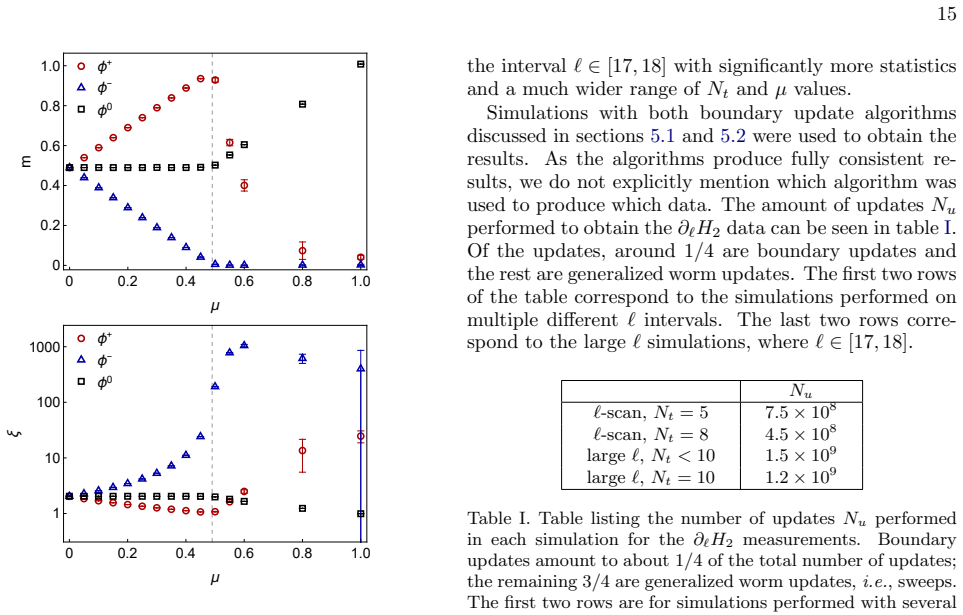
ON SELECTION OF SIMULA TION P ARAMETERS The purpose of the simulations carried out in this work is to verify the relations between entanglement and R´ enyi entropies, and thermodynamic quantities, as discussed in Sec. 3. These relations were derived without referring to a specific type of system and should therefore hold for any sufficiently well behaved ...
-
[3]
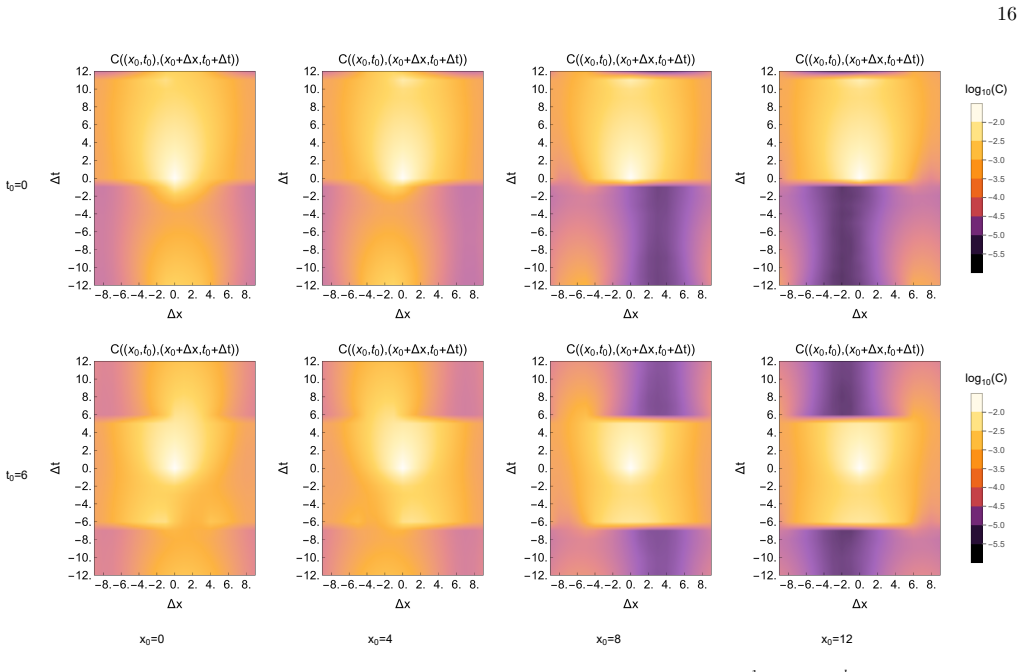
RESUL TS Figure 10 shows the charged two-point correlation function ⟨ϕ−(x0)ϕ+(x)⟩ for the non-linear, (2 + 1)- dimensional lattice O(4) model, simulated in a r = 2- replica system of size Nx × Ny × r · Nt = 18 × 12 × 2 · 12, using the simulation parameter values κ = 1.2, j3 = 0.5, and µ = 0.3, and entangling region width ℓ = 4. Since translation invarianc...
-
[4]
CONCLUSIONS AND OUTLOOK In this work, we showed that, for slab-shaped entan- gling regions, the derivative of the entanglement entropy operator with respect to the entangling region volume approaches the thermal entropy density s in the limit where the linear sizes of the sub-regions are much larger than any correlation length in the system. This relation...
work page 2024
-
[5]
Plaquette The plaquette update chain and its move choice prob- abilities are visualized in figure 19. The first part of the chain consists of plaquette updates that make ∆ kj and ∆χ(i) j mod 2 zero to avoid the formation of defects when the temporal boundary conditions are changed. This is followed by an acceptance test for the actual change of the bounda...
-
[6]
Boundary worm The update chain and movement choice probabili- ties of the boundary worm update are displayed in fig- ure 20. The chain consists of boundary worm updates that remove defects associated to non-zero ∆ kj and ∆χ(i) j mod 2 caused by the change of temporal boundary conditions (cf. notation from section 5.1), and of accep- tance tests for the ∆l...
-
[7]
Entanglement in quantum critical phenomena
G. Vidal, J. I. Latorre, E. Rico, and A. Kitaev, En- tanglement in quantum critical phenomena, Phys. Rev. Lett. 90, 227902 (2003), arXiv:quant-ph/0211074
work page internal anchor Pith review Pith/arXiv arXiv 2003
-
[8]
Entanglement Entropy and Quantum Field Theory
P. Calabrese and J. L. Cardy, Entanglement entropy and quantum field theory, J. Stat. Mech. 0406, P06002 (2004), arXiv:hep-th/0405152
work page internal anchor Pith review Pith/arXiv arXiv 2004
-
[9]
On the RG running of the entanglement entropy of a circle
H. Casini and M. Huerta, On the RG running of the en- tanglement entropy of a circle, Phys. Rev. D 85, 125016 (2012), arXiv:1202.5650 [hep-th]
work page internal anchor Pith review Pith/arXiv arXiv 2012
-
[10]
Entanglement entropy: holography and renormalization group
T. Nishioka, Entanglement entropy: holography and renormalization group, Rev. Mod. Phys. 90, 035007 (2018), arXiv:1801.10352 [hep-th]
work page internal anchor Pith review Pith/arXiv arXiv 2018
-
[11]
Universal crossovers between entanglement entropy and thermal entropy
B. Swingle and T. Senthil, Universal crossovers between entanglement entropy and thermal entropy, Phys. Rev. B 87, 045123 (2013), arXiv:1112.1069 [cond-mat.str-el]
work page internal anchor Pith review Pith/arXiv arXiv 2013
-
[12]
Quantum entanglement in SU(3) lattice Yang-Mills theory at zero and finite temperatures
Y. Nakagawa, A. Nakamura, S. Motoki, and V. I. Za- kharov, Quantum entanglement in SU(3) lattice Yang- Mills theory at zero and finite temperatures, PoS LA T- TICE2010, 281 (2010), arXiv:1104.1011 [hep-lat]
work page internal anchor Pith review Pith/arXiv arXiv 2010
-
[13]
Disentangling the gravity dual of Yang-Mills theory
N. Jokela, K. Rummukainen, A. Salami, A. P¨ onni, and T. Rindlisbacher, Progress in the lattice evaluation of entanglement entropy of three-dimensional Yang-Mills theories and holographic bulk reconstruction, JHEP 12, 137, arXiv:2304.08949 [hep-th]
work page internal anchor Pith review Pith/arXiv arXiv
-
[14]
Typical entanglement entropy with charge conservation
E. Bianchi, P. Don` a, and E. Mui˜ no, Typical en- tanglement entropy with charge conservation (2026), arXiv:2604.26141 [quant-ph]
work page internal anchor Pith review Pith/arXiv arXiv 2026
-
[15]
On R\'enyi entropies of disjoint intervals in conformal field theory
A. Coser, L. Tagliacozzo, and E. Tonni, On R´ enyi en- tropies of disjoint intervals in conformal field theory, J. Stat. Mech. 1401, P01008 (2014), arXiv:1309.2189 [hep-th]
work page internal anchor Pith review Pith/arXiv arXiv 2014
-
[16]
L.-P. Yang, Y. Liu, H. Zou, Z. Y. Xie, and Y. Meurice, Fine structure of the entanglement entropy in the O(2) model, Phys. Rev. E 93, 012138 (2016), arXiv:1507.01471 [cond-mat.stat-mech]
work page internal anchor Pith review Pith/arXiv arXiv 2016
-
[17]
Estimating the central charge from the R\'enyi entanglement entropy
A. Bazavov, Y. Meurice, S. W. Tsai, J. Unmuth-Yockey, L.-P. Yang, and J. Zhang, Estimating the central charge from the R´ enyi entanglement entropy, Phys. Rev. D96, 034514 (2017), arXiv:1703.10577 [hep-lat]
work page internal anchor Pith review Pith/arXiv arXiv 2017
-
[18]
Simulating (2+1)D SU(2) Yang-Mills Lattice Gauge Theory at finite density with tensor networks
G. Cataldi, G. Magnifico, P. Silvi, and S. Montangero, Simulating (2+1)D SU(2) Yang-Mills lattice gauge the- ory at finite density with tensor networks, Phys. Rev. Res. 6, 033057 (2024), arXiv:2307.09396 [hep-lat]
work page internal anchor Pith review Pith/arXiv arXiv 2024
-
[19]
Tensor renormalization group approach to entanglement entropy
T. Hayazaki, D. Kadoh, S. Takeda, and G. Tanaka, Ten- sor renormalization group approach to entanglement en- tropy, JHEP 03, 002, arXiv:2509.02185 [hep-lat]
work page internal anchor Pith review Pith/arXiv arXiv
-
[20]
Z. Wang, Z. Wang, Y.-M. Ding, B.-B. Mao, and Z. Yan, Bipartite reweight-annealing algorithm of quan- tum Monte Carlo to extract large-scale data of entangle- ment entropy and its derivative, Nature Commun. 16, 5880 (2025), arXiv:2406.05324 [cond-mat.str-el]
work page internal anchor Pith review Pith/arXiv arXiv 2025
- [21]
-
[22]
Y. Zhu, Z. Wang, M. Cheng, and Z. Yan, Criticality on R´ enyi defects at (2+1)d O(3) quantum critical points, (2026), arXiv:2605.00104 [cond-mat.str-el]
work page internal anchor Pith review Pith/arXiv arXiv 2026
-
[23]
P. V. Buividovich and M. I. Polikarpov, Numerical study of entanglement entropy in SU(2) lattice gauge theory, Nucl. Phys. B 802, 458 (2008), arXiv:0802.4247 [hep-lat]
work page internal anchor Pith review Pith/arXiv arXiv 2008
-
[24]
Entanglement entropy of SU(3) Yang-Mills theory
Y. Nakagawa, A. Nakamura, S. Motoki, and V. I. Za- kharov, Entanglement entropy of SU(3) Yang-Mills the- ory, PoS LA T2009, 188 (2009), arXiv:0911.2596 [hep- lat]
work page internal anchor Pith review Pith/arXiv arXiv 2009
-
[25]
E. Itou, K. Nagata, Y. Nakagawa, A. Nakamura, and V. I. Zakharov, Entanglement in Four-Dimensional SU(3) Gauge Theory, PTEP 2016, 061B01 (2016), arXiv:1512.01334 [hep-th]
work page internal anchor Pith review Pith/arXiv arXiv 2016
-
[26]
Out-of-equilibrium protocol for R\'enyi entropies via the Jarzynski equality
V. Alba, Out-of-equilibrium protocol for R´ enyi en- 25 tropies via the Jarzynski equality, Phys. Rev. E 95, 062132 (2017), arXiv:1609.02157 [cond-mat.str-el]
work page internal anchor Pith review Pith/arXiv arXiv 2017
-
[27]
A. Rabenstein, N. Bodendorfer, P. Buividovich, and A. Sch¨ afer, Lattice study of R´ enyi entanglement entropy in SU (Nc) lattice Yang-Mills theory with Nc = 2, 3, 4, Phys. Rev. D 100, 034504 (2019), arXiv:1812.04279 [hep-lat]
work page internal anchor Pith review Pith/arXiv arXiv 2019
-
[28]
Entanglement entropy from non-equilibrium Monte Carlo simulations
A. Bulgarelli and M. Panero, Entanglement entropy from non-equilibrium Monte Carlo simulations, JHEP 06, 030, arXiv:2304.03311 [quant-ph]
work page internal anchor Pith review Pith/arXiv arXiv
-
[29]
Entanglement entropy of a color flux tube in (2+1)D Yang-Mills theory
R. Amorosso, S. Syritsyn, and R. Venugopalan, Entan- glement entropy of a color flux tube in (2+1)D Yang- Mills theory, JHEP 12, 177, arXiv:2410.00112 [hep-lat]
work page internal anchor Pith review Pith/arXiv arXiv
-
[30]
Entanglement entropy of a color flux tube in (1+1)D Yang-Mills theory
R. Amorosso, S. Syritsyn, and R. Venugopalan, En- tanglement entropy of a color flux tube in (1+1)D Yang–Mills theory, Phys. Lett. B 868, 139806 (2025), arXiv:2411.12818 [hep-lat]
work page internal anchor Pith review Pith/arXiv arXiv 2025
-
[31]
Duality transformations and the entanglement entropy of gauge theories
A. Bulgarelli and M. Panero, Duality transformations and the entanglement entropy of gauge theories, JHEP 06, 041, arXiv:2404.01987 [quant-ph]
work page internal anchor Pith review Pith/arXiv arXiv
-
[32]
Flow-Based Sampling for Entanglement Entropy and the Machine Learning of Defects
A. Bulgarelli, E. Cellini, K. Jansen, S. K¨ uhn, A. Nada, S. Nakajima, K. A. Nicoli, and M. Panero, Flow-Based Sampling for Entanglement Entropy and the Machine Learning of Defects, Phys. Rev. Lett. 134, 151601 (2025), arXiv:2410.14466 [quant-ph]
work page internal anchor Pith review Pith/arXiv arXiv 2025
-
[33]
A. Bulgarelli, E. Cellini, K. Jansen, S. K¨ uhn, A. Nada, S. Nakajima, K. A. Nicoli, and M. Panero, Comput- ing quantum entanglement with machine learning, in 42th International Symposium on Lattice Field Theory (2025) arXiv:2512.11389 [hep-lat]
-
[34]
R. Amorosso, S. Syritsyn, and R. Venugopalan, Entan- glement Enabled Tomography of Flux Tubes in (2+1)D Yang-Mills Theory, (2026), arXiv:2601.17199 [hep-th]
-
[35]
R. Amorosso, S. Syritsyn, and R. Venugopalan, Topo- logical structure of the entanglement radius of Yang- Mills flux tubes, in 42th International Symposium on Lattice Field Theory (2026) arXiv:2603.10255 [hep-lat]
-
[36]
M. M. Wolf, Violation of the entropic area law for Fermions, Phys. Rev. Lett. 96, 010404 (2006), arXiv:quant-ph/0503219
work page internal anchor Pith review Pith/arXiv arXiv 2006
-
[37]
Entanglement Entropy and the Fermi Surface
B. Swingle, Entanglement Entropy and the Fermi Surface, Phys. Rev. Lett. 105, 050502 (2010), arXiv:0908.1724 [cond-mat.str-el]
work page internal anchor Pith review Pith/arXiv arXiv 2010
-
[38]
S. A. Hartnoll and D. Radicevic, Holographic order pa- rameter for charge fractionalization, Phys. Rev. D 86, 066001 (2012), arXiv:1205.5291 [hep-th]
work page internal anchor Pith review Pith/arXiv arXiv 2012
-
[39]
Holographic Charged Renyi Entropies
A. Belin, L.-Y. Hung, A. Maloney, S. Matsuura, R. C. Myers, and T. Sierens, Holographic Charged Renyi En- tropies, JHEP 12, 059, arXiv:1310.4180 [hep-th]
work page internal anchor Pith review Pith/arXiv arXiv
-
[40]
B. S. DiNunno, N. Jokela, J. F. Pedraza, and A. P¨ onni, Quantum information probes of charge fractional- ization in large- N gauge theories, JHEP 05, 149, arXiv:2101.11636 [hep-th]
work page internal anchor Pith review Pith/arXiv arXiv
-
[41]
Universality of Entropy Scaling in 1D Gap-less Models
V. Korepin, Universality of Entropy Scaling in One Di- mensional Gapless Models, Phys. Rev. Lett. 92, 096402 (2004), arXiv:cond-mat/0311056
work page internal anchor Pith review Pith/arXiv arXiv 2004
-
[42]
Boundary effects in the critical scaling of entanglement entropy in 1D systems
N. Laflorencie, E. S. Sørensen, M.-S. Chang, and I. Af- fleck, Boundary effects in the critical scaling of entan- glement entropy in 1D systems, Phys. Rev. Lett. 96, 100603 (2006), arXiv:cond-mat/0512475
work page internal anchor Pith review Pith/arXiv arXiv 2006
-
[43]
Simon, Natural Entanglement in Bose-Einstein Con- densates, Phys
C. Simon, Natural Entanglement in Bose-Einstein Con- densates, Phys. Rev. A 66, 052323 (2002), arXiv:quant- ph/0110114
-
[44]
Entanglement in Many-Body Systems
L. Amico, R. Fazio, A. Osterloh, and V. Vedral, Entan- glement in many-body systems, Rev. Mod. Phys. 80, 517 (2008), arXiv:quant-ph/0703044
work page internal anchor Pith review Pith/arXiv arXiv 2008
-
[45]
Entanglement Entropy and Mutual Information in Bose-Einstein Condensates
W. Ding and K. Yang, Entanglement Entropy and Mu- tual Information in Bose-Einstein Condensates, Phys. Rev. A 80, 012329 (2009), arXiv:0906.0016 [quant-ph]
work page internal anchor Pith review Pith/arXiv arXiv 2009
- [46]
-
[47]
The nonperturbative functional renormalization group and its applications
N. Dupuis, L. Canet, A. Eichhorn, W. Metzner, J. M. Pawlowski, M. Tissier, and N. Wschebor, The nonper- turbative functional renormalization group and its ap- plications, Phys. Rept. 910, 1 (2021), arXiv:2006.04853 [cond-mat.stat-mech]
work page internal anchor Pith review Pith/arXiv arXiv 2021
-
[48]
T. T. DeGrand and C. DeTar, Lattice methods for quantum chromodynamics (World Scientific, Hacken- sack, NJ, 2006)
work page 2006
-
[49]
C. Gattringer and C. B. Lang, Quantum chromodynam- ics on the lattice , Vol. 788 (Springer, Berlin, 2010)
work page 2010
-
[50]
H. J. Rothe, Lattice Gauge Theories : An Introduction (Fourth Edition) , Vol. 43 (World Scientific Publishing Company, 2012)
work page 2012
-
[51]
Smit, Introduction to Quantum Fields on a Lattice , Vol
J. Smit, Introduction to Quantum Fields on a Lattice , Vol. 15 (Cambridge University Press, 2003)
work page 2003
-
[52]
Simulating QCD at finite density
P. de Forcrand, Simulating QCD at finite density, PoS LA T2009, 010 (2009), arXiv:1005.0539 [hep-lat]
work page internal anchor Pith review Pith/arXiv arXiv 2009
-
[53]
Approaches to the sign problem in lattice field theory
C. Gattringer and K. Langfeld, Approaches to the sign problem in lattice field theory, Int. J. Mod. Phys. A 31, 1643007 (2016), arXiv:1603.09517 [hep-lat]
work page internal anchor Pith review Pith/arXiv arXiv 2016
-
[54]
Lattice field theories with a sign problem
G. Aarts and D. Sexty, Lattice field theories with a sign problem (2026) arXiv:2604.24290 [hep-lat]
work page internal anchor Pith review Pith/arXiv arXiv 2026
-
[55]
M. G. Endres, Method for simulating O(N) lattice mod- els at finite density, Phys. Rev. D 75, 065012 (2007), arXiv:hep-lat/0610029
work page internal anchor Pith review Pith/arXiv arXiv 2007
-
[56]
Lattice study of the Silver Blaze phenomenon for a charged scalar phi-4 field
C. Gattringer and T. Kloiber, Lattice study of the Silver Blaze phenomenon for a charged scalar ϕ4 field, Nucl. Phys. B 869, 56 (2013), arXiv:1206.2954 [hep-lat]
work page internal anchor Pith review Pith/arXiv arXiv 2013
-
[57]
C. Gattringer and T. Kloiber, Spectroscopy in finite density lattice field theory: An exploratory study in the relativistic Bose gas, Phys. Lett. B 720, 210 (2013), arXiv:1212.3770 [hep-lat]
work page internal anchor Pith review Pith/arXiv arXiv 2013
-
[58]
Dual lattice representations for O(N) and CP(N-1) models with a chemical potential
F. Bruckmann, C. Gattringer, T. Kloiber, and T. Sule- jmanpasic, Dual lattice representations for O(N) and CP(N−1) models with a chemical potential, Phys. Lett. B 749, 495 (2015), [Erratum: Phys.Lett.B 751, 595–595 (2015)], arXiv:1507.04253 [hep-lat]
work page internal anchor Pith review Pith/arXiv arXiv 2015
-
[59]
Lattice simulation of the SU(2) chiral model at zero and non-zero pion density
T. Rindlisbacher and P. de Forcrand, Lattice simu- lation of the SU(2) chiral model at zero and non- zero pion density, PoS LA TTICE2015, 171 (2016), arXiv:1512.05684 [hep-lat]
work page internal anchor Pith review Pith/arXiv arXiv 2016
-
[60]
Sampling of General Correlators in Worm Algorithm-based Simulations
T. Rindlisbacher, O. ˚Akerlund, and P. de Forcrand, Sampling of General Correlators in Worm Algorithm- based Simulations, Nucl. Phys. B 909, 542 (2016), arXiv:1602.09017 [hep-lat]
work page internal anchor Pith review Pith/arXiv arXiv 2016
-
[61]
S. Katz, F. Niedermayer, D. Nogradi, and C. Torok, Comparison of algorithms for solving the sign prob- lem in the O(3) model in 1+1 dimensions at finite chemical potential, Phys. Rev. D 95, 054506 (2017), arXiv:1611.03987 [hep-lat]
work page internal anchor Pith review Pith/arXiv arXiv 2017
-
[62]
Rindlisbacher, Lattice Field Theory at Finite Den- sity, Ph.D
T. Rindlisbacher, Lattice Field Theory at Finite Den- sity, Ph.D. thesis, Zurich, ETH (2017)
work page 2017
- [63]
-
[64]
Entanglement entropy and conformal field theory
P. Calabrese and J. Cardy, Entanglement entropy and 26 conformal field theory, J. Phys. A 42, 504005 (2009), arXiv:0905.4013 [cond-mat.stat-mech]
work page internal anchor Pith review Pith/arXiv arXiv 2009
-
[65]
Remarks on entanglement entropy for gauge fields
H. Casini, M. Huerta, and J. A. Rosabal, Remarks on entanglement entropy for gauge fields, Phys. Rev. D89, 085012 (2014), arXiv:1312.1183 [hep-th]
work page internal anchor Pith review Pith/arXiv arXiv 2014
-
[66]
M. Srednicki, Entropy and area, Phys. Rev. Lett. 71, 666 (1993), arXiv:hep-th/9303048
work page internal anchor Pith review Pith/arXiv arXiv 1993
-
[67]
Area laws for the entanglement entropy - a review
J. Eisert, M. Cramer, and M. B. Plenio, Area laws for the entanglement entropy - a review, Rev. Mod. Phys. 82, 277 (2010), arXiv:0808.3773 [quant-ph]
work page internal anchor Pith review Pith/arXiv arXiv 2010
-
[68]
Holographic Entanglement Entropy: An Overview
T. Nishioka, S. Ryu, and T. Takayanagi, Holographic Entanglement Entropy: An Overview, J. Phys. A 42, 504008 (2009), arXiv:0905.0932 [hep-th]
work page internal anchor Pith review Pith/arXiv arXiv 2009
-
[69]
Worm algorithms for classical statistical models
N. Prokof’ev and B. Svistunov, Worm Algorithms for Classical Statistical Models, Phys. Rev. Lett.87, 160601 (2001), arXiv:cond-mat/0103146
work page internal anchor Pith review Pith/arXiv arXiv 2001
-
[70]
Lattice QCD at finite temperature and density
O. Philipsen, Lattice QCD at finite temperature and density, Eur. Phys. J. ST 152, 29 (2007), arXiv:0708.1293 [hep-lat]
work page internal anchor Pith review Pith/arXiv arXiv 2007
-
[71]
R. H. Swendsen and J.-S. Wang, Nonuniversal critical dynamics in Monte Carlo simulations, Phys. Rev. Lett. 58, 86 (1987)
work page 1987
-
[72]
Simulating the All-Order Strong Coupling Expansion I: Ising Model Demo
U. Wolff, Simulating the All-Order Strong Coupling Ex- pansion I: Ising Model Demo, Nucl. Phys. B 810, 491 (2009), arXiv:0808.3934 [hep-lat]
work page internal anchor Pith review Pith/arXiv arXiv 2009
-
[73]
Monte Carlo simulation of abelian gauge-Higgs lattice models using dual representation
A. Schmidt, Y. Delgado Mercado, and C. Gattringer, Monte Carlo simulation of abelian gauge-Higgs lat- tice models using dual representation, PoS LA T- TICE2012, 098 (2012), arXiv:1211.1573 [hep-lat]
work page internal anchor Pith review Pith/arXiv arXiv 2012
-
[74]
Surface worm algorithm for abelian Gauge-Higgs systems on the lattice
Y. Delgado Mercado, C. Gattringer, and A. Schmidt, Surface worm algorithm for abelian Gauge-Higgs sys- tems on the lattice, Comput. Phys. Commun. 184, 1535 (2013), arXiv:1211.3436 [hep-lat]
work page internal anchor Pith review Pith/arXiv arXiv 2013
-
[75]
Worm Algorithm for CP(N-1) Model
T. Rindlisbacher and P. de Forcrand, Worm algorithm for the Worm algorithm for the CP N −1 model model, Nucl. Phys. B 918, 178 (2017), arXiv:1610.01435 [hep- lat]
work page internal anchor Pith review Pith/arXiv arXiv 2017
-
[76]
Improved lattice method for determining entanglement measures in SU(N) gauge theories
T. Rindlisbacher, N. Jokela, A. P¨ onni, K. Rum- mukainen, and A. Salami, Improved lattice method for determining entanglement measures in SU(N) gauge theories, PoS LA TTICE2022, 031 (2022), arXiv:2211.00425 [hep-lat]
work page internal anchor Pith review Pith/arXiv arXiv 2022
-
[77]
P. de Forcrand, M. D’Elia, and M. Pepe, The Inter- action between center monopoles in SU(2) Yang-Mills, Nucl. Phys. B Proc. Suppl. 94, 494 (2001), arXiv:hep- lat/0010072
- [78]
-
[79]
H.-T. Ding, F. Karsch, and S. Mukherjee, Thermo- dynamics of strong-interaction matter from Lattice QCD, Int. J. Mod. Phys. E 24, 1530007 (2015), arXiv:1504.05274 [hep-lat]
work page internal anchor Pith review Pith/arXiv arXiv 2015
-
[80]
C. Schmidt and S. Sharma, The phase structure of QCD, J. Phys. G 44, 104002 (2017), arXiv:1701.04707 [hep-lat]
work page internal anchor Pith review Pith/arXiv arXiv 2017
discussion (0)
Sign in with ORCID, Apple, or X to comment. Anyone can read and Pith papers without signing in.