REVIEW 4 major objections 5 minor 42 references
Can We Probe Spacetime Non-commutativity Through Tidal Deformability of Compact Objects?
T0 review · 4 major / 5 minor · reviewed 2026-08-16 · deepseek-v4-flash
Pith's one-line read The leading non-commutative correction to a star's tidal Love number saturates at $1/(8M^2)$ at black-hole compactness, so neutron stars and boson stars cannot probe non-commutativity through gravitational waves.
desk verdict The claimed 1/(8M^2) black-hole-compactness limit is not what Eq. (38) actually gives; as printed the limit is 128/M^2, so the paper's central quantitative claim is internally inconsistent. read the letter →
The pith
A machine-rendered reading of the paper's core claim, the machinery that carries it, and where it could break.
The reading
What carries the argument
The machinery is the Seiberg-Witten map, a technique that converts a non-commutative gauge field into ordinary fields, applied inside an SO(4,1) de Sitter gauge-theory formulation of gravity. This produces a corrected tetrad and hence a metric that is accurate to second order in a single non-commutativity parameter $\Theta^{r\theta}=\Theta$. The corrected metric enters the effective Newtonian potential $V_{\mathrm{eff}}$, and a multipole expansion of that potential yields the tidal Love number. The load-bearing identity is Eq. (38), which expresses $k_2^{(2)}$ in terms of the compactness $C$ and the surface functions $h(R)=RH'(R)/H(R)$ and $k(R)=K(R)/H(R)$; the factors $(1-2C)^2$ multiplying every logarithm are what make the black-hole-compactness limit finite. The same potential is then connected to the gravitational-wave phase through the standard tidal phase formula, Eq. (32).
What would settle it
Recompute the interior tidal perturbation equations with the non-commutative metric corrections from Section II included inside the star, solve for $h(R)$ and $k(R)$ for a neutron-star equation of state, and take $C\to 1/2$; if $k_2^{(2)}$ deviates from $1/(8M^2)$ or diverges, the paper's central claim fails. Alternatively, exhibit a regular-surface compact-object model whose $h(R)$ or $k(R)$ diverges in the black-hole-compactness limit; Eq. (38) then yields a divergent non-commutative correction despite the $(1-2C)^2$ prefactor.
Extended reading notes
Core claim
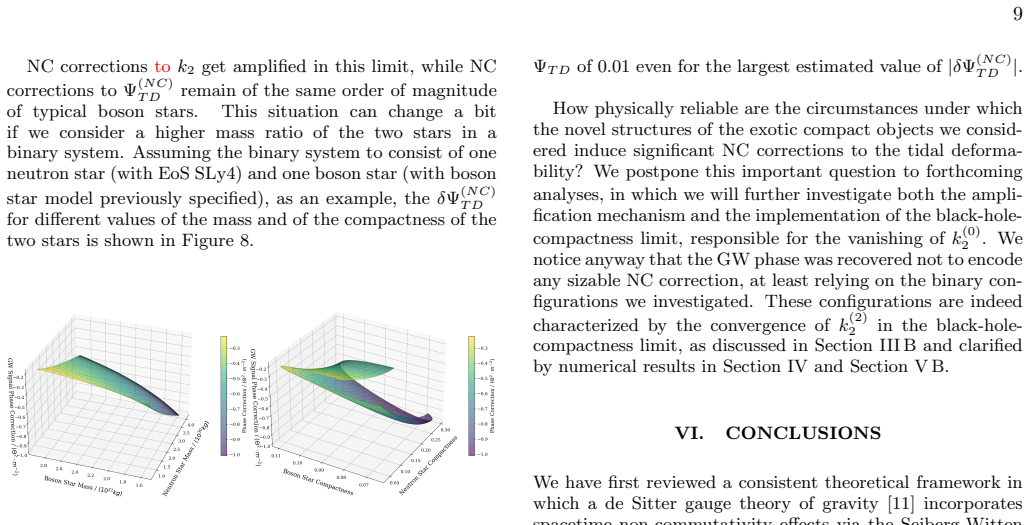
The central claim is a universality statement: for a spherical compact object whose metric remains non-singular at its surface, the leading $\mathcal{O}(\Theta^2)$ correction to the quadrupolar tidal Love number, $k_2^{(2)}$, converges to $1/(8M^2)$ as the compactness $C=M/R$ approaches $1/2$ with $M$ fixed. The apparent logarithmic divergence in the analytic expression is multiplied by $(1-2C)^2$, so it vanishes whenever the surface functions $h(R)$ and $k(R)$ are finite. Since the uncorrected Love number $k_2^{(0)}$ goes to zero in this limit, the non-commutative correction dominates the tidal response of an almost-black-hole object. Applying the result to neutron stars with the SLy4 and FPS equations of state and to axion boson stars, the paper finds non-commutative phase corrections of order $10^{-9}\,\Theta^2\,\mathrm{m}^{-2}$ and $10^{-6}\,\Theta^2\,\mathrm{m}^{-2}$ respectively, which are unobservable for theoretically motivated values of $\Theta$; mixed neutron-star/boson-star binaries give larger but still undetectable corrections. The paper concludes that neutron stars and boson stars cannot constrain spacetime non-commutativity through tidal deformability in gravitational waves.
Load-bearing premise
The argument assumes that a star's internal tidal response, expressed through the two surface functions $h(R)$ and $k(R)$, is unaffected by non-commutativity and remains finite at black-hole compactness; if non-commutative corrections inside the star shift those functions, the claimed limit could change.
Editorial extensions
If this is right
- Near black-hole compactness the non-commutative correction dominates the tidal Love number, because the standard contribution $k_2^{(0)}$ vanishes, so an observation of tidal deformability in that regime would effectively be an observation of non-commutativity.
- No divergence or ultra-Planckian localisation enhancement appears at horizon scales for objects with non-singular surface metrics, removing the proposed mechanism by which neutron stars or boson stars could probe non-commutativity.
- For neutron star binaries, the non-commutative phase correction stays below about $10^{-62}$ when $|\Theta|<10^{-11}\,\mathrm{GeV}^{-1}$, far below the precision of current gravitational-wave phase measurements.
- Boson-star and mixed binaries amplify the effect relative to neutron stars but still require $\Theta\sim 10^{-13}\,\mathrm{m}$ before a phase shift of $0.01$ appears, so under theoretical bounds the signal is not detectable.
- At fixed compactness, lighter compact objects give larger corrections because the limiting value is $1/(8M^2)$, pointing to low-mass exotic objects as the most favourable targets.
Reading between the lines
- If non-commutative corrections are included inside the star rather than only in the exterior potential, the surface functions $h(R)$ and $k(R)$ could acquire $\mathcal{O}(\Theta^2)$ shifts that feed into $k_2^{(2)}$ at the same order as the direct correction; the finite-limit result could then change.
- The ratio of the non-commutative correction to the standard Love number grows without bound as $C\to 1/2$, so at extreme compactness even a tiny $\Theta$ can dominate; the bottleneck is whether any real object reaches such compactness.
- The gravitational-wave phase is a weaker probe than the Love number itself, so future direct measurements of tidal deformability, or observables such as quasinormal-mode frequencies, would be better matched to the size of the effect.
- The claimed universality can be tested by recomputing the limit for other regular-surface models, such as gravastars or anisotropic stars; if any such model has $h(R)$ or $k(R)$ diverging at $C\to 1/2$, the correction would diverge despite the $(1-2C)^2$ prefactor.
Signed reviews
Editorial analysis
A structured set of objections, weighed in public.
Referee Report
Summary. The paper derives the leading-order non-commutative (NC) correction to the tidal Love number k2 within a de Sitter gauge-theory framework, assuming only the Θ^{rθ} component of non-commutativity is nonzero. It claims that for a spherical compact object with a non-singular metric at its surface, this correction approaches the finite value 1/(8M^2) in the black-hole-compactness limit C=M/R→1/2, so that no divergence or ultra-Planckian enhancement occurs at horizon scales. The authors then compute the correction numerically for neutron stars with the SLy4 and FPS equations of state and for axion-like boson stars, estimate the corresponding GW phase corrections, and conclude that neutron stars and boson stars are not viable probes of spacetime non-commutativity through tidal deformability.
Significance. If correct, the paper would remove a proposed observational window for spacetime non-commutativity and would provide a parameter-free prediction for the NC correction at maximal compactness. The work has clear strengths: it uses independently published NC metric corrections, derives an analytic formula, treats two neutron-star EoSs and a boson-star model, and gives explicit order-of-magnitude estimates for GW phase imprints. However, the central quantitative limit is not supported by the printed algebra, and the treatment of the interior tidal response leaves an open question at the same order in Θ. These issues affect the main claims and the derived numerical estimates.
major comments (4)
- [III.B, Eq. (38)] Direct evaluation of Eq. (38) at C=1/2 does not yield the claimed limit in Eq. (39). With the printed prefactor 1/(M^2 C^5)=32/M^2, the h(R) term vanishes at C=1/2 because its coefficient 2C(8C^4+20C^3-66C^2+45C-9) is zero there, the k(R) term is multiplied by (1-2C), and the ln terms are O((1-2C)^2 ln(1-2C)). The remaining constant part of the numerator tends to 4C(4C^4-8C^3+41C^2-36C+9)=1, while the denominator tends to 4C(2C^4-2C^3+13C^2-12C+3)=1/4. The limit of Eq. (38) is therefore 128/M^2, not 1/(8M^2)=0.125/M^2. The quoted value would follow only if the prefactor were C^5/M^2 rather than 1/(M^2 C^5). Since Eqs. (39), (40), (77), (78), and the concluding estimates all rely on the value 1/(8M^2), the quantitative central claim is not supported as printed.
- [IV and V, Eqs. (46)-(49), (63)-(65)] The interior perturbation equations used to obtain H(R) and K(R) contain no non-commutative corrections: Eqs. (46)-(49) are the standard GR equations for neutron-star perturbations, and the boson-star system (63)-(65) is likewise solved in GR. Because Eq. (38) matches the exterior solution using H(R), H'(R), and K(R) from these interior solutions, any O(Θ^2) corrections to the metric inside the star—which the Section II framework would generically produce—enter k2^(2) at the same order as the direct correction. The authors need to justify that the interior NC corrections vanish for the chosen tetrad and gauge, or include them and show that the finite-limit result is unchanged. Without this, the numerical values in Figs. 1-8 and even the claimed C→1/2 limit can change.
- [III.B, between Eqs. (38) and (39)] The argument that h(R) and k(R) remain finite as C→1/2 is asserted but not proved. For a generic matter model, the surface of the star at would-be black-hole compactness may not be regular, and the neutron-star models in Section IV do not reach C=1/2, so the limit is an extrapolation. A precise regularity condition on h(R) and k(R), or a proof that non-singularity of the metric implies finiteness of these ratios, is needed to make Eq. (39) reliable.
- [III.B, Eqs. (35)-(38)] The derivation from Eq. (35) to Eqs. (37) and (38) is not shown: the lengthy algebra involving projections of Veff and the substitution of Eq. (21) and Eq. (20) is not verifiable from the text. Given the arithmetic inconsistency in Eq. (38), the authors should re-derive these expressions and display the intermediate steps or provide a machine-checkable derivation in an ancillary file.
minor comments (5)
- [III.A, Eq. (25)] The multipole expansion in Eq. (25) contains the undefined term 'finir/r' and the coefficient 'ϵ' for the r^2 term; these should be written with explicit coefficients or deleted if they are artifacts.
- [II.B, Eq. (12)] The Moyal product formula is written with x^μ as generic coordinates, but later Θ^{rθ} is stated to have dimension length while Eq. (11) suggests the standard L^2 dimension for Cartesian coordinates; the convention should be stated consistently in one place.
- [IV, Figs. 1-2] The vertical axes in Figs. 1 and 2 should state explicitly whether they show k2^(2) with dimensions m^{-2} or the dimensionless combination k2^(2) Θ^2; the captions as printed are ambiguous.
- [V.A, Eq. (66)] In the definition Φ1(r) := r ϕ1'(r)/ϕ(r), the denominator appears to refer to the background scalar profile ϕ0(r) rather than ϕ1(r); please clarify the notation.
- [III.B, Eq. (40)] Equation (40) inherits the error in Eq. (39), but even after correcting the prefactor, the phase formula should be re-checked dimensionally: with Θ in meters, the right-hand side should be dimensionless only if the numerical coefficient is corrected accordingly.
Circularity Check
No significant circularity: the finite-limit result follows from the paper's own analytic formula, not from a fitted parameter or a load-bearing self-citation.
full rationale
The derivation chain is self-contained in the relevant sense. The non-commutative metric corrections in Eqs. (13)-(15) are imported from Refs. [12,13], and the one co-authored citation [14] is used only as an auxiliary reference for the choice Theta^{r theta} = -Theta^{theta r} = Theta, alongside Refs. [7,13]; it does not supply Eq. (38) or the limit Eq. (39). The central formulas Eq. (37) and Eq. (38) are derived from the paper's own perturbed effective potential Eq. (35), and Eq. (39) is the C -> 1/2 limit under the stated finiteness of h(R) and k(R); no parameter is fitted to the predicted correction, and the limit does not depend on the numerical solutions. The neutron-star and boson-star calculations use standard equations of state and structure equations as inputs, and the numerical outputs are not fed back into the analytic limit. The paper itself notes in Section V that the physical reliability of the amplification scenarios is postponed to future work, and the finiteness of h(R) and k(R) at black-hole compactness is assumed rather than proved; those are limitations or correctness risks, not circular reductions. Any arithmetic issue with evaluating Eq. (38) at C = 1/2 would be a correctness defect, not a circularity defect.
Assumptions & free parameters
free parameters (2)
- Theta (noncommutativity scale)
- axion decay constant f_a =
10^8 GeV
assumptions (5)
- domain assumption The SO(4,1) de Sitter gauge theory with torsion-free condition (Eq 8) is a valid description of gravity, and the Seiberg-Witten map gives the metric corrections up to O(Theta^2).
- ad hoc to paper Only the Theta^(r theta) component of noncommutativity is nonzero, and Theta has dimension length.
- ad hoc to paper The interior tidal perturbation obeys the standard GR equations without non-commutative corrections.
- domain assumption h(R) and k(R) remain finite as C to 1/2 for non-singular-surface compact objects.
- domain assumption The boson star potential can be truncated at O(|Phi|^4), and the scalar perturbation ansatz Eq (62) applies.
Cite this review
Pith. "Pith review of Can We Probe Spacetime Non-commutativity Through Tidal Deformability of Compact Objects?." pith.science (2026). https://pith.science/paper/PIBRKYJP
@misc{pith2026250500498,
  author       = {Pith},
  title        = {Pith review of: Can We Probe Spacetime Non-commutativity Through Tidal Deformability of Compact Objects?},
  year         = {2026},
  howpublished = {\url{https://pith.science/paper/PIBRKYJP}},
  note         = {Machine review of arXiv:2505.00498}
}
read the original abstract
We investigate the impact of spacetime non-commutativity on the tidal deformability of compact objects and explore the feasibility of detecting non-commutative (NC) effects through gravitational wave (GW) observations. We considered NC modifications to spacetime geometry based on de Sitter gauge theory of gravity and calculate their impact on tidal deformability. While several types of compact objects have been proposed as candidates for probing spacetime non-commutativity, particularly at the horizon scales, our study showed analytically that, for compact objects with non-singular metric at their surface (such as neutron stars and boson stars), the NC correction to their tidal deformability converge to a finite value at the black-hole-compactness limit, eliminating infinite enhancement at the horizon scales. We then compute the NC corrections for neutron stars and boson stars, considering several different models, and analyze their imprints on the GW signals. By comparing the results, we assess the scale of NC effects across different compactness regimes and discuss the conditions under which these NC effects can be amplified. While our findings suggest that the leading-order NC correction dominates the tidal deformability of a compact object near the black-hole-compactness limit, we demonstrate that neutron stars and boson stars are not viable candidates to constrain spacetime non-commutativity, while relying on the tidal deformability through GW observations.
Figures


Figures from the paper (3 more)


Reference graph
Works this paper leans on
-
[1]
H. S. Snyder, Phys. Rev. 71, 38 (1947). [2] A. Connes, Publications Math´ ematiques de l’IH ´ES 62, 41 (1985). 10
work page 1947
-
[2]
(59) Eqs. (57)-(59) determine the structure of the boson star in a similar way as the TOV equations, with the mass density and the pressure being replaced by ρ(r) =ω2e−2Γϕ2 0 + e2Λϕ′2 0 +V (|Φ|2), (60) p(r) =ω2e−2Γϕ2 0 + e2Λϕ′2 0 −V (|Φ|2). (61) Despite the similarity between the Boson star’s structure equations and the TOV equations for a neutron star, s...
-
[3]
At this purpose, we employ rela- tions Eqs
(65) We can now solve for H(r), and calculate the Boson stars’ tidal deformability and the corrections due to space- time non-commutativity. At this purpose, we employ rela- tions Eqs. (28)-(29), and further define Φ1(r) := rϕ′ 1(r) ϕ(r) , (66) ψ1(r) := ϕ1(r) H(r) =C exp hZ Φ1(r)−h(r) r dr i , (67) where C is a constant. Eqs. (63)-(65) thus become rh′ +h(...
- [4]
-
[5]
A. H. Chamseddine and J. Fr¨ ohlich, Some elements of connes’ non-commutative geometry, and space-time ge- ometry (1993), arXiv:hep-th/9307012 [hep-th]
work page Pith review arXiv 1993
-
[6]
N. Seiberg and E. Witten, Journal of High Energy Physics 1999, 032–032 (1999)
work page 1999
- [7]
-
[8]
M. Agop, C. Popa, and A. Harabagiu, Communications in Theoretical Physics 50, 1197 (2008)
work page 2008
Show all 42 references
-
[9]
Kanazawa, G
T. Kanazawa, G. Lambiase, G. Vilasi, and Y. Akira, The European Physical Journal C 79 (2019)
2019
-
[10]
Chiritoiu and G
V. Chiritoiu and G. Zet, European Physical Journal C 57, 809 (2008)
2008
-
[11]
Enache, C
V. Enache, C. Popa, V. P˘ aun, and M. Agop, Chinese Physics Letters 25, 3570 (2008)
2008
-
[12]
A. H. Chamseddine, Physics Letters B504, 33–37 (2001)
2001
-
[13]
G. ZET, V. MANTA, and S. BABETI, Interna- tional Journal of Modern Physics C 14, 41 (2003), https://doi.org/10.1142/S0129183103004188
2003 doi
-
[14]
(34) Θ has dimension of length L, being proportional to the commutator [r,θ ], rather than L2, as it happens for the components of Θµν in the Cartesian coordinates’ system
— the other components of Θ µν being all vanishing 2, namely Θµν = 0 0 0 0 0 0 Θ 0 0 −Θ 0 0 0 0 0 0 . (34) Θ has dimension of length L, being proportional to the commutator [r,θ ], rather than L2, as it happens for the components of Θµν in the Cartesian coordinates...
-
[15]
Chaichian, A
M. Chaichian, A. Tureanu, and G. Zet, Physics Letters B 660, 573–578 (2008)
2008
-
[16]
Y. Zhao, Y. Cai, S. Das, G. Lambiase, E. Saridakis, and E. Vagenas, Nuclear Physics B 1004, 116545 (2024)
2024
-
[17]
Hinderer, B
T. Hinderer, B. D. Lackey, R. N. Lang, and J. S. Read, Physical Review D 81, 10.1103/physrevd.81.123016 (2010)
2010 doi
-
[18]
Hinderer, The Astrophysical Journal 677, 1216 (2008)
T. Hinderer, The Astrophysical Journal 677, 1216 (2008)
2008
-
[19]
E. E. Flanagan and T. Hinderer, Physical Review D 77, 10.1103/physrevd.77.021502 (2008)
2008 doi
-
[20]
Maselli, P
A. Maselli, P. Pani, V. Cardoso, T. Abdelsalhin, L. Gualtieri, and V. Ferrari, Phys. Rev. Lett.120, 081101 (2018)
2018
-
[21]
Douchin and P
F. Douchin and P. Haensel, Astronomy & Astro- physics 380, 151–167 (2001)
2001
-
[22]
V. R. Pandharipande and D. G. Ravenhall, Hot nuclear matter (Springer US, Boston, MA, 1989) pp. 103–132
1989
-
[23]
Haensel and A
P. Haensel and A. Y. Potekhin, Astronomy & Astrophysics 428, 191–197 (2004), data is retrieved from Ioffe Institute: http://www.ioffe.ru/astro/NSG/ nseoslist.html
2004
-
[24]
E. W. Kolb and I. I. Tkachev, Phys. Rev. Lett. 71, 3051 (1993)
1993
-
[25]
Cardoso, E
V. Cardoso, E. Franzin, A. Maselli, P. Pani, and G. Ra- poso, Phys. Rev. D 95, 084014 (2017), [Addendum: Phys.Rev.D 95, 089901 (2017)], arXiv:1701.01116 [gr-qc]
2017 arXiv
-
[26]
C. F. B. Macedo, P. Pani, V. Cardoso, and L. C. B. Crispino, Phys. Rev. D 88, 064046 (2013)
2013
-
[27]
Chatziioannou, General Relativity and Gravitation 52, 10.1007/s10714-020-02754-3 (2020)
K. Chatziioannou, General Relativity and Gravitation 52, 10.1007/s10714-020-02754-3 (2020)
2020 doi
-
[28]
Binnington and E
T. Binnington and E. Poisson, Phys. Rev. D 80, 084018 (2009)
2009
-
[29]
H. S. Chia, Physical Review D 104, 10.1103/phys- revd.104.024013 (2021)
2021 doi
-
[30]
J. R. Oppenheimer and G. M. Volkoff, Phys. Rev. 55, 374 (1939)
1939
-
[31]
Y. Suwa, T. Yoshida, M. Shibata, H. Umeda, and K. Takahashi, Monthly Notices of the Royal Astronomi- cal Society 481, 3305–3312 (2018)
2018
-
[32]
L. S. Rocha, J. E. Horvath, L. M. de S´ a, G. Y. Chinen, L. G. Bar˜ ao, and M. G. B. de Avellar, Mass distribution and maximum mass of neutron stars: Effects of orbital inclination angle (2023), arXiv:2312.13244 [astro-ph.HE]
2023 arXiv
-
[33]
Di Luzio, M
L. Di Luzio, M. Giannotti, E. Nardi, and L. Visinelli, Physics Reports 870, 1 (2020), the landscape of QCD axion models
2020
-
[34]
Guerra, C
D. Guerra, C. F. Macedo, and P. Pani, Journal of Cos- mology and Astroparticle Physics 2019 (09), 061
2019
-
[35]
G. G. di Cortona, E. Hardy, J. P. Vega, and G. Villadoro, Journal of High Energy Physics 2016, 10.1007/jhep01(2016)034 (2016)
2016 doi
-
[36]
G. G. Raffelt, Astrophysical axion bounds, in Axions: Theory, Cosmology, and Experimental Searches, edited by M. Kuster, G. Raffelt, and B. Beltr´ an (Springer Berlin Heidelberg, Berlin, Heidelberg, 2008) pp. 51–71
2008
-
[37]
Arvanitaki, S
A. Arvanitaki, S. Dimopoulos, S. Dubovsky, N. Kaloper, and J. March-Russell, Phys. Rev. D 81, 123530 (2010)
2010
-
[38]
Arvanitaki and S
A. Arvanitaki and S. Dubovsky, Phys. Rev. D 83, 044026 (2011)
2011
-
[39]
Arvanitaki, M
A. Arvanitaki, M. Baryakhtar, and X. Huang, Phys. Rev. D 91, 084011 (2015)
2015
-
[40]
Zdr´ ahal, Nuclear Physics B - Proceedings Supple- ments 219-220, 68 (2011), the Proceedings of the 5th Joint International Hadron Structure ’11 Conference
M. Zdr´ ahal, Nuclear Physics B - Proceedings Supple- ments 219-220, 68 (2011), the Proceedings of the 5th Joint International Hadron Structure ’11 Conference
2011
-
[41]
S. L. Liebling and C. Palenzuela, Living Reviews in Rel- ativity 26, 10.1007/s41114-023-00043-4 (2023)
2023 doi
-
[42]
Ferrell and M
R. Ferrell and M. Gleiser, Phys. Rev. D 40, 2524 (1989)
1989
Reviewed August 16, 2026 · model on record in the stance chip above.
Discussion (0). Continue with ORCID to comment.