REVIEW 4 major objections 7 minor 24 references
Steering Conceptual Bias via Transformer Latent-Subspace Activation
T0 review · 4 major / 7 minor · reviewed 2026-08-15 · deepseek-v4-flash
Pith's one-line read G-ACT steers LLM code generation toward C++ by clustering CPP-minus-Python activation differences and using refined per-layer probes to pick the steering vector to inject.
desk verdict A plausible ACT variant for code-language steering, but the central claim rests on probe accuracy against self-defined cluster labels, not on the language of generated code. read the letter →
The pith
A machine-rendered reading of the paper's core claim, the machinery that carries it, and where it could break.
The reading
What carries the argument
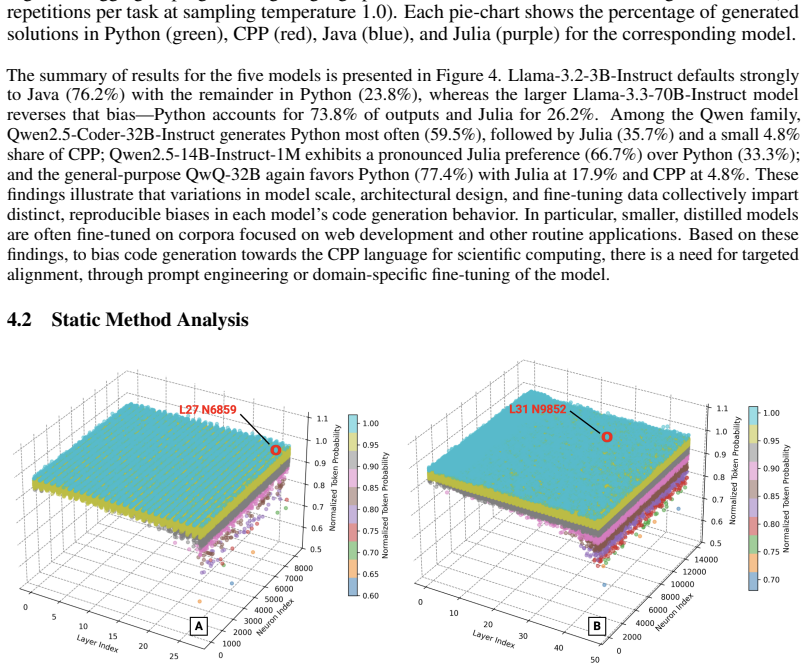
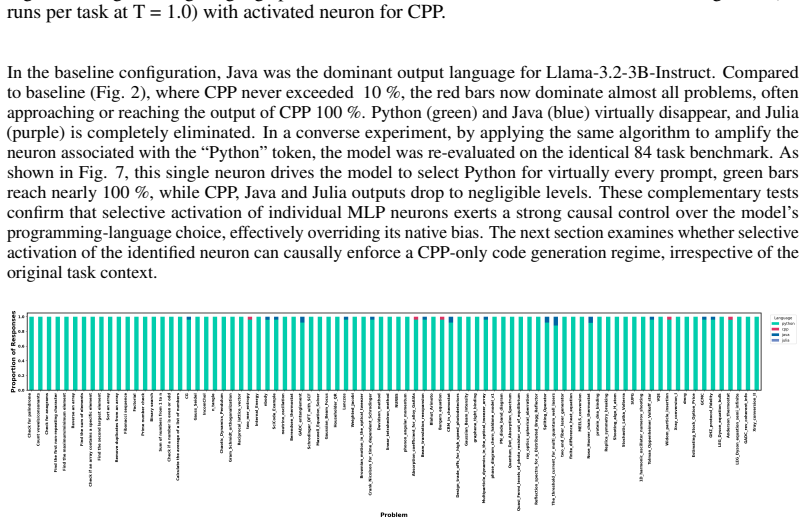
The load-bearing mechanism is the per-layer steering-vector probe trained and refined inside G-ACT. The construction starts with per-prompt difference vectors $\Delta_{i,\ell}=h^+_{i,\ell}-h^-_{i,\ell}$ between CPP- and Python-conditioned activations at each layer; these are clustered with K-means into $C$ centroids $\{c_{k,\ell}\}$. A linear probe $\pi_\ell: \mathbb{R}^D \to \mathbb{R}^C$ at each layer predicts the cluster label of the current activation, and the selected centroid is injected into the residual stream as $h_{i,\ell} \leftarrow h_{i,\ell} + \alpha c_{j,\ell}$. The refinement stage runs autoregressive inference under gradient tracking and backpropagates cross-entropy loss only into the probe parameters, leaving the pretrained model frozen. The static method it replaces decodes effective neuron weights $W_{\mathrm{eff}} = W_{\mathrm{up}} \odot \sigma(W_{\mathrm{gate}})$ through the LM head to find a single most-CPP-correlated neuron, then amplifies that neuron's activation.
What would settle it
Run G-ACT on the same 84-prompt benchmark and count the language of each generated code block, for example by markdown fence or compiler check. If the C++ share of outputs does not rise substantially above the unsteered baseline despite the reported probe-accuracy gains, then probe accuracy is not a valid proxy for steering and the central claim fails.
Extended reading notes
Core claim
G-ACT is the paper's central proposal. For each prompt, the model is run with a CPP-requesting answer and a Python-requesting answer, and the per-layer activation differences are stored. These difference vectors are clustered with K-means; each centroid becomes a steering vector. At generation time, a per-layer linear probe classifies the current activation into a cluster and the corresponding centroid is added to the residual stream. Unlike standard ACT, the probes are placed inside an autoregressive forward pass under gradient tracking and refined by backpropagating cross-entropy loss only through probe parameters, leaving the base model's weights fixed. On LLaMA-3.2 3B this raises average probe accuracy from 0.405 to 0.556 and macro-F1 from 0.165 to 0.238; on early layers 0–6 accuracy goes from 0 to 61.5%. On LLaMA-3.3 70B, where attention-head signals are diffuse, accuracy improves from 6.3% to 19.1%, and the paper recommends hidden-state difference vectors in that regime. The paper also reports that across repeated trials G-ACT produces only C++ implementations on two example prompts, while explicitly leaving a full validation of generated-code correctness out of scope.
Load-bearing premise
The evaluation assumes that probe classification accuracy—how often a probe's predicted cluster label matches the training-set cluster assignment—is a valid proxy for actually steering generated output into the target programming language, and the paper does not report a quantitative language distribution of G-ACT's outputs to test this.
Editorial extensions
If this is right
- If G-ACT works as claimed, LLM-based scientific-code agents can bias their output toward C++ or another target language at inference time, without fine-tuning or changing the prompt.
- The early-layer result (0–6: 0% to 61.5% probe accuracy) suggests that gradient refinement can make previously uninformative layers usable for steering, widening the set of layers available for targeted control.
- Because only probe parameters are updated, the base model's weights remain fixed, which should preserve general capabilities while adding a controllable style direction.
- Steering only a subset of layers keeps the runtime overhead near 1.3–1.4x base generation, making the method practical for agentic systems that generate many code snippets.
- The persistent steering matrices embedded by G-ACT are presented as a route to reproducible model behavior across deployments.
Reading between the lines
- If probe accuracy does track output language, the same cluster-and-inject recipe should transfer to other style axes, such as Python versus Julia or code verbosity, since no part of the difference-vector construction is CPP-specific.
- The paper does not verify that the generated C++ compiles or runs; a natural extension would be to compile and execute the steered outputs on the same benchmark.
- Cluster labels come from K-means, so reported accuracy measures agreement with an unsupervised partition; if clusters do not align with language choice, accuracy gains could occur without language steering, and a direct output-language measurement would settle this.
- Activation steering may offer an alternative to prompt-based or retrieval-based interventions in scientific-coding agents, avoiding the repeated-token and attention-sink failure modes the paper mentions for long agentic interactions, though this is not tested here.
Signed reviews
Editorial analysis
A structured set of objections, weighed in public.
Referee Report
Summary. This paper investigates whether activating latent subspaces in LLMs can steer scientific code generation toward the C++/CPP language. The authors first evaluate five instruction-tuned LLMs on a curated set of 84 scientific coding prompts and report per-model language biases. They then present a static neuron-attribution method that locates and amplifies a single MLP neuron associated with the CPP token, and show that this can shift language selection and code output for LLaMA-3.2-3B, while also noting its fragility across models and prompts. The main contribution is G-ACT (Gradient-Refined Adaptive Activation Steering), which clusters per-prompt CPP-versus-Python activation differences into a small set of steering directions and trains lightweight per-layer probes to select among these directions during inference, refining the probes online with a cross-entropy loss. The quantitative evaluation of G-ACT measures probe classification accuracy and macro-F1 against cluster labels derived from K-means on the training set. Reported results include an average probe-accuracy increase from 0.405 to 0.556 for LLaMA-3.2-3B and an increase from 0.063 to 0.191 for LLaMA-3.3-70B. The paper concludes that G-ACT reliably biases generation toward CPP.
Significance. If the central claim were supported, the work would be relevant to mechanistic interpretability and practical agentic code generation: an inference-time, model-agnostic method for controlling output language with modest overhead would be a useful contribution. The idea of refining lightweight probes online during generation is interesting and the authors provide a detailed algorithmic description. However, the paper's end-to-end claim is not supported by its evidence. The primary metric measures probe agreement with K-means cluster labels, not any property of the generated text, so the reported accuracy numbers do not establish that G-ACT changes the language of generated code. No code, dataset, or systematic output analysis is provided; the only generation examples are two hand-picked snippets in Appendix A.5 with an unquantified assertion of reliability. These deficiencies are load-bearing because they leave the paper's stated contribution—reliable language steering—unverified.
major comments (4)
- [Sec. 4.3.1, Fig. 11, Abstract] The headline claim that G-ACT 'reliably biases generation towards the CPP language' is supported only by probe classification accuracy and macro-F1 computed against K-means cluster labels, not by any measurement of the language of generated outputs. The paper explicitly states that this metric 'isolates probe quality from downstream generation effects,' which concedes that it does not measure generation. No quantitative language distribution of G-ACT-generated code is reported; Appendix A.5 shows two hand-picked outputs and asserts 'only CPP implementations' without supporting numbers. Therefore the abstract's central claim is unsupported by the evidence presented.
- [Sec. 4.3.1, evaluation protocol] The probe evaluation is circular with respect to the construction of the steering vectors. The 'true' cluster labels are the cluster IDs produced by the same K-means procedure applied to the same CPP-versus-Python activation differences used to build the steering centroids, and for test prompts the true label is the nearest-centroid assignment of the averaged difference vector. Accuracy therefore measures how well the linear probe reproduces the K-means assignment on held-out points—a self-consistency check—rather than how well the steering changes model behavior. The reported +15% average accuracy improvement is an internal consistency measure, not an external validation of steering efficacy.
- [Sec. 4.3.1, Fig. 11B, Conclusion] For LLaMA-3.3-70B, the paper reports G-ACT probe accuracy of 19.1% with C=3 clusters, which is below the 33.3% random baseline. The conclusion nevertheless states that 'targeted injections at key layers can reliably bias generation toward CPP despite overall weak activations.' A below-chance score on the method's own proxy metric cannot support a claim of reliable language steering; the 70B results actually undermine the generalizability claim made in the abstract and conclusion.
- [Sec. 4.2.2 and Appendix A.4] The static method is argued to override language choice 'while maintaining functional correctness,' but the C++ example in Appendix A.4 contains syntax errors and undefined identifiers (e.g., 'int N phonons = -1', 'double N_Bohr_Q *= 0', 'std::sqrt(omega\ni))'), and Sec. 4.2.2 itself states that 'comprehensive validation of its correctness and performance has not been conducted and is beyond the scope of this study.' The functional-correctness claim is therefore contradicted by the paper's own evidence, and the qualitative examples cannot be taken as demonstrations of valid C++ generation.
minor comments (7)
- [Abstract] The phrase 'improving the probe classification accuracy by 61.5%' is ambiguous; the body reports an increase from 0% to 61.5% (Sec. 4.3.1), so the abstract should state absolute percentage-point improvement rather than a relative percentage.
- [Sec. 3.3 vs Sec. 4.3] Section 3.3 mentions an 80/20 train/test split, while Section 4.3 uses a 70/30 split; these numbers should be reconciled.
- [Fig. 16 caption] The caption of Figure 16 says 'colored by four K-means clusters,' but the surrounding text and Section 4.3.1 state that the 70B model uses three clusters; the caption and text should agree.
- [Sec. 4.2.2] The magnitude of the static neuron perturbation is never reported, although the text advises tuning it; this omission prevents replication of the static-method experiments.
- [Contribution 3, Conclusion] The claim of 'reproducible transformation matrices' is not substantiated: no code, matrices, or other artifacts are made available, so the reproducibility guarantee is unverifiable.
- [Appendix A.5] The G-ACT example for LLaMA-3.2-3B (P1) also appears to contain C++ errors, such as passing a raw pointer to a function that expects std::vector and an orphaned 'std::endl;' statement; describing these outputs as generated 'CPP implementations' should be qualified, since they may not compile.
- [Sec. 4.1 vs Fig. 4] The text says Llama-3.2-3B 'defaults strongly to Java (76.2%)' in the aggregate results, while the discussion of Figure 2 states that Python predominates with 'roughly 70–80% of outputs'; this apparent contradiction in the baseline characterization should be clarified.
Circularity Check
G-ACT's headline steering result rests on probe accuracy against its own K-means cluster labels, not on measured output language.
-
fitted input called prediction
[Abstract; Sec 4.3.1 Evaluation Metrics; Algorithm lines 21-22]
"In LLaMA-3.2 3B, this approach reliably biases generation towards the CPP language by increasing the average probe classification accuracy by 15% ... The probe classification accuracy and macro-F1 scores serve as the comparison metric. This comparison method provides a clear, layer-wise view of which method more reliably recognizes the correct steering mode by isolating probe quality from downstream generation effects."
The load-bearing metric is probe classification accuracy, which is computed against cluster IDs produced by K-means on the same per-layer CPP-minus-Python difference vectors used both to define the steering centroids and to train the probes; the algorithm's refinement loss is cross-entropy against those same cluster labels. The paper itself says this comparison 'isolates probe quality from downstream generation effects,' meaning it never measures the language of generated code. An improved score only shows that the linear probe agrees better with clustering labels fitted on the same data; it does not establish that generated output is C++.
full rationale
The method is not globally circular: the steering centroids are grounded in genuine CPP-vs-Python activation differences, and the static neuron experiments do report output-language distributions (Sec 4.2.2). However, the central G-ACT claim in the abstract and conclusion is supported only by the probe classification accuracy of Sec 4.3.1, whose ground-truth labels are the K-means cluster IDs derived from the same difference-vector data used to build and train the steering machinery. The probes are trained by cross-entropy against those labels and evaluated by agreement with those labels; the paper explicitly says this isolates probe quality from generation. No quantitative distribution of generated languages under G-ACT is reported, and Appendix A.5 shows only two hand-picked snippets. Thus the headline 'reliably biases generation toward CPP' partially reduces to a self-consistency score of the probe against its own fitted clustering. This warrants a 6: partial circularity in the central evaluation, though the underlying activation-difference construction is empirically grounded.
Assumptions & free parameters
free parameters (5)
- C, number of steering clusters =
4 for Llama-3.2 3B, 3 for Llama-3.3 70B
- alpha, steering strength =
not reported
- E, number of refinement epochs =
50
- k, top-k normalization constant =
100
- Static neuron perturbation amount =
not specified
assumptions (4)
- domain assumption MLP neuron coordinates in the residual stream form an approximately disentangled 'privileged basis', so amplifying a single coordinate shifts token probabilities causally.
- domain assumption Decoding neuron weight vectors through the LM head yields token-level probabilities interpretable as the feature the neuron detects.
- domain assumption The difference between activations on CPP and Python answers captures a 'style shift' direction that, when injected, generalizes to unseen prompts.
- domain assumption All test prompts are out-of-distribution by construction, so classification accuracy on them measures generalization rather than memorization.
Cite this review
Pith. "Pith review of Steering Conceptual Bias via Transformer Latent-Subspace Activation." pith.science (2026). https://pith.science/paper/PIFJL6I5
@misc{pith2026250618887,
  author       = {Pith},
  title        = {Pith review of: Steering Conceptual Bias via Transformer Latent-Subspace Activation},
  year         = {2026},
  howpublished = {\url{https://pith.science/paper/PIFJL6I5}},
  note         = {Machine review of arXiv:2506.18887}
}
read the original abstract
This work examines whether activating latent subspaces in language models (LLMs) can steer scientific code generation toward a specific programming language. Five causal LLMs were first evaluated on scientific coding prompts to quantify their baseline bias among four programming languages. A static neuron-attribution method, perturbing the highest activated MLP weight for a C++ or CPP token, proved brittle and exhibited limited generalization across prompt styles and model scales. To address these limitations, a gradient-refined adaptive activation steering framework (G-ACT) was developed: per-prompt activation differences are clustered into a small set of steering directions, and lightweight per-layer probes are trained and refined online to select the appropriate steering vector. In LLaMA-3.2 3B, this approach reliably biases generation towards the CPP language by increasing the average probe classification accuracy by 15% and the early layers (0-6) improving the probe classification accuracy by 61.5% compared to the standard ACT framework. For LLaMA-3.3 70B, where attention-head signals become more diffuse, targeted injections at key layers still improve language selection. Although per-layer probing introduces a modest inference overhead, it remains practical by steering only a subset of layers and enables reproducible model behavior. These results demonstrate a scalable, interpretable and efficient mechanism for concept-level control for practical agentic systems.
Figures


Figures from the paper (14 more)





Reference graph
Works this paper leans on
-
[6]
Nick Jiang, Anish Kachinthaya, Suzie Petryk, and Yossi Gandelsman. Interpreting and editing vision-language representations to mitigate hallucinations.arXiv preprint arXiv:2410.02762,
-
[7]
Juhee Kim, Woohyuk Choi, and Byoungyoung Lee
doi: 10.1109/IROS58592.2024.10802322. Juhee Kim, Woohyuk Choi, and Byoungyoung Lee. Prompt flow integrity to prevent privilege escalation in llm agents,
arXiv 2024
-
[8]
János Kramár, Tom Lieberum, Rohin Shah, and Neel Nanda
URLhttps://arxiv.org/abs/2503.15547. János Kramár, Tom Lieberum, Rohin Shah, and Neel Nanda. Atp*: An efficient and scalable method for localizing llm behaviour to components.arXiv preprint arXiv:2403.00745,
-
[9]
URLhttps://arxiv.org/abs/2403.00745. Naveen Krishnan. Ai agents: Evolution, architecture, and real-world applications,
-
[10]
URL https://arxiv. org/abs/2503.12687. Chris Lu, Cong Lu, Robert Tjarko Lange, Jakob Foerster, Jeff Clune, and David Ha. The ai scientist: Towards fully automated open-ended scientific discovery,
-
[11]
Leland McInnes, John Healy, and James Melville
URLhttps://arxiv.org/abs/2408.06292. Leland McInnes, John Healy, and James Melville. Umap: Uniform manifold approximation and projection for dimension reduction.arXiv preprint arXiv:1802.03426,
-
[13]
In-context learning and induction heads.arXiv preprint arXiv:2209.11895,
Catherine Olsson, Nelson Elhage, Neel Nanda, Nicholas Joseph, Nova DasSarma, Tom Henighan, Ben Mann, Amanda Askell, Yuntao Bai, Anna Chen, et al. In-context learning and induction heads.arXiv preprint arXiv:2209.11895,
-
[14]
Seongheon Park, Xuefeng Du, Min-Hsuan Yeh, Haobo Wang, and Yixuan Li
URLhttps://github.com/openai/codex. Seongheon Park, Xuefeng Du, Min-Hsuan Yeh, Haobo Wang, and Yixuan Li. Steer llm latents for hallucination detection.arXiv preprint arXiv:2503.01917,
Show all 24 references
-
[15]
Caroline Mazini Rodrigues, Nicolas Boutry, and Laurent Najman
URLhttps://arxiv.org/abs/2412.15115. Caroline Mazini Rodrigues, Nicolas Boutry, and Laurent Najman. Unsupervised discovery of interpretable visual concepts.Information Sciences, 661:120159,
-
[16]
doi: https://doi.org/10.1016/j.egyai
ISSN 2666-5468. doi: https://doi.org/10.1016/j.egyai. 2024.100365. Tomasz Szandała. Unlocking the black box of cnns: Visualising the decision-making process with prism. Information Sciences, 642:119162,
2024
-
[17]
URL https://transformer-circuits.pub/2024/ scaling-monosemanticity. Minyang Tian, Luyu Gao, Shizhuo Dylan Zhang, Xinan Chen, Cunwei Fan, Xuefei Guo, Roland Haas, Pan Ji, Kittithat Krongchon, Yao Li, Shengyan Liu, Di Luo, Yutao Ma, Hao Tong, Kha Trinh, Chenyu Tian, Zihan Wang, ...
2024
-
[18]
17 Ashish Vaswani, Noam Shazeer, Niki Parmar, Jakob Uszkoreit, Llion Jones, Aidan N Gomez, Łukasz Kaiser, and Illia Polosukhin
URLhttps://arxiv.org/abs/2407.13168. 17 Ashish Vaswani, Noam Shazeer, Niki Parmar, Jakob Uszkoreit, Llion Jones, Aidan N Gomez, Łukasz Kaiser, and Illia Polosukhin. Attention is All you Need.Advances in Neural Information Processing Systems,
-
[20]
Kevin Wang, Alexandre Variengien, Arthur Conmy, Buck Shlegeris, and Jacob Steinhardt
URL https: //arxiv.org/abs/2305.16291. Kevin Wang, Alexandre Variengien, Arthur Conmy, Buck Shlegeris, and Jacob Steinhardt. Interpretability in the wild: a circuit for indirect object identification in gpt-2 small.arXiv preprint arXiv:2211.00593,
-
[21]
A survey on large language model based autonomous agents.Frontiers of Computer Science, 18(6):186345, 2024a
Lei Wang, Chen Ma, Xueyang Feng, Zeyu Zhang, Hao Yang, Jingsen Zhang, Zhiyuan Chen, Jiakai Tang, Xu Chen, Yankai Lin, et al. A survey on large language model based autonomous agents.Frontiers of Computer Science, 18(6):186345, 2024a. Tianlong Wang, Xianfeng Jiao, Yinghao Zhu, ...
2025
-
[22]
ISBN 9798400712746
Association for Computing Machinery. ISBN 9798400712746. doi: 10.1145/3696410.3714640. URLhttps://doi.org/10.1145/3696410.3714640. Xingyao Wang, Yangyi Chen, Lifan Yuan, Yizhe Zhang, Yunzhu Li, Hao Peng, and Heng Ji. Executable code actions elicit better llm agents. InICML, 20...
-
[23]
Wei Jie Yeo, Rui Mao, Moloud Abdar, Erik Cambria, and Ranjan Satapathy
doi: 10.1109/ICRA57147.2024.10611447. Wei Jie Yeo, Rui Mao, Moloud Abdar, Erik Cambria, and Ranjan Satapathy. Debiasing clip: Interpreting and correcting bias in attention heads.arXiv preprint arXiv:2505.17425,
2024
-
[24]
Interpreting the repeated token phenomenon in large language models.arXiv preprint arXiv:2503.08908,
Itay Yona, Ilia Shumailov, Jamie Hayes, Federico Barbero, and Yossi Gandelsman. Interpreting the repeated token phenomenon in large language models.arXiv preprint arXiv:2503.08908,
-
[2007]
ISBN 9780898716245
Society for Industrial and Applied Mathematics. ISBN 9780898716245. Davis Brown, Charles Godfrey, Cody Nizinski, Jonathan Tu, and Henry Kvinge. Robustness of edited neural networks. InICLR 2023 Workshop on Mathematical and Empirical Understanding of Foundation Models,
2023
-
[2020]
Guanzhi Wang, Yuqi Xie, Yunfan Jiang, Ajay Mandlekar, Chaowei Xiao, Yuke Zhu, Linxi Fan, and Anima Anandkumar
URL https://proceedings.neurips.cc/paper_ files/paper/2020/file/92650b2e92217715fe312e6fa7b90d82-Paper.pdf. Guanzhi Wang, Yuqi Xie, Yunfan Jiang, Ajay Mandlekar, Chaowei Xiao, Yuke Zhu, Linxi Fan, and Anima Anandkumar. V oyager: An open-ended embodied agent with large language models,
2020
-
[2021]
Plug and play language models: A simple approach to controlled text generation.arXiv preprint arXiv:1912.02164,
Sumanth Dathathri, Andrea Madotto, Janice Lan, Jane Hung, Eric Frank, Piero Molino, Jason Yosinski, and Rosanne Liu. Plug and play language models: A simple approach to controlled text generation.arXiv preprint arXiv:1912.02164,
1912 arXiv
-
[2022]
Shanghua Gao, Ada Fang, Yepeng Huang, Valentina Giunchiglia, Ayush Noori, Jonathan Richard Schwarz, Yasha Ektefaie, Jovana Kondic, and Marinka Zitnik
URL https:// transformer-circuits.pub/2022/toy_model/index.html#motivation-privileged. Shanghua Gao, Ada Fang, Yepeng Huang, Valentina Giunchiglia, Ayush Noori, Jonathan Richard Schwarz, Yasha Ektefaie, Jovana Kondic, and Marinka Zitnik. Empowering biomedical discovery with ai...
2022
-
[2023]
Kumari Nishu, Sachin Mehta, Samira Abnar, Mehrdad Farajtabar, Maxwell Horton, Mahyar Najibi, Moin Nabi, Minsik Cho, and Devang Naik
URL https://transformer-circuits.pub/2023/ privileged-basis/index.html. Kumari Nishu, Sachin Mehta, Samira Abnar, Mehrdad Farajtabar, Maxwell Horton, Mahyar Najibi, Moin Nabi, Minsik Cho, and Devang Naik. From dense to dynamic: Token-difficulty driven moefication of pre-traine...
2023 arXiv
-
[2024]
Mourad Gridach, Jay Nanavati, Christina Mack, Khaldoun Zine El Abidine, and Lenon Mendes
URLhttps://arxiv.org/abs/2407.21783. Mourad Gridach, Jay Nanavati, Christina Mack, Khaldoun Zine El Abidine, and Lenon Mendes. Agentic AI for scientific discovery: A survey of progress, challenges, and future directions. InTowards Agentic AI for Science: Hypothesis Generation,...
-
[2025]
Nelson Elhage et al
URLhttps://arxiv.org/abs/2501.02688. Nelson Elhage et al. Toy Models of Superposition.Transformer Circuits Thread,
Reviewed August 15, 2026 · model on record in the stance chip above.
Discussion (0). Continue with ORCID to comment.