Scattering and Hawking Radiation from Einstein--Euler--Heisenberg--de Sitter Black Holes
Pith reviewed 2026-06-28 08:50 UTC · model grok-4.3
The pith
Greybody factors for scalar and Dirac fields around Einstein-Euler-Heisenberg-de Sitter black holes rise with nonlinear coupling and fall with cosmological constant, while luminosity depends on the temperature prescription.
A machine-rendered reading of the paper's core claim, the machinery that carries it, and where it could break.
Core claim
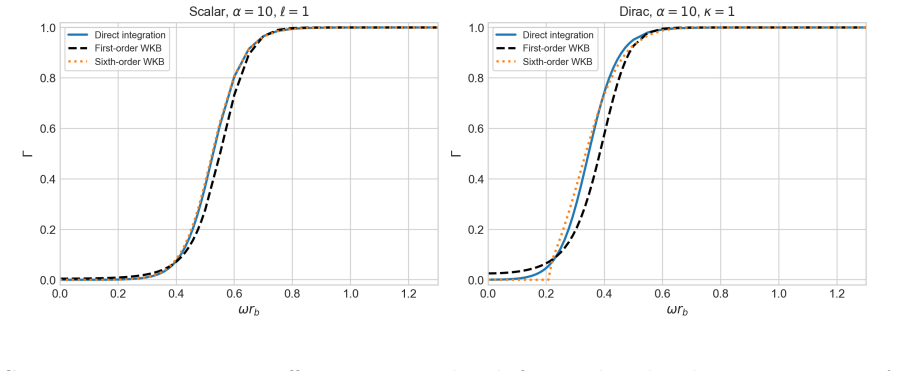
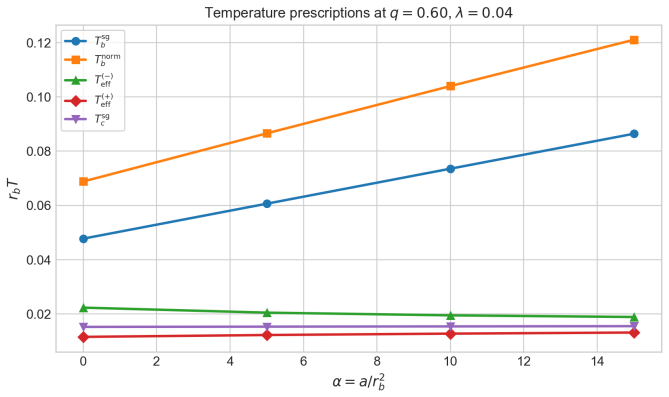
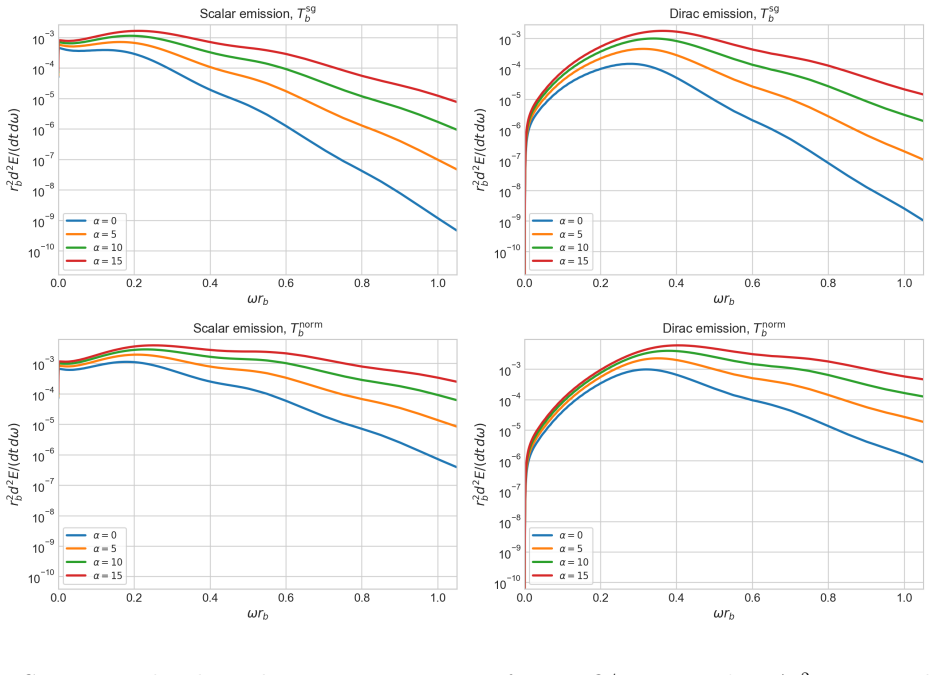
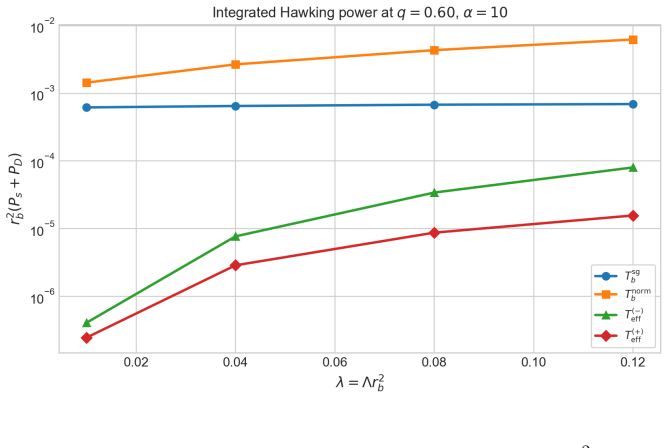
The paper establishes that neutral scalar and neutral massless Dirac greybody factors are computed by direct numerical integration of the wave equation in the static patch between horizons, checked with sixth-order WKB. Along the studied family, the Euler-Heisenberg coupling raises the dominant barriers and shifts half-transmission frequencies upward for both fields. At fixed charge and coupling, the cosmological constant contracts the patch and lowers the thresholds. Luminosity is controlled as much by the de Sitter temperature prescription as by the greybody factors, with event-horizon prescriptions brightening emission as nonlinear correction grows while effective static-patch temperature
What carries the argument
Numerical solution of the radial wave equation as a two-sided scattering problem across the finite static patch, yielding transmission coefficients that determine the greybody factors, together with separate choice of de Sitter temperature for the Hawking spectrum calculation.
If this is right
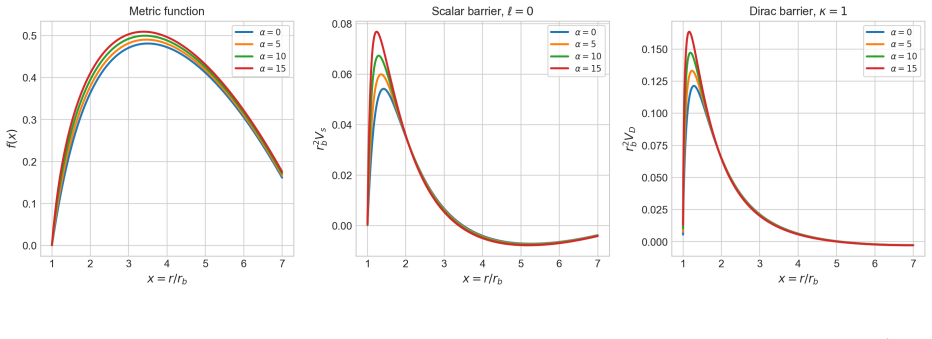
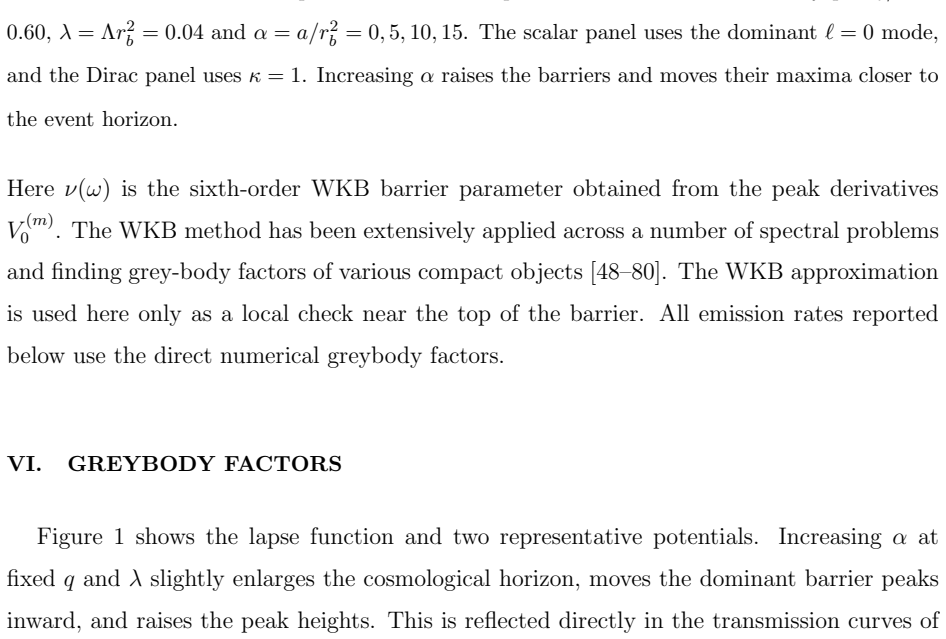
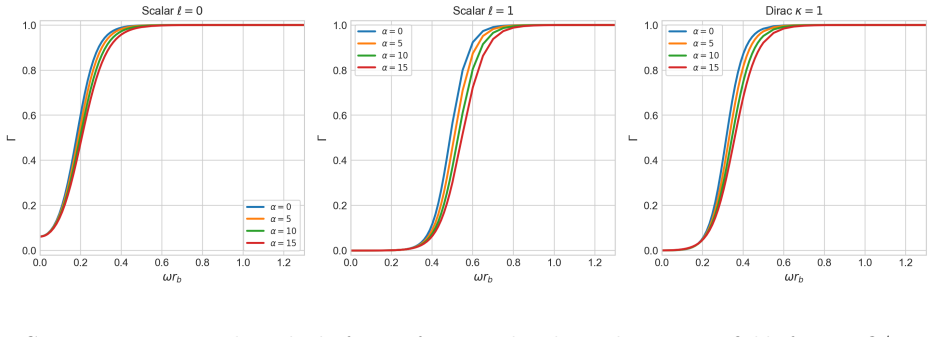
- Increasing the Euler-Heisenberg coupling raises the dominant scalar and Dirac barriers and shifts the half-transmission frequencies upward.
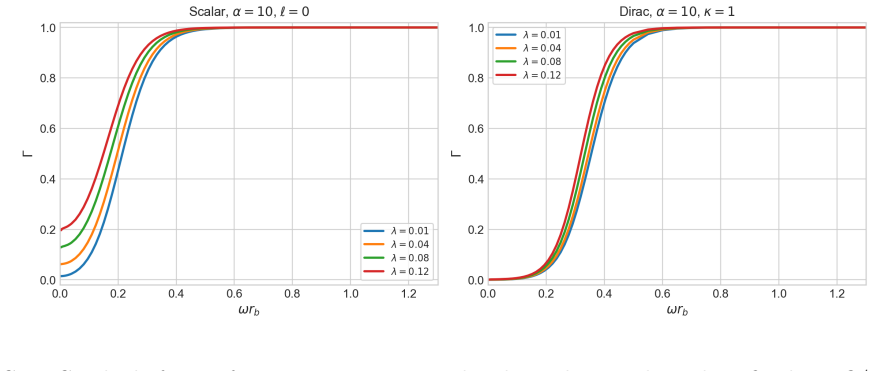
- At fixed charge and nonlinear coupling, increasing the cosmological constant contracts the static patch and lowers the dominant greybody thresholds.
- Event-horizon temperature prescriptions brighten the emission as the nonlinear correction grows.
- Effective static-patch temperatures give much smaller rates and can reverse the trend with nonlinear coupling.
- The evaporation interpretation is not unique unless the temperature convention is specified explicitly.
Where Pith is reading between the lines
- Different temperature prescriptions might correspond to different physical observer frames or coordinate choices in de Sitter space.
- The sensitivity to temperature choice could influence models of black hole evolution in expanding universes.
- Extending the numerical method to charged fields or including backreaction might test whether the prescription dependence persists in more general cases.
Load-bearing premise
The finite region between the black-hole and cosmological horizons can be treated as a two-sided scattering problem whose transmission coefficients are reliably obtained by direct numerical integration, and that a specific de Sitter temperature prescription can be chosen independently when interpreting luminosity.
What would settle it
A recalculation of the spectra using an alternative numerical method or exact solution for the transmission coefficients that produces luminosity trends independent of the chosen temperature prescription.
Figures
read the original abstract
We compute neutral scalar and neutral massless Dirac greybody factors and Hawking spectra for the positive-cosmological-constant branch of the Einstein--Euler--Heisenberg black hole. The finite region between the black-hole and cosmological horizons is treated as a two-sided scattering problem, with direct numerical integrations providing the transmission coefficients and a sixth-order WKB calculation used as a local check near the barrier top. Along the reference family studied here, increasing the Euler--Heisenberg coupling raises the dominant scalar and Dirac barriers and shifts the half-transmission frequencies upward. At fixed charge and nonlinear coupling, increasing the cosmological constant contracts the static patch and lowers the dominant greybody thresholds. The luminosity is controlled as much by the de Sitter temperature prescription as by the greybody factors: event-horizon prescriptions brighten the emission as the nonlinear correction grows, whereas effective static-patch temperatures give much smaller rates and can reverse the trend. Thus the evaporation interpretation is not unique unless the temperature convention is specified explicitly.
Editorial analysis
A structured set of objections, weighed in public.
Referee Report
Summary. The paper computes neutral scalar and neutral massless Dirac greybody factors and Hawking spectra for the positive-cosmological-constant branch of Einstein-Euler-Heisenberg black holes. The static patch between black-hole and cosmological horizons is treated as a two-sided scattering problem; transmission coefficients are obtained by direct numerical integration of the radial wave equation with a sixth-order WKB calculation used as a local check near the barrier peak. Along the reference family, increasing the Euler-Heisenberg coupling raises the dominant barriers and shifts half-transmission frequencies upward, while increasing the cosmological constant contracts the static patch and lowers greybody thresholds. Luminosities depend strongly on the chosen de Sitter temperature prescription, with event-horizon prescriptions yielding brighter emission that grows with nonlinear coupling and effective static-patch temperatures producing smaller rates that can reverse the trend.
Significance. If the numerical results hold, the work supplies concrete parameter trends for greybody factors and spectra in a nonlinear-electrodynamics de Sitter background and explicitly demonstrates the non-uniqueness of evaporation rates under different temperature conventions. Strengths include the use of two independent methods (direct integration plus WKB cross-check) and the clear separation of the greybody computation from the temperature choice, both of which are standard yet often under-emphasized in the de Sitter literature.
minor comments (3)
- The abstract and introduction would benefit from a brief statement of the precise numerical tolerances and convergence criteria used in the direct integrations, together with a short table or plot of sample transmission coefficients versus integration step size or grid resolution.
- Notation for the two temperature prescriptions (event-horizon versus effective static-patch) should be introduced once with explicit formulas and then used consistently in all luminosity plots and tables.
- A short discussion of the range of validity of the sixth-order WKB approximation relative to the numerical results (e.g., percentage deviation at the barrier peak for representative parameter values) would strengthen the cross-check claim.
Simulated Author's Rebuttal
We thank the referee for the careful reading and positive evaluation of our manuscript. The summary accurately describes the computations, methods, and main findings on greybody factors, transmission coefficients, and the sensitivity of luminosities to temperature prescriptions. We appreciate the recognition of the two-method verification and the explicit separation of greybody factors from temperature choices. No specific major comments were provided in the report.
Circularity Check
No significant circularity detected
full rationale
The paper's central results consist of direct numerical integration of the radial wave equation for scalar and Dirac fields on the fixed Einstein-Euler-Heisenberg-de Sitter metric between the black-hole and cosmological horizons, supplemented by a sixth-order WKB check near the barrier peak. Transmission coefficients, barrier heights, half-transmission frequencies, and luminosities under two explicit temperature prescriptions are obtained by varying the Euler-Heisenberg coupling, charge, and cosmological constant as independent inputs; none of these outputs are defined in terms of the others or obtained by fitting to a target quantity. No self-citations, uniqueness theorems, or ansatzes are invoked as load-bearing steps that reduce the claimed trends to the paper's own fitted parameters or prior definitions. The derivation is therefore self-contained against external benchmarks.
Axiom & Free-Parameter Ledger
free parameters (2)
- Euler-Heisenberg coupling constant
- Cosmological constant
axioms (2)
- domain assumption The background is the Einstein-Euler-Heisenberg-de Sitter metric with positive cosmological constant
- standard math Neutral scalar and massless Dirac fields propagate according to the standard wave equations on this curved background
Forward citations
Cited by 2 Pith papers
-
Hawking Emission from Black Holes Evaporating toward Wormholes and the Accuracy of the WKB Approximation
Numerical greybody factors for photons and massless Dirac fields in Simpson-Visser and Casadio-Fabbri-Mazzacurati geometries reveal that WKB overestimates luminosities by orders of magnitude near wormhole endpoints, i...
-
Hawking Radiation from the Dymnikova Regular Black Hole
Numerical greybody factors for the Dymnikova black hole show temperature-driven luminosity suppression near the extremal remnant, with increasing fermion dominance in the residual massless flux.
Reference graph
Works this paper leans on
-
[1]
S. W. Hawking, Commun. Math. Phys.43, 199 (1975)
1975
-
[2]
W. G. Unruh, Phys. Rev. D14, 3251 (1976)
1976
-
[3]
A. Jansen, Eur. Phys. J. Plus132, 546 (2017), arXiv:1709.09178 [gr-qc]
Pith/arXiv arXiv 2017
-
[4]
R. A. Konoplya and A. Zhidenko, JHEP06, 037 (2004), arXiv:hep-th/0402080
Pith/arXiv arXiv 2004
-
[5]
A. Arag´ on, R. B´ ecar, P. A. Gonz´ alez, and Y. V´ asquez, Eur. Phys. J. C80, 773 (2020), arXiv:2004.05632 [gr-qc]
arXiv 2020
- [6]
-
[7]
S. Dyatlov, Commun. Math. Phys.306, 119 (2011), arXiv:1003.6128 [math.AP]
Pith/arXiv arXiv 2011
-
[8]
P. Kanti and R. A. Konoplya, Phys. Rev. D73, 044002 (2006), arXiv:hep-th/0512257
Pith/arXiv arXiv 2006
-
[9]
Y. Mo, Y. Tian, B. Wang, H. Zhang, and Z. Zhong, Phys. Rev. D98, 124025 (2018), 25 arXiv:1808.03635 [gr-qc]
Pith/arXiv arXiv 2018
- [10]
-
[11]
R. A. Konoplya and A. Zhidenko, Phys. Rev. Lett.103, 161101 (2009), arXiv:0809.2822 [hep- th]
Pith/arXiv arXiv 2009
-
[12]
M. A. Cuyubamba, R. A. Konoplya, and A. Zhidenko, Phys. Rev. D93, 104053 (2016), arXiv:1604.03604 [gr-qc]
Pith/arXiv arXiv 2016
- [13]
-
[14]
R. A. Konoplya and A. Zhidenko, Nucl. Phys. B777, 182 (2007), arXiv:hep-th/0703231
Pith/arXiv arXiv 2007
-
[15]
B. C. L¨ utf¨ uo˘ glu, J. Rayimbaev, N. Kurbonov, S. Murodov, and F. Javed, (2026), arXiv:2605.25076 [gr-qc]
Pith/arXiv arXiv 2026
-
[16]
B. C. L¨ utf¨ uo˘ glu, Fortsch. Phys.74, e70074 (2026), arXiv:2510.10579 [gr-qc]
arXiv 2026
-
[17]
R. A. Konoplya and A. Zhidenko, Phys. Rev. D89, 024011 (2014), arXiv:1309.7667 [hep-th]
Pith/arXiv arXiv 2014
-
[18]
S. V. Bolokhov, (2026), arXiv:2605.21533 [gr-qc]
Pith/arXiv arXiv 2026
-
[19]
S. V. Bolokhov, Eur. Phys. J. C84, 634 (2024), arXiv:2404.09364 [gr-qc]
arXiv 2024
-
[20]
M. Skvortsova, Fortsch. Phys.72, 2400036 (2024), arXiv:2311.11650 [gr-qc]
arXiv 2024
-
[21]
R. A. Konoplya and A. Zhidenko, Phys. Rev. D95, 104005 (2017), arXiv:1701.01652 [hep-th]
Pith/arXiv arXiv 2017
-
[22]
Skvortsova, (2026), arXiv:2605.12113 [gr-qc]
M. Skvortsova, (2026), arXiv:2605.12113 [gr-qc]
Pith/arXiv arXiv 2026
- [23]
-
[24]
Malik, Annals Phys.482, 170238 (2025), arXiv:2504.12570 [gr-qc]
Z. Malik, Annals Phys.482, 170238 (2025), arXiv:2504.12570 [gr-qc]
arXiv 2025
-
[25]
W. Heisenberg and H. Euler, Z. Phys.98, 714 (1936), arXiv:physics/0605038
Pith/arXiv arXiv 1936
-
[26]
B. C. L¨ utf¨ uo˘ glu, Phys. Lett. B871, 140026 (2025), arXiv:2508.13361 [gr-qc]
arXiv 2025
- [27]
-
[28]
D. Magos and N. Bret´ on, Phys. Rev. D102, 084011 (2020), arXiv:2009.05904 [gr-qc]
arXiv 2020
- [29]
-
[30]
H. Dai, Z. Zhao, and S. Zhang, Nucl. Phys. B991, 116219 (2023), arXiv:2202.14007 [gr-qc]
arXiv 2023
-
[31]
N. J. Gogoi and P. Phukon, Phys. Dark Univ.44, 101456 (2024), arXiv:2312.13577 [hep-th]
arXiv 2024
-
[32]
Y. Zhao and H. Cheng, Chin. Phys. C48, 125106 (2024), arXiv:2501.11075 [hep-th]
arXiv 2024
-
[33]
K. Jafarzade, Z. Bazyar, S. Saghafi, and K. Nozari, Eur. Phys. J. C85, 869 (2025), arXiv:2504.09690 [gr-qc]
arXiv 2025
-
[34]
H. Yajima and T. Tamaki, Phys. Rev. D63, 064007 (2001), arXiv:gr-qc/0005016. 26
Pith/arXiv arXiv 2001
-
[35]
P. Kanti and T. Pappas, Phys. Rev. D96, 024038 (2017), arXiv:1705.09108 [hep-th]
Pith/arXiv arXiv 2017
-
[36]
T. Pappas and P. Kanti, Phys. Lett. B775, 140 (2017), arXiv:1707.04900 [hep-th]
Pith/arXiv arXiv 2017
-
[37]
R. Bousso and S. W. Hawking, Phys. Rev. D54, 6312 (1996), arXiv:gr-qc/9606052
Pith/arXiv arXiv 1996
-
[38]
Carter, Commun
B. Carter, Commun. Math. Phys.10, 280 (1968)
1968
-
[39]
R. A. Konoplya, Z. Stuchl´ ık, and A. Zhidenko, Phys. Rev. D97, 084044 (2018), arXiv:1801.07195 [gr-qc]
Pith/arXiv arXiv 2018
-
[40]
R. A. Konoplya and A. Zhidenko, Phys. Rev. D97, 084034 (2018), arXiv:1712.06667 [gr-qc]
Pith/arXiv arXiv 2018
-
[41]
H. T. Cho and Y. C. Lin, Class. Quant. Grav.22, 775 (2005), arXiv:gr-qc/0411090
Pith/arXiv arXiv 2005
- [42]
-
[43]
H. T. Cho, Phys. Rev. D68, 024003 (2003), arXiv:gr-qc/0303078
Pith/arXiv arXiv 2003
-
[44]
R. A. Konoplya and A. Zhidenko, Phys. Rev. D76, 084018 (2007), [Erratum: Phys.Rev.D 90, 029901 (2014)], arXiv:0707.1890 [hep-th]
Pith/arXiv arXiv 2007
-
[45]
Iyer and C
S. Iyer and C. M. Will, Phys. Rev. D35, 3621 (1987)
1987
-
[46]
R. A. Konoplya, Phys. Rev. D68, 024018 (2003), arXiv:gr-qc/0303052
Pith/arXiv arXiv 2003
-
[47]
R. A. Konoplya, A. Zhidenko, and A. F. Zinhailo, Class. Quant. Grav.36, 155002 (2019), arXiv:1904.10333 [gr-qc]
Pith/arXiv arXiv 2019
-
[48]
S. V. Bolokhov, (2026), arXiv:2605.03137 [gr-qc]
Pith/arXiv arXiv 2026
-
[49]
R. A. Konoplya and A. Zhidenko, Phys. Rev. D82, 084003 (2010), arXiv:1004.3772 [hep-th]
Pith/arXiv arXiv 2010
-
[50]
B. C. L¨ utf¨ uo˘ glu, Eur. Phys. J. C85, 630 (2025), arXiv:2504.18482 [gr-qc]
arXiv 2025
-
[51]
Skvortsova, (2026), arXiv:2604.25471 [gr-qc]
M. Skvortsova, (2026), arXiv:2604.25471 [gr-qc]
Pith/arXiv arXiv 2026
-
[52]
N. Bret´ on, T. Clark, and S. Fernando, Int. J. Mod. Phys. D26, 1750112 (2017), arXiv:1703.10070 [gr-qc]
Pith/arXiv arXiv 2017
-
[53]
Bolokhov, Eur
S. Bolokhov, Eur. Phys. J. C85, 1166 (2025)
2025
-
[54]
R. A. Konoplya and A. Zhidenko, Phys. Rev. D109, 104005 (2024), arXiv:2403.07848 [gr-qc]
arXiv 2024
-
[55]
S. Fernando, Gen. Rel. Grav.48, 24 (2016), arXiv:1601.06407 [gr-qc]
Pith/arXiv arXiv 2016
-
[56]
R. A. Konoplya and A. Zhidenko, Phys. Lett. B686, 199 (2010), arXiv:0909.2138 [hep-th]
Pith/arXiv arXiv 2010
-
[57]
S. V. Bolokhov and M. Skvortsova, Int. J. Grav. Theor. Phys.1, 3 (2025), arXiv:2507.07196 [gr-qc]
arXiv 2025
-
[58]
R. Karmakar and U. D. Goswami, Phys. Scripta99, 055003 (2024), arXiv:2310.18594 [gr-qc]
arXiv 2024
-
[59]
Skvortsova, EPL149, 59001 (2025), arXiv:2503.03650 [gr-qc]
M. Skvortsova, EPL149, 59001 (2025), arXiv:2503.03650 [gr-qc]. 27
arXiv 2025
-
[60]
R. A. Konoplya and A. Zhidenko, Class. Quant. Grav.40, 245005 (2023), arXiv:2309.02560 [gr-qc]
arXiv 2023
-
[61]
Y. Guo and Y.-G. Miao, Phys. Rev. D102, 064049 (2020), arXiv:2005.07524 [hep-th]
arXiv 2020
-
[62]
S. V. Bolokhov, (2026), arXiv:2605.11013 [gr-qc]
Pith/arXiv arXiv 2026
-
[63]
H. Kodama, R. A. Konoplya, and A. Zhidenko, Phys. Rev. D81, 044007 (2010), arXiv:0904.2154 [gr-qc]
Pith/arXiv arXiv 2010
-
[64]
R. A. Konoplya and A. F. Zinhailo, Phys. Rev. D99, 104060 (2019), arXiv:1904.05341 [gr-qc]
arXiv 2019
- [65]
-
[66]
R. A. Konoplya and A. Zhidenko, Phys. Lett. B856, 138945 (2024), arXiv:2404.09063 [gr-qc]
arXiv 2024
-
[67]
S. V. Bolokhov, (2026), arXiv:2604.11845 [gr-qc]
Pith/arXiv arXiv 2026
-
[68]
R. A. Konoplya and O. S. Stashko, Phys. Rev. D111, 084031 (2025), arXiv:2502.05689 [gr-qc]
arXiv 2025
- [69]
-
[70]
D. S. Eniceicu and M. Reece, Phys. Rev. D102, 044015 (2020), arXiv:1912.05553 [gr-qc]
arXiv 2020
-
[71]
B. C. L¨ utf¨ uo˘ glu, Eur. Phys. J. C85, 486 (2025), arXiv:2503.16087 [gr-qc]
arXiv 2025
-
[72]
S. V. Bolokhov and M. Skvortsova, Eur. Phys. J. C86, 374 (2026), arXiv:2508.19989 [gr-qc]
arXiv 2026
-
[73]
S. V. Bolokhov, Phys. Lett. B856, 138879 (2024), arXiv:2310.12326 [gr-qc]
arXiv 2024
-
[74]
R. A. Konoplya and A. Zhidenko, Phys. Rev. D81, 124036 (2010), arXiv:1004.1284 [hep-th]
Pith/arXiv arXiv 2010
-
[75]
S. V. Bolokhov, Phys. Rev. D110, 024010 (2024), arXiv:2311.05503 [gr-qc]
arXiv 2024
-
[76]
S. V. Bolokhov, Phys. Rev. D109, 064017 (2024)
2024
-
[77]
Skvortsova, EPL154, 49001 (2026), arXiv:2509.18061 [gr-qc]
M. Skvortsova, EPL154, 49001 (2026), arXiv:2509.18061 [gr-qc]
arXiv 2026
-
[78]
M. Skvortsova, Fortsch. Phys.72, 2400132 (2024), arXiv:2405.06390 [gr-qc]
arXiv 2024
-
[79]
R. A. Konoplya, D. Ovchinnikov, and B. Ahmedov, Phys. Rev. D108, 104054 (2023), arXiv:2307.10801 [gr-qc]
arXiv 2023
-
[80]
J. P. Arbelaez, JCAP05, 043 (2026), arXiv:2601.22340 [gr-qc]
Pith/arXiv arXiv 2026
discussion (0)
Sign in with ORCID, Apple, or X to comment. Anyone can read and Pith papers without signing in.