Ambient-Pressure Superconductivity from Boron Icosahedral Superatoms
Pith reviewed 2026-05-18 21:14 UTC · model grok-4.3
The pith
Boron icosahedra with electropositive atoms form ambient-pressure superconductors up to 42 K.
A machine-rendered reading of the paper's core claim, the machinery that carries it, and where it could break.
Core claim
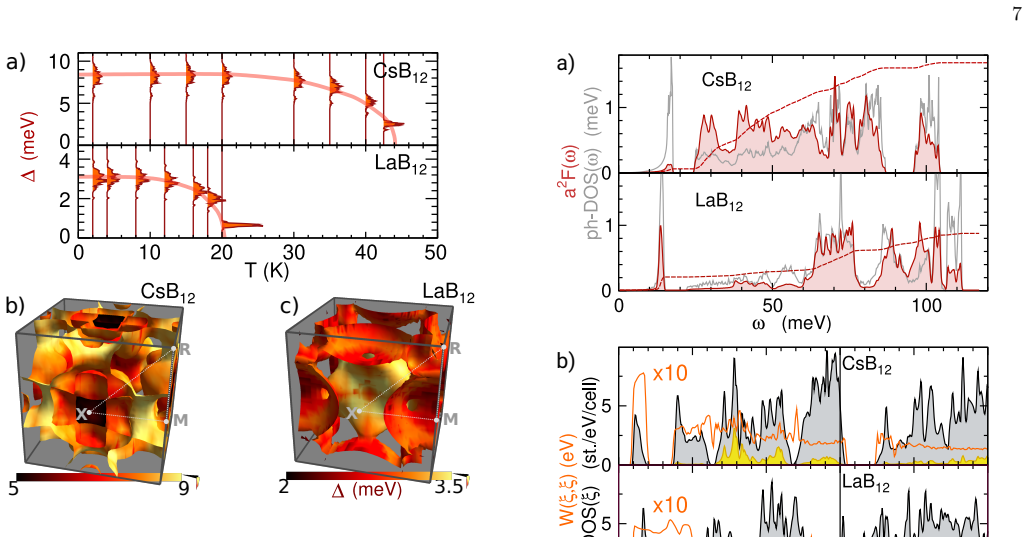
The central claim is that XB12 phases consisting of interconnected B12 icosahedra and interstitial mono- or trivalent atoms X are dynamically stable at ambient pressure after high-pressure formation, metallic, and superconducting with Tc values up to 42 K for CsB12. Superconductivity arises from broad, mode- and momentum-distributed electron-phonon coupling that involves both intra- and inter-icosahedral vibrations, enabled by the covalent B-B bonding within the superatomic network, in contrast to the more localized coupling in MgB2.
What carries the argument
The B12 icosahedral superatom, which preserves its isolated icosahedral geometry while forming an extended covalent crystalline network that, when doped metallic by electropositive X atoms, produces strong and broadly distributed electron-phonon coupling.
If this is right
- The XB12 family supplies a new route to conventional superconductors that operate at ambient pressure with Tc comparable to MgB2.
- Superconductivity is driven by coupling spread across many phonon modes and wave-vectors rather than a narrow subset.
- B12 icosahedra can function as modular superatomic units for designing extended solids with targeted electronic properties.
- High-pressure synthesis followed by pressure release offers a practical route to these phases.
Where Pith is reading between the lines
- Varying the choice of X atom could systematically tune the density of states and phonon spectrum to optimize Tc.
- Similar superatomic architectures built from other stable clusters might yield additional families of high-Tc conventional superconductors.
- The approach suggests that pressure-quench recovery of metastable superatomic crystals is a general strategy worth testing in related boron-rich systems.
Load-bearing premise
The high-pressure structures remain dynamically stable and recoverable once the pressure is removed to ambient conditions.
What would settle it
High-pressure synthesis of CsB12 followed by decompression and transport measurements that find either structural collapse or no superconductivity above roughly 10 K would refute the central prediction.
Figures


read the original abstract
We identify a new family of boron-rich compounds consisting of interconnected B$_{12}$ icosahedra, and electropositive guest atoms ($X$) in interstitial sites. These structures were found through first-principles crystal structure prediction at 50 GPa, where they could form, and are dynamically stable down to ambient pressure, so they could be formed under pressure, and brought back. When $X$ is a mono- or trivalent element the structures are metallic and superconducting. Predicted critical temperatures reach up to 42 K for CsB$_{12}$, rivaling MgB$_2$, the highest-$T_c$ ambient-pressure conventional superconductor. We interpret the XB$_{12}$ phase as a superatomic crystal: the B$_{12}$ units retain the icosahedral shape that they also exhibit in isolation, while forming an extended crystalline network. When X is a mono- or tri-valent atom, the system is metallic, and the B--B covalent bonding promotes strong electron-phonon coupling. Unlike MgB$_2$, where superconductivity is driven by a narrow subset of phonon modes, the XB$_{12}$ compounds exhibit broad, mode- and momentum-distributed coupling through both intra- and inter-superatomic vibrations. Our results highlight the XB$_{12}$ family as a promising platform for superconductivity and demonstrate the potential of superatoms as functional building blocks in solid-state materials design.
Editorial analysis
A structured set of objections, weighed in public.
Referee Report
Summary. The manuscript identifies a new family of boron-rich XB12 compounds consisting of interconnected B12 icosahedra with electropositive guest atoms X. Using first-principles crystal structure prediction at 50 GPa, the authors find structures that are dynamically stable down to ambient pressure. For mono- or trivalent X, these phases are metallic and exhibit superconductivity with predicted Tc up to 42 K for CsB12, comparable to MgB2. The compounds are interpreted as superatomic crystals where B12 units act as building blocks, leading to broad electron-phonon coupling.
Significance. If the predicted structures prove to be synthesizable and stable at ambient pressure, this work would be significant as it proposes a new class of ambient-pressure conventional superconductors with Tc rivaling the current record holder MgB2. The superatomic crystal interpretation offers a novel framework for materials design using boron icosahedra, potentially inspiring further exploration of similar motifs for high-Tc superconductivity.
major comments (2)
- Abstract: The assertion that the XB12 phases 'could be formed under pressure, and brought back' rests on the report of no imaginary phonon modes at 0 GPa. This establishes only local dynamical stability and does not address thermodynamic metastability; no formation energies versus the convex hull of elemental B, Cs, or competing borides are provided. In boron-rich systems this gap is load-bearing for the central ambient-pressure claim, as dynamically stable phases can lie >100 meV/atom above the hull and remain unquenchable.
- Phonon and Eliashberg sections: While the manuscript states that Tc values are obtained from Eliashberg equations, no convergence tests, pseudopotential choices, or k/q-grid details are supplied. This leaves the 42 K value for CsB12 without the standard checks required to support a claim rivaling MgB2.
minor comments (2)
- Abstract: The phrase 'first-principles crystal structure prediction' should specify the algorithm (e.g., USPEX or CALYPSO) and the exact pressure range explored.
- Figure captions: Labels for phonon dispersion plots and Eliashberg spectral functions should explicitly state the pressure at which each calculation was performed.
Simulated Author's Rebuttal
We thank the referee for the constructive and detailed comments. We address each major comment point by point below, indicating where revisions will be made to the manuscript.
read point-by-point responses
-
Referee: Abstract: The assertion that the XB12 phases 'could be formed under pressure, and brought back' rests on the report of no imaginary phonon modes at 0 GPa. This establishes only local dynamical stability and does not address thermodynamic metastability; no formation energies versus the convex hull of elemental B, Cs, or competing borides are provided. In boron-rich systems this gap is load-bearing for the central ambient-pressure claim, as dynamically stable phases can lie >100 meV/atom above the hull and remain unquenchable.
Authors: We agree that the absence of imaginary phonon modes establishes only dynamical (local) stability and does not by itself demonstrate thermodynamic metastability or synthesizability. This is a substantive point, especially for boron-rich compounds. In the revised manuscript we will add formation-energy calculations for the XB12 phases relative to the convex hull of elemental boron, the guest element X, and relevant competing borides. We will also revise the abstract and main text to distinguish clearly between the dynamical stability that has been shown and the additional thermodynamic analysis now provided. revision: yes
-
Referee: Phonon and Eliashberg sections: While the manuscript states that Tc values are obtained from Eliashberg equations, no convergence tests, pseudopotential choices, or k/q-grid details are supplied. This leaves the 42 K value for CsB12 without the standard checks required to support a claim rivaling MgB2.
Authors: We acknowledge the omission of these technical details. In the revised manuscript and supplementary information we will include the pseudopotential choices (PAW potentials with the specific valence configurations and recommended cutoffs), the plane-wave energy cutoffs, the k- and q-point grids used for the phonon and Eliashberg calculations, and explicit convergence tests showing that the reported Tc values (including 42 K for CsB12) change by less than 2 K upon grid refinement. These additions will support the robustness of the predictions. revision: yes
Circularity Check
No circularity: predictions follow from independent first-principles computations on newly identified structures
full rationale
The derivation begins with crystal-structure prediction at 50 GPa, followed by phonon calculations confirming dynamical stability at 0 GPa and separate electron-phonon coupling evaluations that yield Tc values via standard Eliashberg or McMillan-type equations. None of these steps reduces by construction to a fitted parameter, self-citation, or ansatz imported from prior work by the same authors. The superconducting predictions are outputs of the DFT workflow applied to the candidate structures, not tautological restatements of the input data or stability checks. The manuscript therefore remains self-contained against external benchmarks.
Axiom & Free-Parameter Ledger
axioms (1)
- domain assumption Dynamical stability at ambient pressure after high-pressure formation implies synthesizability
invented entities (1)
-
superatomic crystal
no independent evidence
Lean theorems connected to this paper
-
IndisputableMonolith/Foundation/AbsoluteFloorClosure.lean; IndisputableMonolith/Cost/FunctionalEquation.leanreality_from_one_distinction; washburn_uniqueness_aczel unclear?
unclearRelation between the paper passage and the cited Recognition theorem.
We identify a new family of XB12... structures were found through first-principles crystal structure prediction at 50 GPa... Predicted critical temperatures reach up to 42 K for CsB12... solved the fully anisotropic SCDFT equations
What do these tags mean?
- matches
- The paper's claim is directly supported by a theorem in the formal canon.
- supports
- The theorem supports part of the paper's argument, but the paper may add assumptions or extra steps.
- extends
- The paper goes beyond the formal theorem; the theorem is a base layer rather than the whole result.
- uses
- The paper appears to rely on the theorem as machinery.
- contradicts
- The paper's claim conflicts with a theorem or certificate in the canon.
- unclear
- Pith found a possible connection, but the passage is too broad, indirect, or ambiguous to say the theorem truly supports the claim.
Reference graph
Works this paper leans on
- [1]
-
[2]
T. A. Strobel, L. Zhu, P. A. Gu´ nka, G. M. Borstad, and M. Guerette, A lanthanum-filled carbon–boron clathrate, Angewandte Chemie International Edition 60, 2877 (2021)
work page 2021
-
[3]
L. Zhu, H. Liu, M. Somayazulu, Y. Meng, P. A. Gu´ nka, T. B. Shiell, C.-B. Kenney, S. Chariton, V. B. Prakapenka, H. Yoon, et al. , Superconductivity in SrB 3C3 clathrate, Physical Review Research (2023)
work page 2023
-
[4]
T. A. Strobel, T. Bi, P. A. Gu´ nka, M. F. Hansen, J.- M. H¨ ubner, S. G. Dunning, L. Zhu, S. Chariton, V. B. Prakapenka, and Y. Meng, Extending tetrahedral net- work similarity to carbon: A type-i carbon clathrate sta- bilized by boron, Science advances 11, eadv6867 (2025)
work page 2025
-
[5]
J. M. An and W. E. Pickett, Superconductivity of MgB 2: Covalent bonds driven metallic, Phys. Rev. Lett.86, 4366 (2001)
work page 2001
- [6]
- [7]
-
[8]
S. Cataldo and L. Boeri, Metal borohydrides as ambient- pressure high-t superconductors, Phys. Rev. B 107, L060501 (2023)
work page 2023
-
[9]
S. Villa-Cort´ es and O. De la Pe˜ na-Seaman, Superconduc- tivity on sch3 and yh3 hydrides: Effects of applied pres- sure in combination with electron-and hole-doping on the electron–phonon coupling properties, Chinese Journal of Physics 77, 2333 (2022)
work page 2022
- [10]
- [11]
-
[12]
X. Li, W. Zhao, Y. Hao, X. Wang, Z. Gao, and X. Ding, Ambient-pressure superconductivity above 22 k in hole- doped yb2, Journal of Applied Physics 137 (2025)
work page 2025
-
[13]
P. Jena and Q. Sun, Super atomic clusters: design rules and potential for building blocks of materials, Chemical reviews 118, 5755 (2018)
work page 2018
-
[14]
V. Matkovich, J. Economy, R. Giese, and R. Barrett, The structure of metallic dodecarborides, Acta Crystal- lographica 19, 1056 (1965)
work page 1965
-
[15]
C. H. Kennard and L. Davis, Zirconium dodecarborides zrb12. confirmation of the b12 cubooctahedral unit, Jour- nal of Solid State Chemistry 47, 103 (1983)
work page 1983
-
[16]
A. R. Oganov and C. W. Glass, Crystal structure predic- tion using ab initio evolutionary techniques: Principles and applications, The Journal of Chemical Physics 124, 244704 (2006), doi: 10.1063/1.2210932
-
[17]
A. O. Lyakhov, A. R. Oganov, H. T. Stokes, and Q. Zhu, New developments in evolutionary structure prediction algorithm {USPEX}, Comput. Phys. Commun. 184, 1172 (2013)
work page 2013
-
[18]
(), the results for other compositions are reported in the Supplementary Material Figs. S1, S2
-
[19]
H.-J. Zhai, B. Kiran, J. Li, and L.-S. Wang, Hydrocarbon analogues of boron clusters—planarity, aromaticity and antiaromaticity, Nature materials 2, 827 (2003)
work page 2003
-
[20]
S.-J. Xu, J. Nilles, D. Radisic, W.-J. Zheng, S. Stokes, K. Bowen, R. Becker, and I. Boustani, Boron clus- ter anions containing multiple b12 icosahedra, Chemical physics letters 379, 282 (2003)
work page 2003
-
[21]
B. Decker and J. Kasper, The crystal structure of a sim- ple rhombohedral form of boron, Acta Crystallographica 12, 503 (1959)
work page 1959
-
[22]
S. M. Richards and J. S. Kasper, The crystal structure of yb66, Acta Crystallographica Section B: Structural Crys- tallography and Crystal Chemistry 25, 237 (1969)
work page 1969
-
[23]
W. Sun, S. T. Dacek, S. P. Ong, G. Hautier, A. Jain, W. D. Richards, A. C. Gamst, K. A. Persson, and G. Ceder, The thermodynamic scale of inorganic crys- 9 talline metastability, Science advances 2, e1600225 (2016)
work page 2016
-
[24]
L. Zhu, G. M. Borstad, H. Liu, P. A. Gu´ nka, M. Guerette, J.-A. Dolyniuk, Y. Meng, E. Greenberg, V. B. Prakapenka, B. L. Chaloux, A. Epshteyn, R. E. Cohen, and T. A. Strobel, Carbon-boron clathrates as a new class of sp 3-bonded framework materials, Science Advances 6, eaay8361 (2020)
work page 2020
-
[25]
S. Di Cataldo, S. Qulaghasi, G. B. Bachelet, and L. Boeri, High-t c superconductivity in doped boron- carbon clathrates, Physical Review B 105, 064516 (2022)
work page 2022
-
[26]
S. Khanna and P. Jena, Assembling crystals from clus- ters, Physical review letters 69, 1664 (1992)
work page 1992
-
[27]
S. Khanna and P. Jena, Atomic clusters: Building blocks for a class of solids, Physical Review B 51, 13705 (1995)
work page 1995
-
[28]
B. Albert and H. Hillebrecht, Boron: elementary chal- lenge for experimenters and theoreticians, Angewandte Chemie International Edition 48, 8640 (2009)
work page 2009
-
[29]
X.-F. Zhou, A. R. Oganov, X. Shao, Q. Zhu, and H.-T. Wang, Unexpected reconstruction of the α-boron (111) surface, Physical Review Letters 113, 176101 (2014)
work page 2014
-
[30]
J. A. Flores-Livas, M. Grauˇ zinyt˙ e, L. Boeri, G. Profeta, and A. Sanna, Superconductivity in doped polyethylene at high pressure, The European Physical Journal B 91, 176 (2018)
work page 2018
-
[31]
J. E. Moussa and M. L. Cohen, Using molecular frag- ments to estimate electron-phonon coupling and possible superconductivity in covalent materials, Phys. Rev. B78, 064502 (2008)
work page 2008
-
[32]
H. C. Longuet-Higgins and M. d. V. Roberts, The elec- tronic structure of an icosahedron of boron atoms, Pro- ceedings of the Royal Society of London. Series A. Math- ematical and Physical Sciences 230, 110 (1955)
work page 1955
-
[33]
K. Wade, The structural significance of the number of skeletal bonding electron-pairs in carboranes, the higher boranes and borane anions, and various transition-metal carbonyl cluster compounds, Journal of the Chemical So- ciety D: Chemical Communications , 792 (1971)
work page 1971
-
[34]
(), in elements with shallow semi-core p states, such as K, Rb, Cs, Ba, these overlap in energy with those of B 12 superatoms, leading to an occupied manifold of 22 bands
-
[35]
M. L. Cohen and P. W. Anderson, Comments on the max- imum superconducting transition temperature, in AIP Conference Proceedings, Vol. 4, edited by A. I. of Physics (1972)
work page 1972
-
[36]
J. J. Hopfield, Angular momentum and transition-metal superconductivity, Physical Review 186, 443 (1969)
work page 1969
-
[37]
P. Morel and P. W. Anderson, Calculation of the su- perconducting state parameters with retarded electron- phonon interaction, Physical Review 125, 1263 (1962)
work page 1962
-
[38]
D. J. Scalapino, J. R. Schrieffer, and J. W. Wilkins, Strong-Coupling Superconductivity. I, Phys. Rev. 148, 263 (1966)
work page 1966
-
[39]
C. Pellegrini and A. Sanna, Ab initio methods for super- conductivity, Nature Reviews Physics 6, 509 (2024)
work page 2024
-
[40]
P. B. Allen and B. Mitrovi´ c,Theory of Superconducting Tc, Solid State Physics, Vol. 37 (Academic Press, 1983) pp. 1 – 92
work page 1983
-
[41]
J. A. Flores-Livas, L. Boeri, A. Sanna, G. Profeta, R. Arita, and M. I. Eremets, A perspective on conven- tional high-temperature superconductors at high pres- sure: Methods and materials, Phys. Rep. 856, 1 (2020)
work page 2020
-
[42]
P. Morel and P. W. Anderson, Calculation of the Su- perconducting State Parameters with Retarded Electron- Phonon Interaction, Phys. Rev. 125, 1263 (1962)
work page 1962
-
[43]
A. Sanna, J. A. Flores-Livas, A. Davydov, G. Pro- feta, K. Dewhurst, S. Sharma, and E. K. U. Gross, Ab initio eliashberg theory: Making gen- uine predictions of superconducting features, Journal of the Physical Society of Japan 87, 041012 (2018), https://doi.org/10.7566/JPSJ.87.041012
-
[44]
C. Pellegrini, C. Kukkonen, and A. Sanna, Ab initio calculations of superconducting transition temperatures: When going beyond RPA is essential, Phys. Rev. B 108, 064511 (2023)
work page 2023
- [45]
-
[46]
G. Kresse and J. Furthm¨ uller, Efficient iterative schemes for ab initio total-energy calculations using a plane-wave basis set, Phys. Rev. B 54, 11169 (1996)
work page 1996
-
[47]
G. Kresse and D. Joubert, From ultrasoft pseudopoten- tials to the projector augmented-wave method, Phys. Rev. B 59, 1758 (1999)
work page 1999
-
[48]
J. P. Perdew, K. Burke, and M. Ernzerhof, Generalized gradient approximation made simple, Phys. Rev. Lett. 77, 3865 (1996)
work page 1996
-
[49]
Supplemental information regarding details of DFT cal- culations, as well as additional figures detailing the elec- tronic and structural properties of the XB 12 borides is available at XXX [will be updated upon publication]
-
[50]
Quantum espresso: a modular and open-source software project for quantum simulations of materials, Journal of Physics: Condensed Matter 21, 395502 (2009)
work page 2009
-
[51]
P. Giannozzi, O. Andreussi, T. Brumme, O. Bunau, M. B. Nardelli, M. Calandra, R. Car, C. Cavazzoni, D. Ceresoli, M. Cococcioni, N. Colonna, I. Carnimeo, A. D. Corso, S. de Gironcoli, P. Delugas, R. A. DiStasio, A. Ferretti, A. Floris, G. Fratesi, G. Fugallo, R. Gebauer, U. Gerstmann, F. Giustino, T. Gorni, J. Jia, M. Kawa- mura, H.-Y. Ko, A. Kokalj, E. K¨...
work page 2017
-
[52]
D. R. Hamann, Optimized norm-conserving Vanderbilt pseudopotentials, Phys. Rev. B 88, 085117 (2013)
work page 2013
-
[53]
The Elk FP-LAPW Code, http://elk.sourceforge.net
- [54]
- [55]
-
[56]
C. Pellegrini, R. Heid, and A. Sanna, Eliashberg theory with ab-initio coulomb interactions: a minimal numerical scheme applied to layered superconductors, Journal of Physics: Materials 5, 024007 (2022)
work page 2022
-
[57]
M. Kawamura, Fermisurfer: Fermi-surface viewer provid- ing multiple representation schemes, Computer Physics Communications 239, 197 (2019)
work page 2019
discussion (0)
Sign in with ORCID, Apple, or X to comment. Anyone can read and Pith papers without signing in.