REVIEW 4 major objections 4 minor 46 references
Enhancing Orthopox Image Classification Using Hybrid Machine Learning and Deep Learning Models
T0 review · 4 major / 4 minor · reviewed 2026-08-07 · deepseek-v4-flash
Pith's one-line read A frozen ImageNet-pretrained ResNet-50 used as a fixed feature extractor, followed by Logistic Regression, reaches about 91.5% accuracy on the Monkeypox Skin Images Dataset, and the paper contends that earlier 97–98% state-of-the-art…
desk verdict The leakage critique is the real contribution; the paper's own 91.49% is a CV mean, not a hold-out accuracy, so the comparison to prior work does not hold as written. read the letter →
The pith
A machine-rendered reading of the paper's core claim, the machinery that carries it, and where it could break.
The reading
What carries the argument
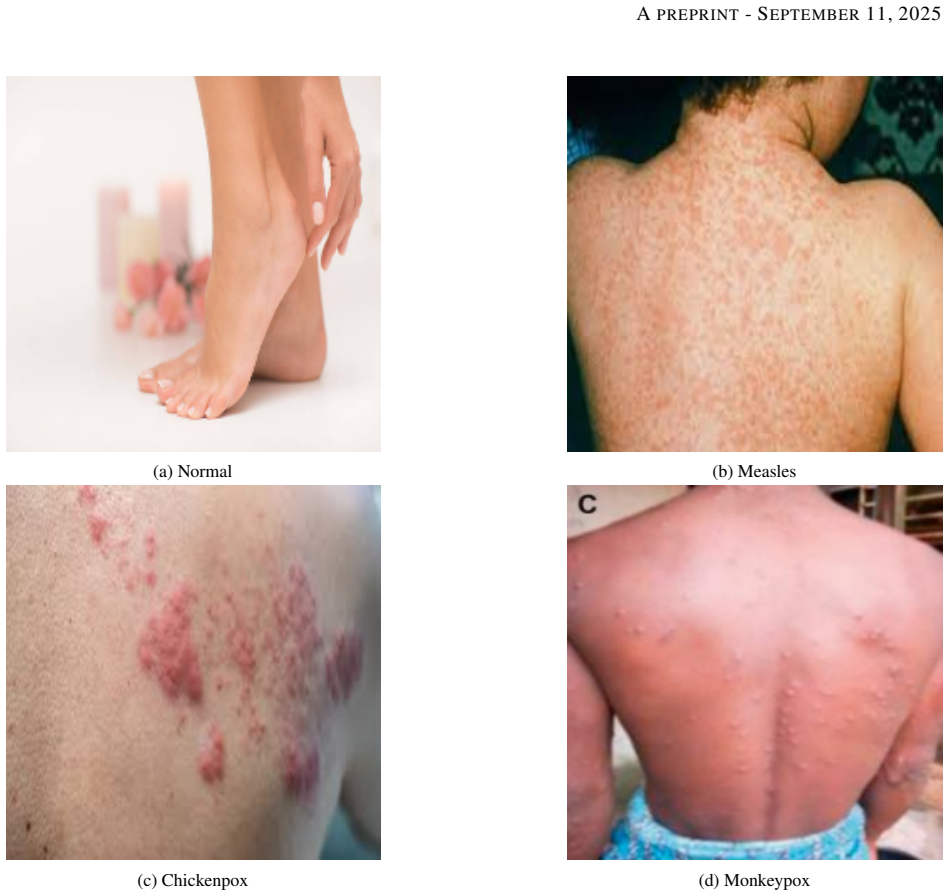
The mechanism is the hybrid pipeline: a frozen ResNet-50 (trained on ImageNet, last layer removed) converts each 224x224 image into a 100,352-dimensional feature vector, and then a lightweight classifier - Logistic Regression, MLP, or SVM - is trained on those vectors. Evaluation uses stratified 10-fold cross-validation over 90% of the dataset (693 images) plus a fixed, held-out stratified test set of 77 images, with Cohen's Kappa as the primary metric because accuracy is misleading on the imbalanced four classes (normal, measles, chickenpox, monkeypox). Two preprocessing variants are added for comparison: SMOTEENN to balance the training set, and random augmentation (vertical flip and Gaussian blur, applied only to training) to enlarge it. The same fixed test set is used for every configuration, which the paper cites as the guarantee of impartial comparison.
What would settle it
Re-evaluate the checkpoints released with Bala et al. [6] and Maqsood et al. [27] on the 77 original, non-augmented images used as this paper's test set: if either model still scores near 97-98%, the leakage claim fails, and if accuracy collapses to the ~90% range, it is supported. A complementary test is to re-run this paper's pipeline with nested cross-validation so the fixed test set is touched only once; if Kappa drops materially below 71%, repeated use of the test set inflated the reported results.
Extended reading notes
Core claim
On the paper's own terms, the central discovery is that deep features extracted once by a frozen ImageNet-pretrained ResNet-50 make orthopox image classification tractable for simple classifiers: Logistic Regression attains the best balance of accuracy (90.00%) and Kappa (71.19%) on the original dataset, and neither SMOTEENN balancing nor six-fold data augmentation changes results by more than a few points. The paper also documents that the two best-performing prior studies, Bala et al. and Maqsood et al., drew their test sets from augmented data (1,738 images) instead of the original dataset, so their reported 97.61% and 98.64% accuracies do not reflect independent generalization; on a clean, stratified 77-image test set the proposed pipeline reaches at most 91.49%. The paper concludes that the apparent performance gap is an artifact of test-set contamination, not a real superiority of complex models.
Load-bearing premise
The evaluation assumes that the fixed 77-image test set can be used repeatedly to pick the best model configuration and still count as unseen data; if the test set influenced the choice of classifier or hyperparameters, the reported accuracies overstate generalization.
Editorial extensions
If this is right
- The two highest published accuracies on the Monkeypox Skin Images Dataset should not be cited as state of the art without first checking whether their test sets were produced by augmentation before splitting; this paper provides the evidence of that leakage.
- A linear classifier on frozen, pretrained deep features is a strong and cheap baseline for small medical image datasets, likely beating many bespoke deep models at a fraction of the training cost.
- Data augmentation should be applied only after the training/validation/test split, because any accuracy gain from augmenting the full dataset and then splitting is not a real gain.
- Balancing and augmentation give diminishing returns: increasing training size by 34% with SMOTEENN or by 600% with augmentation changed Kappa by only a few points, so model capacity is not the bottleneck on this dataset.
- The proposed method's generalization claims rest on a single 77-image test set, and point estimates like 91.49% carry wide confidence intervals at that size.
Reading between the lines
- The same augment-then-split leakage the paper documents for Bala et al. and Maqsood et al. likely affects other small medical imaging benchmarks, so those reported numbers should be audited in the same way before being used as baselines.
- Because frozen features already saturate performance on this dataset, expensive fine-tuning of large models is probably unnecessary here; a testable extension is to compare fine-tuned ResNet-50 against the frozen-feature pipeline under nested cross-validation.
- The fixed test set was reused to select the best configuration, so a natural follow-up is to set aside a second, never-touched test set and check whether the ~71% Kappa survives, or to report a confidence interval for the 77-image accuracy.
- For clinical deployment the four-class accuracy matters less than the confusion pattern between monkeypox and the other rash classes; reporting per-class errors would show whether mistakes are clinically safe, which is where this dataset's next evaluation should focus.
Editorial analysis
A structured set of objections, weighed in public.
Referee Report
Summary. The paper proposes a hybrid pipeline for classifying four classes in the Monkeypox Skin Images Dataset (MSID): a frozen ImageNet-pretrained ResNet-50 extracts deep features, which are then used to train lightweight classifiers (Logistic Regression, SVM, MLP). Three training-condition experiments are compared: original data, SMOTEENN-balanced data, and data augmentation applied only to the training split. The authors report that Logistic Regression on augmented features attains the best mean cross-validation accuracy (91.49%) and use this value to claim near-state-of-the-art performance, while arguing that the higher accuracies reported by Bala et al. (97.61%) and Maqsood et al. (98.64%) are inflated because their test sets were drawn from augmented data. The paper also provides a GitHub link to source code.
Significance. If the evaluation were sound, the paper would make a useful practical contribution: a computationally cheap, interpretable, and auditable pipeline that does not require fine-tuning a deep network, plus a concrete warning about data leakage via test-set augmentation in prior MSID studies. The authors deserve credit for publishing hyperparameter details, making code available, and emphasizing Cohen's Kappa rather than raw accuracy. However, the central quantitative claim is currently not established because the reported headline number is a cross-validation mean, not a hold-out test accuracy, and the fixed 77-image test set appears to have been reused for model selection. These issues materially affect the comparison with prior work and the generalization claims, so the paper needs a substantial revision of its evaluation and reporting before the conclusions can be accepted.
major comments (4)
- [Section 3.5 and Section 4.1] The evaluation protocol does not support the claim of an unbiased final hold-out evaluation. Section 3.5 states that all model configurations are continuously evaluated on the fixed 77-image test set, and Section 4.1 states that the best configuration is selected after inspecting results. Any selection based on that fixed set consumes its information, so the test set is not truly unseen for the selected model. Please report the performance of a single final model on a hold-out set that was never used during development (e.g., a nested cross-validation or a strict three-way split), or present hold-out results with the selection procedure explicitly accounted for.
- [Table 9 and Sections 4.2.3/5] The central comparison of the proposed method (91.49%) with Bala et al. (97.61%) and Maqsood et al. (98.64%) is not valid as presented. The 91.49% is the mean accuracy over 10-fold cross-validation folds reported in Table 7, not an accuracy measured on the fixed 77-image hold-out set, while the prior values are single test-set accuracies. Cross-validation means over models trained on overlapping 90% subsets are not directly comparable to a single split, so the comparison cannot support the paper's conclusion that prior results are inflated. Please report the accuracy and confidence intervals of the final selected model on a properly held-out set and use that number, not the CV mean, in Table 9.
- [Sections 3.5, 4.2, and 5] The claim that results are 'assessed on truly unseen data' (Section 5) is not supported by the evidence, because Tables 3-8 report only cross-validation fold statistics (mean +/- std or SE) and no table reports metrics computed on the 77-image final test set. Please add a table with hold-out accuracy, precision, recall, F1, and Kappa, with confidence intervals, for all configurations, and clearly label in the text which numbers are CV estimates and which are hold-out estimates.
- [Section 4.2.1 (and corresponding paragraphs)] The Mann-Whitney U tests are applied to distributions of Cohen's Kappa obtained from the 10 cross-validation folds. These fold-level values are not independent observations: the training sets overlap across folds and the same fixed test set is reused. The independence assumption of the Mann-Whitney U test is therefore violated. Please use a statistical test or resampling procedure that accounts for the dependence structure, or base the tests on independent test-set evaluations.
minor comments (4)
- [Table 2] Table 2 lists 'Vertical flipping with 50% probability' in the Data Augmentation row but then states 'Vertical flipping was excluded'; the text in Section 3.2 and Figure 2 also say vertical flipping is excluded. Please resolve this contradiction.
- [Throughout] There are several typos and inconsistencies: 'Propossed method' in Table 9, 'SMOTEEN' in the Table 6 heading (should be SMOTEENN), 'EE' in the Table 8 caption (should be SE), and '4.158' in Section 4.2.3 should be '4,158'.
- [Abstract and Section 4.2.3] The abstract says the method works 'without the need for augmented data,' but the experiments include a data-augmentation condition and the best reported mean accuracy is from that condition. Please clarify that strong performance can be obtained without augmentation, while acknowledging that augmentation gives a small improvement.
- [Section 3.3 and Section 4.1] The paper states that 100,352 features are extracted per image from ResNet-50. Please specify the exact layer and pooling strategy (e.g., the 7x7x2048 spatial features before global pooling) so the feature dimensionality is reproducible.
Circularity Check
No significant circularity: the method is an empirical benchmark against an external public dataset, and the only self-citation (reference [35]) supports choice of standard metrics and is not load-bearing.
full rationale
This paper makes no formal derivation whose conclusion is equivalent to its assumptions. The central empirical claim is that an ImageNet-pretrained ResNet-50 feature extractor with simple classifiers, particularly Logistic Regression, achieves competitive accuracy on the Monkeypox Skin Images Dataset (MSID), an external public dataset with independent prior results. The 91.49% figure quoted in Table 9 is the 10-fold cross-validation mean from Table 7, not a hold-out test accuracy, and the paper's comparison of this number with prior single-split test accuracies is a methodological comparability concern, not circularity: the number is not obtained by fitting a parameter and then predicting the same fitted quantity. The only self-citation is reference [35], used in Section 3.5 to justify standard evaluation metrics (accuracy, recall, precision, F1, Cohen's Kappa); those formulas are textbook definitions and do not feed back into the results. The claim that Bala et al. and Maqsood et al. overestimate performance due to test-set augmentation is based on the test-set sizes and split tables quoted from those publications (Table 10), not on a self-referential argument. The repeated use of a fixed 77-image hold-out set for model selection, and the absence of reported hold-out accuracy, are validity limitations but do not make any prediction equivalent to its inputs by construction. No load-bearing step reduces to a self-citation, ansatz imported from the authors' own prior work, or renamed known result. Score 0 is therefore appropriate.
Assumptions & free parameters
free parameters (5)
- Logistic Regression inverse regularization strength (C) =
0.1
- MLP hidden layer size and L2 regularization =
100 neurons, alpha=0.05
- SVM regularization strength and kernel =
C=100, sigmoid kernel
- SMOTEENN nearest-neighbor count =
k=5
- Data augmentation schedule =
6 new images per training image; vertical flip 50%; Gaussian blur kernel 5 with 50% probability
assumptions (5)
- domain assumption The Monkeypox Skin Images Dataset (MSID) is a valid, clinically meaningful benchmark.
- domain assumption ImageNet-pretrained ResNet-50 features transfer to dermatology images without fine-tuning.
- domain assumption The 77-image stratified hold-out set is representative of the clinical population.
- domain assumption Mann-Whitney U tests are valid when applied to scores from 10-fold cross-validation folds.
- ad hoc to paper The fixed test set can be reused for configuration selection and still be considered unseen.
Cite this review
Pith. "Pith review of Enhancing Orthopox Image Classification Using Hybrid Machine Learning and Deep Learning Models." pith.science (2026). https://pith.science/paper/PJBLQB5D
@misc{pith2026250606007,
  author       = {Pith},
  title        = {Pith review of: Enhancing Orthopox Image Classification Using Hybrid Machine Learning and Deep Learning Models},
  year         = {2026},
  howpublished = {\url{https://pith.science/paper/PJBLQB5D}},
  note         = {Machine review of arXiv:2506.06007}
}
read the original abstract
Orthopoxvirus infections must be accurately classified from medical pictures for an easy and early diagnosis and epidemic prevention. The necessity for automated and scalable solutions is highlighted by the fact that traditional diagnostic techniques can be time-consuming and require expert interpretation and there are few and biased data sets of the different types of Orthopox. In order to improve classification performance and lower computational costs, a hybrid strategy is put forth in this paper that uses Machine Learning models combined with pretrained Deep Learning models to extract deep feature representations without the need for augmented data. The findings show that this feature extraction method, when paired with other methods in the state-of-the-art, produces excellent classification outcomes while preserving training and inference efficiency. The proposed approach demonstrates strong generalization and robustness across multiple evaluation settings, offering a scalable and interpretable solution for real-world clinical deployment.
Figures


Figures from the paper (5 more)


Reference graph
Works this paper leans on
-
[1]
Muhammad Ajmal, Muhammad Attique Khan, Tallha Akram, Abdullah Alqahtani, Majed Alhaisoni, Ammar Armghan, Sara A Althubiti, and Fayadh Alenezi. Bf2sknet: Best deep learning features fusion-assisted framework for multiclass skin lesion classification.Neural Computing and Applications, 35(30):22115–22131, 2023
work page 2023
-
[2]
Edited nearest neighbor rule for improving neural networks classifications
Roberto Alejo, José Martínez Sotoca, Rosa Maria Valdovinos, and P Toribio. Edited nearest neighbor rule for improving neural networks classifications. InAdvances in Neural Networks-ISNN 2010: 7th International Symposium on Neural Networks, ISNN 2010, Shanghai, China, June 6-9, 2010, Proceedings, Part I 7, pages 303–310. Springer, 2010
work page 2010
-
[3]
Amal H Alharbi, SK Towfek, Abdelaziz A Abdelhamid, Abdelhameed Ibrahim, Marwa M Eid, Doaa Sami Khafaga, Nima Khodadadi, Laith Abualigah, and Mohamed Saber. Diagnosis of monkeypox disease using transfer learning and binary advanced dipper throated optimization algorithm.Biomimetics, 8(3):313, 2023
work page 2023
-
[4]
Sohaib Asif, Ming Zhao, Yangfan Li, Fengxiao Tang, and Yusen Zhu. Cgo-ensemble: Chaos game optimization algorithm-based fusion of deep neural networks for accurate mpox detection.Neural Networks, 173:106183, 2024
work page 2024
-
[5]
An update of orthopoxvirus molecular evolution.Viruses, 14(2):388, 2022
Igor V Babkin, Irina N Babkina, and Nina V Tikunova. An update of orthopoxvirus molecular evolution.Viruses, 14(2):388, 2022
work page 2022
-
[6]
Diponkor Bala, Md Shamim Hossain, Mohammad Alamgir Hossain, Md Ibrahim Abdullah, Md Mizanur Rahman, Balachandran Manavalan, Naijie Gu, Mohammad S Islam, and Zhangjin Huang. Monkeynet: A robust deep convolutional neural network for monkeypox disease detection and classification.Neural Networks, 161:757–775, 2023
work page 2023
-
[7]
Springer, 2006
Christopher M Bishop and Nasser M Nasrabadi.Pattern recognition and machine learning, volume 4. Springer, 2006
2006
-
[8]
Resnet: Solving vanishing gradient in deep networks
Lokesh Borawar and Ravinder Kaur. Resnet: Solving vanishing gradient in deep networks. InProceedings of International Conference on Recent Trends in Computing: ICRTC 2022, pages 235–247. Springer, 2023
work page 2022
Show all 46 references
-
[9]
Artificial intelligence—a modern approach by stuart russell and peter norvig, prentice hall
Gerd Brewka. Artificial intelligence—a modern approach by stuart russell and peter norvig, prentice hall. series in artificial intelligence, englewood cliffs, nj.The Knowledge Engineering Review, 11(1):78–79, 1996
1996
-
[10]
Medical image classification via svm using lbp features from saliency-based folded data
Zehra Camlica, Hamid R Tizhoosh, and Farzad Khalvati. Medical image classification via svm using lbp features from saliency-based folded data. In2015 IEEE 14th international conference on machine learning and applications (ICMLA), pages 128–132. IEEE, 2015
2015
-
[11]
Application of artificial intelligence techniques for monkeypox: a systematic review
Krishnaraj Chadaga, Srikanth Prabhu, Niranjana Sampathila, Sumith Nireshwalya, Swathi S Katta, Ru-San Tan, and U Rajendra Acharya. Application of artificial intelligence techniques for monkeypox: a systematic review. Diagnostics, 13(5):824, 2023
2023
-
[12]
Smote: synthetic minority over-sampling technique.Journal of artificial intelligence research, 16:321–357, 2002
Nitesh V Chawla, Kevin W Bowyer, Lawrence O Hall, and W Philip Kegelmeyer. Smote: synthetic minority over-sampling technique.Journal of artificial intelligence research, 16:321–357, 2002
2002
-
[13]
Pigmented skin disease classification via deep learning with an attention mechanism.Applied Soft Computing, 170:112571, 2025
Jinbo Chen, Qian Jiang, Zhuang Ai, Qihao Wei, Sha Xu, Baohai Hao, Yaping Lu, Xuan Huang, and Liuqing Chen. Pigmented skin disease classification via deep learning with an attention mechanism.Applied Soft Computing, 170:112571, 2025
2025
-
[14]
A review of medical image data augmentation techniques for deep learning applications.Journal of medical imaging and radiation oncology, 65(5):545–563, 2021
Phillip Chlap, Hang Min, Nym Vandenberg, Jason Dowling, Lois Holloway, and Annette Haworth. A review of medical image data augmentation techniques for deep learning applications.Journal of medical imaging and radiation oncology, 65(5):545–563, 2021. 15 APREPRINT- SEPTEMBER11, 2025
2021
-
[15]
A novel hybrid model combining vision transformers and graph convolutional networks for monkeypox disease effective diagnosis.Information Fusion, 117:102858, 2025
Bihter Das, Huseyin Alperen Dagdogen, Muhammed Onur Kaya, and Resul Das. A novel hybrid model combining vision transformers and graph convolutional networks for monkeypox disease effective diagnosis.Information Fusion, 117:102858, 2025
2025
-
[16]
Imagenet: A large-scale hierarchical image database
Jia Deng, Wei Dong, Richard Socher, Li-Jia Li, Kai Li, and Li Fei-Fei. Imagenet: A large-scale hierarchical image database. In2009 IEEE conference on computer vision and pattern recognition, pages 248–255. Ieee, 2009
2009
-
[17]
Lsnet: a deep learning based method for skin lesion classification using limited samples and transfer learning.Multimedia Tools and Applications, pages 1–21, 2024
Xiaodan Deng. Lsnet: a deep learning based method for skin lesion classification using limited samples and transfer learning.Multimedia Tools and Applications, pages 1–21, 2024
2024
-
[18]
James H Diaz. The disease ecology, epidemiology, clinical manifestations, management, prevention, and control of increasing human infections with animal orthopoxviruses.Wilderness & environmental medicine, 32(4):528–536, 2021
2021
-
[19]
Utilizing convolutional neural networks to classify monkeypox skin lesions.Scientific reports, 13(1):14495, 2023
Entesar Hamed I Eliwa, Amr Mohamed El Koshiry, Tarek Abd El-Hafeez, and Heba Mamdouh Farghaly. Utilizing convolutional neural networks to classify monkeypox skin lesions.Scientific reports, 13(1):14495, 2023
2023
-
[20]
Shapiro–wilk test with known mean.REVSTAT- statistical Journal, 14(1):89–100, 2016
Zofia Hanusz, Joanna Tarasinska, and Wojciech Zielinski. Shapiro–wilk test with known mean.REVSTAT- statistical Journal, 14(1):89–100, 2016
2016
-
[21]
Deep residual learning for image recognition
Kaiming He, Xiangyu Zhang, Shaoqing Ren, and Jian Sun. Deep residual learning for image recognition. In Proceedings of the IEEE conference on computer vision and pattern recognition, pages 770–778, 2016
2016
-
[22]
Artificial intelligence in dermatology—where we are and the way to the future: a review.American journal of clinical dermatology, 21:41–47, 2020
Daniel T Hogarty, John C Su, Kevin Phan, Mohamed Attia, Mohammed Hossny, Saeid Nahavandi, Patricia Lenane, Fergal J Moloney, and Anousha Yazdabadi. Artificial intelligence in dermatology—where we are and the way to the future: a review.American journal of clinical dermatology,...
2020
-
[23]
Resnet 50
Brett Koonce. Resnet 50. InConvolutional neural networks with swift for tensorflow: image recognition and dataset categorization, pages 63–72. Springer, 2021
2021
-
[24]
Federated deep learning for monkeypox disease detection on gan-augmented dataset.IEEE Access, 2024
Dipanjali Kundu, Md Mahbubur Rahman, Anichur Rahman, Diganta Das, Umme Raihan Siddiqi, Md Golam Ra- biul Alam, Samrat Kumar Dey, Ghulam Muhammad, and Zulfiqar Ali. Federated deep learning for monkeypox disease detection on gan-augmented dataset.IEEE Access, 2024
2024
-
[25]
Deep learning.nature, 521(7553):436–444, 2015
Yann LeCun, Yoshua Bengio, and Geoffrey Hinton. Deep learning.nature, 521(7553):436–444, 2015
2015
-
[26]
Classification of cardiac arrhythmia of 12 lead ecg using combination of smoteenn, xgboost and machine learning algorithms
BR Manju and Anju R Nair. Classification of cardiac arrhythmia of 12 lead ecg using combination of smoteenn, xgboost and machine learning algorithms. In2019 9th International Symposium on Embedded Computing and System Design (ISED), pages 1–7. IEEE, 2019
2019
-
[27]
Mox-net: Multi-stage deep hybrid feature fusion and selection framework for monkeypox classification.Expert Systems with Applications, 255:124584, 2024
Sarmad Maqsood, Robertas Damaševi ˇcius, Sana Shahid, and Nils D Forkert. Mox-net: Multi-stage deep hybrid feature fusion and selection framework for monkeypox classification.Expert Systems with Applications, 255:124584, 2024
2024
-
[28]
Mann-whitney u test.The Corsini encyclopedia of psychology, pages 1–1, 2010
Patrick E McKnight and Julius Najab. Mann-whitney u test.The Corsini encyclopedia of psychology, pages 1–1, 2010
2010
-
[29]
Monkeypox.The Lancet, 401(10370):60–74, 2023
Oriol Mitjà, Dimie Ogoina, Boghuma K Titanji, Cristina Galvan, Jean-Jacques Muyembe, Michael Marks, and Chloe M Orkin. Monkeypox.The Lancet, 401(10370):60–74, 2023
2023
-
[30]
Towards a guideline for evaluation metrics in medical image segmentation.BMC Research Notes, 15(1):210, 2022
Dominik Müller, Iñaki Soto-Rey, and Frank Kramer. Towards a guideline for evaluation metrics in medical image segmentation.BMC Research Notes, 15(1):210, 2022
2022
-
[31]
The who declaration of monkeypox as a global public health emergency.Jama, 328(7):615–617, 2022
Jennifer B Nuzzo, Luciana L Borio, and Lawrence O Gostin. The who declaration of monkeypox as a global public health emergency.Jama, 328(7):615–617, 2022
2022
-
[32]
An innovative deep learning framework for skin cancer detection employing convnextv2 and focal self-attention mechanisms.Results in Engineering, 25:103692, 2025
Burhanettin Ozdemir and Ishak Pacal. An innovative deep learning framework for skin cancer detection employing convnextv2 and focal self-attention mechanisms.Results in Engineering, 25:103692, 2025
2025
-
[33]
Data classification with k-fold cross validation and holdout accuracy estimation methods with 5 different machine learning techniques
Kaushika Pal and Biraj V Patel. Data classification with k-fold cross validation and holdout accuracy estimation methods with 5 different machine learning techniques. In2020 fourth international conference on computing methodologies and communication (ICCMC), pages 83–87. IEEE, 2020
2020
-
[34]
Orthopox viruses: infections in humans.Transfusion Medicine and Hemotherapy, 37(6):351, 2010
Georg Pauli, Johannes Blümel, Reinhard Burger, Christian Drosten, Albrecht Gröner, Lutz Gürtler, Margarethe Heiden, Martin Hildebrandt, Bernd Jansen, Thomas Montag-Lessing, et al. Orthopox viruses: infections in humans.Transfusion Medicine and Hemotherapy, 37(6):351, 2010
2010
-
[35]
Automatic assessment of alzheimer’s disease diagnosis based on deep learning techniques.Computers in biology and medicine, 120:103764, 2020
Alejandro Puente-Castro, Enrique Fernandez-Blanco, Alejandro Pazos, and Cristian R Munteanu. Automatic assessment of alzheimer’s disease diagnosis based on deep learning techniques.Computers in biology and medicine, 120:103764, 2020. 16 APREPRINT- SEPTEMBER11, 2025
2020
-
[36]
Erfan Rahmani, Ziba Bayat, Mehrdad Farrokhi, Shiva Karimian, Reza Zahedpasha, Hamed Sabzehie, Sepehr Ramezani Poor, Parisa Jafari Khouzani, Solmaz Aminpour, Mohammad Karami, et al. Monkeypox: A comprehensive review of virology, epidemiology, transmission, diagnosis, prevention...
2024
-
[37]
Alsufiani, and Faris A Almalki
Nadeem Sarwar, Asma Irshad, Qamar H Naith, Kholod D. Alsufiani, and Faris A Almalki. Skin lesion segmentation using deep learning algorithm with ant colony optimization.BMC Medical Informatics and Decision Making, 24(1):265, 2024
2024
-
[38]
An increasing danger of zoonotic orthopoxvirus infections.PLoS pathogens, 9(12):e1003756, 2013
Sergei N Shchelkunov. An increasing danger of zoonotic orthopoxvirus infections.PLoS pathogens, 9(12):e1003756, 2013
2013
-
[39]
Evaluation of artificial intelligence-powered screening for sexually transmitted infections-related skin lesions using clinical images and metadata.BMC medicine, 22(1):296, 2024
Nyi N Soe, Zhen Yu, Phyu M Latt, David Lee, Jason J Ong, Zongyuan Ge, Christopher K Fairley, and Lei Zhang. Evaluation of artificial intelligence-powered screening for sexually transmitted infections-related skin lesions using clinical images and metadata.BMC medicine, 22(1):296, 2024
2024
-
[40]
Dscc_net: multi-classification deep learning models for diagnosing of skin cancer using dermoscopic images.Cancers, 15(7):2179, 2023
Maryam Tahir, Ahmad Naeem, Hassaan Malik, Jawad Tanveer, Rizwan Ali Naqvi, and Seung-Won Lee. Dscc_net: multi-classification deep learning models for diagnosing of skin cancer using dermoscopic images.Cancers, 15(7):2179, 2023
2023
-
[41]
Skin cancer detection using ensemble of machine learning and deep learning techniques.Multimedia Tools and Applications, 82(18):27501– 27524, 2023
Jitendra V Tembhurne, Nachiketa Hebbar, Hemprasad Y Patil, and Tausif Diwan. Skin cancer detection using ensemble of machine learning and deep learning techniques.Multimedia Tools and Applications, 82(18):27501– 27524, 2023
2023
-
[42]
Unext: Mlp-based rapid medical image segmentation network
Jeya Maria Jose Valanarasu and Vishal M Patel. Unext: Mlp-based rapid medical image segmentation network. In International conference on medical image computing and computer-assisted intervention, pages 23–33. Springer, 2022
2022
-
[43]
Multi-classification of skin lesion images including mpox disease using transformer-based deep learning architectures.Diagnostics, 15(3):374, 2025
Seyfettin Vuran, Murat Ucan, Mehmet Akin, and Mehmet Kaya. Multi-classification of skin lesion images including mpox disease using transformer-based deep learning architectures.Diagnostics, 15(3):374, 2025
2025
-
[44]
Data-centric artificial intelligence: A survey.ACM Computing Surveys, 57(5):1–42, 2025
Daochen Zha, Zaid Pervaiz Bhat, Kwei-Herng Lai, Fan Yang, Zhimeng Jiang, Shaochen Zhong, and Xia Hu. Data-centric artificial intelligence: A survey.ACM Computing Surveys, 57(5):1–42, 2025
2025
-
[45]
Detection of ovarian tumors in obstetric ultrasound imaging using logistic regression classifier with an advanced machine learning approach.IEEE Access, 8:44999–45008, 2020
Zheng Zhang and Yibo Han. Detection of ovarian tumors in obstetric ultrasound imaging using logistic regression classifier with an advanced machine learning approach.IEEE Access, 8:44999–45008, 2020
2020
-
[46]
Rotation invariant convolutions for 3d point clouds deep learning
Zhiyuan Zhang, Binh-Son Hua, David W Rosen, and Sai-Kit Yeung. Rotation invariant convolutions for 3d point clouds deep learning. In2019 International conference on 3d vision (3DV), pages 204–213. IEEE, 2019. 17
2019
Reviewed August 7, 2026 · model on record in the stance chip above.
Discussion (0). Continue with ORCID to comment.