REVIEW 4 major objections 7 minor 116 references
Synchronized two-timescale hierarchical RL jointly adapts long- and short-term operating rules, with proven average-gap rates and higher, stabler profits under joint shocks.
Reviewed by Pith at T0; open to challenge. T0 means a machine referee read the full paper against a public rubric. the ladder, T0–T4 →
T0 review · grok-4.5
2026-07-30 22:09 UTC pith:PJE5RPXP
load-bearing objection Solid ops HRL paper with a real synchronized two-timescale population convergence result and a clean 2×2 simulation; theory does not yet cover the sampled PPO-Clip they actually run. the 4 major comments →
Two-Timescale Hierarchical Reinforcement Learning for Resilient Operations
The pith
A machine-rendered reading of the paper's core claim, the machinery that carries it, and where it could break.
Core claim
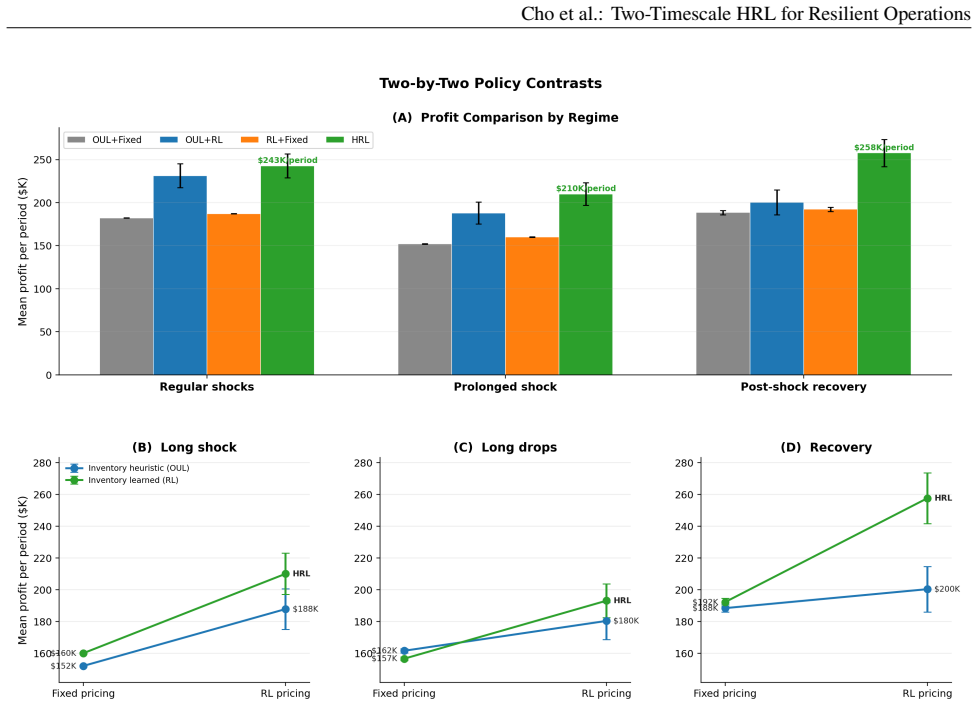
When long-term and short-term policies are interdependent, synchronizing their update scales yields the first convergence guarantees for coupled two-timescale hierarchical learning: over T periods the average optimality gap is O(T^{-1/2}), improving to O(log T/T) when poor decisions produce clearer profit losses. In the used-car setting, joint adaptation of replenishment and pricing raises mean profit by 9.2% under joint shocks and 11.8% under a prolonged joint shock versus the strongest partially adaptive benchmark, and keeps a more stable profit trajectory through disruption and recovery.
What carries the argument
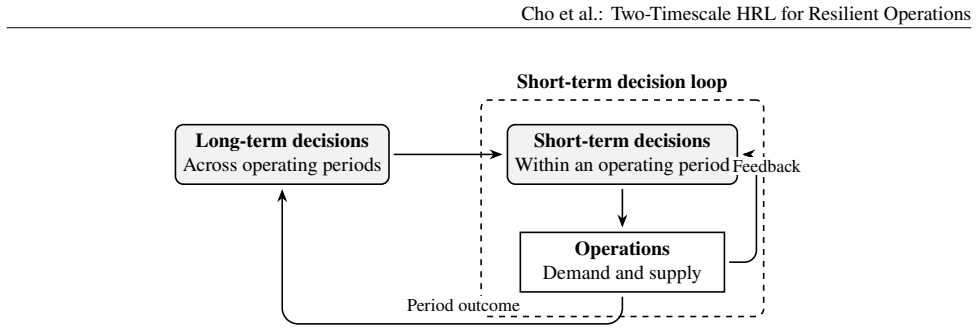
Synchronized two-timescale PPO-style policy improvement: the cumulative short-term update scale within a period is tied to the long-term step by M η_f = {K/(1−Γ)} η_s, so each layer’s movement stays aligned with the other’s learning signal and the average gap to an optimal policy pair can be bounded.
Load-bearing premise
The proved rates are for idealized population updates with exact advantages on finite state and action spaces, not for the sampled, parameterized policies actually trained in the case study.
What would settle it
In the paper’s paired used-car design, check whether HRL still beats OUL+RL on mean profit and recovery under joint demand–supply shocks (and whether the 2×2 interaction contrast stays positive in recovery); a clear loss or non-positive coordination contrast would undercut the central empirical claim, while desynchronizing the two learning rates in the finite population setting should destroy the claimed average-gap decay.
If this is right
- Firms can add joint adaptive learning on top of existing hierarchical planning without rewriting decision layers.
- Short-term adaptation alone is enough for routine seasonality and one-sided shocks; joint demand–supply shocks require long-term adaptation as well.
- The largest joint-adaptation gains appear in recovery, via higher prices, stronger inventory retention, and fewer lost sales.
- When bad decisions create steeper profit losses, the same synchronized scheme can approach the optimal policy pair faster on average.
- Compared with the best partial-adaptation benchmark, the method targets roughly 9–12% higher mean profit and lower profit variability under complex disruptions.
Where Pith is reading between the lines
- The same synchronized two-timescale template could transfer to other hierarchical pairs the paper only names in passing—capacity sizing with real-time admission, or sourcing commitments with expedited production—without new organizational structure.
- If market sharpness is rare in flat-margin retail, practitioners should expect the slower square-root average-gap regime and invest more in reward design that makes bad long-term commitments visible.
- A natural next stress test is multi-echelon or multi-product hierarchies, where more than two coupled timescales would force a richer synchronization rule than the single M–η link used here.
Editorial analysis
A structured set of objections, weighed in public.
Referee Report
Summary. The paper formulates resilient operations as a two-timescale hierarchical RL problem in which a long-term policy (e.g., replenishment) and a short-term policy (e.g., arrival-level pricing) are trained jointly with PPO-Clip under a shared discounted objective. The theoretical contribution (Section 5; Supp. S1–S2) analyzes a population exponentiated-gradient counterpart of the two coupled updates and proves, under a rate-synchronization condition Mη_f = {K/(1−Γ)}η_s, an O(T^{-1/2}) bound on the average optimality gap to an optimal stationary policy pair (Theorem 1), improving to O(log T/(μT)) under a "market sharpness" condition relating the KL policy distance to the objective gap (Assumption 4, Theorem 2). The empirical contribution is a used-car inventory–pricing case study: a paired 2×2 design (OUL/RL replenishment × fixed/RL pricing) over 30 common-random-number seeds, with demand-only, supply-only, joint, and prolonged joint shocks. HRL improves mean profit by 9.2% (joint shocks) and 11.8% (prolonged shock) over the strongest partially adaptive benchmark, with the 2×2 interaction contrast significantly positive during demand-drop and recovery windows (Table 5).
Significance. If the results hold, the paper makes two genuine contributions. First, the synchronization condition Mη_f = {K/(1−Γ)}η_s is an explicit, interpretable, parameter-level prescription for coupling two learning rates, and the S1 proof is a clean KL-drift plus performance-difference argument in which the first-order cross-term cancels algebraically and residuals are controlled at O(η_s²); to my knowledge a global average-gap guarantee for coupled two-timescale PPO-style updates has not appeared before. Second, the case study is methodologically careful for this literature: paired common-random-number paths, 30 seeds, reported confidence intervals, and a factorial interaction contrast that separates joint value from additive single-layer gains; the recovery-window interaction of $53.4K [30.4, 76.4] is a falsifiable, non-trivial finding. The managerial message — short-term adaptation suffices for one-sided shocks, joint adaptation matters under joint shocks and recovery — is well supported by the event-window and diagnosis figures. Limitations on scope (population theory vs. sampled algorithm; unverified sharpness condition) are noted below.
major comments (4)
- [§5 / Abstract; S1 Step 5; Algorithm 1] §5, Abstract, and §2 contributions vs. Supp. S1 Steps 4–5: Theorems 1–2 are proved only for the population exponentiated-gradient update p+(a) ∝ p(a)exp{ηA(a)} with exact advantages. The cancellation that yields O(T^{-1/2}) (S1, Step 5) is exact because the same advantage object appears in the long-term and short-term first-order terms. Algorithm 1 instead uses sampled records, empirical advantages, minibatch PPO-Clip with early stopping, and fixed n_f (lines 9–15). With biased/noisy fast updates the drift gains an additional O(η_f Var_fast + bias) term; for fixed n_f and η_f ∝ η_s this is O(η_s/n_f), which does not balance against η_s to give O(T^{-1/2}) — it gives an error floor unless n_f grows or variance reduction is assumed. §5 does disclose the abstraction, but the Abstract and contribution bullets state the rates for 'our policies' without qualification. Please either (i) scope t
- [§5, population update; §4.1 Eq. (1)] §5, population update definition: The manuscript justifies the exponentiated-gradient form by citing Huang et al. (2024) for PPO-Clip. However, the exact maximizer of the clipped surrogate min(wA, clip(w,1±ε)A) coincides with the unconstrained exponentiated-gradient step only while the clip is inactive; once clipping binds, the update differs. In the coupled setting this must hold at both layers simultaneously under the synchronized rates. Please state explicit conditions under which the clip remains inactive in the population analysis (e.g., stepsize bounds relative to advantage bounds and the trust region), or clarify how Theorems 1–2 interact with an active clip at either layer. As written, the representative update used for the proofs is asserted rather than derived for the PPO-Clip objective the paper implements.
- [§5.3 Assumption 4; Theorem 2; S4] §5.3 Assumption 4 and Theorem 2: market sharpness is the load-bearing condition for the headline O(log T/T) rate, yet it is neither verified nor shown verifiable in the case study, and the motivating example (static quadratic pricing, Gallego–Van Ryzin) is a much weaker statement than a uniform policy-level inequality L* − L ≥ μΦ over all learning iterates in a discounted two-timescale MDP. In addition, the accelerated schedule η_{s,t} = 2/{μ(t+t0)} requires knowing μ, which is generally unknown. Please (i) give a verifiable sufficient condition or a numerical check (e.g., estimate L*−L against Φ in the S4 environments or the used-car simulator), and (ii) discuss implementability when μ is unknown (e.g., robust schedules, or the rate under misspecified μ). The S4.1(b) illustration shows faster decay in a sharper landscape but does not test the assumption itself.
- [§6.1, S3.1–S3.3; Tables 3–5] §6 and S3: the headline profit gains are computed against baselines sharing the same hand-calibrated demand model (logit coefficients α0, α_fit, γ, δ, χ; Beta attribute distributions; fixed 30% markup for Fixed pricing). The paired design isolates policy effects, and the 9.2%/11.8% margins are against OUL+RL (which shares the RL pricing layer), so the concern is narrower than baseline weakness: it is whether the interaction contrast Δcoord and the recovery-phase advantage are robust to the demand-model calibration and shock intensity. No sensitivity analysis is reported. Please add a robustness check varying key demand coefficients, markup level, and shock magnitudes, at least for the joint-shock and prolonged-shock settings, and report whether the significant interaction contrasts in Table 5 survive.
minor comments (7)
- [§5.1, §5.3, Eq. (1)] Notation: g^s_t = A^s/(1−Γ) and Φ are defined only inside S1 but used/referenced in §5.2–5.3 of the main text; define them (or point explicitly to S1) before Assumption 4. In Eq. (1), the expectation's sampling distribution is unspecified.
- [Theorem 1] Theorem 1 uses a horizon-aware stepsize η_s = T^{-1/2}; state this explicitly in the theorem statement and comment on the anytime question (does a η_s,t = t^{-1/2} schedule give the same bound?).
- [Table 5] Table 5, demand-drop row: the interaction CI [0.6, 34.8] barely excludes zero; consider reporting within-seed paired p-values or additional seeds before describing this as 'clear evidence'.
- [§1, §2, §5.2] The claim 'to our knowledge, the first convergence guarantees for coupled two-timescale learning' should be tempered: two-timescale stochastic approximation and two-timescale actor–critic convergence results exist (e.g., Borkar; Konda–Tsitsiklis); specify precisely what is new (coupled PPO-style policy-improvement updates under a shared discounted objective).
- [S4.3, Figure S1] Figure S1: the x-axis label 'Slow periods' is undefined; clarify. Panel (b)'s larger initial gap is noted in the text, but readers may misread the panels as comparable; consider normalizing or annotating.
- [References; S3.1] Several references are only loosely connected to the claims they support (e.g., impulse-buying studies Ngo et al. 2024, Silalahi et al. 2025 cited for the urgency–sensitivity interaction in S3.1); either strengthen the justification or trim.
- [Throughout] Typographical: missing spaces in several places ('organizationsalreadyuse', 'short-term-levelBellmantelescoping'); 'Experiment 2 therefore, studies' (§6.3) has a stray comma.
Circularity Check
No significant circularity: rates follow from stated assumptions via KL drift; case-study profits are separate empirical metrics.
full rationale
The load-bearing theoretical claims are Theorems 1–2 on average optimality-gap rates for synchronized two-timescale population policy-improvement maps. The proofs (Supp. S1–S2) start from finite Markov structure, bounded payoffs, positive action probabilities, the exact exponentiated-gradient update p+ ∝ p exp{ηA}, a performance-difference decomposition of G_t, and KL drift inequalities; synchronization Mη_f = {K/(1−Γ)}η_s cancels first-order cross terms and leaves O(η_s^2) residuals that telescope to O(T^{-1/2}), with market sharpness (Assumption 4) converting the drift into a contraction for the log T/T rate. None of these steps defines the gap in terms of the claimed rate, fits a free parameter to the target quantity, or imports a uniqueness/ansatz result from overlapping authors as an external fact. Citations to single-policy PPO analyses (e.g., Huang et al., Jin et al., Schulman et al.) supply the one-step population form; the coupled two-timescale argument is developed in-paper. The used-car study evaluates realized period profit Π_t against rule-based and partially adaptive baselines under controlled shocks; training rewards r^LT and r^ST are shaping signals and are not algebraically identified with the reported profit gains (9.2%, 11.8%). Mild modeling choices (logit demand, shock schedules, OUL baselines) are domain setup, not circular reductions. The known gap between population exact-advantage analysis and sampled PPO-Clip Algorithm 1 is a scope/correctness issue, not circularity. Score 0; steps empty.
Axiom & Free-Parameter Ledger
free parameters (7)
- Long-term learning rate schedule η_s (η_s=T^{-1/2} or 2/{μ(t+t_0)}) =
T^{-1/2} (Thm 1); 2/{μ(t+t_0)} (Thm 2)
- Short-term rate via synchronization M η_f = {K/(1-Γ)} η_s =
Linked to η_s by K, M, Γ
- PPO clip ε_clip, short-term batch n_f, discount Γ
- Reward shapers κ, λ_I, λ_lost and lost-sale penalties λ_c
- Logit demand coefficients (α0, α_fit, γ, δ, χ) and seasonality Fourier weights
- Market sharpness constant μ =
μ>0 (Assumption 4)
- OUL service factor z_α and fixed 30% markup =
markup 30%
axioms (7)
- domain assumption Finite long-term/short-term states and actions; Markov transitions at both scales (Assumption 1).
- domain assumption Bounded period rewards/costs by B (Assumption 2).
- domain assumption Policies keep strictly positive probability on all feasible actions during learning (Assumption 3).
- ad hoc to paper Market sharpness: optimality gap ≥ μ times KL policy distance Φ (Assumption 4).
- ad hoc to paper Population update is the exact exponentiated-gradient / soft policy improvement map with exact advantages.
- domain assumption Shocks and customer streams are exogenous; policies are compared under common random numbers.
- standard math Classical performance-difference / KL one-step drift inequalities for multiplicative weights updates.
invented entities (2)
-
Synchronized two-timescale hierarchical PPO training loop (Algorithm 1)
no independent evidence
-
Optimality gap G_t after within-period short-term updates
independent evidence
read the original abstract
Unexpected shocks recur in global operations, requiring decision rules that adapt as market and operating conditions change. Many operational systems also have hierarchical structures in which long-term and short-term decisions pursue a shared objective. We study how hierarchical reinforcement learning can strengthen resilience by adapting these interdependent rules jointly. We develop a two-timescale hierarchical reinforcement learning framework that adapts long-term and short-term policies at their respective time scales. Because the policies are interdependent, we synchronize their updates and prove, to our knowledge, the first convergence guarantees for coupled two-timescale learning. Over $T$ periods, our policies' average gap from an optimal policy pair is $O(T^{-1/2})$, improving to $O(\log T/T)$ when poor decisions produce clearer profit losses. In a used-car case study, inventory replenishment is the long-term decision and customer-arrival pricing the short-term decision. Relative to the strongest partially adaptive benchmark, the framework increases mean profit by $9.2\%$ under joint demand-supply shocks and by $11.8\%$ under a prolonged shock scenario, while maintaining a more stable profit trajectory over time. Short-term adaptation addresses routine seasonality and one-sided disruptions by responding immediately to changing conditions. Under joint demand-supply shocks, however, it is insufficient alone; long-term adaptation is also needed to create favorable conditions for short-term decisions. Joint adaptation thus yields higher and more stable profits through disruption and recovery. Because many organizations already use hierarchical planning, the framework strengthens operational resilience without altering existing decision structures.
Figures


Reference graph
Works this paper leans on
-
[1]
arXiv preprint arXiv:1707.06347 , year=
Proximal policy optimization algorithms , author=. arXiv preprint arXiv:1707.06347 , year=
-
[2]
International Conference on Machine Learning , pages=
Trust region policy optimization , author=. International Conference on Machine Learning , pages=. 2015 , organization=
2015
-
[3]
Proceedings of the AAAI Conference on Artificial Intelligence , volume=
Adaptive trust region policy optimization: Global convergence and faster rates for regularized mdps , author=. Proceedings of the AAAI Conference on Artificial Intelligence , volume=
-
[4]
The Twelfth International Conference on Learning Representations , year=
On stationary point convergence of PPO-Clip , author=. The Twelfth International Conference on Learning Representations , year=
-
[5]
Proceedings of the AAAI Conference on Artificial Intelligence , volume=
Ppo-clip attains global optimality: Towards deeper understandings of clipping , author=. Proceedings of the AAAI Conference on Artificial Intelligence , volume=
-
[6]
Proximal Policy Optimization , howpublished =
-
[7]
Spinning Up PPO implementation (TF1) , howpublished =
-
[8]
PPO , howpublished =
-
[9]
Stable Baselines3 PPO source code , howpublished =
-
[10]
Proceedings of the Nineteenth International Conference on Machine Learning , pages=
Approximately optimal approximate reinforcement learning , author=. Proceedings of the Nineteenth International Conference on Machine Learning , pages=
-
[11]
Manufacturing & Service Operations Management , volume=
An overview of pricing models for revenue management , author=. Manufacturing & Service Operations Management , volume=. 2003 , publisher=
2003
-
[12]
Linear convergence of gradient and proximal-gradient methods under the polyak-
Karimi, Hamed and Nutini, Julie and Schmidt, Mark , booktitle=. Linear convergence of gradient and proximal-gradient methods under the polyak-. 2016 , organization=
2016
-
[13]
Management Science , volume=
Optimal dynamic pricing of inventories with stochastic demand over finite horizons , author=. Management Science , volume=. 1994 , publisher=
1994
-
[14]
Management Science , volume=
Information distortion in a supply chain: The bullwhip effect , author=. Management Science , volume=. 1997 , publisher=
1997
-
[15]
Management Science , volume=
Quantifying the bullwhip effect in a simple supply chain: The impact of forecasting, lead times, and information , author=. Management Science , volume=. 2000 , publisher=
2000
-
[16]
MIT Sloan Management Review , year=
A supply chain view of the resilient enterprise , author=. MIT Sloan Management Review , year=
-
[17]
, author=
Building the resilient supply chain. , author=. 2004 , publisher=
2004
-
[18]
Annals of Operations Research , volume=
Supply chain disruptions and resilience: a major review and future research agenda , author=. Annals of Operations Research , volume=. 2022 , publisher=
2022
-
[19]
Manufacturing & Service Operations Management , volume=
Coordinating inventory control and pricing strategies with random demand and fixed ordering cost , author=. Manufacturing & Service Operations Management , volume=. 2003 , publisher=
2003
-
[20]
arXiv preprint arXiv:2501.18049 , year=
Joint pricing and resource allocation: An optimal online-learning approach , author=. arXiv preprint arXiv:2501.18049 , year=
-
[21]
Expert Systems with Applications , volume=
Contextual reinforcement learning for supply chain management , author=. Expert Systems with Applications , volume=. 2024 , publisher=
2024
-
[22]
arXiv preprint arXiv:2410.21109 , year=
Dual-agent deep reinforcement learning for dynamic pricing and replenishment , author=. arXiv preprint arXiv:2410.21109 , year=
-
[23]
Production and Operations Management , pages=
Multi-agent deep reinforcement learning for multi-echelon inventory management , author=. Production and Operations Management , pages=. 2022 , publisher=
2022
-
[24]
Sensors (Basel, Switzerland) , volume=
Multi-Agent Deep Reinforcement Learning for Integrated Demand Forecasting and Inventory Optimization in Sensor-Enabled Retail Supply Chains , author=. Sensors (Basel, Switzerland) , volume=
-
[25]
arXiv preprint arXiv:2403.00318 , year=
Deep Reinforcement Learning for Solving Management Problems: Towards A Large Management Mode , author=. arXiv preprint arXiv:2403.00318 , year=
-
[26]
arXiv preprint arXiv:2504.09831 , year=
Offline dynamic inventory and pricing strategy: Addressing censored and dependent demand , author=. arXiv preprint arXiv:2504.09831 , year=
-
[27]
arXiv preprint arXiv:2308.01649 , year=
Marlim: Multi-agent reinforcement learning for inventory management , author=. arXiv preprint arXiv:2308.01649 , year=
-
[28]
2021 IEEE 45th Annual Computers, Software, and Applications Conference (COMPSAC) , pages=
A novel dynamic demand forecasting model for resilient supply chains using machine learning , author=. 2021 IEEE 45th Annual Computers, Software, and Applications Conference (COMPSAC) , pages=. 2021 , organization=
2021
-
[29]
Management Science , volume=
Optimal policies for dynamic pricing and inventory control with nonparametric censored demands , author=. Management Science , volume=. 2024 , publisher=
2024
-
[30]
arXiv preprint arXiv:2411.08631 , year=
Deep Generative Demand Learning for Newsvendor and Pricing , author=. arXiv preprint arXiv:2411.08631 , year=
-
[31]
Manufacturing & Service Operations Management , volume=
Dynamic joint assortment and pricing optimization with demand learning , author=. Manufacturing & Service Operations Management , volume=. 2021 , publisher=
2021
-
[32]
Advances in Neural Information Processing Systems , volume=
Dynamic pricing and assortment under a contextual MNL demand , author=. Advances in Neural Information Processing Systems , volume=
-
[33]
arXiv preprint arXiv:2304.02022 , year=
Online Joint Assortment-Inventory Optimization under MNL Choices , author=. arXiv preprint arXiv:2304.02022 , year=
-
[34]
Management Science , volume=
A practical end-to-end inventory management model with deep learning , author=. Management Science , volume=. 2023 , publisher=
2023
-
[35]
Operations Research , year=
On dynamic pricing with covariates , author=. Operations Research , year=
-
[36]
arXiv preprint arXiv:2501.15338 , year=
Fairness-aware Contextual Dynamic Pricing with Strategic Buyers , author=. arXiv preprint arXiv:2501.15338 , year=
-
[37]
arXiv preprint arXiv:2504.02324 , year=
Dynamic Assortment Selection and Pricing with Censored Preference Feedback , author=. arXiv preprint arXiv:2504.02324 , year=
-
[38]
International Transactions in Operational Research , volume=
An integrated model of supply chain resilience considering supply and demand uncertainties , author=. International Transactions in Operational Research , volume=. 2025 , publisher=
2025
-
[39]
IIE Transactions , volume=
OR/MS models for supply chain disruptions: A review , author=. IIE Transactions , volume=. 2016 , publisher=
2016
-
[40]
1998 , publisher=
Reinforcement learning: An introduction , author=. 1998 , publisher=
1998
-
[41]
2020 , publisher=
Bandit Algorithms , author=. 2020 , publisher=
2020
-
[42]
arXiv preprint arXiv:1909.08593 , year=
Fine-tuning language models from human preferences , author=. arXiv preprint arXiv:1909.08593 , year=
Pith/arXiv arXiv 1909
-
[43]
Advances in neural information processing systems , volume=
Training language models to follow instructions with human feedback , author=. Advances in neural information processing systems , volume=
-
[44]
Advances in neural information processing systems , volume=
Deep reinforcement learning from human preferences , author=. Advances in neural information processing systems , volume=
-
[45]
Discrete Event Dynamic Systems , volume=
Recent advances in hierarchical reinforcement learning , author=. Discrete Event Dynamic Systems , volume=. 2003 , publisher=
2003
-
[46]
Journal of Artificial Intelligence Research , volume=
Hierarchical reinforcement learning with the MAXQ value function decomposition , author=. Journal of Artificial Intelligence Research , volume=
-
[47]
ACM Computing Surveys (CSUR) , volume=
Hierarchical reinforcement learning: A comprehensive survey , author=. ACM Computing Surveys (CSUR) , volume=. 2021 , publisher=
2021
-
[48]
International Journal of Production Research , volume=
A review on reinforcement learning algorithms and applications in supply chain management , author=. International Journal of Production Research , volume=. 2023 , publisher=
2023
-
[49]
Management Science , volume=
Association between supply chain glitches and operating performance , author=. Management Science , volume=. 2005 , publisher=
2005
-
[50]
Journal of Operations Management , volume=
The effect of supply chain glitches on shareholder wealth , author=. Journal of Operations Management , volume=. 2003 , publisher=
2003
-
[51]
Management Science , volume=
On the value of mitigation and contingency strategies for managing supply chain disruption risks , author=. Management Science , volume=. 2006 , publisher=
2006
-
[52]
International Journal of Logistics: Research and Applications , volume=
Robust strategies for mitigating supply chain disruptions , author=. International Journal of Logistics: Research and Applications , volume=. 2006 , publisher=
2006
-
[53]
Operations Research , volume=
Combined pricing and inventory control under uncertainty , author=. Operations Research , volume=. 1999 , publisher=
1999
-
[54]
Management Science , volume=
Integrating dynamic pricing and replenishment decisions under supply capacity uncertainty , author=. Management Science , volume=. 2010 , publisher=
2010
-
[55]
European journal of operational research , volume=
Responsive pricing under supply uncertainty , author=. European journal of operational research , volume=. 2007 , publisher=
2007
-
[56]
ICML , volume=
Policy invariance under reward transformations: Theory and application to reward shaping , author=. ICML , volume=. 1999 , organization=
1999
-
[57]
11th International Conference on Autonomous Agents and Multiagent Systems (AAMAS 2012) , pages=
Dynamic potential-based reward shaping , author=. 11th International Conference on Autonomous Agents and Multiagent Systems (AAMAS 2012) , pages=. 2012 , organization=
2012
-
[58]
Neural networks , volume=
Online learning of shaping rewards in reinforcement learning , author=. Neural networks , volume=. 2010 , publisher=
2010
-
[59]
arXiv preprint arXiv:1606.06565 , year=
Concrete problems in AI safety , author=. arXiv preprint arXiv:1606.06565 , year=
-
[60]
Synthese , volume=
Reward tampering problems and solutions in reinforcement learning: A causal influence diagram perspective , author=. Synthese , volume=. 2021 , publisher=
2021
-
[61]
2021 , publisher=
Lyapunov inequalities and applications , author=. 2021 , publisher=
2021
-
[62]
arXiv preprint arXiv:2308.07843 , year=
Dyadic reinforcement learning , author=. arXiv preprint arXiv:2308.07843 , year=
-
[63]
Algorithms , volume=
Designing reinforcement learning algorithms for digital interventions: pre-implementation guidelines , author=. Algorithms , volume=. 2022 , publisher=
2022
-
[64]
Proceedings of the ACM on interactive, mobile, wearable and ubiquitous technologies , volume=
Just-in-time but not too much: Determining treatment timing in mobile health , author=. Proceedings of the ACM on interactive, mobile, wearable and ubiquitous technologies , volume=. 2018 , publisher=
2018
-
[65]
Handbooks in Operations Research and Management Science , volume=
Hierarchical production planning , author=. Handbooks in Operations Research and Management Science , volume=. 1993 , publisher=
1993
-
[66]
The Roots of Logistics , pages=
Hierarchical integration of production planning and scheduling , author=. The Roots of Logistics , pages=. 2012 , publisher=
2012
-
[67]
Operations Research , volume=
Inventory control in a fluctuating demand environment , author=. Operations Research , volume=. 1993 , publisher=
1993
-
[68]
International Journal of Production Research , volume=
Developing a strategic supply chain resiliency index: an assessment of the global lithium supply for US automotive EV battery production , author=. International Journal of Production Research , volume=. 2026 , publisher=
2026
-
[69]
Management Science , volume=
Dynamic pricing in the presence of inventory considerations: Research overview, current practices, and future directions , author=. Management Science , volume=. 2003 , publisher=
2003
-
[70]
MIT Sloan Management Review , volume=
Supply-chain breakdown , author=. MIT Sloan Management Review , volume=
-
[71]
Production and Operations Management , volume=
Managing disruption risks in supply chains , author=. Production and Operations Management , volume=. 2005 , publisher=
2005
-
[72]
Operations Research , volume=
Disruption risk mitigation in supply chains: The risk exposure index revisited , author=. Operations Research , volume=. 2019 , publisher=
2019
-
[73]
Electronic Commerce Research , volume=
Dynamic pricing and the direct-to-customer model in the automotive industry , author=. Electronic Commerce Research , volume=. 2005 , publisher=
2005
-
[74]
Transportation Research Part E: Logistics and Transportation Review , volume=
Predicting the impacts of epidemic outbreaks on global supply chains: A simulation-based analysis on the coronavirus outbreak (COVID-19/SARS-CoV-2) case , author=. Transportation Research Part E: Logistics and Transportation Review , volume=. 2020 , publisher=
2020
-
[75]
International Journal of Production Economics , volume=
The costs of maritime supply chain disruptions: The case of the Suez Canal blockage by the ‘Ever Given’megaship , author=. International Journal of Production Economics , volume=. 2025 , publisher=
2025
-
[76]
2025 , publisher=
Panama Canal Drought and Supply Chain Disruptions in Asia--United States Trade: Evidence from Micro-Level Trade Shipments and Vessel Trajectory Data , author=. 2025 , publisher=
2025
-
[77]
Management Science , volume=
Global dual sourcing: Tailored base-surge allocation to near-and offshore production , author=. Management Science , volume=. 2010 , publisher=
2010
-
[78]
Management Science , volume=
Pricing and capacity sizing for systems with shared resources: Approximate solutions and scaling relations , author=. Management Science , volume=. 2003 , publisher=
2003
-
[79]
Manufacturing & Service Operations Management , volume=
On-demand service platforms , author=. Manufacturing & Service Operations Management , volume=. 2018 , publisher=
2018
-
[80]
Transportation Science , volume=
Dynamic pricing and routing for same-day delivery , author=. Transportation Science , volume=. 2020 , publisher=
2020
discussion (0)
Sign in with ORCID, Apple, or X to comment. Anyone can read and Pith papers without signing in.