REVIEW 3 major objections 5 minor 36 references
Chaotic wave packet spreading in two-dimensional disordered nonlinear lattices
T0 review · 3 major / 5 minor · reviewed 2026-08-14 · deepseek-v4-flash
Pith's one-line read In 2D disordered nonlinear lattices, wave packets spread by t^{1/5} (weak chaos) or t^{1/3} (strong chaos), while the maximum Lyapunov exponent decays as t^{-0.37} or t^{-0.46}, and a proposed dimension-independent scaling law ties the…
desk verdict Solid 2D numerics for spreading and MLE decay; the scaling conjecture is the soft spot but honestly labeled. read the letter →
The pith
A machine-rendered reading of the paper's core claim, the machinery that carries it, and where it could break.
The reading
What carries the argument
The central objects are the normalized energy (or norm) density distribution ξ_{l,m}, its second moment m2, and the finite-time maximum Lyapunov exponent Λ computed from a deviation vector's evolution. The load-bearing identity is the proposed scaling law of Eq. (10), Λ1(t)/m2_1(t) = Λ(t)/m2(t), which asserts that the ratio of chaoticity to wave-packet extent is independent of lattice dimensionality; combined with known exponents it predicts Λ ∝ $t^{{a_m - a_m^1 + α_Λ^1}}$. The deviation-vector distributions and their wandering area A(t) supply the mechanism: moving chaotic seeds thermalize the wave packet interior.
What would settle it
Compute the ratio Λ(t)/m2(t) for both one- and two-dimensional DKG and DDNLS systems in the same dynamical regime and check whether the curves for different dimensions collapse onto each other; failure to collapse would disprove the dimension-independent scaling law. A complementary test would simulate a 3D disordered nonlinear lattice and compare the measured Lyapunov-exponent decay exponent with the value predicted by Eq. (11) under the same scaling assumption.
Extended reading notes
Core claim
The paper claims that in both 2D DKG and DDNLS lattices with quartic nonlinearities, an initially compact wave packet spreads subdiffusively and destroys Anderson localization, with the same power laws in both models: m2 ∝ $t^{{1/(1+2d)}}$ = $t^{{1/5}}$ in the weak chaos regime and m2 ∝ $t^{{1/(1+d)}}$ = $t^{{1/3}}$ in the strong chaos regime. It further claims that chaos persists throughout the observed evolution, with the finite-time maximum Lyapunov exponent decaying as Λ ∝ $t^{{αΛ}}$ with αΛ ≈ −0.37 (weak chaos) and −0.46 (strong chaos), slower than the regular-motion decay $t^{{-1}}$, indicating no crossover to regularity. The deviation-vector distributions show localized 'chaotic seeds' wandering randomly through the excited part of the lattice, homogenizing chaos and supporting thermalization. Finally, the paper proposes the dimension-independent scaling assumption Λ1(t)/m2_1(t) = Λ(t)/m2(t) between one- and two-dimensional systems, which, combined with earlier 1D results and theoretical spreading exponents, predicts αΛ ≈ −0.38 and −0.47, in good agreement with the numerically observed values.
Load-bearing premise
The load-bearing premise is the dimension-independent scaling law Λ1(t)/m2_1(t) = Λ(t)/m2(t), which is assumed without derivation; if that ratio equality fails, the predicted Lyapunov-decay exponents (−0.38 and −0.47) do not follow.
Editorial extensions
If this is right
- The destruction of Anderson localization by nonlinearity is generic in two dimensions, since both DKG and DDNLS show identical spreading exponents, t^{1/5} and t^{1/3}, in their respective regimes.
- Chaos persists for at least the simulated time scales, as Λ decays more slowly than t^{-1}, so no crossover to regular or quasiperiodic dynamics is expected on those time scales.
- Thermalization precedes spreading: the Lyapunov time remains shorter than the spreading time, with T_D/T_L growing as t^{0.43} (weak chaos) and t^{0.21} (strong chaos).
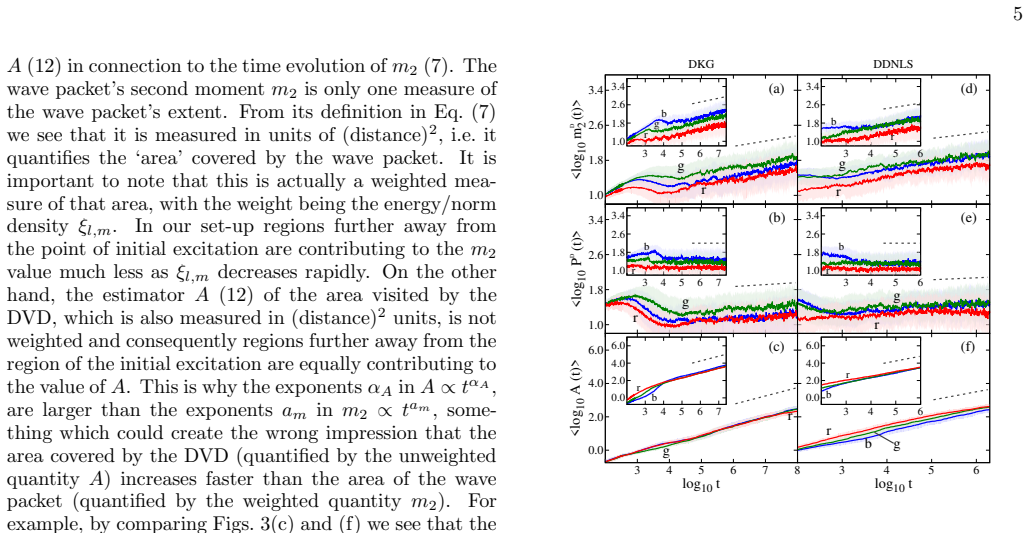
- The wandering area of the deviation-vector center grows as t^{0.5} (weak) and t^{0.55} (strong), showing that chaotic seeds visit a widening region as the wave packet expands.
- The proposed scaling law connects chaoticity to spreading across dimensions, allowing Lyapunov-exponent decay to be predicted from spreading exponents rather than fitted independently.
Reading between the lines
- If the dimension-independent scaling law holds in three dimensions, Eq. (11) predicts αΛ ≈ −0.42 for weak chaos (with a_m = 1/7) and ≈ −0.55 for strong chaos (with a_m = 1/4), a testable extension the paper leaves for future work.
- The scaling relation Λ/m2 being dimension-independent suggests that the ratio of the chaoticity rate to the effective wave-packet area is a dynamical invariant across lattice geometries, which could be probed directly by computing Λ(t) m2(t) for one- and two-dimensional systems in the same regime.
- The contrast between the unweighted wandering area A(t) growing as t^{0.5}–t^{0.55} and the weighted second moment growing as t^{0.2}–t^{0.33} implies that the 'thermalization front' extends beyond the energy-carrying core of the wave packet; measuring this front separately in experiments could provide a finer test of the thermalization picture.
- Because both models yield nearly identical exponents for every observable studied, the results support a universality class for disordered nonlinear wave-packet spreading that may extend beyond quartic nonlinearities to other power-law nonlinearities.
Signed reviews
Editorial analysis
A structured set of objections, weighed in public.
Referee Report
Summary. This manuscript reports extensive numerical simulations of wave-packet spreading in two-dimensional disordered nonlinear lattices, specifically the 2D Klein-Gordon (DKG) model and the 2D discrete nonlinear Schrödinger equation (DDNLS), in both the weak and strong chaos regimes. The authors find that the second moment of the wave packet grows as m2 ∝ t^{a_m} with a_m ≈ 1/5 in the weak chaos case and a_m ≈ 1/3 in the strong chaos case, consistent with earlier theoretical predictions by Flach. They also compute the finite-time maximum Lyapunov exponent Λ and find Λ ∝ t^{α_Λ} with α_Λ ≈ −0.37 (weak chaos) and −0.46 (strong chaos). The deviation-vector distributions show localized chaotic seeds wandering within the excited part of the lattice. The central new proposal is a dimension-independent scaling relation, Eq. (10): Λ_1(t)/m2_1(t) = Λ(t)/m2(t), which the authors use to predict α_Λ values of −0.38 and −0.47. The paper concludes that the obtained α_Λ values are accurately predicted by this scaling.
Significance. If the empirical results hold, this paper provides a substantial advance: it extends the study of subdiffusive spreading and chaoticity in disordered nonlinear lattices from one to two dimensions, covering both the weak and strong chaos regimes, and it demonstrates universality across two different models with quartic nonlinearities. The numerical effort is a clear strength: integration times up to 10^8, lattice sizes up to 450×450, 50 disorder realizations, and several parameter sets per model. The measured spreading exponents a_m ≈ 1/5 and 1/3 match independent theoretical predictions with small quoted statistical errors, and the DVD analysis provides a plausible mechanism for thermalization. However, the paper's central new claim—a dimension-independent scaling that predicts α_Λ—is based on an assumed relation, Eq. (10), that is not derived and is only validated indirectly. The manuscript is therefore a valuable empirical study whose theoretical interpretation needs to be reframed or further supported.
major comments (3)
- The dimension-independent scaling relation Λ_1(t)/m2_1(t) = Λ(t)/m2(t) is introduced as an assumption ('This can be quantified by assuming...') and is the sole basis for the predicted α_Λ values in Eq. (11). Because the authors themselves label this a conjecture and defer a direct 3D test, the headline statement that the scaling 'allows the prediction of the obtained α_Λ values' overstates the evidence. The agreement between the predicted exponents (−0.38, −0.47) and the fitted ones (−0.37, −0.46) is not a convincing validation because the scaling relation was formulated after the 2D results were known and because no independent data are used to test it. I recommend either (a) providing a direct test of Eq. (10) by computing Λ(t)/m2(t) for the 1D and 2D time series over the same time window and showing that the ratio is independent of dimension, or (b) explicitly reframing Eq. (11) as a heuristic consistency check rather than a prediction. As written, the central claim of a universal scaling law is not established.
- The exponents α_Λ are quoted as ≈ −0.37 and −0.46 without any uncertainty estimate, while the a_m values in footnotes [33] and [34] are given with standard errors. Moreover, the fits are performed over the last two decades of the evolution, a window that appears to be selected post hoc. This matters because the agreement between the predicted and observed α_Λ values is at the 0.01 level, and without error bars or a stated window-selection criterion that agreement cannot be quantitatively assessed. Please report uncertainties for α_Λ, for example by using a bootstrap regression over several fitting windows, and state the rule used to choose the fitting interval.
- The claim that the measured exponents a_m ≈ 1/3 confirm the strong chaos regime relies on the asymptotic behavior visible in the last two decades of the data. Since the strong chaos cases have larger initial excitations and a crossover from a transient regime is possible, the manuscript should demonstrate that the fitted values are robust to the choice of the fitting window, for instance by showing that the local derivative a_m(t) is flat over at least two non-overlapping sub-windows within the fitted range. Without this, the distinction between weak and strong chaos rests on a fitting procedure that is not fully documented.
minor comments (5)
- The last entry in footnote [34] reads '0.3362±0.0002 (S2D)', but S2D was already listed earlier; this is presumably a typo for S3D.
- In the list of strong chaos DKG cases, the case with W = 12.5, L = 15, h_{l,m} = 0.035 is labeled '(Case W 3K)', which is inconsistent with the S1K/S2K labels used for the other strong chaos cases; this should likely be S3K.
- The notation r^{(D)}_{l,m} and \bar{r}^{(D)}_{l,m} is confusing because the superscript D is used both for the deviation-vector distribution and for the dimensional label of the center; please use a clearer notation, e.g., \bar{\mathbf{r}}^{(D)} for the center of the distribution.
- The notation 'max[0,t]{l^D(t)}' is not standard; please explain that it denotes the maximum over the time interval [0,t], or use a more explicit notation such as \max_{0 \le s \le t} l^D(s).
- The caption lists a_D^P = 0.0 for the strong chaos insets, while the text states 'a very slow increase P_D ∝ t^{0.045}'; please clarify whether the strong chaos participation number is strictly constant or grows with a very small exponent.
Circularity Check
No significant circularity: the measured exponents are checked against independent theory, and the proposed scaling law is used to predict the Lyapunov exponents from previously published 1D data rather than fitted to the 2D results.
full rationale
The paper's central quantitative comparisons are not circular. The measured spreading exponents am ≈ 1/5 and ≈ 1/3 are verified against Flach's independent theoretical predictions [12], and the measured Lyapunov decay exponents αΛ ≈ −0.37 and −0.46 are compared with the values −0.38 and −0.47 obtained from Eqs. (10)–(11). Eq. (11) follows from the assumed dimension-independent scaling Eq. (10) as αΛ = α1_Λ + a_m − a1_m; the inputs are the theoretical 2D exponents a_m from [12] and the previously published 1D numerical exponents a1_m, α1_Λ from [17,19]. None of these inputs is the 2D αΛ value being predicted, so the agreement is an independent test of Eq. (10), not a reconstruction of its inputs. The paper explicitly identifies Eq. (10) as a conjecture and defers a 3D test, correctly signaling that the scaling law is not derived from first principles; a post hoc conjecture is a scientific limitation, but it is not circular reasoning. The self-citations in Eq. (11) are empirical 1D results whose assumptions do not include the target 2D data, so they count as independent evidence under the stated criteria. No fitted 2D parameter is renamed as a prediction, and no claimed result is defined in terms of the quantity it is supposed to explain.
Assumptions & free parameters
free parameters (2)
- 1D MLE decay exponent for weak chaos (α_Λ^1) =
-0.25
- 1D MLE decay exponent for strong chaos (α_Λ^1) =
-0.30
assumptions (4)
- domain assumption Theoretical spreading exponents a_m = 1/(1+2d) for weak chaos and a_m = 1/(1+d) for strong chaos (Flach 2010).
- ad hoc to paper Dimension-independent scaling relation Λ_1(t)/m2_1(t) = Λ(t)/m2(t) in Eq. (10).
- domain assumption Finite-time Lyapunov exponents computed up to t=10^8 with 50 realizations are representative of asymptotic behavior.
- domain assumption The Gibbsian region condition for the DDNLS model bounds the energy-norm density.
Cite this review
Pith. "Pith review of Chaotic wave packet spreading in two-dimensional disordered nonlinear lattices." pith.science (2026). https://pith.science/paper/PJOZPKLF
@misc{pith2026190807594,
  author       = {Pith},
  title        = {Pith review of: Chaotic wave packet spreading in two-dimensional disordered nonlinear lattices},
  year         = {2026},
  howpublished = {\url{https://pith.science/paper/PJOZPKLF}},
  note         = {Machine review of arXiv:1908.07594}
}
abstract
We reveal the generic characteristics of wave packet delocalization in two-dimensional nonlinear disordered lattices by performing extensive numerical simulations in two basic disordered models: the Klein-Gordon system and the discrete nonlinear Schr\"{o}dinger equation. We find that in both models (a) the wave packet's second moment asymptotically evolves as $t^{a_m}$ with $a_m \approx 1/5$ ($1/3$) for the weak (strong) chaos dynamical regime, in agreement with previous theoretical predictions [S.~Flach, Chem.~Phys.~{\bf 375}, 548 (2010)], (b) chaos persists, but its strength decreases in time $t$ since the finite time maximum Lyapunov exponent $\Lambda$ decays as $\Lambda \propto t^{\alpha_{\Lambda}}$, with $\alpha_{\Lambda} \approx -0.37$ ($-0.46$) for the weak (strong) chaos case, and (c) the deviation vector distributions show the wandering of localized chaotic seeds in the lattice's excited part, which induces the wave packet's thermalization. We also propose a dimension-independent scaling between the wave packet's spreading and chaoticity, which allows the prediction of the obtained $\alpha_{\Lambda}$ values.
Figures


Reference graph
Works this paper leans on
-
[33]
Fitting with a straight line the curves of Figs. 1(a) and (c) in the last 2 decades of the evolution we get for am 0.2007±0.0005 (W 1K), 0.2028±0.0006 (W 2K), 0.1961± 0.0004 (W 3K), 0.2051± 0.0007 (W 1D), 0.1986± 0.0003 (W 2D) and 0.2006± 0.0003 (W 3D)
work page 2007
-
[34]
In a similar way as in [33], from the results of Figs. 2(a) and (c) we get am = 0.3309± 0.0001 (S1K), 0.3289± 0.0002 (S2K), 0.3307± 0.0003 (S3K), 0.3292± 0.0002 (S1D), 0.3318±0.0001 (S2D) and 0.3362±0.0002 (S2D)
-
[1]
P. W. Anderson, Phys. Rev. 109, 1492 (1958); B. Kramer and A. MacKinnon, Rep. Prog. Phys. 56, 1469 (1993)
work page 1958
-
[2]
T. Schwartz, G. Bartal, S. Fishman, and M. Segev, Nature 446, 52 (2007); J. Billy, V. Josse, Z. Zuo, A. Bernard, B. Hambrecht, P. Lugan, D. Cl´ ement, L. Sanchez-Palencia, P. Bouyer, and A. Aspect, Na- ture 453, 891 (2008); G. Roati, C. D’Errico, L. Fallani, M. Fattori, C. Fort, M. Zaccanti, G. Modugno, M. Mod- ugno, and M. Inguscio, Nature 453, 895 (2008)
work page 2007
-
[3]
D. L. Shepelyansky, Phys. Rev. Lett. 70 1787 (1993); M. I. Molina, Phys. Rev. B 58, 12547 (1998); A. S. Pikovsky and D. L. Shepelyansky, Phys. Rev. Lett. 100, 094101 (2008); H. Veksler, Y. Krivolapov, and S. Fishman, Phys. Rev. E 80, 037201 (2009); Ch. Skokos and S. Flach, Phys. Rev. E 82, 016208 (2010); A. Iomin, Phys. Rev. E81, 017601 (2010); A. V. Milo...
work page 1993
-
[4]
G. Kopidakis, S. Komineas, S. Flach, and S. Aubry, Phys. Rev. Lett. 100, 084103 (2008)
work page 2008
-
[5]
I. Garc´ ıa-Mata and D. L. Shepelyansky, Phys. Rev. E79, 026205 (2009)
work page 2009
- [6]
Show all 36 references
-
[7]
Skokos, D
Ch. Skokos, D. O. Krimer, S. Komineas and S. Flach, Phys. Rev. E 79, 056211 (2009)
2009
-
[8]
Mulansky, K
M. Mulansky, K. Ahnert, A. Pikovsky, and D. L. Shep- elyansky, Phys. Rev. E 80, 056212 (2009)
2009
-
[9]
Oganesyan, A
V. Oganesyan, A. Pal, and D. A. Huse, Phys. Rev. B 80, 115104 (2009)
2009
-
[10]
D. O. Krimer and S. Flach, Phys. Rev. E 82, 046221 (2010)
2010
-
[11]
T. V. Laptyeva, J. D. Bodyfelt, D. O. Krimer, Ch. Skokos, and S. Flach, Europhys. Lett. 91, 30001 (2010)
2010
-
[12]
Flach, Chem
S. Flach, Chem. Phys. 375, 548 (2010)
2010
-
[13]
J. D. Bodyfelt, T. V. Laptyeva, Ch. Skokos, D. O. Krimer, and S. Flach, Phys. Rev. E 84, 016205 (2011)
2011
-
[14]
D. M. Basko, Ann. Phys. 326, 1577 (2011)
2011
-
[15]
D. M. Basko, Phys. Rev. E 86, 036202 (2012)
2012
-
[16]
T. V. Laptyeva, J. D. Bodyfelt, and S. Flach, Euro- phys. Lett. 98, 60002 (2012)
2012
-
[17]
Skokos, I
Ch. Skokos, I. Gkolias, and S. Flach, Phys. Rev. Lett. 111, 064101 (2013)
2013
-
[18]
Mulansky, Chaos 24, 024401 (2014)
M. Mulansky, Chaos 24, 024401 (2014)
2014
-
[19]
Senyange, B
B. Senyange, B. Many Manda, and Ch. Skokos, Phys. Rev. E 98, 052229 (2018)
2018
-
[20]
Vakulchyk, M
I. Vakulchyk, M. V. Fistul, and S. Flach, Phys. Rev. Lett. 122, 040501 (2019)
2019
-
[21]
M. O. Sales, W. S. Dias, A. R. Neto, M. L. Lyra, and F. A. B. F de Moura, Solid State Commun.270, 6 (2018)
2018
-
[22]
Here, the time of evolution of the 2D DDNLS system be- comes up to 2 times longer than in [5, 21], considering at the same time larger systems, more disordered realiza- tions and also computing the MLE
-
[23]
Senyange and Ch
B. Senyange and Ch. Skokos, Eur. Phys. J. Spec. Top. 227, 625 (2018)
2018
-
[24]
Danieli, B
C. Danieli, B. Many Manda, T. Mithun, and Ch. Skokos, MinE 1, 447 (2019)
2019
-
[25]
Benettin, L
G. Benettin, L. Galgani, A. Giorgilli, and J.-M. Strelcyn, Meccanica 15, 21 (1980)
1980
-
[26]
Skokos, Lect
Ch. Skokos, Lect. Notes Phys. 790, 63 (2010)
2010
-
[27]
Skokos and E
Ch. Skokos and E. Gerlach, Phys. Rev. E 82, 036704 (2010); E. Gerlach and Ch. Skokos, Discr. Cont. Dyn. Sys.-Supp. 2011, 475 (2011); E. Ger- lach, S. Eggl, and Ch. Skokos, Int. J. Bifurcation Chaos 22, 1250216 (2012)
2010
-
[28]
Blanes, F
S. Blanes, F. Casas, A. Farres, J. Laskar, J. Makazaga, and A. Murua, App. Num. Math. 68, 58 (2013)
2013
-
[29]
Skokos, E
Ch. Skokos, E. Gerlach, J. D. Bodyfelt, G. Pa- pamikos, and S. Eggl, Phys. Lett. A 378, 1809 (2014); E. Gerlach, J. Meichsner, and Ch. Skokos, Eur. Phys. J. Spec. Top. 225, 1103 (2016)
2014
-
[30]
1 in [16])
In the cases studied here the smallest consideredW value is W = 9 and the largest W = 14, which, respectively, correspond to average NM participation numbers of≈ 60 and≈ 10 (see also the inset of Fig. 1 in [16])
-
[31]
W. S. Cleveland and S. J. Devlin, J. Am. Stat. Assoc. 83, 596 (1988)
1988
-
[32]
Flach, Lect
S. Flach, Lect. Notes Phys. 173, 45 (2016); T. Mithun, Y. Kati, C. Danieli, and S. Flach, Phys. Rev. Lett. 120, 184101 (2018)
2016
-
[35]
Johansson, G
M. Johansson, G. Kopidakis, and S. Aubry, Euro- phys. Lett. 91, 50001 (2010); S. Aubry, Int. J. Bifurcation Chaos 21, 2125 (2011)
2010
-
[36]
L. H. Miranda Filho, M. A. Amato, Y. Elskens, and T. M. Rocha Filho, Comm. Nonlinear Sci. Num. Simul. 74, 236 (2019); A. Ngapasare, G. Theocharis, O. Richoux, Ch. Skokos, and V. Achilleos, Phys. Rev. E 99, 032211 (2019)
2019
Reviewed August 14, 2026 · model on record in the stance chip above.
Discussion (0). Continue with ORCID to comment.