REVIEW 4 major objections 5 minor 9 cited by
Baichuan-M2: Scaling Medical Capability with Large Verifier System
T0 review · 4 major / 5 minor · reviewed 2026-08-05 · deepseek-v4-flash
Pith's one-line read This paper claims a 32B medical model beats far larger rivals by training inside a dynamic patient-simulator verifier.
desk verdict Strong engineering, weak evidential hygiene: the paper's own Figure 5 shows HealthBench was used to guide training, so the SOTA claim is not out-of-sample until the authors rule out contamination. read the letter →
The pith
A machine-rendered reading of the paper's core claim, the machinery that carries it, and where it could break.
The reading
What carries the argument
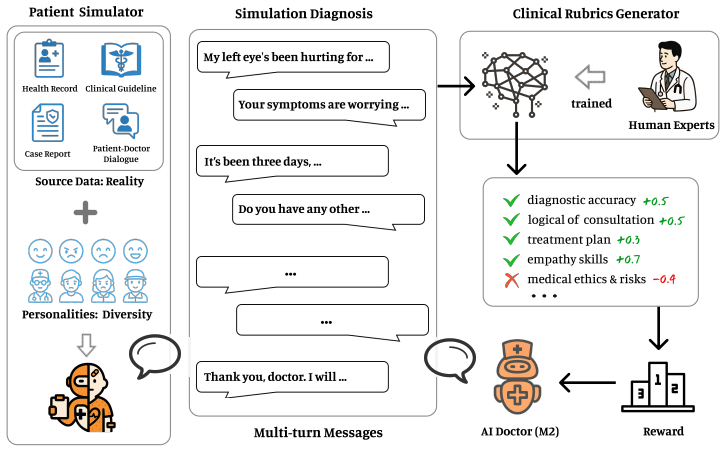
The load-bearing object is the closed-loop verifier system. It has two modules: a Patient Simulator, whose three components (termination gate, affective unit, factual unit) keep simulated patients diverse yet consistent while preventing information leakage; and a Clinical Rubrics Generator, which turns each dialogue slice into weighted rubrics across dimensions such as diagnostic accuracy, consultation logic, treatment rationality, communication and empathy, and medical ethics. Around this loop the paper runs multi-stage RL with a modified GRPO objective—no KL term, asymmetric clipping with a raised upper bound, length-normalized loss, and simplified advantage normalization. The verifier sup
What would settle it
Re-run Baichuan-M2 on HealthBench Hard under an independent protocol with the same scoring rules; if its point estimate drops below 32 or into the noise band of gpt-oss-120B, the headline claim fails. Separately, have blinded clinicians rate the model's consultations on held-out real cases; if clinician-rated quality does not track the HealthBench gains, the dynamic verifier is rewarding rubric-shaped responses rather than clinical competence.
Extended reading notes
Core claim
On its own terms, the paper's discovery is that a 32B model can reach a HealthBench overall score of 60.1 and Hard score of 34.7 while retaining general abilities, surpassing all compared open-source models (gpt-oss-120B, Qwen3-235B-A22B, DeepSeek-R1, GLM-4.5, Kimi-K2) and most compared closed-source models (o3, Grok 3, Gemini 2.5 Pro, GPT-4.1). The claimed cause is the training environment: a dynamic interactive verifier rather than a static answer key. In this environment, a patient simulator produces diverse multi-turn consultations, a clinical rubrics generator emits weighted expert-style rubrics for each context, and an improved GRPO loop converts those rubrics into dense reward. The pa
Load-bearing premise
The learned reward from the Clinical Rubrics Generator is trusted as a proxy for expert clinical judgment; the paper's only validation is a 92.7% consistency rate against expert rubrics, measured with GPT-4.1 as referee on 100 cases—not against patient outcomes.
Editorial extensions
If this is right
- A 32B open model becomes a practical alternative to much larger closed systems for private and local medical deployment, including on consumer-grade hardware.
- Training reward can be generated dynamically for open-ended clinical tasks such as history taking, triage, communication, and safety, which static USMLE-style QA cannot reward.
- The interaction between patient simulator and rubric generator allows reinforcement learning to keep improving skills that are normally evaluated only by human experts.
- The same staged RL recipe should transfer to other medical benchmarks, matching the paper's reported gains on SuperGPQA and MedXQA after rule-based RL.
Reading between the lines
- The 92.7% rubrics-agreement figure is measured by GPT-4.1 as referee, so the reward signal's validity ultimately rests on an LLM judge; blinded clinician ratings on held-out real cases would test whether the trained model's gains reflect clinical competence rather than rubric-shaped output.
- The Pareto-front framing implies a scaling hypothesis the authors do not test: verifier quality matters more than parameter count for clinical benchmarks; running the same verifier pipeline on a larger base model would test that.
- The dynamic-verifier recipe is domain-general in principle: any high-stakes conversational setting with incomplete information and multi-turn judgment—legal counsel, psychiatric triage—could use a simulator plus rubric generator to create dense reward where static exams fail.
Signed reviews
Editorial analysis
A structured set of objections, weighed in public.
Referee Report
Summary. The paper introduces Baichuan-M2, a 32B medical LLM trained with mid-training, supervised fine-tuning, and a multi-stage RL pipeline. The RL loop uses a learned Clinical Rubrics Generator as a dense reward and a Patient Simulator for multi-turn interactions. Headline results are on OpenAI's HealthBench: 60.1 overall, 34.7 Hard, and 91.5 Consensus, which the authors claim outperforms all compared open-source models and most closed-source models, with GPT-5 being the only model above 32 on HealthBench Hard. The paper also reports general-capability benchmarks, quantization results, and speculative decoding speedups. The central claim is that a 32B open-source model sets a new Pareto front for medical AI at deployable scale.
Significance. If the HealthBench numbers are out-of-sample and produced under a fair, comparable protocol, the result is significant: it would show that a 32B open-source model can surpass far larger open-source and many closed-source models on a challenging medical benchmark, with practical deployment implications. The paper provides a detailed description of a novel interactive verifier system and a multi-stage RL recipe, and it openly discusses limitations. However, the significance is currently conditional: the development-time use of HealthBench is not shown to be disjoint from the final evaluation, no error bars or evaluation protocols are given for the headline comparisons, and the reward-validity chain from the learned rubrics to clinical competence is not empirically calibrated. These issues must be resolved before the SOTA claim can be accepted.
major comments (4)
- [§3.3.2, Fig. 5] The caption states 'All results are evaluated on a random subset of HealthBench.' This is the same benchmark on which the headline 60.1/34.7 scores are reported in §4.1 and Figs. 6–7. The paper nowhere states that this random subset was excluded from the final evaluation, nor that no other HealthBench items informed checkpoint selection, length-penalty threshold tuning, or hyperparameter decisions. As written, the SOTA claim is compatible with the model being selected on the evaluation set. Please provide an explicit disjointness statement with item-level logs, or re-evaluate on a fully held-out split that is demonstrably separate from all development-time uses of HealthBench.
- [§4.1, Figs. 6–7] The headline comparisons are point estimates with no confidence intervals, no number of repeated runs, and no stated evaluation protocol. The reported margins over gpt-oss-120B (60.1 vs 57.6 overall; 34.7 vs 30 on Hard) and over o3 (60.1 vs 59.8 overall) are small relative to sampling and scorer variance. Please report the full evaluation protocol: scoring prompts, temperature, max tokens, rubric aggregation method, and whether all models were run through the identical HealthBench harness. Without this, the claim of outperforming 'most advanced closed-source counterparts' is under-specified.
- [§2.2.4 and §3.3.2] The Clinical Rubrics Generator is validated only by a 92.7% consistency rate against expert rubrics, with GPT-4.1 as referee, and is then used as the RL reward; the final evaluation, HealthBench, also uses doctor-written rubric criteria. This is not circularity by construction, but it is a validity gap for the claim that the model is 'deeply aligned with clinical reasoning.' Optimizing a rubric-shaped reward could improve HealthBench-style rubric scores without improving clinical decision-making. Please provide external calibration: e.g., on a held-out sample, compare reward-model scores with independent clinician ratings, or report performance on a non-rubric clinical outcome task.
- [Abstract and §3.3] The abstract and §1 claim that the dynamic verifier system is 'essential' for aligning LLM capabilities with clinical practice, and §3.3 attributes the gains to multi-stage RL with the patient simulator and rubrics generator. No ablation isolates these components. For example, the paper does not compare training with a static expert-written rubric reward, nor training without the patient simulator, nor rule-based RL alone. Without at least one ablation, the causal claim about the verifier system is unsupported. Please add an ablation or soften the causal language to what the experiments actually establish.
minor comments (5)
- [§2.2] Typo: 'which are are modeled through patient simulators' should read 'which are modeled through patient simulators.'
- [§2.1.2 and Fig. 2] The module is called 'Fact Unit' in Fig. 2 but 'Factual Unit' in the text; please unify the terminology.
- [§2] Grammar: 'transcends conventional answer verifier' should be 'transcends conventional answer verifiers'; similar phrasing appears in the abstract and introduction.
- [§4.1, Figs. 6–7] GPT-5 is mentioned in the text and abstract as the only model above 32 on HealthBench Hard, with a score of 46.2, but it is not shown in Fig. 7. Including GPT-5's score and its evaluation setting would make the comparison complete and reproducible.
- [§4.1, Fig. 9/10] The axis figures show '95% CI' in the legend but the displayed values are point estimates only; please clarify whether the intervals are omitted for readability or were not computed.
Circularity Check
Development-time use of HealthBench for length-penalty analysis is not disclosed as excluded from the final evaluation, so the headline 60.1/34.7 scores may be partially in-sample. The rubric-based RL pipeline itself is not circular.
-
fitted input called prediction
[Section 3.3.2, Figure 5 caption; Section 4.1]
"Figure 5: Impact of length penalty. ... All results are evaluated on a random subset of HealthBench. ... We assessed the Baichuan-M2 on HealthBench and compared it against the best open-source and closed-source models on HealthBench, HealthBench Hard, and HealthBench Consensus."
The length-penalty mechanism (Eq. 3) is the final reward component R = R_rubric + R_length, and Figure 5 evaluates its effect on 'a random subset of HealthBench' during training. The same benchmark is then used in Section 4.1 to report the paper's central SOTA claim (60.1 overall, 34.7 Hard). The paper never states that the random subset used for length-penalty analysis and checkpoint/ hyperparameter decisions was excluded from the final HealthBench evaluation. If any of those items remained in the final evaluation set, the reported scores are in-sample point estimates: a parameter (length penalty, training checkpoints) fitted to HealthBench is renamed as an independent HealthBench prediction. The lack of item-level logs or an explicit train/eval split prevents the reader from ruling out t
full rationale
Baichuan-M2's derivation chain is mostly self-contained: the Clinical Rubrics Generator is trained on internally curated expert rubrics, not on HealthBench items, and HealthBench is an external benchmark with human-written rubrics, so the rubric-shaped reward/evaluation overlap is not equivalence by construction. The patient-simulator component cites prior work [16] with overlapping authors, but the paper also provides its own fidelity evaluations (Figure 3) and that component is not the load-bearing step for the headline score. The one serious circularity concern is the evaluation protocol: Section 3.3.2 explicitly says results are evaluated on a random subset of HealthBench during the length-penalty analysis, while Section 4.1 reports final HealthBench scores without stating that this subset was held out. Since the length-penalty reward is part of the final model and training progress / threshold choices appear to be informed by that HealthBench subset, the reported 60.1/34.7 point estimates are not demonstrated to be out-of-sample. This is a partial circularity: the final evaluation may be measuring performance on data already used to select the model, rather than an independent prediction. The absence of released harness, weights, and item-level logs compounds the issue. I therefore assign a score of 6 rather than 0-2, while noting that the core RL training design is not circular by construction.
Assumptions & free parameters
free parameters (3)
- Quality threshold (thresh) for length penalty =
not reported
- Mid-training corpus mixing ratio =
2:2:1 (medical:general:math)
- Rubric weight annotations =
integer weights in [-10, 10]
assumptions (3)
- domain assumption HealthBench rubric scores are a valid proxy for real clinical decision-making capability
- ad hoc to paper Agreement of the Clinical Rubrics Generator with experts (92.7%, judged by GPT-4.1) transfers to reward validity during RL
- domain assumption Patient simulator fidelity metrics (privacy, fact, personification) guarantee that RL on simulated dialogues improves real consultation skill
invented entities (2)
-
Patient Simulator
-
Clinical Rubrics Generator
Cite this review
Pith. "Pith review of Baichuan-M2: Scaling Medical Capability with Large Verifier System." pith.science (2026). https://pith.science/paper/PK2ZJANY
@misc{pith2026250902208,
  author       = {Pith},
  title        = {Pith review of: Baichuan-M2: Scaling Medical Capability with Large Verifier System},
  year         = {2026},
  howpublished = {\url{https://pith.science/paper/PK2ZJANY}},
  note         = {Machine review of arXiv:2509.02208}
}
read the original abstract
As large language models (LLMs) advance in conversational and reasoning capabilities, their practical application in healthcare has become a critical research focus. However, there is a notable gap between the performance of medical LLMs on static benchmarks such as USMLE and their utility in real-world clinical decision-making. This discrepancy arises because traditional exams fail to capture the dynamic, interactive nature of medical consultations. To address this challenge, we introduce a novel dynamic verification framework that moves beyond static answer verifier, establishing a large-scale, high-fidelity interactive reinforcement learning system. Our framework comprises two key components: a Patient Simulator that creates realistic clinical environments using de-identified medical records, and a Clinical Rubrics Generator that dynamically produces multi-dimensional evaluation metrics. Building on this foundation, we develop Baichuan-M2, a 32B-parameter medical augmented reasoning model trained through a multi-stage reinforcement learning strategy with an improved Group Relative Policy Optimization (GRPO) algorithm. Evaluated on HealthBench, Baichuan-M2 outperforms all other open-source models and most advanced closed-source counterparts, achieving a score above 32 on the challenging HealthBench Hard benchmark-previously exceeded only by GPT-5. Our work demonstrates that robust dynamic verifier system is essential for aligning LLM capabilities with practical clinical applications, establishing a new Pareto front in the performance-parameter trade-off for medical AI deployment.
Figures


Figures from the paper (10 more)




Forward citations
Cited by 9 Pith papers
-
Evaluating Counterfactual Sensitivity to Patient Information in Medication-Safety Reasoning
A new benchmark shows that 28 LLMs all decline when patient information changes whether a medication-safety rule applies, exposing a warning-retention failure.
-
MedDDC-Eval: Diagnosis-Decoupled Evaluation of Multi-Turn Medical Consultation Agents
MedDDC-Eval decouples evaluation of multi-turn consultation agents from their terminal diagnosis generators by scoring policy-elicited histories under one frozen shared diagnostic reader.
-
MentalHospital: A Virtual Environment for Evaluating Psychiatric Clinical Encounters
EHR-derived standardized patients and dual-track evaluation reveal LLMs trail clinicians by 37.28 points on full psychiatric encounters, with mental-status assessment the main bottleneck.
-
LingxiDiagBench: A Multi-Agent Framework for Benchmarking LLMs in Chinese Psychiatric Consultation and Diagnosis
A 16,000-case Chinese psychiatric consultation benchmark shows LLMs reach ~92% accuracy on depression-vs-anxiety but only ~29–43% on comorbidity and 12-way differential diagnosis, and dynamic interviewing does not rel...
-
MedRealMM: A Real-World Multimodal Benchmark for Chinese Online Medical Consultation
On a new benchmark of 5,620 real multimodal online consultations, top LLMs trail the original physicians mainly because they trigger more unsafe or unsupported negative criteria.
-
Active Learning for Neurosymbolic Program Synthesis
The abstract claims a new active learning technique, constrained conformal evaluation (tool SmartLabel), that finds the ground-truth program in 98% of benchmarks, but the delivered full text is a different paper, leav...
-
C-MIG: Multi-view Information Gain-based Retrieval-Augmented Generation for Clinical Diagnosis Reasoning
C-MIG uses multi-view information gain from retrieved documents and refinements to supervise RAG-RL for clinical diagnosis, claiming top performance on four medical benchmarks.
-
OpenHospital: A Thing-in-itself Arena for Evolving and Benchmarking LLM-based Collective Intelligence
OpenHospital is an interactive physician-patient multi-agent arena that improves clinical metrics via ground-truth reflection and reports cooperative behaviors as evidence of evolving LLM collective intelligence.
-
InfiMed-ORBIT: Aligning LLMs on Open-Ended Complex Tasks via Rubric-Based Incremental Training
Rubric-based incremental RL with LLM-generated case-specific checklists lifts Qwen3-4B's HealthBench-Hard score from 7.0 to 27.5 with 2k samples, and improves InfoBench instruction-following from 42.0 to 82.9.
Reference graph
Works this paper leans on
-
[1]
Healai: A healthcare LLM for effective medical documentation
Sagar Goyal, Eti Rastogi, Sree Prasanna Rajagopal, Dong Yuan, Fen Zhao, Jai Chintagunta, Gautam Naik, and Jeff Ward. Healai: A healthcare LLM for effective medical documentation. In Luz Angelica Caudillo-Mata, Silvio Lattanzi, Andrés Muñoz Medina, Leman Akoglu, Aristides Gionis, and Sergei Vassilvitskii, editors,Proceedings of the 17th ACM International C...
arXiv 2024
-
[2]
Marco Cascella, Jonathan Montomoli, Valentina Bellini, and Elena Giovanna Bignami. Evalu- ating the feasibility of chatgpt in healthcare: An analysis of multiple clinical and research scenarios. J. Medical Syst. , 47(1):33, 2023. doi: 10.1007/S10916-023-01925-4. URL https://doi.org/10.1007/s10916-023-01925-4
-
[3]
Intille, Nawar Shara, Guodong Gordon Gao, and Dakuo Wang
Ziqi Yang, Xuhai Xu, Bingsheng Yao, Ethan Rogers, Shao Zhang, Stephen S. Intille, Nawar Shara, Guodong Gordon Gao, and Dakuo Wang. Talk2care: An llm-based voice assistant for communication between healthcare providers and older adults. Proc. ACM Interact. Mob. Wearable Ubiquitous Technol., 8(2):73:1–73:35, 2024. doi: 10.1145/3659625. URL https: //doi.org/...
doi:10.1145/3659625 2024
-
[4]
Beyond distillation: Pushing the limits of medical LLM reasoning with minimalist rule-based RL
Che Liu, Haozhe Wang, Jiazhen Pan, Zhongwei Wan, Yong Dai, Fangzhen Lin, Wenjia Bai, Daniel Rueckert, and Rossella Arcucci. Beyond distillation: Pushing the limits of medical LLM reasoning with minimalist rule-based RL. CoRR, abs/2505.17952, 2025. doi: 10.48550/ARXIV . 2505.17952. URL https://doi.org/10.48550/arXiv.2505.17952
-
[5]
Huatuogpt-o1, towards medical complex reasoning with llms
Junying Chen, Zhenyang Cai, Ke Ji, Xidong Wang, Wanlong Liu, Rongsheng Wang, Jianye Hou, and Benyou Wang. Huatuogpt-o1, towards medical complex reasoning with llms. CoRR, abs/2412.18925, 2024. doi: 10.48550/ARXIV .2412.18925. URL https://doi.org/10. 48550/arXiv.2412.18925
-
[6]
Deepseek-r1: Incentivizing reasoning capability in llms via reinforcement learning
Daya Guo, Dejian Yang, Haowei Zhang, Junxiao Song, Ruoyu Zhang, Runxin Xu, Qihao Zhu, Shirong Ma, Peiyi Wang, Xiao Bi, et al. Deepseek-r1: Incentivizing reasoning capability in llms via reinforcement learning. CoRR, abs/2501.12948, 2025. doi: 10.48550/ARXIV .2501.12948. URL https://doi.org/10.48550/arXiv.2501.12948
-
[7]
Aaron Jaech, Adam Kalai, Adam Lerer, Adam Richardson, Ahmed El-Kishky, Aiden Low, Alec Helyar, Aleksander Madry, Alex Beutel, Alex Carney, et al. Openai o1 system card. CoRR, abs/2412.16720, 2024. doi: 10.48550/ARXIV .2412.16720. URL https://doi.org/ 10.48550/arXiv.2412.16720
-
[8]
Zhihong Shao, Peiyi Wang, Qihao Zhu, Runxin Xu, Junxiao Song, Mingchuan Zhang, Y . K. Li, Y . Wu, and Daya Guo. Deepseekmath: Pushing the limits of mathematical reasoning in open language models. CoRR, abs/2402.03300, 2024. doi: 10.48550/ARXIV .2402.03300. URL https://doi.org/10.48550/arXiv.2402.03300
Show all 89 references
-
[9]
Introducing Claude 4
Anthropic. Introducing Claude 4. https://www.anthropic.com/news/claude-4, May
-
[10]
Kimi K2: open agentic intelligence
Kimi Team, Yifan Bai, Yiping Bao, Guanduo Chen, Jiahao Chen, Ningxin Chen, Ruijue Chen, Yanru Chen, Yuankun Chen, Yutian Chen, et al. Kimi K2: open agentic intelligence. CoRR, abs/2507.20534, 2025. doi: 10.48550/ARXIV .2507.20534. URL https://doi.org/10. 48550/arXiv.2507.20534
-
[11]
Glm-4.5: Agentic, reasoning, and coding (arc) foundation models
Aohan Zeng, Xin Lv, Qinkai Zheng, Zhenyu Hou, Bin Chen, Chengxing Xie, Cunxiang Wang, Da Yin, Hao Zeng, Jiajie Zhang, et al. Glm-4.5: Agentic, reasoning, and coding (arc) foundation models. arXiv preprint arXiv:2508.06471, 2025
2025 arXiv
-
[12]
Glm-4.1v-thinking: Towards versatile multimodal reasoning with scalable reinforcement learning
Wenyi Hong, Wenmeng Yu, Xiaotao Gu, Guo Wang, Guobing Gan, Haomiao Tang, Jiale Cheng, Ji Qi, Junhui Ji, Lihang Pan, et al. Glm-4.1v-thinking: Towards versatile multimodal reasoning with scalable reinforcement learning. CoRR, abs/2507.01006, 2025. doi: 10.48550/ARXIV . 2507.010...
-
[13]
Lingshu: A generalist foundation model for unified multimodal medical understanding and reasoning
LASA Team, Weiwen Xu, Hou Pong Chan, Long Li, Mahani Aljunied, Ruifeng Yuan, Jianyu Wang, Chenghao Xiao, Guizhen Chen, Chaoqun Liu, Zhaodonghui Li, Yu Sun, Junao Shen, Chaojun Wang, Jie Tan, Deli Zhao, Tingyang Xu, Hao Zhang, and Yu Rong. Lingshu: A generalist foundation model...
-
[14]
Usmle scoring policies and score reporting guidelines 2024
National Board of Medical Examiners (NBME). Usmle scoring policies and score reporting guidelines 2024. Technical Report USMLE-POL-2024-01, Federation of State Medical Boards (FSMB) and National Board of Medical Examiners (NBME), 2024. URL https://www. usmle.org/scoring/policies
2024
- [15]
-
[16]
Exploring the inquiry-diagnosis relationship with advanced patient simulators
Zhaocheng Liu, Quan Tu, Wen Ye, Yu Xiao, Zhishou Zhang, Hengfu Cui, Yalun Zhu, Qiang Ju, Shizheng Li, and Jian Xie. Exploring the inquiry-diagnosis relationship with advanced patient simulators. CoRR, abs/2501.09484, 2025. doi: 10.48550/ARXIV .2501.09484. URL https://doi.org/1...
-
[17]
Patient safety, what does clinical simulation and teaching innovation contribute? Medicina Intensiva (English Edition) , 49(3): 165–173, 2025
María Jesús Broch Porcar and Álvaro Castellanos-Ortega. Patient safety, what does clinical simulation and teaching innovation contribute? Medicina Intensiva (English Edition) , 49(3): 165–173, 2025
2025
-
[18]
Agent hospital: A simulacrum of hospital with evolvable medical agents
Junkai Li, Siyu Wang, Meng Zhang, Weitao Li, Yunghwei Lai, Xinhui Kang, Weizhi Ma, and Yang Liu. Agent hospital: A simulacrum of hospital with evolvable medical agents. CoRR, abs/2405.02957, 2024. doi: 10.48550/ARXIV .2405.02957. URL https://doi.org/10. 48550/arXiv.2405.02957
-
[19]
Wenxuan Wang, Zizhan Ma, Zheng Wang, Chenghan Wu, Jiaming Ji, Wenting Chen, Xiang Li, and Yixuan Yuan. A survey of llm-based agents in medicine: How far are we from baymax? In Wanxiang Che, Joyce Nabende, Ekaterina Shutova, and Mohammad Taher Pilehvar, editors, Findings of the...
2025
-
[20]
Consulting Psychologists Press Palo Alto, CA, 1962
Isabel Briggs Myers et al.The myers-briggs type indicator, volume 34. Consulting Psychologists Press Palo Alto, CA, 1962
1962
-
[21]
Challenges and barriers of using large language models (llm) such as chatgpt for diagnostic medicine with a focus on digital pathology –a recent scoping review
Ehsan Ullah, Anil Parwani, Mirza Mansoor Baig, and Rajendra Singh. Challenges and barriers of using large language models (llm) such as chatgpt for diagnostic medicine with a focus on digital pathology –a recent scoping review. Diagnostic Pathology, 19(1):43, 2024. doi: 10.118...
2024 doi
- [22]
-
[23]
The learnability of in-context learning
Noam Wies, Yoav Levine, and Amnon Shashua. The learnability of in-context learning. In Alice Oh, Tristan Naumann, Amir Globerson, Kate Saenko, Moritz Hardt, and Sergey Levine, editors, Advances in Neural Information Processing Systems 36: Annual Conference on Neural Informatio...
2023
-
[24]
Jailbreak and guard aligned language models with only few in-context demonstrations
Zeming Wei, Yifei Wang, and Yisen Wang. Jailbreak and guard aligned language models with only few in-context demonstrations. CoRR, abs/2310.06387, 2023. doi: 10.48550/ARXIV .2310. 06387. URL https://doi.org/10.48550/arXiv.2310.06387. 20
-
[25]
Sewon Min, Xinxi Lyu, Ari Holtzman, Mikel Artetxe, Mike Lewis, Hannaneh Hajishirzi, and Luke Zettlemoyer. Rethinking the role of demonstrations: What makes in-context learning work? In Yoav Goldberg, Zornitsa Kozareva, and Yue Zhang, editors, Proceedings of the 2022 Conference...
2022 doi
-
[26]
Baichuan-m1: Pushing the medical capability of large language models, 2025
Bingning Wang, Haizhou Zhao, Huozhi Zhou, Liang Song, Mingyu Xu, Wei Cheng, Xiangrong Zeng, Yupeng Zhang, Yuqi Huo, Zecheng Wang, Zhengyun Zhao, Da Pan, Fei Kou, Fei Li, Fuzhong Chen, Guosheng Dong, Han Liu, Hongda Zhang, Jin He, Jinjie Yang, Kangxi Wu, Kegeng Wu, Lei Su, Linl...
2025 arXiv
-
[27]
Chi, Quoc V
Jason Wei, Xuezhi Wang, Dale Schuurmans, Maarten Bosma, Brian Ichter, Fei Xia, Ed H. Chi, Quoc V . Le, and Denny Zhou. Chain-of-thought prompting elicits reasoning in large language models. In Sanmi Koyejo, S. Mohamed, A. Agarwal, Danielle Belgrave, K. Cho, and A. Oh, editors,...
2022
-
[28]
Large language models are zero-shot reasoners
Takeshi Kojima, Shixiang Shane Gu, Machel Reid, Yutaka Matsuo, and Yusuke Iwa- sawa. Large language models are zero-shot reasoners. In Sanmi Koyejo, S. Mo- hamed, A. Agarwal, Danielle Belgrave, K. Cho, and A. Oh, editors, Advances in Neu- ral Information Processing Systems 35:...
2022
-
[29]
When more is less: Understanding chain-of-thought length in llms
Yuyang Wu, Yifei Wang, Tianqi Du, Stefanie Jegelka, and Yisen Wang. When more is less: Understanding chain-of-thought length in llms. CoRR, abs/2502.07266, 2025. doi: 10.48550/ARXIV .2502.07266. URLhttps://doi.org/10.48550/arXiv.2502.07266
-
[30]
Baichuan alignment technical report
Mingan Lin, Fan Yang, Yan-Bin Shen, Haoze Sun, Tianpeng Li, Tao Zhang, Chenzheng Zhu, Miao Zheng, Xu Li, Yijie Zhou, Mingyang Chen, Yanzhao Qin, Youquan Li, Hao Liang, Fei Li, Yadong Li, Mang Wang, Guosheng Dong, Kuncheng Fang, Jianhua Xu, Bin Cui, Wentao Zhang, Zenan Zhou, an...
-
[31]
DAPO: an open-source LLM reinforcement learning system at scale
Qiying Yu, Zheng Zhang, Ruofei Zhu, Yufeng Yuan, Xiaochen Zuo, Yu Yue, Tiantian Fan, Gaohong Liu, Lingjun Liu, Xin Liu, Haibin Lin, Zhiqi Lin, Bole Ma, Guangming Sheng, Yuxuan Tong, Chi Zhang, Mofan Zhang, Wang Zhang, Hang Zhu, Jinhua Zhu, Jiaze Chen, Jiangjie Chen, Chengyi Wa...
-
[32]
Understanding r1-zero-like training: A critical perspective
Zichen Liu, Changyu Chen, Wenjun Li, Penghui Qi, Tianyu Pang, Chao Du, Wee Sun Lee, and Min Lin. Understanding r1-zero-like training: A critical perspective. CoRR, abs/2503.20783,
-
[33]
AIME problems and solutions, 2025
AIME. AIME problems and solutions, 2025. URL https://artofproblemsolving.com/ wiki/index.php/AIME_Problems_and_Solutions
2025
-
[34]
Supergpqa: Scaling LLM evaluation across 285 graduate disciplines
Xinrun Du, Yifan Yao, Kaijing Ma, Bingli Wang, Tianyu Zheng, King Zhu, Minghao Liu, Yiming Liang, Xiaolong Jin, Zhenlin Wei, et al. Supergpqa: Scaling LLM evaluation across 285 graduate disciplines. CoRR, abs/2502.14739, 2025. doi: 10.48550/ARXIV .2502.14739. URL https://doi.o...
- [35]
-
[36]
Reinforcement learning with rubric anchors
Zenan Huang, Yihong Zhuang, Guoshan Lu, Zeyu Qin, Haokai Xu, Tianyu Zhao, Ru Peng, Jiaqi Hu, Zhanming Shen, Xiaomeng Hu, et al. Reinforcement learning with rubric anchors. arXiv preprint arXiv:2508.12790, 2025
2025 arXiv
-
[37]
Fast on the easy, deep on the hard: Efficient reasoning via powered length penalty
Zehui Ling, Deshu Chen, Hongwei Zhang, Yifeng Jiao, Xin Guo, and Yuan Cheng. Fast on the easy, deep on the hard: Efficient reasoning via powered length penalty. CoRR, abs/2506.10446,
-
[38]
MedxpertQA: Benchmarking expert-level medical reasoning and understanding
Yuxin Zuo, Shang Qu, Yifei Li, Zhang-Ren Chen, Xuekai Zhu, Ermo Hua, Kaiyan Zhang, Ning Ding, and Bowen Zhou. MedxpertQA: Benchmarking expert-level medical reasoning and understanding. In F orty-second International Conference on Machine Learning, 2025. URL https://openreview....
2025
-
[39]
Qwen3 technical report
An Yang, Anfeng Li, Baosong Yang, Beichen Zhang, Binyuan Hui, Bo Zheng, Bowen Yu, Chang Gao, Chengen Huang, Chenxu Lv, et al. Qwen3 technical report. CoRR, abs/2505.09388,
-
[40]
Gemini 2.5: Pushing the frontier with advanced reasoning, multimodality, long context, and next generation agentic capabilities
Gheorghe Comanici, Eric Bieber, Mike Schaekermann, Ice Pasupat, Noveen Sachdeva, Inderjit Dhillon, Marcel Blistein, Ori Ram, Dan Zhang, Evan Rosen, et al. Gemini 2.5: Pushing the frontier with advanced reasoning, multimodality, long context, and next generation agentic capabil...
- [41]
-
[42]
gpt-oss-120b & gpt-oss-20b model card
Sandhini Agarwal, Lama Ahmad, Jason Ai, Sam Altman, Andy Applebaum, Edwin Arbus, Rahul K Arora, Yu Bai, Bowen Baker, Haiming Bao, et al. gpt-oss-120b & gpt-oss-20b model card. arXiv preprint arXiv:2508.10925, 2025
2025 arXiv
-
[43]
Gonzalez, and Ion Stoica
Tianle Li, Wei-Lin Chiang, Evan Frick, Lisa Dunlap, Tianhao Wu, Banghua Zhu, Joseph E. Gonzalez, and Ion Stoica. From crowdsourced data to high-quality benchmarks: Arena-hard and benchbuilder pipeline. CoRR, abs/2406.11939, 2024. doi: 10.48550/ARXIV .2406.11939. URL https://do...
- [44]
-
[45]
Writingbench: A comprehensive benchmark for generative writing
Yuning Wu, Jiahao Mei, Ming Yan, Chenliang Li, Shaopeng Lai, Yuran Ren, Zijia Wang, Ji Zhang, Mengyue Wu, Qin Jin, and Fei Huang. Writingbench: A comprehensive benchmark for generative writing. CoRR, abs/2503.05244, 2025. doi: 10.48550/ARXIV .2503.05244. URL https://doi.org/10...
2025 doi
-
[46]
Instruction-following evaluation for large language models
Jeffrey Zhou, Tianjian Lu, Swaroop Mishra, Siddhartha Brahma, Sujoy Basu, Yi Luan, Denny Zhou, and Le Hou. Instruction-following evaluation for large language models. CoRR, abs/2311.07911, 2023. doi: 10.48550/ARXIV .2311.07911. URL https://doi.org/10. 48550/arXiv.2311.07911
-
[47]
Cfbench: A comprehensive constraints-following benchmark for llms
Tao Zhang, Chenglin Zhu, Yanjun Shen, Wenjing Luo, Yan Zhang, Hao Liang, Fan Yang, Mingan Lin, Yujing Qiao, Weipeng Chen, Bin Cui, Wentao Zhang, and Zenan Zhou. Cfbench: A comprehensive constraints-following benchmark for llms. In Wanxiang Che, Joyce Nabende, Ekaterina Shutova...
2025
-
[48]
GPTQ: accurate post- training quantization for generative pre-trained transformers
Elias Frantar, Saleh Ashkboos, Torsten Hoefler, and Dan Alistarh. GPTQ: accurate post- training quantization for generative pre-trained transformers. CoRR, abs/2210.17323, 2022. doi: 10.48550/ARXIV .2210.17323. URLhttps://doi.org/10.48550/arXiv.2210.17323
-
[49]
Alignbench: Benchmarking chinese alignment of large language models
Xiao Liu, Xuanyu Lei, Shengyuan Wang, Yue Huang, Andrew Feng, Bosi Wen, Jiale Cheng, Pei Ke, Yifan Xu, Weng Lam Tam, Xiaohan Zhang, Lichao Sun, Xiaotao Gu, Hongning Wang, Jing Zhang, Minlie Huang, Yuxiao Dong, and Jie Tang. Alignbench: Benchmarking chinese alignment of large l...
2024
-
[50]
Gonzalez, Clark W
Lianmin Zheng, Liangsheng Yin, Zhiqiang Xie, Chuyue Sun, Jeff Huang, Cody Hao Yu, Shiyi Cao, Christos Kozyrakis, Ion Stoica, Joseph E. Gonzalez, Clark W. Barrett, and Ying Sheng. Sglang: Efficient execution of structured language model programs. In Amir Globersons, Lester Mack...
2024
-
[51]
Optimize weight rounding via signed gradient descent for the quantization of llms
Wenhua Cheng, Weiwei Zhang, Haihao Shen, Yiyang Cai, Xin He, Kaokao Lv, and Yi Liu. Optimize weight rounding via signed gradient descent for the quantization of llms. In Yaser Al-Onaizan, Mohit Bansal, and Yun-Nung Chen, editors, Findings of the Association for Computational L...
2024 doi
-
[52]
Croci, Bo Li, Pashmina Cameron, Martin Jaggi, Dan Alistarh, Torsten Hoefler, and James Hensman
Saleh Ashkboos, Amirkeivan Mohtashami, Maximilian L. Croci, Bo Li, Pashmina Cameron, Martin Jaggi, Dan Alistarh, Torsten Hoefler, and James Hensman. Quarot: Outlier- free 4-bit inference in rotated llms. In Amir Globersons, Lester Mackey, Danielle Bel- grave, Angela Fan, Ulric...
2024
-
[54]
QQQ: quality quattuor-bit quantization for large language models
Ying Zhang, Peng Zhang, Mincong Huang, Jingyang Xiang, Yujie Wang, Chao Wang, Yineng Zhang, Lei Yu, Chuan Liu, and Wei Lin. QQQ: quality quattuor-bit quantization for large language models. CoRR, abs/2406.09904, 2024. doi: 10.48550/ARXIV .2406.09904. URL https://doi.org/10.485...
-
[56]
Efficient memory management for large language model serving with pagedattention
Woosuk Kwon, Zhuohan Li, Siyuan Zhuang, Ying Sheng, Lianmin Zheng, Cody Hao Yu, Joseph Gonzalez, Hao Zhang, and Ion Stoica. Efficient memory management for large language model serving with pagedattention. In Jason Flinn, Margo I. Seltzer, Peter Druschel, Antoine Kaufmann, and...
2023
-
[57]
explanation
Yuhui Li, Fangyun Wei, Chao Zhang, and Hongyang Zhang. Eagle-3: Scaling up inference acceleration of large language models via training-time test. arXiv preprint arXiv:2503.01840, 2025. A Example of Evaluation Prompt for Rubrics Here are examples of evaluation prompts for posi...
2025 arXiv
-
[58]
Are these capillary (fingerstick) or venous measurements? Fasting = ≥8 hours without caloric intake
-
[59]
Check the trend: Is this consistently >105, or an isolated reading? ACOG targets are fasting <95 mg/dL (1-hr postprandial <140, 2-hr <120)
-
[60]
If postprandial values are also elevated, basal alone may be insufficient
Review postprandial (1- and 2-hour) glucose logs. If postprandial values are also elevated, basal alone may be insufficient. 2.Assess Patient Context:
-
[61]
Weight/BMI: Higher BMI often requires more insulin
-
[62]
Insulin Type: Is it glargine/detemir? Glargine U300 may provide more stable coverage than U100
-
[63]
Non-compliance or inadequate carb control can drive hyperglycemia
Diet/Activity: Review carb intake, meal timing, and exercise. Non-compliance or inadequate carb control can drive hyperglycemia
-
[64]
Hypoglycemia Risk: Any prior lows? Basal increases can cause nocturnal hypoglycemia
-
[65]
Other Factors: Ketones? Renal function? Other meds? Fetal growth (ultrasound)? History of macrosomia?
-
[66]
3.ACOG Recommendations (Practice Bulletin #190):
Gestational Age: At 32 weeks, insulin resistance increases, but dosing must balance efficacy and safety. 3.ACOG Recommendations (Practice Bulletin #190):
-
[67]
Fasting >95 mg/dL warrants intensification
-
[68]
Start conservatively: Increase basal by 10-20% (e.g., 18 units) instead of 25% (20 units)
-
[69]
Recheck in 2-3 days: Monitor fasting + postprandial levels after adjustment
-
[70]
2.Adding prandial insulin (rapid-acting) for meals if postprandial values are elevated
If fasting remains >95 after 18 units, consider: 1.Splitting basal (e.g., 10 units at bedtime + 8 units at 3 AM). 2.Adding prandial insulin (rapid-acting) for meals if postprandial values are elevated. 3.Switching to an insulin pump or U300 glargine for more stable coverage. 4...
-
[71]
Ketone Testing: If fasting >130 mg/dL or symptoms of DKA (nausea, vomiting), check urine/blood ketones
-
[72]
Avoid Aggressive Increases: A 4-unit jump risks hypoglycemia, especially if the patient is sensitive or has variable absorption
-
[73]
1.When to Escalate:
Re-evaluate Diet: Refer to a diabetes educator for carb counting and meal planning. 1.When to Escalate:
-
[74]
If fasting remains >100 after 18 units + dietary review → Consider adding prandial insulin or endocrinology consult
-
[75]
If fasting >130 or ketonuria → urgent evaluation (possible pre-existing diabetes or insulin resistance)
-
[76]
2.Documentation & Follow-up:
Document A1c (if recent) to assess overall control. 2.Documentation & Follow-up:
-
[77]
Per ACOG, intensification indicated
Note: "Fasting glucose 105 mg/dL on 16U basal insulin. Per ACOG, intensification indicated. Adjusting basal insulin to 18U nightly. Will recheck fasting + 1-hr postprandial in 72 hours. Educated on hypoglycemia signs. Ketone testing if BG >130 or symptoms."
-
[78]
Schedule close follow-up (within 3-5 days)
-
[79]
Recommended Action Plan: 1.Immediate:
Coordinate with endocrinology if needed (complex cases, ketonuria, or if control remains suboptimal). Recommended Action Plan: 1.Immediate:
-
[80]
Increase basal insulin to 18 units nightly (not 20)
-
[81]
Reinforce glucose monitoring (fasting + 1-hr post each meal)
-
[82]
2.Within 72 hours:
Check for nocturnal hypoglycemia (2-3 AM glucose). 2.Within 72 hours:
-
[83]
If fasting >95, consider: 1.19-20 units basal (if no hypoglycemia)
Review new logs. If fasting >95, consider: 1.19-20 units basal (if no hypoglycemia). 2.Adding prandial insulin (e.g., 4-6 units pre-meals based on carb intake). 3.Switching to glargine U300 if not already used. 3.Long-term:
-
[84]
Weekly visits until stable
-
[85]
Anesthesia consult for delivery planning (type/duration of labor, neonatal glucose monitoring)
-
[86]
Key References: • ACOG Practice Bulletin #190 (Gestational Diabetes) • ADA Standards of Care (2023): Recommend fasting <95 mg/dL in pregnancy
Screen for preeclampsia (BP, proteinuria). Key References: • ACOG Practice Bulletin #190 (Gestational Diabetes) • ADA Standards of Care (2023): Recommend fasting <95 mg/dL in pregnancy. • Avoid HbA1c >6.0-6.5% to reduce neonatal complications. Consult your attending or endocri...
2023
-
[87]
Intensify
Context & Why ACOG Suggests “Intensify” Your patient’s fasting glucose ≈105 mg/dL is consistently above the target, so “intensify” is indicated
-
[88]
increase glargine from 16U to 18 U at 2200 h
How to Intensify Basal Insulin Safely 2.1. Choose the right increment • Why 2–4 U? • Basal insulin (e.g., glargine, detemir) has a relatively flat dose-response curve; a 10–20 % bump is enough to shift fasting glucose by ~10–15 mg/dL in most pregnant women. • Larger jumps incr...
-
[89]
intensify if >95 mg/dL
Practical Tips for the Resident 5.Safety & Follow-up 6.Re-check fasting glucose in 3–4 days after the dose change. 7.If fasting ≤95 mg/dL and no hypoglycaemia, maintain the new dose. 8.If fasting still >95 mg/dL, consider a second incremental increase (another 2U) or add a sma...
2024
-
[2024]
URL https://api.semanticscholar.org/CorpusID:274342032
-
[2025]
Online; accessed September 22, 2025
2025
Reviewed August 5, 2026 · model on record in the stance chip above.
Discussion (0). Continue with ORCID to comment.