REVIEW 4 major objections 5 minor 40 references
CEIDM: A Controlled Entity and Interaction Diffusion Model for Enhanced Text-to-Image Generation
T0 review · 4 major / 5 minor · reviewed 2026-08-05 · deepseek-v4-flash
Pith's one-line read CEIDM claims that injecting LLM-mined interaction triplets and entity masks into a diffusion model simultaneously improves entity fidelity and interaction accuracy.
desk verdict Interesting action-offset and LLM-mining ideas, but the under-specified Entity Control Network breaks the 'free of training' claim and the eval has a tuning loop. read the letter →
The pith
A machine-rendered reading of the paper's core claim, the machinery that carries it, and where it could break.
The reading
What carries the argument
The load-bearing components are the Interaction Enhance Attention (IEA) layer and the Entity Control Network (ECN), inserted into a latent diffusion transformer. IEA is a gated self-attention layer whose keys and values concatenate visual tokens with three interaction-condition token sets—explicit triplets, LLM-mined implicit triplets, and offset action features—weighted by an interaction scaling coefficient δ. ECN creates soft attention masks from CLIP embeddings of the subject and object, refines the masked regions through parallel multi-scale convolutions, and fuses them with a dynamic network. A third mechanism, the action clustering and offset operation, clusters action embeddings with
What would settle it
Inspect the released code for the entity control network's checkpoint: if no weights exist and the network is randomly initialized at inference, the reported entity-control gains cannot arise as described. Independently, re-run the full pipeline from scratch with no training step and with random ECN weights; if the HOI detection mAP does not approach the reported 31.91/33.69, the entity-control claim is falsified.
Extended reading notes
Core claim
CEIDM's central claim is that fine-grained control of interacting entities in text-to-image generation can be achieved as a training-free plug-in layer on top of a frozen diffusion model, by supplying the denoising transformer with three kinds of interaction information and a dedicated entity pathway. The interaction pathway embeds explicit (subject, action, object) triplets, uses a chain-of-thought LLM to surface implicit relationships such as 'near' and 'facing', and perturbs clustered action features along global and local directions so the model sees semantically neighboring actions. The entity pathway generates semantically guided soft masks for subject and object, enhances the masked v
Load-bearing premise
The paper's 'free of training' claim rests on the assumption that its new entity control network can be inserted as-is, but the paper never says where that network's parameters come from; if the parameters are not already pretrained, the method cannot be run as written, and if they are trained, the claim is inaccurate.
Editorial extensions
If this is right
- Any frozen T2I diffusion model can be upgraded with entity and interaction control without retraining; the paper demonstrates this on InteractDiffusion and several personalized Stable Diffusion checkpoints while preserving each model's style.
- LLM-mined implicit triplets can be added to HICO-DET to form a richer annotation set, giving both generation and detection systems extra supervision for relationships like 'near' and 'facing'.
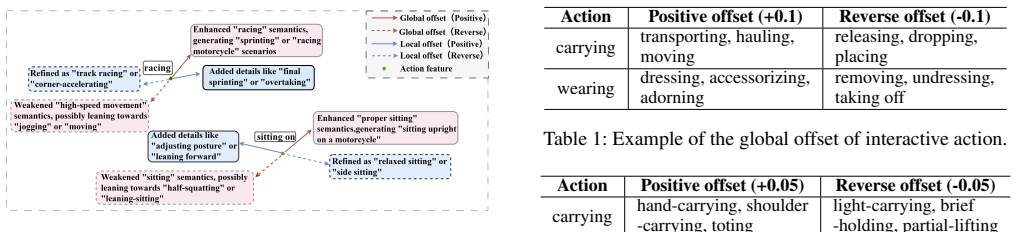
- Bidirectional action offsets make near-synonymous verbs such as carrying versus wearing, or riding versus sitting on, distinguishable in generated images, reducing action confusion in multi-object scenes.
- Semantic soft masks plus multi-scale entity refinement should reduce typical entity artifacts—extra fingers, three legs, blurred faces—by forcing separate attention to each entity region.
- The larger detection gains with a stronger HOI detector indicate the method helps most on fine action details, with the paper noting a remaining gap between generated and real images.
Reading between the lines
- Beyond the paper's experiments, the cluster-and-offset operation is a general recipe: any fine-grained attribute that text-to-image models confuse, such as pose, material, or emotion, could be enriched by the same bidirectional perturbation around category centers.
- Beyond the paper's claims, the implicit-triplet mining could be repurposed as a data-generation tool: if LLM-mined triplets from HICO-DET prompts are used to augment HOI detector training, the contribution would extend from generation to perception; the paper does not run this experiment.
- Beyond the paper's reported settings, the method's architecture-agnostic design suggests a natural stress test in 3D or video HOI generation, where implicit relations like 'near' and 'facing' could also impose spatial and temporal consistency.
- Beyond the paper's experiments, the interaction scaling coefficient δ and the sampling interval strategy are simple knobs that could be tuned per prompt type, potentially improving rare HOI categories where the paper's reported gains are smaller.
Editorial analysis
A structured set of objections, weighed in public.
Referee Report
Summary. The paper proposes CEIDM, a training-free extension of InteractDiffusion for text-to-image generation with joint control of entities and their interactions. It introduces four additions: (a) explicit interactive triplets encoded through CLIP and MLPs; (b) an LLM-based chain-of-thought mechanism that mines implicit interaction triplets; (c) a K-means-based action clustering and bidirectional offset method that augments action features; and (d) an Entity Control Network (ECN) that produces soft entity masks and refines entity features via multi-scale convolutions and dynamic fusion. Experiments on HICO-DET report that CEIDM improves FID/KID and FGAHOI detection mAP over Stable Diffusion, GLIGEN, and InteractDiffusion, with ablations attributing gains to each component.
Significance. If the reported gains are reproducible, the paper would make a useful contribution: controllable generation that does not require retraining a diffusion backbone is practically attractive, and the idea of using LLM-mined implicit relations and action-feature offsets is interesting and goes beyond fixed layout or triplet conditioning. The work explicitly builds on prior components and provides a detailed ablation, which is a strength. However, the central empirical claim is currently under-supported: the ECN is described only functionally, the hyperparameters are selected on the evaluation metric itself, and all numbers come from a single seed. The method as written cannot be instantiated or verified, which substantially limits the significance in its present form.
major comments (4)
- [Entity Control Network (ECN) and Implementation Details] The paper states 'Our method is free of training,' but the ECN is described only as an MLP for mask generation, parallel multi-scale convolutional branches, and a dynamic fusion network, with no equations, no parameter initialization, no pretrained checkpoint, and no training procedure. If these modules are randomly initialized and frozen, their input-dependent stochastic transforms would not plausibly produce the consistent FID/mAP improvements in Table 4 (e.g., FID 16.25→16.12, mAP 31.64→31.91). If they are trained or borrowed, the 'free of training' claim is false and the 'Ec.' ablation row cannot be attributed to the mechanism as described. This is load-bearing because the full method in Table 3 includes the ECN, and every reported advantage over InteractDiffusion depends partly on these unspecified networks.
- [Implementation Details, Figs. 5–6, Appendix G] The hyperparameters δ, w, s1, s2, and temp are selected by sensitivity analysis on the FGAHOI detection mAP, which is also the principal evaluation metric reported in Tables 3 and 4. No held-out split, fixed validation protocol, or seed variation is described, and all results use a single random seed (default 489) with no error bars. Because the same metric drives both hyperparameter selection and final reporting, the reported gains in mAP are partially circular and their statistical significance is unknown. The differences in Table 4 are small (e.g., 31.64 vs. 31.91 for Swin-Tiny full mAP) and may be within run-to-run noise. Please provide a separate validation set for hyperparameter choice, report multiple seeds with means and variances, or otherwise demonstrate that the tuning does not inflate the headline numbers.
- [Interactive Action Clustering and Offset] The action-offset mechanism is central to the paper's claim of more accurate action generation, but it is not specified enough to be reproduced. The text defines Ai as CLIP embeddings of actions but does not give the exact feature representation, the number of clusters k for K-means, the initialization, the distance metric, or the formula for the global and local offset directions. The examples list offset magnitudes of ±0.1 and ±0.05, but the mapping from 'offset quantity' to m, and how multiple offsets are combined in G, is not specified. Without these details, the 'Cl.' ablation row cannot be independently instantiated, and the reported contribution of clustering/offset to the final scores cannot be validated.
- [Quantitative evaluation and Table 3] The paper reports best-over-baseline FID and KID but only one inference run. FID and KID are known to be noisy on finite samples, and the reported margin over InteractDiffusion (FID 18.69 vs. 16.12) is substantial, but the mAP differences are smaller and the single-seed protocol means no confidence interval is available. In addition, the 'HICO-DET GT' row evaluates detector performance on ground-truth images, and CEIDM's Swin-Tiny mAP exceeds that of the real data (31.91 vs. 29.94); this surprising result deserves discussion. At minimum, the authors should report standard errors over multiple seeds and clarify the GT comparison.
minor comments (5)
- [Throughout] The manuscript contains grammatical issues such as 'a image generation method', 'we proposes', and 'of f set'. A careful language pass is needed.
- [Equation (7)] Typo: 'Sof tmax' should be 'Softmax'.
- [Figure 2 and Figure 3] The framework figure is dense and the caption does not clearly map each panel to the corresponding subsection; Figure 3's 'partial decoding results' are not explained. Please enlarge or annotate the sub-figures and refer to them in the main text more precisely.
- [Table 4] The column abbreviation 'Ec.' is explained as 'entity control network' in the caption but the term 'ECN' is used in the Method section. Keep notation consistent.
- [References to appendices] The text references Appendix B, C, D, E, F, and G for essential implementation and analysis details. In the provided manuscript these appendices are missing. If they are part of the submission, they must be included; otherwise the described experimental settings, prompts, and sensitivity results are not available to the reader.
Circularity Check
Hyperparameters δ, w, s1, s2, temp are tuned on the FGAHOI mAP used as the headline metric, making part of the reported gain a self-selected prediction; ECN weights unspecified.
-
fitted input called prediction
[Implementation Details (Experiments) and Fig.5/Fig.6, Table 3/Table 4]
"Additionally, we conducted sensitive analysis by adjusting the interaction scaling coefficient δ from 1.0 to 2.0 in 0.1 increments (see Fig.5 and Fig.6). ... We implemented: (1) the IEA layer with δ = 1.3 and feature output fusion weight w = 0.7; (2) sampling strategy hyperparameters s1 = 1, s2 = 0.7; (3) temp = 2.0 in attention mask computation."
The interaction scaling coefficient δ and the other hyperparameters are chosen by sweeping δ over 1.0–2.0 while inspecting the FGAHOI-derived HOI detection mAP and quality scores (Fig.5 and Fig.6). The same FGAHOI mAP is then reported in Table 3 and Table 4 as evidence that CEIDM 'outperforms the existing methods in all indicators.' Therefore the δ-attributed improvements (FID 16.25→16.12, mAP 31.64→31.91 in Table 4) are not independent predictions; they are the result of selecting the hyperparameter to maximize the very metric used to claim success. The main comparison with InteractDiffusion retains independent content, but the headline 'all indicators' claim is partly self-confirming.
full rationale
The derivation chain is mostly self-contained: the method builds on InteractDiffusion, CLIP, a pretrained LLM, and the external HICO-DET/FGAHOI benchmarks. The new interaction modules (LLM mining, action clustering/offset, IEA) are not defined in terms of the outputs they are supposed to predict, and no load-bearing self-citation chain is present. However, one evaluation loop is partially circular: the implementation section reports a sensitivity sweep of δ (1.0–2.0) against FGAHOI mAP and quality scores, then fixes δ = 1.3 and reports the same FGAHOI mAP as the headline result. The δ-attributed gain is therefore a selection artifact rather than an independent prediction. The main comparison with InteractDiffusion is not fully circular because the other components produce the bulk of the improvement even without δ, and the baselines are external. Separately, the Entity Control Network's MLP/convolutional/fusion weights are never specified despite the 'free of training' claim, so the Ec. ablation gain cannot be independently verified; this is a reproducibility/correctness concern rather than a circularity.
Assumptions & free parameters
free parameters (6)
- Interaction scaling coefficient delta =
1.3
- IEA fusion weight w =
0.7
- Sampling interval hyperparameters s1, s2 =
s1=1, s2=0.7
- Mask temperature temp =
2.0
- Action offset values =
examples +/-0.1 and +/-0.05
- K-means cluster count k for action clustering =
unstated
assumptions (5)
- domain assumption HICO-DET triple annotations used as prompts are a valid testbed for entity and interaction control in T2I.
- domain assumption FGAHOI detector mAP is a valid measure of interaction controllability.
- domain assumption Qwen-Turbo LLM extracts reasonable implicit relationship triples from prompts.
- domain assumption CLIP action embeddings cluster semantically such that K-means and linear offsets shift action meaning as intended.
- standard math Diffusion model background and attention mechanisms work as described.
Cite this review
Pith. "Pith review of CEIDM: A Controlled Entity and Interaction Diffusion Model for Enhanced Text-to-Image Generation." pith.science (2026). https://pith.science/paper/PKMKDMTI
@misc{pith2026250817760,
  author       = {Pith},
  title        = {Pith review of: CEIDM: A Controlled Entity and Interaction Diffusion Model for Enhanced Text-to-Image Generation},
  year         = {2026},
  howpublished = {\url{https://pith.science/paper/PKMKDMTI}},
  note         = {Machine review of arXiv:2508.17760}
}
read the original abstract
In Text-to-Image (T2I) generation, the complexity of entities and their intricate interactions pose a significant challenge for T2I method based on diffusion model: how to effectively control entity and their interactions to produce high-quality images. To address this, we propose CEIDM, a image generation method based on diffusion model with dual controls for entity and interaction. First, we propose an entity interactive relationships mining approach based on Large Language Models (LLMs), extracting reasonable and rich implicit interactive relationships through chain of thought to guide diffusion models to generate high-quality images that are closer to realistic logic and have more reasonable interactive relationships. Furthermore, We propose an interactive action clustering and offset method to cluster and offset the interactive action features contained in each text prompts. By constructing global and local bidirectional offsets, we enhance semantic understanding and detail supplementation of original actions, making the model's understanding of the concept of interactive "actions" more accurate and generating images with more accurate interactive actions. Finally, we design an entity control network which generates masks with entity semantic guidance, then leveraging multi-scale convolutional network to enhance entity feature and dynamic network to fuse feature. It effectively controls entities and significantly improves image quality. Experiments show that the proposed CEIDM method is better than the most representative existing methods in both entity control and their interaction control.
Figures


Figures from the paper (4 more)


Reference graph
Works this paper leans on
-
[1]
Bansal, A.; Chu, H.-M.; Schwarzschild, A.; Sengupta, S.; Goldblum, M.; Geiping, J.; and Goldstein, T. 2023. Universal guidance for diffusion models. In Proceedings of the IEEE/CVF Conference on Computer Vision and Pattern Recognition, 843--852
work page 2023
-
[2]
Bi \'n kowski, M.; Sutherland, D. J.; Arbel, M.; and Gretton, A. 2018. Demystifying mmd gans. arXiv preprint arXiv:1801.01401
arXiv 2018
-
[3]
Chao, Y.-W.; Liu, Y.; Liu, X.; Zeng, H.; and Deng, J. 2018. Learning to detect human-object interactions. In 2018 IEEE Winter Conference on Applications of Computer Vision (wacv), 381--389. IEEE
work page 2018
-
[4]
Chen, M.; Laina, I.; and Vedaldi, A. 2024. Training-free layout control with cross-attention guidance. In Proceedings of the IEEE/CVF Winter Conference on Applications of Computer Vision, 5343--5353
work page 2024
-
[5]
Chung, J.; Hyun, S.; and Heo, J.-P. 2024. Style injection in diffusion: A training-free approach for adapting large-scale diffusion models for style transfer. In Proceedings of the IEEE/CVF Conference on Computer Vision and Pattern Recognition, 8795--8805
work page 2024
-
[6]
Dai, S.; Li, W.; Sun, H.; Huang, H.; Ma, C.; Huang, H.; Xu, K.; and Hu, R. 2024. Interfusion: Text-driven generation of 3d human-object interaction. In European Conference on Computer Vision, 18--35. Springer
work page 2024
-
[7]
Devlin, J.; Chang, M.-W.; Lee, K.; and Toutanova, K. 2019. Bert: Pre-training of deep bidirectional transformers for language understanding. In Proceedings of the 2019 Conference of the North American Chapter of the Association for Computational Linguistics: Human Language Technologies, Volume 1 (long and short papers), 4171--4186
work page 2019
-
[8]
Dhariwal, P.; and Nichol, A. 2021. Diffusion models beat gans on image synthesis. Advances in Neural Information Processing Systems, 34: 8780--8794
work page 2021
Show all 40 references
-
[9]
Ding, R.; and Zhou, B. 2025. Enhancing domain-specific knowledge graph reasoning via metapath-based large model prompt learning. Electronics, 14(5): 1012
2025
-
[10]
Esser, P.; Rombach, R.; and Ommer, B. 2021. Taming transformers for high-resolution image synthesis. In Proceedings of the IEEE/CVF Conference on Computer Vision and Pattern Recognition, 12873--12883
2021
-
[11]
Gao, C.; Liu, S.; Zhu, D.; Liu, Q.; Cao, J.; He, H.; He, R.; and Yan, S. 2020. Interactgan: Learning to generate human-object interaction. In Proceedings of the 28th ACM International Conference on Multimedia, 165--173
2020
-
[12]
Heusel, M.; Ramsauer, H.; Unterthiner, T.; Nessler, B.; and Hochreiter, S. 2017. Gans trained by a two time-scale update rule converge to a local nash equilibrium. Advances in Neural Information Processing Systems, 30
2017
-
[13]
Ho, J.; Jain, A.; and Abbeel, P. 2020. Denoising diffusion probabilistic models. Advances in Neural Information Processing Systems, 33: 6840--6851
2020
-
[14]
T.; Jiang, X.; Chan, C
Hoe, J. T.; Jiang, X.; Chan, C. S.; Tan, Y.-P.; and Hu, W. 2024. Interactdiffusion: Interaction control in text-to-image diffusion models. In Proceedings of the IEEE/CVF Conference on Computer Vision and Pattern Recognition, 6180--6189
2024
-
[15]
Hua, T.; Zheng, H.; Bai, Y.; Zhang, W.; Zhang, X.-P.; and Mei, T. 2021. Exploiting relationship for complex-scene image generation. In Proceedings of the AAAI Conference on Artificial Intelligence, volume 35, 1584--1592
2021
-
[16]
Huang, L.; Chen, D.; Liu, Y.; Shen, Y.; Zhao, D.; and Zhou, J. 2023. Composer: Creative and controllable image synthesis with composable conditions. arXiv preprint arXiv:2302.09778
2023 arXiv
-
[17]
Li, Y.; Liu, H.; Wu, Q.; Mu, F.; Yang, J.; Gao, J.; Li, C.; and Lee, Y. J. 2023. Gligen: Open-set grounded text-to-image generation. In Proceedings of the IEEE/CVF Conference on Computer Vision and Pattern Recognition, 22511--22521
2023
-
[18]
Liu, L.; Ren, Y.; Lin, Z.; and Zhao, Z. 2022. Pseudo numerical methods for diffusion models on manifolds. arXiv preprint arXiv:2202.09778
2022 arXiv
-
[19]
Ma, S.; Wang, Y.; Wang, S.; and Wei, Y. 2023. Fgahoi: Fine-grained anchors for human-object interaction detection. IEEE Transactions on Pattern Analysis and Machine Intelligence, 46(4): 2415--2429
2023
-
[20]
P.; Tancik, M.; Barron, J
Mildenhall, B.; Srinivasan, P. P.; Tancik, M.; Barron, J. T.; Ramamoorthi, R.; and Ng, R. 2021. Nerf: Representing scenes as neural radiance fields for view synthesis. Communications of the ACM, 65(1): 99--106
2021
-
[21]
Nichol, A.; Dhariwal, P.; Ramesh, A.; Shyam, P.; Mishkin, P.; McGrew, B.; Sutskever, I.; and Chen, M. 2021. Glide: Towards photorealistic image generation and editing with text-guided diffusion models. arXiv preprint arXiv:2112.10741
2021 arXiv
-
[22]
W.; Hallacy, C.; Ramesh, A.; Goh, G.; Agarwal, S.; Sastry, G.; Askell, A.; Mishkin, P.; Clark, J.; et al
Radford, A.; Kim, J. W.; Hallacy, C.; Ramesh, A.; Goh, G.; Agarwal, S.; Sastry, G.; Askell, A.; Mishkin, P.; Clark, J.; et al. 2021. Learning transferable visual models from natural language supervision. In International Conference on Machine Learning, 8748--8763. PmLR
2021
-
[23]
Ramesh, A.; Dhariwal, P.; Nichol, A.; Chu, C.; and Chen, M. 2022. Hierarchical text-conditional image generation with clip latents. arXiv preprint arXiv:2204.06125, 1(2): 3
2022 arXiv
-
[24]
Rombach, R.; Blattmann, A.; Lorenz, D.; Esser, P.; and Ommer, B. 2022. High-resolution image synthesis with latent diffusion models. In Proceedings of the IEEE/CVF Conference on Computer Vision and Pattern Recognition, 10684--10695
2022
-
[25]
L.; Ghasemipour, K.; Gontijo Lopes, R.; Karagol Ayan, B.; Salimans, T.; et al
Saharia, C.; Chan, W.; Saxena, S.; Li, L.; Whang, J.; Denton, E. L.; Ghasemipour, K.; Gontijo Lopes, R.; Karagol Ayan, B.; Salimans, T.; et al. 2022. Photorealistic text-to-image diffusion models with deep language understanding. Advances in Neural Information Processing Syste...
2022
-
[26]
Sohl-Dickstein, J.; Weiss, E.; Maheswaranathan, N.; and Ganguli, S. 2015. Deep unsupervised learning using nonequilibrium thermodynamics. In International Conference on Machine Learning, 2256--2265. pmlr
2015
-
[27]
Song, J.; Meng, C.; and Ermon, S. 2020. Denoising diffusion implicit models. arXiv preprint arXiv:2010.02502
2020 arXiv
-
[28]
Tang, D.; Cao, X.; Wu, X.; Li, J.; Yao, J.; Bai, X.; Jiang, D.; Li, Y.; and Meng, D. 2025. AeroGen: Enhancing remote sensing object detection with diffusion-driven data generation. In Proceedings of the Computer Vision and Pattern Recognition Conference, 3614--3624
2025
-
[29]
Tang, K.; Li, S.; Tang, J.; Li, D.; Wang, P.; and Wang, T. 2024. Fusing structural information with knowledge enhanced text representation for knowledge graph completion. Data Mining and Knowledge Discovery, 38(3): 1316--1333
2024
-
[30]
Wang, Z.; Bao, J.; Gu, S.; Chen, D.; Zhou, W.; and Li, H. 2025. Designdiffusion: High-quality text-to-design image generation with diffusion models. In Proceedings of the Computer Vision and Pattern Recognition Conference, 20906--20915
2025
-
[31]
Yang, A.; Li, A.; Yang, B.; Zhang, B.; Hui, B.; Zheng, B.; Yu, B.; Gao, C.; Huang, C.; Lv, C.; et al. 2025. Qwen3 technical report. arXiv preprint arXiv:2505.09388
2025 arXiv
-
[32]
Yang, Z.; Wang, J.; Gan, Z.; Li, L.; Lin, K.; Wu, C.; Duan, N.; Liu, Z.; Liu, C.; Zeng, M.; et al. 2023. Reco: Region-controlled text-to-image generation. In Proceedings of the IEEE/CVF Conference on Computer Vision and Pattern Recognition, 14246--14255
2023
-
[33]
Yao, J.; Yang, B.; and Wang, X. 2025. Reconstruction vs. generation: Taming optimization dilemma in latent diffusion models. In Proceedings of the Computer Vision and Pattern Recognition Conference, 15703--15712
2025
-
[34]
Zhang, L.; Rao, A.; and Agrawala, M. 2023. Adding conditional control to text-to-image diffusion models. In Proceedings of the IEEE/CVF International Conference on Computer Vision, 3836--3847
2023
-
[35]
Zhao, J.; Zheng, H.; Wang, C.; Lan, L.; Huang, W.; and Yang, W. 2023. Null-text guidance in diffusion models is secretly a cartoon-style creator. In Proceedings of the 31st ACM International Conference on Multimedia, 5143--5152
2023
-
[36]
Zheng, G.; Li, S.; Wang, H.; Yao, T.; Chen, Y.; Ding, S.; and Li, X. 2022. Entropy-driven sampling and training scheme for conditional diffusion generation. In European Conference on Computer Vision, 754--769. Springer
2022
-
[37]
Zheng, G.; Zhou, X.; Li, X.; Qi, Z.; Shan, Y.; and Li, X. 2023. Layoutdiffusion: Controllable diffusion model for layout-to-image generation. In Proceedings of the IEEE/CVF Conference on Computer Vision and Pattern Recognition, 22490--22499
2023
-
[38]
Zhou, D.; Li, Y.; Ma, F.; Zhang, X.; and Yang, Y. 2024. Migc: Multi-instance generation controller for text-to-image synthesis. In Proceedings of the IEEE/CVF Conference on Computer Vision and Pattern Recognition, 6818--6828
2024
-
[39]
, " * write output.state after.block = add.period write newline
ENTRY address archivePrefix author booktitle chapter edition editor eid eprint howpublished institution isbn journal key month note number organization pages publisher school series title type volume year label extra.label sort.label short.list INTEGERS output.state before.all...
-
[40]
write newline
" write newline "" before.all 'output.state := FUNCTION n.dashify 't := "" t empty not t #1 #1 substring "-" = t #1 #2 substring "--" = not "--" * t #2 global.max substring 't := t #1 #1 substring "-" = "-" * t #2 global.max substring 't := while if t #1 #1 substring * t #2 gl...
Reviewed August 5, 2026 · model on record in the stance chip above.
Discussion (0). Sign in to comment.