REVIEW 3 major objections 5 minor 36 references
CoCo-Fed: A Unified Framework for Memory- and Communication-Efficient Federated Learning at the Wireless Edge
T0 review · 3 major / 5 minor · reviewed 2026-08-03 · deepseek-v4-flash
Pith's one-line read CoCo-Fed claims to make federated learning at the wireless edge both memory-efficient and communication-efficient in one framework: local optimizer states shrink to O(r²), and each node uploads a single consolidated r_a×r_a matrix per round
desk verdict A genuinely useful communication-compression scheme for wireless FL whose main theoretical claim is not actually proven: the cross-layer interference that the de-combining step must tolerate is dropped in the key inequality. read the letter →
The pith
A machine-rendered reading of the paper's core claim, the machinery that carries it, and where it could break.
The reading
What carries the argument
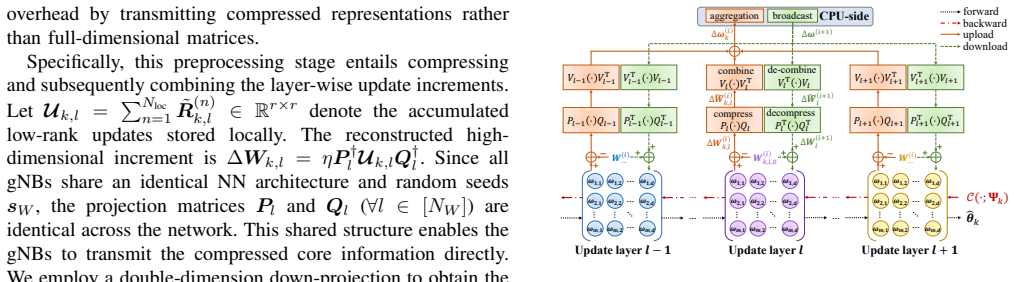
The workhorse is the low-rank projection pair (P_l, Q_l), generated seed-wise from truncated SVD of a random matrix so that no large projector needs to be stored, and the Gaussian mixing matrix V whose r-dimensional sub-blocks V_l superimpose layer-updates in a code-division-multiplexing-like manner. The local update rule W ← W + η P_l^† R Q_l^† keeps the optimizer states in r×r space, and the global combination ΔW = Σ_l V_l ΔW_l V_l^T packs the whole network's update into one r_a×r_a matrix. Recovery at the server uses V_l^T ΔW V_l, which isolates layer l when V_l^T V_j ≈ 0 for j≠l. Stochastic rounding quantization (both uplink and downlink) is the only other source of error in the Theorem
What would settle it
Take the exact V used in the simulations (r_a between 40 and 100), compute the Frobenius norm of V_l^T V_j for l≠j, and compare it with the signal term V_l^T V_l. If that cross-interference is not small relative to the layer-update norms, then the de-combination step V_l^T ΔW V_l injects uncontrolled noise, and the claimed constant-size communication with FedAvg-comparable accuracy would be refuted by a divergence between CoCo-Fed and full-precision FedAvg that does not shrink as r_a increases.
Extended reading notes
Core claim
The central claim is that a federated learning system can be designed so that both local memory and global communication scale with the projection rank r (or r_a), not with the model's layer dimensions. The mechanism is a double-dimension down-projection of gradients (P_l G Q_l) for the local optimizer, followed by an orthogonal subspace superposition of all layer updates into a single matrix per gNB (Σ_l V_l ΔW_l V_l^T). The paper argues that because the Gaussian sub-matrices V_l are approximately orthogonal, the consolidated matrix can be de-combined at the server into per-layer updates with bounded error. Theorem 4 gives a discrepancy bound versus FedAvg that depends on the number of quan
Load-bearing premise
The whole recovery step hinges on the unquantified assumption that the Gaussian sub-matrices V_l are nearly orthogonal to each other (V_l^T V_j ≈ 0), and the proof drops the cross-layer interference term in Eq. (68) without including it in the Theorem 4 bound.
Editorial extensions
If this is right
- Per-gNB uplink traffic becomes a single r_a×r_a matrix per round, so communication cost is independent of the number of layers and their dimensions; total uplink traffic is K r_a² and downlink is r_a².
- Local optimizer memory drops to O(r²) per layer, and because the low-rank updates are merged back into the backbone weights, inference adds no extra parameters or latency.
- If the near-orthogonality condition holds for the chosen r_a, the server-side de-combination recovers each layer's update with an error that shrinks as uplink/downlink quantization bits increase (Theorem 4).
- The convergence analysis covers unsupervised training (reconstruction loss), which is the relevant setting for wireless sensing tasks where labels are unavailable.
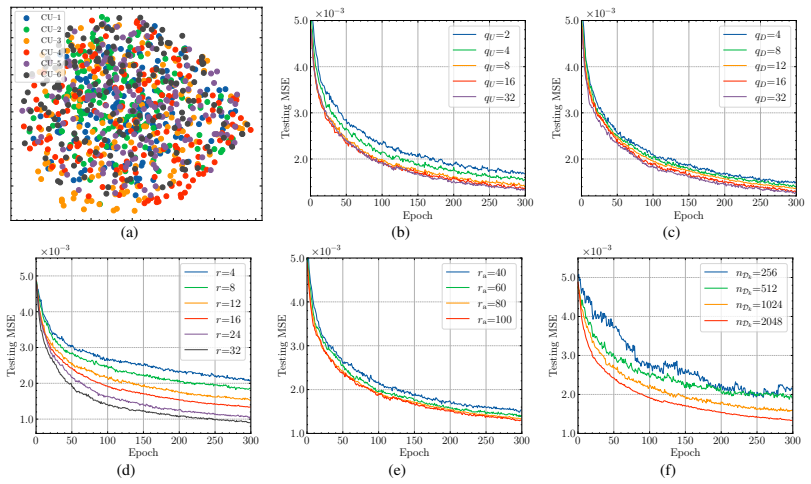
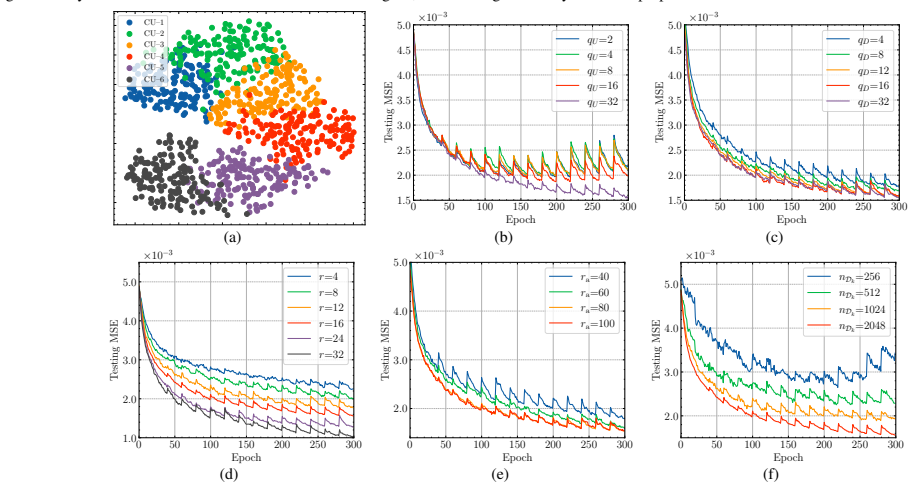
- Simulations on angle-of-arrival estimation show the framework converges under both IID and non-IID data distributions, with final accuracy approaching full fine-tuning as SNR grows.
Reading between the lines
- A direct testable extension is to always use strictly orthogonal V sub-blocks when r_a ≥ r·N_W (the paper's Case 1); if accuracy is unchanged relative to random Gaussian V, the random near-orthogonality is not essential, and the constant-size payload claim becomes unconditional.
- The proof's reliance on near-orthogonality suggests a practical guardrail: monitor ‖V_l^T V_j‖ for the chosen r_a; when it is not negligible, the de-combination noise should be added to the error bound or compensated by a small correction step.
- Because the per-round payload is constant in model size, the framework's advantage should grow for deeper/wider models; a natural next experiment is to increase model width while holding r_a fixed and verify that the MSE gap relative to full fine-tuning does not grow.
- The same superposition idea could transfer to supervised federated learning, provided the local convergence theorem is re-derived without the unsupervised loss assumption; the communication-side mechanism is agnostic to the loss function.
Editorial analysis
A structured set of objections, weighed in public.
Referee Report
Summary. The paper proposes CoCo-Fed, a federated learning framework for O-RAN that (i) compresses local gradients to r×r via seed-generated random projections and runs the optimizer in this low-rank space, and (ii) superimposes per-layer updates into a single r_a×r_a matrix using Gaussian matrices, followed by quantization and aggregation. It claims memory O(r^2), communication independent of model size, and rigorous convergence under an unsupervised loss. The theoretical part contains a local convergence theorem for SGD with projections, a Gaussian orthogonality lemma, and an aggregation-error bound versus FedAvg. Experiments on an unsupervised AoA estimation task with a ViT backbone compare against LoRA, GaLore, Flora, and full fine-tuning under IID and non-IID settings.
Significance. If the claimed guarantees held, the paper would make a useful contribution: it unifies local memory reduction and communication compression in a way that standard PEFT/MEFT and quantization methods do not, and the 'superposition of layer updates' idea is an original combination of random projections and CDM-like signaling. The empirical study is extensive: it evaluates memory, communication bits, convergence, sensitivity to r, r_a, quantization bits, buffer size, and IID/non-IID conditions, and compares against three relevant baselines plus MUSIC. The paper is also transparent about the SGD-for-Adam simplification and about the performance gap relative to full fine-tuning. However, the load-bearing theoretical claim — that the constant-size transmission achieves FedAvg-comparable accuracy — rests on a proof step that discards the cross-layer interference, which is not negligible at the simulated parameters. The convergence theorem itself applies to a simplified optimizer and relies on assumptions not verified for the actual model. The empirical results are plausible and useful, but the theoretical guarantees are not yet established.
major comments (3)
- [Appendix E, Eq. (68); Section IV-D3] The proof of Theorem 4 drops the cross-layer interference term. In Eq. (68), P_l†∆WQ_l† is replaced by P_l†P_l∆W_lQ_lQ_l†, which is valid only if V_l^T V_j = 0 for j≠l. For V drawn i.i.d. N(0,1/r_a), the entries of V_l^T V_j have standard deviation 1/√r_a; with the default r=24, r_a=60, N_W=14, the expected relative magnitude of one interfering layer is ~r/r_a ≈ 0.4, and the accumulated interference is of the same order as the desired update. This term is absent from the final bound, so Theorem 4 does not support the claims in Section IV (constant-size upload with FedAvg-comparable accuracy) or the abstract. The authors need either to include the interference term in the bound (which will introduce a dependence on N_W r/r_a) or to restrict the claim to the strictly orthogonal regime r_a ≥ rN_W.
- [Section IV-D1 and Algorithm 1 / Eqs. (6)-(9)] Theorem 2 analyzes the SGD update W^(n)=W^(n-1)+ηP†PGQQ†, whereas the implemented local optimizer is Adam, defined in Eqs. (6)-(8). The text acknowledges this simplification, but the abstract and Section VII claim a rigorous convergence proof for CoCo-Fed without qualification. Since the proof does not cover the actual algorithm, the convergence guarantee is not established for the proposed method. If the claim is intended only as an analysis of the low-rank projection mechanism, it should be stated as such throughout.
- [Appendix B, Theorem 2] The proof of Theorem 2 has gaps that prevent it from being a rigorous guarantee. First, the gradient form in Theorem 1 is derived for a 'chained reversible' network, but the implementation uses a ViT; the paper cites GaLore for this transfer, but no verification is provided. Second, the contraction factor κ=η(C_G−(L_A+L_BD_WD_C)ε_P,Q) is not shown to be positive and less than 1; the proof requires this for the exponential decay in Eq. (20). Third, Eq. (38) computes E[X_Ci,l]=d(d+7) by effectively treating f^(n) and f^(n-1) as independent, although the features are deterministic functions of the previous weights. These unverified steps make the convergence statement an upper-bound exercise rather than a proof of convergence for the deployed model.
minor comments (5)
- [Section IV-D2 / Theorem 3] The statement of Theorem 3 is for one Gaussian matrix, not for the sub-matrices V_l used in the superposition. The text in Appendix E (around Eq. (68)) appears to apply it to V_l^T V_l'; this requires a separate bound on cross-Gram matrices. Also, the phrase '∥V_l^T V_l'−I_m∥_F→m for l≠l'' is not meaningful; presumably a typo for →0 or similar.
- [Section IV-B, Eq. (12)] ∆_c W_{k,l}=P_l∆W_{k,l}Q_l is exactly ηU_{k,l} because P_lP_l^T=I_r and Q_l^TQ_l=I_r; the ≈ sign is unnecessary and slightly misleading.
- [Section VI-B / Table III] The comparison of communication overhead in Table III would be clearer if the baseline bit counts were broken down into uplink and downlink separately with the number of clients K used; currently the percentages mix uplink and downlink, making it hard to verify the 1.33% figure.
- [Figure 4(b)] The axis label 'Transimission overhead (r'imes105' bits)' appears corrupted; it should be 'Transmission overhead (×10^5 bits)'.
- [Section VII / Figs. 3-5] The conclusion states 'estimation accuracy comparable to full fine-tuning', but Figs. 3 and 5 show a consistent performance gap between CoCo-Fed and Full FT. This wording should be softened to 'with a small degradation' or similar.
Circularity Check
Theorem 4's proof reduces the FedAvg-comparison claim to an assumed recovery property: Eq. (68) drops the cross-layer interference term that the theorem is supposed to bound.
-
self definitional
[Appendix E, Eq. (68), used by Theorem 4 in Section IV-D3]
"According to Theorem 3, we know that ∥V_l^T V_{l'} − I_m∥_F → m for l=l' and ∥V_l^T V_{l'} − I_m∥_F → m for l≠l' with large r_a. It means that if r_a is preset properly, ∥P†_l ∆W Q†_l−∆W_l∥^2_F = ∥P†_l P_l ∆W_l Q_l Q†_l−∆W_l∥^2_F, which is approximated to 0."
The theorem is supposed to bound the gap between CoCo-Fed's recovered layer update, P†_l ∆W Q†_l, and the FedAvg update, ∆W_l. Instead of bounding this gap, the proof replaces the recovered update with the no-cross-interference expression P†_l P_l ∆W_l Q_l Q†_l and then declares the difference approximately zero. The vanishing of V_l^T V_j for j≠l and V_l^T V_l ≈ I is precisely the recoverability property that Theorem 4 is meant to establish; it is not a proven consequence of the stated hypotheses. Thus the theorem's conclusion is assumed in its own proof.
full rationale
The central mathematical claim that CoCo-Fed matches full-precision FedAvg (Theorem 4) is not derived from independent bounds: at the key de-combination step (Appendix E, Eq. (68)), the proof sets the actual recovered quantity equal to the no-interference FedAvg update by invoking approximate orthogonality of Gaussian sub-matrices. That orthogonality is exactly what needs to be proved for the superposition protocol to work. For the default simulation parameters (r_a=60, r=24, N_W=14), Gaussian cross-block terms have expected Frobenius norm on the order of r/√r_a ≈ 3.1, so the dropped interference is not negligible; the final bound omits this term entirely. This is a question-begging reduction in the paper's flagship convergence theorem. The remainder of the paper is largely independent: the local-memory analysis and communication-size claims follow directly from the construction, and the simulation results are not produced by fitting constants from the theorems. The self-citations to the authors' prior AoA model and backbone are not load-bearing for the main theoretical claim. Weighing the central proof reduction against the substantial independent engineering content, the circularity is partial rather than total.
Assumptions & free parameters
free parameters (7)
- projection rank r =
default 24 (swept 4–32)
- transmission dimension r_a =
default 60 (swept 40–100)
- uplink quantization bits q_U =
default 2 (swept 2–32)
- downlink quantization bits q_D =
default 8 (swept 4–32)
- learning rate η =
1e-3
- Tikhonov regularization γ =
1e-2
- local update steps N_loc =
20
assumptions (7)
- domain assumption The ViT/backbone can be treated as a chained reversible network for gradient-form analysis.
- domain assumption A_i and B_i are L-continuous and B_i, W_l, C_i are bounded during training.
- domain assumption Layer inputs f_l are distributed as N(0, I_d) after normalization.
- ad hoc to paper Gaussian sub-matrices V_l are approximately orthogonal for the chosen r_a.
- standard math Unbiased stochastic rounding and the quantization error lemma from [18] hold exactly.
- domain assumption Backhaul links are error-free and uploads arrive perfectly synchronized.
- domain assumption A pre-trained ViT backbone is available at every gNB.
Cite this review
Pith. "Pith review of CoCo-Fed: A Unified Framework for Memory- and Communication-Efficient Federated Learning at the Wireless Edge." pith.science (2026). https://pith.science/paper/PLDZX5Z5
@misc{pith2026260100549,
  author       = {Pith},
  title        = {Pith review of: CoCo-Fed: A Unified Framework for Memory- and Communication-Efficient Federated Learning at the Wireless Edge},
  year         = {2026},
  howpublished = {\url{https://pith.science/paper/PLDZX5Z5}},
  note         = {Machine review of arXiv:2601.00549}
}
read the original abstract
The deployment of large-scale neural networks within the Open Radio Access Network (O-RAN) architecture is pivotal for enabling native edge intelligence. However, this paradigm faces two critical bottlenecks: the prohibitive memory footprint required for local training on resource-constrained gNBs, and the saturation of bandwidth-limited backhaul links during the global aggregation of high-dimensional model updates. To address these challenges, we propose CoCo-Fed, a novel Compression and Combination-based Federated learning framework that unifies local memory efficiency and global communication reduction. Locally, CoCo-Fed breaks the memory wall by performing a double-dimension down-projection of gradients, adapting the optimizer to operate on low-rank structures without introducing additional inference parameters/latency. Globally, we introduce a transmission protocol based on orthogonal subspace superposition, where layer-wise updates are projected and superimposed into a single consolidated matrix per gNB, drastically reducing the backhaul traffic. Beyond empirical designs, we establish a rigorous theoretical foundation, proving the convergence of CoCo-Fed even under unsupervised learning conditions suitable for wireless sensing tasks. Extensive simulations on an angle-of-arrival estimation task demonstrate that CoCo-Fed significantly outperforms state-of-the-art baselines in both memory and communication efficiency while maintaining robust convergence under non-IID settings.
Figures


Figures from the paper (3 more)

Reference graph
Works this paper leans on
-
[1]
Task-oriented 6G native-AI network architecture,
Y . Yang, J. Wu, T. Chenet al., “Task-oriented 6G native-AI network architecture,”IEEE Network, vol. 38, no. 1, pp. 219–227, Jan. 2024
2024
-
[2]
Explainable AI in 6G O-RAN: A tutorial and survey on architecture, use cases, challenges, and future research,
B. Brik, H. Chergui, L. Zanzi, F. Devoti, A. Ksentini, M. S. Siddiqui, X. Costa-P `erez, and C. Verikoukis, “Explainable AI in 6G O-RAN: A tutorial and survey on architecture, use cases, challenges, and future research,”IEEE Commun. Surv. Tutorials, vol. 27, no. 5, pp. 2826–2859, Oct. 2025
2025
-
[3]
Toward 6g native-AI network: Foun- dation model-based cloud-edge-end collaboration framework,
X. Chen, Z. Guo, X. Wanget al., “Toward 6g native-AI network: Foun- dation model-based cloud-edge-end collaboration framework,”IEEE Commun. Mag., vol. 63, no. 8, pp. 23–30, Jul. 2025
2025
-
[4]
Intellicise wireless networks from semantic communications: A survey, research issues, and challenges,
P. Zhang, W. Xu, Y . Liuet al., “Intellicise wireless networks from semantic communications: A survey, research issues, and challenges,” IEEE Commun. Surv. Tutorials, vol. 27, no. 3, pp. 2051–2084, Aug. 2025
-
[5]
Communication-efficient learning of deep networks from decentralized data,
B. McMahan, E. Moore, D. Ramage, S. Hampson, and B. A. y Arcas, “Communication-efficient learning of deep networks from decentralized data,” inProc. Int. Conf. Artif. Intell. Stat. (AISTATS), vol. 54, Fort Lauderdale, FL, USA, April, 2017, pp. 1273–1282
2017
-
[6]
A comprehensive tutorial and survey of O-RAN: Exploring slicing-aware architecture, deployment options, use cases, and challenges,
K. Alam, H. M. Asif, T. Matthiaset al., “A comprehensive tutorial and survey of O-RAN: Exploring slicing-aware architecture, deployment options, use cases, and challenges,”IEEE Commun. Surv. Tutorials , Early Access, pp. 1–40, 2025
2025
-
[7]
Scheduling and aggregation design for asynchronous federated learning over wireless networks,
C. Hu, Z. Chen, and E. G. Larsson, “Scheduling and aggregation design for asynchronous federated learning over wireless networks,”IEEE J. Sel. Areas Commun., vol. 41, no. 4, pp. 874–886, Apr. 2023
2023
-
[8]
Lora: Low-rank adaptation of large language models,
E. J. Hu, Y . Shen, P. Walliset al., “Lora: Low-rank adaptation of large language models,” inInt. Conf. Learn. Represent. (ICLR), Virtual Event, April 2022, pp. 1–13
2022
Show all 36 references
-
[9]
Galore: Memory-Efficient LLM training by gradient low-rank projection,
J. Zhao, Z. Zhang, B. Chenet al., “Galore: Memory-Efficient LLM training by gradient low-rank projection,” inProc. Int. Conf. Mach. Learn. (ICML), Vienna, Austria, July, 2024, pp. 1–23
2024
-
[10]
A comprehensive survey on communication-efficient federated learning in mobile edge environments,
N. Jia, Z. Qu, B. Ye, Y . Wang, S. Hu, and S. Guo, “A comprehensive survey on communication-efficient federated learning in mobile edge environments,”IEEE Commun. Surv. Tut., pp. 1–1, 2025
2025
-
[11]
Low-rank adaptation for foundation models: A com- prehensive review,
M. Yanget al., “Low-rank adaptation for foundation models: A com- prehensive review,”arXiv:2501.00365, Dec. 2024
2024
-
[12]
A survey on parameter-efficient fine-tuning for foundation models in federated learn- ing,
J. Bian, Y . Peng, L. Wang, Y . Huang, and J. Xu, “A survey on parameter-efficient fine-tuning for foundation models in federated learn- ing,”arXiv:2504.21099, Apr. 2025
2025 arXiv
-
[13]
Few-shot parameter-efficient fine-tuning is better and cheaper than in-context learning,
H. Liu, D. Tam, M. Muqeeth, J. Mohta, T. Huang, M. Bansal, and C. Raffel, “Few-shot parameter-efficient fine-tuning is better and cheaper than in-context learning,” inAdvances in Neural Information Processing Systems 35: Annual Conference on Neural Information Processing Syste...
2022
-
[14]
BitFit: Simple parameter- efficient fine-tuning for transformer-based masked language-models,
E. B. Zaken, Y . Goldberg, and S. Ravfogel, “BitFit: Simple parameter- efficient fine-tuning for transformer-based masked language-models,” inProceedings of the 60th Annual Meeting of the Association for Computational Linguistics (Volume 2: Short Papers), ACL 2022, Dublin, Ire...
2022
-
[15]
Loraprune: Structured pruning meets low-rank parameter-efficient fine-tuning,
M. Zhang, H. Chen, C. Shenet al., “Loraprune: Structured pruning meets low-rank parameter-efficient fine-tuning,” inAnnu. Meet. Assoc. Comput. Linguist. (ACL), Bangkok, Thailand, August, 2024, pp. 3013– 3026
2024
-
[16]
Adaptive budget allocation for parameter-efficient fine-tuning,
Q. Zhang, M. Chen, A. Bukharinet al., “Adaptive budget allocation for parameter-efficient fine-tuning,” inInt. Conf. Learn. Represent. (ICLR), Kigali, Rwanda, May 1-5, 2023, pp. 1–17
2023
-
[17]
Flora: Low-rank adapters are secretly gradient compressors,
Y . Hao, Y . Cao, and L. Mou, “Flora: Low-rank adapters are secretly gradient compressors,” inInt. Conf. Mach. Learn. (ICML), Vienna, Austria, July, 2024, pp. 1–18
2024
-
[18]
Design and analysis of uplink and downlink communications for federated learning,
S. Zheng, C. Shen, and X. Chen, “Design and analysis of uplink and downlink communications for federated learning,”IEEE J. Sel. Areas Commun., vol. 39, no. 7, pp. 2150–2167, Jul. 2021
2021
-
[19]
High-dimensional stochastic gradient quantization for communication-efficient edge learning,
Y . Du, S. Yang, and K. Huang, “High-dimensional stochastic gradient quantization for communication-efficient edge learning,”IEEE Trans. Signal Process., vol. 68, pp. 2128–2142, Mar. 2020
2020
-
[20]
Fed-QSSL: A framework for personalized federated learning under bitwidth and data heterogeneity,
Y . Chen, H. Vikalo, and C. Wang, “Fed-QSSL: A framework for personalized federated learning under bitwidth and data heterogeneity,” inProc. AAAI Conf. Artif. Intell., Vancouver, Canada, Feb. 2024, pp. 11 443–11 452
2024
-
[21]
Deep anomaly detection for time-series data in industrial IoT: A communication-efficient on-device federated learning approach,
Y . Liu, S. Garg, J. Nieet al., “Deep anomaly detection for time-series data in industrial IoT: A communication-efficient on-device federated learning approach,”IEEE Internet Things J., vol. 8, no. 8, pp. 6348– 6358, Jul. 2021
2021
-
[22]
A distributed synchronous SGD algorithm with global Top-k sparsification for low bandwidth networks,
S. Shi, Q. Wang, K. Zhaoet al., “A distributed synchronous SGD algorithm with global Top-k sparsification for low bandwidth networks,” inInt. Conf. Distributed Computing Systems (ICDCS), Dallas, TX, USA, July, 2019, pp. 2238–2247
2019
-
[23]
Latency-efficient wireless federated learning with sparsification and quantization for heterogeneous devices,
X. Chen, A. Wang, X. Deng, and J. Gui, “Latency-efficient wireless federated learning with sparsification and quantization for heterogeneous devices,”IEEE Internet Things J., vol. 12, no. 1, pp. 488–501, Jan. 2025
2025
-
[24]
An image is worth 16x16 words: Transformers for image recognition at scale,
A. Dosovitskiyet al., “An image is worth 16x16 words: Transformers for image recognition at scale,” inInt. Conf. Learn. Represent. (ICLR), Virtual Event, May, 2021, pp. 1–21
2021
-
[25]
Parameter-efficient transfer learning for NLP,
N. Houlsby, A. Giurgiu, S. Jastrzebskiet al., “Parameter-efficient transfer learning for NLP,” inProc. Int. Conf. Mach. Learn. (ICML), California, USA, Jun. 2019, pp. 2790–2799
2019
-
[26]
Unsupervised AoA estimation based on dual-path knowledge-aware auto-encoders,
Z. Guo, Y . Xiao, X. Wang, and X. Chen, “Unsupervised AoA estimation based on dual-path knowledge-aware auto-encoders,”IEEE Trans. Wirel. Commun., Early Access, pp. 1–15, Feb. 2025
2025
-
[27]
Understanding self-supervised learning with dual deep networks,
Y . Tian, L. Yu, X. Chen, and S. Ganguli, “Understanding self-supervised learning with dual deep networks,”arXiv:2010.00578, Feb. 2021
2010 arXiv
-
[28]
Direct localization for massive MIMO,
N. Garcia, H. Wymeersch, E. G. Larsson, A. M. Haimovich, and M. Coulon, “Direct localization for massive MIMO,”IEEE Trans. Signal Process., vol. 65, no. 10, pp. 2475–2487, May 2017
2017
-
[29]
An elementary proof of a theorem of Johnson and Lindenstrauss,
S. Dasgupta and A. Gupta, “An elementary proof of a theorem of Johnson and Lindenstrauss,”Random Struct. Algorithms, vol. 22, no. 1, pp. 60–65, Jan. 2003
2003
-
[30]
Study on artificial intelligence (AI)/machine learning (ML) for NR air interface (Release 18),
3GPP TR 28.843 V19.0.0, “Study on artificial intelligence (AI)/machine learning (ML) for NR air interface (Release 18),”3rd Generation Partnership Project (3GPP), 2025
2025
-
[31]
A simplified parametric channel estimation scheme for OFDM systems,
S. Liu, F. Wang, R. Zhang, and Y . Liu, “A simplified parametric channel estimation scheme for OFDM systems,”IEEE Trans. Wirel. Commun., vol. 7, no. 12-1, pp. 5082–5090, Dec. 2008
2008
-
[32]
MUSIC, maximum likelihood and Cramer- Rao bound: Further results and comparisons,
P. Stoica and A. Nehorai, “MUSIC, maximum likelihood and Cramer- Rao bound: Further results and comparisons,” inIEEE Int. Conf. Acoustics, Speech Signal Process. (ICASSP), Glasgow, Scotland, May 1989, pp. 2605–2608
1989
-
[33]
Accurate channel prediction based on transformer: Making mobility negligible,
H. Jiang, M. Cui, D. W. K. Ng, and L. Dai, “Accurate channel prediction based on transformer: Making mobility negligible,”IEEE J. Sel. Areas Commun., vol. 40, no. 9, pp. 2717–2732, Sep. 2022
2022
-
[34]
Unsupervised learning strategy for direction-of-arrival estimation network,
Y . Yuan, S. Wu, M. Wu, and N. Yuan, “Unsupervised learning strategy for direction-of-arrival estimation network,”IEEE Signal Process. Lett., vol. 28, pp. 1450–1454, Jul. 2021
2021
-
[35]
UMAP: Uniform manifold approximation and projection for dimension reduction,
L. McInnes and J. Healy, “UMAP: Uniform manifold approximation and projection for dimension reduction,”arXiv:1802.03426, Sep. 2020
2020 arXiv
-
[36]
High-dimensional probability: An introduction with applications in data science,
O. Papaspiliopoulos, “High-dimensional probability: An introduction with applications in data science,”Quantitative Finance, vol. 20, no. 10, pp. 1591–1594, 2020
2020
Reviewed August 3, 2026 · model on record in the stance chip above.
Discussion (0). Sign in to comment.