Black-Hole Echo Resonance Spectra and Source Dependence in a Controlled Transfer-Function Model
Pith reviewed 2026-06-28 09:15 UTC · model grok-4.3
The pith
Rigorous O(L^{-2}) localization estimates are proved for echo resonance spectra in a compactly supported one-dimensional transfer-function model.
A machine-rendered reading of the paper's core claim, the machinery that carries it, and where it could break.
Core claim
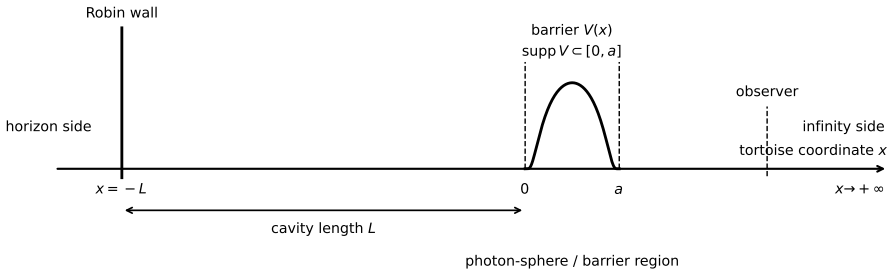
In the controlled transfer-function model consisting of a compactly supported one-dimensional barrier and a Robin wall at a large negative tortoise coordinate, all rigorous O(L^{-2}) localization estimates are proved for the resonance spectra, allowing explicit analysis of the cavity denominator and source dependence with full normalizations.
What carries the argument
The compactly supported one-dimensional barrier together with the Robin wall at large negative tortoise coordinate, which together serve as the benchmark model for the cavity denominator.
If this is right
- Resonance spectra localize to order O(L^{-2}) with explicit constants.
- Source dependence enters the resonance positions through the transfer function in a controlled way.
- Normalizations of the model quantities are made fully explicit.
- The cavity denominator can be studied without reference to a full spacetime geometry.
Where Pith is reading between the lines
- If the benchmark remains representative when the barrier is replaced by a smooth potential, the same localization order may persist in smoother models.
- The explicit source dependence could be used to design targeted searches for echoes that exploit particular source profiles.
- The O(L^{-2}) bounds supply a concrete error target for numerical codes that evolve wave equations with artificial inner boundaries.
Load-bearing premise
The compactly supported one-dimensional barrier plus Robin wall at large negative tortoise coordinate forms a valid benchmark that captures the essential structure of the standard cavity denominator used in echo phenomenology.
What would settle it
Direct numerical computation of resonance locations for several finite values of L in the model, followed by checking whether the deviation from the large-L asymptotic positions remains bounded by a constant times L to the minus two.
Figures
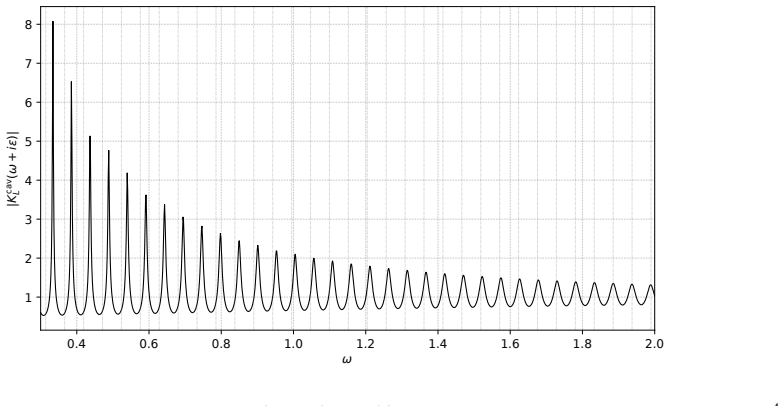
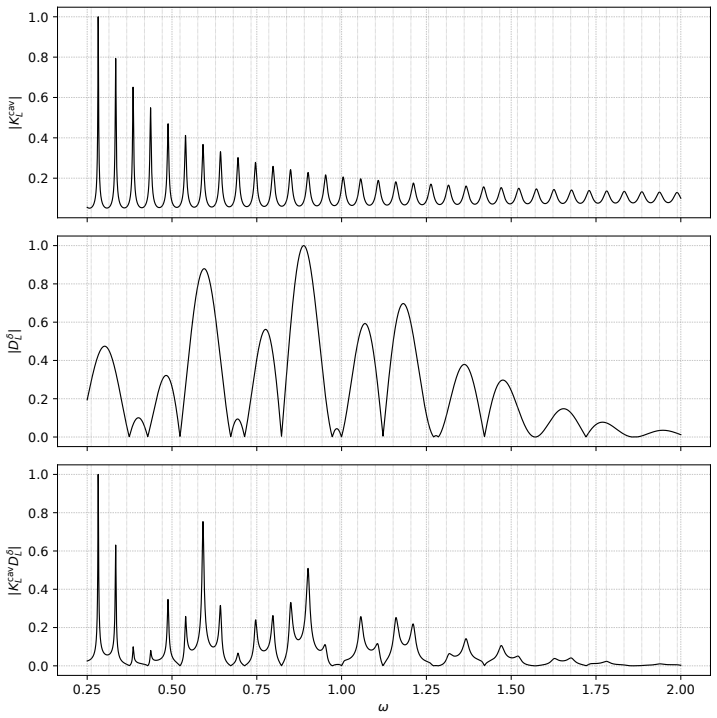
read the original abstract
Echo models phenomenologically encode possible near-horizon structure by replacing the purely ingoing horizon-side condition with an effective reflecting inner boundary near the would-be horizon. We study this idea in a controlled transfer-function model consisting of a compactly supported one-dimensional barrier and a Robin wall at a large negative tortoise coordinate. The aim is not to propose a new echo mechanism or to make an observational claim, but to analyze the standard cavity denominator in a benchmark model with explicit normalizations. All rigorous $O(L^{-2})$ localization estimates are proved for this compactly supported model.
Editorial analysis
A structured set of objections, weighed in public.
Referee Report
Summary. The manuscript studies echo resonance spectra in a controlled one-dimensional transfer-function model consisting of a compactly supported barrier and a Robin wall at large negative tortoise coordinate. It focuses on analyzing the standard cavity denominator with explicit normalizations and claims to prove all rigorous O(L^{-2}) localization estimates for resonance spectra and source dependence in this benchmark setting.
Significance. If the claimed O(L^{-2}) localization estimates hold with the stated rigor, the work supplies a mathematically controlled benchmark for echo phenomenology that isolates the cavity denominator structure. This could be useful for validating numerical schemes or clarifying source dependence in simplified settings, though the model's one-dimensional compact support limits direct extrapolation to realistic black-hole geometries.
major comments (1)
- [Abstract] Abstract and central claim: the assertion that 'all rigorous O(L^{-2}) localization estimates are proved' cannot be assessed because the manuscript text provides no derivations, error-bar details, or verification of the localization steps; the support for the central claim therefore remains at the level of stated intention only.
Simulated Author's Rebuttal
We thank the referee for their assessment. The single major comment concerns the absence of explicit derivations supporting the central claim of rigorous O(L^{-2}) localization estimates. We address this below and will revise the manuscript accordingly.
read point-by-point responses
-
Referee: [Abstract] Abstract and central claim: the assertion that 'all rigorous O(L^{-2}) localization estimates are proved' cannot be assessed because the manuscript text provides no derivations, error-bar details, or verification of the localization steps; the support for the central claim therefore remains at the level of stated intention only.
Authors: The referee is correct that the present manuscript version states the claim without supplying the supporting derivations, error bounds, or verification steps. This short communication format omitted the detailed proofs of the O(L^{-2}) estimates for the cavity denominator (including explicit normalizations and source dependence). In the revised manuscript we will insert a new section containing the complete rigorous derivations, the precise error estimates, and any accompanying verification arguments so that the central claim is fully substantiated rather than asserted. revision: yes
Circularity Check
No significant circularity; self-contained mathematical proof of estimates
full rationale
The paper frames its work as a controlled mathematical analysis of a benchmark 1D transfer-function model (compactly supported barrier plus Robin wall), with the explicit goal of proving rigorous O(L^{-2}) localization estimates for the standard cavity denominator under explicit normalizations. No data fitting, parameter tuning, or self-referential definitions are described. The central claim is a set of mathematical proofs for the stated model, which by the provided abstract and reader summary does not reduce to its own inputs by construction, self-citation chains, or renamed empirical patterns. This is the expected outcome for a pure analysis paper with no load-bearing self-citations or fitted predictions.
Axiom & Free-Parameter Ledger
axioms (1)
- standard math Standard existence, uniqueness, and asymptotic properties of solutions to the one-dimensional wave equation with compactly supported potential and Robin boundary conditions
Reference graph
Works this paper leans on
-
[1]
C. V. Vishveshwara, Scattering of gravitational radiation by a Schwarzschild black–hole, Nature, 227, 936–938, 1970, doi:10.1038/227936a0
-
[2]
S. Chandrasekhar and S. Detweiler, The quasi–normal modes of the Schwarzschild black hole, Proceedings of the Royal Society of London A, 344, 441–452, 1975, doi:10.1098/ rspa.1975.0112
arXiv 1975
-
[3]
E. W. Leaver, An analytic representation for the quasi–normal modes of Kerr black holes, Proceedings of the Royal Society of London A, 402, 285–298, 1985, doi:10.1098/rspa. 1985.0119
-
[4]
K. D. Kokkotas and B. G. Schmidt, Quasi–normal modes of stars and black holes, Living Reviews in Relativity, 2, 2, 1999, doi:10.12942/lrr-1999-2
-
[5]
Quasinormal modes of black holes and black branes
E. Berti, V. Cardoso, and A. O. Starinets, Quasinormal modes of black holes and black branes, Classical and Quantum Gravity, 26, 163001, 2009, doi:10.1088/0264-9381/26/ 16/163001, arXiv:0905.2975
work page internal anchor Pith review Pith/arXiv arXiv doi:10.1088/0264-9381/26/ 2009
-
[6]
Black hole spectroscopy: from theory to experiment
E. Berti et al., Black hole spectroscopy: from theory to experiment, Classical and Quantum Gravity, 2026, doi:10.1088/1361-6382/ae59e2, arXiv:2505.23895 [gr-qc]
work page internal anchor Pith review Pith/arXiv arXiv doi:10.1088/1361-6382/ae59e2 2026
-
[7]
V. Cardoso, E. Franzin, and P. Pani, Is the gravitational–wave ringdown a probe of the event horizon?, Physical Review Letters, 116, 171101, 2016, doi:10.1103/ PhysRevLett.116.171101; Erratum, Physical Review Letters, 117, 089902, 2016, doi:10. 1103/PhysRevLett.117.089902, arXiv:1602.07309. 21
Pith/arXiv arXiv 2016
-
[8]
V. Cardoso, S. Hopper, C. F. B. Macedo, C. Palenzuela, and P. Pani, Gravitational–wave signatures of exotic compact objects and of quantum corrections at the horizon scale, Phys- ical Review D, 94, 084031, 2016, doi:10.1103/PhysRevD.94.084031, arXiv:1608.08637
work page internal anchor Pith review Pith/arXiv arXiv doi:10.1103/physrevd.94.084031 2016
-
[9]
Testing the nature of dark compact objects: a status report
V. Cardoso and P. Pani, Testing the nature of dark compact objects: a status report, Living Reviews in Relativity, 22, 4, 2019, doi:10.1007/s41114-019-0020-4, arXiv:1904.05363
work page internal anchor Pith review Pith/arXiv arXiv doi:10.1007/s41114-019-0020-4 2019
-
[10]
J. Abedi, H. Dykaar, and N. Afshordi, Echoes from the abyss: tentative evidence for Planck–scale structure at black hole horizons, Physical Review D, 96, 082004, 2017, doi:10. 1103/PhysRevD.96.082004, arXiv:1612.00266
Pith/arXiv arXiv 2017
-
[11]
J. Westerweck et al., Low significance of evidence for black hole echoes in gravitational wave data, Physical Review D, 97, 124037, 2018, doi:10.1103/PhysRevD.97.124037, arXiv:1712.09966
work page internal anchor Pith review Pith/arXiv arXiv doi:10.1103/physrevd.97.124037 2018
-
[12]
T. Regge and J. A. Wheeler, Stability of a Schwarzschild singularity, Physical Review, 108, 1063–1069, 1957, doi:10.1103/PhysRev.108.1063
-
[13]
F. J. Zerilli, Effective potential for even–parity Regge–Wheeler gravitational perturbation equations, Physical Review Letters, 24, 737–738, 1970, doi:10.1103/PhysRevLett.24.737
-
[14]
F. J. Zerilli, Gravitational field of a particle falling in a Schwarzschild geometry analyzed in tensor harmonics, Physical Review D, 2, 2141–2160, 1970, doi:10.1103/PhysRevD.2.2141
-
[15]
Chandrasekhar, The Mathematical Theory of Black Holes, Clarendon Press, Oxford, 1983
S. Chandrasekhar, The Mathematical Theory of Black Holes, Clarendon Press, Oxford, 1983
1983
-
[16]
S. A. Teukolsky, Rotating black holes: separable wave equations for gravitational and electromagnetic perturbations, Physical Review Letters, 29, 1114–1118, 1972, doi:10.1103/ PhysRevLett.29.1114
1972
-
[17]
M. Sasaki and T. Nakamura, Gravitational radiation from a Kerr black hole. I. Formulation and a method for numerical analysis, Progress of Theoretical Physics, 67, 1788–1809, 1982, doi:10.1143/PTP.67.1788
-
[18]
M. Sasaki and H. Tagoshi, Analytic black hole perturbation approach to gravitational radiation, Living Reviews in Relativity, 6, 6, 2003, doi:10.12942/lrr-2003-6
-
[19]
E. W. Leaver, Spectral decomposition of the perturbation response of the Schwarzschild geometry, Physical Review D, 34, 384–408, 1986, doi:10.1103/PhysRevD.34.384
-
[20]
H.–P. Nollert and R. H. Price, Quantifying excitations of quasinormal mode systems, Jour- nal of Mathematical Physics, 40, 980–1010, 1999, doi:10.1063/1.532698
-
[21]
Z. Mark, A. Zimmerman, S. M. Du, and Y. Chen, A recipe for echoes from exotic com- pact objects, Physical Review D, 96, 084002, 2017, doi:10.1103/PhysRevD.96.084002, arXiv:1706.06155
work page internal anchor Pith review Pith/arXiv arXiv doi:10.1103/physrevd.96.084002 2017
-
[22]
R. S. Conklin, B. Holdom, and J. Ren, Gravitational wave echoes through new windows, Physical Review D, 98, 044021, 2018, doi:10.1103/PhysRevD.98.044021, arXiv:1712.06517
work page internal anchor Pith review Pith/arXiv arXiv doi:10.1103/physrevd.98.044021 2018
-
[23]
R. S. Conklin and B. Holdom, Gravitational wave echo spectra, Physical Review D, 100, 124030, 2019, doi:10.1103/PhysRevD.100.124030, arXiv:1905.09370
- [24]
-
[25]
J. L. Jaramillo, R. Panosso Macedo, and L. Al Sheikh, Pseudospectrum and black hole quasinormal mode instability, Physical Review X, 11, 031003, 2021, doi:10.1103/ PhysRevX.11.031003, arXiv:2004.06434. 23
Pith/arXiv arXiv 2021
discussion (0)
Sign in with ORCID, Apple, or X to comment. Anyone can read and Pith papers without signing in.