Complex Conformal Manifolds
Pith reviewed 2026-07-01 02:07 UTC · model grok-4.3
The pith
Analytically continuing marginal couplings into the complex plane yields complex CFTs but confines rational points to the real regime.
A machine-rendered reading of the paper's core claim, the machinery that carries it, and where it could break.
Core claim
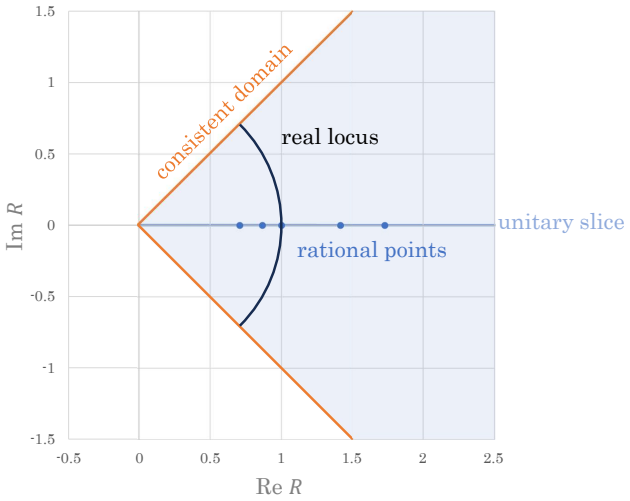
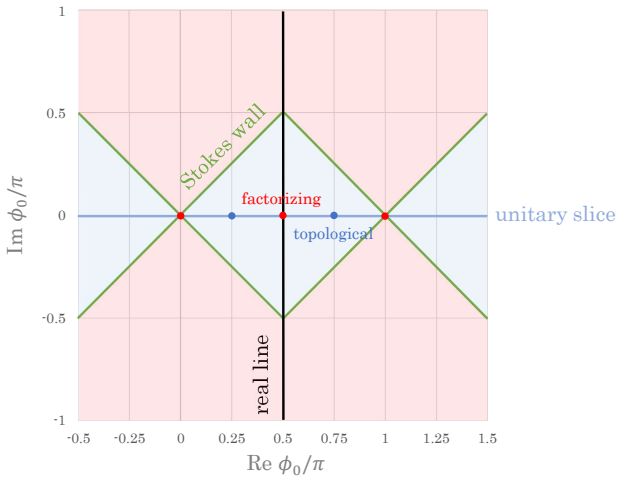
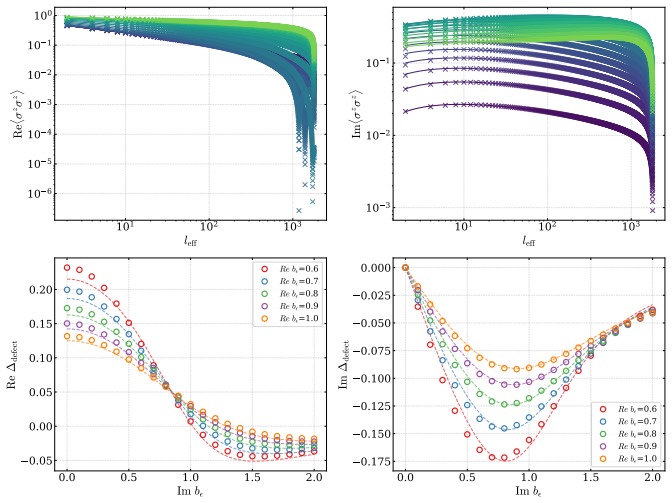
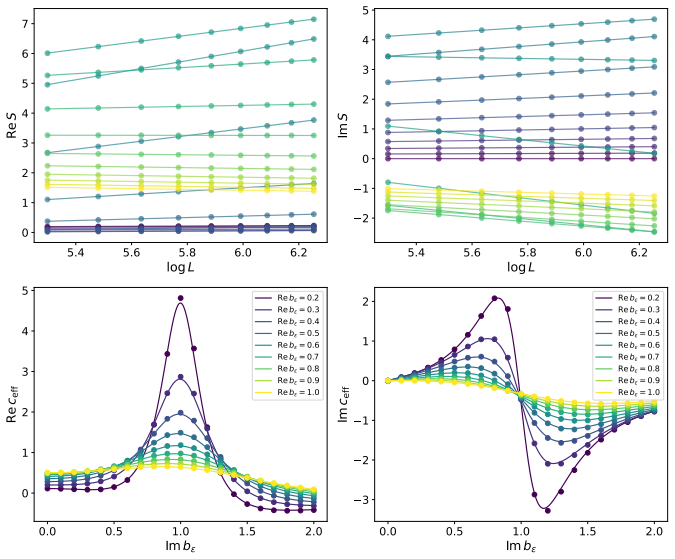
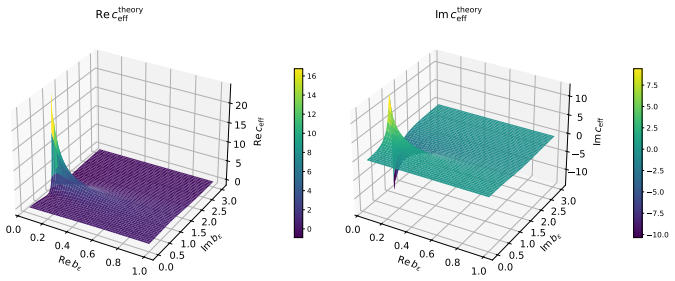
By analytically continuing exactly marginal couplings into the complex plane, one obtains complex CFTs with generically complex spectra while preserving conformal symmetry for bulk, boundary, and defect deformations. Using the compact free boson, the global structure of the complexified Gaussian conformal manifold is uncovered. More generally, genuinely complex rational CFTs do not exist: rational points remain confined to the real regime. For the Ising defect, exact expressions for the defect spectrum, energy transmission coefficient, and effective central charge are derived from the continuation and verified in lattice models via bulk-defect correlators, entanglement entropy, and complex e
What carries the argument
Analytic continuation of exactly marginal couplings into the complex plane, which preserves conformal symmetry across bulk, boundary, and defect deformations.
If this is right
- The Gaussian conformal manifold acquires a specific global structure once its couplings are complexified.
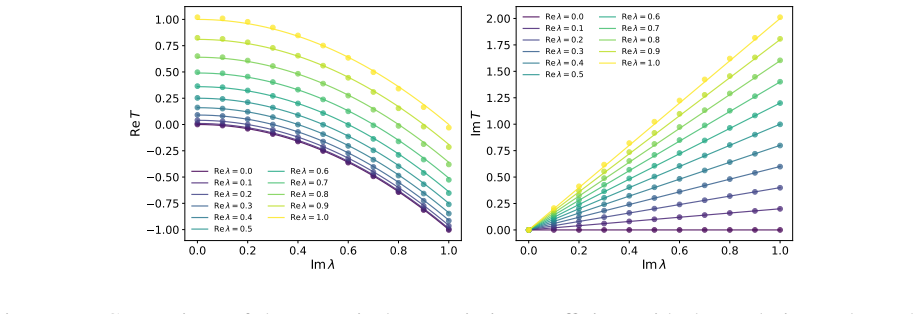
- Exact formulas for defect spectrum, energy transmission, and effective central charge follow directly from continuation in the Ising model.
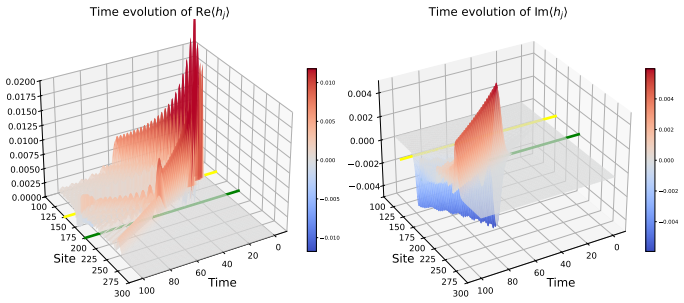
- Non-Hermitian Ising and free-fermion chains reproduce the predicted complex defect data through correlators, entanglement, and energy transport.
- Complex boundary RG flows admit a holographic treatment via the AdS/BCFT dictionary.
Where Pith is reading between the lines
- The same continuation procedure could be applied to other solvable CFTs with known marginal deformations to generate additional complex examples.
- The restriction of rational points to the real axis may simplify classification efforts for fixed points in complex RG flows.
- Holographic duals of these complex manifolds could provide new controlled settings for studying nonunitary gravity.
Load-bearing premise
The analytic continuation of exactly marginal couplings into the complex plane preserves conformal symmetry.
What would settle it
A lattice or numerical computation that produces a rational CFT with genuinely complex parameters whose data cannot be recovered by any real-axis continuation, or a mismatch between the continued Ising defect spectrum and direct measurements in a non-Hermitian chain.
Figures
read the original abstract
Complex conformal field theories (CFTs) have recently emerged as essential frameworks for understanding non-Hermitian criticality, weakly first-order phase transitions, and walking renormalization group flows, while their general structures remain largely unknown. In this work, we propose a systematic construction of complex CFTs by analytically continuing exactly marginal couplings into the complex plane. This procedure applies uniformly to bulk, boundary, and defect deformations, preserving conformal symmetry while generically complexifying operator spectra and other universal data. Using the compact free boson as a solvable laboratory, we uncover the global structure of the complexified Gaussian conformal manifold. More generally, we demonstrate that genuinely complex rational CFTs do not exist: rational points remain confined to the real regime, providing a sharp distinction between real and complex theories. In the defect case, we investigate the one-parameter family of conformal defects in the Ising CFT and derive exact expressions for the defect spectrum, energy transmission coefficient, and effective central charge from analytic continuation. The theoretical predictions are precisely verified in non-Hermitian critical Ising and free fermion chains using bulk-defect correlators, entanglement entropy, and complex energy transport, providing concrete evidence for the complex defect conformal manifold. Finally, we study complex boundary renormalization-group flows through the AdS/BCFT correspondence. Our results establish complex conformal manifolds as a controlled bridge between solvable lattice models, complex CFTs, and holography, while providing stringent analytic benchmarks for the nonunitary conformal bootstrap.
Editorial analysis
A structured set of objections, weighed in public.
Referee Report
Summary. The paper proposes constructing complex CFTs by analytic continuation of exactly marginal couplings into the complex plane, uniformly for bulk, boundary, and defect cases while preserving conformal invariance. Using the compact free boson, it maps the global structure of the complexified Gaussian conformal manifold. It argues that genuinely complex rational CFTs cannot exist because analyticity of the spectrum combined with discreteness of the rationals confines rational points to the real axis. For the Ising defect, exact expressions are derived for the defect spectrum, energy transmission, and effective central charge via continuation; these are verified against non-Hermitian lattice chains. Boundary RG flows are studied via AdS/BCFT. The work positions complex conformal manifolds as a bridge between lattice models, complex CFTs, and holography.
Significance. If the central claims hold, the construction supplies a controlled, uniform method for generating complex CFT data and the no-go result on rational points supplies a sharp structural distinction between real and complex theories. Explicit lattice verifications for both bulk and defect cases, together with the AdS/BCFT analysis, provide reproducible benchmarks that strengthen the analytic continuation framework.
minor comments (3)
- [§2.2] §2.2 (Gaussian manifold): the statement that the radius squared remains the only modulus after complexification would benefit from an explicit listing of the preserved and broken symmetries to clarify the dimension of the manifold.
- The general no-go argument (analyticity plus discreteness) is stated clearly but the precise domain of analyticity in the complex coupling is not delimited; a short paragraph specifying the radius of convergence or branch cuts would remove ambiguity.
- Figure 4 (defect spectrum): the plotted points for complex g are difficult to distinguish from the real-axis data; a different marker style or inset would improve readability.
Simulated Author's Rebuttal
We thank the referee for their positive summary, assessment of significance, and recommendation of minor revision. No major comments were raised in the report.
Circularity Check
No significant circularity; derivation self-contained
full rationale
The paper's central construction proceeds by analytic continuation of exactly marginal couplings, with explicit verification that conformal invariance is preserved in bulk, boundary, and defect sectors via the solvable Gaussian model and direct lattice computations (bulk-defect correlators, entanglement, energy transport). The claim that rational CFT points lie only on the real axis rests on the explicit global structure of the complexified Gaussian manifold plus a general analyticity-plus-discreteness argument; neither step reduces to a fitted parameter renamed as prediction, a self-definitional loop, or a load-bearing self-citation. Lattice verifications are independent of the analytic continuation ansatz and provide external falsifiability. No enumerated circularity pattern is present.
Axiom & Free-Parameter Ledger
free parameters (1)
- complex marginal couplings
axioms (1)
- domain assumption Analytic continuation of exactly marginal couplings preserves conformal symmetry
Reference graph
Works this paper leans on
-
[1]
Belavin, A.M
A.A. Belavin, A.M. Polyakov and A.B. Zamolodchikov,Infinite Conformal Symmetry in Two-Dimensional Quantum Field Theory,Nucl. Phys. B241(1984) 333
1984
-
[2]
Conformal Field Theory , ISBN =
P. Di Francesco, P. Mathieu and D. Senechal,Conformal Field Theory, Graduate Texts in Contemporary Physics, Springer-Verlag, New York (1997), 10.1007/978-1-4612-2256-9
-
[3]
J. Cardy,Conformal Field Theory and Statistical Mechanics, inLes Houches Summer School: Session 89: Exact Methods in Low-Dimensional Statistical Physics and Quantum Computing, 7, 2008 [0807.3472]
Pith/arXiv arXiv 2008
-
[4]
EPFL Lectures on Conformal Field Theory in D>= 3 Dimensions
S. Rychkov,EPFL Lectures on Conformal Field Theory in D>=3 Dimensions, SpringerBriefs in Physics (1, 2016), 10.1007/978-3-319-43626-5, [1601.05000]
work page internal anchor Pith review Pith/arXiv arXiv doi:10.1007/978-3-319-43626-5 2016
-
[5]
D. Poland, S. Rychkov and A. Vichi,The Conformal Bootstrap: Theory, Numerical Techniques, and Applications,Rev. Mod. Phys.91(2019) 015002 [1805.04405]
Pith/arXiv arXiv 2019
-
[6]
Cardy,Conformal Invariance and Surface Critical Behavior,Nucl
J.L. Cardy,Conformal Invariance and Surface Critical Behavior,Nucl. Phys. B240(1984) 514
1984
-
[7]
Cardy,Boundary Conditions, Fusion Rules and the Verlinde Formula,Nucl
J.L. Cardy,Boundary Conditions, Fusion Rules and the Verlinde Formula,Nucl. Phys. B324 (1989) 581
1989
-
[8]
Affleck and A.W.W
I. Affleck and A.W.W. Ludwig,Universal noninteger ’ground state degeneracy’ in critical quantum systems,Phys. Rev. Lett.67(1991) 161
1991
-
[9]
K. Sakai and Y . Satoh,Entanglement through conformal interfaces,JHEP12(2008) 001 [0809.4548]
Pith/arXiv arXiv 2008
-
[10]
Eisler and I
V . Eisler and I. Peschel,Exact results for the entanglement across defects in critical chains, J. Phys. A45(2012) 155301
2012
-
[11]
E.M. Brehm and I. Brunner,Entanglement entropy through conformal interfaces in the 2D Ising model,JHEP09(2015) 080 [1505.02647]
Pith/arXiv arXiv 2015
-
[12]
E.M. Brehm, I. Brunner, D. Jaud and C. Schmidt-Colinet,Entanglement and topological interfaces,Fortsch. Phys.64(2016) 516 [1512.05945]
Pith/arXiv arXiv 2016
-
[13]
M. Gutperle and J.D. Miller,A note on entanglement entropy for topological interfaces in rcfts,1512.07241
-
[14]
X. Wen, Y . Wang and S. Ryu,Entanglement evolution across a conformal interface,J. Phys. A51(2018) 195004 [1711.02126]
Pith/arXiv arXiv 2018
-
[15]
D. Rogerson, F. Pollmann and A. Roy,Entanglement entropy and negativity in the Ising model with defects,JHEP06(2022) 165 [2204.03601]. 37
arXiv 2022
-
[16]
T. Quella, I. Runkel and G.M.T. Watts,Reflection and transmission for conformal defects, JHEP04(2007) 095 [hep-th/0611296]
Pith/arXiv arXiv 2007
-
[17]
I. Brunner and C. Schmidt-Colinet,Reflection and transmission of conformal perturbation defects,J. Phys. A49(2016) 195401 [1508.04350]
Pith/arXiv arXiv 2016
-
[18]
M. Meineri, J. Penedones and A. Rousset,Colliders and conformal interfaces,Journal of High Energy Physics2020(2019) [1904.10974]
arXiv 2019
- [19]
- [20]
-
[21]
D.B. Kaplan, J.-W. Lee, D.T. Son and M.A. Stephanov,Conformality Lost,Phys. Rev. D80 (2009) 125005 [0905.4752]
Pith/arXiv arXiv 2009
-
[22]
V . Gorbenko, S. Rychkov and B. Zan,Walking, Weak first-order transitions, and Complex CFTs,JHEP10(2018) 108 [1807.11512]
Pith/arXiv arXiv 2018
-
[23]
V . Gorbenko, S. Rychkov and B. Zan,Walking, Weak first-order transitions, and Complex CFTs II. Two-dimensional Potts model at Q>4,SciPost Phys.5(2018) 050 [1808.04380]
Pith/arXiv arXiv 2018
-
[24]
H. Ma and Y .-C. He,Shadow of complex fixed point: Approximate conformality of Q>4 Potts model,Phys. Rev. B99(2019) 195130 [1811.11189]
Pith/arXiv arXiv 2019
-
[25]
J.L. Jacobsen and K.J. Wiese,Lattice Realization of Complex Conformal Field Theories: Two-Dimensional Potts Model with Q>4 States,Phys. Rev. Lett.133(2024) 077101 [2402.10732]
arXiv 2024
-
[26]
Y . Tang, H. Ma, Q. Tang, Y .-C. He and W. Zhu,Reclaiming the Lost Conformality in a Non-Hermitian Quantum 5-State Potts Model,Phys. Rev. Lett.133(2024) 076504 [2403.00852]
arXiv 2024
- [27]
- [28]
-
[29]
A. Nahum, J.T. Chalker, P. Serna, M. Ortu˜no and A.M. Somoza,Deconfined Quantum Criticality, Scaling Violations, and Classical Loop Models,Phys. Rev. X5(2015) 041048 [1506.06798]
Pith/arXiv arXiv 2015
-
[30]
C. Wang, A. Nahum, M.A. Metlitski, C. Xu and T. Senthil,Deconfined quantum critical points: symmetries and dualities,Phys. Rev. X7(2017) 031051 [1703.02426]. 38
Pith/arXiv arXiv 2017
-
[31]
P. Serna and A. Nahum,Emergence and spontaneous breaking of approximate O(4) symmetry at a weakly first-order deconfined phase transition,Phys. Rev. B99(2019) 195110 [1805.03759]
Pith/arXiv arXiv 2019
- [32]
-
[33]
Nahum,Note on Wess-Zumino-Witten models and quasiuniversality in 2+1 dimensions, Phys
A. Nahum,Note on Wess-Zumino-Witten models and quasiuniversality in 2+1 dimensions, Phys. Rev. B102(2020) 201116 [1912.13468]
arXiv 2020
- [34]
-
[35]
C. Yang and T. Scaffidi,Asymptotic freedom, lost: Complex conformal field theory in the two-dimensional O(N>2)nonlinear sigma model and its realization in Heisenberg spin chains,2601.02459
- [36]
-
[37]
J.L. Jacobsen and K.J. Wiese,Making complex CFTs real: The two-dimensional Potts model for Q>4and complex Q,2606.18125
-
[38]
Y . Tang, Q. Liu, Q. Tang and W. Zhu,Boundary criticality of complex conformal field theory: A case study in the non-Hermitian 5-state Potts model,SciPost Phys.19(2025) 164 [2512.07625]
arXiv 2025
-
[39]
V .V . Linden, B. De V os, K. Vervoort, F. Verstraete and A. Ueda,Spiral renormalization group flow and universal entanglement spectrum of the non-Hermitian five-state Potts model, Phys. Rev. B113(2026) 205106 [2507.14732]
Pith/arXiv arXiv 2026
-
[40]
Y . Liu, H. Shimizu, D. Liu and K. Kawabata,Extracting Boundary Conformal Data from Periodic Non-Hermitian Critical Chains,2606.16785
-
[41]
Zamolodchikov,Irreversibility of the flux of the renormalization group in a 2d field theory,JETP Lett.43(1986) 730
A.B. Zamolodchikov,Irreversibility of the flux of the renormalization group in a 2d field theory,JETP Lett.43(1986) 730
1986
-
[42]
Cardy,Continuously Varying Exponents and the Value of the Central Charge,J
J.L. Cardy,Continuously Varying Exponents and the Value of the Central Charge,J. Phys. A 20(1987) L891
1987
-
[43]
D. Green, Z. Komargodski, N. Seiberg, Y . Tachikawa and B. Wecht,Exactly Marginal Deformations and Global Symmetries,JHEP06(2010) 106 [1005.3546]
Pith/arXiv arXiv 2010
-
[44]
J. Gomis, P.-S. Hsin, Z. Komargodski, A. Schwimmer, N. Seiberg and S. Theisen, Anomalies, Conformal Manifolds, and Spheres,JHEP03(2016) 022 [1509.08511]
Pith/arXiv arXiv 2016
-
[45]
A. Karch and Y . Sato,Conformal Manifolds with Boundaries or Defects,JHEP07(2018) 156 [1805.10427]. 39
Pith/arXiv arXiv 2018
-
[46]
C.P. Herzog and I. Shamir,On Marginal Operators in Boundary Conformal Field Theory, JHEP10(2019) 088 [1906.11281]
arXiv 2019
-
[47]
N. Drukker, Z. Kong and G. Sakkas,Broken Global Symmetries and Defect Conformal Manifolds,Phys. Rev. Lett.129(2022) 201603 [2203.17157]
arXiv 2022
-
[48]
S. Komatsu, Y . Kusuki, M. Meineri and H. Ooguri,Continuous Family of Conformal Field Theories and Exactly Marginal Operators,Phys. Rev. Lett.136(2026) 241603 [2512.11045]
arXiv 2026
-
[49]
A. Antinucci, C. Copetti, G. Galati and G. Rizi,Defect Conformal Manifolds from Phantom Noninvertible Symmetries,Phys. Rev. Lett.135(2025) 211602 [2505.09668]
arXiv 2025
-
[50]
Y . Choi, H. Ha, D. Kim, Y . Kusuki, S. Ohyama and S. Ryu,Higher structures on boundary conformal manifolds: Higher Berry phase and boundary conformal field theory,Phys. Rev. D113(2026) 106005 [2507.12525]
arXiv 2026
-
[51]
M. Oshikawa and I. Affleck,Boundary conformal field theory approach to the two-dimensional critical ising model with a defect line,Nucl. Phys. B495(1997) 533 [cond-mat/9612187]
Pith/arXiv arXiv 1997
-
[52]
M. Oshikawa and I. Affleck,Defect lines in the Ising model and boundary states on orbifolds,Phys. Rev. Lett.77(1996) 2604 [hep-th/9606177]
Pith/arXiv arXiv 1996
-
[53]
K. Yamamoto, M. Nakagawa, M. Tezuka, M. Ueda and N. Kawakami,Universal properties of dissipative tomonaga-luttinger liquids: Case study of a non-hermitian xxz spin chain, 2112.12467
-
[54]
Vafa,Toward Classification of Conformal Theories,Phys
C. Vafa,Toward Classification of Conformal Theories,Phys. Lett. B206(1988) 421
1988
-
[55]
Anderson and G.W
G. Anderson and G.W. Moore,Rationality in Conformal Field Theory,Commun. Math. Phys.117(1988) 441
1988
-
[56]
P. Etingof,On vafa’s theorem for tensor categories,Mathematical Research Letters9(2002) 651 [math/02070079101]
Pith/arXiv arXiv 2002
-
[57]
M. Miyamoto,Modular invariance of vertex operator algebras satisfying c 2-cofiniteness, DUKE MATHEMATICAL JOURNAL122(2004) [math/0209101]
Pith/arXiv arXiv 2004
-
[58]
Haldane,’luttinger liquid theory’ of one-dimensional quantum fluids
F. Haldane,’luttinger liquid theory’ of one-dimensional quantum fluids. i. properties of the luttinger model and their extension to the general 1d interacting spinless fermi gas,Journal of Physics C: Solid State Physics14(1981) 2585
1981
-
[59]
K. Yamamoto and N. Kawakami,Universal description of dissipative Tomonaga-Luttinger liquids with SU(N) spin symmetry: Exact spectrum and critical exponents,Phys. Rev. B107 (2023) 045110 [2207.04395]. 40
arXiv 2023
- [60]
- [61]
- [62]
-
[63]
Peschel,Calculation of reduced density matrices from correlation functions,J
I. Peschel,Calculation of reduced density matrices from correlation functions,J. Phys. A36 (2003) L205 [cond-mat/0212631]
Pith/arXiv arXiv 2003
-
[64]
V . Eisler and I. Peschel,Reduced density matrices and entanglement entropy in free lattice models,J. Phys. A42(2009) 504003 [0906.1663]
Pith/arXiv arXiv 2009
-
[65]
P.-Y . Chang, J.-S. You, X. Wen and S. Ryu,Entanglement spectrum and entropy in topological non-Hermitian systems and nonunitary conformal field theory,Phys. Rev. Res.2 (2020) 033069 [1909.01346]
arXiv 2020
-
[66]
H. Shimizu and K. Kawabata,Complex entanglement entropy for complex conformal field theory,Phys. Rev. B112(2025) 085112 [2502.02001]
arXiv 2025
- [67]
-
[68]
A. Mollabashi, N. Shiba, T. Takayanagi, K. Tamaoka and Z. Wei,Pseudo Entropy in Free Quantum Field Theories,Phys. Rev. Lett.126(2021) 081601 [2011.09648]
arXiv 2021
-
[69]
K. Doi, J. Harper, A. Mollabashi, T. Takayanagi and Y . Taki,Pseudoentropy in dS/CFT and Timelike Entanglement Entropy,Phys. Rev. Lett.130(2023) 031601 [2210.09457]
arXiv 2023
-
[70]
P. Calabrese and J. Cardy,Entanglement entropy and conformal field theory,J. Phys. A42 (2009) 504005 [0905.4013]
Pith/arXiv arXiv 2009
-
[71]
V . Eisler and I. Peschel,Entanglement in fermionic chains with interface defects,Annalen Phys.522(2010) 679 [1005.2144]
Pith/arXiv arXiv 2010
- [72]
-
[73]
P. Calabrese and J.L. Cardy,Evolution of entanglement entropy in one-dimensional systems, J. Stat. Mech.0504(2005) P04010 [cond-mat/0503393]
Pith/arXiv arXiv 2005
-
[74]
P. Calabrese and J. Cardy,Quantum quenches in 1+1 dimensional conformal field theories, J. Stat. Mech.1606(2016) 064003 [1603.02889]
Pith/arXiv arXiv 2016
-
[75]
Takayanagi,Holographic dual of bcft,Phys
T. Takayanagi,Holographic dual of bcft,Phys. Rev. Lett.107(2011) 101602 [1105.5165]. 41
Pith/arXiv arXiv 2011
-
[76]
M. Fujita, T. Takayanagi and E. Tonni,Aspects of ads/bcft,JHEP11(2011) 043 [1108.5152]
Pith/arXiv arXiv 2011
- [77]
- [78]
-
[79]
R. Maeda, N. Nakamura and T. Takayanagi,Holographic dual of pt symmetric bcft, 2606.18629
-
[80]
I. Akal, Y . Kusuki, T. Takayanagi and Z. Wei,Codimension two holography for wedges, Phys. Rev. D102(2020) 126007 [2007.06800]
arXiv 2020
discussion (0)
Sign in with ORCID, Apple, or X to comment. Anyone can read and Pith papers without signing in.