REVIEW 3 major objections 5 minor 12 references
On the formation of satellites in dense solid-particle disks
T0 review · 3 major / 5 minor · reviewed 2026-08-06 · deepseek-v4-flash
Pith's one-line read In dense solid-particle disks left by giant impacts, the largest satellite's mass scales nearly linearly with the disk's mass, at about 20%, while disk mass decides whether one or two moons form.
desk verdict Useful ensemble statistics for satellite formation from dense solid-particle disks, with a clean scaling law, but the JWST detectability estimate is off by a factor of several in mass and the manuscript is not clean. read the letter →
The pith
A machine-rendered reading of the paper's core claim, the machinery that carries it, and where it could break.
The reading
What carries the argument
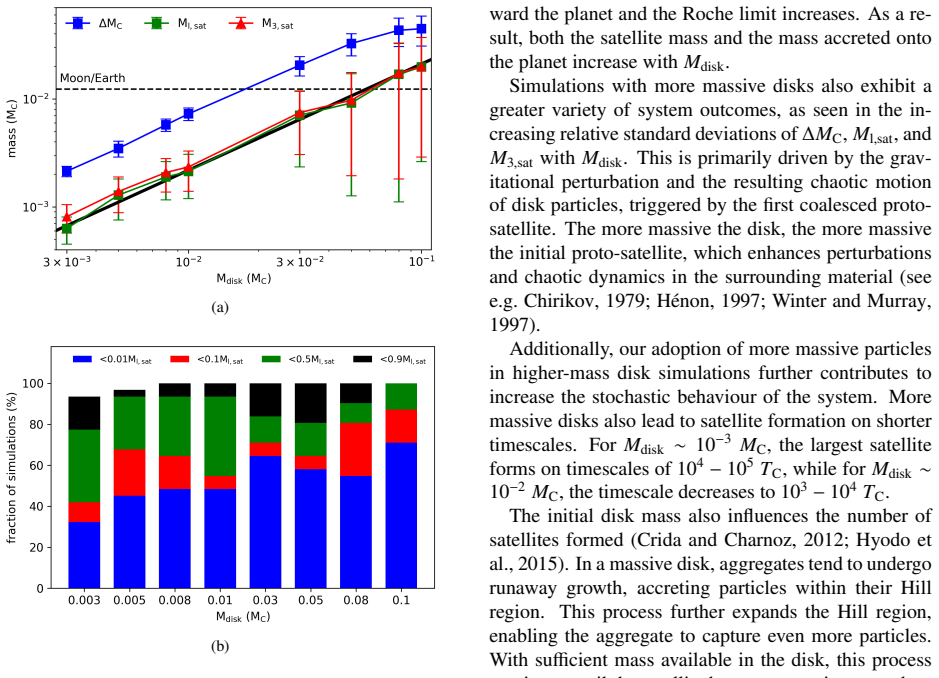
The argument is carried by 3D N-body ensembles of a self-gravitating solid-particle disk with surface density $\Sigma(a) = \Sigma_0 (a/R_{\rm C})^{-\beta}$ and 50,000 equal-mass particles, evolved with a hybrid collision rule: a collision is accretive only if the pair's Jacobi energy (the binding energy in the planet's tidal field) is negative and the particles' radii are within $0.7$ mutual Hill radii; otherwise the collision is elastic, and merging is perfect with no fragmentation or tidal stripping. Satellite growth is then regulated by inner Lindblad resonances, the orbital resonances through which a satellite shepherds surrounding disk material and, in response, migrates outward. The load-bearing output is the power-law fit $M_{\rm l,sat} = (0.20 \pm 0.16)\,M_{\rm disk}^{0.98 \pm 0.16}$, which the authors connect directly to the analytical mass-angular-momentum prediction for accretion from a massive disk.
What would settle it
Run the same 30-run ensembles at $M_{\rm disk}=0.005\,M_{\rm C}$ and $\beta=3$ with planetary tides switched on ($k_2/Q \sim 10^{-3}$-$10^{-2}$): if the fraction of runs that still produce a second satellite with at least 10% of the largest satellite's mass falls below roughly 50%, the claimed two-satellite regime for $0.003$-$0.03\,M_{\rm C}$ does not survive the physics the paper itself identifies as missing. A parallel check: include collisional fragmentation at $M_{\rm disk}=0.03\,M_{\rm C}$; if the mean $M_{\rm l,sat}$ drops by more than about a factor of two, the fitted coefficient of about 0.2 is an artifact of perfect merging.
Extended reading notes
Core claim
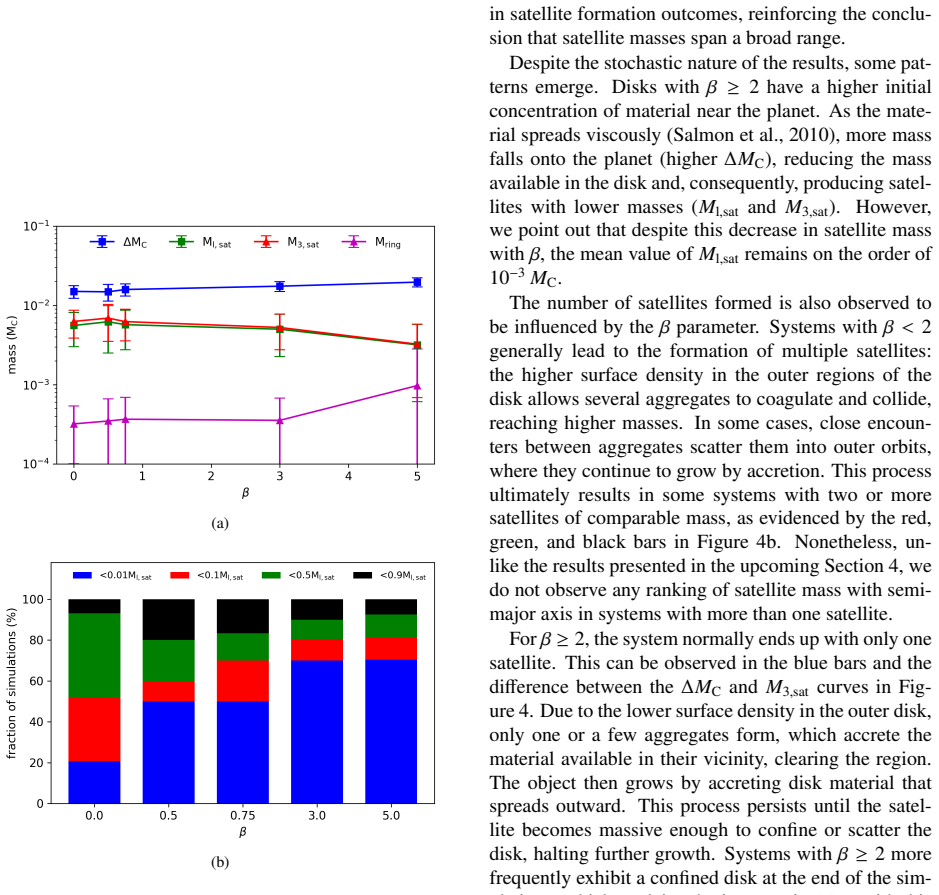
The paper's central finding is an empirical scaling law extracted from ensembles of 30 simulations for each disk model: the mean mass of the largest satellite follows $M_{\rm l,sat} = (0.20 \pm 0.16)\,M_{\rm disk}^{0.98 \pm 0.16}$, so the typical largest satellite carries about one fifth of the initial disk mass, with run-to-run scatter of the same order as the mean. The multiplicity of the system is set by disk mass: for $M_{\rm disk} \geq 0.03\,M_{\rm C}$ a single gravitationally dominant satellite forms in most simulations, while for $0.003 < M_{\rm disk} < 0.03\,M_{\rm C}$ systems typically end with two satellites, the inner one being 10-50% as massive as the outer. Flatter surface-density profiles (lower $\beta$) give more massive satellites, while steeper profiles funnel more mass onto the planet. Interpreting Solar System cases through this law, Moon-like satellites require disks around $0.03$-$0.1\,M_{\rm C}$, Charon-like masses would need disks $\gtrsim 0.3\,M_{\rm C}$ (strongly suggesting Charon did not accrete from an impact-generated disk), and Phobos-like moons require extremely low-mass disks. The paper also estimates that a disk near the $0.03\,M_{\rm C}$ threshold around a 1.6-Earth-radius planet orbiting a Sun-like star could yield a detectable Earth-Moon-like system at 10 parts-per-million photometric precision.
Load-bearing premise
The load-bearing premise is that every gravitationally bound collision merges the two bodies perfectly, with no fragmentation, no tidal stripping, and no mass loss, while the planet's tidal forces are not computed in the N-body integration; the authors explicitly warn this may overestimate satellite masses and note that tides become important for disks below about $0.005\,M_{\rm C}$.
Editorial extensions
If this is right
- Disks with $M_{\rm disk} \gtrsim 0.03\,M_{\rm C}$ are expected to leave a single gravitationally dominant satellite, with any additional satellites at least about 100 times less massive in more than half of the runs.
- Over the studied range, the mean largest-satellite mass stays close to $0.2\,M_{\rm disk}$, so knowledge of an impact-generated disk mass directly estimates the typical moon mass, and vice versa.
- Moon-like satellites around terrestrial planets are compatible with disks of $0.03$-$0.1\,M_{\rm C}$, matching the disk masses inferred for the proto-lunar impact.
- Charon-like satellites require disks at least around $0.3\,M_{\rm C}$, which is far above the masses giant-impact simulations give for Pluto, so accretion from such a disk is not the likely Charon formation path.
- A disk near $0.03\,M_{\rm C}$ around a 1.6-Earth-radius planet could produce an exomoon detectable at 10 parts-per-million photometric precision, which suggests that the absence of exomoon detections so far partly reflects instrumental limits.
Reading between the lines
- If the near-linear scaling extends beyond the fitted range, observers could invert a measured exomoon mass into a parent-disk mass; the paper itself warns the fit is only justified inside the simulated span, roughly $0.003$-$0.1\,M_{\rm C}$.
- The embedded reviewer note in the reference list concedes that calling $\beta=3$ a typical value was incorrect; since the disk-mass scaling was measured almost entirely at $\beta=3$, applying it across the full range of impact-generated profiles is an extrapolation, not a tested result.
- Switching on fragmentation, tidal stripping, and planetary tides would likely lower $M_{\rm l,sat}$ (the paper says so), which would push the JWST-detectability threshold upward; a straightforward extension is to rerun the 30-run ensembles with those processes included.
- The two-satellite systems formed between $0.003$ and $0.03\,M_{\rm C}$ should leave distinctive transit-timing and transit-duration variations; searching for such correlated signals in Kepler or JWST light curves is a testable observational corollary.
Editorial analysis
A structured set of objections, weighed in public.
Referee Report
Summary. This paper uses three-dimensional N-body simulations of dense, self-gravitating solid-particle disks (50,000 equal-mass particles) to study satellite formation around terrestrial planets and super-Earths. For each model, 30 simulations are run with identical initial angular momentum but randomized angular elements. The authors explore the effects of the disk surface-density exponent beta at fixed disk mass and then vary the initial disk mass Mdisk from 0.003 to 0.1 MC at beta = 3. The main results are: (i) large run-to-run stochasticity in satellite masses, with approximately Gaussian distributions; (ii) disks above about 0.03 MC predominantly form one dominant satellite, whereas disks between about 0.003 and 0.03 MC tend to form two-satellite systems; (iii) a fitted power law for the mean largest-satellite mass, Ml,sat = (0.20 +/- 0.16) Mdisk^(0.98 +/- 0.16), approximately linear in disk mass and consistent with the analytical prediction of Ida et al. (1997); and (iv) applications to the Moon, Charon, Phobos, and the JWST detectability of exomoons. The central quantitative claim is Eq. (4).
Significance. The paper's main contribution is statistical: by running 30 simulations per parameter set, it quantifies the stochasticity that earlier single-run or few-run studies could not characterize, and it provides a simple mapping from initial disk mass to typical largest-satellite mass. If the scaling law holds, it is immediately useful for connecting giant-impact-generated disk masses to observable exomoon masses, and the JWST detectability estimate gives a concrete observational target. The recovery of the Hyodo et al. (2015) single/two-satellite threshold at about 0.03 MC and the agreement with the Ida et al. (1997) analytical scaling are genuine positive checks. However, the central result is an empirical fit to simulations whose collision model lacks fragmentation, tidal stripping, and planetary tides; the authors acknowledge that these omissions may overestimate satellite masses. The quantitative coefficient and the low-mass threshold therefore remain provisional until the sensitivity to these neglected physical effects is quantified.
major comments (3)
- [Section 4, Eq. (4), and Section 4.1] The fitted power law in Eq. (4) is obtained from simulations that include Mdisk = 0.003 and 0.005 MC, yet Section 4.1 states that for Mdisk <= 0.005 MC the tidal migration timescale ttide becomes comparable to the second-satellite formation timescale (10^6-10^7 TC) and that formation would be driven by planetary tides, which are not included in the N-body model. These low-mass points anchor the low-mass end of the fit and define the 0.003-0.03 MC two-satellite regime, so the scaling law and the threshold are not tested under the physics claimed to dominate there. Please refit Eq. (4) with these points excluded (and possibly also Mdisk = 0.008) to show how the coefficient A and exponent b change, or otherwise provide a quantitative bound on the systematic error from missing tidal effects.
- [Section 2.2 and Eq. (4)] The collision treatment assumes that every gravitationally bound collision leads to perfect merging, with no fragmentation, no tidal stripping, and no mass loss, and planetary tides are not included in the N-body integration. As the authors note, this 'may overestimate satellite masses.' Because the normalization A = 0.20 in Eq. (4) and the inferred disk-mass requirements for Charon and Phobos in Section 4 depend directly on the absolute satellite masses, the paper should provide a quantitative estimate of this bias, for example by testing a simple fragmentation prescription or by comparing against SPH-calibrated collision outcomes, or explicitly reframe the fitted relation as an upper-limit estimate.
- [Section 4 and Section 5] Equation (4) is used to infer that Charon formation would require Mdisk >= 0.3 MC and that direct Phobos formation requires Mdisk ~ 10^-7 - 10^-6 MC. These values lie outside the fitted range (0.003 - 0.1 MC) by factors of 3 and by several orders of magnitude, respectively. The authors do note that Eq. (4) is only 'certainly suitable' within the fitted range, but the Charon and Phobos passages are still framed as quantitative conclusions. Please either soften these inferences to extrapolation-level statements or, if the extrapolation is to be retained, justify the power law beyond the simulated range with an independent argument.
minor comments (5)
- [References] The reference list contains an extraneous passage in Portuguese between Goldreich and Soter (1966) and Goldreich and Tremaine (1980) beginning 'Obrigado por este comentario...' that appears to be leftover author-response text. This should be removed before publication.
- [Section 3, first paragraph] The phrase 'how the initial surface density profile influences on the system' should read 'influences the system' or 'has an influence on the system.'
- [Figure 5 caption] The dashed horizontal line in Figure 5a is described in the body text as the Moon-to-Earth mass ratio, but this is not stated in the caption; please add it for self-containedness.
- [Section 4] The stopping criterion Mring = 0.05 Mdisk is said to be 'determined through test simulations,' but no details of those tests are given; a sentence describing the number of test runs and the criterion used to judge that satellite mass growth is negligible would aid reproducibility.
- [Equation (5)] In Eq. (5), the symbols n and a are not explicitly defined at first use; please define n as the satellite's mean motion and a as its semi-major axis, and clarify that all masses are in units of MC.
Circularity Check
No circularity: the empirical scaling law is an independent fit to simulation output, compared against an external analytical prediction, with all caveats explicitly stated.
full rationale
The paper's central result is an empirical power-law fit, Eq. (4), to ensemble-averaged satellite masses obtained from N-body simulations. This is a fit, not a derivation, and no fitted parameter is inserted back into the simulation inputs or into the analytical comparison. The agreement with Ida et al. (1997) is a comparison against an external analytical result, not a self-citation or a definitional identity. The later uses of Eq. (4) to estimate Charon, Phobos, and JWST detectability are explicitly presented as extrapolations; the authors even warn that the Phobos match is "likely coincidental." The acknowledged limitations—neglect of fragmentation and tidal stripping, and the absence of planetary tides for disks below about 0.005 M_C—are stated as physical caveats, not hidden inputs that force the fitted law. Self-citations appear only in contextual or supporting roles and are not load-bearing for the main scaling result. No equation is shown to reduce by construction to its own inputs, and no fitted parameter is renamed as a prediction. Therefore no significant circularity is present.
Assumptions & free parameters
free parameters (3)
- Scaling coefficient A in Ml,sat = A Mdisk^b =
0.20 ± 0.16
- Scaling exponent b =
0.98 ± 0.16
- Stopping criterion ring mass Mring = 0.05 Mdisk =
0.05 Mdisk
assumptions (5)
- domain assumption Collisions are accretive when the pair's Jacobi energy is negative and the sum of physical radii is below 0.7 mutual Hill radius (Section 2.2, Eq. 3).
- domain assumption Planetary tides are negligible during satellite formation for the simulated disk masses; checked only by comparing formation and tidal timescales (Section 4.1, Eq. 5).
- domain assumption A disk of 50,000 equal-mass particles approximates the fluid-like behavior of a dense solid-particle disk (Section 2.1).
- domain assumption Same-parameter runs share identical initial angular momentum because semimajor axes, eccentricities, and inclinations are fixed while only angular elements are randomized (Section 2.1).
- standard math The Roche limit is computed with the perfect-fluid approximation, giving 2.9 R_C (Section 2.1).
Cite this review
Pith. "Pith review of On the formation of satellites in dense solid-particle disks." pith.science (2026). https://pith.science/paper/POYZMB57
@misc{pith2026250704954,
  author       = {Pith},
  title        = {Pith review of: On the formation of satellites in dense solid-particle disks},
  year         = {2026},
  howpublished = {\url{https://pith.science/paper/POYZMB57}},
  note         = {Machine review of arXiv:2507.04954}
}
read the original abstract
Single massive satellites are of great observational interest, as they can produce prominent and potentially detectable signatures. For terrestrial planets and super-Earths, giant impacts in the late stages of formation may generate dense self-gravitating disks - favourable environments for the formation of such satellites. Motivated by this, we explore satellite formation in dense solid-particle disks through three-dimensional N-body simulations, focusing on the effects of disk mass and the surface density exponent. Our results reveal significant variability in the masses and configurations of satellites formed under identical disk parameters, highlighting the stochastic nature of the process. Higher disk masses and flatter surface density profiles favour the formation of more massive satellites. Disks with masses above 0.03 planetary masses typically yield a single dominant satellite, while those between 0.003 and 0.03 tend to form two-satellite systems. On average, the mass of the largest satellite scales linearly with the initial disk mass, in agreement with analytical predictions. We estimate that a disk with a minimal mass of 0.03 planetary masses around a 1.6 Earth-mass planet orbiting a Sun-like star could form an Earth-Moon-like system detectable by telescopes with a photometric precision of 10 parts per million - a level achievable by the James Webb Space Telescope.
Figures


Figures from the paper (4 more)


Reference graph
Works this paper leans on
-
[1]
Formation conditions of Titan’s and Enceladus’s building blocks in Saturn’s circumplanetary disk
Anderson SE, Mousis O, Ronnet T. Formation conditions of Titan’s and Enceladus’s building blocks in Saturn’s circumplanetary disk. The Planetary Science Journal. 2021;2(2):50. Barnes J, Hut P. A hierarchical O(N log N) force-calculation algo- rithm. Nature. 1986;324(6096):446-449. Barr AC, Dobos V , Kiss LL. Interior structures and tidal heating in the TR...
arXiv 2005
-
[11]
On the physics of resonant disk-satellite interaction
Meyer-Vernet N, Sicardy B. On the physics of resonant disk-satellite interaction. Icarus. 1987;69(1):157-175. Moraes RA, Vieira Neto E. Exploring formation scenarios for the ex- omoon candidate Kepler 1625b I. Monthly Notices of the Royal Astronomical Society. 2020;495(4):3763-3776. Moraes RA, Kley W, Vieira Neto E. Growth and evolution of satellites in a...
work page 1987
-
[12]
arXiv preprint arXiv:2401.13293. Tobie G, Mocquet A, Sotin C. Tidal dissipation within large icy satel- lites: Applications to Europa and Titan. Icarus. 2005;177(2):534-
arXiv 2005
-
[35]
A common mass scaling for satellite systems of gaseous planets
Canup RM, Ward WR. A common mass scaling for satellite systems of gaseous planets. Nature. 2006;441(7095):834-839. Canup RM, Esposito LW. Accretion in the Roche zone: Coexistence of rings and ringmoons. Icarus. 1995;113(2):331-352. Canup RM, Ward WR. Origin of Europa and the Galilean satellites. In: Europa. University of Arizona Press
work page 2006
-
[211]
The hunt for exomoons with Kepler (HEK)
Kipping DM, Bakos GA, Buchhave L, Nesvorn ´y D, Schmitt A. The hunt for exomoons with Kepler (HEK). I. Description of a new ob- servational project. The Astrophysical Journal. 2012;750(2):115. Kipping DM. Transit timing e ffects due to an exomoon–II. Monthly Notices of the Royal Astronomical Society . 2009;396(3):1797-
work page 2012
-
[389]
Obrigado por este comentario. De fato, nos nao fomos corretos ao chamar beta=3 como um valor tipico, uma vez que simulacoes de giant impact encontram valores normalmente que variam de 1 a 5 (Canup, 2004; Cuk and Stewart, 2012; Meier et al., 2014; Citron et al., 2015; Hyodo et al., 2017; Kenyon and Benjamin, 2021). Aqui, nos seguimos Sasaki and Hosono (201...
work page 2018
-
[549]
Formation of the Janus- Epimetheus system through collisions
Treffenst¨adt LL, Mour ˜ao DC, Winter OC. Formation of the Janus- Epimetheus system through collisions. Astronomy & Astrophysics. 2015;583:A80. Ward WR. On the evolution of the protolunar disc. Philosophical Transactions of the Royal Society A. 2014;372(2024):20130250. Wimarsson J, Xiang Z, Ferrari F, Jutzi M, Madeira G, Raducan SD, et al. Rapid formation...
work page 2024
-
[568]
Formation of super-Earths and mini-Neptunes from rings of planetesimals
Ogihara M, Kokubo E, Suzuki TK, Morbidelli A. Formation of close- in super-Earths in evolving protoplanetary disks due to disk winds. Astronomy & Astrophysics. 2018;615:A63. Ohtsuki K. Capture probability of colliding planetesimals: Dynamical constraints on accretion of planets, satellites, and ring particles. Icarus. 1993;106(1):228-246. Raymond SN, Quin...
work page Pith review arXiv 2018
Show all 12 references
-
[1804]
Evolution of a circumterrestrial disk and formation of a single Moon
Kokubo E, Ida S, Makino J. Evolution of a circumterrestrial disk and formation of a single Moon. Icarus. 2000;148(2):419-436. Lambrechts M, Morbidelli A, Jacobson SA, Johansen A, Bitsch B, Izidoro A, et al. Formation of planetary systems by pebble ac- cretion and migration: Ho...
2000
-
[2009]
p. 59-83. Canup RM. Simulations of a late lunar-forming impact. Icarus. 2004;168(2):433-456. Canup RM. Forming a Moon with an Earth-like composition via a giant impact. Science. 2012;338(6110):1052-1055. Carrera D, Ford EB, Izidoro A. Formation of short-period planets by disc ...
2004
-
[2024]
exomoons
Szab´o GM, Szatm ´ar K, Div ´eki Z, Simon A. Possibility of a pho- tometric detection of “exomoons.” Astronomy & Astrophysics. 2006;450(1):395-398. Szul´agyi J, Mayer L, Quinn T. Circumplanetary discs around young giant planets: a comparison between core-accretion and disc ins...
2006
-
[2500]
The ’breaking the chains’ migration model for super-Earth formation: the effect of collisional fragmentation
Esteves L, Izidoro A, Bitsch B, Jacobson SA, Raymond SN, Deienno R, et al. The ’breaking the chains’ migration model for super-Earth formation: the effect of collisional fragmentation. Monthly Notices of the Royal Astronomical Society. 2022;509(2):2856-2868. Fu H, Jacobsen SB....
2022
Reviewed August 6, 2026 · model on record in the stance chip above.
Discussion (0). Continue with ORCID to comment.