REVIEW 3 major objections 4 minor 13 references
Non-unitary Variational Quantum Eigensolver with the Localized Active Space Method and Cost Mitigation
T0 review · 3 major / 4 minor · reviewed 2026-08-10 · deepseek-v4-flash
Pith's one-line read LAS-nuVQE couples a cheap classical fragment wave function with a non-unitary Jastrow correction, reaching chemical accuracy on both test molecules with under 70 total circuit gates.
desk verdict A solid noiseless benchmark combining LASSCF with nuVQE, but the resource claim omits state preparation and the chemical-accuracy result is spin-contaminated. read the letter →
The pith
A machine-rendered reading of the paper's core claim, the machinery that carries it, and where it could break.
The reading
What carries the argument
The load-bearing object is the linearized qubit Jastrow operator J(α,λ) = 1 − Σ_i α_i Z_i − Σ_{i<j} λ_ij Z_i Z_j, applied through the modified expectation value E = ⟨Ψ|J†H_QJ|Ψ⟩ / ⟨Ψ|J†J|Ψ⟩. Because J contains only diagonal Pauli-Z strings, it never enters the circuit; its classical parameters are optimized alongside the hardware-efficient ansatz angles, and the denominator accounts for the non-unitary normalization. This is what lets nuVQE add correlation without adding gates.
What would settle it
Compile the full circuit for square cyclobutadiene including direct-initialization state preparation of the LASSCF wave function, count every gate, and run the optimization on a noisy processor; if the total gate count exceeds the coherence limits or the energy no longer stays within chemical accuracy of the CASCI reference, the paper's core resource claim fails. A noiseless equivalent is to repeat the simulations with the state-preparation circuit included in every gate count and wall-clock estimate.
Extended reading notes
Core claim
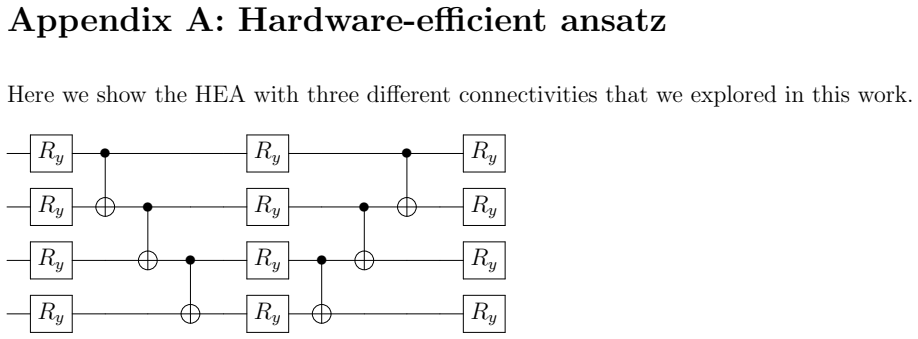
The central claim is that the non-unitary operator J = 1 − Σ_i α_i Z_i − Σ_{i<j} λ_ij Z_i Z_j, applied not as a circuit but through the expectation values of J†H_QJ and J†J, restores interfragment correlation on top of a LASSCF reference while leaving the circuit depth unchanged. Using a linear-connectivity hardware-efficient ansatz built on a directly initialized LASSCF state, the authors find that LAS-nuVQE reaches chemical accuracy in the active-space Hamiltonians of H4 and square cyclobutadiene with fewer than 70 gates total, and that it recovers over 95% of the interfragment correlation energy missing from LASSCF at two layers and above 99.9% at four layers. They further show that adding a spin-penalty term produces spin-pure energies for square cyclobutadiene, and that Pauli grouping together with shot-frugal sampling cuts the measurement cost of the J-transformed Hamiltonian by one to two orders of magnitude, bringing estimated one-query wall-clock times below those of vanilla VQE with HEA.
Load-bearing premise
The quoted gate counts count only the hardware-efficient ansatz layers on top of the initial state, assuming the LASSCF fragment wave function can be prepared by direct initialization at a cost that does not affect the resource numbers; if that state preparation requires circuits comparable to or deeper than the ansatz itself, the under-70-gates claim would not hold on hardware.
Editorial extensions
If this is right
- At equal HEA depth, LAS-nuVQE yields lower energy error than VQE with the same HEA for H4 at both geometries and for square cyclobutadiene at every tested number of layers.
- The non-unitary correction recovers more than 95% of the LASSCF-missing interfragment correlation at two layers and over 99.9% at four or more layers for square cyclobutadiene.
- The spin-constrained variant restores the correct S^2 = 0 state for square cyclobutadiene while retaining an accuracy edge over spin-constrained plain VQE.
- With qubit-wise or fully-commuting Pauli grouping plus shot-frugal sampling, the measurement overhead of the J-transformed Hamiltonian drops by up to two orders of magnitude, making one query of nuVQE faster in wall-clock estimates than one query of HEA-based VQE at 100 qubits on the modeled superconducting platform.
- LAS-nuVQE reaches chemical accuracy with under 70 total gates (24 single-qubit plus 21 CNOT gates for H4; 40 single-qubit plus 28 CNOT gates for square cyclobutadiene).
Reading between the lines
- Because the Jastrow operator is diagonal in the computational basis, its measurement overhead is concentrated in diagonal Pauli strings; combining LAS-nuVQE with readout-error mitigation or sparse Pauli sampling may further cut the cost beyond the paper's grouping and shot-frugal results.
- The same non-unitary correction could be applied on top of any fragment-based initial state, not only LASSCF; the paper's mechanism suggests cluster mean-field or density-matrix-embedding references would benefit similarly, but this is not tested.
- The gate-count assumption for direct initialization is the natural next thing to check: if fragment-product states can be prepared by fewer gates than one HEA layer, the under-70-gates regime generalizes to larger fragments.
- Spin constraints in the paper address S^2; extending the penalty to particle-number or spatial-symmetry operators could make HEA applicable to excited states, a testable extension.
Editorial analysis
A structured set of objections, weighed in public.
Referee Report
Summary. The manuscript introduces LAS-nuVQE, a variational quantum eigensolver variant in which a hardware-efficient ansatz is applied to a LASSCF initial state and a linearized qubit Jastrow operator J = 1 - sum_i alpha_i Z_i - sum_ij lambda_ij Z_i Z_j is folded into the objective function E = <Psi|J^dagger H J|Psi> / <Psi|J^dagger J|Psi>. Noiseless simulations are reported for H4 and square cyclobutadiene, with claims of chemical accuracy using fewer than 70 gates, spin-constrained calculations using a penalty term, measurement-cost mitigation via Pauli grouping and shot-frugal sampling, and wall-clock scaling estimates for up to 100 qubits. The paper argues that LAS-nuVQE is a more accurate and cheaper alternative to vanilla VQE with HEA for multireference systems.
Significance. If the resource claims held, this would be a practically useful recipe for near-term multireference quantum chemistry, because it combines a fragment-based multireference initial state with shallow HEA circuits and avoids the ancilla overhead of implementing nonunitary operations directly. The paper has genuine strengths: the energy expression in Eq. (10) is the exact expectation value of the non-unitary state rather than a fitted surrogate, comparisons are made to external FCI/CASCI references, the code is openly available, and the noiseless simulations consistently show LAS-nuVQE improving on LAS-VQE at equal HEA depth. However, the quantitative headline claims are not yet supported: the quoted gate counts exclude the LASSCF state-preparation circuit, and the cyclobutadiene chemical-accuracy result rests on heavily spin-contaminated states. The scalability conclusion likewise depends on strong, unverified assumptions.
major comments (3)
- [Computational details and Algorithm 1; Sec. III.B] The quoted gate counts (24 SQGs + 21 CNOTs for H4 and 40 SQGs + 28 CNOTs for cyclobutadiene) count only the HEA layers. The Computational Details state that all simulations use DI state preparation with Qiskit, and Algorithm 1 step 1 explicitly prepares the LASSCF wave function with DI. The DI cost is not included in the abstract's '<70 total gates' claim, in Section III.B, or in the conclusion. Please report the full circuit including the LASSCF initialization, or revise the headline claim to refer to HEA layers only; without this, the hardware-feasibility comparison is incomplete.
- [Sec. III.B and III.C, Tables 1 and 2] The cyclobutadiene chemical-accuracy result in Fig. 5(a) is obtained from unconstrained runs whose spin expectation values range from 0.67 to 1.52 (Table 1), i.e., states that are not the targeted singlet. The spin-constrained energies in Table 2 are several mEh higher at the same layer counts (e.g., -153.6758 Ha at 4 layers versus -153.7023 Ha unconstrained) and are not compared to the CASCI reference, so it is unclear whether any spin-pure state reaches chemical accuracy. The headline claim for cyclobutadiene should therefore be restricted to the unconstrained states, or the spin-constrained data should be shown to meet chemical accuracy.
- [Sec. III.E, Figs. 9 and 10] The wall-clock comparison relies on three unqualified assumptions: N_l = N_q, one Jastrow parameter saves one single-qubit gate, and shot counts drop by two orders of magnitude. The text provides no evidence or sensitivity analysis for these assumptions. Because the conclusion that nuVQE with grouping and shot-frugal sampling is cheaper than HEA at 100 qubits follows directly from these assumptions, the scalability conclusion should be presented as conditional and accompanied by a sensitivity study over layer counts and shot-reduction factors.
minor comments (4)
- [Sec. III.D] The word 'respectivity' should be 'respectively'.
- [Sec. III.E] The text contains 'walk clock estimation' and 'natural atom/trapped ion platform'; these should read 'wall clock estimation' and 'neutral atom/trapped ion platform'.
- [Abstract] The quantity '103−4' appears to be a formatting error for 10^3-4 and should be typeset consistently.
- [Sec. II.B, Eq. (16)] In the definition of WRS, M is described as 'the sum of the coefficient'; for the probability p_i = |c_i|/M to be normalized, M should be the sum of absolute values of the coefficients.
Circularity Check
No significant circularity: the energy benchmarks are evaluated against external FCI/CASCI references, and the Jastrow ansatz is taken from prior non-self work.
full rationale
The central numerical claim, that LAS-nuVQE reaches chemical accuracy with fewer than 70 HEA gates, is obtained by minimizing the exact expectation value in Eq. (10) of the non-unitary state and comparing it with FCI/CASCI references computed independently. No fitted parameter is renamed as a prediction, and no target quantity is inserted into the ansatz by definition. The Jastrow operator J = 1 - sum alpha_i Z_i - sum lambda_ij Z_i Z_j is adopted from Benfenati et al. (ref 23), not from the authors' own prior work, and its parameters are variationally optimized against the same Hamiltonian rather than fit to the reported benchmark energies. The interfragment-correlation metric p0 in Eq. (11) is a normalized energy difference, so reporting 95% of interfragment correlation recovered is a restatement of the computed energy lowering, but the underlying comparison to CASCI remains external and non-circular. Several self-citations appear, including LASSCF refs 25-26, LAS-UCC ref 35, and state preparation ref 52, but they are background methodology citations and are not used to force the paper's numerical conclusions. There is no imported uniqueness theorem and no ansatz justified solely by a self-citation. The unaccounted cost of direct-initialization state preparation in the reported gate counts is a genuine resource-accounting omission and a hardware-feasibility risk, but it is an incompleteness issue, not a circular derivation: the energy numbers themselves do not depend on the omitted circuit. The scalability extrapolations rest on explicit assumptions about layer counts, shot counts, and Pauli-group savings, so they are modeling estimates rather than predictions derived from the method's equations. For these reasons, no circular step can be exhibited, and the appropriate circularity score is 0.
Assumptions & free parameters
free parameters (6)
- Jastrow coefficients alpha_i, lambda_ij =
optimized variationally; init Uniform(-0.1, 0.1)
- HEA rotation parameters theta =
optimized variationally
- Spin penalty coefficient mu_C =
1.0
- Pauli-count scaling exponent p in h(Nq) approximately a Nq^p =
not reported
- Assumed layer count N_l = N_q =
N_l = N_q
- Shot reduction factor for shot-frugal sampling =
10^2
assumptions (6)
- domain assumption Jastrow operator truncated to J = 1 - sum alpha_i Z_i - sum lambda_ij Z_i Z_j suffices to capture interfragment correlation.
- domain assumption LASSCF wave function can be prepared on a quantum computer via direct initialization at negligible or uncounted cost.
- domain assumption Noiseless statevector and QASM simulations are representative of the method's performance on near-term hardware.
- domain assumption Spin penalty with mu_C = 1 (eq. 12) yields spin-pure states without materially degrading the energy.
- ad hoc to paper For wall-clock estimates, N_l = N_q, one Jastrow parameter saves one single-qubit gate, and shot counts drop by two orders of magnitude.
- standard math Rayleigh-Ritz variational principle and fermion-to-qubit mappings (Jordan-Wigner, Bravyi-Kitaev, Parity) are valid.
Cite this review
Pith. "Pith review of Non-unitary Variational Quantum Eigensolver with the Localized Active Space Method and Cost Mitigation." pith.science (2026). https://pith.science/paper/PPV6FN5I
@misc{pith2026250113371,
  author       = {Pith},
  title        = {Pith review of: Non-unitary Variational Quantum Eigensolver with the Localized Active Space Method and Cost Mitigation},
  year         = {2026},
  howpublished = {\url{https://pith.science/paper/PPV6FN5I}},
  note         = {Machine review of arXiv:2501.13371}
}
read the original abstract
Accurately describing strongly correlated systems with affordable quantum resources remains a central challenge for quantum chemistry applications on near and intermediate-term quantum computers. The localized active space self-consistent field (LASSCF) approximates the complete active space self-consistent field (CASSCF) by generating active space-based wave functions within specific fragments while treating interfragment correlation with mean-field approach, hence is computationally less expensive. Hardware-efficient ansatzes (HEA) offer affordable and shallower circuits, yet they often fail to capture the necessary correlation. Previously, Jastrow-factor-inspired non-unitary qubit operators were proposed to use with HEA for variational quantum eigensolver (VQE) calculations (nuVQE), as they do not increase circuit depths and recover correlation beyond the mean-field level for Hartree-Fock initial states. Here, we explore running nuVQE with LASSCF as the initial state. The method, named LAS-nuVQE, is shown to recover interfragment correlations, reach chemical accuracy with a small number of gates (<70) in both H4 and square cyclobutadiene. To further address the inherent symmetry-breaking in HEA, we implemented spin-constrained LAS-nuVQE to extend the capabilities of HEA further and show spin-pure results for square cyclobutadiene. We mitigate the increased measurement overhead of nuVQE via Pauli grouping and shot-frugal sampling, reducing measurement costs by up to two orders of magnitude compared to ungrouped operator, and show that one can achieve better accuracy with a small number of shots (10^3-4) per one expectation value calculation compared to noiseless simulations with one or two orders of magnitude more shots. Finally, wall clock time estimates show that, with our measurement mitigation protocols, nuVQE becomes a cheaper and more accurate alternative than VQE with HEA.
Figures


Figures from the paper (10 more)




Reference graph
Works this paper leans on
-
[1]
(1) McArdle, S.; Endo, S.; Aspuru-Guzik, A.; Benjamin, S. C.; Yuan, X. Quantum compu- tational chemistry. Reviews of Modern Physics 2020, 92, 015003. (2) Bauer, B.; Bravyi, S.; Motta, M.; Chan, G. K.-L. Quantum Algorithms for Quantum Chemistry and Quantum Materials Science.Chemical Reviews 2020, 120, 12685–12717. (3) Cao, Y.; Romero, J.; Olson, J. P.; Deg...
work page 2020
-
[23]
(68) Choi, S.; Loaiza, I.; Izmaylov, A. F. Fluid fermionic fragments for optimizing quan- tum measurements of electronic Hamiltonians in the variational quantum eigensolver. Quantum 2023, 7,
work page 2023
-
[79]
(6) Kandala, A.; Mezzacapo, A.; Temme, K.; Takita, M.; Brink, M.; Chow, J. M.; Gam- betta, J. M. Hardware-efficient variational quantum eigensolver for small molecules and quantum magnets. Nature 2017, 549, 242–246. (7) Peruzzo, A.; McClean, J.; Shadbolt, P.; Yung, M.-H.; Zhou, X.-Q.; Love, P. J.; Aspuru- Guzik, A.; O’Brien, J. L. A variational eigenvalue...
arXiv 2017
-
[83]
W.; Gidney, C.; Motta, M.; McClean, J
(66) Berry, D. W.; Gidney, C.; Motta, M.; McClean, J. R.; Babbush, R. Qubitization of Arbitrary Basis Quantum Chemistry Leveraging Sparsity and Low Rank Factorization. Quantum 2019, 3,
work page 2019
-
[208]
(67) Huggins, W. J.; McClean, J. R.; Rubin, N. C.; Jiang, Z.; Wiebe, N.; Whaley, K. B.; Babbush, R. Efficient and noise resilient measurements for quantum chemistry on near- term quantum computers. npj Quantum Information 2021, 7,
work page 2021
-
[703]
(19) Mitra, A.; D’Cunha, R.; Wang, Q.; Hermes, M. R.; Alexeev, Y.; Gray, S. K.; Otten, M.; Gagliardi, L. The Localized Active Space Method with Unitary Selective Coupled Clus- ter. Journal of Chemical Theory and Computation 2024, 20, 7865–7875. (20) Matsuzawa, Y.; Kurashige, Y. Jastrow-type Decomposition in Quantum Chemistry for Low-Depth Quantum Circuits...
work page 2024
-
[889]
(69) Verteletskyi, V.; Yen, T.-C.; Izmaylov, A. F. Measurement optimization in the vari- ational quantum eigensolver using a minimum clique cover. The Journal of Chemical Physics 2020, 152, 124114. 36 (70) Yen, T.-C.; Verteletskyi, V.; Izmaylov, A. F. Measuring All Compatible Operators in One Series of Single-Qubit Measurements Using Unitary Transformatio...
arXiv 2020
-
[949]
(75) Sung, K. J.; Yao, J.; Harrigan, M. P.; Rubin, N. C.; Jiang, Z.; Lin, L.; Babbush, R.; McClean, J. R. Using models to improve optimizers for variational quantum algorithms. Quantum Science and Technology 2020, 5, 044008. (76) AbuGhanem, M. IBM Quantum Computers: Evolution, Performance, and Future Di- rections. 2024; https://arxiv.org/abs/2410.00916. 3...
arXiv 2020
Show all 13 references
-
[1208]
2024; https://github.com/ MatthewRHermes/mrh
(58) https://github.com/MatthewRHermes/mrh. 2024; https://github.com/ MatthewRHermes/mrh. (59) Sun, Q.; Berkelbach, T. C.; Blunt, N. S.; Booth, G. H.; Guo, S.; Li, Z.; Liu, J.; Mc- Clain, J. D.; Sayfutyarova, E. R.; Sharma, S.; Wouters, S.; Chan, G. K.-L. PySCF: the Python-bas...
2024
-
[1484]
M.; Zubarev, D
(55) Austin, B. M.; Zubarev, D. Y.; Lester, W. A. J. Quantum Monte Carlo and Related Approaches. Chemical Reviews 2012, 112, 263–288. (56) Javadi-Abhari, A.; Treinish, M.; Krsulich, K.; Wood, C. J.; Lishman, J.; Gacon, J.; Martiel, S.; Nation, P. D.; Bishop, L. S.; Cross, A. W...
2012
-
[2024]
H.; Lu, P.; Nocedal, J.; Zhu, C
(57) Byrd, R. H.; Lu, P.; Nocedal, J.; Zhu, C. A Limited Memory Algorithm for Bound Constrained Optimization. SIAM Journal on Scientific Computing 1995, 16, 1190–
1995
-
[3007]
L.; Shkolnikov, V.; Barron, G
(17) Tang, H. L.; Shkolnikov, V.; Barron, G. S.; Grimsley, H. R.; Mayhall, N. J.; Barnes, E.; Economou, S. E. Qubit-ADAPT-VQE: An Adaptive Algorithm for Con- structing Hardware-Efficient Ans¨ atze on a Quantum Processor.PRX Quantum 2021, 2, 020310. (18) Fedorov, D. A.; Alexeev...
2021
-
[6113]
A.; Scuseria, G
(32) Jim´ enez-Hoyos, C. A.; Scuseria, G. E. Cluster-based mean-field and perturbative de- scription of strongly correlated fermion systems: Application to the one- and two- dimensional Hubbard model. Physical Review B 2015, 92, 085101. (33) Papastathopoulos-Katsaros, A.; Jim´...
2015
Reviewed August 10, 2026 · model on record in the stance chip above.
Discussion (0). Continue with ORCID to comment.