REVIEW 3 major objections 5 minor 2 cited by
Dynamical Local Tadpole-Improvement in Quantum Simulations of Gauge Theories
T0 review · 3 major / 5 minor · reviewed 2026-08-16 · deepseek-v4-flash
Pith's one-line read In real-time lattice gauge theory simulations, the tadpole improvement factor is generically different at each plaquette and changes with time.
desk verdict The genuinely new observation—that tadpole improvement factors are spacetime-dependent in real-time gauge-theory simulations—is right, but the paper demonstrates sensitivity, not yet improvement; still worth a serious referee. read the letter →
The pith
A machine-rendered reading of the paper's core claim, the machinery that carries it, and where it could break.
The reading
What carries the argument
The load-bearing object is equation (6), the local mean-field tadpole factor $u_{0,i}$, defined from the instantaneous expectation value of the plaquette operator plus its Hermitian conjugate in the current quantum state. At each Trotter step it is inserted into the Kogut-Susskind Hamiltonian's magnetic term as $1/u_{0,i}^4$ (or $1/u_{0,i}^6$ for the honeycomb cells), and the iteration is repeated until convergence. This converts a fixed constant of lattice perturbation theory into a state-dependent, space-time-dependent coupling, and it is the mechanism by which ultraviolet link self-energy corrections are supposed to be removed from real-time dynamics.
What would settle it
A direct check would be to run the same small SU(2) systems at a sequence of smaller lattice spacings (or larger volumes) and compare continuum extrapolations of observables such as electric energy density with and without dynamical local tadpole improvement. If the dynamically improved evolution does not reduce the lattice-spacing dependence relative to vacuum-improved or unimproved evolution, the central claim fails. A more analytic falsifier would be a weak-coupling calculation of the exact time-dependent tadpole coefficient for a simple out-of-equilibrium state, compared against Eq. (6).
Extended reading notes
Core claim
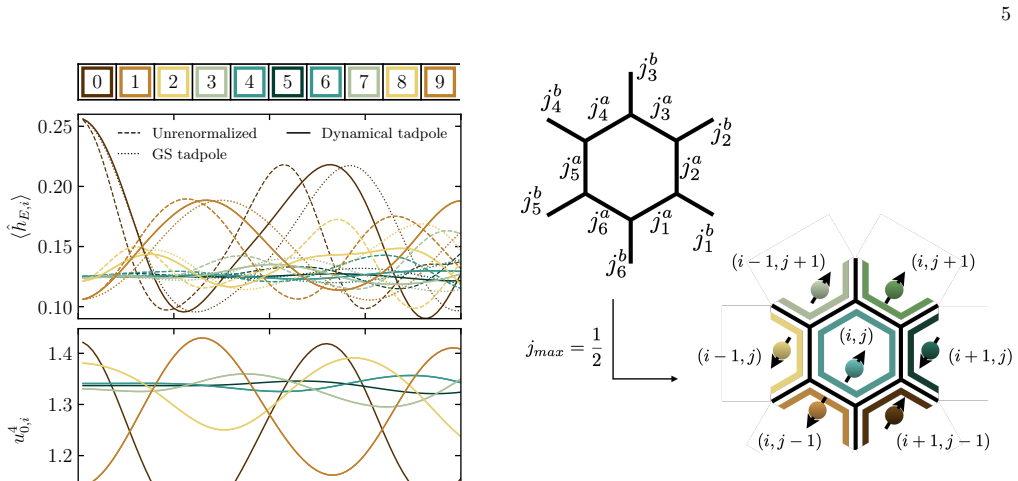
On the paper's own terms, the discovery is that the mean-field tadpole renormalization is a property of the quantum state, not of the lattice action. The standard tadpole-improvement factor, $u_{0,i} = \bigl(1 + \frac{1}{2N_c}\langle\psi|\hat{\square}_i+\hat{\square}_i^\dagger|\psi\rangle\bigr)^{1/4}$, is a local, instantaneous observable of the evolving state. In Euclidean Monte Carlo simulations the ensemble average makes this a single global constant per configuration, but in real-time evolution the expectation value of the plaquette operator depends on the surrounding interaction environment, so each plaquette has its own $u_{0,i}(t)$. The paper argues that the Hamiltonian must therefore be updated at every time step with these local factors, iterated to convergence, and that using either the unrenormalized Hamiltonian or a fixed vacuum value introduces errors that are not controlled as the lattice spacing is reduced. Numerical experiments on 10-plaquette SU(2) chains and $7\times3$ honeycomb lattices, truncated to $j_{\max}=1/2$, show that for a product-state initial condition the local factors remain near unity, while for an entangled initial state obtained by applying a plaquette operator to the interacting vacuum, the time evolution with dynamical local tadpole improvement differs substantially from both unimproved and vacuum-improved evolution. The paper further notes that the resulting Hamiltonian is generically not translationally invariant during evolution, even though the interacting vacuum is.
Load-bearing premise
The load-bearing premise is that the plaquette expectation value in the instantaneous out-of-equilibrium state gives the correct mean-field renormalization of the Hamiltonian at that same time step, an extrapolation of the Euclidean-vacuum Lepage-Mackenzie formula to arbitrary non-equilibrium states; the paper does not derive this from first principles.
Editorial extensions
If this is right
- Real-time gauge-theory algorithms must measure, at least in principle, the local plaquette expectation values at each time step and insert them into the Hamiltonian; a fixed vacuum-improvement factor is not a controlled approximation.
- During evolution from generic initial states, the improved Hamiltonian is no longer translationally invariant, so circuit constructions or error analyses that assume Hamiltonian symmetries must be revisited.
- The effect is amplified when the initial state is entangled and has localized excess energy density, pointing to hadronization, heavy-ion collisions, and strong-field QED as settings where this correction matters.
- Tadpole terms are the dominant lattice-spacing artifacts to the energies, while higher-order Symanzik and Hamiltonian improvements are parametrically smaller by comparison.
Reading between the lines
- Beyond the paper's numerics, the self-consistent iteration of $u_{0,i}(t)$ is a nonlinear feedback into the evolution operator; one could view it as a time-dependent mean-field approximation whose back-reaction on entanglement and thermalization in larger systems is untested.
- A natural next test is to compare dynamically improved evolution against exact continuum-limit results in integrable or weak-coupling regimes where perturbation theory provides a benchmark; the paper does not perform such a comparison.
- The protocol's practical cost, measuring every plaquette every Trotter step, could be reduced by exploiting smoothness of $u_{0,i}(t)$ and sampling sparsely in time, but the paper notes only that the measurement count can be kept system-size-independent in special bases, not generally.
Signed reviews
Editorial analysis
A structured set of objections, weighed in public.
Referee Report
Summary. The paper argues that in real-time (Minkowski) Hamiltonian lattice gauge theory simulations, the tadpole-improvement factor relating lattice link variables to continuum fields is not a constant per configuration but is generically space- and time-dependent, because it is fixed by the expectation value of the plaquette operator in the instantaneous state. The authors propose an iterative protocol in which u0,i(t) is recomputed self-consistently at each time step from local plaquette expectation values, Eq. (6), and they demonstrate the resulting dynamics for a jmax=1/2-truncated SU(2) plaquette chain and a 2+1D honeycomb lattice, comparing unimproved, ground-state-improved, and dynamically-improved evolutions for two classes of initial states. They also note that the improved Hamiltonian becomes non-translationally invariant during evolution and discuss algorithmic challenges for measuring the off-diagonal plaquette operators.
Significance. If the central claim is correct, the paper identifies a genuinely new systematic element for quantum simulations of non-equilibrium gauge theories: the standard constant-vacuum tadpole factor is not adequate for states with local energy-density inhomogeneities, and an instantaneous mean-field update is needed. This would matter for simulations of scattering, fragmentation, and other processes with spatially varying energy density. The paper's strengths are the clear algorithmic statement in Fig. 1, the explicit two-system numerical demonstration that u0,i(t) is state- and position-dependent, the use of two different initial-state structures (product and entangled), and the honest identification of truncation and implementation issues in Sec. IV. What is not yet shown is that the proposed protocol actually reduces lattice-spacing artifacts; the numerical evidence is at a single lattice spacing, a single truncation, and small volumes. The conceptual point is plausible and the paper is a useful contribution, but the central 'improvement' claim still requires validation.
major comments (3)
- [III.A, III.B, Figs. 3–7] The central claim that the dynamical local scheme is an 'improvement' is not established by the numerical evidence. All simulations are performed at a=1, jmax=1/2, and fixed small volumes, so the differences among unimproved, ground-state-improved, and dynamically-improved evolutions demonstrate state dependence, but difference is not improvement: there is no continuum extrapolation, no variation of the gauge-field truncation, and no benchmark showing that the dynamical-tadpole results have reduced O(a) sensitivity. I request a concrete quantitative test: repeat at least one of the two systems at two or three lattice spacings with the appropriate coupling rescaling, and with jmax=1/2 versus a higher truncation, and show that the dynamical local scheme reduces the lattice-spacing dependence of a chosen observable such as the time-dependent electric energy density.
- [II, Eq. (6)] The identification u0,i = (1 + (1/(2Nc))⟨ψ|□i + □i†|ψ⟩)^(1/4) is taken directly from the Euclidean vacuum Lepage-Mackenzie construction and applied to arbitrary instantaneous states without derivation. In Ref. [18] the plaquette expectation value is a proxy for the link renormalization in the vacuum ensemble generated by the improved action; for a generic out-of-equilibrium state there is no first-principles argument that the same relation removes the lattice-spacing artifacts from the Hamiltonian. The paper shows that the iterative procedure converges, but convergence of a self-consistent mean-field equation does not imply that the fixed point is the correct renormalization. This is a load-bearing assumption for the paper's 'improvement' claim. I request either a derivation in a controlled setting (e.g., perturbative evaluation in a time-dependent background) or a numerical check against a known continuum-limit result.
- [III.A, IV] The observed magnitude of the dynamical-tadpole effect could be enhanced by the jmax=1/2 truncation and by the small-system/boundary choices; the authors acknowledge this possibility in Sec. IV. Since all quantitative statements about 'significant' deviations (Figs. 4 and 7) are made in this truncated Hilbert space, the relevance for the full SU(2) theory is not yet quantified. I ask that the revision include a systematic assessment of how the effect changes with truncation and system size, at least for one of the two setups, so that the reader can separate genuine tadpole physics from truncation artifacts.
minor comments (5)
- [III.A, Eq. (12)] The state |ψ2⟩ is written as N □0 |ψGS⟩_{u0}; the subscript notation on the ground-state ket is not defined and should be explained (presumably the ground state of the Hamiltonian with the converged tadpole factors).
- [III.A, Eq. (7) and footnote 5] The sentence 'the coefficients of the four terms in this controlled-plaquette operator can be found in Ref. [20]' is confusing because explicit coefficients already appear in Eq. (7); please state exactly which coefficients are meant.
- [Figs. 3, 4, 6, 7] The captions say 'The solid line corresponds to...' but each figure shows multiple solid curves distinguished by color; please use 'solid curves' and clarify the color coding in the captions.
- [II, after Eq. (5)] The sentence 'In the continuum, it is UV divergent' has an ambiguous antecedent; please rephrase to refer to the tadpole diagram or the two-point contraction explicitly.
- [IV] The statement that 'the number of steps required to measure all plaquettes are independent of system size' needs grammatical correction to 'is independent' and, more importantly, should be supported by the promised simple protocols rather than left as an assertion.
Circularity Check
The spacetime dependence of u0 is built into its defining equation, but the numerical evolution results are independent demonstrations, so circularity is partial.
-
self definitional
[Eq. (6), Section II; iterative update in Fig. 1 and Section IV]
"u0,i = ( 1 + 1/(2Nc) ⟨ψ|ˆ2i + ˆ2† i |ψ⟩ )^{1/4} , (6) ... 'we point out that this expectation value depends on the strong-interaction environment surrounding the plaquette, and the mean-field value (hence improvement factor) is generally different for each plaquette, and is time dependent.'"
Eq. (6) defines the tadpole-improvement factor u0,i as a function of the plaquette expectation value in the very state |ψ(t)> that evolves under the Hamiltonian containing that factor. Consequently, the announced 'new element'—that u0,i is generically space- and time-dependent—is a direct algebraic consequence of the definition once the state is not translationally invariant, rather than an independent derived prediction. The numerical simulations that evolve the self-consistently modified Hamiltonian and compare with constant-u0 or unimproved evolutions are real computations, so the circularity is confined to the central observation; whether this state-dependent prescription actually reduces lattice-spacing artifacts is asserted rather than benchmarked.
full rationale
The paper’s core methodological proposal is a self-consistent mean-field update: Eq. (6) defines each tadpole factor u0,i from the plaquette expectation value in the current state |ψ(t)>, and Fig. 1 instructs re-evaluating this expectation value after each Trotter step and updating H(u0). Hence the central claim that u0,i is generically space- and time-dependent follows immediately from the defining equation—this is a self-definitional element, not a standalone first-principles result. However, the numerical results in Figs. 3–7 are not circular: they integrate the modified Hamiltonian and produce nontrivial differences in electric energy densities between unimproved, ground-state-improved, and dynamically improved evolutions. The Lepage–Mackenzie formula is an external input (Ref. [18]), and the self-citation to the authors’ prior improved honeycomb Hamiltonian (Ref. [16]) is not load-bearing for the central claim. The main weakness—absence of a continuum-limit benchmark demonstrating that the dynamical tadpole protocol actually reduces discretization errors—is a correctness/validity concern rather than circularity. Overall, partial circularity of the central observation, with independent numerical content in the demonstrations.
Assumptions & free parameters
free parameters (3)
- g =
0.5
- δt =
0.025
- System sizes =
L=10 chain; 7x3 honeycomb
assumptions (5)
- domain assumption The Kogut-Susskind Hamiltonian (Eq 1) correctly describes the leading-order dynamics of SU(2) lattice gauge theory.
- ad hoc to paper The tadpole improvement factor u0 in Eq (6), derived from Euclidean vacuum renormalization, is valid when evaluated in an arbitrary time-evolving state.
- domain assumption Truncating the gauge Hilbert space to jmax=1/2 suffices to demonstrate the effect qualitatively.
- domain assumption The iterative fixed-point procedure for u0,i(t+δt) converges exponentially fast (Section II, Fig 1).
- domain assumption A finite time step δt=0.025 with the full Hamiltonian (no Trotterization) is a valid approximation of the continuous evolution over t in [0,2].
Cite this review
Pith. "Pith review of Dynamical Local Tadpole-Improvement in Quantum Simulations of Gauge Theories." pith.science (2026). https://pith.science/paper/PQ2HPJTR
@misc{pith2026250421575,
  author       = {Pith},
  title        = {Pith review of: Dynamical Local Tadpole-Improvement in Quantum Simulations of Gauge Theories},
  year         = {2026},
  howpublished = {\url{https://pith.science/paper/PQ2HPJTR}},
  note         = {Machine review of arXiv:2504.21575}
}
read the original abstract
We identify a new element in quantum simulations of lattice gauge theories, arising from spacetime-dependent quantum corrections in the relation between the link variables defined on the lattice and their continuum counterparts. While in Euclidean spacetime simulations, based on Monte Carlo sampling, the corresponding tadpole improvement leads to a constant rescaled value per gauge configuration, in Minkowski spacetime simulations it requires a state- and time-dependent update of the coefficients of operators involving link variables in the Hamiltonian. To demonstrate this effect, we present the results of numerical simulations of the time evolution of truncated SU(2) plaquette chains and honeycomb lattices in 2+1D, starting from excited states with regions of high energy density, and with and without entanglement.
Figures


Figures from the paper (3 more)


Forward citations
Cited by 2 Pith papers
-
Quantum Error Correction Codes for Truncated SU(2) Lattice Gauge Theories
Gauss's law constraints in jmax=1/2 SU(2) lattice gauge theory are converted into stabilizer codes that correct single-qubit errors using about 9N or 12N physical qubits per N plaquettes.
-
Obtaining continuum physics from dynamical simulations of Hamiltonian lattice gauge theories
The paper introduces the SBTE protocol, which treats approximate time evolution error as negligible once it is below statistical uncertainty, and shows this makes continuum-limit renormalization in lattice gauge theor...
Reference graph
Works this paper leans on
-
[18]
G. P. Lepage and P. B. Mackenzie, On the viability of lat- tice perturbation theory, Phys. Rev. D 48, 2250 (1993), arXiv:hep-lat/9209022
arXiv 1993
-
[1]
M. C. Ba˜ nulset al. , Simulating Lattice Gauge Theories within Quantum Technologies, Eur. Phys. J. D 74, 165 (2020), arXiv:1911.00003 [quant-ph]
arXiv 2020
-
[2]
N. Klco, A. Roggero, and M. J. Savage, Standard model physics and the digital quantum revolution: thoughts about the interface, Rept. Prog. Phys. 85, 064301 (2022), arXiv:2107.04769 [quant-ph]
arXiv 2022
-
[3]
C. W. Bauer et al. , Quantum Simulation for High- Energy Physics, PRX Quantum 4, 027001 (2023), arXiv:2204.03381 [quant-ph]
arXiv 2023
-
[4]
D. Beck et al. , Quantum Information Science and Tech- nology for Nuclear Physics. Input into U.S. Long-Range Planning, 2023 (2023) arXiv:2303.00113 [nucl-ex]
arXiv 2023
-
[5]
A. Di Meglio et al. , Quantum Computing for High- Energy Physics: State of the Art and Challenges, PRX Quantum 5, 037001 (2024), arXiv:2307.03236 [quant-ph]
arXiv 2024
-
[6]
C. W. Bauer, Z. Davoudi, N. Klco, and M. J. Savage, Quantum simulation of fundamental particles and forces, Nat. Rev. Phys. 5, 420 (2023), arXiv:2404.06298 [hep- ph]
arXiv 2023
-
[7]
R. C. Farrell, M. Illa, and M. J. Savage, Steps to- ward quantum simulations of hadronization and energy loss in dense matter, Phys. Rev. C 111, 015202 (2025), arXiv:2405.06620 [quant-ph]
arXiv 2025
Show all 37 references
-
[8]
A. N. Ciavarella, C. W. Bauer, and J. C. Halimeh, Generic Hilbert Space Fragmentation in Kogut–Susskind Lattice Gauge Theories (2025), arXiv:2502.03533 [quant- ph]
2025
-
[9]
L¨ uscher and P
M. L¨ uscher and P. Weisz, On-shell improved lattice gauge theories, Commun. Math. Phys. 98, 433 (1985), [Erra- tum: Commun.Math.Phys. 98, 433 (1985)]
1985
-
[10]
G. D. Moore, Improved Hamiltonian for Minkowski Yang-Mills theory, Nucl. Phys. B 480, 689 (1996), arXiv:hep-lat/9605001
1996 arXiv
-
[11]
Luo, S.-H
X.-Q. Luo, S.-H. Guo, H. Kroger, and D. Schutte, Im- proved lattice gauge field Hamiltonian, Phys. Rev. D 59, 034503 (1999), arXiv:hep-lat/9804029
1999 arXiv
-
[12]
Carlsson and B
J. Carlsson and B. H. J. McKellar, Direct improvement of Hamiltonian lattice gauge theory, Phys. Rev. D 64, 094503 (2001), arXiv:hep-lat/0105018
2001 arXiv
-
[13]
Carlsson, Improvement and analytic techniques in Hamiltonian lattice gauge theory , Ph.D
J. Carlsson, Improvement and analytic techniques in Hamiltonian lattice gauge theory , Ph.D. thesis, The Uni- versity of Melbourne (2003), arXiv:hep-lat/0309138
2003 arXiv
-
[14]
Carena, H
M. Carena, H. Lamm, Y.-Y. Li, and W. Liu, Improved Hamiltonians for Quantum Simulations of 10 https://science.osti.gov/np/Research/ Quantum-Information-Science 11 https://www.qscience.org 12 https://phys.washington.edu 13 https://www.artsci.washington.edu Gauge Theories, Phys....
2022 arXiv
-
[15]
Gustafson and R
E. Gustafson and R. Van de Water, Improved Fermion Hamiltonians for Quantum Simulation, PoS LA T- TICE2023, 215 (2024), arXiv:2402.04317 [hep-lat]
2024 arXiv
-
[16]
M. Illa, M. J. Savage, and X. Yao, Improved Honeycomb and Hyper-Honeycomb Lattice Hamiltonians for Quan- tum Simulations of Non-Abelian Gauge Theories (2025), arXiv:2503.09688 [hep-lat]
2025 arXiv
-
[17]
Symanzik, Continuum Limit and Improved Action in Lattice Theories
K. Symanzik, Continuum Limit and Improved Action in Lattice Theories. 1. Principles and φ4 Theory, Nucl. Phys. B 226, 187 (1983)
1983
-
[19]
J. B. Kogut and L. Susskind, Hamiltonian Formulation of Wilson’s Lattice Gauge Theories, Phys. Rev. D 11, 395 (1975)
1975
-
[20]
N. Klco, J. R. Stryker, and M. J. Savage, SU(2) non- Abelian gauge field theory in one dimension on digital quantum computers, Phys. Rev. D 101, 074512 (2020), arXiv:1908.06935 [quant-ph]
2020 arXiv
-
[21]
Hayata, Y
T. Hayata, Y. Hidaka, and Y. Kikuchi, Diagnosis of in- formation scrambling from Hamiltonian evolution un- der decoherence, Phys. Rev. D 104, 074518 (2021), arXiv:2103.05179 [quant-ph]
2021 arXiv
-
[22]
A Rahman, R
S. A Rahman, R. Lewis, E. Mendicelli, and S. Powell, SU(2) lattice gauge theory on a quantum annealer, Phys. Rev. D 104, 034501 (2021), arXiv:2103.08661 [hep-lat]
2021 arXiv
-
[23]
Yao, SU(2) gauge theory in 2+1 dimensions on a plaquette chain obeys the eigenstate thermaliza- tion hypothesis, Phys
X. Yao, SU(2) gauge theory in 2+1 dimensions on a plaquette chain obeys the eigenstate thermaliza- tion hypothesis, Phys. Rev. D 108, L031504 (2023), arXiv:2303.14264 [hep-lat]
2023 arXiv
-
[24]
M¨ uller and X
B. M¨ uller and X. Yao, Simple Hamiltonian for quan- tum simulation of strongly coupled (2+1)D SU(2) lattice gauge theory on a honeycomb lattice, Phys. Rev. D 108, 094505 (2023), arXiv:2307.00045 [quant-ph]
2023 arXiv
-
[25]
Turro, A
F. Turro, A. Ciavarella, and X. Yao, Classical and quantum computing of shear viscosity for (2+1)D SU(2) gauge theory, Phys. Rev. D 109, 114511 (2024), arXiv:2402.04221 [hep-lat]
2024 arXiv
-
[26]
Hartse, L
J. Hartse, L. Fidkowski, and N. Mueller, Stabilizer Scars, (2024), arXiv:2411.12797 [quant-ph]
2024
-
[27]
A Rahman, R
S. A Rahman, R. Lewis, E. Mendicelli, and S. Powell, Self-mitigating Trotter circuits for SU(2) lattice gauge theory on a quantum computer, Phys. Rev. D 106, 074502 (2022), arXiv:2205.09247 [hep-lat]
2022 arXiv
-
[28]
Ciavarella, N
A. Ciavarella, N. Klco, and M. J. Savage, Trailhead for quantum simulation of SU(3) Yang-Mills lattice gauge theory in the local multiplet basis, Phys. Rev. D 103, 094501 (2021), arXiv:2101.10227 [quant-ph]
2021 arXiv
-
[29]
Ebner, B
L. Ebner, B. M¨ uller, A. Sch¨ afer, C. Seidl, and X. Yao, Eigenstate thermalization in (2+1)-dimensional SU(2) 9 lattice gauge theory, Phys. Rev. D 109, 014504 (2024), arXiv:2308.16202 [hep-lat]
2024 arXiv
-
[30]
Ebner, A
L. Ebner, A. Sch¨ afer, C. Seidl, B. M¨ uller, and X. Yao, Entanglement entropy of (2+1)-dimensional SU(2) lat- tice gauge theory on plaquette chains, Phys. Rev. D 110, 014505 (2024), arXiv:2401.15184 [hep-lat]
2024 arXiv
-
[31]
Turro and X
F. Turro and X. Yao, Emergent Hydrodynamic Mode on SU(2) Plaquette Chains and Quantum Simulation (2025), arXiv:2502.17551 [hep-ph]
2025 arXiv
-
[32]
Leone, S
L. Leone, S. F. E. Oliviero, and A. Hamma, Stabilizer R´ enyi Entropy, Phys. Rev. Lett. 128, 050402 (2022), arXiv:2106.12587 [quant-ph]
2022 arXiv
-
[33]
Leone and L
L. Leone and L. Bittel, Stabilizer entropies are mono- tones for magic-state resource theory, Phys. Rev. A 110, L040403 (2024), arXiv:2404.11652 [quant-ph]
2024 arXiv
-
[34]
C. E. P. Robin and M. J. Savage, The Magic in Nu- clear and Hypernuclear Forces, (2024), arXiv:2405.10268 [nucl-th]
2024
-
[35]
K. Lee, F. Turro, and X. Yao, Quantum computing for energy correlators, Phys. Rev. D 111, 054514 (2025), arXiv:2409.13830 [hep-ph]
2025 arXiv
-
[36]
Levin and Z.-C
M. Levin and Z.-C. Gu, Braiding statistics approach to symmetry-protected topological phases, Phys. Rev. B86, 115109 (2012), arXiv:1202.3120 [cond-mat.str-el]
2012 arXiv
-
[37]
Wolfram Research, Inc., Mathematica, Version 14.2.10 (2025), Champaign, IL
2025
Reviewed August 16, 2026 · model on record in the stance chip above.
Discussion (0). Continue with ORCID to comment.