REVIEW 3 major objections 5 minor 68 references
Understanding Physical Properties of Unseen Deformable Objects by Leveraging Large Language Models and Robot Actions
T0 review · 3 major / 5 minor · reviewed 2026-08-07 · deepseek-v4-flash
Pith's one-line read A robot's probing actions — bend, fold, push, recover — let a large language model classify physical properties of previously unseen deformable objects at 78.57% accuracy, and those labels drive bin-packing plans that succeed 96.84% of…
desk verdict A genuinely new interaction-based LLM pipeline for deformability, but the headline accuracy hides a systematic 0% on rigid objects and the planning metric may not be end-to-end. read the letter →
The pith
A machine-rendered reading of the paper's core claim, the machinery that carries it, and where it could break.
The reading
What carries the argument
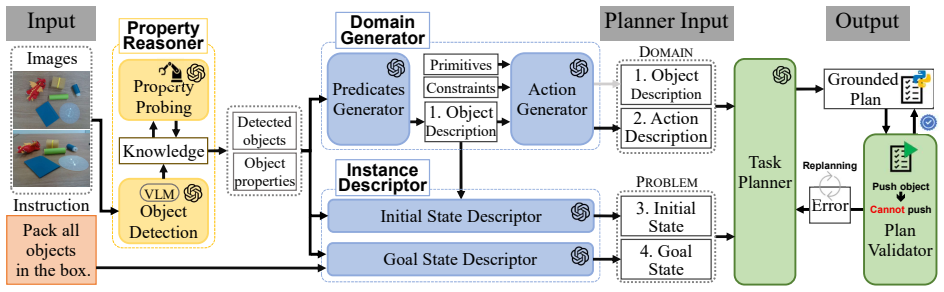
The load-bearing mechanism is the probing protocol: a dimension-matched deforming action (bend for 1D objects, fold for 2D objects, push for 3D objects) always followed by a recovery attempt, with three labeled still images — before, during, and after recovery — that the LLM reads to judge whether deformation happened and whether the object returned to its original shape. The five target properties are defined in plain language, the protocol can be organized as a decision tree, and the resulting labels become predicates in a Python-coded, PDDL-style domain whose action schemas encode the packing constraints. A plan validator executes the generated code, detects syntax errors and constraint violations, and feeds the output back to regenerate the action schemas and replan until a valid plan is found.
What would settle it
Run the probing loop on the two rigid objects that currently score 0% (Objects 2 and 9) while adding a no-change cue such as a pixel-difference mask between the before and after images, and count how often the LLM returns 'rigid'; if the score stays near zero, the LLM's visual judgment of 'no deformation' is the bottleneck, while a jump above 80% would show the three-still format itself was the problem.
Extended reading notes
Core claim
The paper's central claim is that physical properties of previously unseen deformable objects need not be learned from data or assumed from a known category: a robot can probe each object and a large language model can classify it from three still images of the interaction into one of five properties — rigid, bendable, foldable, compressible, or plastic — and these labels compile directly into the constraints of a long-horizon plan. On 14 objects across 38 bin-packing instances, the interaction-based method reaches 78.57% property-probing accuracy, against 34.29% and 22.86% for image-only baselines, and the resulting plans reach 96.84% success after five replanning rounds. The intended takeaway is that robotic interactability plus LLM commonsense reasoning can stand in for the closed-world assumption of classical task planning, with no fine-tuning.
Load-bearing premise
The load-bearing premise is that a language model can correctly tell, from three still photographs, whether an object deformed under a robot's action and whether it returned to its original shape afterwards; the paper's own data show this fails for rigid objects, since both rigid test objects score 0% with the robot-interaction methods.
Editorial extensions
If this is right
- A robot can classify a never-seen object into one of five deformation properties purely by executing scripted probes, with no per-object training and no fine-tuning — the pipeline reports 78.57% overall probing accuracy on 14 objects.
- The discovered property labels become planning predicates automatically, so pointing the pipeline at a new task domain amounts to swapping the constraint set rather than reprogramming the planner.
- Plan validation with replanning lifts bin-packing success from 76.05% on the first attempt to 96.84% after five rounds, indicating that most LLM planning errors are detectable and correctable rather than fatal.
- Physical interaction, not visual appearance, is what carries the classification: image-only baselines reach 34.29% and 22.86%, while interaction-based methods reach 78.57% and 73.57%.
Reading between the lines
- The 0% rigidity scores on the two rigid test objects hint that the LLM is biased to report deformation whenever the robot acts; a cheap test would be to feed the model a no-change cue such as a pixel-difference mask between the before and after images and see whether 'rigid' is ever returned.
- The same probe-and-read loop should transfer to other physical properties — thermal response, magnetic attraction, water resistance — as long as the state change is as visually legible as bending or folding; the paper's five-property set is task-driven, not a ceiling of the method.
- Most of the replanning gain comes after the first round, which suggests the dominant errors are systematic code bugs (such as a place action that forgets to update the in-bin flag) that a single simulator check could catch; five replanning rounds may be an artifact of not compiling the generated Python.
- Free-form LLM judgment (Robot, 78.57%) edged out the decision-tree scaffold (Robot+Tree, 73.57%), so imposing hard symbolic structure on the perception step can cost accuracy; using the tree only to choose actions while leaving the final label free-form might combine both strengths.
Editorial analysis
A structured set of objections, weighed in public.
Referee Report
Summary. The paper proposes an LLM-based pipeline that probes the physical properties (rigid, bendable, foldable, compressible, plastic) of previously unseen objects through robot interactions, then uses the discovered properties to generate task plans for a bin-packing domain. The pipeline consists of a property reasoner (VLM-based detection/naming plus LLM reasoning over before/during/after probing images), a domain generator, an instance descriptor, an LLM task planner, and an LLM plan validator with iterative replanning. Experiments on 14 objects and 38 randomly generated bin-packing instances report 78.57% property-probing accuracy for the interaction-based Robot method (vs 34.29% for image-only), and 96.84% planning success after five replanning attempts.
Significance. The paper's strength is its clear experimental setup: a real dual-arm robot, a nontrivial object set, a detailed prompt protocol, and a direct comparison between interaction-based and image-only property reasoning. The finding that robot interaction improves property classification for most non-rigid objects is useful evidence for the value of physical probing in LLM-based manipulation. However, the central claim is substantially weakened by a systematic failure on rigid objects: both interaction methods achieve 0% accuracy on the two rigid objects in Table 1c, while image-only methods do better on one of them. Because rigidity is the baseline property in the five-property taxonomy, this is not a minor edge case. In addition, the planning-success metric is computed in a simulation whose action preconditions are themselves generated by the LLM, so it does not independently validate the discovered properties. If these issues are addressed with per-property analysis and a scoped claim, the work would be a solid contribution to LLM-based task and motion planning.
major comments (3)
- [§5.2, Table 1c] The interaction-based methods (Robot and Robot+Tree) achieve 0% accuracy on both rigid objects (Objects 2 and 9), whereas the non-interaction Image method achieves 60% and Image+Name achieves 100% for Object 9. Since rigidity is one of the five properties in the taxonomy and is the baseline distinction for deformability, this is a systematic failure in the core mechanism, not a random error. The aggregate 78.57% is driven by the 11 non-rigid objects and hides the fact that the robot interaction actively suppresses the correct answer for rigid 1D/3D objects. The discussion in §5.4 only addresses thin 2D-object failures (Object 6 and Object C) and does not analyze the rigid-object failures. Please report per-property accuracy, provide a failure analysis for Objects 2 and 9, and either improve the probing procedure or temper the claim that robot interactions reveal physical properties.
- [§5.3, Fig. 8a] The planning success metric is computed by executing the LLM-generated Python simulation, in which the action preconditions and effects are also generated by the LLM. If a rigid object is mislabeled as compressible, the planner can still 'push' it in the simulation and the plan counts as successful, so the reported 96.84% planning success rate does not provide independent evidence that the probed properties are correct. It only demonstrates self-consistency of the generated code with the (possibly wrong) property labels. Please report planning success conditioned on whether property probing was correct versus incorrect, and clarify that the planning metric does not validate physical property discovery.
- [§4.1.2 and Table 1c] The claim that 'robot interactions significantly help the LLM reason about the object properties' is not supported for the rigid category: for Objects 2 and 9 the interaction methods are worse than the image-only methods. The paper should report a confusion matrix across all five properties and test whether the interaction benefit is confined to non-rigid objects. Without this, the headline comparison (78.57% vs 34.29%) overstates the generality of the conclusion and leaves the reader unable to judge when the proposed probing protocol is reliable.
minor comments (5)
- [§5.2] There is a typo: 'PbD mathod' should be 'PbD method'.
- [Table 1c] The abbreviation 'C: compressive' is inconsistent with the term 'compressible' used throughout the text; please unify the terminology.
- [Fig. 3a] The decision tree does not show which deforming action is applied for each dimension (bend/fold/push) at the root; making this explicit would help the reader follow the probing protocol.
- [Appendix A.2] The Robot+Tree prompt example only covers a 3D object and asks about compressible versus rigid; please provide the corresponding prompts for 1D and 2D objects so that the tree's behavior is fully specified.
- [§5.3] The text says the validation process repeats 'until T without any error is obtained,' but the experiments cap replanning at five attempts; please reconcile this description with the actual experimental protocol.
Circularity Check
No significant circularity; property labels are checked against external ground truth and planning success against executable Python state transitions.
full rationale
The paper's derivation chain is not circular. Property probing evaluates LLM judgments against externally defined ground-truth labels (Table 1c), with no parameter fitted to the reported accuracy. The 'Robot' method feeds three images (before/during/after probing) to GPT-4o; the output label is compared to the ground truth, not to the prompt content. Similarly, 'Robot+Tree' applies a fixed decision tree derived from dictionary definitions, not from the experimental outcomes. The planning stage generates Python code whose preconditions and effects encode the constraint set C; the plan validator executes this code and checks for 'Cannot...' tags and goal-state satisfaction, which are independent checks rather than the LLM ratifying its own plan. The strongest apparent self-reference—the LLM serving as both planner and validator—does not reduce the validation to the planner's own output because execution failures (e.g., 'Cannot push') are produced by the Python state machine. Replanning uses the execution trace Exe as feedback, an external signal. The 0% rigidity accuracy for Objects 2 and 9 (Table 1c) is a performance/correctness concern, not a circularity concern; no quantity is defined in terms of the result it predicts. No self-citation is load-bearing, and no prediction is equivalent to its inputs by construction. Therefore no circular steps are identified.
Assumptions & free parameters
assumptions (5)
- ad hoc to paper The five properties (rigid, bendable, foldable, compressible, plastic) are sufficient to describe deformability for bin-packing.
- domain assumption Probing actions bend, fold, push, and recover are sufficient to reveal the five properties.
- domain assumption The LLM can correctly infer deformation and recovery from three images.
- domain assumption Object dimension (1D/2D/3D) can be determined visually and determines the appropriate probing action.
- ad hoc to paper The manually written bin-packing constraints C are correct and complete for safe packing.
Cite this review
Pith. "Pith review of Understanding Physical Properties of Unseen Deformable Objects by Leveraging Large Language Models and Robot Actions." pith.science (2026). https://pith.science/paper/PR65N2QZ
@misc{pith2026250603760,
  author       = {Pith},
  title        = {Pith review of: Understanding Physical Properties of Unseen Deformable Objects by Leveraging Large Language Models and Robot Actions},
  year         = {2026},
  howpublished = {\url{https://pith.science/paper/PR65N2QZ}},
  note         = {Machine review of arXiv:2506.03760}
}
read the original abstract
In this paper, we consider the problem of understanding the physical properties of unseen objects through interactions between the objects and a robot. Handling unseen objects with special properties such as deformability is challenging for traditional task and motion planning approaches as they are often with the closed world assumption. Recent results in Large Language Models (LLMs) based task planning have shown the ability to reason about unseen objects. However, most studies assume rigid objects, overlooking their physical properties. We propose an LLM-based method for probing the physical properties of unseen deformable objects for the purpose of task planning. For a given set of object properties (e.g., foldability, bendability), our method uses robot actions to determine the properties by interacting with the objects. Based on the properties examined by the LLM and robot actions, the LLM generates a task plan for a specific domain such as object packing. In the experiment, we show that the proposed method can identify properties of deformable objects, which are further used for a bin-packing task where the properties take crucial roles to succeed.
Figures


Figures from the paper (5 more)


Reference graph
Works this paper leans on
-
[1]
R. E. Fikes, N. J. Nilsson, STRIPS: A new approach to the application of theorem proving to problem solving, Artificial intelligence 2 (3-4) (1971) 189–208
work page 1971
-
[2]
C. Aeronautiques, A. Howe, C. Knoblock, I. D. McDermott, A. Ram, M. Veloso, D. Weld, D. W. Sri, A. Barrett, D. Christianson, et al., PDDL— the planning domain definition language, Technical Report, Tech. Rep
- [3]
-
[4]
M. Ahn, A. Brohan, N. Brown, Y . Chebotar, O. Cortes, B. David, C. Finn, C. Fu, K. Gopalakrishnan, K. Hausman, et al., Do as I can, not as I say: Grounding language in robotic affordances, arXiv preprint arXiv:2204.01691
- [5]
-
[6]
X. Ma, Y . Bhalgat, B. Smart, S. Chen, X. Li, J. Ding, J. Gu, D. Z. Chen, S. Peng, J.-W. Bian, et al., When LLMs step into the 3D world: A survey and meta-analysis of 3d tasks via multi-modal large language models, arXiv preprint arXiv:2405.10255
-
[7]
R. Fu, J. Liu, X. Chen, Y . Nie, W. Xiong, Scene-LLM: Extending language model for 3d visual understanding and reasoning, arXiv preprint arXiv:2403.11401
-
[8]
S. Wang, M. Han, Z. Jiao, Z. Zhang, Y . N. Wu, S.-C. Zhu, H. Liu, LLM3: Large language model-based task and motion planning with motion failure reasoning, arXiv preprint arXiv:2403.11552
Show all 68 references
-
[9]
Shirai, C
K. Shirai, C. C. Beltran-Hernandez, M. Hamaya, A. Hashimoto, S. Tanaka, K. Kawaharazuka, K. Tanaka, Y . Ushiku, S. Mori, Vision-language interpreter for robot task planning, in: Proc. of International Conference on Robotics and Automation (ICRA), 2024, pp. 2051–2058
2024
-
[10]
Z. Zhao, W. S. Lee, D. Hsu, Large language models as commonsense knowledge for large-scale task planning, in: Proc. ofAdvances in Neural Information Processing Systems (NeurIPS), V ol. 36, 2024
2024
-
[11]
Z. Wu, Z. Wang, X. Xu, J. Lu, H. Yan, Embodied task planning with large language models, arXiv preprint arXiv:2307.01848
-
[12]
R. Wu, C. Ning, H. Dong, Learning foresightful dense visual a ffordance for deformable object manipulation, in: Proc. of International Conference on Computer Vision (ICCV), 2023, pp. 10947–10956
2023
-
[13]
Z. Wang, A. H. Qureshi, DeRi-Bot: Learning to collaboratively manipulate rigid objects via deformable objects, IEEE Robotics and Automa- tion Letters
-
[14]
Y . Deng, K. Mo, C. Xia, X. Wang, Learning language-conditioned deformable object manipulation with graph dynamics, in: Proc. of International Conference on Robotics and Automation (ICRA), 2024, pp. 7508–7514
2024
-
[15]
Guler, K
P. Guler, K. Pauwels, A. Pieropan, H. Kjellstr ¨om, D. Kragic, Estimating the deformability of elastic materials using optical flow and position- based dynamics, in: Proc. of International Conference on Humanoid Robots (Humanoids), 2015, pp. 965–971. 11
2015
-
[16]
Petit, F
A. Petit, F. Ficuciello, G. A. Fontanelli, L. Villani, B. Siciliano, Using physical modeling and RGB-D registration for contact force sensing on deformable objects, in: Proc. of International Conference on Informatics in Control, Automation and Robotics (ICINCO), V ol. 2, 2017...
2017
-
[17]
Haouchine, W
N. Haouchine, W. Kuang, S. Cotin, M. Yip, Vision-based force feedback estimation for robot-assisted surgery using instrument-constrained biomechanical three-dimensional maps, IEEE Robotics and Automation Letters 3 (3) (2018) 2160–2165
2018
-
[18]
P. Zhou, P. Zheng, J. Qi, C. Li, H.-Y . Lee, A. Duan, L. Lu, Z. Li, L. Hu, D. Navarro-Alarcon, Reactive human–robot collaborative manipulation of deformable linear objects using a new topological latent control model, Robotics and Computer-Integrated Manufacturing 88 (2024) 102727
2024
-
[19]
Huang, X
J. Huang, X. Chu, X. Ma, K. W. S. Au, Deformable object manipulation with constraints using path set planning and tracking, IEEE Trans- actions on Robotics
-
[20]
Matas, S
J. Matas, S. James, A. J. Davison, Sim-to-real reinforcement learning for deformable object manipulation, in: Proc. of Conference on Robot Learning (CoRL), 2018, pp. 734–743
2018
-
[21]
S. Liu, Z. Zeng, T. Ren, F. Li, H. Zhang, J. Yang, C. Li, J. Yang, H. Su, J. Zhu, et al., Grounding DINO: Marrying DINO with grounded pre-training for open-set object detection, arXiv preprint arXiv:2303.05499
-
[22]
A. Wang, T. Kurutach, K. Liu, P. Abbeel, A. Tamar, Learning robotic manipulator visual planning and acting, arXiv preprint arXiv:1905.04411
1905 arXiv
-
[23]
M. Yan, Y . Zhu, N. Jin, J. Bohg, Self-supervised learning of state estimation for manipulating deformable linear objects, IEEE Robotics and Automation Letters 5 (2) (2020) 2372–2379
2020
-
[24]
Lippi, P
M. Lippi, P. Poklukar, M. C. Welle, A. Varava, H. Yin, A. Marino, D. Kragic, Latent space roadmap for visual action planning of deformable and rigid object manipulation, in: Proc. of International Conference on Intelligent Robots and Systems (IROS), 2020, pp. 5619–5626
2020
-
[25]
T. Fu, C. Li, J. Liu, F. Li, C. Wang, R. Song, Flingflow: Llm-driven dynamic strategies for e fficient cloth flattening, IEEE Robotics and Automation Letters
-
[26]
Shridhar, L
M. Shridhar, L. Manuelli, D. Fox, Cliport: What and where pathways for robotic manipulation, in: Proc. of Conference on Robot Learning (CoRL), 2022, pp. 894–906
2022
-
[27]
Bartsch, A
A. Bartsch, A. B. Farimani, LLM-craft: Robotic crafting of elasto-plastic objects with large language models, arXiv preprint arXiv:2406.08648
-
[28]
Hanheide, M
M. Hanheide, M. G ¨obelbecker, G. S. Horn, A. Pronobis, K. Sj ¨o¨o, A. Aydemir, P. Jensfelt, C. Gretton, R. Dearden, M. Janicek, et al., Robot task planning and explanation in open and uncertain worlds, Artificial Intelligence 247 (2017) 119–150
2017
-
[29]
C. H. Song, J. Wu, C. Washington, B. M. Sadler, W.-L. Chao, Y . Su, LLM-planner: Few-shot grounded planning for embodied agents with large language models, in: Proc. of International Conference on Computer Vision (ICCV), 2023, pp. 2998–3009
2023
-
[30]
M. Ahn, D. Dwibedi, C. Finn, M. G. Arenas, K. Gopalakrishnan, K. Hausman, B. Ichter, A. Irpan, N. Joshi, R. Julian, et al., Autort: Embodied foundation models for large scale orchestration of robotic agents, arXiv preprint arXiv:2401.12963
-
[31]
Shridhar, J
M. Shridhar, J. Thomason, D. Gordon, Y . Bisk, W. Han, R. Mottaghi, L. Zettlemoyer, D. Fox, Alfred: A benchmark for interpreting grounded instructions for everyday tasks, in: Proc. of Conference on Computer Vision and Pattern Recognition (CVPR), 2020, pp. 10740–10749
2020
-
[32]
Y . Liu, L. Palmieri, S. Koch, I. Georgievski, M. Aiello, Delta: Decomposed e fficient long-term robot task planning using large language models, arXiv preprint arXiv:2404.03275
-
[33]
J. Gao, B. Sarkar, F. Xia, T. Xiao, J. Wu, B. Ichter, A. Majumdar, D. Sadigh, Physically grounded vision-language models for robotic manipulation, in: Proc. of International Conference on Robotics and Automation (ICRA), IEEE, 2024, pp. 12462–12469
2024
-
[34]
W. Xie, J. Lavering, N. Correll, DeliGrasp: Inferring object properties with LLMs for adaptive grasp policies, Arxiv preprint arXiv: 2403.07832
-
[35]
X. Zhao, M. Li, C. Weber, M. B. Hafez, S. Wermter, Chat with the environment: Interactive multimodal perception using large language models, in: Proc. of International Conference on Intelligent Robots and Systems (IROS), IEEE, 2023, pp. 3590–3596
2023
-
[36]
W. Lai, T. Zhang, T. L. Lam, Y . Gao, Vision-language model-based physical reasoning for robot liquid perception, in: Proc. of International Conference on Intelligent Robots and Systems (IROS), IEEE, 2024, pp. 9652–9659
2024
-
[37]
Achiam, S
J. Achiam, S. Adler, S. Agarwal, L. Ahmad, I. Akkaya, F. L. Aleman, D. Almeida, J. Altenschmidt, S. Altman, S. Anadkat, et al., GPT-4 technical report, arXiv preprint arXiv:2303.08774
-
[38]
J. Wei, X. Wang, D. Schuurmans, M. Bosma, F. Xia, E. Chi, Q. V . Le, D. Zhou, et al., Chain-of-thought prompting elicits reasoning in large language models, in: Proc. of Advances in Neural Information Processing Systems (NeurIPS), V ol. 35, 2022, pp. 24824–24837
2022
-
[39]
1D”, “line
Cambridge Dictionary, Definitions for search terms: “1D”, “line”, “compressible”, and others, Accessed: Oct. 24, 2024 (Oct. 2024). URL https://dictionary.cambridge.org/
2024
-
[40]
Dosovitskiy, An image is worth 16x16 words: Transformers for image recognition at scale, arXiv preprint arXiv:2010.11929
A. Dosovitskiy, An image is worth 16x16 words: Transformers for image recognition at scale, arXiv preprint arXiv:2010.11929
2010 arXiv
-
[41]
[Definitions of dimensions and shapes]
T. Z. Zhao, V . Kumar, S. Levine, C. Finn, Learning fine-grained bimanual manipulation with low-cost hardware, arXiv preprint arXiv:2304.13705. 12 Appendix A. Prompts Appendix A.1. Prompts for Object Detection and Naming (Sec. 4.1.1) Prompts for the object detection and naming...
-
[42]
Result - Property: ‘’ —template end— Answer: —template start—
-
[43]
When the robot pushes the object, it deforms and does not return to its original shape after the force is removed
Reasoning - The object is a 3D cuboid. When the robot pushes the object, it deforms and does not return to its original shape after the force is removed. This indicates that the object can be shaped and retains the new form, which aligns with the property of being plastic
-
[44]
Result - Property: ‘is plastic’ —template end— Prompt for the property probing: Robot+Tree Message 1: Describe the scenes 1. 2. 3. Answer 1 : 1. The object is a small, red, rectangular box placed on a flat surface. It appears to be made of cardboard or a similar material
-
[45]
The box is slightly deformed, indicating pressure from the gripper
The object is the same red box, but it is now being grasped by a black robotic gripper. The box is slightly deformed, indicating pressure from the gripper. Message 2: We will now probe the object’s properties. This table defines the physical properties of the object we are inv...
-
[46]
Description of 1st image: -
-
[47]
Description of 2st image: -
-
[48]
Result - Property: ‘’ —template end— Answer 3-1: —template start—
-
[49]
Description of 1st image: - The red 3D cuboid is intact and maintains its original shape, placed on a flat surface
-
[50]
Description of 2nd image: - The red 3D cuboid is being pushed by a robotic gripper, and its shape is visibly deformed
-
[51]
Reasoning - The deformation of the cuboid when pushed indicates that it can be compressed, showing a change in shape under pressure
-
[52]
Result - Property: ‘is compressible’ —template end— Answer 3-2: —template start—
-
[53]
Description of 1st image: - The red 3D cuboid is intact and centered within a marked area on a flat surface
-
[54]
Description of 2nd image: - A robotic arm is pressing the red cuboid, causing it to deform visibly
-
[55]
This indicates that the object does not recover from deformation
Reasoning - After the robot releases the object, the cuboid remains deformed and does not return to its original shape. This indicates that the object does not recover from deformation. 5
-
[56]
‘python # only write a code here without example instantiation
Result - Property: ‘is plastic’ —template end— Appendix A.3. Prompts for Predicate Generator (Sec. 4.2.1) Prompt for the predicate generator Message: Our goal is to define the types of objects and their predicates within the dataclass Object. Here, we have the types, names, an...
-
[57]
**Weight**: Determines if the object is heavy or light, impacting how it can be packed and whether it requires special handling
-
[58]
**Material**: Identifies if the object is plastic, metal, or another material, affecting its fragility and packing requirements
-
[59]
**Rigidity**: Indicates if the object is rigid or flexible, influencing how it can be positioned and stacked
-
[60]
**Size**: Defines the dimensions of the object, crucial for determining fit within a box
-
[61]
pick obj.name
**Shape**: Affects how objects can be arranged and packed efficiently. These properties help in planning and executing effective bin-packing strategies. Message 2: This is Object class you have to use. from dataclasses import dataclass @dataclass class Object: # Basic dataclas...
-
[62]
Object Class (Start with [@dataclass])
-
[63]
Action Class (Start with [class Action:])
-
[64]
Object initial State (Start with [# Object Initial State])
-
[65]
Planning State (Start with [if name == ” main ”:]) And this is a planning result of the code. bend black 1D line pick black 1D line place black 1D line pick yellow 3D cuboid place yellow 3D cuboid Cannot push yellow 3D cuboid pick white 3D cylinder place white 3D cylinder Cann...
-
[66]
The ‘place’ action for the blue 2D rectangle (plastic object) is executed without any issue, which aligns with the constraints
-
[67]
pick { obj . name }
The sequence of actions seems to follow the given rules, but the ‘push’ action fails for compressible objects. Second, check the error part follows the notes !!Note1. Do not assume the physical properties of the object. !!Note2. If a predicate required by the constraints is no...
-
[68]
packing all object in the box
start 1. fold yellow 2. place yellow 3. place red 4. push red 5. place blue0. start 2. place white 3. place green 4. place brown 5. push brown1. pick white Figure D.11: The real-world execution of task planning which leverages probed properties. Given the instruction “packing ...
Reviewed August 7, 2026 · model on record in the stance chip above.
Discussion (0). Sign in to comment.