REVIEW 1 major objections 1 cited by
Graph neural networks encounter the same barriers of heterophily, scale, and temporality across twelve domains.
Reviewed by Pith at T0; open to challenge. T0 means a machine referee read the full paper against a public rubric. the ladder, T0–T4 →
T0 review · grok-4.3
2026-06-26 04:50 UTC pith:PRK266HA
load-bearing objection This survey organizes GNN applications across twelve domains around the WL hierarchy but gives no review protocol, so its cross-domain patterns rest on unverified selection. the 1 major comments →
Graph Neural Networks Applications Across Domains: All Insights You Need
The pith
A machine-rendered reading of the paper's core claim, the machinery that carries it, and where it could break.
Core claim
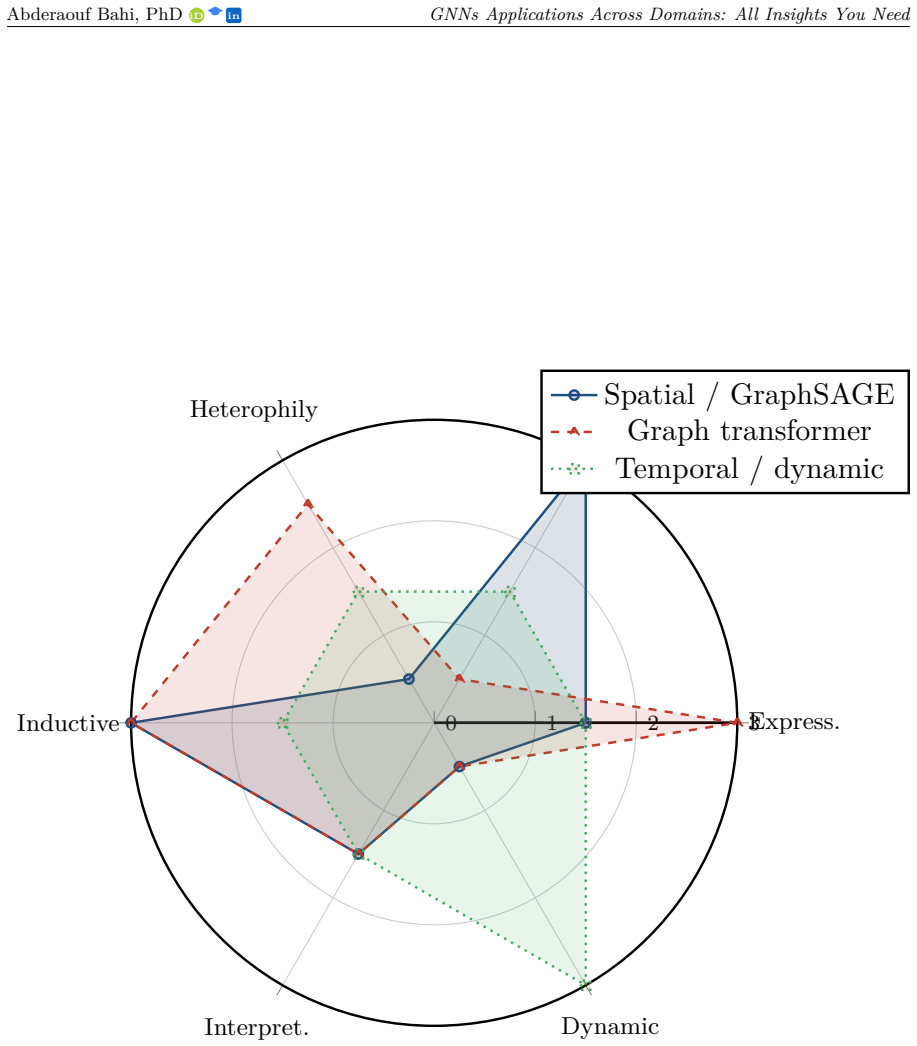
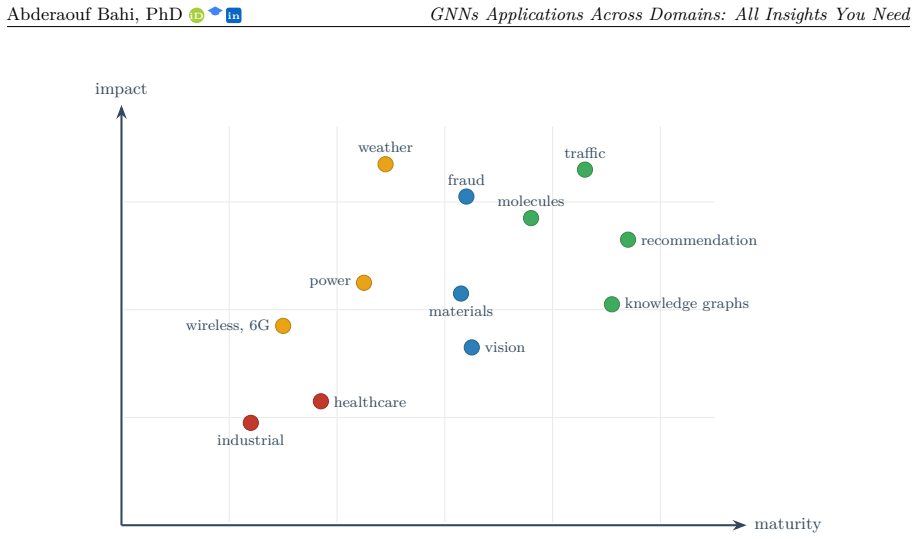
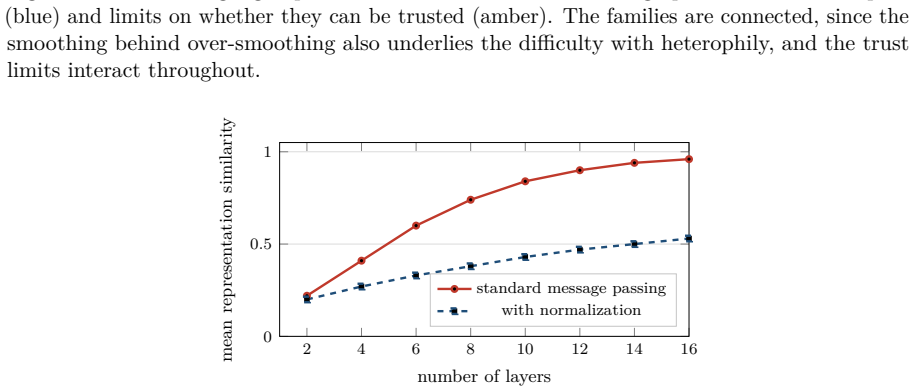
By deriving spectral and spatial formulations from first principles and tying them to the Weisfeiler-Leman hierarchy, the survey shows that across recommendation systems, molecular learning, healthcare, traffic, energy, and other domains, the same constraints recur: heterophily undercuts standard message passing, scale creates computational bottlenecks, and temporal dynamics add difficulty beyond static graphs. Architectures that perform well on public benchmarks seldom reach practical use, with issues like over-smoothing and distribution shift acting as adoption gates.
What carries the argument
The Weisfeiler-Leman hierarchy as the reference for what graph architectures can distinguish, used to evaluate domain-specific models and graph construction choices.
Load-bearing premise
The selection of twelve domains and the papers within them captures general constraints rather than reflecting biases in the surveyed literature.
What would settle it
A new domain or large-scale study where a single architecture succeeds across heterophilic, temporal, and large graphs while also deploying successfully would undermine the claimed recurring patterns.
If this is right
- Graph construction in each domain carries specific costs that must be weighed against benefits.
- Heterophily handling becomes a cross-cutting requirement rather than a niche fix.
- Temporal extensions are needed beyond static GNNs for dynamic settings like traffic or climate.
- Deployment favors models that address robustness and fairness over pure accuracy on benchmarks.
- Over-squashing and over-smoothing limit performance at scale in multiple fields.
Where Pith is reading between the lines
- Future architectures might benefit from mechanisms that explicitly target heterophily in a domain-agnostic way.
- Evaluation should shift toward deployment metrics rather than leaderboard scores.
- Integration with other modalities like language models could address some knowledge graph challenges but not scale issues.
- Climate and materials science may require specialized temporal and multi-scale handling.
Editorial analysis
A structured set of objections, weighed in public.
Referee Report
Summary. The paper is a survey of GNNs that organizes the field around a shared design space derived from spectral and spatial message-passing formulations, explicitly links expressive power to the Weisfeiler-Leman hierarchy, and reviews applications in twelve domains (recommendation, knowledge graphs, drug discovery, healthcare, vision, traffic, power systems, wireless networks, fraud detection, industrial prognostics, materials science, climate). It claims to separate reported performance gains from baseline artefacts and identifies recurring cross-domain constraints: heterophily and scale limit the same models, temporal graphs are harder than static ones, and leaderboard leaders rarely reach deployment.
Significance. If the literature sampling and artefact-separation claims hold, the survey supplies a useful synthesis that treats over-smoothing, robustness, and distribution shift as adoption constraints rather than afterthoughts. The explicit WL-hierarchy backbone is a clear strength that grounds domain-specific observations in a common theoretical reference. The work would be strengthened by making the selection protocol reproducible so that the identified patterns can be treated as field-level regularities.
major comments (1)
- [Abstract / cross-domain comparison] Abstract and cross-domain comparison section: the assertion that reported gains are separated from artefacts of weak baselines or favourable splits is load-bearing for the claim that heterophily, scale, and temporal difficulty are general constraints. No review protocol, inclusion criteria, search strategy, or quantitative balance check (e.g., fraction of heterophilic vs. homophilic graphs or positive vs. negative results) is described, leaving open the possibility that the recurring patterns are artefacts of the sampled papers rather than representative regularities.
Simulated Author's Rebuttal
We thank the referee for the positive assessment of the survey's organizational framework, WL-hierarchy grounding, and treatment of adoption constraints. The single major comment concerns the reproducibility of the literature sampling used to support cross-domain claims. We address it directly below and commit to a revision that formalizes the protocol.
read point-by-point responses
-
Referee: [Abstract / cross-domain comparison] Abstract and cross-domain comparison section: the assertion that reported gains are separated from artefacts of weak baselines or favourable splits is load-bearing for the claim that heterophily, scale, and temporal difficulty are general constraints. No review protocol, inclusion criteria, search strategy, or quantitative balance check (e.g., fraction of heterophilic vs. homophilic graphs or positive vs. negative results) is described, leaving open the possibility that the recurring patterns are artefacts of the sampled papers rather than representative regularities.
Authors: We agree that an explicit, reproducible review protocol is required to substantiate that the identified patterns (heterophily and scale as recurring limits, temporal graphs as harder, leaderboard-deployment gap) reflect field-level regularities rather than sampling bias. The current manuscript describes the domains and the separation of gains from artefacts on a per-domain basis but does not provide a consolidated methods subsection detailing search strategy, inclusion/exclusion criteria, or quantitative balance statistics. In the revised version we will insert a new subsection (placed after the WL-hierarchy discussion) that specifies: (i) search keywords and databases (arXiv, Google Scholar, major conferences 2018–2024), (ii) inclusion criteria (peer-reviewed empirical studies with at least one standard benchmark and baseline comparison), (iii) exclusion criteria (purely theoretical works without experiments, non-English papers), and (iv) a summary table reporting the number of papers retained per domain together with the fraction of heterophilic graphs, positive vs. negative results, and temporal vs. static settings. This addition will allow readers to evaluate representativeness while preserving the existing domain-specific analyses. We therefore treat the referee’s observation as correct and actionable. revision: yes
Circularity Check
No circularity: survey organizes literature without self-referential derivations
full rationale
This is a survey paper whose core activity is organizing existing work around a design space, deriving spectral/spatial formulations from shared first principles, and linking expressive power to the Weisfeiler-Leman hierarchy. No new parameters are fitted to data subsets, no predictions are generated from the survey's own inputs, and no self-citation chains are invoked to justify uniqueness or force architectural choices. The cross-domain patterns (heterophily, scale, temporal difficulty) are presented as observed regularities from sampled papers rather than quantities constructed by definition or renaming. The representativeness concern is a methodological limitation, not a circular reduction. The paper is therefore self-contained against external benchmarks with score 0.
Axiom & Free-Parameter Ledger
Cite this review
Pith. "Pith review of Graph Neural Networks Applications Across Domains: All Insights You Need." pith.science (2026). https://pith.science/paper/PRK266HA
@misc{pith2026260627202,
  author       = {Pith},
  title        = {Pith review of: Graph Neural Networks Applications Across Domains: All Insights You Need},
  year         = {2026},
  howpublished = {\url{https://pith.science/paper/PRK266HA}},
  note         = {Machine review of arXiv:2606.27202}
}
read the original abstract
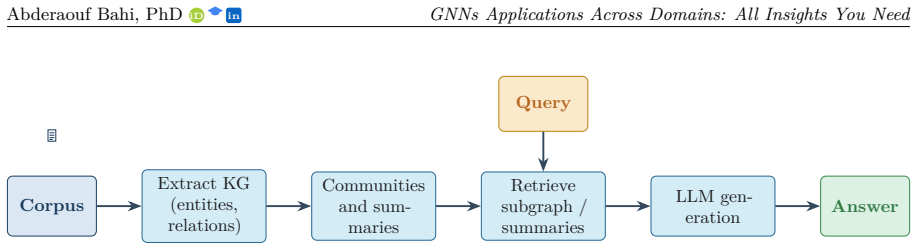
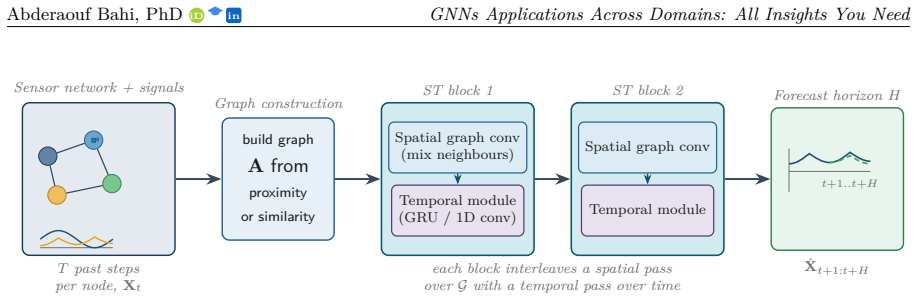
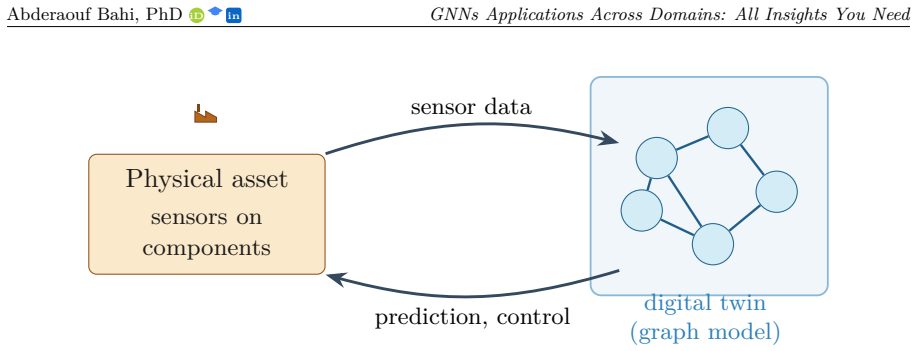
Graph neural networks have moved from a niche representation-learning technique to the default model class wherever data carry relational structure. The interesting question is no longer whether message passing helps on a given dataset, but where graph structure earns its computational cost and where it does not. This survey organises the field around a single design space, derives the spectral and spatial formulations from shared first principles, and connects expressive power to the Weisfeiler-Leman hierarchy with explicit statements of what current architectures can and cannot separate. Against that methodological backbone we examine twelve application domains, among them recommendation and social networks, knowledge graphs and language-model integration, drug discovery and molecular property learning, healthcare and neuroscience, computer vision, traffic and urban computing, power and renewable-energy systems, wireless and sixth-generation networks, fraud and cybersecurity, industrial prognostics, materials science, and climate modelling. For each domain we specify the graph-construction choices and their costs, identify which architecture families dominate and why, and separate reported gains from artefacts of weak baselines or favourable splits. A cross-domain comparison exposes recurring patterns: heterophily and scale undercut the same models almost everywhere, temporal graphs remain harder than their static counterparts, and the architectures that top public leaderboards are seldom the ones that reach deployment. We treat over-smoothing, over-squashing, robustness, distribution shift, fairness, and explainability not as a closing checklist but as the constraints that decide adoption.
Figures













Forward citations
Cited by 1 Pith paper
-
When does distribution shift break graph neural networks calibration?
GNN calibration under distribution shift is governed by a single closed-form slope κ(hs, ht, ρ) that sets the optimal global temperature T⋆=1/κ and explains when node-wise recalibration cannot help.
Reference graph
Works this paper leans on
-
[1]
A Deep Learning Approach to Antibiotic Discovery,
J. M. Stokes, K. Yang, K. Swanson, W. Jin, A. Cubillos-Ruiz, and et al., “A Deep Learning Approach to Antibiotic Discovery,”Cell, vol. 180, no. 4, pp. 688–702, 2020
2020
-
[2]
Learning Skillful Medium-Range Global Weather Forecasting,
R. Lam, A. Sanchez-Gonzalez, M. Willson, P. Wirnsberger, M. Fortunato, and et al., “Learning Skillful Medium-Range Global Weather Forecasting,”Science, vol. 382, no. 6677, pp. 1416–1421, 2023
2023
-
[3]
A Comprehensive Survey on Graph Neural Networks,
Z. Wu, S. Pan, F. Chen, G. Long, C. Zhang, and P. S. Yu, “A Comprehensive Survey on Graph Neural Networks,”IEEE Transactions on Neural Networks and Learning Systems, vol. 32, no. 1, pp. 4–24, 2021
2021
-
[4]
Graph Neural Networks: A Review of Methods and Applications,
J. Zhou, G. Cui, S. Hu, Z. Zhang, C. Yang, Z. Liu, L. Wang, C. Li, and M. Sun, “Graph Neural Networks: A Review of Methods and Applications,”AI Open, vol. 1, pp. 57–81, 2020
2020
-
[5]
Deep Learning on Graphs: A Survey,
Z. Zhang, P. Cui, and W. Zhu, “Deep Learning on Graphs: A Survey,”IEEE Transactions on Knowledge and Data Engineering, vol. 34, no. 1, pp. 249–270, 2022
2022
-
[6]
Machine Learning on Graphs: A Model and Comprehensive Taxonomy,
I. Chami, S. Abu-El-Haija, B. Perozzi, C. Ré, and K. Murphy, “Machine Learning on Graphs: A Model and Comprehensive Taxonomy,”Journal of Machine Learning Research, 2022
2022
-
[7]
Graph Convolutional Networks: A Comprehensive Review,
S. Zhang, H. Tong, J. Xu, and R. Maciejewski, “Graph Convolutional Networks: A Comprehensive Review,”Computational Social Networks, vol. 6, p. 11, 2019
2019
-
[8]
Representation Learning on Graphs: Methods and Applications,
W. L. Hamilton, R. Ying, and J. Leskovec, “Representation Learning on Graphs: Methods and Applications,”IEEE Data Engineering Bulletin, vol. 40, no. 3, pp. 52–74, 2017
2017
-
[9]
Geometric Deep Learning: Going Beyond Euclidean Data,
M. M. Bronstein, J. Bruna, Y. LeCun, A. Szlam, and P. Vandergheynst, “Geometric Deep Learning: Going Beyond Euclidean Data,”IEEE Signal Processing Magazine, vol. 34, no. 4, pp. 18–42, 2017
2017
-
[10]
Geometric Deep Learning: Grids, Groups, Graphs, Geodesics, and Gauges,
M. M. Bronstein, J. Bruna, T. Cohen, and P. Veličković, “Geometric Deep Learning: Grids, Groups, Graphs, Geodesics, and Gauges,” arXiv preprint, 2021
2021
-
[11]
Everything is Connected: Graph Neural Networks,
P. Veličković, “Everything is Connected: Graph Neural Networks,”Current Opinion in Structural Biology, 2023
2023
-
[12]
Graph Neural Networks in Recommender Systems: A Survey,
S. Wu, F. Sun, W. Zhang, X. Xie, and B. Cui, “Graph Neural Networks in Recommender Systems: A Survey,”ACM Computing Surveys, vol. 55, no. 5, pp. 97:1–97:37, 2023. 129 Abderaouf Bahi, PhD iD in GNNs Applications Across Domains: All Insights You Need
2023
-
[13]
A Survey on Knowledge Graphs: Representation, Acquisition, and Applications,
S. Ji, S. Pan, E. Cambria, P. Marttinen, and P. S. Yu, “A Survey on Knowledge Graphs: Representation, Acquisition, and Applications,”IEEE Transactions on Neural Networks and Learning Systems, 2021
2021
-
[14]
A Compact Review of Molecular Property Prediction with Graph Neural Networks,
O. Wieder, S. Kohlbacher, M. Kuenemann, A. Garon, P. Ducrot, T. Seidel, and T. Langer, “A Compact Review of Molecular Property Prediction with Graph Neural Networks,”Drug Discovery Today: Technologies, vol. 37, pp. 1–12, 2020
2020
-
[15]
Graph Neural Network for Traffic Forecasting: A Survey,
W. Jiang and J. Luo, “Graph Neural Network for Traffic Forecasting: A Survey,”Expert Systems with Applications, vol. 207, p. 117921, 2022
2022
-
[16]
A Review of Graph Neural Networks and Their Applications in Power Systems,
W. Liao, B. Bak-Jensen, J. R. Pillai, Y. Wang, and Y. Wang, “A Review of Graph Neural Networks and Their Applications in Power Systems,”Journal of Modern Power Systems and Clean Energy, vol. 10, no. 2, pp. 345–360, 2022
2022
-
[17]
W. L. Hamilton,Graph Representation Learning. Morgan and Claypool (Synthesis Lectures on AI and ML), 2020
2020
-
[18]
A Survey on the Expressive Power of Graph Neural Networks,
R. Sato, “A Survey on the Expressive Power of Graph Neural Networks,” arXiv preprint, 2020
2020
-
[19]
Weisfeiler and Leman Go Machine Learning: The Story So Far,
C. Morris, Y. Lipman, H. Maron, B. Rieck, N. M. Kriege, M. Grohe, M. Fey, and K. Borgwardt, “Weisfeiler and Leman Go Machine Learning: The Story So Far,”Journal of Machine Learning Research, 2023
2023
-
[20]
Self-Supervised Learning on Graphs: Contrastive, Generative, or Predictive,
L. Wu, H. Lin, C. Tan, Z. Gao, and S. Z. Li, “Self-Supervised Learning on Graphs: Contrastive, Generative, or Predictive,”IEEE Transactions on Knowledge and Data Engineering, 2021
2021
-
[21]
Self-Supervised Learning of Graph Neural Networks: A Unified Review,
Y. Xie, Z. Xu, J. Zhang, Z. Wang, and S. Ji, “Self-Supervised Learning of Graph Neural Networks: A Unified Review,”IEEE Transactions on Pattern Analysis and Machine Intelligence, 2022
2022
-
[22]
Representation Learning for Dynamic Graphs: A Survey,
S. M. Kazemi, R. Goel, K. Jain, I. Kobyzev, A. Sethi, P. Forsyth, and P. Poupart, “Representation Learning for Dynamic Graphs: A Survey,”Journal of Machine Learning Research, 2020
2020
-
[23]
A Survey on Heterogeneous Graph Embedding: Methods, Techniques, Applications and Sources,
X. Wang, D. Bo, C. Shi, S. Fan, Y. Ye, and P. S. Yu, “A Survey on Heterogeneous Graph Embedding: Methods, Techniques, Applications and Sources,”IEEE Transactions on Big Data, vol. 9, no. 2, pp. 415–436, 2022
2022
-
[24]
A Comprehensive Survey of Graph Neural Networks for Knowledge Graphs,
Z. Ye, Y. J. Kumar, G. O. Sing, F. Song, and J. Wang, “A Comprehensive Survey of Graph Neural Networks for Knowledge Graphs,”IEEE Access, vol. 10, pp. 75729–75741, 2022
2022
-
[25]
Graph Convolutional Networks for Computational Drug Development and Discovery,
M. Sun, S. Zhao, C. Gilvary, O. Elemento, J. Zhou, and F. Wang, “Graph Convolutional Networks for Computational Drug Development and Discovery,”Briefings in Bioinformat- ics, vol. 21, no. 3, pp. 919–935, 2020
2020
-
[26]
A Survey on Graph Neural Networks for Time Series: Forecasting, Classification, Imputation, and Anomaly Detection,
M. Jin, H. Y. Koh, Q. Wen, D. Zambon, C. Alippi, G. I. Webb, I. King, and S. Pan, “A Survey on Graph Neural Networks for Time Series: Forecasting, Classification, Imputation, and Anomaly Detection,”IEEE Transactions on Pattern Analysis and Machine Intelligence, 2024
2024
-
[27]
Graph Neural Networks for Wireless Communications: From Theory to Practice,
Y. Shen, J. Zhang, S. H. Song, and K. B. Letaief, “Graph Neural Networks for Wireless Communications: From Theory to Practice,”IEEE Transactions on Wireless Communica- tions, 2023. 130 Abderaouf Bahi, PhD iD in GNNs Applications Across Domains: All Insights You Need
2023
-
[28]
A Comprehensive Survey on Trustworthy Graph Neural Networks: Privacy, Robustness, Fairness, and Explainability,
E. Dai, T. Zhao, H. Zhu, J. Xu, Z. Guo, H. Liu, J. Tang, and S. Wang, “A Comprehensive Survey on Trustworthy Graph Neural Networks: Privacy, Robustness, Fairness, and Explainability,”Machine Intelligence Research, 2024
2024
-
[29]
Bench- marking Graph Neural Networks,
V. P. Dwivedi, C. K. Joshi, A. T. Luu, T. Laurent, Y. Bengio, and X. Bresson, “Bench- marking Graph Neural Networks,”Journal of Machine Learning Research, vol. 24, pp. 1–48, 2023
2023
-
[30]
Open Graph Benchmark: Datasets for Machine Learning on Graphs,
W. Hu, M. Fey, M. Zitnik, Y. Dong, H. Ren, B. Liu, M. Catasta, and J. Leskovec, “Open Graph Benchmark: Datasets for Machine Learning on Graphs,” inAdvances in Neural Information Processing Systems (NeurIPS), 2020
2020
-
[31]
Simplifying Graph Convolutional Networks,
F. Wu, A. Souza, T. Zhang, C. Fifty, T. Yu, and K. Weinberger, “Simplifying Graph Convolutional Networks,” inInternational Conference on Machine Learning (ICML), 2019, pp. 6861–6871
2019
-
[32]
Beyond Homophily in Graph Neural Networks: Current Limitations and Effective Designs,
J. Zhu, Y. Yan, L. Zhao, M. Heimann, L. Akoglu, and D. Koutra, “Beyond Homophily in Graph Neural Networks: Current Limitations and Effective Designs,” inAdvances in Neural Information Processing Systems (NeurIPS), 2020
2020
-
[33]
Geom-GCN: Geometric Graph Convolutional Networks,
H. Pei, B. Wei, K. C.-C. Chang, Y. Lei, and B. Yang, “Geom-GCN: Geometric Graph Convolutional Networks,” inInternational Conference on Learning Representations (ICLR), 2020
2020
-
[34]
Inductive Representation Learning on Large Graphs,
W. L. Hamilton, R. Ying, and J. Leskovec, “Inductive Representation Learning on Large Graphs,” inAdvances in Neural Information Processing Systems (NeurIPS), 2017
2017
-
[35]
Cluster-GCN: An Efficient Algorithm for Training Deep and Large Graph Convolutional Networks,
W.-L. Chiang, X. Liu, S. Si, Y. Li, S. Bengio, and C.-J. Hsieh, “Cluster-GCN: An Efficient Algorithm for Training Deep and Large Graph Convolutional Networks,” inACM SIGKDD Conference on Knowledge Discovery and Data Mining (KDD), 2019, pp. 257–266
2019
-
[36]
Foundations and Modeling of Dynamic Networks Using Dynamic Graph Neural Networks: A Survey,
J. Skarding, B. Gabrys, and K. Musial, “Foundations and Modeling of Dynamic Networks Using Dynamic Graph Neural Networks: A Survey,”IEEE Access, vol. 9, pp. 79143–79168, 2021
2021
-
[37]
How Powerful are Graph Neural Networks?
K. Xu, W. Hu, J. Leskovec, and S. Jegelka, “How Powerful are Graph Neural Networks?” inInternational Conference on Learning Representations (ICLR), 2019
2019
-
[38]
Weisfeiler and Leman Go Neural: Higher-Order Graph Neural Networks,
C. Morris, M. Ritzert, M. Fey, W. L. Hamilton, J. E. Lenssen, G. Rattan, and M. Grohe, “Weisfeiler and Leman Go Neural: Higher-Order Graph Neural Networks,” inAAAI Conference on Artificial Intelligence, 2019, pp. 4602–4609
2019
-
[39]
Explainability in Graph Neural Networks: A Taxonomic Survey,
H. Yuan, H. Yu, S. Gui, and S. Ji, “Explainability in Graph Neural Networks: A Taxonomic Survey,”IEEE Transactions on Pattern Analysis and Machine Intelligence, vol. 45, no. 5, pp. 5782–5799, 2023
2023
-
[40]
Towards Graph Foundation Models: A Survey and Beyond,
J. Liu, C. Yang, Z. Lu, J. Chen, Y. Li, M. Zhang, T. Bai, Y. Fang, L. Sun, P. S. Yu, and C. Shi, “Towards Graph Foundation Models: A Survey and Beyond,” arXiv preprint, 2023
2023
-
[41]
Position: Graph Foundation Models Are Already Here,
H. Mao, Z. Chen, W. Tang, J. Zhao, Y. Ma, T. Zhao, N. Shah, M. Galkin, and J. Tang, “Position: Graph Foundation Models Are Already Here,” inInternational Conference on Machine Learning (ICML), 2024
2024
-
[42]
From Local to Global: A Graph RAG Approach to Query-Focused Summarization,
D. Edge, H. Trinh, N. Cheng, J. Bradley, A. Chao, A. Mody, S. Truitt, and J. Larson, “From Local to Global: A Graph RAG Approach to Query-Focused Summarization,” arXiv preprint, 2024. 131 Abderaouf Bahi, PhD iD in GNNs Applications Across Domains: All Insights You Need
2024
-
[43]
Large Language Models on Graphs: A Comprehensive Survey,
B. Jin, G. Liu, C. Han, M. Jiang, H. Ji, and J. Han, “Large Language Models on Graphs: A Comprehensive Survey,”IEEE Transactions on Knowledge and Data Engineering, 2024
2024
-
[44]
One for All: Towards Training One Graph Model for All Classification Tasks,
H. Liu, J. Feng, L. Kong, N. Liang, D. Tao, Y. Chen, and M. Zhang, “One for All: Towards Training One Graph Model for All Classification Tasks,” inInternational Conference on Learning Representations (ICLR), 2024
2024
-
[45]
Towards Foundation Models for Knowledge Graph Reasoning,
M. Galkin, X. Yuan, H. Mostafa, J. Tang, and Z. Zhu, “Towards Foundation Models for Knowledge Graph Reasoning,” inInternational Conference on Learning Representations (ICLR), 2024
2024
-
[46]
A New Model for Learning in Graph Domains,
M. Gori, G. Monfardini, and F. Scarselli, “A New Model for Learning in Graph Domains,” inIEEE International Joint Conference on Neural Networks (IJCNN), 2005, pp. 729–734
2005
-
[47]
The Graph Neural Network Model,
F. Scarselli, M. Gori, A. C. Tsoi, M. Hagenbuchner, and G. Monfardini, “The Graph Neural Network Model,”IEEE Transactions on Neural Networks, vol. 20, no. 1, pp. 61–80, 2009
2009
-
[48]
Spectral Networks and Locally Connected Networks on Graphs,
J. Bruna, W.Zaremba, A. Szlam, andY. LeCun, “Spectral Networks and Locally Connected Networks on Graphs,” inInternational Conference on Learning Representations (ICLR), 2014
2014
-
[49]
Convolutional Neural Networks on Graphs with Fast Localized Spectral Filtering,
M. Defferrard, X. Bresson, and P. Vandergheynst, “Convolutional Neural Networks on Graphs with Fast Localized Spectral Filtering,” inAdvances in Neural Information Pro- cessing Systems (NeurIPS), 2016
2016
-
[50]
Semi-Supervised Classification with Graph Convolutional Networks,
T. N. Kipf and M. Welling, “Semi-Supervised Classification with Graph Convolutional Networks,” inInternational Conference on Learning Representations (ICLR), 2017
2017
-
[51]
Graph Attention Networks,
P. Veličković, G. Cucurull, A. Casanova, A. Romero, P. Liò, and Y. Bengio, “Graph Attention Networks,” inInternational Conference on Learning Representations (ICLR), 2018
2018
-
[52]
Neural Message Passing for Quantum Chemistry,
J. Gilmer, S. S. Schoenholz, P. F. Riley, O. Vinyals, and G. E. Dahl, “Neural Message Passing for Quantum Chemistry,” inInternational Conference on Machine Learning (ICML), 2017
2017
-
[53]
Do Transformers Really Perform Bad for Graph Representation?
C. Ying, T. Cai, S. Luo, S. Zheng, G. Ke, D. He, Y. Shen, and T.-Y. Liu, “Do Transformers Really Perform Bad for Graph Representation?” inAdvances in Neural Information Processing Systems (NeurIPS), 2021
2021
-
[54]
Relational Inductive Biases, Deep Learning, and Graph Networks,
P. W. Battaglia, J. B. Hamrick, V. Bapst, A. Sanchez-Gonzalez, and et al., “Relational Inductive Biases, Deep Learning, and Graph Networks,” arXiv preprint, 2018
2018
-
[55]
A Survey of Large Language Models for Graphs,
X. Ren, J. Tang, D. Yin, N. Chawla, and C. Huang, “A Survey of Large Language Models for Graphs,” inACM SIGKDD Conference on Knowledge Discovery and Data Mining (KDD), 2024
2024
-
[56]
Graph Retrieval-Augmented Generation: A Survey,
B. Peng, Y. Zhu, Y. Liu, X. Bo, H. Shi, C. Hong, Y. Zhang, and S. Tang, “Graph Retrieval-Augmented Generation: A Survey,” arXiv preprint, 2024
2024
-
[57]
Adversarial Attack and Defense on Graph Data: A Survey,
L. Sun, Y. Dou, C. Yang, K. Zhang, J. Wang, P. S. Yu, L. He, and B. Li, “Adversarial Attack and Defense on Graph Data: A Survey,”IEEE Transactions on Knowledge and Data Engineering, 2022
2022
-
[58]
MoleculeNet: A Benchmark for Molecular Machine Learning,
Z. Wu, B. Ramsundar, E. N. Feinberg, J. Gomes, C. Geniesse, A. S. Pappu, K. Leswing, and V. Pande, “MoleculeNet: A Benchmark for Molecular Machine Learning,”Chemical Science, vol. 9, no. 2, pp. 513–530, 2018. 132 Abderaouf Bahi, PhD iD in GNNs Applications Across Domains: All Insights You Need
2018
-
[59]
Geometric Deep Learning on Graphs and Manifolds Using Mixture Model CNNs,
F. Monti, D. Boscaini, J. Masci, E. Rodolà, J. Svoboda, and M. M. Bronstein, “Geometric Deep Learning on Graphs and Manifolds Using Mixture Model CNNs,” inIEEE Conference on Computer Vision and Pattern Recognition (CVPR), 2017
2017
-
[60]
Diffusion-Convolutional Neural Networks,
J. Atwood and D. Towsley, “Diffusion-Convolutional Neural Networks,” inAdvances in Neural Information Processing Systems (NeurIPS), 2016
2016
-
[61]
Learning Convolutional Neural Networks for Graphs,
M. Niepert, M. Ahmed, and K. Kutzkov, “Learning Convolutional Neural Networks for Graphs,” inInternational Conference on Machine Learning (ICML), 2016, pp. 2014–2023
2016
-
[62]
FastGCN: Fast Learning with Graph Convolutional Networks via Importance Sampling,
J. Chen, T. Ma, and C. Xiao, “FastGCN: Fast Learning with Graph Convolutional Networks via Importance Sampling,” inInternational Conference on Learning Representations (ICLR), 2018
2018
-
[63]
GraphSAINT: Graph Sampling Based Inductive Learning Method,
H. Zeng, H. Zhou, A. Srivastava, R. Kannan, and V. Prasanna, “GraphSAINT: Graph Sampling Based Inductive Learning Method,” inInternational Conference on Learning Representations (ICLR), 2020
2020
-
[64]
Dynamic Edge-Conditioned Filters in Convolutional Neural Networks on Graphs,
M. Simonovsky and N. Komodakis, “Dynamic Edge-Conditioned Filters in Convolutional Neural Networks on Graphs,” inIEEE Conference on Computer Vision and Pattern Recognition (CVPR), 2017
2017
-
[65]
Residual Gated Graph ConvNets,
X. Bresson and T. Laurent, “Residual Gated Graph ConvNets,” arXiv preprint, 2017
2017
-
[66]
E(n) Equivariant Graph Neural Networks,
V. G. Satorras, E. Hoogeboom, and M. Welling, “E(n) Equivariant Graph Neural Networks,” inInternational Conference on Machine Learning (ICML), 2021, pp. 9323–9332
2021
-
[67]
Principal Neighbourhood Aggregation for Graph Nets,
G. Corso, L. Cavalleri, D. Beaini, P. Liò, and P. Veličković, “Principal Neighbourhood Aggregation for Graph Nets,” inAdvances in Neural Information Processing Systems (NeurIPS), 2020
2020
-
[68]
Position: Future Directions in the Theory of Graph Machine Learning,
C. Morris, F. Frasca, N. Dym, H. Maron, I. I. Ceylan, R. Levie, D. Lim, M. M. Bronstein, M. Grohe, and S. Jegelka, “Position: Future Directions in the Theory of Graph Machine Learning,” inInternational Conference on Machine Learning (ICML), 2024
2024
-
[69]
Graph Neural Networks Exponentially Lose Expressive Power for Node Classification,
K. Oono and T. Suzuki, “Graph Neural Networks Exponentially Lose Expressive Power for Node Classification,” inInternational Conference on Learning Representations (ICLR), 2020
2020
-
[70]
Representation Learning on Graphs with Jumping Knowledge Networks,
K. Xu, C. Li, Y. Tian, T. Sonobe, K. ichi Kawarabayashi, and S. Jegelka, “Representation Learning on Graphs with Jumping Knowledge Networks,” inInternational Conference on Machine Learning (ICML), 2018
2018
-
[71]
Predict then Propagate: Graph Neu- ral Networks meet Personalized PageRank,
J. Klicpera, A. Bojchevski, and S. Günnemann, “Predict then Propagate: Graph Neu- ral Networks meet Personalized PageRank,” inInternational Conference on Learning Representations (ICLR), 2019
2019
-
[72]
Simple and Deep Graph Convolutional Networks,
M. Chen, Z. Wei, Z. Huang, B. Ding, and Y. Li, “Simple and Deep Graph Convolutional Networks,” inInternational Conference on Machine Learning (ICML), 2020
2020
-
[73]
DropEdge: Towards Deep Graph Convolutional Networks on Node Classification,
Y. Rong, W. Huang, T. Xu, and J. Huang, “DropEdge: Towards Deep Graph Convolutional Networks on Node Classification,” inInternational Conference on Learning Representations (ICLR), 2020
2020
-
[74]
PairNorm: Tackling Oversmoothing in GNNs,
L. Zhao and L. Akoglu, “PairNorm: Tackling Oversmoothing in GNNs,” inInternational Conference on Learning Representations (ICLR), 2020. 133 Abderaouf Bahi, PhD iD in GNNs Applications Across Domains: All Insights You Need
2020
-
[75]
A Generalization of Transformer Networks to Graphs,
V. P. Dwivedi and X. Bresson, “A Generalization of Transformer Networks to Graphs,” AAAI Workshop on Deep Learning on Graphs, 2021
2021
-
[76]
Rethinking Graph Transformers with Spectral Attention,
D. Kreuzer, D. Beaini, W. L. Hamilton, V. Létourneau, and P. Tossou, “Rethinking Graph Transformers with Spectral Attention,” inAdvances in Neural Information Processing Systems (NeurIPS), 2021, pp. 21618–21629
2021
-
[77]
Recipe for a General, Powerful, Scalable Graph Transformer,
L. Rampášek, M. Galkin, V. P. Dwivedi, A. T. Luu, G. Wolf, and D. Beaini, “Recipe for a General, Powerful, Scalable Graph Transformer,” inAdvances in Neural Information Processing Systems (NeurIPS), 2022
2022
-
[78]
Structure-Aware Transformer for Graph Repre- sentation Learning,
D. Chen, L. O’Bray, and K. Borgwardt, “Structure-Aware Transformer for Graph Repre- sentation Learning,” inInternational Conference on Machine Learning (ICML), 2022
2022
-
[79]
Pure Transformers are Powerful Graph Learners,
J. Kim, T. D. Nguyen, S. Min, S. Cho, M. Lee, H. Lee, and S. Hong, “Pure Transformers are Powerful Graph Learners,” inAdvances in Neural Information Processing Systems (NeurIPS), 2022
2022
-
[80]
Diffusion Convolutional Recurrent Neural Network: Data-Driven Traffic Forecasting,
Y. Li, R. Yu, C. Shahabi, and Y. Liu, “Diffusion Convolutional Recurrent Neural Network: Data-Driven Traffic Forecasting,” inInternational Conference on Learning Representations (ICLR), 2018
2018
discussion (0)
Sign in with ORCID, Apple, or X to comment. Anyone can read and Pith papers without signing in.