Propagation effects of Lorentz violation in gravitational waves
Pith reviewed 2026-05-21 13:23 UTC · model grok-4.3
The pith
Lorentz-violating operators rescale gravitational wave speed and induce birefringence.
A machine-rendered reading of the paper's core claim, the machinery that carries it, and where it could break.
Core claim
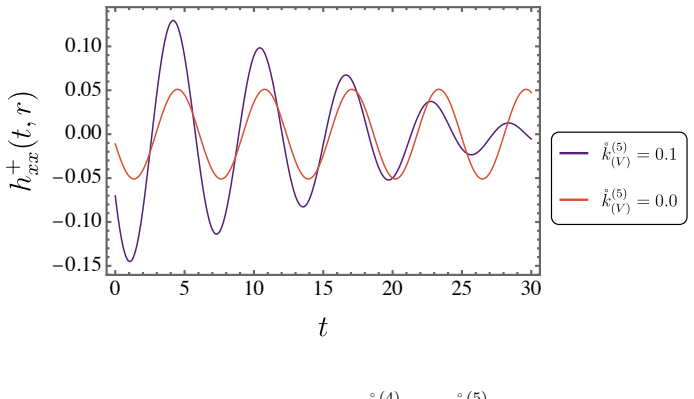
The combined effects of the CPT-even dimension-four coefficient and the CPT-odd dimension-five coefficient modify the gravitational wave dispersion relation, rescaling the propagation speed and adding helicity-dependent terms that cause birefringence and polarization mixing. This occurs without introducing additional propagating degrees of freedom. The retarded Green function associated with the modified wave operator is derived, and explicit expressions for the gravitational waveform from matter sources are obtained, including alterations to the strain from binary black hole systems via shifted retarded times, amplitude rescaling, and higher derivative corrections to the quadrupole formula.
What carries the argument
The modified wave operator that incorporates the isotropic contributions of the dimension-four and dimension-five Lorentz-violating coefficients and yields the retarded Green function for computing altered gravitational waveforms.
If this is right
- The gravitational waveform from binary black hole systems exhibits shifted retarded times, amplitude rescaling, and higher derivative corrections to the quadrupole formula.
- Helicity-dependent corrections produce birefringence and polarization mixing in the detected strain.
- Constraints from GW170817/GRB 170817A and GWTC-3 propagation tests translate into bounds on the specific isotropic coefficients using polarization consistency arguments.
- The tensorial gravitational radiation sector remains intact without additional propagating degrees of freedom.
Where Pith is reading between the lines
- These modifications provide a concrete way to test Lorentz invariance in the gravitational sector using the polarization content of future multi-messenger events.
- The absence of new modes means any detected effects would appear as corrections to the standard two tensor polarizations rather than as extra signals.
- The derived Green function offers a calculational tool that could be applied to other source types or combined with matter interactions in extended models.
Load-bearing premise
The analysis assumes that the effects are dominated by isotropic contributions from the CPT-even dimension-four and CPT-odd dimension-five operators and that observational constraints from gravitational wave events can be mapped directly onto bounds for these specific coefficients.
What would settle it
A high-precision measurement of arrival times and polarizations from a distant gravitational wave event that shows identical propagation speeds and no helicity-dependent differences for the two tensor modes would falsify significant effects from these operators.
Figures




read the original abstract
We investigate the propagation of gravitational waves in the presence of Lorentz- and diffeomorphism-violating operators within the linearized gravitational sector of the Standard Model Extension. Focusing on isotropic contributions, we analyze the combined effects of the CPT-even dimension-four coefficient $\mathring{k}^{(4)}_{(I)}$ and the CPT-odd dimension-five coefficient $\mathring{k}^{(5)}_{(V)}$ on tensorial gravitational radiation. The modified dispersion relation induces both a rescaling of the propagation speed and helicity-dependent corrections, leading to birefringence and polarization mixing without introducing additional propagating degrees of freedom. We derive the retarded Green function associated with the modified wave operator and obtain explicit expressions for the gravitational waveform generated by matter sources. As an application, we examine a binary black hole system and show how Lorentz violation alters the observed strain through shifted retarded times, amplitude rescaling, and higher derivative corrections to the quadrupole formula. Using GW170817/GRB 170817A, published GWTC-3 propagation tests, and conservative polarization consistency arguments, we translate existing observational constraints into bounds on $\mathring{k}^{(4)}_{(I)}$ and $\mathring{k}^{(5)}_{(V)}$.
Editorial analysis
A structured set of objections, weighed in public.
Referee Report
Summary. The manuscript investigates the propagation of gravitational waves under isotropic Lorentz- and diffeomorphism-violating operators in the linearized gravitational sector of the Standard Model Extension. It focuses on the combined effects of the CPT-even dimension-four coefficient k^(4)_(I) and the CPT-odd dimension-five coefficient k^(5)_(V), deriving a modified dispersion relation that rescales propagation speed and introduces helicity-dependent corrections. This leads to birefringence and polarization mixing without additional propagating degrees of freedom. The authors construct the associated retarded Green function, obtain explicit waveform expressions for matter sources, apply the framework to a binary black hole system, and translate existing constraints from GW170817/GRB 170817A and GWTC-3 into bounds on the coefficients.
Significance. If the central claims are verified, particularly the mode content and absence of instabilities, the work supplies explicit, usable expressions for Lorentz-violating corrections to gravitational waveforms and the retarded propagator. These can be directly compared with existing and future detector data, extending prior SME analyses by treating the isotropic combination of dimension-four and dimension-five operators in a unified propagation calculation.
major comments (1)
- [Section deriving the modified wave operator and dispersion relation] The central claim that the modified wave operator produces only the two tensor modes (with birefringence but no extra propagating degrees of freedom) is load-bearing for the Green-function construction and all subsequent waveform results. For the CPT-odd dimension-five term, which introduces a third-order derivative piece, the manuscript must supply an explicit characteristic analysis of the isotropic wave operator (including the combined k^(4)_(I) + k^(5)_(V) contribution) and demonstrate that the characteristic polynomial factors into exactly two physical roots while any additional root is either non-propagating or identically zero.
minor comments (2)
- [Green function derivation] Clarify the precise definition of the isotropic projections for both operators and confirm that all higher-order terms are retained consistently when constructing the retarded Green function.
- [Application to binary systems] In the binary-black-hole application, state explicitly which post-Newtonian order is used for the quadrupole formula before applying the Lorentz-violating corrections.
Simulated Author's Rebuttal
We thank the referee for the detailed and constructive report. The single major comment raises a valid point about the need for an explicit characteristic analysis to confirm the mode content. We address it below and will revise the manuscript to incorporate the requested analysis.
read point-by-point responses
-
Referee: [Section deriving the modified wave operator and dispersion relation] The central claim that the modified wave operator produces only the two tensor modes (with birefringence but no extra propagating degrees of freedom) is load-bearing for the Green-function construction and all subsequent waveform results. For the CPT-odd dimension-five term, which introduces a third-order derivative piece, the manuscript must supply an explicit characteristic analysis of the isotropic wave operator (including the combined k^(4)_(I) + k^(5)_(V) contribution) and demonstrate that the characteristic polynomial factors into exactly two physical roots while any additional root is either non-propagating or identically zero.
Authors: We agree that an explicit characteristic analysis strengthens the central claim and is necessary for rigor, particularly given the third-order term. In the revised manuscript we will add a dedicated subsection performing this analysis for the combined isotropic operator. We will derive the principal symbol of the wave operator in Fourier space, form the characteristic polynomial, and show that it factors into precisely two physical roots (corresponding to the right- and left-circularly polarized tensor modes with the modified dispersion relation). The additional root is identically zero, arising from the structure of the isotropic coefficients together with the transverse-traceless gauge constraints that eliminate scalar and vector modes. This confirms the absence of extra propagating degrees of freedom while preserving the birefringence and polarization-mixing effects already derived. The Green function and waveform expressions remain unchanged but will be cross-referenced to the new analysis. revision: yes
Circularity Check
Minor self-citation to SME framework; central derivation of modified dispersion, Green function, and waveform corrections remains independent
full rationale
The paper starts from the standard linearized SME wave operator for isotropic k^(4)_(I) and k^(5)_(V), derives the modified dispersion relation, constructs the retarded Green function, and obtains explicit quadrupole waveform corrections with shifted retarded times and amplitude rescaling. These steps are performed directly from the modified operator without reducing to a fitted parameter or self-referential definition. Bounds on the coefficients are obtained by reinterpreting published external constraints (GW170817/GRB 170817A and GWTC-3 propagation tests) under conservative polarization arguments rather than by fitting new data to the model. Any self-citation to prior SME literature is expected for the operator definitions but is not load-bearing for the propagation or Green-function results. No self-definitional, fitted-input, uniqueness-imported, or ansatz-smuggled circularity is exhibited by the paper's own equations.
Axiom & Free-Parameter Ledger
free parameters (2)
- k^(4)_(I)
- k^(5)_(V)
axioms (2)
- domain assumption Linearized gravitational sector of the Standard Model Extension with only isotropic contributions from the specified operators.
- domain assumption Existing GW170817 and GWTC-3 constraints can be mapped directly onto the chosen SME coefficients via polarization consistency arguments.
Lean theorems connected to this paper
-
IndisputableMonolith/Foundation/AlexanderDuality.leanalexander_duality_circle_linking unclear?
unclearRelation between the paper passage and the cited Recognition theorem.
The modified dispersion relation induces both a rescaling of the propagation speed and helicity-dependent corrections, leading to birefringence and polarization mixing without introducing additional propagating degrees of freedom. We derive the retarded Green function associated with the modified wave operator
-
IndisputableMonolith/Foundation/RealityFromDistinction.leanreality_from_one_distinction unclear?
unclearRelation between the paper passage and the cited Recognition theorem.
ω = (1−k^(4)_(I))|p| ± k^(5)_(V) ω²
What do these tags mean?
- matches
- The paper's claim is directly supported by a theorem in the formal canon.
- supports
- The theorem supports part of the paper's argument, but the paper may add assumptions or extra steps.
- extends
- The paper goes beyond the formal theorem; the theorem is a base layer rather than the whole result.
- uses
- The paper appears to rely on the theorem as machinery.
- contradicts
- The paper's claim conflicts with a theorem or certificate in the canon.
- unclear
- Pith found a possible connection, but the passage is too broad, indirect, or ambiguous to say the theorem truly supports the claim.
Reference graph
Works this paper leans on
-
[1]
Translation from LVK parameterized dispersion tests 22
-
[2]
Birefringent phase accumulation 23
-
[3]
Strain–based effects 24 VI. Conclusion26 VII. Acknowledgments27 VIII. Data Availability Statement28 References28 I. INTRODUCTION General Relativity has established itself as the prevailing geometric framework for gravitational interactions, having undergone extensive scrutiny across a wide range of physical regimes. Its predictions have been confronted wi...
-
[4]
Translation from LVK parameterized dispersion tests To connect ourd= 5 CPT–odd term with LVK propagation tests, we employ the standard parameterized modified dispersion relation adopted in the LVK “Tests of GR” framework [56], E2 =p 2c2 +A α pαcα,(53) where constraints onA α are obtained by combining multiple events across the LVK catalogs. Forα= 3, Eq. (...
-
[5]
Birefringent phase accumulation An independent and physically transparent constraint on˚k(5) (V) follows from the absence of large polarization rotation in observed GW signals. The helicity–dependent dispersion relation implies an accumulated relative phase ∆ϕ= (ω + −ω −)L≃2 ˚k(5) (V) ω2 L,(60) which induces mixing between the (+,×) polarization states du...
-
[6]
Strain–based effects The bounds above rely on catalog-level propagation analyses and on phase-accumulation ar- guments. One can also obtain complementarystrain-basedconsistency bounds by using the fact that LVK observations show that the measured strain is well described by GR templates, with no statistically significant evidence for additional growth or ...
work page 2025
-
[7]
I. P. L. was partially supported by the National Council for Scientific and Technological Development - CNPq, grant 312547/2023-4 and to acknowledge networking support by the COST Action BridgeQG (CA23130), the COST Action RQI (CA23115) and the COST Action FuSe (CA24101) supported by COST (European Cooperation in Science and Technology). 27 VIII. DATA AVA...
work page 2023
-
[8]
R. N. Manchester, “Pulsars and Gravity,”Int. J. Mod. Phys. D, vol. 24, no. 06, p. 1530018, 2015
work page 2015
-
[9]
C. M. Will, “Bounding the mass of the graviton using gravitational wave observations of inspiralling compact binaries,”Phys. Rev. D, vol. 57, pp. 2061–2068, 1998
work page 2061
-
[10]
Submillimeter tests of the gravitational inverse square law: a search for ’large’ extra dimensions,
C. D. Hoyle, U. Schmidt, B. R. Heckel, E. G. Adelberger, J. H. Gundlach, D. J. Kapner, and H. E. Swanson, “Submillimeter tests of the gravitational inverse square law: a search for ’large’ extra dimensions,”Phys. Rev. Lett., vol. 86, pp. 1418–1421, 2001
work page 2001
-
[11]
Cosmological Tests of Gravity,
B. Jain and J. Khoury, “Cosmological Tests of Gravity,”Annals Phys., vol. 325, pp. 1479–1516, 2010
work page 2010
-
[12]
Modified Gravity and Cosmology,
T. Clifton, P. G. Ferreira, A. Padilla, and C. Skordis, “Modified Gravity and Cosmology,”Phys. Rept., vol. 513, pp. 1–189, 2012
work page 2012
-
[13]
Cosmological Tests of Modified Gravity,
K. Koyama, “Cosmological Tests of Modified Gravity,”Rept. Prog. Phys., vol. 79, no. 4, p. 046902, 2016
work page 2016
-
[14]
Testing general relativity with pulsar timing,
I. H. Stairs, “Testing general relativity with pulsar timing,”Living Rev. Rel., vol. 6, p. 5, 2003
work page 2003
-
[15]
Testing Relativistic Gravity with Radio Pulsars,
N. Wex, “Testing Relativistic Gravity with Radio Pulsars,” 2 2014
work page 2014
-
[16]
Pulsars as probes of gravity and fundamental physics,
M. Kramer, “Pulsars as probes of gravity and fundamental physics,”Int. J. Mod. Phys. D, vol. 25, no. 14, p. 1630029, 2016
work page 2016
-
[17]
Testing General Relativity with Present and Future Astrophysical Observations,
E. Bertiet al., “Testing General Relativity with Present and Future Astrophysical Observations,” Class. Quant. Grav., vol. 32, p. 243001, 2015
work page 2015
-
[18]
Spontaneous Breaking of Lorentz Symmetry in String Theory,
V. A. Kostelecky and S. Samuel, “Spontaneous Breaking of Lorentz Symmetry in String Theory,” Phys. Rev. D, vol. 39, p. 683, 1989
work page 1989
-
[19]
V. A. Kostelecky and R. Potting, “CPT and strings,”Nucl. Phys. B, vol. 359, pp. 545–570, 1991
work page 1991
-
[20]
Nonstandard optics from quantum space-time,
R. Gambini and J. Pullin, “Nonstandard optics from quantum space-time,”Phys. Rev. D, vol. 59, p. 124021, 1999
work page 1999
-
[21]
Loop generated bounds on changes to the graviton dispersion relation,
C. P. Burgess, J. M. Cline, E. Filotas, J. Matias, and G. D. Moore, “Loop generated bounds on changes to the graviton dispersion relation,”JHEP, vol. 03, p. 043, 2002
work page 2002
-
[22]
CPT violation and the standard model,
D. Colladay and V. A. Kostelecky, “CPT violation and the standard model,”Phys. Rev. D, vol. 55, pp. 6760–6774, 1997
work page 1997
-
[23]
Gravity, Lorentz violation, and the standard model,
V. A. Kostelecky, “Gravity, Lorentz violation, and the standard model,”Phys. Rev. D, vol. 69, p. 105009, 2004. 28
work page 2004
-
[24]
Lorentz Symmetry Violations from Matter-Gravity Couplings with Lunar Laser Ranging,
A. Bourgoin, C. Le Poncin-Lafitte, A. Hees, S. Bouquillon, G. Francou, and M.-C. Angonin, “Lorentz Symmetry Violations from Matter-Gravity Couplings with Lunar Laser Ranging,”Phys. Rev. Lett., vol. 119, no. 20, p. 201102, 2017
work page 2017
-
[25]
J. B. R. Battat, J. F. Chandler, and C. W. Stubbs, “Testing for Lorentz Violation: Constraints on Standard-Model Extension Parameters via Lunar Laser Ranging,”Phys. Rev. Lett., vol. 99, p. 241103, 2007
work page 2007
-
[26]
Atom Interferometry tests of the isotropy of post-Newtonian gravity,
H. Muller, S.-w. Chiow, S. Herrmann, S. Chu, and K.-Y. Chung, “Atom Interferometry tests of the isotropy of post-Newtonian gravity,”Phys. Rev. Lett., vol. 100, p. 031101, 2008
work page 2008
-
[27]
Constraints on Lorentz violation from gravitational ˇCerenkov radiation,
V. A. Kosteleck´ y and J. D. Tasson, “Constraints on Lorentz violation from gravitational ˇCerenkov radiation,”Phys. Lett. B, vol. 749, pp. 551–559, 2015
work page 2015
-
[28]
Tests of local Lorentz invariance violation of gravity in the standard model extension with pulsars,
L. Shao, “Tests of local Lorentz invariance violation of gravity in the standard model extension with pulsars,”Phys. Rev. Lett., vol. 112, p. 111103, 2014
work page 2014
-
[29]
Lorentz-Violating Matter-Gravity Couplings in Small-Eccentricity Binary Pulsars,
L. Shao, “Lorentz-Violating Matter-Gravity Couplings in Small-Eccentricity Binary Pulsars,”Sym- metry, vol. 11, no. 9, p. 1098, 2019
work page 2019
-
[30]
New pulsar limit on local Lorentz invariance violation of gravity in the standard-model extension,
L. Shao, “New pulsar limit on local Lorentz invariance violation of gravity in the standard-model extension,”Phys. Rev. D, vol. 90, no. 12, p. 122009, 2014
work page 2014
-
[31]
L. Shao and Q. G. Bailey, “Testing the Gravitational Weak Equivalence Principle in the Standard- Model Extension with Binary Pulsars,”Phys. Rev. D, vol. 99, no. 8, p. 084017, 2019
work page 2019
-
[32]
Matter-Sector Lorentz Violation in Binary Pulsars,
R. J. Jennings, J. D. Tasson, and S. Yang, “Matter-Sector Lorentz Violation in Binary Pulsars,” Phys. Rev. D, vol. 92, no. 12, p. 125028, 2015
work page 2015
-
[33]
Testing velocity-dependent CPT-violating gravitational forces with radio pulsars,
L. Shao and Q. G. Bailey, “Testing velocity-dependent CPT-violating gravitational forces with radio pulsars,”Phys. Rev. D, vol. 98, no. 8, p. 084049, 2018
work page 2018
-
[34]
Testing Lorentz symmetry with planetary orbital dynamics,
A. Hees, Q. G. Bailey, C. Le Poncin-Lafitte, A. Bourgoin, A. Rivoldini, B. Lamine, F. Meynadier, C. Guerlin, and P. Wolf, “Testing Lorentz symmetry with planetary orbital dynamics,”Phys. Rev. D, vol. 92, no. 6, p. 064049, 2015
work page 2015
-
[35]
Superconducting-Gravimeter Tests of Local Lorentz Invariance,
N. A. Flowers, C. Goodge, and J. D. Tasson, “Superconducting-Gravimeter Tests of Local Lorentz Invariance,”Phys. Rev. Lett., vol. 119, no. 20, p. 201101, 2017
work page 2017
-
[36]
Matter-gravity couplings and Lorentz violation,
A. V. Kostelecky and J. D. Tasson, “Matter-gravity couplings and Lorentz violation,”Phys. Rev. D, vol. 83, p. 016013, 2011
work page 2011
-
[37]
Signals for Lorentz violation in post-Newtonian gravity,
Q. G. Bailey and V. A. Kostelecky, “Signals for Lorentz violation in post-Newtonian gravity,”Phys. Rev. D, vol. 74, p. 045001, 2006
work page 2006
-
[38]
Lorentz and Diffeomorphism Violations in Linearized Gravity,
V. A. Kosteleck´ y and M. Mewes, “Lorentz and Diffeomorphism Violations in Linearized Gravity,” Phys. Lett. B, vol. 779, pp. 136–142, 2018
work page 2018
-
[39]
Lorentz 29 violation in the linearized gravity,
A. F. Ferrari, M. Gomes, J. R. Nascimento, E. Passos, A. Y. Petrov, and A. J. da Silva, “Lorentz 29 violation in the linearized gravity,”Phys. Lett. B, vol. 652, pp. 174–180, 2007
work page 2007
-
[40]
Testing local Lorentz invariance with gravitational waves,
V. A. Kosteleck´ y and M. Mewes, “Testing local Lorentz invariance with gravitational waves,”Phys. Lett. B, vol. 757, pp. 510–514, 2016
work page 2016
-
[41]
S. Hou, X.-L. Fan, T. Zhu, and Z.-H. Zhu, “Nontensorial gravitational wave polarizations from the tensorial degrees of freedom: Linearized Lorentz-violating theory of gravity,”Phys. Rev. D, vol. 109, no. 8, p. 084011, 2024
work page 2024
-
[42]
Y. Dong, Z. Wang, and L. Shao, “New limits on the local Lorentz invariance violation of gravity in the standard model extension with pulsars,”Phys. Rev. D, vol. 109, no. 8, p. 084024, 2024
work page 2024
-
[43]
T. Zhu, W. Zhao, J.-M. Yan, Y.-Z. Wang, C. Gong, and A. Wang, “Constraints on parity and Lorentz violations in gravity from GWTC-3 through a parametrization of modified gravitational wave propagations,”Phys. Rev. D, vol. 110, no. 6, p. 064044, 2024
work page 2024
-
[44]
Signals for Lorentz violation in gravitational waves,
M. Mewes, “Signals for Lorentz violation in gravitational waves,”Phys. Rev. D, vol. 99, no. 10, p. 104062, 2019
work page 2019
-
[45]
L. Haegel, K. O’Neal-Ault, Q. G. Bailey, J. D. Tasson, M. Bloom, and L. Shao, “Search for anisotropic, birefringent spacetime-symmetry breaking in gravitational wave propagation from GWTC-3,”Phys. Rev. D, vol. 107, no. 6, p. 064031, 2023
work page 2023
-
[46]
K. O’Neal-Ault, Q. G. Bailey, T. Dumerchat, L. Haegel, and J. Tasson, “Analysis of Birefringence and Dispersion Effects from Spacetime-Symmetry Breaking in Gravitational Waves,”Universe, vol. 7, no. 10, p. 380, 2021
work page 2021
-
[47]
Q. G. Bailey, A. S. Gard, N. A. Nilsson, R. Xu, and L. Shao, “Classical radiation fields for scalar, electromagnetic, and gravitational waves with spacetime-symmetry breaking,”Annals Phys., vol. 461, p. 169582, 2024
work page 2024
-
[48]
N. A. Nilsson and C. L.-P. Lafitte, “Spacetime symmetry breaking effects in gravitational-wave generation at the first post-Newtonian order,”Phys. Rev. D, vol. 109, no. 2, p. 024035, 2024
work page 2024
-
[49]
Gravitational-wave generation in the presence of Lorentz invariance violation,
S. Aoulad Lafkih, M.-C. Angonin, C. Le Poncin-Lafitte, and N. A. Nilsson, “Gravitational-wave generation in the presence of Lorentz invariance violation,” 6 2025
work page 2025
-
[50]
T.-C. Li, T. Zhu, W. Zhao, and A. Wang, “Power spectra and circular polarization of primordial gravitational waves with parity and Lorentz violations,”JCAP, vol. 07, p. 005, 2024
work page 2024
-
[51]
Gravitational waves in a minimal gravitational SME,
A. A. Ara´ ujo Filho, N. Heidari, and I. P. Lobo, “Gravitational waves in a minimal gravitational SME,” 2 2026
work page 2026
-
[52]
Gravitational waves effects in a lorentz–violating scenario,
K. M. Amarilo, M. B. Ferreira Filho, A. A. Ara´ ujo Filho, and J. A. A. S. Reis, “Gravitational waves effects in a lorentz–violating scenario,”Physics Letters B, vol. 855, p. 138785, 2024
work page 2024
-
[53]
Q. Wang, J.-M. Yan, T. Zhu, and W. Zhao, “Modified gravitational wave propagations in linearized gravity with Lorentz and diffeomorphism violations and their gravitational wave constraints,”Phys. 30 Rev. D, vol. 111, no. 8, p. 084064, 2025
work page 2025
-
[54]
R. Abbottet al., “GWTC-3: Compact Binary Coalescences Observed by LIGO and Virgo during the Second Part of the Third Observing Run,”Phys. Rev. X, vol. 13, no. 4, p. 041039, 2023
work page 2023
-
[55]
Theory of gravitational waves,
A. Le Tiec and J. Novak, “Theory of gravitational waves,” inAn Overview of Gravitational Waves: Theory, Sources and Detection, pp. 1–41, World Scientific, 2017
work page 2017
-
[56]
Polarizations of gravitational waves in f (r) gravity,
D. Liang, Y. Gong, S. Hou, Y. Liu,et al., “Polarizations of gravitational waves in f (r) gravity,” Physical Review D, vol. 95, no. 10, p. 104034, 2017
work page 2017
-
[57]
Velocity memory effect for polarized gravi- tational waves,
P.-M. Zhang, C. Duval, G. Gibbons, and P. Horvathy, “Velocity memory effect for polarized gravi- tational waves,”Journal of Cosmology and Astroparticle Physics, vol. 2018, no. 05, p. 030, 2018
work page 2018
-
[58]
Polarizations of gravitational waves in horndeski theory,
S. Hou, Y. Gong, and Y. Liu, “Polarizations of gravitational waves in horndeski theory,”The European Physical Journal C, vol. 78, no. 5, p. 378, 2018
work page 2018
-
[59]
Signals for lorentz violation in gravitational waves,
M. Mewes, “Signals for lorentz violation in gravitational waves,”Physical Review D, vol. 99, no. 10, p. 104062, 2019
work page 2019
-
[60]
Polarizations of gravitational waves in the bumblebee gravity model,
D. Liang, R. Xu, X. Lu, and L. Shao, “Polarizations of gravitational waves in the bumblebee gravity model,”Physical Review D, vol. 106, no. 12, p. 124019, 2022
work page 2022
-
[61]
Tests of general relativity with gw150914,
B. P. e. a. L. S. C. Abbott and V. Collaboration), “Tests of general relativity with gw150914,”Phys. Rev. Lett., vol. 116, p. 221101, 2016
work page 2016
-
[62]
Gw170817: Observation of gravitational waves from a binary neutron star inspiral,
B. P. e. a. Abbott, “Gw170817: Observation of gravitational waves from a binary neutron star inspiral,”Phys. Rev. Lett., vol. 119, p. 161101, 2017
work page 2017
-
[63]
Tests of general relativity with binary black holes from the ligo–virgo catalog gwtc-3,
V. C. Abbott, R. et al. (LIGO Scientific Collaboration, “Tests of general relativity with binary black holes from the ligo–virgo catalog gwtc-3,”Phys. Rev. D, vol. 105, p. 042003, 2022
work page 2022
-
[64]
How does geometry affect quantum gases?,
A. A. Ara´ ujo Filho and J. A. A. S. Reis, “How does geometry affect quantum gases?,”International Journal of Modern Physics A, vol. 37, no. 11n12, p. 2250071, 2022
work page 2022
-
[65]
A. A. Ara´ ujo Filho,Thermal aspects of field theories. Amazon. com, 2022
work page 2022
-
[66]
Thermal analysis of photon-like particles in rainbow gravity,
J. Furtado, H. Hassanabadi, J. Reis,et al., “Thermal analysis of photon-like particles in rainbow gravity,”arXiv preprint arXiv:2305.08587, 2023
-
[67]
Thermodynamic properties of neutral dirac particles in the presence of an electromagnetic field,
R. Oliveiraet al., “Thermodynamic properties of neutral dirac particles in the presence of an electromagnetic field,”The European Physical Journal Plus, vol. 135, no. 1, pp. 1–10, 2020
work page 2020
-
[68]
Thermodynamics of massless particles in curved spacetime,
A. A. Ara´ ujo Filho, “Thermodynamics of massless particles in curved spacetime,”International Journal of Geometric Methods in Modern Physics, vol. 20, no. 13, p. 2350226, 2023. 31
work page 2023
discussion (0)
Sign in with ORCID, Apple, or X to comment. Anyone can read and Pith papers without signing in.