Physics-Informed Discovery of Yield Functions in Plasticity via Convex Neural Representations
Pith reviewed 2026-06-27 04:55 UTC · model grok-4.3
The pith
A convex neural network identifies anisotropic yield functions from displacement and reaction force data alone by embedding it in elastoplastic stress integration.
A machine-rendered reading of the paper's core claim, the machinery that carries it, and where it could break.
Core claim
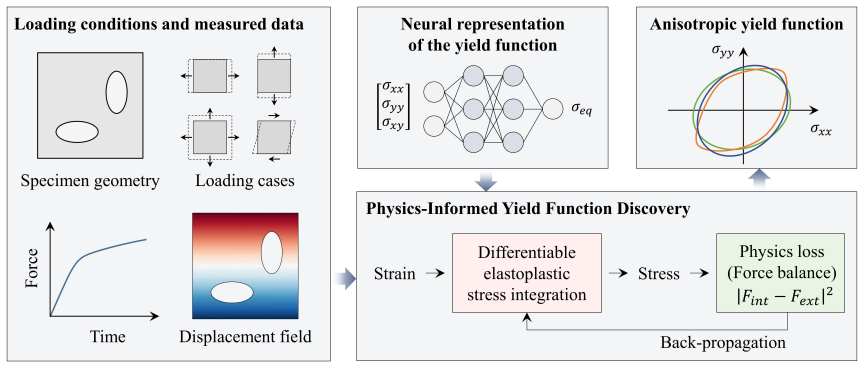
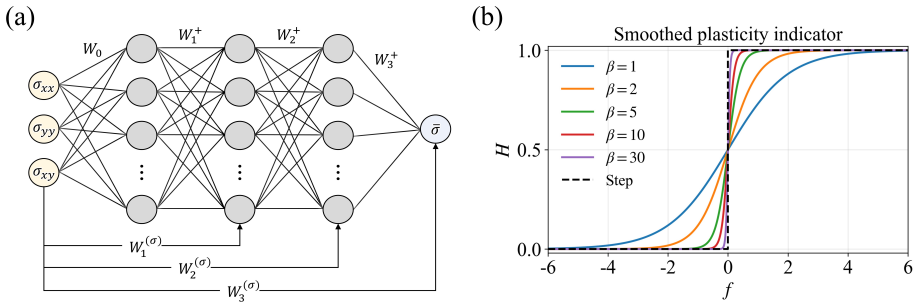
The framework identifies the yield function as a mechanically constrained constitutive component inside elastoplastic stress integration from full-field displacement and reaction force data without requiring stress observations, plastic strain measurements, direct yield surface data, or a prescribed parametric yield function. The yield function is represented by a convex neural network enforcing convexity and positive homogeneity of degree one while imposing the assumed tension-compression symmetry, and this neural yield function is trained with a differentiable stress update and a physics-informed force equilibrium loss across multiple loading cases.
What carries the argument
Convex neural network as the yield function inside a differentiable elastoplastic stress integration trained by force equilibrium loss
If this is right
- The recovered yield function produces accurate displacement predictions in elastoplastic finite-element simulations for the benchmark cases.
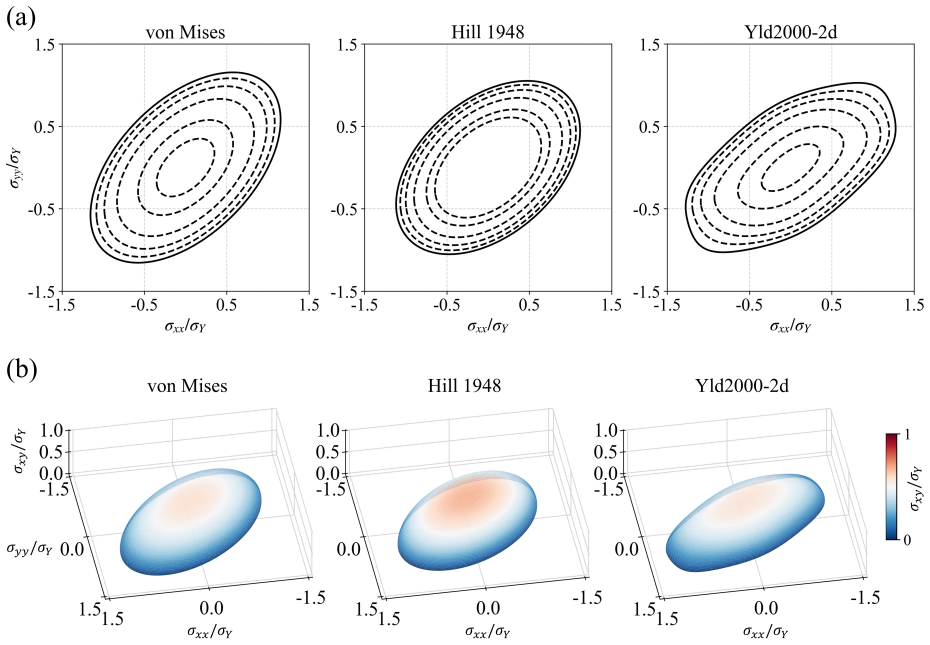
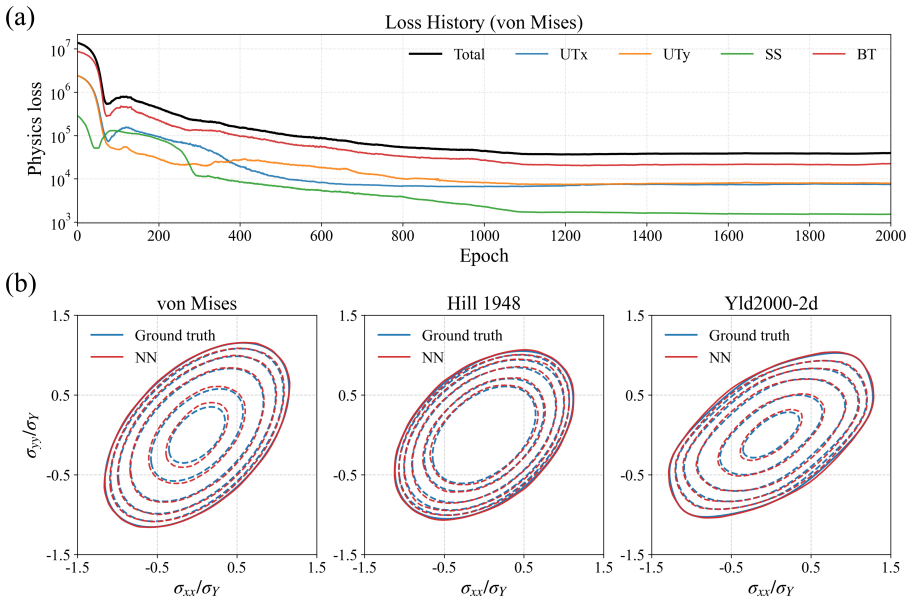
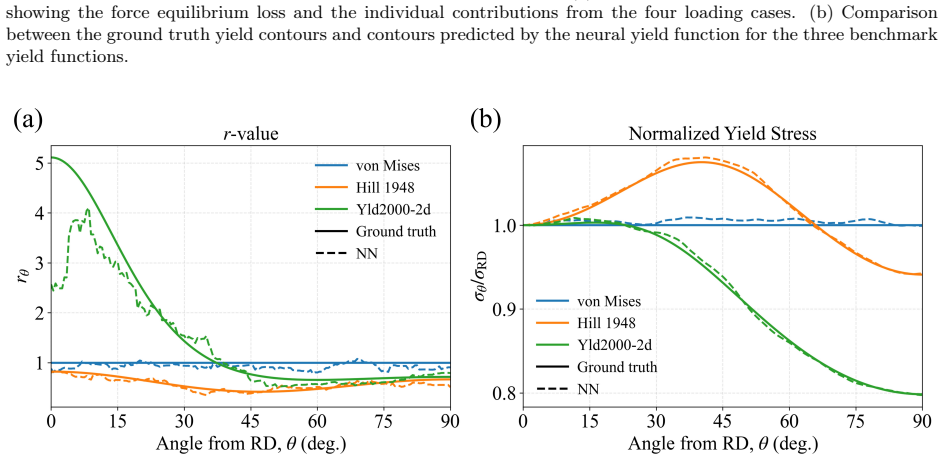
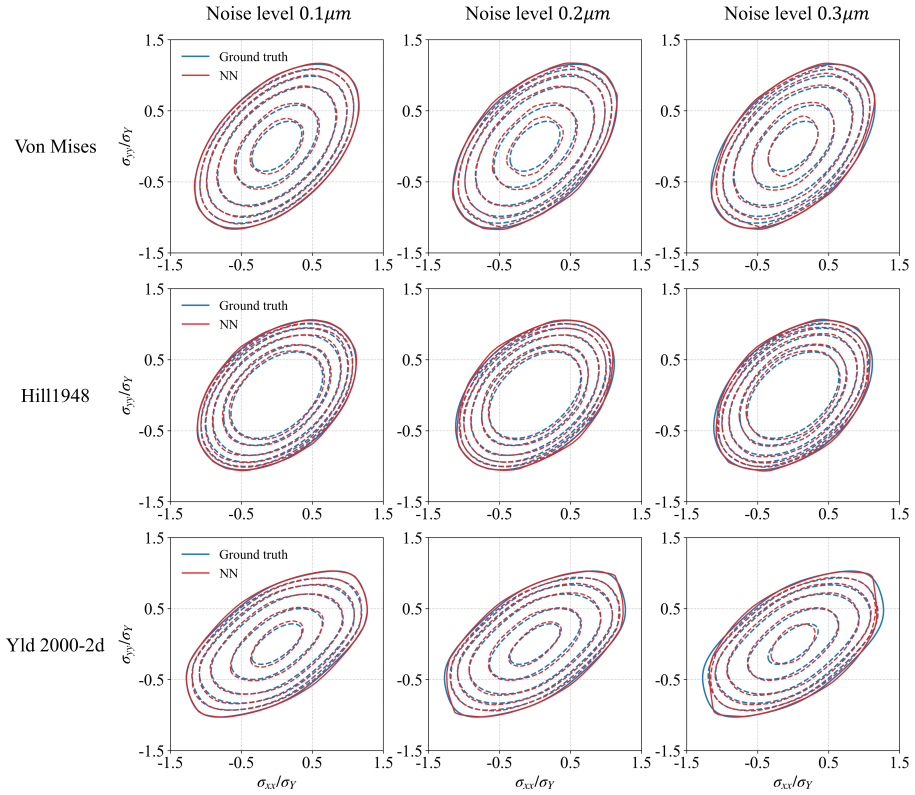
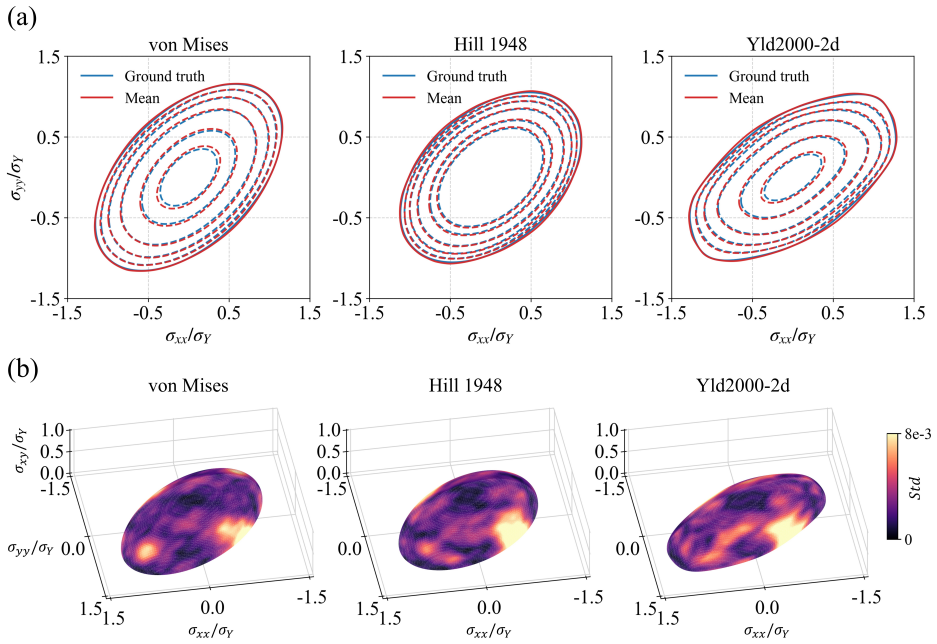
- The method recovers yield contours for von Mises, Hill 1948, and Yld2000-2d from noisy displacement data.
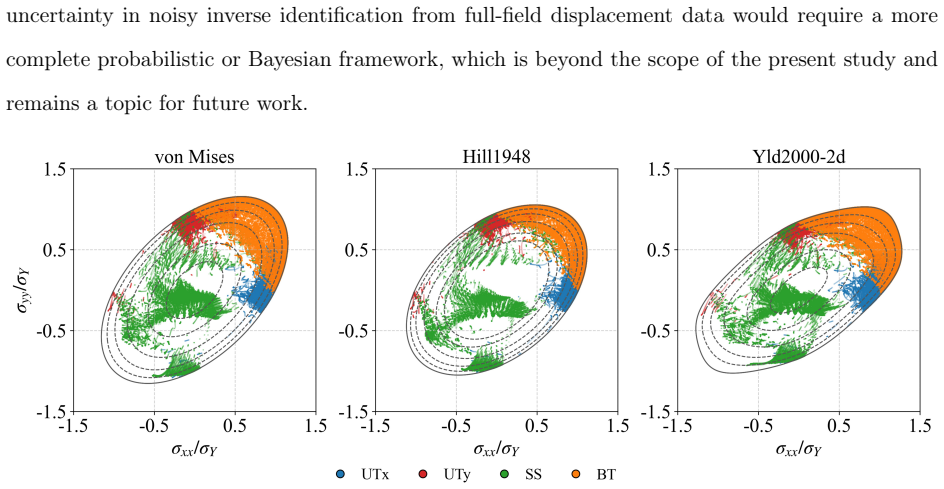
- Identification succeeds when the data provide access to plastically active stress states across multiple load cases.
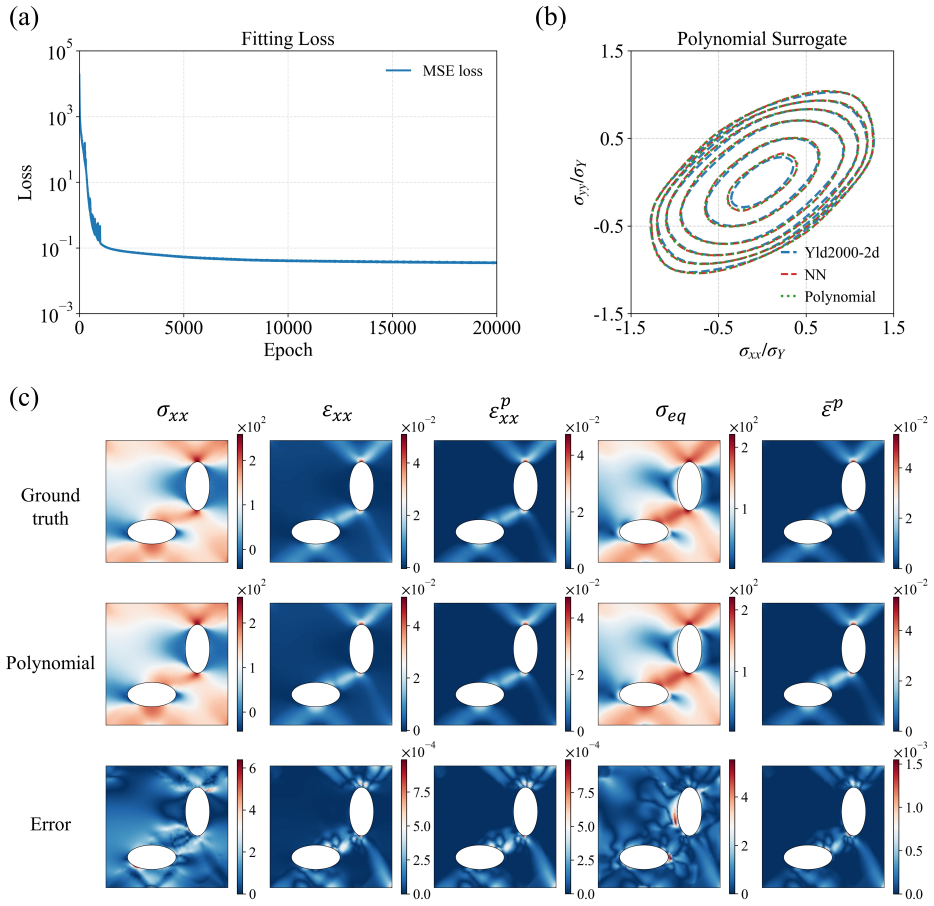
- The trained neural yield function can be replaced by a polynomial surrogate for deployment in standard simulations.
Where Pith is reading between the lines
- The same embedding strategy could be used to discover other rate-independent constitutive functions by replacing the yield network with a different mechanically constrained representation.
- Extension to three-dimensional stress states would require only additional load cases that activate out-of-plane plasticity.
- The approach supplies a route to update yield models in situ from imaging-based displacement fields during ongoing experiments.
- If the tension-compression symmetry assumption is relaxed, the framework could address materials with asymmetric yielding.
Load-bearing premise
Training the convex neural yield function with a differentiable stress update and physics-informed force equilibrium loss across multiple loading cases is sufficient to identify the true yield function from displacement data, assuming tension-compression symmetry and access to plastically active stress states.
What would settle it
Generate synthetic displacement and force data from a known analytic yield function such as von Mises or Hill 1948 in finite-element simulations, then check whether the trained neural yield contour matches the original surface within the plastically active stress states visited by the loads; mismatch falsifies the claim.
Figures
read the original abstract
Identifying anisotropic yield functions remains challenging since yielding is not directly observed in full-field mechanical measurements, directional calibration can require many loading directions, and selecting an appropriate analytical form is nontrivial. This study proposes a physics-informed framework for discovering yield functions from full-field displacement data and reaction force data, without stress observations, plastic strain measurements, direct yield surface data, or a prescribed parametric yield function. The framework identifies the yield function as a mechanically constrained constitutive component inside elastoplastic stress integration, rather than through direct stress-space supervision. The yield function is represented by a convex neural network that enforces convexity and positive homogeneity of degree one while imposing the assumed tension-compression symmetry, and this neural yield function is trained with a differentiable stress update and a physics-informed force equilibrium loss across multiple loading cases. The proposed framework is validated using finite element (FE) benchmark studies with von Mises, Hill 1948, and Yld2000-2d yield functions, assessing yield contour agreement, displacement-noise sensitivity, identifiability through plastically active stress states, epistemic uncertainty, and polynomial-surrogate deployment. This study provides a mechanics-constrained pathway for discovering anisotropic yield functions from displacement and force data while keeping the identified component within the structure of elastoplastic stress integration.
Editorial analysis
A structured set of objections, weighed in public.
Referee Report
Summary. The paper claims to introduce a physics-informed framework for discovering anisotropic yield functions from full-field displacement and reaction force data using convex neural networks. The yield function is embedded in a differentiable elastoplastic stress integration, trained via force equilibrium loss without needing stress observations or prescribed parametric forms. Validation is performed on finite element benchmarks with von Mises, Hill 1948, and Yld2000-2d yield functions, evaluating contour agreement, noise sensitivity, identifiability, uncertainty, and surrogate deployment.
Significance. If the central claim holds, this work offers a significant advancement in constitutive model discovery for plasticity by integrating mechanical constraints directly into the learning process. The use of convex neural representations enforcing positive homogeneity and tension-compression symmetry, combined with differentiable return mapping, allows identification from standard experimental data types. This could reduce reliance on analytical forms and direct yield surface measurements. The benchmark studies provide evidence of feasibility on synthetic data.
major comments (2)
- [Abstract] Abstract and identifiability assessment: the claim that the framework recovers the true yield function (rather than any convex function consistent with the data) rests on the physics-informed loss across multiple loading cases being sufficient for unique identification. The described validation via plastically active states does not include explicit tests such as recovery of a deliberately perturbed yield function or cross-validation on held-out loadings, leaving open the possibility of non-uniqueness in the loss landscape.
- [Validation studies] Validation studies (FE benchmarks): while yield contour agreement is reported for von Mises, Hill 1948, and Yld2000-2d cases, the manuscript does not quantify how the inferred stress states span the yield surface or demonstrate that the equilibrium residual loss is injective with respect to the neural parameters under the imposed symmetry and convexity constraints.
minor comments (1)
- [Abstract] The abstract refers to 'epistemic uncertainty' quantification but provides no detail on the method used (e.g., ensemble variance or Bayesian approximation) or how it is visualized in the results.
Simulated Author's Rebuttal
We thank the referee for the constructive comments on our manuscript. We address each major comment below and will incorporate revisions to strengthen the identifiability assessment and validation as described.
read point-by-point responses
-
Referee: [Abstract] Abstract and identifiability assessment: the claim that the framework recovers the true yield function (rather than any convex function consistent with the data) rests on the physics-informed loss across multiple loading cases being sufficient for unique identification. The described validation via plastically active states does not include explicit tests such as recovery of a deliberately perturbed yield function or cross-validation on held-out loadings, leaving open the possibility of non-uniqueness in the loss landscape.
Authors: We agree that the current validation relies on recovery across benchmarks with known yield functions and plastically active states but does not include the explicit uniqueness tests suggested. In the revised manuscript we will add cross-validation on held-out loading cases (withheld from training) and a perturbation test in which a deliberately modified yield function is used to generate data and recovery is attempted, to demonstrate that the physics-informed loss selects the true function under the convexity and symmetry constraints. revision: yes
-
Referee: [Validation studies] Validation studies (FE benchmarks): while yield contour agreement is reported for von Mises, Hill 1948, and Yld2000-2d cases, the manuscript does not quantify how the inferred stress states span the yield surface or demonstrate that the equilibrium residual loss is injective with respect to the neural parameters under the imposed symmetry and convexity constraints.
Authors: We will revise the validation section to include quantitative measures (e.g., histograms or coverage metrics) of how the inferred stress states from the training loadings populate the yield surface in principal stress space for each benchmark. We will also add a discussion of injectivity, showing that the combination of positive homogeneity, convexity, tension-compression symmetry, and the multi-case equilibrium loss constrains the neural parameters sufficiently to recover the target function in the reported benchmarks; if feasible we will include a simple numerical sensitivity check on parameter perturbations. revision: yes
Circularity Check
No significant circularity; derivation grounded in external force equilibrium data across independent loadings.
full rationale
The paper trains a convex neural representation of the yield function by minimizing a physics-informed loss that enforces force equilibrium on observed displacement and reaction force data from multiple loading cases, using a differentiable return-mapping procedure. This loss is computed from external benchmark FE data (von Mises, Hill 1948, Yld2000-2d) and is not equivalent to the network parameters by construction. No self-definitional steps appear (e.g., no quantity defined in terms of itself), no fitted inputs are relabeled as predictions, and no load-bearing self-citations or uniqueness theorems imported from prior author work are invoked in the provided text. The framework remains self-contained against the external data and benchmark validations, with identifiability assessed empirically via plastically active states rather than by definitional reduction.
Axiom & Free-Parameter Ledger
free parameters (1)
- neural network parameters
axioms (2)
- domain assumption The yield function must be convex and positively homogeneous of degree one
- domain assumption Tension-compression symmetry holds for the material
invented entities (1)
-
Convex neural network for yield function
no independent evidence
Reference graph
Works this paper leans on
-
[1]
J. C. Simo, T. J. R. Hughes, Computational Inelasticity, Springer, New York, 1998.doi: 10.1007/b98904
-
[2]
R. Hill, A theory of the yielding and plastic flow of anisotropic metals, Proceedings of the Royal Society of London. Series A. Mathematical and Physical Sciences 193 (1033) (1948) 281–297. doi:10.1098/rspa.1948.0045
-
[3]
F. Barlat, J. C. Brem, J. W. Yoon, K. Chung, R. E. Dick, D. J. Lege, F. Pourboghrat, S. H. Choi, E. Chu, Plane stress yield function for aluminum alloy sheets—part 1: Theory, International Journal of Plasticity 19 (9) (2003) 1297–1319.doi:10.1016/S0749-6419(02) 00019-0
-
[4]
T. Kirchdoerfer, M. Ortiz, Data-driven computational mechanics, Computer Methods in Ap- plied Mechanics and Engineering 304 (2016) 81–101.doi:10.1016/j.cma.2016.02.001
-
[5]
M. Raissi, P. Perdikaris, G. E. Karniadakis, Physics-informed neural networks: A deep learning framework for solving forward and inverse problems involving nonlinear partial differential equations, Journal of Computational Physics 378 (2019) 686–707.doi:10.1016/j.jcp.2018. 10.045
-
[6]
G. E. Karniadakis, I. G. Kevrekidis, L. Lu, P. Perdikaris, S. Wang, L. Yang, Physics- informed machine learning, Nature Reviews Physics 3 (2021) 422–440.doi:10.1038/ s42254-021-00314-5
2021
-
[7]
F. Masi, I. Stefanou, P. Vannucci, V. Maffi-Berthier, Thermodynamics-based artificial neural networks for constitutive modeling, Journal of the Mechanics and Physics of Solids 147 (2021) 104277.doi:10.1016/j.jmps.2020.104277
-
[8]
N. N. Vlassis, W. Sun, Sobolev training of thermodynamic-informed neural networks for in- terpretable elasto-plasticity models with level set hardening, Computer Methods in Applied Mechanics and Engineering 377 (2021) 113695.doi:10.1016/j.cma.2021.113695
-
[9]
K. A. Meyer, F. Ekre, Thermodynamically consistent neural network plasticity modeling and discovery of evolution laws, Journal of the Mechanics and Physics of Solids 180 (2023) 105416. doi:10.1016/j.jmps.2023.105416
-
[10]
J. N. Fuhg, C. M. Hamel, K. Johnson, R. Jones, N. Bouklas, Modular machine learning-based elastoplasticity: Generalization in the context of limited data, Computer Methods in Applied Mechanics and Engineering 407 (2023) 115930.doi:10.1016/j.cma.2023.115930
-
[11]
Y. Heider, K. Wang, W. Sun, SO(3)-invariance of informed-graph-based deep neural network for anisotropic elastoplastic materials, Computer Methods in Applied Mechanics and Engi- neering 363 (2020) 112875.doi:10.1016/j.cma.2020.112875
-
[12]
J. N. Fuhg, N. Bouklas, On physics-informed data-driven isotropic and anisotropic constitutive models through probabilistic machine learning and space-filling sampling, Computer Methods in Applied Mechanics and Engineering 394 (2022) 114915.doi:10.1016/j.cma.2022.114915
-
[13]
K. Linka, E. Kuhl, A new family of constitutive artificial neural networks towards automated model discovery, Computer Methods in Applied Mechanics and Engineering 403 (2023) 115731. doi:10.1016/j.cma.2022.115731
-
[14]
L. Linden, D. K. Klein, K. A. Kalina, J. Brummund, O. Weeger, M. Kästner, Neural networks meet hyperelasticity: A guide to enforcing physics, Journal of the Mechanics and Physics of Solids 179 (2023) 105363.doi:10.1016/j.jmps.2023.105363
-
[15]
J. N. Fuhg, R. E. Jones, N. Bouklas, Extreme sparsification of physics-augmented neural net- worksforinterpretablemodeldiscoveryinmechanics, ComputerMethodsinAppliedMechanics and Engineering 426 (2024) 116973.doi:10.1016/j.cma.2024.116973
-
[16]
M. Schmidt, H. Lipson, Distilling free-form natural laws from experimental data, Science 324 (5923) (2009) 81–85.doi:10.1126/science.1165893
-
[17]
S. L. Brunton, J. L. Proctor, J. N. Kutz, Discovering governing equations from data by sparse 37 identification of nonlinear dynamical systems, Proceedings of the National Academy of Sciences of the United States of America 113 (15) (2016) 3932–3937.doi:10.1073/pnas.1517384113
-
[18]
G. F. Bomarito, T. S. Townsend, K. M. Stewart, K. V. Esham, J. M. Emery, J. D. Hochhalter, Development of interpretable, data-driven plasticity models with symbolic regression, Com- puters & Structures 252 (2021) 106557.doi:10.1016/j.compstruc.2021.106557
-
[19]
E. Kabliman, A. H. Kolody, J. Kronsteiner, M. Kommenda, G. Kronberger, Application of symbolic regression for constitutive modeling of plastic deformation, Applications in Engineer- ing Science 6 (2021) 100052.doi:10.1016/j.apples.2021.100052
-
[20]
M. Flaschel, S. Kumar, L. De Lorenzis, Unsupervised discovery of interpretable hyperelas- tic constitutive laws, Computer Methods in Applied Mechanics and Engineering 381 (2021) 113852.doi:10.1016/j.cma.2021.113852
-
[21]
M. Flaschel, S. Kumar, L. De Lorenzis, Discovering plasticity models without stress data, npj Computational Materials 8 (2022) 91.doi:10.1038/s41524-022-00752-4
-
[22]
A. Joshi, P. Thakolkaran, Y. Zheng, M. Escande, M. Flaschel, L. De Lorenzis, S. Kumar, Bayesian-EUCLID: Discovering hyperelastic material laws with uncertainties, Computer Meth- ods in Applied Mechanics and Engineering 398 (2022) 115225.doi:10.1016/j.cma.2022. 115225
-
[23]
M. Flaschel, S. Kumar, L. De Lorenzis, Automated discovery of generalized standard material models with EUCLID, Computer Methods in Applied Mechanics and Engineering 405 (2023) 115867.doi:10.1016/j.cma.2022.115867
-
[24]
P. Thakolkaran, A. Joshi, Y. Zheng, M. Flaschel, L. De Lorenzis, S. Kumar, NN-EUCLID: Deep-learning hyperelasticity without stress data, Journal of the Mechanics and Physics of Solids 169 (2022) 105076.doi:10.1016/j.jmps.2022.105076
-
[25]
A. Nascimento, S. Roongta, M. Diehl, I. J. Beyerlein, A machine learning model to predict yield surfaces from crystal plasticity simulations, International Journal of Plasticity 161 (2023) 103507.doi:10.1016/j.ijplas.2022.103507
-
[26]
P. Fazily, J. W. Yoon, Machine learning-driven stress integration method for anisotropic plasticity in sheet metal forming, International Journal of Plasticity 166 (2023) 103642. doi:10.1016/j.ijplas.2023.103642
-
[27]
J. N. Fuhg, A. Fau, N. Bouklas, M. Marino, Enhancing phenomenological yield functions with data: Challenges and opportunities, European Journal of Mechanics - A/Solids 99 (2023) 104925.doi:10.1016/j.euromechsol.2023.104925
-
[28]
M. A. Sutton, J.-J. Orteu, H. Schreier, Image Correlation for Shape, Motion and Deformation Measurements: Basic Concepts, Theory and Applications, Springer, New York, 2009.doi: 10.1007/978-0-387-78747-3
-
[29]
S. Avril, M. Bonnet, A.-S. Bretelle, M. Grédiac, F. Hild, P. Ienny, F. Latourte, D. Lemosse, S. Pagano, E. Pagnacco, F. Pierron, Overview of identification methods of mechanical pa- rameters based on full-field measurements, Experimental Mechanics 48 (4) (2008) 381–402. doi:10.1007/s11340-008-9148-y
-
[30]
S.Soare, J.W.Yoon, O.Cazacu, Ontheuseofhomogeneouspolynomialstodevelopanisotropic yield functions with applications to sheet forming, International Journal of Plasticity 24 (6) (2008) 915–944.doi:10.1016/j.ijplas.2007.07.016
-
[31]
S. Soare, F. Barlat, Convex polynomial yield functions, Journal of the Mechanics and Physics of Solids 58 (11) (2010) 1804–1818.doi:10.1016/j.jmps.2010.08.005
-
[32]
H. Xu, M. Flaschel, L. De Lorenzis, Discovering non-associated pressure-sensitive plasticity models with EUCLID, Advanced Modeling and Simulation in Engineering Sciences 12 (1) (2025) 1.doi:10.1186/s40323-024-00281-3
-
[33]
R. Lourenço, P. Georgieva, E. Cueto, A. Andrade-Campos, An indirect training approach for implicit constitutive modelling using recurrent neural networks and the virtual fields method, Computer Methods in Applied Mechanics and Engineering 425 (2024) 116961.doi:10.1016/ 38 j.cma.2024.116961
arXiv 2024
-
[34]
X. Wu, Y. Zhang, S. Mao, Learning the physics-consistent material behavior from measur- able data via PDE-constrained optimization, Computer Methods in Applied Mechanics and Engineering 437 (2025) 117748.doi:10.1016/j.cma.2025.117748
-
[35]
C. H. Tung, J. Li, The anti-dogbone: Evaluating and designing optimal tensile specimens for deep learning of constitutive relations, Extreme Mechanics Letters 69 (2024) 102157.doi: 10.1016/j.eml.2024.102157
-
[36]
T. B. Stoughton, J. W. Yoon, Review of Drucker’s postulate and the issue of plastic stability in metal forming, International Journal of Plasticity 22 (3) (2006) 391–433.doi:10.1016/j. ijplas.2005.03.002
work page doi:10.1016/j 2006
-
[37]
R. Hill, The Mathematical Theory of Plasticity, Clarendon Press, Oxford, 1950, oxford Aca- demic DOI corresponds to the later Oxford University Press edition.doi:10.1093/oso/ 9780198503675.001.0001
-
[38]
R. Hill, A general theory of uniqueness and stability in elastic-plastic solids, Journal of the Mechanics and Physics of Solids 6 (3) (1958) 236–249.doi:10.1016/0022-5096(58)90029-2
-
[39]
A. Franchi, F. Genna, F. Paterlini, Research note on the quasi-convexity of the yield function and its relationship to Drucker’s postulate, International Journal of Plasticity 6 (3) (1990) 369–375.doi:10.1016/0749-6419(90)90011-9
-
[40]
D. Bigoni, A. Piccolroaz, Yield criteria for quasibrittle and frictional materials, International Journal of Solids and Structures 41 (11–12) (2004) 2855–2878.doi:10.1016/j.ijsolstr. 2003.12.024
-
[41]
A. Piccolroaz, D. Bigoni, Yield criteria for quasibrittle and frictional materials: A generaliza- tion to surfaces with corners, International Journal of Solids and Structures 46 (20) (2009) 3587–3596.doi:10.1016/j.ijsolstr.2009.06.006
-
[42]
Lubliner, Plasticity Theory, Macmillan, New York, 1990
J. Lubliner, Plasticity Theory, Macmillan, New York, 1990
1990
-
[43]
B. Amos, L. Xu, J. Z. Kolter, Input convex neural networks, in: Proceedings of the 34th International Conference on Machine Learning, Vol. 70 of Proceedings of Machine Learning Research, PMLR, 2017, pp. 146–155.arXiv:1609.07152,doi:10.48550/arXiv.1609.07152
work page internal anchor Pith review Pith/arXiv arXiv doi:10.48550/arxiv.1609.07152 2017
-
[44]
R. S. Hansen, D. W. Waldram, T. Q. Thai, R. B. Berke, Super resolution digital image cor- relation (SR-DIC): an alternative to image stitching at high magnifications, Experimental Mechanics 61 (9) (2021) 1351–1368.doi:10.1007/s11340-021-00729-2
-
[45]
T. Siebert, E. Hack, G. Lampeas, K. Splitthof, E. A. Patterson, Uncertainty quantification for DIC displacement measurements in industrial environments, Experimental Techniques 45 (5) (2021) 685–694.doi:10.1007/s40799-021-00447-3. 39
discussion (0)
Sign in with ORCID, Apple, or X to comment. Anyone can read and Pith papers without signing in.