REVIEW 4 major objections 6 minor 1 cited by
Holographic striped superconductor with ionic lattice
T0 review · 4 major / 6 minor · reviewed 2026-08-12 · deepseek-v4-flash
Pith's one-line read Adding an ionic lattice to a holographic striped superconductor makes the striped superconducting phase, in which charge-density-wave and superconducting orders coexist, the most stable of the three competing phases.
desk verdict Solid numerical study of striped superconductors on ionic lattices, with a real new phase-diagram trend, but the abstract's global 'lowest free energy' claim rests on a single parameter point. read the letter →
The pith
A machine-rendered reading of the paper's core claim, the machinery that carries it, and where it could break.
The reading
What carries the argument
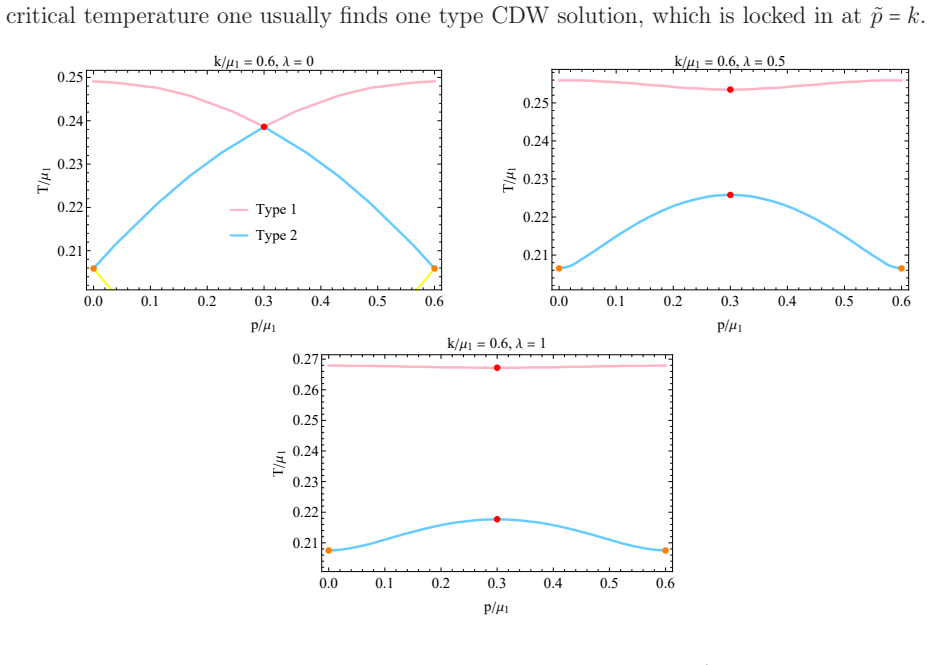
The load-bearing object is the four-dimensional bulk action with two gauge fields and two scalar order parameters. The dilaton $\Phi$ (with source turned off) acts as the CDW order parameter, while the complex scalar $\Psi$ (written as $\eta e^{i\theta}$ with $\theta=0$) acts as the SC order parameter; a non-zero $\eta$ breaks U(1) spontaneously. The ionic lattice is implanted through the boundary condition $\mu_2(x)=\mu_2+\mu_1\lambda\cos(kx)$ on the second gauge field, so the background is periodic in $x$ and translation symmetry is explicitly broken. The numerical construction uses the Einstein-DeTurck method to solve the fully back-reacted Einstein equations, and the free energy is extracted through holographic renormalization of the boundary stress tensor. The commensurate-state ansatz, in which CDW wave-vectors are restricted to rational multiples $\tilde{p}/k$ of the lattice wave-vector, is what allows the lock-in of Type I ($\tilde{p}/k=1$) and Type II ($\tilde{p}/k=1/2$) solutions to be exhibited.
What would settle it
Solve the fully back-reacted equations while allowing the CDW and PDW wave-vectors $\tilde{p}$ to take incommensurate values (for instance $\tilde{p}/k=2/3$ or an irrational ratio) and compare the average free energy with the SSC solution at the same $X$, $T$, $\lambda$, and $k$; if any incommensurate solution has lower free energy, the claimed ground-state selection and phase diagram would change. A direct check of the reported free-energy ordering at a parameter point outside the one shown (for example $X<X_c$ or $\lambda=2$) would also test the claim's generality.
Extended reading notes
Core claim
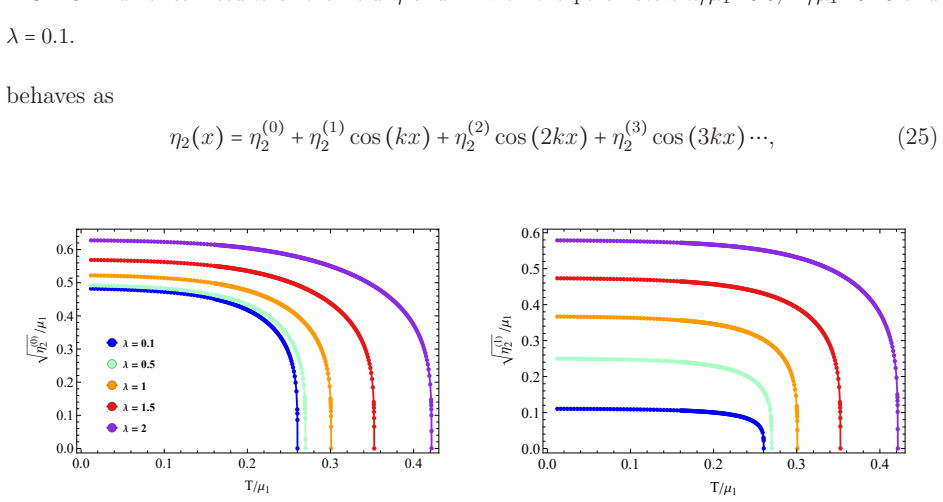
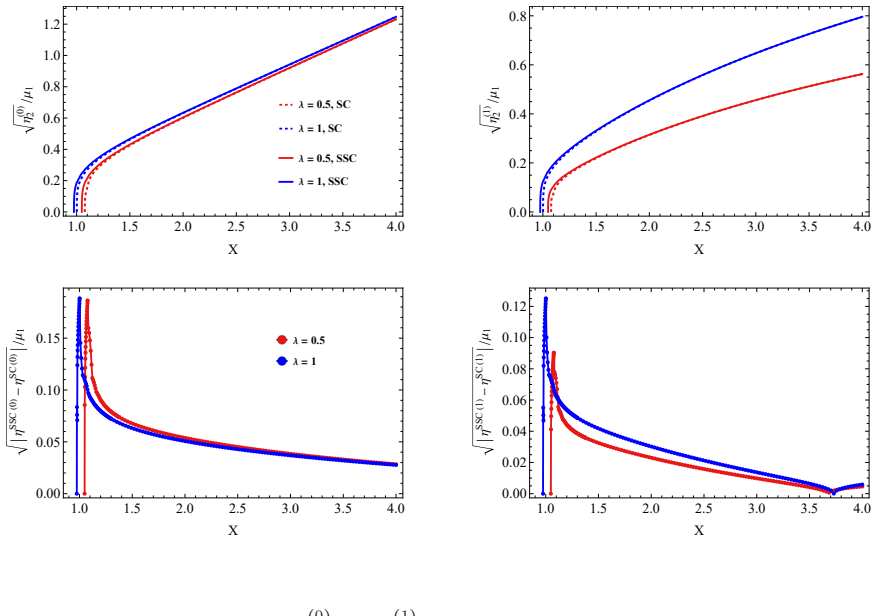
The paper's central claim is that in a holographic striped superconductor with an ionic lattice, the striped superconducting phase is the true ground state among the competing phases. The claim is established by computing the average free energy of fully back-reacted numerical backgrounds for the pure ionic lattice, the CDW phase, the SC phase, and the SSC phase, and verifying that the SSC free energy is lowest. The mechanism behind the phase structure is the separate treatment of the two orders: the dilaton field $\Phi$ is the order parameter for translational symmetry breaking (CDW), and the complex scalar $\Psi$ (with $\eta$ its magnitude) is the order parameter for U(1) symmetry breaking (SC). The ionic lattice, introduced as a spatially modulated chemical potential $\mu_2(x)=\mu_2+\mu_1\lambda\cos(kx)$, shifts the phase diagram: stronger lattice amplitude suppresses CDW and promotes SC, and locks CDW solutions into commensurate states at $\tilde{p}/k=1$ and $\tilde{p}/k=1/2$. The paper further identifies the pair-density-wave component of the SSC phase by subtracting the SC-phase condensate from the SSC condensate, $\eta^{\mathrm{PDW}}_2=|\eta^{\mathrm{SSC}}_2-\eta^{\mathrm{SC}}_2|$, and finds that this PDW component is enhanced by the lattice and peaks at an optimal doping.
Load-bearing premise
The load-bearing assumption is that restricting all CDW and PDW states to commensurate wave-vectors, with $\tilde{p}/k$ equal to $1$ or $1/2$, does not miss a lower-free-energy incommensurate solution; the paper never solves for such states, so the stability of the SSC phase is only verified within this commensurate ansatz.
Editorial extensions
If this is right
- If the SSC phase is indeed the lowest-free-energy state, then at low temperature and fixed doping the system will pass through either CDW then SSC (for small doping) or SC then SSC (for large doping) as temperature drops.
- For fixed doping and temperature, increasing the ionic lattice amplitude should make SC order easier to form (higher $T_c$) and CDW harder (lower $T_c$), so the lattice can be used as a control knob to favor superconductivity.
- The CDW order locks into commensurate states at $\tilde{p}/k=1$ (Type I) and $\tilde{p}/k=1/2$ (Type II), with Type I always thermodynamically preferred in the parameter range studied.
- The PDW component, defined by the difference between SSC and SC condensates, increases with lattice amplitude and exhibits a maximum at an optimal doping, so a finite lattice potential is a suitable environment for studying pair density waves.
- The phase diagram, with SC and CDW competing and SSC emerging where both orders coexist, reproduces qualitative features seen in doped Kagome superconductors and related materials.
Reading between the lines
- A natural next step is to relax the commensurate ansatz and solve for incommensurate CDW and PDW states; the paper's own commensurate restriction leaves open the possibility that an incommensurate state could out-compete the SSC phase in some regions of the phase diagram.
- If the lattice-amplitude trends persist to other values of the lattice wave-vector $k/\mu_1$, the model predicts a generic mechanism: explicit periodic potentials favor pairing over charge ordering, which could be tested in cold-atom or photonic analogues of holographic superconductors.
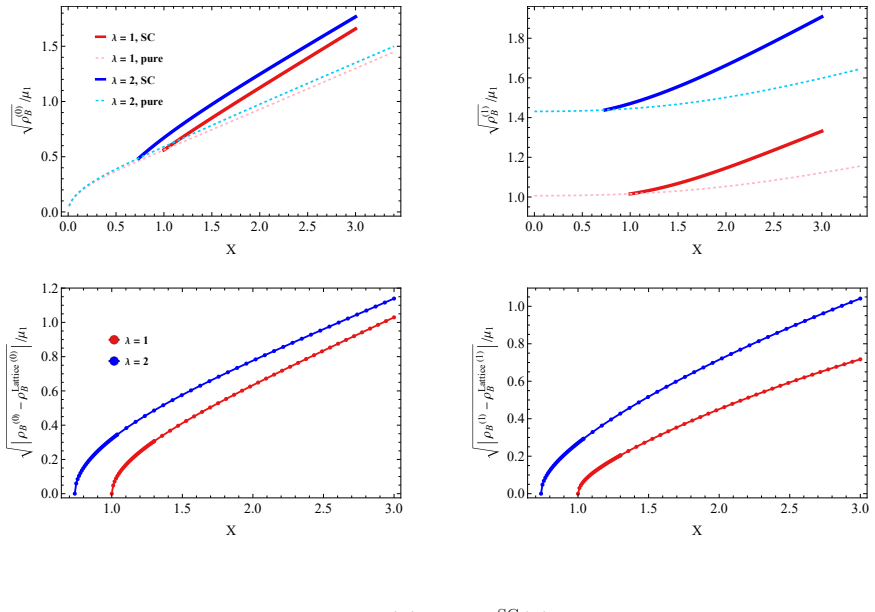
- The near-1000-fold larger charge-density response in the SC phase compared with the CDW phase suggests that the lattice-induced enhancement of superconductivity has a strong, directly measurable boundary signature in the charge distribution.
- One could extend the model to compute optical conductivity in the SSC phase; the paper lists this as future work, and a finite DC conductivity from the ionic lattice would make contact with transport measurements.
Editorial analysis
A structured set of objections, weighed in public.
Referee Report
Summary. This paper extends a holographic model of a striped superconductor with separate CDW and SC order parameters by introducing an ionic lattice through a spatially modulated chemical potential. Using perturbative stability analyses and full backreacted numerical solutions, the authors map out CDW, SC, and striped superconducting (SSC) regions in the doping-temperature plane, find commensurate lock-in of CDW modes, and report that the lattice amplitude lowers the CDW critical temperature and raises the SC critical temperature. The paper claims that the SSC phase has the lowest free energy among the three phases. The numerical method is pseudo-spectral collocation with the Einstein-DeTurck trick, and the reported residual is small.
Significance. If the thermodynamic claim is properly established, the paper would provide a useful holographic realization of commensurate lock-in in a model with competing CDW and SC orders, with phase diagrams that qualitatively resemble materials such as kagome superconductors. The model cleanly separates translation symmetry breaking from U(1) breaking, and the definitions of PDW order parameters in the presence of the lattice are sensible extensions of the authors' earlier work. The numerics are standard and the residual checks are reported. However, the central stability claim currently rests on a single free-energy evaluation and on a restricted commensurate ansatz; the significance hinges on completing that comparison.
major comments (4)
- [Sec. V.F, Fig. 24] The claim that the SSC phase has the lowest free energy among the three phases is supported by a single computation at X=1.6, λ=1, in the region X>Xc. The text states 'Without loss of generality' but no argument is given that this point is representative. The phase diagrams in Fig. 18 cover X∈[0,3] with λ=0, 0.5, 1, 2, and the critical doping Xc moves from ~1.55 to ~1.06 as λ increases. Near Xc the free-energy differences between phases are expected to be small, and the ordering could change. The abstract's 'it is verified that the SSC phase has the lowest free energy' is therefore an overstatement. The authors should compute the free-energy ordering for multiple values of (X,λ), including X below Xc and near Xc, or provide a quantitative argument for why one representative point suffices.
- [Sec. V.F, Eqs. (14)-(15)] The free-energy formula F = m − μ1 QA − μ2 QB − T S with QB = μ2 (kc/2π)∫ρB(x)dx uses the constant part μ2 of the boundary source. However, the boundary chemical potential is μ2(x) = μ2 + μ1λ cos(kx). For a spatially varying source, the grand-canonical potential should involve the local combination ∫ μ2(x)ρB(x)dx, not μ2 times the total charge. The term ∫ μ1λ cos(kx)ρB(x)dx is omitted, and this term generally differs between the SC, CDW, and SSC phases. As written, the free-energy comparison in Fig. 24 may not be the correct thermodynamic potential for the latticed system. The authors should derive the free energy from the on-shell Euclidean action with the inhomogeneous source, or justify why the oscillating part of the chemical potential should be excluded from the Legendre transform.
- [Secs. III.B, IV.A, V.A] All fully backreacted solutions are restricted to commensurate states: the CDW sector is solved only for p~/k = 1 and 1/2, and the SC sector is solved only for p~/k = 1 (Sec. IV.A). Incommensurate CDW and striped superconducting states are never constructed or compared. Consequently, the phase diagram and the free-energy ordering are established only within this commensurate ansatz. If an incommensurate state had lower free energy, the claimed phase diagram and the stability of the SSC phase would change. The authors should either extend the numerical analysis to incommensurate wavevectors or explicitly present the results as applying to the commensurate sector and remove 'phase diagram' claims to that level.
- [Sec. V.A, Fig. 18] The boundaries of the SSC region in Fig. 18 appear to be obtained from the perturbative instabilities of the individual CDW and SC sectors rather than from a direct computation of the phase boundaries by free-energy comparison. The SSC phase is identified as the overlap of the CDW and SC instability regions, with the boundary between CDW and SSC (or SC and SSC) being the onset of the second order parameter in the presence of the first. Such boundaries are not necessarily thermodynamic transition lines. The single-point free-energy check in Sec. V.F is therefore essential, and the previous comments show that it is incomplete. The paper should clarify how each boundary in Fig. 18 is obtained and state explicitly that the phase diagram is based on linear instabilities.
minor comments (6)
- [Sec. II, after Eq. (2)] The sentence 'The equations of motion can be derived directly as follows' is duplicated; one occurrence should be removed.
- [Fig. 3 caption] The phrase 'the commensurate rate k/p~ = 1' should read 'p~/k = 1' for consistency with Sec. III.B.
- [Eq. (15)] The entropy S is written as S = kc ∫ sqrt(Qxx Qyy) dx without specifying that the integrand is evaluated on the horizon z=1; this should be stated explicitly.
- [Eq. (6) and Eqs. (14)-(15)] The symbol μ2 is used both for the constant part of the chemical potential and for the full function μ2(x)=μ2+μ1λ cos(kx). A separate symbol (for example, μ̄2 for the average) would remove ambiguity, especially in the free-energy definitions.
- [Fig. 24] The legend refers to 'RN black hole' while the text and other figure captions refer to the pure ionic background; the naming should be unified.
- [Reference [44]] Reference [44] is cited as 'to appear in JHEP' with an arXiv number; published details should be provided if they are now available.
Circularity Check
No significant circularity: the phase diagram and free-energy ordering are numerical outputs of the stated equations of motion, not fitted inputs or self-referential definitions.
full rationale
The paper's central results are obtained by solving the bulk equations of motion (Sec. II) numerically: critical temperatures come from linear perturbation analysis (Secs. III.A and IV.A), and free energies are evaluated from the holographically renormalized boundary data via Eq. (14). No parameter is fitted to the target phase diagram or to the free-energy ordering, and the SSC stability claim rests on a direct comparison of computed free energies in Fig. 24. The frequent citations to the authors' earlier works [22], [40], and [44] supply the model, the two-gauge formalism, and the commensurate-lock-in methodology; these are building blocks, not the result being claimed, and the present numerical values are new. The PDW diagnostic ηPDW_2 = |ηSSC_2 - ηSC_2| (Sec. V.B) is a subtraction designed to remove the lattice-induced condensate already present in the SC phase; it is a measurement convention, not a prediction that reduces to its own definition. Two limitations should be flagged but are not circularity: Sec. V.F states "Without loss of generality, we compute the free energy for the case of X > Xc with λ=1," so the abstract's global lowest-free-energy claim is supported at only a single parameter point, and Secs. III.B and IV.A restrict all solutions to commensurate states (p̃/k = 1 and 1/2), leaving incommensurate competitors unexamined. These are scope and evidence concerns, not cases where an output is equivalent to an input by construction. I therefore find no significant circularity.
Assumptions & free parameters
free parameters (4)
- beta (dilaton-gauge coupling) =
-129
- e (charge of complex scalar) =
4
- scalar masses m_s^2 = m_v^2 =
-8
- lattice wavenumber k/mu1 =
0.6 or 2.0
assumptions (5)
- domain assumption AdS/CFT (gauge/gravity) duality maps the boundary strongly-coupled superconducting system to a weakly-coupled bulk gravitational theory.
- domain assumption The model with two U(1) gauge fields, a dilaton and a complex scalar (action (1)) is sufficient to describe independent CDW and SC order parameters.
- domain assumption The ionic lattice is implemented only as a spatially modulated chemical potential for the B gauge field at the boundary (Eq. 6), with no other lattice effects.
- domain assumption The Einstein-DeTurck method with the chosen ansatz (4) finds the relevant static black hole solutions in this ansatz class.
- ad hoc to paper Perturbative critical temperatures remain valid for the phase diagram even when computed only for commensurate momentum modes.
Cite this review
Pith. "Pith review of Holographic striped superconductor with ionic lattice." pith.science (2026). https://pith.science/paper/PSRIT7CH
@misc{pith2026241110181,
  author       = {Pith},
  title        = {Pith review of: Holographic striped superconductor with ionic lattice},
  year         = {2026},
  howpublished = {\url{https://pith.science/paper/PSRIT7CH}},
  note         = {Machine review of arXiv:2411.10181}
}
read the original abstract
We construct a holographic model to study the striped superconductor on ionic lattices. This model features a phase diagram with three distinct phases, namely the charge density wave (CDW) phase, ordinary superconducting phase (SC) and the striped superconducting phase (SSC). The effect of the ionic lattices on the phase diagram is investigated in detail. First, due to the periodic nature of the background, different types of CDW solutions can be found below the critical temperature. Furthermore, with the increase of the lattice amplitude these solutions are locked in different commensurate states. Second, we find that the critical temperature of CDW phase decreases with the increase of the lattice amplitude, while that of the SC phase increases. Additionally, the background solutions are obtained for different phases, and it is verified that the SSC phase has the lowest free energy among all three phases.
Figures


Figures from the paper (21 more)








Forward citations
Cited by 1 Pith paper
-
Disordered Charged Horizons
Fully backreacted disordered charged black branes show disorder survives in the infrared of AdS4, producing residual resistivity, but decays in AdS3, indicating a Harris-criterion violation in strongly coupled systems.
Reference graph
Works this paper leans on
-
[22]
Enhancement of Critical Temperature of a Striped Holographic Superconductor
S. Ganguli, J. A. Hutasoit, and G. Siopsis,Enhancement of Critical Temperature of a Striped Holographic Superconductor, Phys. Rev. D 86 (2012) 125005, [arXiv:1205.3107]
work page Pith review arXiv 2012
-
[44]
G. T. Horowitz, J. E. Santos, and D. Tong,Further Evidence for Lattice-Induced Scaling, JHEP 11 (2012) 102, [arXiv:1209.1098]
arXiv 2012
-
[1]
Two types of CDW solutions 12
-
[2]
The dilaton fieldϕ 14
-
[3]
The Superconducting Phase with ionic lattice 20 A
The charge densityρB 16 IV. The Superconducting Phase with ionic lattice 20 A. Perturbation analysis 20 B. Numerical analysis with full back-reaction 21
-
[4]
The behavior of the condensationη 21
-
[5]
The Striped Superconducting Phase with ionic lattice 25 A
The behavior of the charge densityρB 23 V. The Striped Superconducting Phase with ionic lattice 25 A. Phase diagram 25 B. The temperature behavior of order parametersϕ, η 28 C. The temperature behavior of charge densityρB 30 D. The doping behavior of the order parameterη 31 E. The doping behavior of charge densityρB 32 F. Free energy of all phases 34 VI. ...
-
[6]
These solutions are illustrated in Fig
Two types of CDW solutions As indicated by the phase diagram, we numerically solve the equations of motion to demonstrate two distinct background solutions at the same temperature below the critical ones. These solutions are illustrated in Fig. (4) and Fig. (5). Both Type I and Type II solutions exhibit a charge density wave with a periodicity matching th...
Show all 65 references
-
[7]
In the asymptotically AdS spacetime, the equation of motion forϕ(z) requires that near the boundaryz = 0 it behaves as, ϕ≈ ϕ1z+ ϕ2z2+⋯
The dilaton field ϕ Since the generation of CDW in the background is signaled by the non-zero solution of the dilaton fieldϕ, next we intend to look into its behavior during the course of phase transition. In the asymptotically AdS spacetime, the equation of motion forϕ(z) req...
-
[8]
The charge density in the dual theory can be extracted from the bulk solution ofBt(x, z)= µ(x)− ρB(x)z+⋯
The charge density ρB Wenowexaminethebehaviorofthechargedensity ρB(x)asafunctionofthetemperature T, doping parameterX, as well as the lattice amplitudeλ. The charge density in the dual theory can be extracted from the bulk solution ofBt(x, z)= µ(x)− ρB(x)z+⋯. In the presence o...
-
[9]
(24) We need to setη1 = 0 at z = 0 to guarantee that U(1) symmetry is broken spontaneously
The behavior of the condensation η Similarly, the requirement of the asymptotic AdS spacetime gives rise to the expansion of η(z) near the boundary (z → 0) as, η ≈ η1z+ η2z2+⋯ . (24) We need to setη1 = 0 at z = 0 to guarantee that U(1) symmetry is broken spontaneously. After n...
-
[10]
Similarly, in the presence of ionic lattice we find all the series appear in the Fourier expansion of the numerical solution
The behavior of the charge densityρB Now we turn to study the behavior of charge densityρB(x) after the SC phase transition with different X, T and λ. Similarly, in the presence of ionic lattice we find all the series appear in the Fourier expansion of the numerical solution. ...
-
[11]
E. Berg, E. Fradkin, and S. A. Kivelson,Theory of the striped superconductor, Phys. Rev. B 79 (Feb, 2009) 064515
2009
-
[12]
E. Berg, E. Fradkin, S. A. Kivelson, and J. M. Tranquada,Striped superconductors: how spin, charge and superconducting orders intertwine in the cuprates, New Journal of Physics 11 (nov, 2009) 115004
2009
-
[13]
D. F. Agterberg, J. C. Séamus Davis, S. D. Edkins, E. Fradkin, D. J. Van Harlingen, S. A. Kivelson, P. A. Lee, L. Radzihovsky, J. M. Tranquada, and Y. Wang,The Physics of Pair Density Waves, arXiv e-prints (Apr., 2019) arXiv:1904.09687, [arXiv:1904.09687]
2019 arXiv
-
[14]
D. F. Agterberg, J. S. Davis, S. D. Edkins, E. Fradkin, D. J. Van Harlingen, S. A. Kivelson, P. A. Lee, L. Radzihovsky, J. M. Tranquada, and Y. Wang,The physics of pair-density waves: Cuprate superconductors and beyond, Annual Review of Condensed Matter Physics 11 (2020), no. ...
2020
-
[15]
K. Cho, M. Kończykowski, S. Teknowijoyo, M. A. Tanatar, J. Guss, P. B. Gartin, J. M. Wilde, A. Kreyssig, R. J. McQueeney, A. I. Goldman, V. Mishra, P. J. Hirschfeld, and R. Prozorov,Using controlled disorder to probe the interplay between charge order and 38 superconductivity ...
2018 arXiv
-
[16]
J. Li, Q. Li, J. Liu, Y. Xiang, H. Yang, Z. Wang, Y. Yao, and H.-H. Wen,Local pairing versus bulk superconductivity intertwined by the charge density wave order in Cs (V1−xTax) 3Sb5, Physical Review Materials 8 (Jan., 2024) 014801, [arXiv:2404.11131]
2024 arXiv
-
[17]
H. Liu, J. McGreevy, and D. Vegh,Non-Fermi liquids from holography, Phys. Rev. D 83 (2011) 065029, [arXiv:0903.2477]
2011 arXiv
-
[18]
Mutka,Superconductivity in irradiated charge-density-wave compounds 2H-NbSe2, 2H-TaS2, and 2H-TaSe2, Phys
H. Mutka,Superconductivity in irradiated charge-density-wave compounds 2H-NbSe2, 2H-TaS2, and 2H-TaSe2, Phys. Rev. B 28 (Sep, 1983) 2855–2858
1983
-
[19]
Keimer, S
B. Keimer, S. A. Kivelson, M. R. Norman, S. Uchida, and J. Zaanen,From quantum matter to high-temperature superconductivity in copper oxides, Nature (London) 518 (2, 2015)
2015
-
[20]
S. A. Hartnoll, A. Lucas, and S. Sachdev,Holographic quantum matter, arXiv:1612.07324
-
[21]
Flauger, E
R. Flauger, E. Pajer, and S. Papanikolaou,A Striped Holographic Superconductor, Phys. Rev. D 83 (2011) 064009, [arXiv:1010.1775]
2011 arXiv
-
[23]
Donos and J
A. Donos and J. P. Gauntlett,Holographic charge density waves, Phys. Rev. D 87 (2013), no. 12 126008, [arXiv:1303.4398]
2013 arXiv
-
[24]
Erdmenger, X.-H
J. Erdmenger, X.-H. Ge, and D.-W. Pang,Striped phases in the holographic insulator/superconductor transition, JHEP 11 (2013) 027, [arXiv:1307.4609]
2013 arXiv
-
[25]
Donos,Striped phases from holography, JHEP 05 (2013) 059, [arXiv:1303.7211]
A. Donos,Striped phases from holography, JHEP 05 (2013) 059, [arXiv:1303.7211]
2013 arXiv
-
[26]
Withers,Black branes dual to striped phases, Class
B. Withers,Black branes dual to striped phases, Class. Quant. Grav. 30 (2013) 155025, [arXiv:1304.0129]
2013 arXiv
-
[27]
Y. Ling, C. Niu, J. Wu, Z. Xian, and H.-b. Zhang,Metal-insulator Transition by Holographic Charge Density Waves, Phys. Rev. Lett. 113 (2014) 091602, [arXiv:1404.0777]
2014 arXiv
-
[28]
Kiritsis and L
E. Kiritsis and L. Li,Holographic Competition of Phases and Superconductivity, JHEP 01 (2016) 147, [arXiv:1510.00020]
2016 arXiv
-
[30]
Cremonini, L
S. Cremonini, L. Li, and J. Ren,Intertwined Orders in Holography: Pair and Charge Density Waves, JHEP 08 (2017) 081, [arXiv:1705.05390]. 39
2017 arXiv
-
[31]
R.-G. Cai, L. Li, Y.-Q. Wang, and J. Zaanen,Intertwined Order and Holography: The Case of Parity Breaking Pair Density Waves, Phys. Rev. Lett. 119 (2017), no. 18 181601, [arXiv:1706.01470]
2017 arXiv
-
[32]
Ling and M.-H
Y. Ling and M.-H. Wu,Holographic striped superconductor, JHEP 03 (2021) 260, [arXiv:2011.12150]
2021 arXiv
-
[33]
Y. Ling, P. Liu, C. Niu, and J.-P. Wu,Building a doped Mott system by holography, Phys. Rev. D 92 (2015), no. 8 086003, [arXiv:1507.02514]
2015 arXiv
-
[34]
Baggioli and M
M. Baggioli and M. Goykhman,Phases of holographic superconductors with broken translational symmetry, JHEP 07 (2015) 035, [arXiv:1504.05561]
2015 arXiv
-
[35]
Y. Ling, P. Liu, and J.-P. Wu,A novel insulator by holographic Q-lattices, JHEP 02 (2016) 075, [arXiv:1510.05456]
2016 arXiv
-
[36]
Baggioli and M
M. Baggioli and M. Goykhman,Under The Dome: Doped holographic superconductors with broken translational symmetry, JHEP 01 (2016) 011, [arXiv:1510.06363]
2016 arXiv
-
[37]
Baggioli and O
M. Baggioli and O. Pujolas,On Effective Holographic Mott Insulators, JHEP 12 (2016) 107, [arXiv:1604.08915]
2016 arXiv
-
[38]
Cremonini, L
S. Cremonini, L. Li, and J. Ren,Holographic Pair and Charge Density Waves, Phys. Rev. D 95 (2017), no. 4 041901, [arXiv:1612.04385]
2017 arXiv
-
[39]
Andrade, M
T. Andrade, M. Baggioli, A. Krikun, and N. Poovuttikul,Pinning of longitudinal phonons in holographic spontaneous helices, JHEP 02 (2018) 085, [arXiv:1708.08306]
2018 arXiv
-
[40]
Alberte, M
L. Alberte, M. Ammon, A. Jiménez-Alba, M. Baggioli, and O. Pujolàs,Holographic Phonons, Phys. Rev. Lett. 120 (2018), no. 17 171602, [arXiv:1711.03100]
2018 arXiv
-
[41]
Amoretti, D
A. Amoretti, D. Areán, B. Goutéraux, and D. Musso,DC resistivity of quantum critical, charge density wave states from gauge-gravity duality, Phys. Rev. Lett. 120 (2018), no. 17 171603, [arXiv:1712.07994]
2018 arXiv
-
[42]
Amoretti, D
A. Amoretti, D. Areán, B. Goutéraux, and D. Musso,Effective holographic theory of charge density waves, Phys. Rev. D 97 (2018), no. 8 086017, [arXiv:1711.06610]
2018 arXiv
-
[43]
Cai and S.-J
W. Cai and S.-J. Sin,The superconducting dome for holographic doped Mott insulator with hyperscaling violation, Eur. Phys. J. C 81 (2021), no. 6 565, [arXiv:2009.00381]
2021 arXiv
-
[45]
G. T. Horowitz, J. E. Santos, and D. Tong,Optical Conductivity with Holographic Lattices, 40 JHEP 07 (2012) 168, [arXiv:1204.0519]
2012 arXiv
-
[46]
G. T. Horowitz and J. E. Santos,General Relativity and the Cuprates, JHEP 06 (2013) 087, [arXiv:1302.6586]
2013 arXiv
-
[47]
Y. Ling, C. Niu, J.-P. Wu, Z.-Y. Xian, and H.-b. Zhang,Holographic Fermionic Liquid with Lattices, JHEP 07 (2013) 045, [arXiv:1304.2128]
2013 arXiv
-
[48]
Y. Ling, C. Niu, J.-P. Wu, and Z.-Y. Xian,Holographic Lattice in Einstein-Maxwell-Dilaton Gravity, JHEP 11 (2013) 006, [arXiv:1309.4580]
2013 arXiv
-
[49]
Andrade and A
T. Andrade and A. Krikun,Commensurability effects in holographic homogeneous lattices, JHEP 05 (2016) 039, [arXiv:1512.02465]
2016 arXiv
-
[50]
Andrade and A
T. Andrade and A. Krikun,Commensurate lock-in in holographic non-homogeneous lattices, JHEP 03 (2017) 168, [arXiv:1701.04625]
2017 arXiv
-
[51]
Andrade,Holographic Lattices and Numerical Techniques, 12, 2017
T. Andrade,Holographic Lattices and Numerical Techniques, 12, 2017. arXiv:1712.00548
2017 arXiv
-
[52]
Andrade, A
T. Andrade, A. Krikun, K. Schalm, and J. Zaanen,Doping the holographic Mott insulator, Nature Phys. 14 (2018), no. 10 1049–1055, [arXiv:1710.05791]
2018 arXiv
-
[53]
Krikun,Holographic discommensurations, JHEP 12 (2018) 030, [arXiv:1710.05801]
A. Krikun,Holographic discommensurations, JHEP 12 (2018) 030, [arXiv:1710.05801]
2018 arXiv
-
[54]
Y. Ling, P. Liu, and M.-H. Wu,The commensurate state and lock-in in a holographic model, to appear in JHEP (11, 2024) [arXiv:2310.14324]
2024 arXiv
-
[55]
Headrick, S
M. Headrick, S. Kitchen, and T. Wiseman,A new approach to static numerical relativity and its application to Kaluza-Klein black holes, Classical and Quantum Gravity 27 (Feb., 2010) 035002, [arXiv:0905.1822]
2010 arXiv
-
[56]
Figueras, J
P. Figueras, J. Lucietti, and T. Wiseman,Ricci solitons, ricci flow and strongly coupled cft in the schwarzschild unruh or boulware vacua, Classical and Quantum Gravity 28 (Oct., 2011) 215018
2011
-
[57]
A. Adam, S. Kitchen, and T. Wiseman,A numerical approach to finding general stationary vacuum black holes, Classical and Quantum Gravity 29 (July, 2012) 165002
2012
-
[58]
Boyd,Chebyshev and fourier spectral methods(2nd edition), Courier Corporation, Dover
J. Boyd,Chebyshev and fourier spectral methods(2nd edition), Courier Corporation, Dover. (2001)
2001
-
[59]
O. J. C. Dias, J. E. Santos, and B. Way,Numerical Methods for Finding Stationary Gravitational Solutions, Class. Quant. Grav. 33 (2016), no. 13 133001, [arXiv:1510.02804]
2016 arXiv
-
[60]
Y. Ling, P. Liu, and M.-H. Wu,Holographic superconductor induced by charge density waves, Phys. Rev. D 102 (2020) 126013, [arXiv:1911.10368]. 41
2020 arXiv
-
[61]
J. Liu, Q. Li, Y. Li, X. Fan, J. Li, P. Zhu, H. Deng, J.-X. Yin, H. Yang, J. Li, H.-H. Wen, and Z. Wang,Enhancement of superconductivity and phase diagram of ta-doped kagome superconductor csv3sb5, Scientific reports 14 (April, 2024) 9580
2024
-
[62]
Zhong, J
Y. Zhong, J. Liu, X. Wu, Z. Guguchia, J. X. Yin, A. Mine, Y. Li, S. Najafzadeh, D. Das, C. Mielke, R. Khasanov, H. Luetkens, T. Suzuki, K. Liu, X. Han, T. Kondo, J. Hu, S. Shin, Z. Wang, X. Shi, Y. Yao, and K. Okazaki,Nodeless electron pairing in CsV3Sb5-derived kagome superco...
2023 arXiv
-
[63]
Sur, K.-T
Y. Sur, K.-T. Kim, S. Kim, and K. Kim,Optimized superconductivity in the vicinity of a nematic quantum critical point in the kagome superconductor Cs(V1−xTix)3Sb5, Nature Communications 14 (07, 2023)
2023
-
[64]
L. Huai, H. Li, Y. Han, Y. Luo, S. Peng, Z. Wei, J. Shen, B. Wang, Y. Miao, X. Sun, Z. Ou, B. Liu, X. Yu, Z. Xiang, M.-Q. Kuang, Z. Qiao, X. Chen, and J. He,Two-dimensional phase diagram of the charge density wave in doped CsV3Sb5, npj Quantum Materials 9 (03, 2024)
2024
-
[65]
Xu, C.-M
H. Xu, C.-M. Chung, M. Qin, U. Schollwöck, S. R. White, and S. Zhang,Coexistence of superconductivity with partially filled stripes in the Hubbard model, Science 384 (May, 2024) eadh7691, [arXiv:2303.08376]
2024 arXiv
-
[66]
Balasubramanian and P
V. Balasubramanian and P. Kraus,A Stress Tensor for Anti-de Sitter Gravity, Communications in Mathematical Physics 208 (Dec., 1999) 413–428, [hep-th/9902121]. 42
1999 arXiv
Reviewed August 12, 2026 · model on record in the stance chip above.
Discussion (0). Continue with ORCID to comment.