REVIEW 4 major objections 6 minor 34 references
This paper claims that managing 3D Gaussian splats by separating color and geometry tasks, adapting spherical-harmonic order per splat, and pruning per task achieves state-of-the-art appearance and geometry reconstruction with dramatically
Reviewed by Pith at T0; open to challenge. T0 means a machine referee read the full paper against a public rubric. the ladder, T0–T4 →
T0 review · deepseek-v4-flash
2026-08-04 16:35 UTC pith:PSTPBQ7D
load-bearing objection Real compression gains and a clever management framework, but the BMVS ablation shows the management step worsens geometry — the 'superior geometry' claim needs to be walked back or explained. the 4 major comments →
Effective Gaussian Management for High-fidelity Scene Reconstruction
The pith
A machine-rendered reading of the paper's core claim, the machinery that carries it, and where it could break.
Core claim
At the center of the paper is a management discipline for Gaussian splats. The scene is partitioned into three subsets—common, color-active, and normal-active—and rendering equations are rewritten with indicator functions so that each subset contributes only to the appropriate output (color, depth, or normal). A gradient inner-product test decides when a splat is in conflict and should be split into task-specific children. Spherical-harmonic order is upgraded per splat only when accumulated gradient magnitude warrants it, and pruning is performed separately within each subset based on accumulated transmittance-weighted opacity. This is enabled by a two-branch setup in which an SDF volume bra
What carries the argument
The load-bearing mechanism is the gradient-conflict-aware separation operation: for each common Gaussian, the cosine-similarity inner product between the gradient of the radiance loss and the gradient of the geometry loss is computed; a negative product means the two tasks want to move the splat in opposing directions, so the splat is split into a color-active and a normal-active child, each rendered only in the corresponding branch. This is fed by CoRe, a confidence-based distillation module in which a lightweight confidence network in the SDF branch and a per-Gaussian confidence attribute in the Gaussian branch modulate the normal supervision, switching from pretrained single-image normals
Load-bearing premise
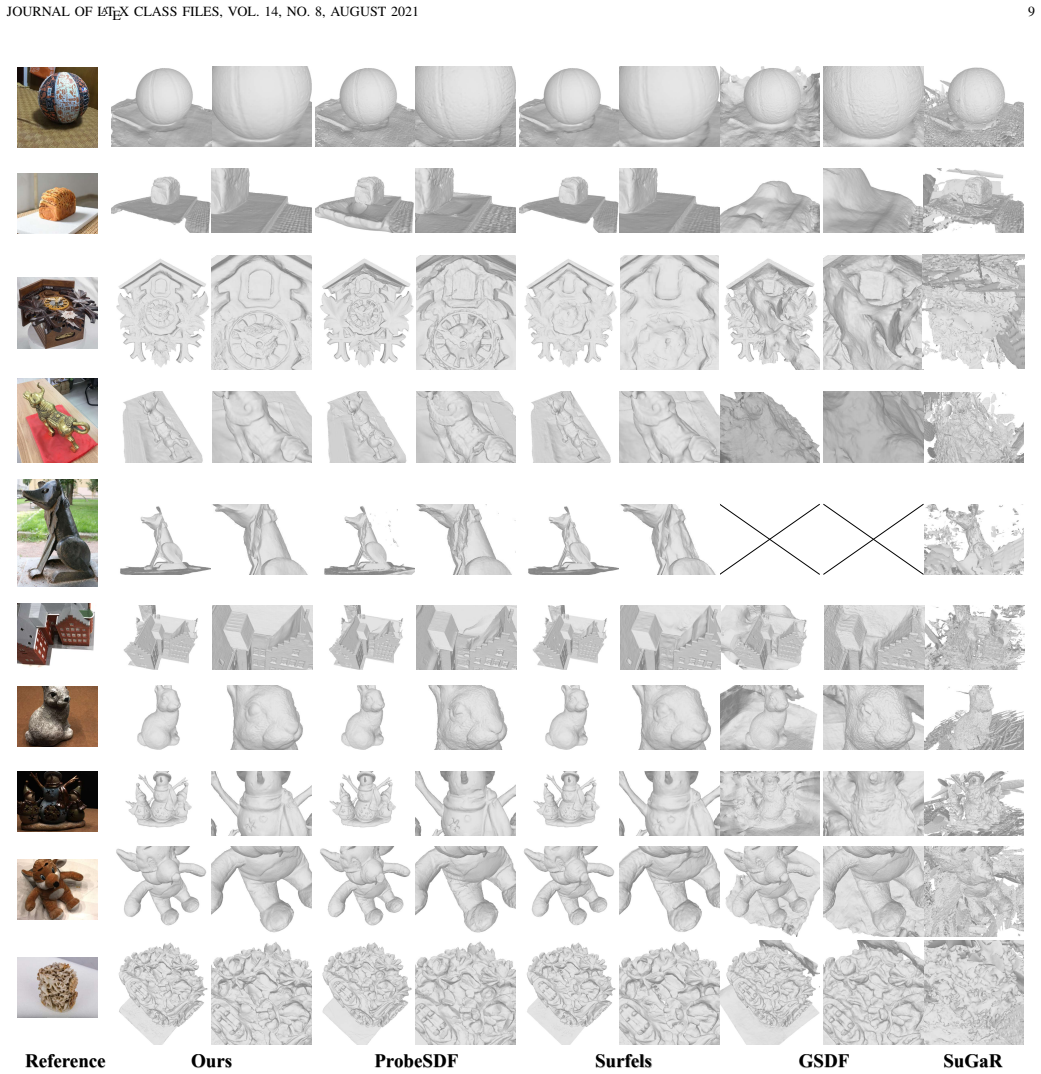
The load-bearing premise, stated explicitly by the paper in Section VI, is that the SDF-derived normal map used to steer Gaussian splitting and pruning is accurate enough; when that geometric supervision is wrong, the paper's own failure-case figure shows reconstruction degrades sharply, so if the supervision is unreliable the reported gains in quality and compactness do not transfer.
What would settle it
A direct ablation would settle whether the central mechanism does the work: keep the same confidence-based SDF supervision and the same pruning rule, but disable only the 'Gaussian separate operation' so every splat carries both color and normal attributes and is optimized under a single coupled gradient. If PSNR, Chamfer distance, and model size remain essentially unchanged, then the paper's claimed gradient-conflict mitigation is not the cause of the reported results.
If this is right
- Adding this management to a vanilla Gaussian-surfel or hybrid SDF-Gaussian pipeline improves its PSNR/SSIM while cutting model size by a factor of roughly 2 to 50 across the tested scenes, with Chamfer distance staying at or near the original level.
- The per-splat adaptive SH-order rule reproduces the appearance quality of fixed order-3 color representation with parameters equivalent to order 1 or 2, meaning flat regions stay cheap while detailed regions get more capacity.
- Task-decoupled pruning preserves both appearance and geometry better than a single global contribution prune, because it avoids one task's pruning criterion starving the other task.
- The confidence mechanism alone accounts for a meaningful part of the quality gain: removing it raises Chamfer distance (for example, from 2.67 to 3.25 on one benchmark) and lowers PSNR.
- The two-stage normal-supervision schedule is necessary for stable convergence: early training relies on pretrained single-image normals, and later training switches to the more accurate SDF-derived normals at a fixed iteration.
Where Pith is reading between the lines
- My inference: if the gradient-conflict mechanism is the real driver of the gains, then any joint optimization of appearance and geometry over shared primitives—not just Gaussian splatting—could benefit from task-decoupled attribute assignment; implicit-field models with a single parameter set might be extended similarly.
- My inference: the reported dependence on high-quality geometric supervision suggests a natural stress test—run the management pipeline on scenes with reflective or textureless surfaces where SDF normals are unreliable, and measure whether the compactness and quality gains persist or collapse.
- My inference: the per-splat SH upgrade rule is an adaptive bit-allocation scheme; the same criterion could be applied to other per-primitive capacities, such as basis-function counts in directional encodings, so the idea likely transfers beyond spherical-harmonic color.
- My inference: the current 1-to-2-hour training cost is dominated by the SDF branch; if CoRe were decoupled as an offline normal estimator, the 15-to-20-minute management stage could be the only per-scene cost, making the framework more practical for large-scale use.
Editorial analysis
A structured set of objections, weighed in public.
Referee Report
Summary. The manuscript proposes a 'Gaussian management' framework for joint appearance and geometry reconstruction from multi-view RGB images. It introduces three main components: CoRe, a dual-branch module that distills normals from an SDF branch into a Gaussian branch through a confidence mechanism; GauSep, which partitions Gaussians into common, color-active, and normal-active sets based on per-attribute gradient conflicts and renders these sets separately; and GauRep, which adaptively upgrades spherical-harmonic orders and performs task-decoupled pruning. The method is evaluated on BMVS and DTU against SuGaR, SURFELS, GSDF, and ProbeSDF, with ablations and a compatibility study in which the management module is applied to GSDF and SURFELS backbones. The headline claim is that the approach achieves superior or comparable appearance and geometry reconstruction while using significantly fewer parameters.
Significance. If the reported numbers are reliable, the framework offers a useful practical contribution: substantial parameter compression (45.14 MB vs. 811.8 MB for GSDF on BMVS; 17.44 MB vs. 838.7 MB on DTU) with PSNR improvements, and the adaptive SH-order idea is clearly motivated and ablated. The paper is also commendable for providing per-component ablations and a compatibility study. However, the central claim is only partially supported. On BMVS, the final model's Chamfer distance is worse than both SURFELS and ProbeSDF, and applying the proposed management to the paper's own CoRe backbone degrades SSIM and CD even though PSNR improves. In addition, the same baseline is reported with materially different Chamfer distances in Tables I and II, which weakens the reliability of the comparison. These issues are addressable with additional analysis and a more careful framing, but they currently prevent acceptance.
major comments (4)
- [Table II (BMVS) / Abstract] The core claim that management 'achieves superior or comparable performance in appearance and geometry ... while using significantly fewer parameters' is contradicted by the paper's own numbers. On BMVS, CoRe w/ GM (the final model) has PSNR 31.54 vs. CoRe 31.33, but SSIM drops from 0.960 to 0.951 and CD increases from 2.24 to 2.67. The final CD 2.67 is also worse than SURFELS (2.27) and ProbeSDF (2.245) in Table I. Since GauSep and GauRep are the main contributions, the paper needs to address this internal regression: either show per-scene CD differences are not significant, or adjust management to preserve geometry, or revise the abstract/conclusion to claim appearance+compression gains while acknowledging a geometry trade-off on BMVS.
- [Tables I-II (baseline consistency)] The same baselines are reported inconsistently. GSDF DTU CD is 0.80 in Table I but 1.91 in Table II; SURFELS BMVS CD is 2.27 in Table I and 2.35 in Table II (DTU 0.88 vs. 0.90). The caption of Table II says reproduced results are used for fairness, while Table I reportedly uses original reported numbers. If so, the discrepancy must be explained; a 2.4x difference for GSDF cannot be dismissed as run-to-run noise. Until this is resolved, the paper's geometry ranking and the claim of fair comparison are unstable.
- [Sec. IV-D, Eq. (28), Eq. (12)] The geometric supervision used by the final management stage is generated by the method's own Gaussian branch. After CoRe training, 'we have obtained the final geometry used for supervision. Then we use B_g without the runtime confidence mechanism as the backbone' (Sec. IV-D1), and L^s_geo in Eq. (28) minimizes against this N_g. Thus the managed model is trained to reproduce the pre-management normals of the same branch it modifies. Fig. 11 and Sec. VI show that when this supervision is inaccurate, reconstruction degrades sharply. The paper should validate N_g against ground truth normals/scans and, ideally, include a management experiment with an independent normal source to rule out self-reinforcing bias.
- [Table II (compatibility claim)] The abstract says management 'can be seamlessly integrated to improve performance while reducing size of the model.' Table II shows this is not always true: on BMVS, GSDF w/ GM has lower PSNR than GSDF (29.75 vs. 30.19), and SURFELS w/ GM has worse CD (2.93 vs. 2.35). The compatibility claim should be qualified by metric and dataset, or supported with additional experiments.
minor comments (6)
- [Sec. IV-A, Eq. (14)] Equation (14) has a misplaced parenthesis and a grammar issue. The condition should read I(||∇_p L_rad|| < ζ_rad && ||∇_R L_geo|| > ζ_geo), not '... & ||∇_R L_geo||)> ζ_geo'.
- [Abstract / Introduction] The abstract says 'superior or comparable performance' while the Introduction says 'superior performance in reconstructing both appearance and geometry.' These formulations are inconsistent and should be aligned with the actual results.
- [Sec. IV-D1 and Eq. (12)] Typos: 'mangement' in the abstract, 'swith' in Eq. (12), and 'precedure' in Sec. IV-D1. Please proofread.
- [Algorithm 1] The pseudocode uses symbols that are not defined in the text: 'IterateAllImages', 'τ_p', and the relationship between τ_c/τ_g in Sec. IV-B2 and the branch conditions in the algorithm is not explicit. The pseudocode should be self-contained or refer explicitly to the equations defining each threshold.
- [Sec. V-C] The text says 'GSDF ... achieves better PSNR and SSIM' but Table I shows Ours has PSNR 31.54 vs. 30.19 and SSIM 0.951 vs. 0.908 for GSDF on BMVS. This sentence is at best ambiguous and should be rephrased to avoid contradicting the table.
- [Table III / Adaptive SH] For 'Ours w/ D.#3', the fixed order-3 configuration has higher PSNR than the adaptive Ours on both datasets (31.78 vs. 31.54 on BMVS; 35.22 vs. 34.85 on DTU). The paper should explain why the adaptive version trades a small PSNR loss for better CD/size, since the current discussion emphasizes the size benefit and does not address the PSNR gap explicitly.
Circularity Check
No significant circularity: central claims are externally evaluated; the internal normal self-distillation loop is disclosed and not load-bearing.
full rationale
The paper's derivation chain is not circular. GauSep (Eqs. 18-21) and GauRep (Eqs. 22-23) are management heuristics driven by gradient magnitudes and contribution weights; they do not define the target metrics in terms of themselves. CoRe introduces a two-stage normal-distillation loop: Eq. (12) switches the normal supervision for the Gaussian branch from the pretrained Omnidata normal N_c to the SDF-derived N_v, while Eq. (25) supervises the SDF branch normal N_v partly against the Gaussian branch normal N_g (L_volume includes lambda_vol * L_cos(N_v, N_g)); later, Sec. IV-D2 updates N in L_geo to N_g for the management stage. This is a self-reinforcing bootstrap, but it is seeded by an external pretrained estimator (Omnidata [26]) plus multi-view RGB supervision, and the final geometry is evaluated against external ground-truth scans on DTU/BMVS with held-out views. The paper explicitly flags the dependency in Sec. VI ('our method shows a high dependence on high-precision geometric supervision') and Fig. 11 shows degradation when the geometry supervision fails; this is a disclosed limitation, not a hidden equivalence. There are no self-citations, no imported uniqueness theorems, and no fitted parameter that is renamed as a prediction: the reported PSNR/CD numbers come from independent benchmarks after training. The management step does reduce SSIM/CD on BMVS relative to the CoRe backbone (Table II: 0.951/2.67 vs 0.960/2.24), which weakens the abstract's broad 'superior or comparable' geometry claim for that dataset, but this is a correctness/consistency issue, not circularity. Overall circularity burden is low.
Axiom & Free-Parameter Ledger
free parameters (6)
- SH upgrade threshold tau_d =
0.0001 (0->1, 1->2); 0.0002 (2->3)
- Gradient-separation thresholds tau_c, tau_g =
not stated
- Pruning percentile tau_g% =
not stated
- Loss weights =
lambda_n 0.04->0.02; lambda_s 0.01->0.11; lambda_curv 0.005; lambda_opac 0.01; lambda_mask varies; lambda_vol 0.01; lamb
- Confidence-target thresholds zeta_rad, zeta_geo =
0.0002, 0.0001
- SDF sampling half-width k =
3
axioms (6)
- domain assumption The inner product of radiance and geometry gradients (Eq. 21) identifies destructive gradient conflicts whose resolution by attribute decoupling improves joint optimization.
- domain assumption The SDF branch's distilled normals are more reliable than the pretrained Omnidata normals, so switching supervision at T_i=15,000 improves geometry.
- domain assumption Flattening Gaussians to zero scale in one axis (Eq. 3) yields an unambiguous normal attribute n_i = R_z_i.
- domain assumption Screened Poisson reconstruction from rendered normal/depth maps produces the final mesh; geometry quality is evaluated after this post-processing, not directly from Gaussian attributes.
- domain assumption Spherical harmonics up to order 3 suffice for high-fidelity appearance.
- domain assumption Pretrained normal estimates from Omnidata are reliable warm-up supervision.
read the original abstract
This paper proposes an effective Gaussian management framework for high-fidelity scene reconstruction of both appearance and geometry. Unlike recent Gaussian Splatting (GS) pipelines that treat all primitives uniformly during optimization, our framework explicitly manages the attribute activation, representation and pruning of Gaussian. Specifically, our framework first introduces GauSep, a novel densification strategy that selectively activates Gaussian color or normal attributes to alleviate destructive gradient conflicts arising from dual supervision. We further propose GauRep, an adaptive Gaussian representation that dynamically adjusts spherical harmonics (SHs) orders and performs task-decoupled pruning to reduce redundancy at both the individual and global levels. To provide reliable geometric supervision for above mangement process, we additionally introduce CoRe, an regularized surface reconstruction module that distills robust normal fields from an SDF branch to the Gaussian representation through a confidence mechanism. Notably, the proposed Gaussian management is compatible with various reconstruction architectures and can be seamlessly integrated to improve performance while reducing size of the model. Extensive experiments demonstrate that our approach achieves superior or comparable performance in appearance and geometry reconstruction compared with state-of-the-art methods, while using significantly fewer parameters.
Figures




Reference graph
Works this paper leans on
-
[1]
Large-scale data for multiple-view stereopsis,
H. Aanæs, R. R. Jensen, G. V ogiatzis, E. Tola, and A. B. Dahl, “Large-scale data for multiple-view stereopsis,”International Journal of Computer Vision, pp. 1–16, 2016
2016
-
[2]
Deformable 3d gaussians for high-fidelity monocular dynamic scene reconstruction,
Z. Yang, X. Gao, W. Zhou, S. Jiao, Y . Zhang, and X. Jin, “Deformable 3d gaussians for high-fidelity monocular dynamic scene reconstruction,” inProceedings of the IEEE/CVF conference on computer vision and pattern recognition, 2024, pp. 20 331–20 341
2024
-
[3]
Kinectfusion: real-time 3d reconstruction and interaction using a moving depth cam- era,
S. Izadi, D. Kim, O. Hilliges, D. Molyneaux, R. Newcombe, P. Kohli, J. Shotton, S. Hodges, D. Freeman, A. Davisonet al., “Kinectfusion: real-time 3d reconstruction and interaction using a moving depth cam- era,” inProceedings of the 24th annual ACM symposium on User interface software and technology, 2011, pp. 559–568
2011
-
[4]
Remode: Probabilistic, monocular dense reconstruction in real time,
M. Pizzoli, C. Forster, and D. Scaramuzza, “Remode: Probabilistic, monocular dense reconstruction in real time,” in2014 IEEE international conference on robotics and automation (ICRA). IEEE, 2014, pp. 2609– 2616
2014
-
[5]
Nerf: Representing scenes as neural radiance fields for view synthesis,
B. Mildenhall, P. P. Srinivasan, M. Tancik, J. T. Barron, R. Ramamoorthi, and R. Ng, “Nerf: Representing scenes as neural radiance fields for view synthesis,”Communications of the ACM, vol. 65, no. 1, pp. 99–106, 2021
2021
-
[6]
Neus: Learning neural implicit surfaces by volume rendering for multi-view reconstruction,
P. Wang, L. Liu, Y . Liu, C. Theobalt, T. Komura, and W. Wang, “Neus: Learning neural implicit surfaces by volume rendering for multi-view reconstruction,”arXiv preprint arXiv:2106.10689, 2021. JOURNAL OF LATEX CLASS FILES, VOL. 14, NO. 8, AUGUST 2021 13
Pith/arXiv arXiv 2021
-
[7]
Nerf++: Analyzing and improving neural radiance fields,
K. Zhang, G. Riegler, N. Snavely, and V . Koltun, “Nerf++: Analyzing and improving neural radiance fields,”arXiv preprint arXiv:2010.07492, 2020
Pith/arXiv arXiv 2010
-
[8]
Instant neural graphics primitives with a multiresolution hash encoding,
T. M ¨uller, A. Evans, C. Schied, and A. Keller, “Instant neural graphics primitives with a multiresolution hash encoding,”ACM transactions on graphics (TOG), vol. 41, no. 4, pp. 1–15, 2022
2022
-
[9]
Hdrsplat: Gaussian splatting for high dynamic range 3d scene reconstruction from raw images,
S. Singh, A. Garg, and K. Mitra, “Hdrsplat: Gaussian splatting for high dynamic range 3d scene reconstruction from raw images,”arXiv preprint arXiv:2407.16503, 2024
Pith/arXiv arXiv 2024
-
[10]
Ewa splatting,
M. Zwicker, H. Pfister, J. Van Baar, and M. Gross, “Ewa splatting,”IEEE Transactions on Visualization and Computer Graphics, vol. 8, no. 3, pp. 223–238, 2002
2002
-
[11]
2d gaussian splatting for geometrically accurate radiance fields,
B. Huang, Z. Yu, A. Chen, A. Geiger, and S. Gao, “2d gaussian splatting for geometrically accurate radiance fields,” inACM SIGGRAPH 2024 conference papers, 2024, pp. 1–11
2024
-
[12]
Sugar: Surface-aligned gaussian splatting for efficient 3d mesh reconstruction and high-quality mesh rendering,
A. Gu ´edon and V . Lepetit, “Sugar: Surface-aligned gaussian splatting for efficient 3d mesh reconstruction and high-quality mesh rendering,” inProceedings of the IEEE/CVF Conference on Computer Vision and Pattern Recognition, 2024, pp. 5354–5363
2024
-
[13]
High-quality surface reconstruction using gaussian surfels,
P. Dai, J. Xu, W. Xie, X. Liu, H. Wang, and W. Xu, “High-quality surface reconstruction using gaussian surfels,” inACM SIGGRAPH 2024 Conference Papers. Association for Computing Machinery, 2024
2024
-
[14]
Delaunay triangulation based surface recon- struction,
F. Cazals and J. Giesen, “Delaunay triangulation based surface recon- struction,” inEffective computational geometry for curves and surfaces. Springer, 2006, pp. 231–276
2006
-
[15]
A comparison and evaluation of multi-view stereo reconstruction algo- rithms,
S. M. Seitz, B. Curless, J. Diebel, D. Scharstein, and R. Szeliski, “A comparison and evaluation of multi-view stereo reconstruction algo- rithms,” in2006 IEEE computer society conference on computer vision and pattern recognition (CVPR’06), vol. 1. IEEE, 2006, pp. 519–528
2006
-
[16]
Mip-nerf 360: Unbounded anti-aliased neural radiance fields,
J. T. Barron, B. Mildenhall, D. Verbin, P. P. Srinivasan, and P. Hedman, “Mip-nerf 360: Unbounded anti-aliased neural radiance fields,” inPro- ceedings of the IEEE/CVF conference on computer vision and pattern recognition, 2022, pp. 5470–5479
2022
-
[17]
3d gaussian splatting for real-time radiance field rendering,
B. Kerbl, G. Kopanas, T. Leimk ¨uhler, and G. Drettakis, “3d gaussian splatting for real-time radiance field rendering,”ACM Transactions on Graphics, vol. 42, no. 4, July 2023. [Online]. Available: https://repo-sam.inria.fr/fungraph/3d-gaussian-splatting/
2023
-
[18]
Scaffold-gs: Structured 3d gaussians for view-adaptive rendering,
T. Lu, M. Yu, L. Xu, Y . Xiangli, L. Wang, D. Lin, and B. Dai, “Scaffold-gs: Structured 3d gaussians for view-adaptive rendering,” in Proceedings of the IEEE/CVF Conference on Computer Vision and Pattern Recognition, 2024, pp. 20 654–20 664
2024
-
[19]
Spec-gaussian: Anisotropic view-dependent appearance for 3d gaussian splatting,
Z. Yang, X. Gao, Y .-T. Sun, Y . Huang, X. Lyu, W. Zhou, S. Jiao, X. Qi, and X. Jin, “Spec-gaussian: Anisotropic view-dependent appearance for 3d gaussian splatting,”Advances in Neural Information Processing Systems, vol. 37, pp. 61 192–61 216, 2024
2024
-
[20]
Neus2: Fast learning of neural implicit surfaces for multi- view reconstruction,
Y . Wang, Q. Han, M. Habermann, K. Daniilidis, C. Theobalt, and L. Liu, “Neus2: Fast learning of neural implicit surfaces for multi- view reconstruction,” inProceedings of the IEEE/CVF International Conference on Computer Vision, 2023, pp. 3295–3306
2023
-
[21]
Neuralangelo: High-fidelity neural surface reconstruction,
Z. Li, T. M ¨uller, A. Evans, R. H. Taylor, M. Unberath, M.-Y . Liu, and C.-H. Lin, “Neuralangelo: High-fidelity neural surface reconstruction,” inProceedings of the IEEE/CVF Conference on Computer Vision and Pattern Recognition, 2023, pp. 8456–8465
2023
-
[22]
Gsdf: 3dgs meets sdf for improved rendering and reconstruction,
M. Yu, T. Lu, L. Xu, L. Jiang, Y . Xiangli, and B. Dai, “Gsdf: 3dgs meets sdf for improved rendering and reconstruction,”arXiv preprint arXiv:2403.16964, 2024
Pith/arXiv arXiv 2024
-
[23]
Neusg: Neural implicit surface reconstruction with 3d gaussian splatting guidance,
H. Chen, C. Li, and G. H. Lee, “Neusg: Neural implicit surface reconstruction with 3d gaussian splatting guidance,”arXiv preprint arXiv:2312.00846, 2023
Pith/arXiv arXiv 2023
-
[24]
Screened poisson surface reconstruction,
M. Kazhdan and H. Hoppe, “Screened poisson surface reconstruction,” ACM Transactions on Graphics (ToG), vol. 32, no. 3, pp. 1–13, 2013
2013
-
[25]
Deferredgs: Decoupled and relightable gaussian splatting with deferred shading,
T. Wu, J.-M. Sun, Y .-K. Lai, Y . Ma, L. Kobbelt, and L. Gao, “Deferredgs: Decoupled and relightable gaussian splatting with deferred shading,” IEEE Transactions on Pattern Analysis and Machine Intelligence, 2025
2025
-
[26]
Omnidata: A scalable pipeline for making multi-task mid-level vision datasets from 3d scans,
A. Eftekhar, A. Sax, J. Malik, and A. Zamir, “Omnidata: A scalable pipeline for making multi-task mid-level vision datasets from 3d scans,” inProceedings of the IEEE/CVF International Conference on Computer Vision, 2021, pp. 10 786–10 796
2021
-
[27]
Lightgaussian: Unbounded 3d gaussian compression with 15x reduction and 200+ fps,
Z. Fan, K. Wang, K. Wen, Z. Zhu, D. Xu, Z. Wanget al., “Lightgaussian: Unbounded 3d gaussian compression with 15x reduction and 200+ fps,”Advances in neural information processing systems, vol. 37, pp. 140 138–140 158, 2024
2024
-
[28]
Lgs: A light-weight 4d gaussian splatting for efficient surgical scene reconstruction,
H. Liu, Y . Liu, C. Li, W. Li, and Y . Yuan, “Lgs: A light-weight 4d gaussian splatting for efficient surgical scene reconstruction,” in International Conference on Medical Image Computing and Computer- Assisted Intervention. Springer, 2024, pp. 660–670
2024
-
[29]
Pup 3d-gs: Principled uncertainty pruning for 3d gaussian splatting,
A. Hanson, A. Tu, V . Singla, M. Jayawardhana, M. Zwicker, and T. Goldstein, “Pup 3d-gs: Principled uncertainty pruning for 3d gaussian splatting,” inProceedings of the Computer Vision and Pattern Recogni- tion Conference, 2025, pp. 5949–5958
2025
-
[30]
Instant neural surface reconstruction,
Y .-C. Guo, “Instant neural surface reconstruction,” 2022, https://github.com/bennyguo/instant-nsr-pl
2022
-
[31]
Blendedmvs: A large-scale dataset for generalized multi-view stereo networks,
Y . Yao, Z. Luo, S. Li, J. Zhang, Y . Ren, L. Zhou, T. Fang, and L. Quan, “Blendedmvs: A large-scale dataset for generalized multi-view stereo networks,”Computer Vision and Pattern Recognition (CVPR), 2020
2020
-
[32]
Probesdf: Light field probes for neural surface reconstruction,
B. Toussaint, D. Thomas, and J.-S. Franco, “Probesdf: Light field probes for neural surface reconstruction,” inProceedings of the Computer Vision and Pattern Recognition Conference, 2025, pp. 11 026–11 035
2025
-
[33]
Tanks and temples: Benchmarking large-scale scene reconstruction,
A. Knapitsch, J. Park, Q.-Y . Zhou, and V . Koltun, “Tanks and temples: Benchmarking large-scale scene reconstruction,”ACM Transactions on Graphics (ToG), vol. 36, no. 4, pp. 1–13, 2017
2017
-
[34]
Deep blending for free-viewpoint image-based rendering,
P. Hedman, J. Philip, T. Price, J.-M. Frahm, G. Drettakis, and G. Bros- tow, “Deep blending for free-viewpoint image-based rendering,”ACM Transactions on Graphics (ToG), vol. 37, no. 6, pp. 1–15, 2018. Jiateng Liureceived the B.S. degree from Nan- jing University of Posts and Telecommunications, Nanjing, China. He is currently pursuing the Ph.D. degree un...
2018
discussion (0)
Sign in with ORCID, Apple, or X to comment. Anyone can read and Pith papers without signing in.