Rectifying Mask via Entropy for Distractor-Free 3DGS in Ambiguous Scenarios
Pith reviewed 2026-06-30 07:06 UTC · model grok-4.3
The pith
Entropy from reconstruction separates ambiguous distractors from static scenes in 3D Gaussian splatting.
A machine-rendered reading of the paper's core claim, the machinery that carries it, and where it could break.
Core claim
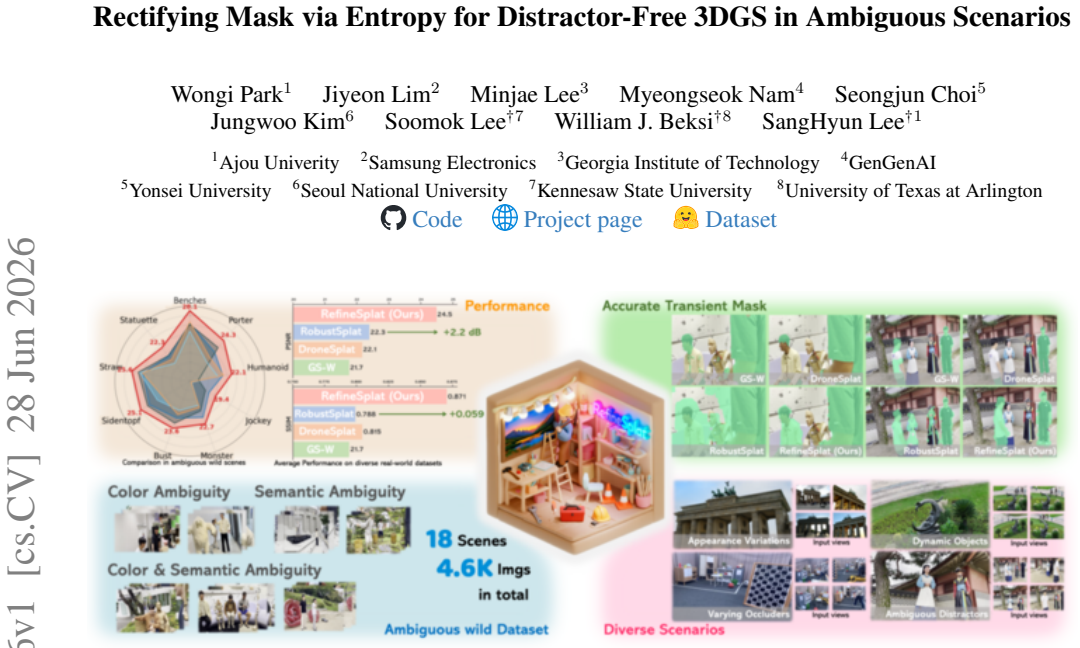
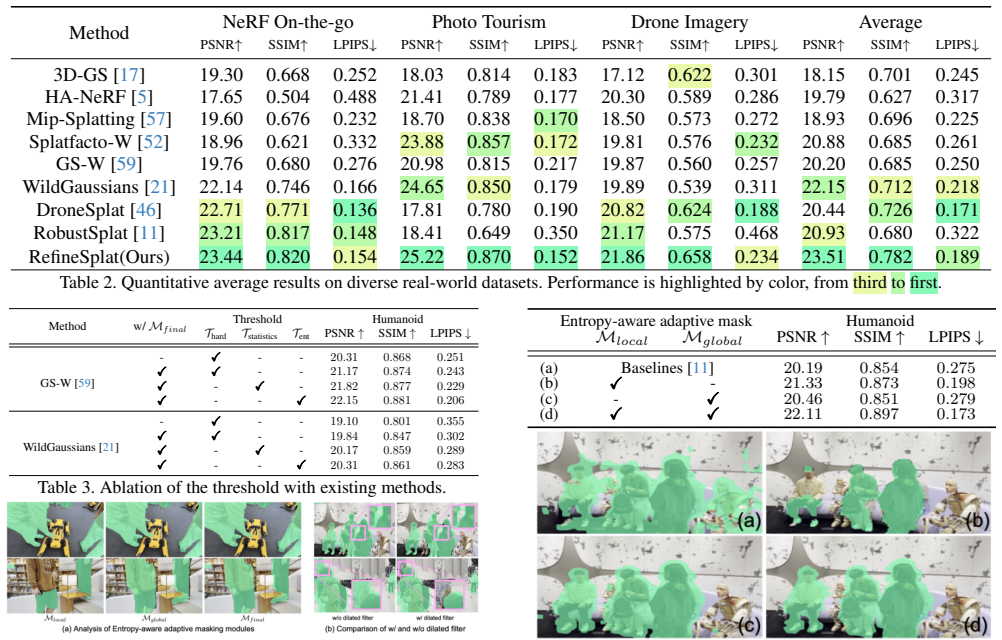
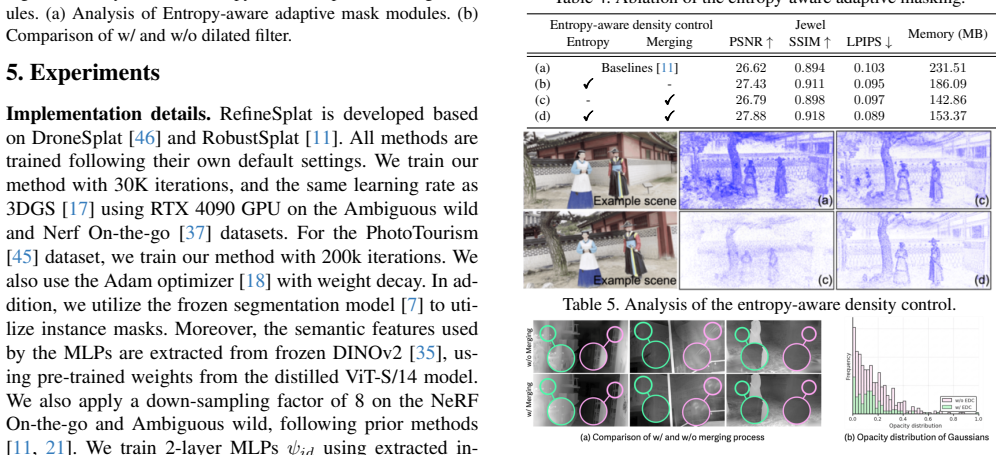
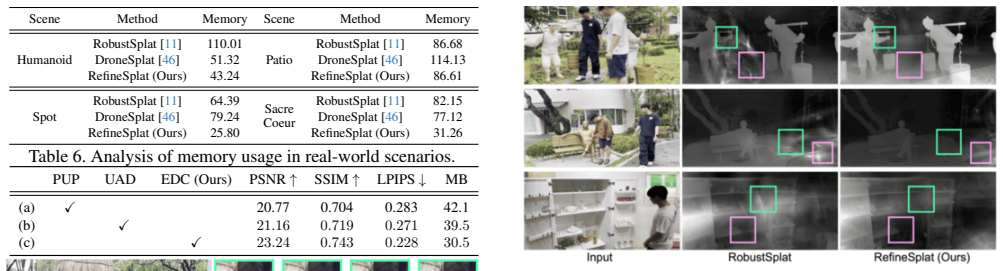
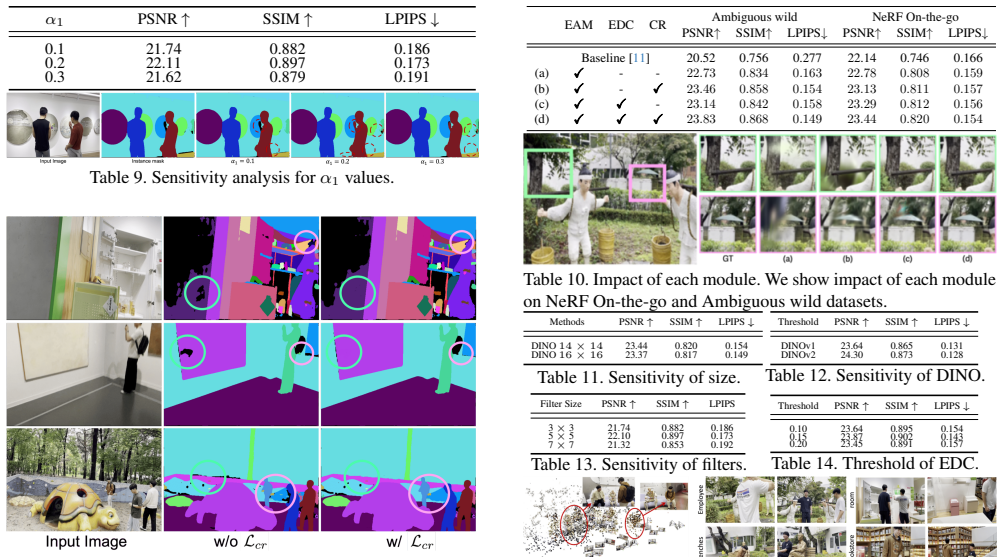
A systematic framework constructs transient masks to identify diverse ambiguous distractors by leveraging entropy and instance masks, and proposes entropy-aware density control to align Gaussians in ambiguous scenarios considering entropy-aware positional gradients, resulting in distractor-free novel view synthesis.
What carries the argument
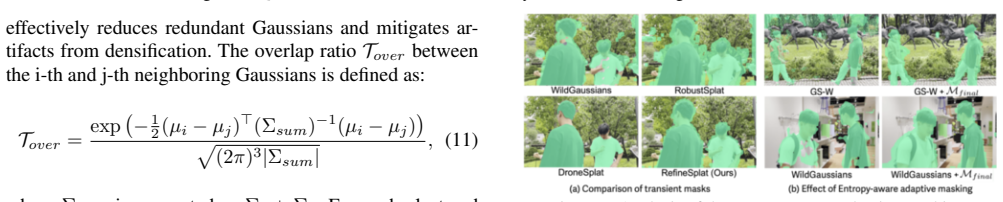
The entropy-aware adaptive masking method that uses entropy computed from the reconstruction to distinguish transient distractors when color or semantic ambiguity is present.
If this is right
- Transient masks can be constructed without depending solely on color or semantic information.
- Instance masks enhance the capture of ambiguous distractors when combined with entropy.
- Entropy-aware positional gradients allow better alignment of Gaussians in ambiguous scenarios.
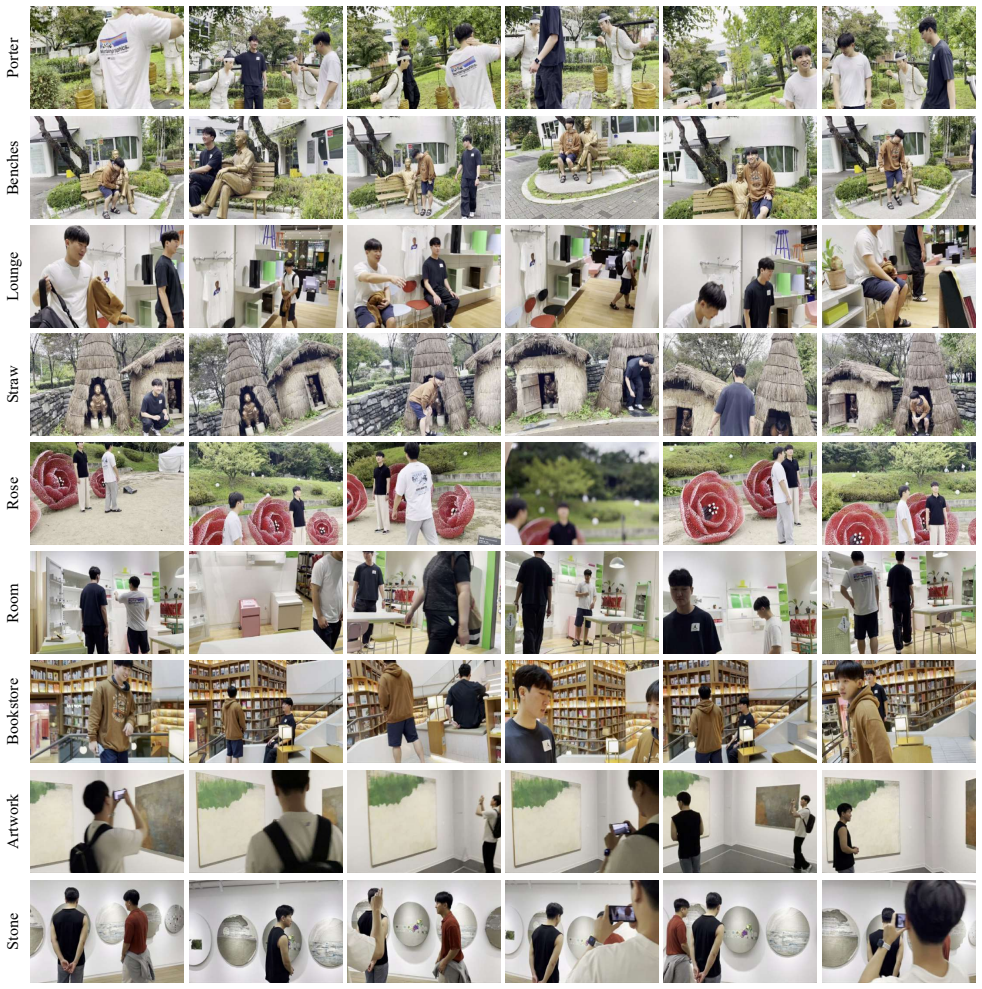
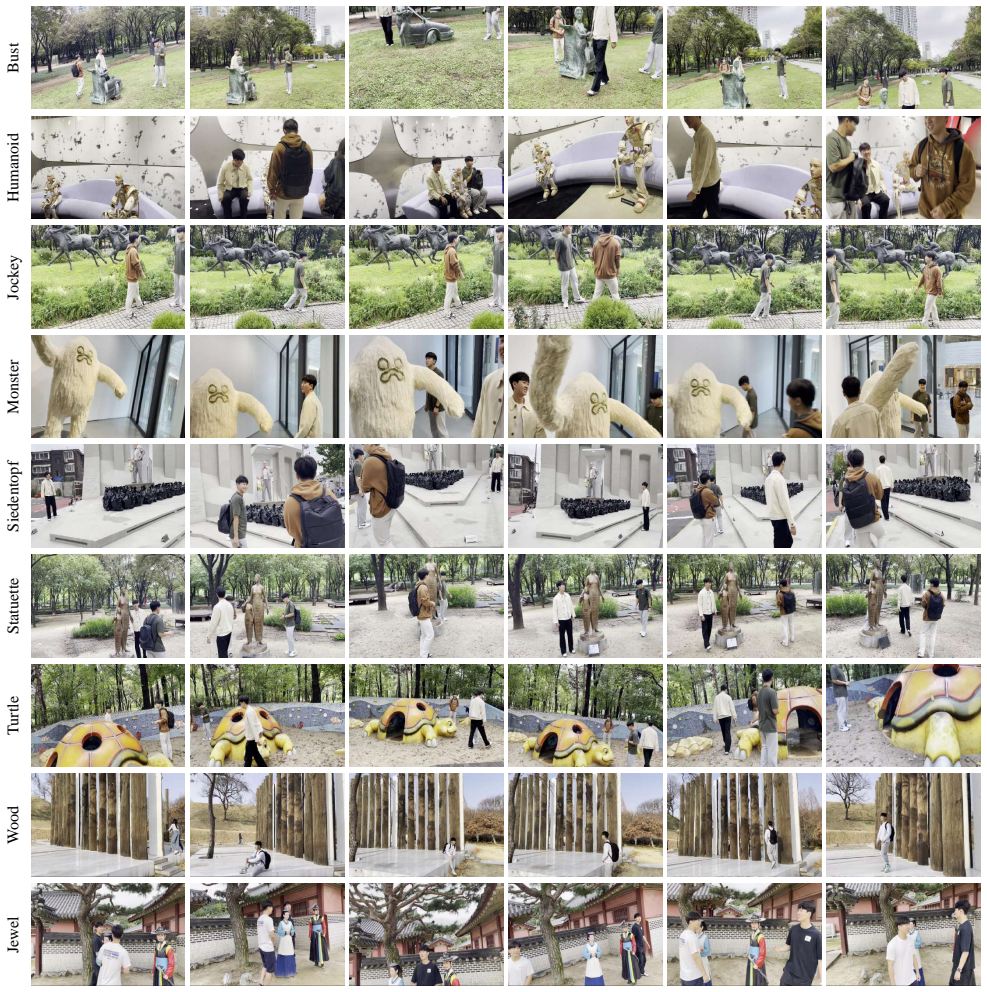
- The introduced dataset of 18 ambiguous scenes serves as a rigorous validation benchmark.
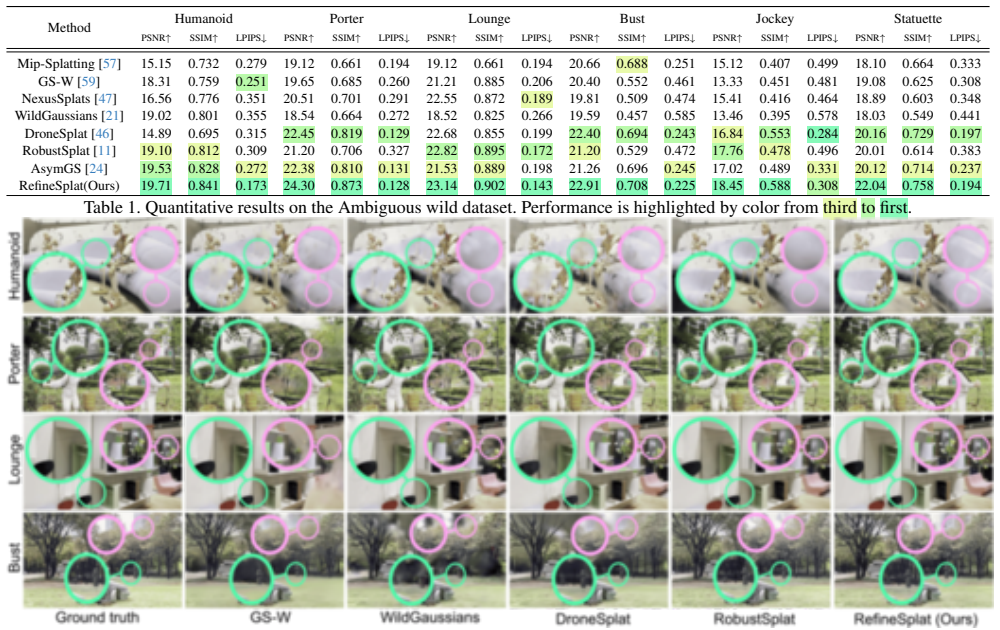
- Novel view synthesis achieves state-of-the-art results on various datasets including the new one.
Where Pith is reading between the lines
- Applying similar entropy-based separation could improve distractor handling in other 3D reconstruction approaches.
- The public release of the ambiguous scenes dataset enables comparative testing of alternative masking strategies.
- Scenes where entropy fails to differentiate could highlight needs for additional cues in future work.
Load-bearing premise
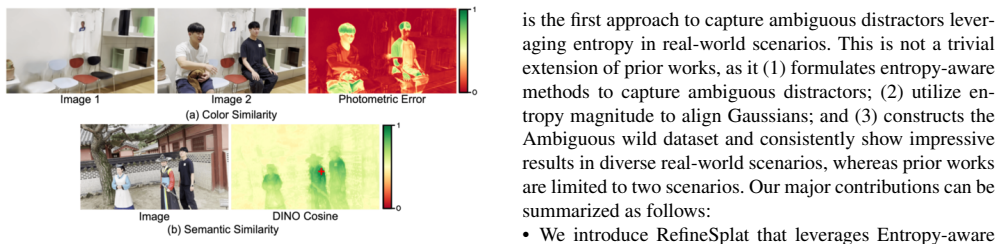
Entropy computed from the reconstruction can reliably separate transient distractors from static scene content even when color or semantic cues are ambiguous.
What would settle it
An ambiguous scene in which entropy values overlap substantially between distractor and static regions, leading to ineffective masking that fails to produce clean reconstructions.
Figures






read the original abstract
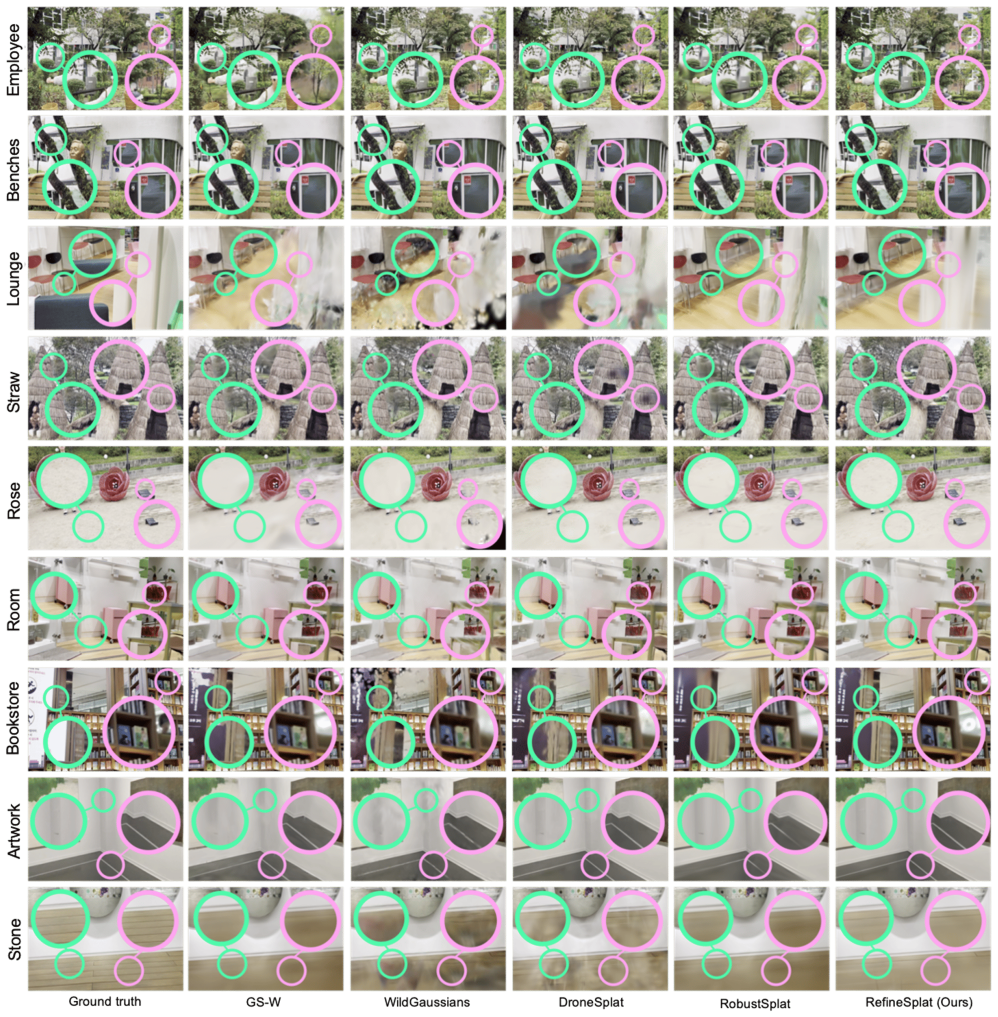
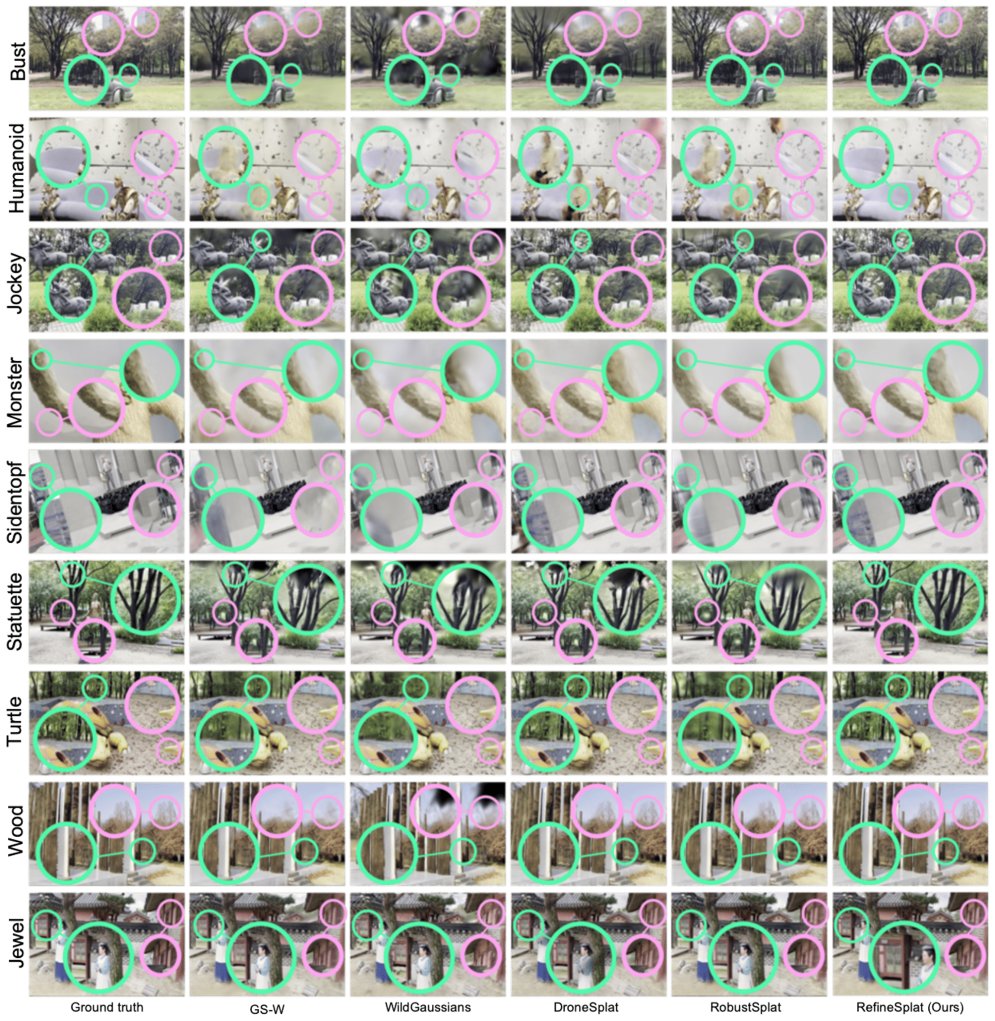
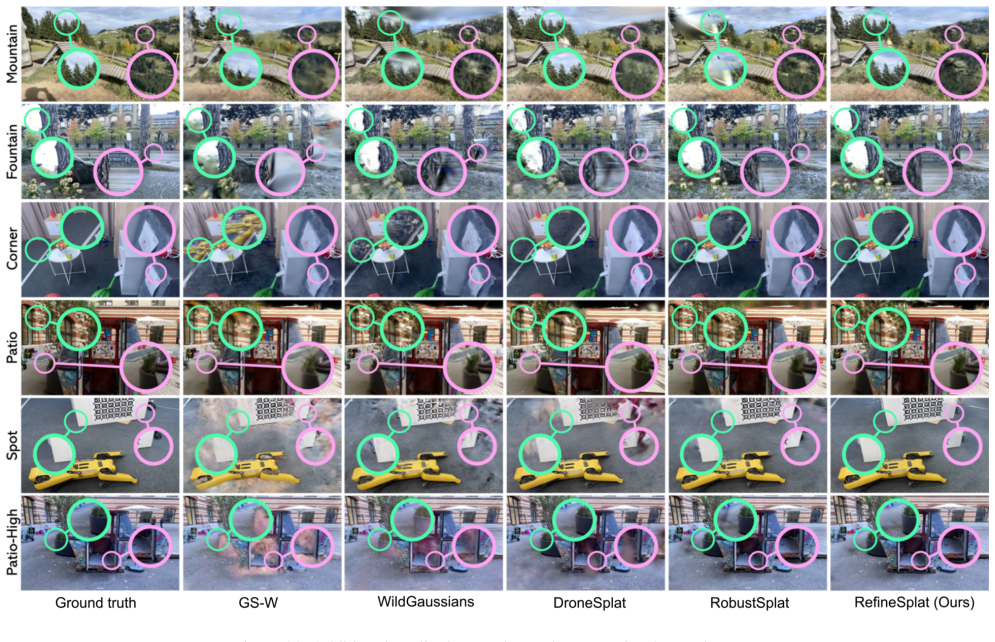
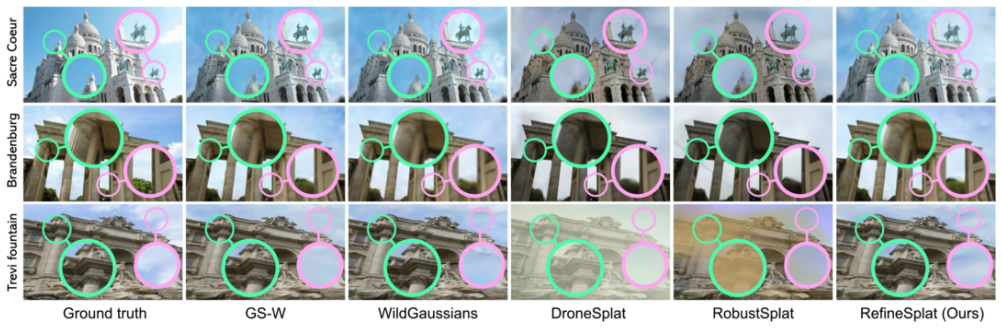
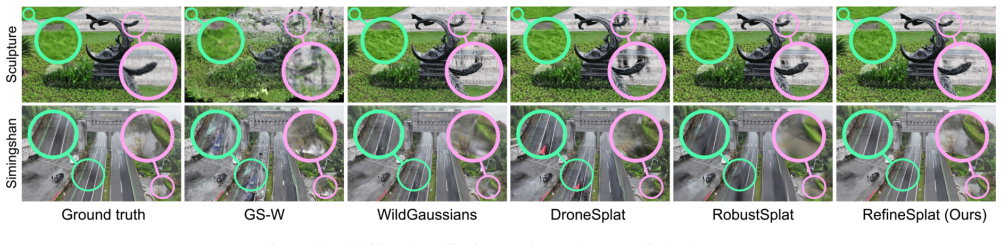
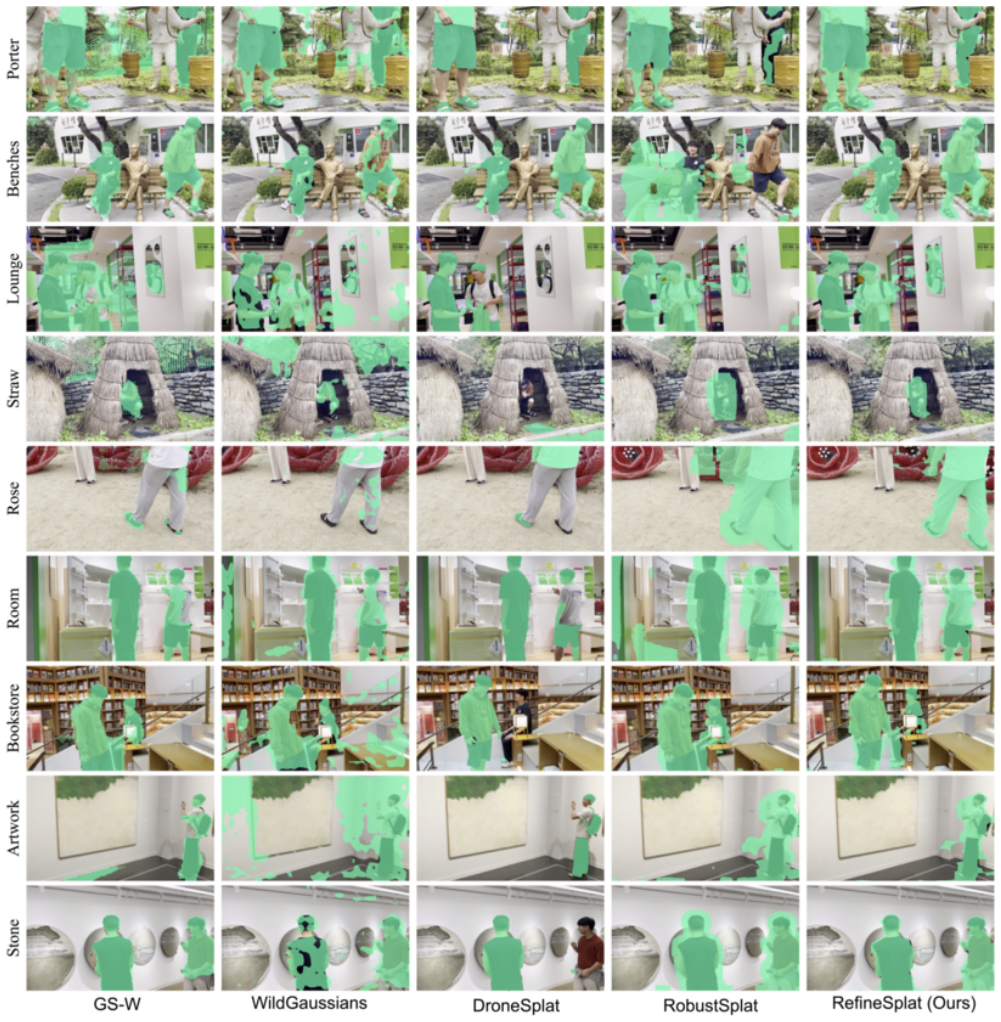
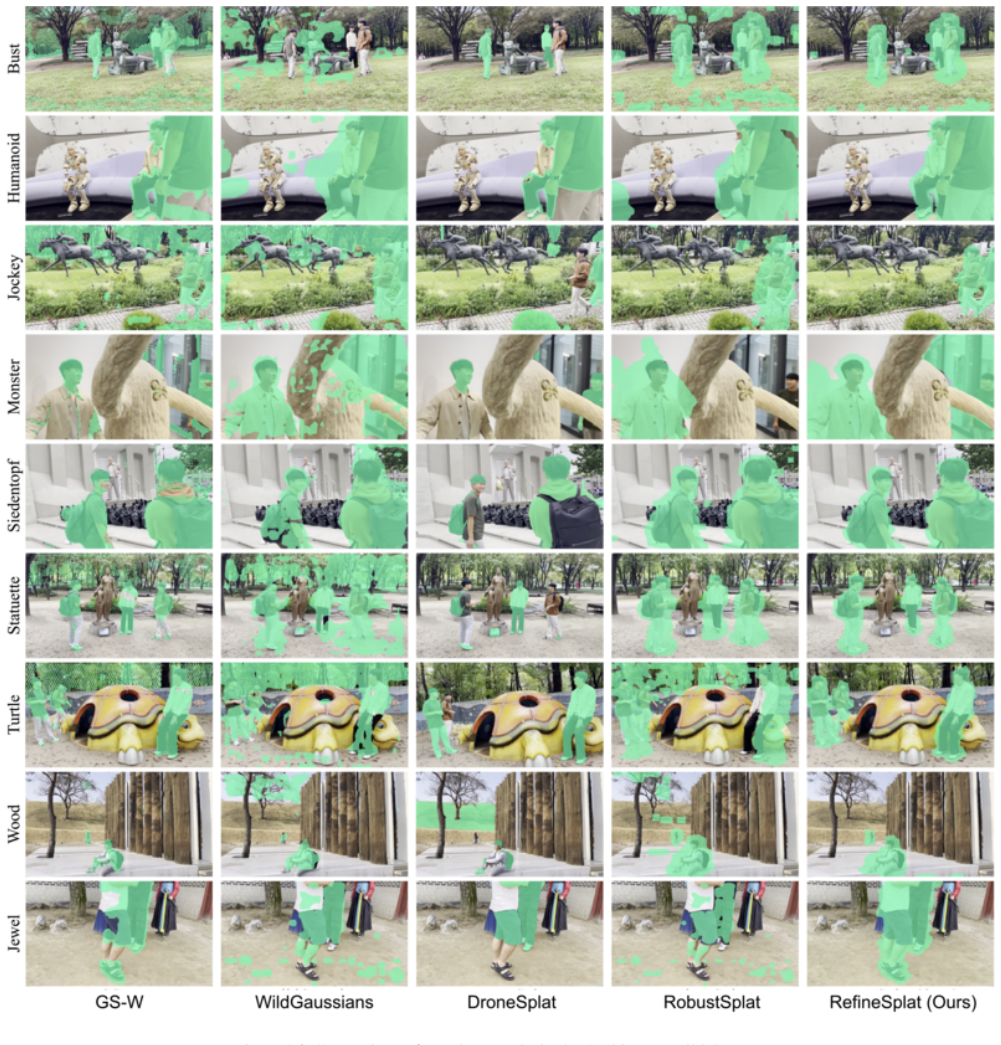
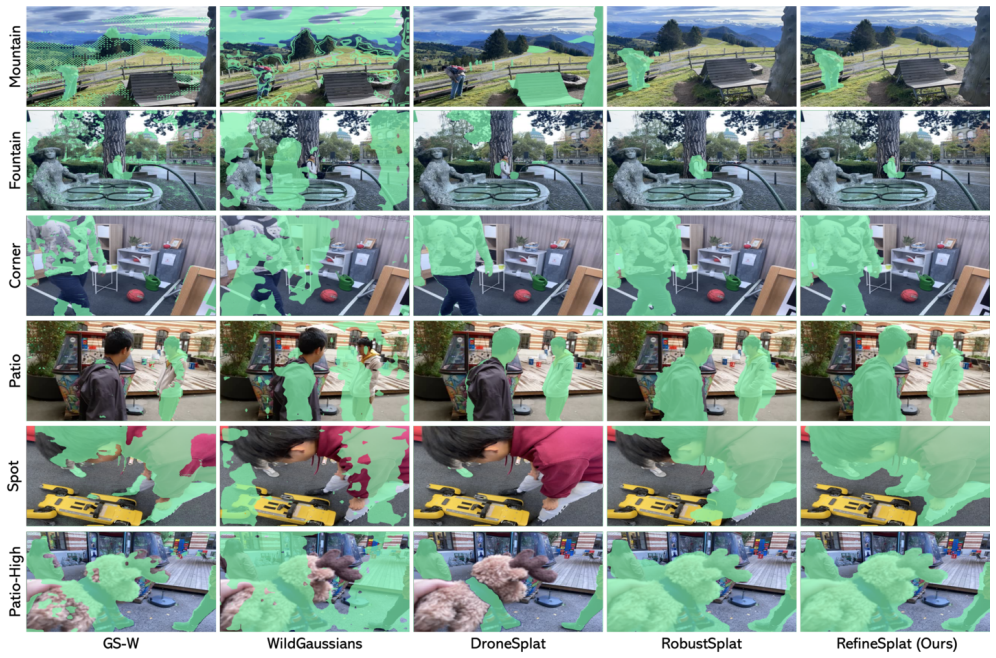
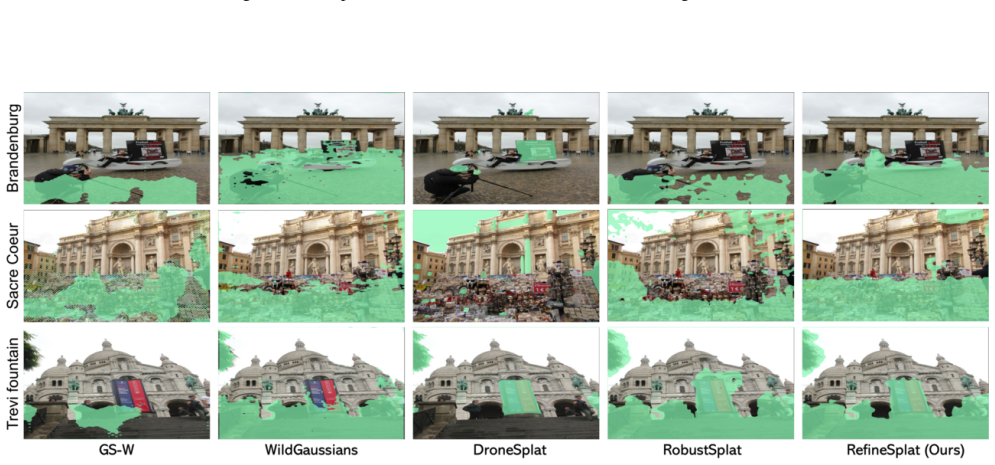
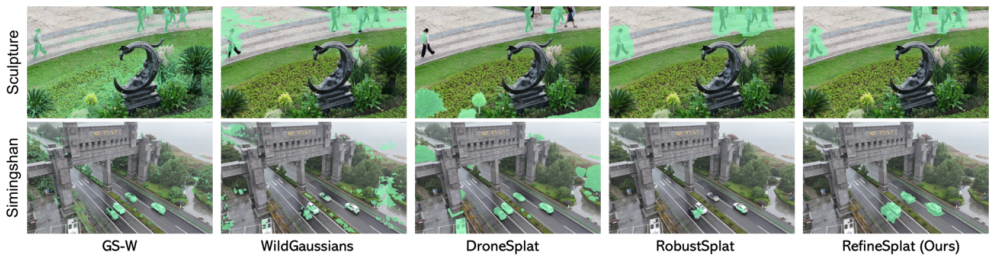
We present RefineSplat, a systematic framework that effectively constructs transient masks to identify diverse ambiguous distractors. To do this, we qualitatively and quantitatively analyze issues and propose a novel entropy-aware adaptive masking method. Unlike existing approaches that struggle to distinguish transient elements from static scenes due to color or semantic ambiguity, RefineSplat captures ambiguous distractors leveraging entropy and instance masks. Furthermore, we propose a simple yet effective entropy-aware density control to align Gaussians in ambiguous scenarios considering Entropy-aware positional gradients. Additionally, to rigorously validate our method, we first create and release the Ambiguous wild dataset, including 18 scenes where distractors and static scenes are hard to distinguish due to color or semantic resemblances. Experimental results on various datasets demonstrate that RefineSplat shows state-of-the-art performance, showing distractor-free novel view synthesis.
Editorial analysis
A structured set of objections, weighed in public.
Referee Report
Summary. The paper presents RefineSplat, a framework for 3D Gaussian Splatting that constructs transient masks for ambiguous distractors using an entropy-aware adaptive masking method combined with instance masks. It additionally introduces entropy-aware density control based on positional gradients and releases the Ambiguous wild dataset containing 18 scenes with color or semantic ambiguities between distractors and static content. The central claim is that this approach achieves state-of-the-art distractor-free novel view synthesis on various datasets where prior methods fail due to ambiguity.
Significance. If the entropy-based masking and density control are shown to reliably separate transient elements without circular dependency on the initial reconstruction, the work would address a practical limitation in real-world 3DGS applications and the released dataset would provide a useful benchmark for the community.
major comments (2)
- [Abstract] Abstract: The entropy-aware adaptive masking computes entropy from the current 3DGS reconstruction to identify transient distractors, but the description provides no mechanism showing how the adaptive schedule or instance-mask fallback prevents the initial unmasked optimization from producing corrupted high-entropy signals across both static and transient content in ambiguous scenes.
- [Abstract] Abstract: The claim of state-of-the-art performance is stated without reference to any quantitative tables, ablation studies, or specific metrics, making it impossible to assess whether the data support the superiority over existing methods that struggle with color/semantic ambiguity.
Simulated Author's Rebuttal
We thank the referee for the comments. We address each point below, clarifying details from the manuscript and noting where revisions to the abstract will improve accessibility.
read point-by-point responses
-
Referee: [Abstract] Abstract: The entropy-aware adaptive masking computes entropy from the current 3DGS reconstruction to identify transient distractors, but the description provides no mechanism showing how the adaptive schedule or instance-mask fallback prevents the initial unmasked optimization from producing corrupted high-entropy signals across both static and transient content in ambiguous scenes.
Authors: The abstract summarizes the approach at a high level, but Section 3.2 provides the full mechanism: the process initializes with instance masks to guide early optimization and establish a reliable baseline reconstruction before entropy computation begins. An adaptive schedule then applies entropy thresholds derived from positional gradients, using instance masks as a persistent fallback to protect static regions. This staged design avoids initial corruption by ensuring entropy signals are only refined after instance-guided separation. We will revise the abstract to briefly reference this staged adaptive schedule and instance-mask fallback for clarity. revision: partial
-
Referee: [Abstract] Abstract: The claim of state-of-the-art performance is stated without reference to any quantitative tables, ablation studies, or specific metrics, making it impossible to assess whether the data support the superiority over existing methods that struggle with color/semantic ambiguity.
Authors: The manuscript supports the SOTA claim with detailed results in Section 4, including quantitative comparisons on the Ambiguous wild dataset and other benchmarks, plus ablations isolating the entropy-aware masking and density control components. While abstracts conventionally avoid table citations, we agree the summary could be strengthened. We will revise the abstract to reference the experimental validation in Section 4 and note the supporting quantitative and ablation studies. revision: partial
Circularity Check
No circularity detected; derivation self-contained in description
full rationale
The provided abstract and text describe an entropy-aware adaptive masking method for 3DGS without any equations, fitting procedures, or derivation steps that reduce to self-definition or fitted inputs. No self-citations, uniqueness theorems, or ansatzes are quoted that would create load-bearing circularity. The method is presented as addressing ambiguity via entropy and instance masks, with no evidence of the prediction or mask depending on itself by construction. This is the common case of an honest non-finding when no specific reduction can be exhibited from quoted paper content.
Axiom & Free-Parameter Ledger
Reference graph
Works this paper leans on
-
[1]
Cosmos World Foundation Model Platform for Physical AI
Niket Agarwal, Arslan Ali, Maciej Bala, Yogesh Balaji, Erik Barker, Tiffany Cai, Prithvijit Chattopadhyay, Yongxin Chen, Yin Cui, Yifan Ding, et al. Cosmos world foun- dation model platform for physical ai.arXiv preprint arXiv:2501.03575, 2025. 4
work page internal anchor Pith review Pith/arXiv arXiv 2025
-
[2]
Revising densification in gaussian splatting.arXiv preprint arXiv:2404.06109, 2024
Samuel Rota Bul `o, Lorenzo Porzi, and Peter Kontschieder. Revising densification in gaussian splatting.arXiv preprint arXiv:2404.06109, 2024. 3, 1
-
[3]
nuscenes: A multi- modal dataset for autonomous driving
Holger Caesar, Varun Bankiti, Alex H Lang, Sourabh V ora, Venice Erin Liong, Qiang Xu, Anush Krishnan, Yu Pan, Gi- ancarlo Baldan, and Oscar Beijbom. nuscenes: A multi- modal dataset for autonomous driving. InProceedings of the IEEE/CVF conference on computer vision and pattern recognition, pages 11621–11631, 2020. 4
2020
-
[4]
Nerf-hugs: Improved neural radiance fields in non-static scenes using heuristics-guided segmentation
Jiahao Chen, Yipeng Qin, Lingjie Liu, Jiangbo Lu, and Guanbin Li. Nerf-hugs: Improved neural radiance fields in non-static scenes using heuristics-guided segmentation. In Proceedings of the IEEE/CVF Conference on Computer Vi- sion and Pattern Recognition, pages 19436–19446, 2024. 2
2024
-
[5]
Hallucinated neural radiance fields in the wild
Xingyu Chen, Qi Zhang, Xiaoyu Li, Yue Chen, Ying Feng, Xuan Wang, and Jue Wang. Hallucinated neural radiance fields in the wild. InProceedings of the IEEE/CVF Con- ference on Computer Vision and Pattern Recognition, pages 12943–12952, 2022. 6, 7
2022
-
[6]
Hac: Hash-grid assisted context for 3d gaussian splatting compression
Yihang Chen, Qianyi Wu, Weiyao Lin, Mehrtash Harandi, and Jianfei Cai. Hac: Hash-grid assisted context for 3d gaussian splatting compression. InEuropean Conference on Computer Vision, pages 422–438. Springer, 2024. 3
2024
-
[7]
Tracking anything with decoupled video segmentation
Ho Kei Cheng, Seoung Wug Oh, Brian Price, Alexan- der Schwing, and Joon-Young Lee. Tracking anything with decoupled video segmentation. InProceedings of the IEEE/CVF International Conference on Computer Vision, pages 1316–1326, 2023. 3, 6, 1, 2
2023
-
[8]
Gaussianpro: 3d gaussian splatting with progressive propagation
Kai Cheng, Xiaoxiao Long, Kaizhi Yang, Yao Yao, Wei Yin, Yuexin Ma, Wenping Wang, and Xuejin Chen. Gaussianpro: 3d gaussian splatting with progressive propagation. InForty- first International Conference on Machine Learning, 2024. 1
2024
-
[9]
Swag: Splatting in the wild images with appearance-conditioned gaussians
Hiba Dahmani, Moussab Bennehar, Nathan Piasco, Luis Roldao, and Dzmitry Tsishkou. Swag: Splatting in the wild images with appearance-conditioned gaussians. InEuropean Conference on Computer Vision, pages 325–340. Springer,
-
[10]
Lightgaussian: Unbounded 3d gaussian compression with 15x reduction and 200+ fps
Zhiwen Fan, Kevin Wang, Kairun Wen, Zehao Zhu, De- jia Xu, and Zhangyang Wang. Lightgaussian: Unbounded 3d gaussian compression with 15x reduction and 200+ fps. arXiv preprint arXiv:2311.17245, 2023. 3
-
[11]
Chuanyu Fu, Yuqi Zhang, Kunbin Yao, Guanying Chen, Yuan Xiong, Chuan Huang, Shuguang Cui, and Xiaochun Cao. Robustsplat: Decoupling densification and dynamics for transient-free 3dgs.arXiv preprint arXiv:2506.02751,
-
[12]
1, 2, 4, 5, 6, 7, 8, 3
-
[13]
Surfacesplat: Connecting surface reconstruc- tion and gaussian splatting
Zihui Gao, Jia-Wang Bian, Guosheng Lin, Hao Chen, and Chunhua Shen. Surfacesplat: Connecting surface reconstruc- tion and gaussian splatting. InProceedings of the IEEE/CVF International Conference on Computer Vision, pages 28525– 28534, 2025. 2
2025
-
[14]
Pup 3d-gs: Principled uncertainty pruning for 3d gaussian splatting
Alex Hanson, Allen Tu, Vasu Singla, Mayuka Jayawardhana, Matthias Zwicker, and Tom Goldstein. Pup 3d-gs: Principled uncertainty pruning for 3d gaussian splatting. InProceedings of the Computer Vision and Pattern Recognition Conference, pages 5949–5958, 2025. 7
2025
-
[15]
Tri-miprf: Tri-mip represen- tation for efficient anti-aliasing neural radiance fields
Wenbo Hu, Yuling Wang, Lin Ma, Bangbang Yang, Lin Gao, Xiao Liu, and Yuewen Ma. Tri-miprf: Tri-mip represen- tation for efficient anti-aliasing neural radiance fields. In Proceedings of the IEEE/CVF International Conference on Computer Vision, pages 19774–19783, 2023. 1
2023
-
[16]
Spectral-gs: Taming 3d gaussian splatting with spectral entropy
Letian Huang, Jie Guo, Jialin Dan, Ruoyu Fu, Yuanqi Li, and Yanwen Guo. Spectral-gs: Taming 3d gaussian splatting with spectral entropy. InProceedings of the SIGGRAPH Asia 2025 Conference Papers, pages 1–11, 2025. 1
2025
-
[17]
Robust dual gaussian splatting for immersive human-centric volu- metric videos.ACM Transactions on Graphics (TOG), 43 (6):1–15, 2024
Yuheng Jiang, Zhehao Shen, Yu Hong, Chengcheng Guo, Yize Wu, Yingliang Zhang, Jingyi Yu, and Lan Xu. Robust dual gaussian splatting for immersive human-centric volu- metric videos.ACM Transactions on Graphics (TOG), 43 (6):1–15, 2024. 3
2024
-
[18]
3d gaussian splatting for real-time radiance field rendering.ACM Trans
Bernhard Kerbl, Georgios Kopanas, Thomas Leimk ¨uhler, and George Drettakis. 3d gaussian splatting for real-time radiance field rendering.ACM Trans. Graph., 42(4):139–1,
-
[19]
Adam: A Method for Stochastic Optimization
Diederik P Kingma. Adam: A method for stochastic opti- mization.arXiv preprint arXiv:1412.6980, 2014. 6, 2, 4
work page internal anchor Pith review Pith/arXiv arXiv 2014
-
[20]
Segment any- thing
Alexander Kirillov, Eric Mintun, Nikhila Ravi, Hanzi Mao, Chloe Rolland, Laura Gustafson, Tete Xiao, Spencer White- head, Alexander C Berg, Wan-Yen Lo, et al. Segment any- thing. InProceedings of the IEEE/CVF international con- ference on computer vision, pages 4015–4026, 2023. 2, 4, 7, 3
2023
-
[21]
Jonas Kulhanek and Torsten Sattler. Nerfbaselines: Con- sistent and reproducible evaluation of novel view synthesis methods.arXiv preprint arXiv:2406.17345, 2024. 2
-
[22]
Wildgaussians: 3d gaussian splatting in the wild.arXiv preprint arXiv:2407.08447, 2024
Jonas Kulhanek, Songyou Peng, Zuzana Kukelova, Marc Pollefeys, and Torsten Sattler. Wildgaussians: 3d gaussian splatting in the wild.arXiv preprint arXiv:2407.08447, 2024. 1, 2, 4, 5, 6, 7, 3
-
[23]
Compact 3d gaussian representation for radiance field
Joo Chan Lee, Daniel Rho, Xiangyu Sun, Jong Hwan Ko, and Eunbyung Park. Compact 3d gaussian representation for radiance field. InProceedings of the IEEE/CVF Conference on Computer Vision and Pattern Recognition, pages 21719– 21728, 2024. 3, 1
2024
-
[24]
Op- timized minimal 3d gaussian splatting.arXiv preprint arXiv:2503.16924, 2025
Joo Chan Lee, Jong Hwan Ko, and Eunbyung Park. Op- timized minimal 3d gaussian splatting.arXiv preprint arXiv:2503.16924, 2025. 3
-
[25]
Robust neural rendering in the wild with asymmetric dual 3d gaussian splatting.Advances in Neural Information Processing Systems, 38:50166–50191, 2026
Chengqi Li, Zhihao Shi, Yangdi Lu, Wenbo He, and Xiangyu Xu. Robust neural rendering in the wild with asymmetric dual 3d gaussian splatting.Advances in Neural Information Processing Systems, 38:50166–50191, 2026. 5
2026
-
[26]
Nerf-ms: Neural radiance fields with multi-sequence
Peihao Li, Shaohui Wang, Chen Yang, Bingbing Liu, We- ichao Qiu, and Haoqian Wang. Nerf-ms: Neural radiance fields with multi-sequence. InProceedings of the IEEE/CVF International Conference on Computer Vision, pages 18591– 18600, 2023. 1, 2
2023
-
[27]
Yue Li, Qi Ma, Runyi Yang, Huapeng Li, Mengjiao Ma, Bin Ren, Nikola Popovic, Nicu Sebe, Ender Konukoglu, Theo 18 Gevers, et al. Scenesplat: Gaussian splatting-based scene un- derstanding with vision-language pretraining.arXiv preprint arXiv:2503.18052, 2025. 2
-
[28]
Kitti-360: A novel dataset and benchmarks for urban scene understanding in 2d and 3d.IEEE Transactions on Pattern Analysis and Machine Intelligence, 45(3):3292–3310, 2022
Yiyi Liao, Jun Xie, and Andreas Geiger. Kitti-360: A novel dataset and benchmarks for urban scene understanding in 2d and 3d.IEEE Transactions on Pattern Analysis and Machine Intelligence, 45(3):3292–3310, 2022. 4
2022
-
[29]
Hybridgs: Decou- pling transients and statics with 2d and 3d gaussian splatting
Jingyu Lin, Jiaqi Gu, Lubin Fan, Bojian Wu, Yujing Lou, Renjie Chen, Ligang Liu, and Jieping Ye. Hybridgs: Decou- pling transients and statics with 2d and 3d gaussian splatting. arXiv preprint arXiv:2412.03844, 2024. 2, 3, 5
-
[30]
Scaffold-gs: Structured 3d gaussians for view-adaptive rendering
Tao Lu, Mulin Yu, Linning Xu, Yuanbo Xiangli, Limin Wang, Dahua Lin, and Bo Dai. Scaffold-gs: Structured 3d gaussians for view-adaptive rendering. InProceedings of the IEEE/CVF Conference on Computer Vision and Pattern Recognition, pages 20654–20664, 2024. 3
2024
-
[31]
Taming 3dgs: High-quality radiance fields with limited resources
Saswat Subhajyoti Mallick, Rahul Goel, Bernhard Kerbl, Markus Steinberger, Francisco Vicente Carrasco, and Fer- nando De La Torre. Taming 3dgs: High-quality radiance fields with limited resources. InSIGGRAPH Asia 2024 Con- ference Papers, pages 1–11, 2024. 1
2024
-
[32]
Alexander Markin, Vadim Pryadilshchikov, Artem Ko- marichev, Ruslan Rakhimov, Peter Wonka, and Evgeny Bur- naev. T-3dgs: Removing transient objects for 3d scene re- construction.arXiv preprint arXiv:2412.00155, 2024. 2, 5
-
[33]
Nerf in the wild: Neural radiance fields for uncon- strained photo collections
Ricardo Martin-Brualla, Noha Radwan, Mehdi SM Sajjadi, Jonathan T Barron, Alexey Dosovitskiy, and Daniel Duck- worth. Nerf in the wild: Neural radiance fields for uncon- strained photo collections. InProceedings of the IEEE/CVF conference on computer vision and pattern recognition, pages 7210–7219, 2021. 1, 2
2021
-
[34]
Xuyi Meng, Chen Wang, Jiahui Lei, Kostas Daniilidis, Ji- atao Gu, and Lingjie Liu. Zero-1-to-g: Taming pretrained 2d diffusion model for direct 3d generation.arXiv preprint arXiv:2501.05427, 2025. 5
-
[35]
Nerf: Representing scenes as neural radiance fields for view syn- thesis.Communications of the ACM, 65(1):99–106, 2021
Ben Mildenhall, Pratul P Srinivasan, Matthew Tancik, Jonathan T Barron, Ravi Ramamoorthi, and Ren Ng. Nerf: Representing scenes as neural radiance fields for view syn- thesis.Communications of the ACM, 65(1):99–106, 2021. 1, 2, 3, 5, 6
2021
-
[36]
DINOv2: Learning Robust Visual Features without Supervision
Maxime Oquab, Timoth ´ee Darcet, Th ´eo Moutakanni, Huy V o, Marc Szafraniec, Vasil Khalidov, Pierre Fernandez, Daniel Haziza, Francisco Massa, Alaaeldin El-Nouby, et al. Dinov2: Learning robust visual features without supervision. arXiv preprint arXiv:2304.07193, 2023. 1, 2, 6
work page internal anchor Pith review Pith/arXiv arXiv 2023
-
[37]
Forestsplats: Deformable transient field for gaussian splatting in the wild
Wongi Park, Myeongseok Nam, Siwon Kim, Sangwoo Jo, and Soomok Lee. Forestsplats: Deformable transient field for gaussian splatting in the wild. InProceedings of the IEEE/CVF Winter Conference on Applications of Computer Vision, pages 6978–6987, 2026. 1, 2, 3, 4, 7, 5
2026
-
[38]
Nerf on-the-go: Exploiting uncertainty for distractor-free nerfs in the wild
Weining Ren, Zihan Zhu, Boyang Sun, Jiaqi Chen, Marc Pollefeys, and Songyou Peng. Nerf on-the-go: Exploiting uncertainty for distractor-free nerfs in the wild. InProceed- ings of the IEEE/CVF Conference on Computer Vision and Pattern Recognition, pages 8931–8940, 2024. 1, 2, 4, 6, 3
2024
-
[39]
High-resolution image synthesis with latent diffusion models
Robin Rombach, Andreas Blattmann, Dominik Lorenz, Patrick Esser, and Bj ¨orn Ommer. High-resolution image synthesis with latent diffusion models. InProceedings of the IEEE/CVF conference on computer vision and pattern recognition, pages 10684–10695, 2022. 3, 4
2022
-
[40]
Robustnerf: Ig- noring distractors with robust losses
Sara Sabour, Suhani V ora, Daniel Duckworth, Ivan Krasin, David J Fleet, and Andrea Tagliasacchi. Robustnerf: Ig- noring distractors with robust losses. InProceedings of the IEEE/CVF Conference on Computer Vision and Pattern Recognition, pages 20626–20636, 2023. 1, 7
2023
-
[41]
Johannes Lutz Schönberger and Jan-Michael Frahm
Sara Sabour, Lily Goli, George Kopanas, Mark Matthews, Dmitry Lagun, Leonidas Guibas, Alec Jacobson, David J Fleet, and Andrea Tagliasacchi. Spotlesssplats: Ignor- ing distractors in 3d gaussian splatting.arXiv preprint arXiv:2406.20055, 2024. 1, 2, 4, 7, 3, 5
-
[42]
Structure- from-motion revisited
Johannes L Schonberger and Jan-Michael Frahm. Structure- from-motion revisited. InProceedings of the IEEE con- ference on computer vision and pattern recognition, pages 4104–4113, 2016. 8, 2
2016
-
[43]
Pixelwise View Selection for Un- structured Multi-View Stereo
Johannes Lutz Sch ¨onberger, Enliang Zheng, Marc Pollefeys, and Jan-Michael Frahm. Pixelwise View Selection for Un- structured Multi-View Stereo. InEuropean Conference on Computer Vision (ECCV), 2016. 3
2016
-
[44]
A mathematical theory of communi- cation.The Bell system technical journal, 27(3):379–423,
Claude E Shannon. A mathematical theory of communi- cation.The Bell system technical journal, 27(3):379–423,
-
[45]
Seungjoo Shin, Jaesik Park, and Sunghyun Cho. Locality- aware gaussian compression for fast and high-quality ren- dering.arXiv preprint arXiv:2501.05757, 2025. 2
-
[46]
Photo tourism: exploring photo collections in 3d
Noah Snavely, Steven M Seitz, and Richard Szeliski. Photo tourism: exploring photo collections in 3d. InACM siggraph 2006 papers, pages 835–846. ACM, 2006. 6, 3, 4
2006
-
[47]
Dronesplat: 3d gaussian splatting for robust 3d reconstruction from in-the-wild drone imagery
Jiadong Tang, Yu Gao, Dianyi Yang, Liqi Yan, Yufeng Yue, and Yi Yang. Dronesplat: 3d gaussian splatting for robust 3d reconstruction from in-the-wild drone imagery. InProceed- ings of the Computer Vision and Pattern Recognition Con- ference, pages 833–843, 2025. 1, 2, 4, 5, 6, 7, 3
2025
-
[48]
Nexussplats: Efficient 3d gaussian splatting in the wild.arXiv preprint arXiv:2411.14514, 2024
Yuzhou Tang, Dejun Xu, Yongjie Hou, Zhenzhong Wang, and Min Jiang. Nexussplats: Efficient 3d gaussian splatting in the wild.arXiv preprint arXiv:2411.14514, 2024. 5, 7, 3
-
[49]
Steepest descent density control for compact 3d gaussian splatting
Peihao Wang, Yuehao Wang, Dilin Wang, Sreyas Mo- han, Zhiwen Fan, Lemeng Wu, Ruisi Cai, Yu-Ying Yeh, Zhangyang Wang, Qiang Liu, et al. Steepest descent density control for compact 3d gaussian splatting. InProceedings of the Computer Vision and Pattern Recognition Conference, pages 26663–26672, 2025. 3
2025
-
[50]
Yihao Wang, Marcus Klasson, Matias Turkulainen, Shuzhe Wang, Juho Kannala, and Arno Solin. Desplat: Decom- posed gaussian splatting for distractor-free rendering.arXiv preprint arXiv:2411.19756, 2024. 2, 3, 5
-
[51]
Desplat: Decomposed gaussian splatting for distractor-free rendering
Yihao Wang, Marcus Klasson, Matias Turkulainen, Shuzhe Wang, Juho Kannala, and Arno Solin. Desplat: Decomposed gaussian splatting for distractor-free rendering. InProceed- ings of the Computer Vision and Pattern Recognition Con- ference, pages 722–732, 2025. 2, 4
2025
-
[52]
Image quality assessment: from error visibility to structural similarity.IEEE TIP, 13(4):600–612, 2004
Zhou Wang, Alan C Bovik, Hamid R Sheikh, and Eero P Simoncelli. Image quality assessment: from error visibility to structural similarity.IEEE TIP, 13(4):600–612, 2004. 6
2004
-
[53]
Congrong Xu, Justin Kerr, and Angjoo Kanazawa. Splatfacto-w: A nerfstudio implementation of gaussian 19 splatting for unconstrained photo collections.arXiv preprint arXiv:2407.12306, 2024. 6, 7, 5
-
[54]
Jiacong Xu, Yiqun Mei, and Vishal M Patel. Wild-gs: Real- time novel view synthesis from unconstrained photo collec- tions.arXiv preprint arXiv:2406.10373, 2024. 2
-
[55]
Depth anything: Unleashing the power of large-scale unlabeled data
Lihe Yang, Bingyi Kang, Zilong Huang, Xiaogang Xu, Jiashi Feng, and Hengshuang Zhao. Depth anything: Unleashing the power of large-scale unlabeled data. InProceedings of the IEEE/CVF Conference on Computer Vision and Pattern Recognition, pages 10371–10381, 2024. 2
2024
-
[56]
Cross-ray neural radiance fields for novel- view synthesis from unconstrained image collections
Yifan Yang, Shuhai Zhang, Zixiong Huang, Yubing Zhang, and Mingkui Tan. Cross-ray neural radiance fields for novel- view synthesis from unconstrained image collections. In Proceedings of the IEEE/CVF International Conference on Computer Vision, pages 15901–15911, 2023. 2, 1
2023
-
[57]
Absgs: Recovering fine details in 3d gaussian splatting
Zongxin Ye, Wenyu Li, Sidun Liu, Peng Qiao, and Yong Dou. Absgs: Recovering fine details in 3d gaussian splatting. InProceedings of the 32nd ACM International Conference on Multimedia, pages 1053–1061, 2024. 3
2024
-
[58]
Mip-splatting: Alias-free 3d gaussian splat- ting
Zehao Yu, Anpei Chen, Binbin Huang, Torsten Sattler, and Andreas Geiger. Mip-splatting: Alias-free 3d gaussian splat- ting. InProceedings of the IEEE/CVF Conference on Com- puter Vision and Pattern Recognition, pages 19447–19456,
-
[59]
Frequency-aware density control via reparameterization for high-quality rendering of 3d gaussian splatting
Zhaojie Zeng, Yuesong Wang, Lili Ju, and Tao Guan. Frequency-aware density control via reparameterization for high-quality rendering of 3d gaussian splatting. InProceed- ings of the AAAI Conference on Artificial Intelligence, pages 9833–9841, 2025. 3
2025
-
[60]
Gaussian in the wild: 3d gaussian splatting for unconstrained image collections
Dongbin Zhang, Chuming Wang, Weitao Wang, Peihao Li, Minghan Qin, and Haoqian Wang. Gaussian in the wild: 3d gaussian splatting for unconstrained image collections. In European Conference on Computer Vision, pages 341–359. Springer, 2024. 1, 5, 6, 7, 3
2024
-
[61]
The unreasonable effectiveness of deep features as a perceptual metric
Richard Zhang, Phillip Isola, Alexei A Efros, Eli Shecht- man, and Oliver Wang. The unreasonable effectiveness of deep features as a perceptual metric. InProceedings of the IEEE conference on computer vision and pattern recogni- tion, pages 586–595, 2018. 6
2018
-
[62]
Neural shell texture splatting: More details and fewer primitives
Xin Zhang, Anpei Chen, Jincheng Xiong, Pinxuan Dai, Yu- jun Shen, and Weiwei Xu. Neural shell texture splatting: More details and fewer primitives. InProceedings of the IEEE/CVF International Conference on Computer Vision, pages 25229–25238, 2025. 3
2025
-
[63]
Gaus- sianspa: An” optimizing-sparsifying” simplification frame- work for compact and high-quality 3d gaussian splatting
Yangming Zhang, Wenqi Jia, Wei Niu, and Miao Yin. Gaus- sianspa: An” optimizing-sparsifying” simplification frame- work for compact and high-quality 3d gaussian splatting. In Proceedings of the Computer Vision and Pattern Recognition Conference, pages 26673–26682, 2025. 3
2025
-
[64]
Wildgs-slam: Monocular gaussian splatting slam in dynamic environments
Jianhao Zheng, Zihan Zhu, Valentin Bieri, Marc Pollefeys, Songyou Peng, and Iro Armeni. Wildgs-slam: Monocular gaussian splatting slam in dynamic environments. InPro- ceedings of the Computer Vision and Pattern Recognition Conference, pages 11461–11471, 2025. 1, 4 20
2025
discussion (0)
Sign in with ORCID, Apple, or X to comment. Anyone can read and Pith papers without signing in.