REVIEW 3 major objections 5 minor
HIVE-3D: Hierarchical Voxel Enhancement for High-Quality 3D Scene Generation
T0 review · 3 major / 5 minor · reviewed 2026-08-02 · deepseek-v4-flash
Pith's one-line read HIVE-3D: hierarchical voxel refinement turns a single scene image into a high-resolution 3D scene while preserving the coarse layout.
desk verdict A plausible engineering contribution undermined by overclaiming and an unvalidated load-bearing lifting step. read the letter →
The pith
A machine-rendered reading of the paper's core claim, the machinery that carries it, and where it could break.
The reading
What carries the argument
The hierarchical component tree and the voxel super-resolution adapter. The tree maps image regions to voxel subsets through averaged voxel-to-image cross-attention scores, softmax-normalized over image tokens, aggregated over masked tokens, and thresholded to select voxels. The adapter freezes the original sparse-structure generator, adds a trainable projection module and a dedicated cross-attention layer per block, and encodes coarse voxels with the pretrained sparse-structure VAE so the new condition lives in the same latent space as the diffusion process. Coarse-to-fine recursion avoids large resolution jumps that destabilize registration. Scale is estimated from mean point-to-centroid d
What would settle it
On a dataset with ground-truth 3D instance masks, run only the 2D-to-3D lifting stage and compare the thresholded voxel set for each image segment against the true instance voxels; if per-instance IoU is not high (say below 0.5 on average), the hierarchical refinement is built on misassigned components and the central claim fails.
Extended reading notes
Core claim
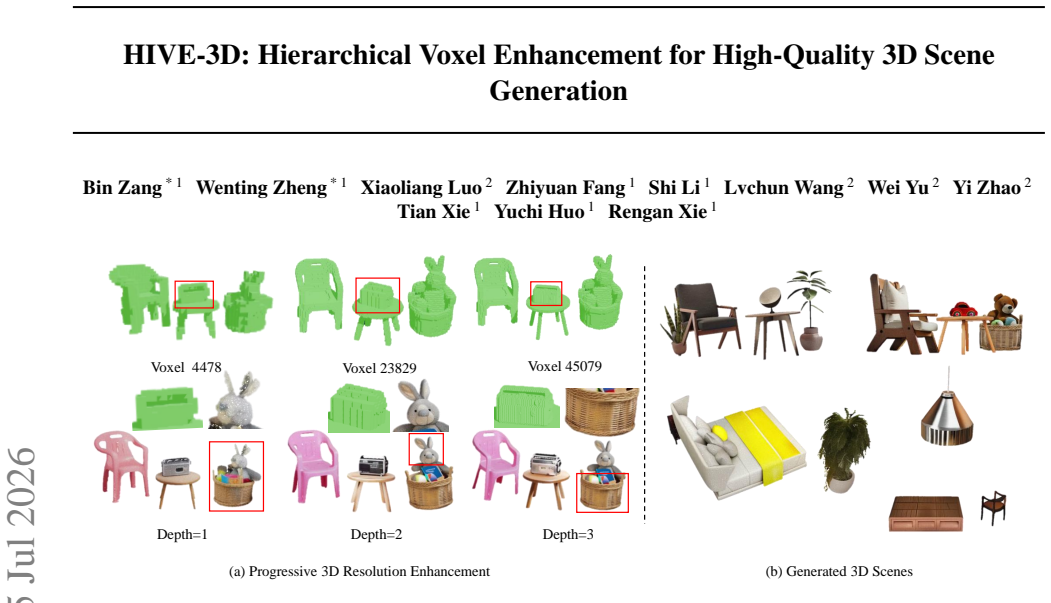
The central claim is that generative resolution can be upgraded at the component level without breaking the scene. The pipeline first builds a coarse scene with a pretrained structured-latent voxel generator, then exploits the fact that the generator's cross-attention maps already encode which image tokens correspond to which active voxels. Thresholding the aggregated attention over a 2D instance mask selects the voxels for that component, turning 2D segmentation into 3D segmentation. Each component is then regenerated by a lightweight adapter that injects the coarse voxel as an additional condition into the frozen generator, so the refined voxel inherits the coarse structure while adding de
Load-bearing premise
The load-bearing premise is that thresholding the generator's attention scores cleanly separates each object's voxels from the rest of the scene; the paper reports no threshold value or accuracy for this segmentation, and its own failure analysis shows that errors in the initial scene or its parsing propagate into poor registration.
Editorial extensions
If this is right
- Scene generation from one image can reach per-object detail comparable to single-object generators while keeping the global layout.
- Refinement depth becomes a tunable knob: more recursion levels produce finer geometry at a predictable runtime cost.
- Because refinement is component-wise, the pipeline can in principle expand to larger scenes by deepening the tree.
- The attention-based 2D-to-3D lifting means instance segmentation in 3D comes almost for free from the base generator's cross-attention, without extra 3D supervision.
- Outlier-robust registration, rather than closest-point matching, is the right choice when coarse and fine components differ greatly in point density.
Reading between the lines
- The adapter design is not tied to one specific base generator; the same frozen-generator-plus-conditioning trick could stack multiple resolution upgrades or extend to other structured latents, making the hierarchy itself the reusable contribution.
- The attention-threshold segmentation is the pivotal step; a direct validation study with ground-truth instance labels would either confirm or refute the whole pipeline, and a learned voxel-grouping head could replace the threshold if needed.
- The component tree suggests an editing interface: refine, replace, or re-pose individual objects in a scene without regenerating the whole scene.
- If the method transfers to multi-view or video input, the same tree structure could aggregate appearance from several viewpoints and enforce cross-view consistency during the diffusion steps, an extension the paper itself names as future work.
Editorial analysis
A structured set of objections, weighed in public.
Referee Report
Summary. HIVE-3D proposes a hierarchical, coarse-to-fine pipeline for single-image 3D scene generation. It first generates a coarse scene with TRELLIS, decomposes the scene by lifting 2D segmentations (Florence-2 + SAM2) into 3D voxel components using cross-attention from TRELLIS's GL transformer, and organizes these components into a scene tree. A voxel super-resolution model, trained with IP-Adapter-style adapters, refines each component conditioned on the coarse voxels and a super-resolved image. Refined components are rescaled via a centroid-distance proxy and registered back into the scene with RANSAC. Experiments on 3D-FRONT and real images report improved CD and F-Score over TRELLIS, but also show degraded IoU, SSIM, and LPIPS in some settings.
Significance. If the claims are substantiated, HIVE-3D would be a useful and well-engineered contribution to high-resolution 3D scene generation, showing how to reuse strong 2D segmentation and foundation 3D models in a modular pipeline. The paper is clearly written and includes detailed implementation and ablation sections, which supports reproducibility. The main strengths are the hierarchical voxel SR idea, the explicit system design, and the honest reporting of runtime and failure cases. However, the headline claim of state-of-the-art performance is not consistently supported by the paper's own quantitative results, and the load-bearing component-lifting step is not validated. The significance of the work depends on addressing these issues.
major comments (3)
- [Abstract and Sec. 5.2 / Tables 1 and 6] The abstract and Sec. 5.2 claim that HIVE-3D 'significantly outperforms previous approaches' and shows 'consistently strong performance across all metrics.' These claims are contradicted by the paper's own numbers. Table 1 reports IoU 0.7449 vs TRELLIS 0.8603, and Table 6 reports SSIM 0.79 vs 0.80 and LPIPS 0.33 vs 0.31 (both worse than TRELLIS). Only CD and F-Score improve. Please qualify the SOTA claim, report statistical significance, or provide a reasoned argument for why the IoU/SSIM/LPIPS regressions are acceptable. As written, the central claim is not supported.
- [Sec. 4.1 / A.1] The 2D-to-3D attention-based component lifting is a load-bearing step: every downstream refinement, scale estimate, and RANSAC registration operates on the voxels selected by thresholding aggregated GL cross-attention scores. The paper does not report the threshold value, does not validate that the selected voxels correspond to the intended image segment, and does not analyze sensitivity to the threshold. This step is borrowed from Fuse3D but applied here to full scenes, where attention maps may be noisier. A quantitative validation (e.g., voxel-to-mask IoU against ground-truth segments on a few 3D-FRONT scenes, with a threshold sweep) is necessary to support the pipeline. Appendix D concedes that failures in initial parsing propagate to registration.
- [Sec. 4.3 / A.2] Scale estimation uses the mean distance of surface points to the centroid as a 'robust proxy' for object scale, motivated by pose invariance. This is an unvalidated geometric assumption. The ablation in Table 4 shows the full model outperforms the variant without scale estimation, but it does not validate the proxy against ground-truth scale ratios or alternative estimators (e.g., bounding-box-based). Because an incorrect scale factor directly breaks the subsequent RANSAC registration, and the paper itself reports a severe registration drop when scale estimation is ablated, this assumption needs explicit validation for the method to be reliably applied.
minor comments (5)
- [Table 2] LPIPS worsens from depth 1 to depth 2/3 (0.38 to 0.41), while the text says quality 'progressively improves.' Please clarify or correct the interpretation.
- [Table 6 / Sec. 5.2] Table 6 is titled 'Quantitative Comparisons on 3D-FRONT and real data,' but the evaluation protocol for real images is not specified. How are reference images for SSIM/LPIPS/PSNR obtained on real data? Please clarify.
- [Sec. 4.1 / Figure 2] The abbreviation 'HYPIR' in Figure 2 is used without introduction; define it in the caption or the main text.
- [A.4] Minor typos: 'sparse structure V AE encoder' and 'V oxel-SR' contain inconsistent spacing; the title also has 'V oxel' with a space. These should be cleaned up for camera-ready.
- [Sec. C.5] The comparison with VIAFormer and ULTRA3D is qualitative and high-level; consider adding a brief quantitative comparison if the respective methods and evaluation settings are compatible, or at least state why quantitative comparison is omitted.
Circularity Check
No significant circularity: HIVE-3D's result is an empirical pipeline validated against external baselines; the Fuse3D attention-lifting dependency is a borrowed, falsifiable premise, not a self-referential derivation.
full rationale
The paper's claimed contribution is an empirical pipeline, not a mathematical derivation. The coarse scene is produced by TRELLIS; the hierarchical tree is built with external segmentation models (Florence-2, SAM2) and the Fuse3D attention-lifting heuristic; the voxel super-resolution model is a separately trained conditional generator whose objective (Eq. 2) is the standard flow-matching loss, not a quantity defined by the evaluation metrics; scale and pose are estimated from the two geometries being aligned and are not presented as independent predictions. Quantitative comparisons (Tables 1 and 6) are made against external baselines on 3D-FRONT and real images, and the ablations (Tables 2-4, 7) test components rather than fitting them to the test set. The only circularity-adjacent issue is that the 2D-to-3D attention correspondence is attributed to Fuse3D (Jin et al., 2025), whose authors overlap with this paper (Xie, Zheng, Huo). However, this is a borrowed, externally falsifiable premise about TRELLIS cross-attention behavior, not a claim whose output is defined as its input, and no equation in the paper reduces a prediction to a fitted value or to the evaluation target. The paper explicitly acknowledges limitations from 2D segmentation errors (Sec. 6) and TRELLIS-bound failures (Appendix D); these are robustness/validity gaps, not equivalence-by-construction. Under the strict standard requiring a quoted reduction, no circular step is present.
Assumptions & free parameters
free parameters (4)
- Attention threshold for voxel selection
- Cross-attention heads used for lifting =
0, 4, 12
- Voxel SR training hyperparameters =
lr 1e-4, wd 1e-2, batch 24, 100k iters, EMA 0.9999, dropout 10%
- RANSAC registration hyperparameters =
voxel size 0.0156, FPFH radius 0.0780, max corr 0.0234, 100k iterations, conf 0.999
assumptions (5)
- domain assumption TRELLIS's GL flow transformer learns cross-attention correspondences between image tokens and 3D voxels that can be used for segmentation.
- domain assumption Off-the-shelf Florence-2 and SAM2 produce correct hierarchical 2D masks.
- domain assumption A frozen TRELLIS GS with new cross-attention layers can learn to condition on coarse voxel latents without catastrophic forgetting.
- ad hoc to paper Mean distance-to-centroid is a reliable scale proxy invariant to pose and detail changes.
- domain assumption Objaverse-XL 10,000-asset subset is representative for scene components.
Cite this review
Pith. "Pith review of HIVE-3D: Hierarchical Voxel Enhancement for High-Quality 3D Scene Generation." pith.science (2026). https://pith.science/paper/PUPDRBKP
@misc{pith2026260713468,
  author       = {Pith},
  title        = {Pith review of: HIVE-3D: Hierarchical Voxel Enhancement for High-Quality 3D Scene Generation},
  year         = {2026},
  howpublished = {\url{https://pith.science/paper/PUPDRBKP}},
  note         = {Machine review of arXiv:2607.13468}
}
read the original abstract
Recently, a line of works can generate impressive 3D objects from a single image, but they are limited by restricted representation resolution, making them unsuitable for 3D scene generation. In this work, we introduce HIVE-3D, a novel method for high-quality 3D scene generation based on hierarchical voxel enhancement framework. Specifically, given a single scene image as input, we first produce a coarse initial scene, then introduce image segmentation and attention-based retrieval to align 2D image components with 3D scene components. Subsequently, we organize these scene relations into a hierarchical component tree, where nodes closer to the leaves denote finer-grained components. Finally, we propose a voxel super-resolution model that generates refined voxels for the target instance while maintaining strong consistency with the coarse voxels. Equipped with this model, we perform coarse-to-fine hierarchical super-resolution on images and voxels for each component, producing a high-resolution and high-quality 3D scene. Extensive experiments demonstrate that our method significantly outperforms previous approaches, achieving state-of-the-art performance.
Figures


Figures from the paper (9 more)


Reviewed August 2, 2026 · model on record in the stance chip above.
Discussion (0). Continue with ORCID to comment.